“So It Goes”

Anyone who has read Slaughterhouse-Five (SH5) by Kurt Vonnegut will recognize this phrase. It stays with you after reading the most famous (or is it infamous?) and arguably the most representative of Vonnegut’s novels.

I’m not sure if SH5 is still required reading in high school English courses… I know it used to be. (I’d be reluctant to guess what required reading might be in high school these days, but that’s another topic.) For my part, I missed the opportunity to read SH5 when I was in school. Perhaps the book wasn’t considered appropriate fare for a Catholic school curriculum.

I’ve only come around to Vonnegut’s works in the last few years. I did read Galapagos in my early twenties, but I found it to be quite forgettable… it certainly didn’t convince me to read anything more by him. Maybe I wasn’t ready for the author’s unique style and keen critical eye.

Something must have changed, because I’ve read three of his books in rapid succession. In this post, I offer my thoughts on what may be his best-known novels. My comments are organized in my order of reading, which just happened to be in reverse order of their publishing date.

Kurt Vonnegut

The author of the books I’m going to discuss is worthy of some discussion himself. Kurt Vonnegut, Jr. (1922-2007) was born in Indianapolis, to German immigrants. He attended Cornell University but dropped out in 1943 after being placed on academic probation. He enlisted in the US Army and was deployed to Europe in 1944 as an intelligence scout. After the war, he pursued academic and technical career paths, never quite succeeding at anything. Vonnegut had a couple of stories published in the early 1950s, which persuaded him to give up other opportunities to pursue writing full-time. His success as a writer did not happen overnight.

Slaughterhouse-Five (1969)

It’s a challenge to summarize SH5. At its core, the story is an account of the Allied fire-bombing of Dresden, Germany in the final months of the Second World War. What genre is the book? Good question. There is an element of historical fiction, but it could just as easily be classified as science fiction. Given that the book was influenced by Vonnegut’s time in the US military, we could even label it as a biography. The author was captured by the Germans, and as a POW he witnessed the destruction of the city firsthand.
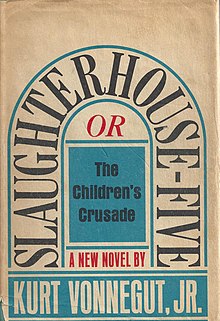
In Vonnegut’s signature style, there is a sharp satirical edge to the book. Vonnegut makes no secret of his disdain for “military intelligence”. The casual disregard for life in wartime is a theme repeated often in the book… almost sickeningly so. I think that’s exactly the response Vonnegut wants to elicit from us. That’s where the phrase “so it goes” comes from. SH5 was published at the height of the anti-war movement in the US, and it was the book that made Vonnegut a household name.

The main character in SH5 is Billy Pilgrim, a US draftee. The science fiction element to the story is that Pilgrim experiences time travel. He calls it coming “unstuck in time.” I think the message here is that history is bound to repeat itself. I found this to be a very effective tool; one that shows Vonnegut exercising his full prowess as a mature storyteller.

To summarize, I thought SH5 was brilliant. An amazing creative piece… forceful in its social commentary and totally original. Considering the current events in the world, it is as timely now as when it was written. Very highly recommended!

Cat’s Cradle (1960)

Where to begin in explaining this novel?

Cat’s Cradle is a first-person account of the narrator, Jonah, who travels to San Lorenzo, a fictitious and extremely poor island nation. Through an unbelievable sequence of events, Jonah becomes president of the country. At the subsequent inauguration ceremony, an unfortunate incident results in mass destruction on a global scale, when a material called “ice-nine” accidentally comes into contact with seawater.
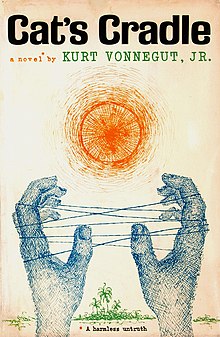
The book deals with two important themes and manages to touch on several others besides. One major subplot in the book is a fictitious, hedonistic religion called Bokonism. It is the dominant religion in San Lorenzo, seemingly a response by the poor citizens of the country to their dire socioeconomic circumstances.

The book is also a biting commentary on the risks of technology. Ice-nine was invented for military purposes by a brilliant scientist who has complete and callous indifference to the great risks it poses. The obvious parallel is to the proliferation of nuclear weapons, which would have been in Vonnegut’s mind when he wrote Cat’s Cradle in 1960. The story takes the idea of a manmade technological threat to its logical and tragic conclusion.

Only someone with a vivid imagination, black humour and a gift for sharp insight… someone like Vonnegut… could have created Cat’s Cradle. It was a fascinating read, and like SH5, very relevant to the unstable world we find ourselves in.

Player Piano (1952)

Player Piano was Vonnegut’s first novel. It tells the story of Paul Proteus, an engineer and manager of the Ilium Works, one of many large industrial complexes that have radically revamped American society. Machines have replaced human beings in every facet of life. For his part, Proteus becomes increasingly uncomfortable as he is being groomed for an expanded role in the system he helped create. The story turns on a clever “double agent” plot, as Proteus finds himself aligned with other, like-minded rebels.
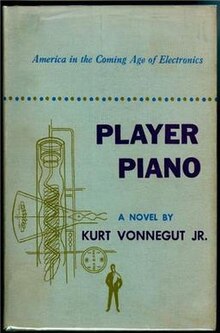
As compared to the other novels, I found the storyline in Player Piano to be the least risky… maybe even simplistic. There are no tricks with time travel here. I suspect Vonnegut was still finding his voice and his style when he wrote the book. Even so, it is a well-constructed story of an all-too-possible dystopian future. Such a future may have been easy to imagine in the early 1950s, as post-war innovations began to change American society; at least it was for Vonnegut.

Of the three novels, Player Piano had the most impact on me. I accept that as a result of my own work as an engineer and manager. Did my career path make me more sensitive to the sharp commentary that Vonnegut dishes out for these vocations in his grim novel? Probably. I don’t take any of it personally, but I do relate to his criticism of an unbridled drive for efficiency.

The world Vonnegut imagines in Player Piano is devoid of almost all pleasure, at least for the average citizen. For the elite (that is to say, the politically savvy) the upside is limitless, as long as the growing majority of displaced citizens are kept notionally busy and marginally employed. It’s a novel that heads to an inevitable tipping point.

The fatal flaw exposed in Player Piano is a conflation of an unstoppable quest for perfection (in countless industrial processes and even in human interactions) with human happiness. I found myself making connections to recent opinion pieces that assess the risks of the increasing use of Artificial Intelligence in our society. Again, Vonnegut’s story seems eerily relevant to our current circumstances.

I can recommend all three of these Vonnegut novels. In my view, his social commentary is timeless, and that keeps the books current. I want to continue my exploration of his work, to see how well his insights have held up in other areas.

Until next time, be well and BE FAST!

Stroke News Digest

I haven’t written much about strokes lately, so it was time to scan the recent headlines. It turns out there is quite a lot to report on, and much of it (but not all) is good news. I always prefer to start with the positives, so here goes…

Announcing the Black Friday Sale!

If you’ve been waiting to order your copy of Stroke of Luck: My Life in Amateur Athletics, now’s the perfect time. I’ve reduced prices for e-book and print editions by a marathon-inspired 26.2 percent. These are the best prices you’ll see in 2024. The book would be a great gift for a runner… or non-runner… on your holiday gift list!

Order your copy of Stroke of Luck on Amazon today!

Sale prices will be in effect until December 1.

Awareness Campaigns are Working

June is Stroke Awareness Month in Canada. Heart and Stroke is committed to helping improve the lives of people at risk for and living with heart disease and stroke. When it comes to stroke, much has changed in the last several decades. The keys are increased awareness of the signs of stroke, and some revolutionary changes in stroke diagnostics and treatment.

Promoting stroke awareness is a priority for Heart and Stroke. Their media campaigns rely on an easy-to-remember acronym… F-A-S-T. By now, most of us will have seen the television ads and billboards, which remind us of the major signs of stroke, as follows:

  • F is for FACE… Is it drooping?
  • A is for ARMS… Is the person unable to lift both?
  • S is for SPEECH… Is it slurred or incoherent?
  • T is for TIME… Call 9-1-1 if any of these conditions exist!

Heart and Stroke notes that awareness campaigns have been successful. For example, 4 in 10 Canadians surveyed can name at least 2 signs of stroke. Women and older Canadians are more likely to recognize stroke symptoms. Of course, there is always more that can be done.

At this point, I will add a caveat about stroke awareness, because my symptoms did not fall into the F-A-S-T framework. It’s an 80-20 situation. I encourage everyone to read my blog pieces where I describe the less frequent symptoms. These include problems with balance and eyes/ears. So, if you can, please remember BE FAST, to cover off all the signs of stroke.

U of Calgary – Leading in Stroke Research

While there can never be a good time or place to have a stroke, it’s been said that Calgary is the place to be if is going to happen to you. I do have some direct experience in this regard, but I didn’t fully appreciate how much innovation is happening here.

A couple of March 2024 articles in Arch, the University of Calgary magazine (here and here) highlight advancements in diagnosis and treatment that originated at the Calgary Stroke Program (CSP). Here are just a few:

(1) A Calgary-based clinical trial led to a procedure known as EVT (endovascular thrombectomy), which is drastically reducing the death rate from one of the most common types of strokes. EVT is a procedure that can disrupt large clots in the brain. If done promptly after the onset of symptoms, EVT can triple a patient’s chance of making a full recovery from certain strokes.

(2) The Alberta Stroke Program Early CT Score (ASPECTS) is a grading system for strokes. This tool, which is based on a brain CT scan, has been adopted around the world as a way of measuring changes in a patient’s condition.

(3) A clinical trial of a clot-busting drug called Tenecteplase (TNKase™) compared it to the standard drug used for dissolving blood clots in brain arteries with acute ischemic stroke. As a result, TNKase™ is becoming the standard of care in hospitals around the world.

I could go on. The innovations originating in Calgary cover diagnostic processes, treatment options and rehabilitative therapies. It is a remarkable success story. On a personal note, I have come to know several of the doctors involved in these research programs. They are truly miracle workers.

Stroke Incidence is Increasing

A study in The Lancet Neurology found that the global prevalence of cardiovascular disease, including stroke, increased from 271 million in 1990 to 523 million in 2019. The study found that population growth and aging account for this increase. While stroke mortality rates had been declining in the latter part of the twentieth century, some countries have actually seen a reversal in this trend since 2010. Unfortunately, the US and UK are two countries that have seen an increase in stroke numbers.

A study on stroke prevalence by the Centers for Disease Control and Prevention fills in some of the details for the US. Here are a couple of headlines: stroke is the fifth leading cause of death in the US and it costs the economy about $56 billion annually. Digging deeper, the CDC study confirms the trend in stroke incidence. Overall US stroke prevalence increased by about 8 percent from 2011-2013 to 2020-22. The increase was slightly higher in females than males. There was an inverse relationship between education level and stroke prevalence. Perhaps most worrying was a significant increase in adults aged 18-64. As you might guess, obesity is a leading risk factor for stroke.

Not surprisingly, the trends in Canada are similar. Stroke is the fifth leading cause of death in Canada, accounting for about 13,000 deaths annually. There are more than 108,000 strokes in Canada each year… that’s one every five minutes. And nearly 900,000 Canadians are living with the outcome of strokes. As in other countries, it’s a result of our aging population.

Fortunately, when strokes do happen, more people are recognizing them and taking action.

Before signing off, I couldn’t help but include a photograph taken on yesterday’s short walk along the Elbow River in Calgary. The picture has nothing to do with strokes, but I liked it. Yes, winter is here!

Elbow River (November 20, 2024)

Thanks for reading. Be well, and BE FAST…

Head Hunting

The Art of Jaume Plensa

I was looking for an excuse to go into downtown Calgary for some photography, and I thought about the “big head” sculpture that sits in front of The Bow building. Like the building, the sculpture is iconic; it’s a monumental and very popular piece of public art. I’ve photographed the sculpture many times, but it seems to always have more to offer, depending on the season, the time of day and of course, the light.

First, some background. The sculpture’s official name is Wonderland and it’s by the Spanish artist, Jaume Plensa. Plensa was born in 1955 in Barcelona. He studied art in his home city. Over several decades he has lived, worked and exhibited his art in cities across Europe and the United States. Plensa has received international recognition for his exhibitions and installation pieces. His diverse works include sculpture, fountains and graphic arts.

Wonderland (2012), Calgary

Wonderland is one of many sculptures that Plensa has created for public spaces around the world. When I looked into the origin of Wonderland, I learned that he has installed similar large-scale pieces across Europe, Asia and North America.

Wonderland is ideally situated in the curved façade of The Bow, where it’s been since 2013. The sculpture depicts the head of a young girl. It’s about 12 metres high, and it’s made of bent steel wire. I think the piece is so popular because it has openings at ground level, which let visitors enter the sculpture’s inner space. Plensa invites us to contemplate Calgary’s downtown from the perspective of the subject. It’s a thought-provoking piece, for sure.

Here are several of the many shots of Wonderland I’ve taken over the years.

Julia (2018), Madrid

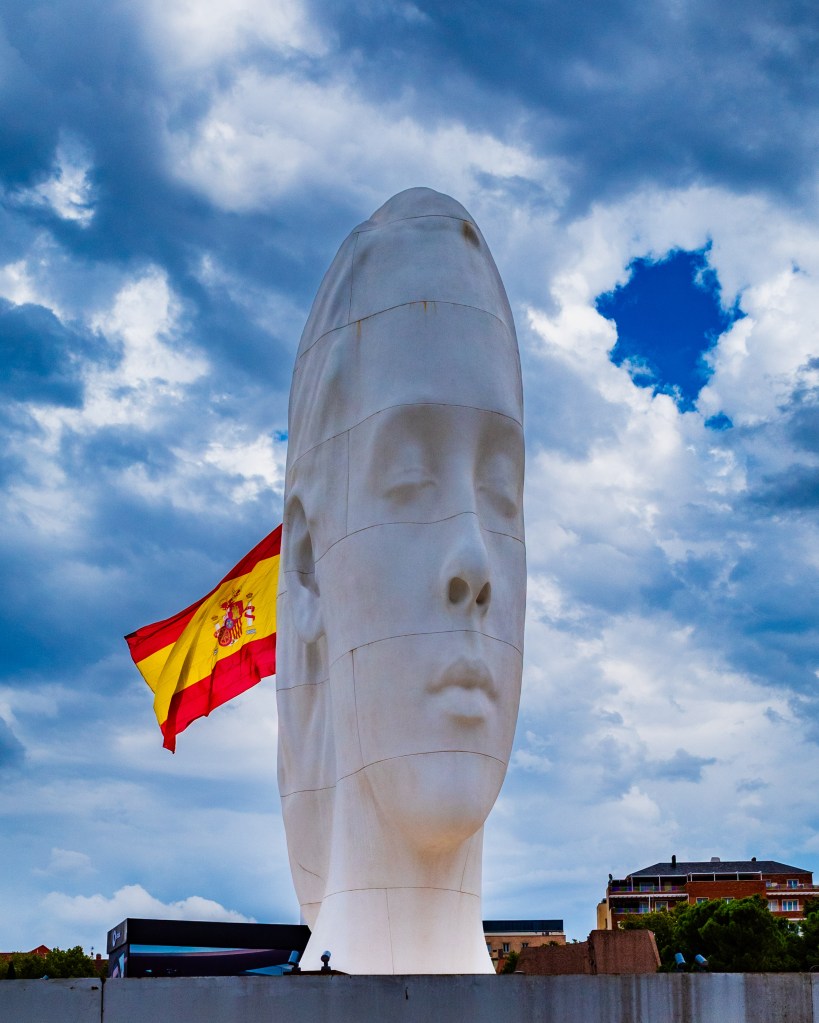
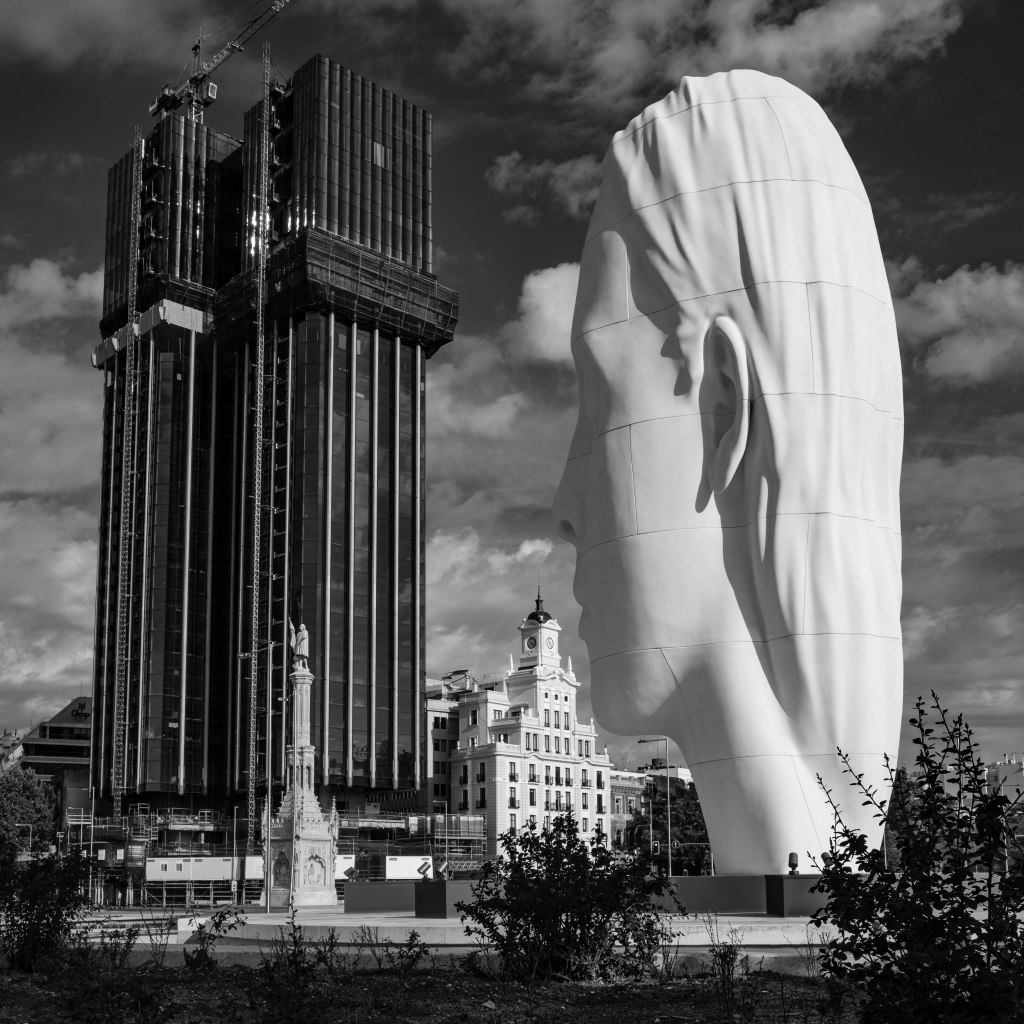
I realized that Debbie and I had seen other Plensa pieces in our travels. Most recently, we stayed a couple of blocks from a monumental sculpture in the Plaza de Colón in Madrid, called Julia. About the same size as the Calgary piece, Julia is also a sculpture of a young woman’s head. The subject’s eyes are closed as if she is meditating.

Julia is typical of Plensa’s large, elongated and flattened busts. When you look at them straight on, they give the impression of being on an angle. It’s an impressive optical illusion. The Madrid piece is made of polyester resin and white marble dust. It’s stunning.

We passed Julia several times a day while we were in the city, and each time I took a few photos. While Julia has been in her current location since 2018, it turns out that she may not be installed permanently… it’s a good thing I took so many photos while we were nearby. Here are a couple of my favourites:

Sanna (2013), Bordeaux

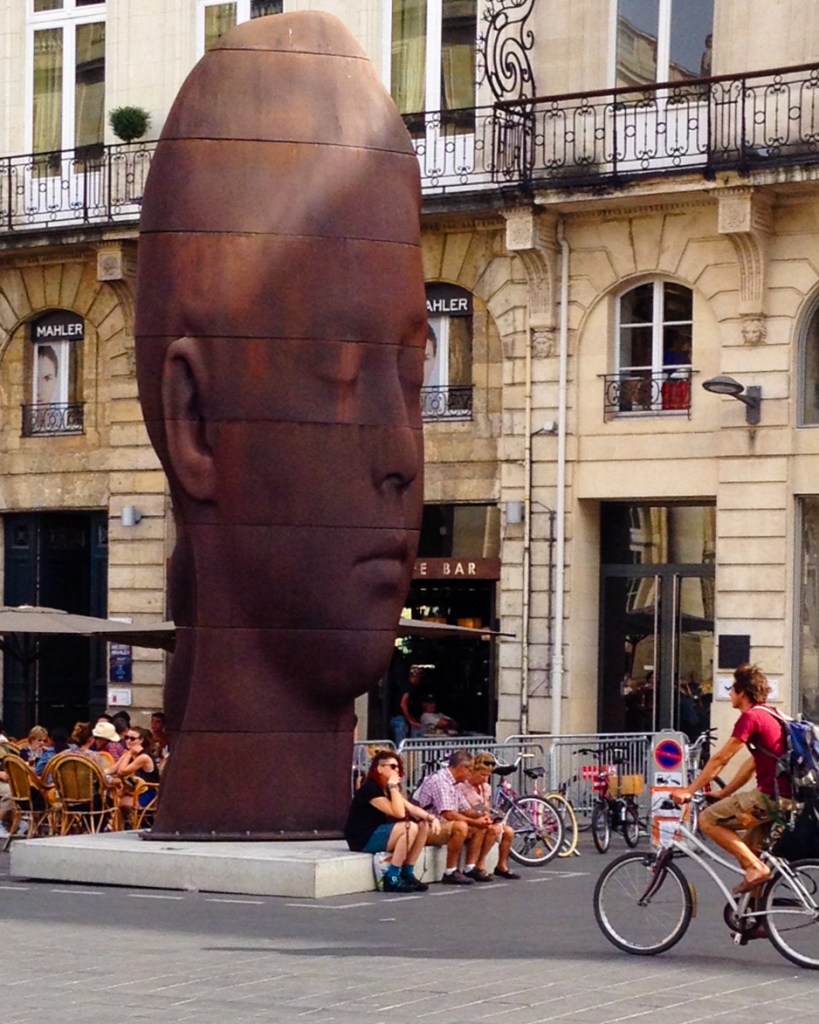
As I did more research into the artist, I realized we had seen another sculpture similar to Julia in Bordeaux, France some years earlier. Sure enough, it was another Plensa piece called Sanna. That one sits in the Theatre Square (the Place de la Comédie) in the heart of the city. Its perspective has been manipulated in the same way as the Madrid piece, and the subject is also shown in a quiet, contemplative pose. Unlike Julia, Sanna is made of cast iron. She is 7 metres high.

The story of Sanna coming to be in Bordeaux is that in 2013 the city hosted an exposition of Plensa’s pieces. The event was popular, so much so that residents initiated a movement to acquire Sanna permanently. As far as I know, it will remain in place until at least 2027.

We have very fond memories of our visit to Bordeaux. The square where Sanna sits is busy with cafes and shops. If we ever make it back there, I hope Sanna will still be there.

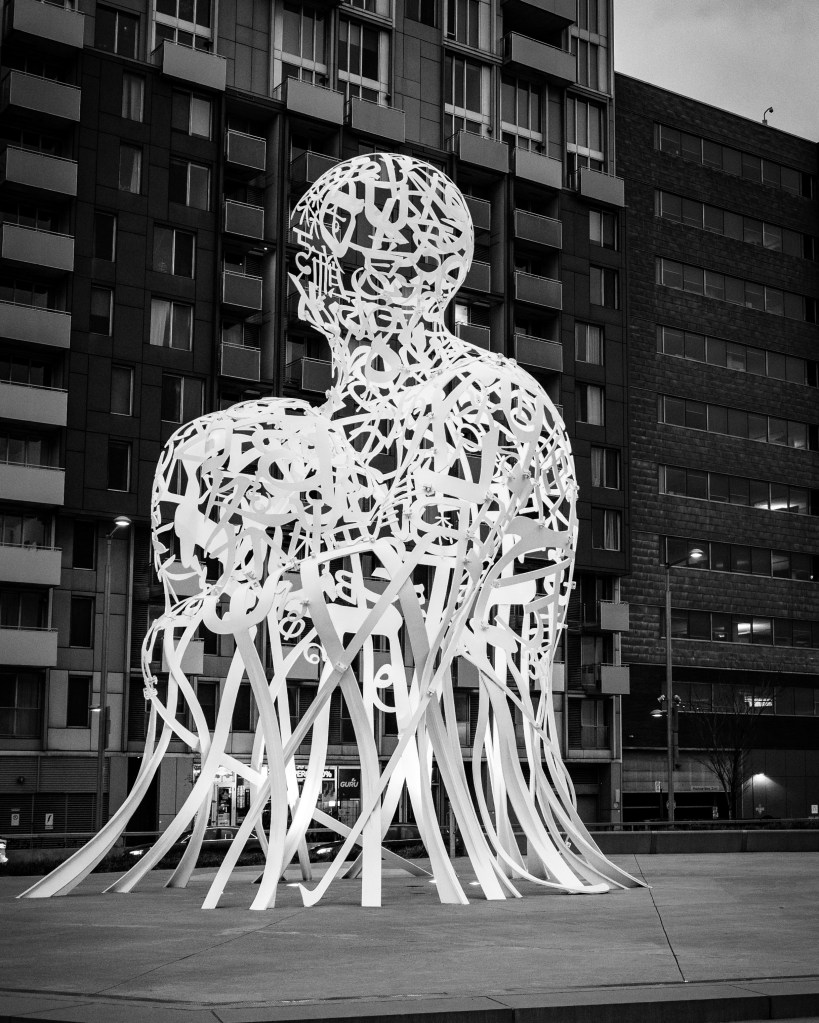
Source (2017), Montreal

The final Plensa sculpture I want to highlight is installed on a terrace in Rue Wellington, just at the entrance to downtown Montreal. Somewhat in the same style as Wonderland, Source is a three-dimensional piece within an open outer frame. It’s a stainless-steel sculpture formed from a random pattern of letters taken from different alphabets, which depict a sitting figure.

The Montreal piece symbolizes the many cultures that have come together over the city’s long history. Fittingly, it was installed for the 375th anniversary of Montreal’s founding in 2017. Like the Calgary piece, Source is open, so it invites visitors to enter the inner space of the piece.

Our stop at the Source was short, and I only have one photo of the piece. Rest assured, I will take more time to check it out next time we are in Montreal.

Concluding thoughts

So what is my take on Plensa, and his large public art pieces?

In a 2019 interview with Forbes, Plensa discusses his use of altered perspective and open gridwork sculptural elements. He described using these techniques as a way of exploring his interest in the way humans communicate, and how different cultures use language.

For me, Plensa’s sculptures seem designed to invite close inspection and discussion. We want to get close to these sculptures. We want to walk around them and even into them. The large scale of his head sculptures could be intimidating, but Plensa defuses this by the way he plays with perspective, and by his use of serene and peaceful subjects.

Having seen four of his works in person, and looked at many others on his website, I find them to be beautiful and innovative. It’s clear from Plensa’s vast catalogue that his formula is a success: there are literally dozens of his pieces installed around the world. I don’t take this as evidence of an overworked theme. Rather, I would say that Plensa has achieved his goal: his works encourage us to get together in pleasant locations and talk. For this reason alone, his art is well suited to the public spaces in which we find it.