Thoughts on Decline

I think about my own mortality a lot. Perhaps too much. Sometimes a trivial observation will send my mind down that track—like when I’m walking down a busy street, and I realize that I’m older than almost all the people I see.

Given my personal health story, thoughts of my humanness are perhaps more present than they were when I was young and, as the saying goes, invincible. I’ve experienced a significant decline, one that goes beyond “aging”, although a growing count of orbits around the sun means I’m experiencing that type of decline as well. Apparently, aging occurs in both a stepwise and linear fashion, and the decades of our 40s and 60s are where the biggest steps occur. I think I can attest. And of course, I know how the story will end.
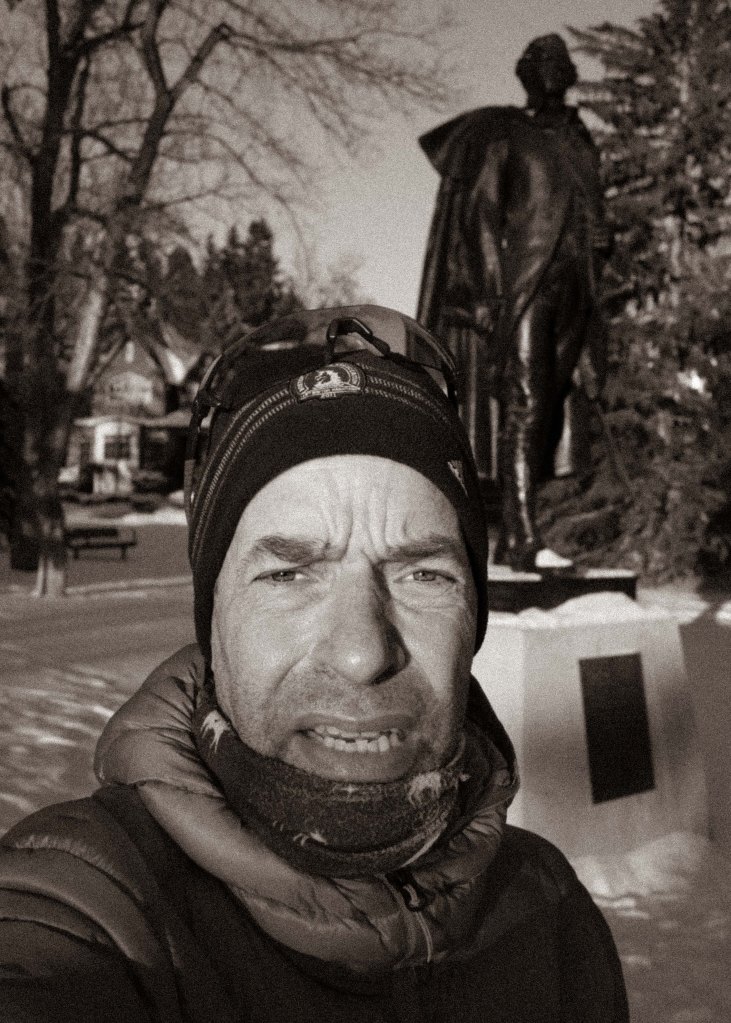
But then, sometimes, the most amazing things happen, things that make me celebrate my situation, my very obvious mortality. Things like today’s run1, in which I reluctantly took on Calgary’s arctic conditions, and returned home somehow feeling 20 years younger. It was a wonderful outing, easily my best run in a month, and one that made me feel truly alive. You may know the feeling— it’s like history being made, even if the run itself counted for nothing.

My recent reading list includes several books that deal with decline and death, and that may explain my focus on the subject. While this piece doesn’t offer any great insights, I generally find it easiest to deal with things by writing. So here goes, with a decidedly unfestive, but hopefully not depressing, piece.

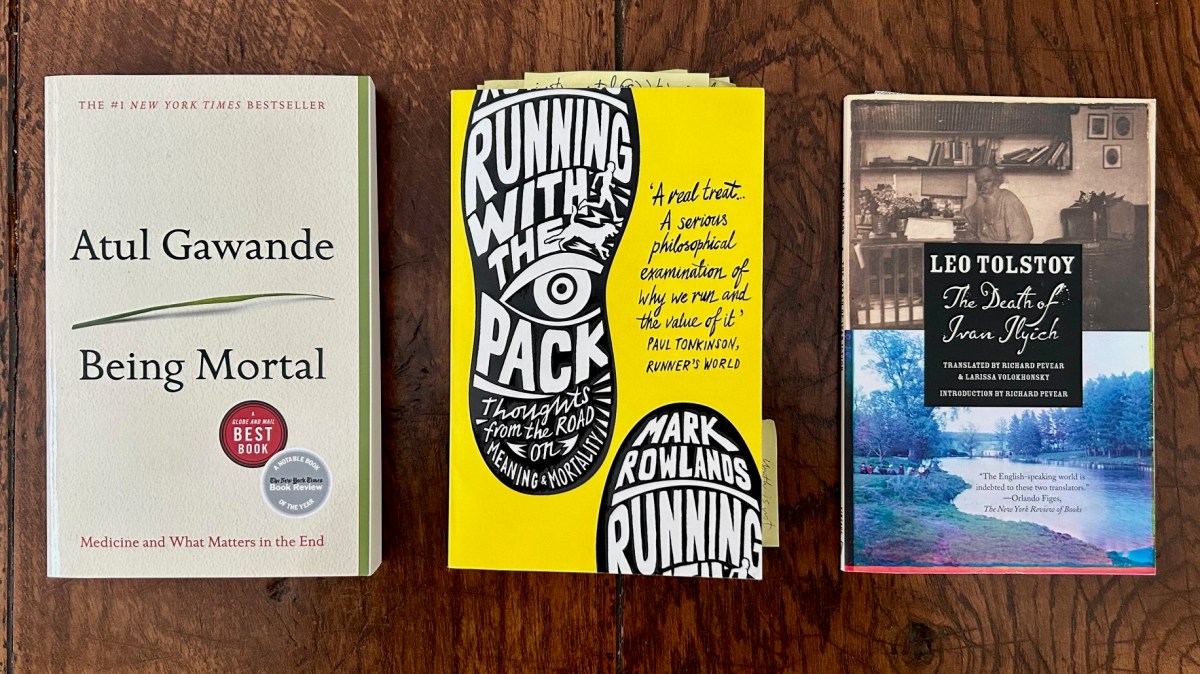
Being Mortal, by Atul Gawande

Being Mortal, by surgeon and author Atul Gawande, was suggested to me by a friend. We were both dealing with parents in their declining years—in fact, my mother had died just a few weeks before. I sat on his recommendation for a while, perhaps because I was afraid to open the book. I’m glad I eventually did.

Gawande describes how modern medical intervention has changed the profile of physical decline, essentially blurring the transition from life to death. While sobering, the book makes the point that our societal approach to medicine is often not suited to the needs of people nearing the end of life.

Gawande argues that the role of the medical establishment should not be to ensure survival at all costs. He would rather see the system as enabling well-being, however a person (the patient) might define it. He presents numerous examples of human decline, not all of which are age-related, to support his contention that the best action at any time may be palliative, rather than interventional.

I finished Being Mortal with a feeling of anxiety. I suppose the book confirmed what I already knew, that the circumstances of my own demise are likely to be unknown to me. I looked back over the ever-growing list of people I’ve known who have died. The full gamut of difficult human experience is there for my contemplation.

My takeaways? I should ensure that those around me are aware of my wishes at the end of my life, and to the extent possible, stay involved in the process.

Running with the Pack, by Mark Rowlands

Running with the Pack, by philosopher and University of Miami professor Mark Rowlands, is a book I discovered during the formative stages of my research for Stroke of Luck. The challenge I faced at the time was to understand my long personal connection with running at a deeper level. The evidence clearly demonstrated a connection, but I was grappling with a version of that most fundamental philosophical question: “What is the meaning of life?”

Rowlands’ unique book helped me organize my thoughts. I appreciated his ability to parse philosophical discourse into manageable pieces. Better still was his framing of mini-lectures around his own running. (And his dogs, which play a major role in his life.) While the answers remain as elusive as ever, I certainly relate to Rowlands’ thought process.

I wanted to see what Rowlands had to say about decline. In fact, he says a lot. He observes that philosophers have tended to be less interested in decline, even though for human beings it is an inevitable aspect of living. Using the example of running injuries, Rowlands explains why there really is no escaping our decline, given our evolution as mammals and our physiology.

So, what are we to do? Rowlands would have us look to young children and animals, especially dogs. These beings instinctively know what is important in life—the things that bring joy, the things that are worth doing for their own sake. Things like, you guessed it, running. The highlight of Rowlands’ book is his explanation of the “intrinsic value” of running; the idea that when we are immersed in a run, we experience it for its own sake. We find joy in an activity that has no instrumental value.

This line of thinking was hugely beneficial to my own assessment of running and its importance to me. As Rowlands says, “youth exists whenever action has become play”. That may explain why today’s run made me feel 20 years younger—it was pure joy to be outside and in control. In a small way, it was a statement of defiance against my own decline.

The Death of Ivan Ilyich, by Leo Tolstoy

The Death of Ivan Ilyich is a short work by Leo Tolstoy, written in 1886. It tells the story of the demise of a prominent and successful bureaucrat from an unspecified affliction, or possibly the result of a seemingly insignificant fall while doing a home renovation project. (Aside: I must remember to point out to Deb how dangerous these activities can be!)

Whatever the cause, Ivan’s death is slow and painful, both physically and emotionally. His illness highlights many themes that remain relevant today. First is the superficial nature of Ivan’s relationships with his family and friends. Those close to him are too absorbed in their own affairs to understand what he is going through, much less feel any empathy for him. Quite the opposite. His suffering proves to be an inconvenience to his socially conscious wife and an opportunity for his rivals at work.

Second, it’s a story about the role of medicine. The medical care offered to Ivan is inept and, worse, insensitive. As readers, it’s tempting to look at Ivan’s situation with full awareness of the miracles that modern medicine could have offered him. However, after having read Being Mortal, I realized that Ivan faced the same issues we face today. Are today’s invasive interventions any more humanistic than those of Ivan’s callous doctor? Medicine shouldn’t be about the miracles that science can offer, but whether and when the tools at hand should be used at all.

What does it all mean?

I’ve highlighted three books that allowed me to think about decline from new and different perspectives. The books could not be more different. This is a subject where it is worthwhile considering as many viewpoints as possible. For that reason alone, I recommend all three books. Read together, they complement each other well.

It seems the best course of action is to be prepared for my own decline by knowing how I define living. That will inform any difficult conversations with family and friends, as we face decisions about the type and extent of medical intervention I am ultimately willing to endure. Until then, I should seek joy as I’ve always done—by going for a run!

I hope 2026 is good for you and yours. Remember, BE FAST!
  1. I wrote this piece in mid-December, during a long cold snap. I decided to sit on it for a while, realizing that it would have been a downer during the festive season. Now, here we are, well into the new year and in the middle of another cold snap, so I decided it was time to hit the “publish” button. SK ↩︎
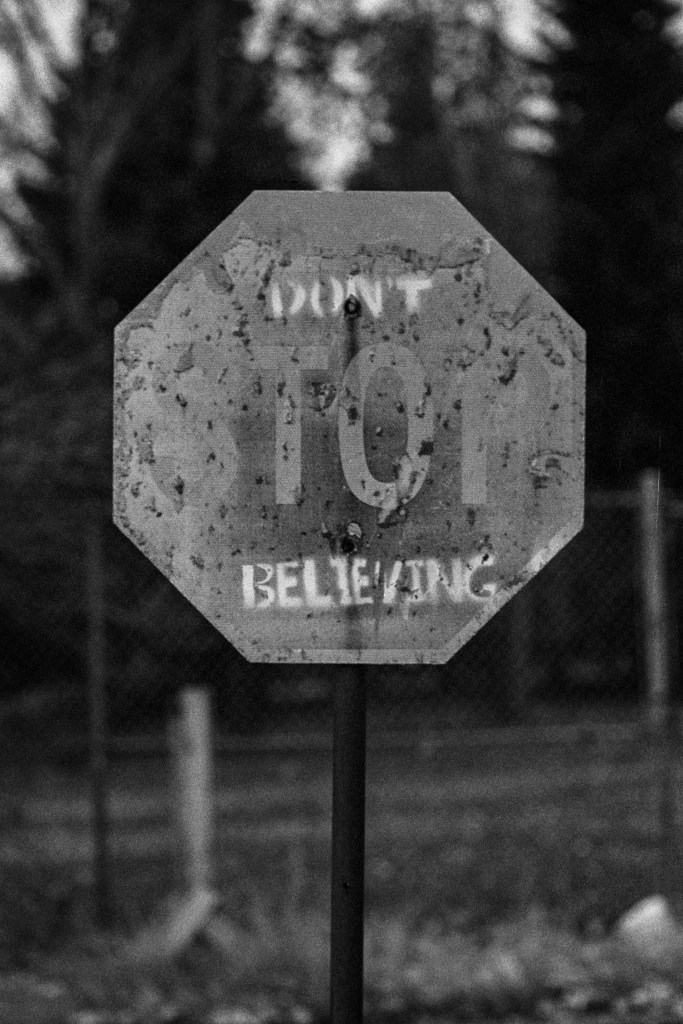
Don’t Stop Believing

Sometimes life is hard.

It will be obvious from the long gap between posts that I haven’t been thinking much about the blog lately. It has been a difficult time on the personal front. I don’t feel like going into the specifics—maybe I will someday. 

Several times, I’ve tried putting my feelings into words, never sure if the result would end up in a blog post. Each time I’ve tried, it has been a failure. It’s frustrating, especially since I’m usually not at a loss for words. 

Music seems to help. As I write this, I’m listening to Car Wheels on a Gravel Road, a classic album by Lucinda Williams. This is melancholic music. It suits my mood and I think it makes me feel better—it’s hard to say. The lyrics of one of my favourite songs, Time from Pink Floyd’s Dark Side of the Moon, have been stuck in my head. This verse seems appropriate. 

Every year is getting shorter
Never seem to find the time
Plans that either come to naught
Or half a page of scribbled lines

My half pages (not literal, of course—they’re typed on my iPad) have been piling up, as I’ve grappled with anxiety. I’ve been feeling helpless against our overwhelming insignificance. Our impermanence. Our mortality.

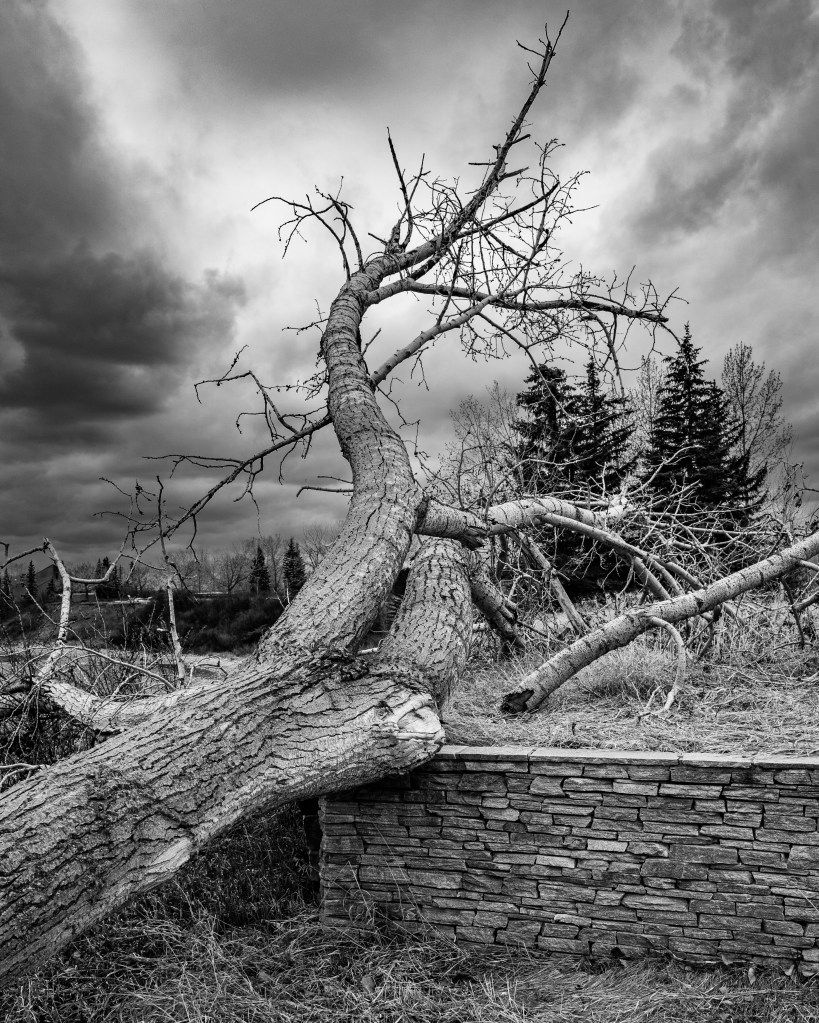
North Glenmore Park pathway, April 2024

Then came a breakthrough of sorts. It was in a situation that might not be conducive to finding inspiration. But it was no surprise to me because I was running at the time. Anyone familiar with my story (Stroke of Luck is still available, by the way) will know that running has often been a source of consolation and positivity in my life.

To set the scene, I met a small but hardy group of my teammates at Carburn Park in Calgary for an interval workout. It was a ladder workout, which for those who aren’t familiar, is a session with increasing length intervals. This workout, with intervals of 400m up to 2000m, looked daunting. Each set totaled 5.4k, and Coach Janice had specified 2-3 sets. I had to go back to her to confirm the details because it seemed that she must have miscalculated. This was TOO MUCH!

To add another degree of difficulty, the weather was awful. The threatening sky opened up just as we finished our warmup jog around the lagoon. Clouds turned to rain, then snow. My eyes were being pelted with icy crystals. We were soaked in no time. The temperature hovered just above freezing. 

We ran south beside the steel-blue water of the Bow River, and I began to wonder what on earth we were doing. It didn’t help that I was the slowest runner in our group, meaning I also had the pleasure of watching my friends stretch out and away from me as the first set wore on. 

As I approached the turnaround point, now miles from my warm car, my mood lightened. I was enjoying this. Even as my vision was being obscured by sleet, my thoughts were becoming clearer. Then, as if on cue, the sun peeked out briefly, casting a warm glow on the wet pathway in front of me. (I didn’t bring a camera on this run—it would have been waterlogged—so I can’t even show you a picture of that special but fleeting moment.)

By now, I was totally on my own. My teammates were out of sight, and the pathway was deserted. I was enjoying the feeling of movement, of being in control. Running was proof of life. I was thriving in what had just a few minutes earlier seemed an impossible task. 

Then the following thoughts came into my head, without any prompting:

  • I don’t have all the answers
  • Sometimes there are no answers to find
  • All I have to offer is my best effort
  • I can only control what I do, not what anyone else does 

I eventually made my way back to Carburn, where I caught up with my teammates. They had waited for me—how nice! We were soaked, shivering, and content. We patted each other on the back for getting through this monstrous workout on a rotten night, together. On that day, we were all heroes. Of course, even heroes need to dry off and warm up, so we said our short goodbyes and headed home. 

With my mind clear, even if temporarily, I was ready to face whatever challenges were still waiting for me. Running and music and writing can help me figure things out, even if the answers themselves remain elusive. 

Look for more pieces and photography soon. 

Peace.

What Makes a Good Photograph?

Most of us carry a camera around every day and make liberal use of it. There are surely more photos being generated now than at any time in history.

It’s obvious that the vast majority of these photos are meant for instant consumption. They aren’t expected to be great, and 99.99% of them aren’t.

Anyone who has a sincere interest in producing photographs that stand out from the crowd faces a real challenge.

So what makes a good photograph?

Maybe we can try to check a few boxes. Is the picture well composed; is it sharply focused; is it properly exposed? In other words, we might be tempted to conclude that technical quality is essential for a good photograph.

But these metrics don’t tell the whole story. On one extreme, Ansel Adams is known for technically perfect photographs. But, for every technical purist, there is a photographer who is more intuitive. Think of Robert Capa’s iconic photos from the Normandy beaches on D-Day. They aren’t perfect, but no one could deny they are iconic photographs.

If a photograph has emotional impact, then we will likely be willing to overlook any technical flaws.

One of my favourite bloggers, the late Tim Vanderweert, wrote a number of pieces on aesthetics. I went back and read some of the excellent pieces on his Leicaphilia website. Tim had the breadth of understanding of philosophical concepts that let him dig into the works of Leibniz, Hume and Kant, in order to try to explain the foundations of what we perceive as beauty.

The essence of Tim’s observations, which I’ve significantly simplified for my purpose, is that aesthetic judgements are neither objective nor subjective. (Only Tim could make the connection between the classical philosophers and our modern perceptions of art in general, and photography in particular. I’m glad he did.)

Even if they don’t resolve the question, these concepts help explain why one person’s sense of what makes a good picture is different from others.

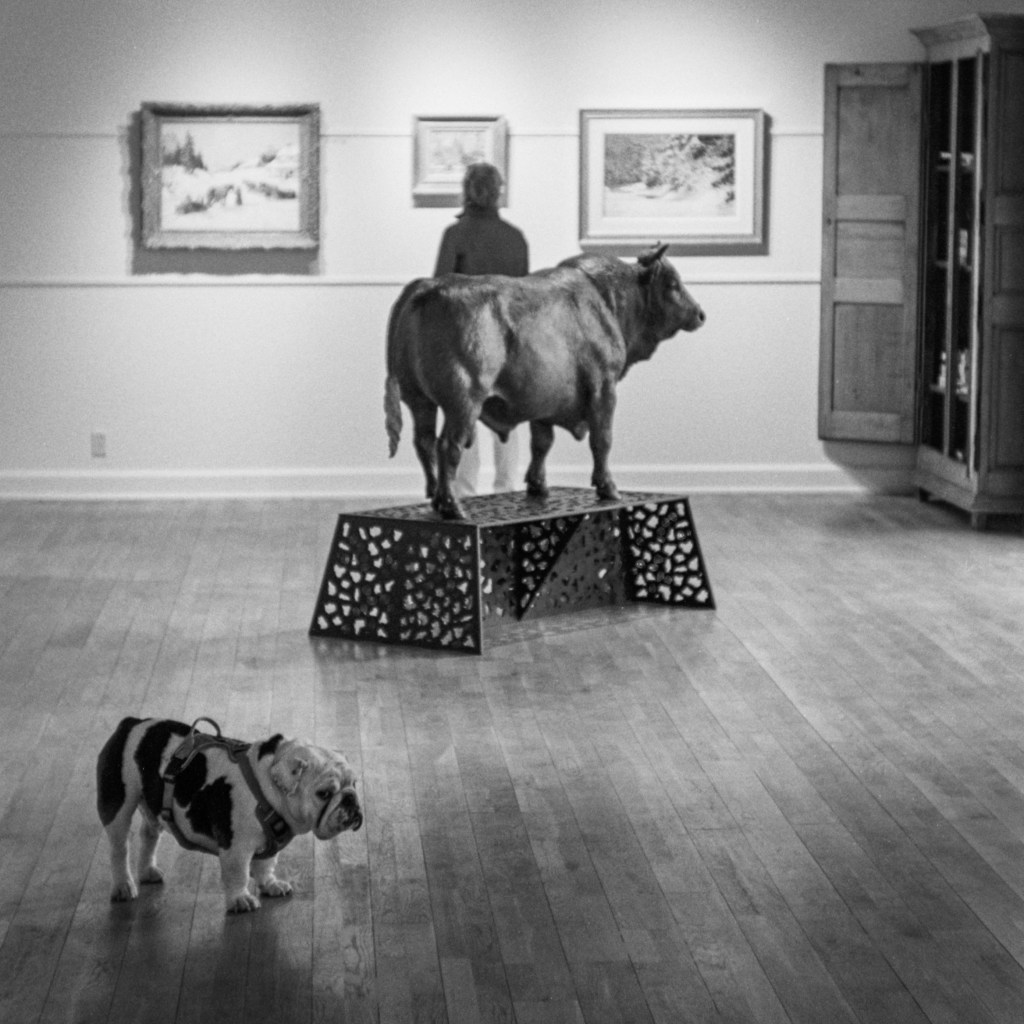
I’ve learned a few things when it comes to photography. First, I have to trust my instincts. I look around constantly. I try to be ready in case a scene develops in front of me. And most importantly, if a scene attracts my attention, I reach for a camera. This hastily taken photograph in Calgary’s Masters Gallery is an example. I’m pretty sure I didn’t do more than guess at my settings. The result is far from perfect technically, but I think it works.

Borduas and Friend (Leica M3, 2022)

Second, I’ve learned to make my best effort to get the technical bits right, then do a careful job of editing until I like what I see. Maybe it’s colour, form, a humorous scene on the street, an interesting cloud formation, or something else. Maybe I shot the picture on film or on my phone. Maybe I have to crop the original to highlight what I saw. It doesn’t matter. Whatever it was that made me take the picture, select it from among all the others, and then labour over it in Lightroom is probably worth seeing to a conclusion.

Third, I’m getting used to not seeing much of a reaction from Instagram, probably because most users on that platform (for reasons unknown) are more interested in pictures of my lunch. And that’s okay too. It’s just that I don’t usually see any merit in taking pictures of my food when there’s so much more out there.

Subway escalator, San Francisco (Olympus OM-2, 2019)

I guess I didn’t answer the question. But at least it’s fun to keep exploring.

Running and Thermodynamics

In his book, “Running with the Pack”, philosopher Mark Rowlands makes some interesting observations about evolution. His essay, “The Serpent of Eden” starts by explaining the first and second laws of thermodynamics. While this immediately caught my attention as a chemical engineer, it may not resonate with everyone.

Basically, the preposition of the first law is that energy can neither be created nor destroyed; it can only be converted from one form into another. The second law states that any closed system (like the universe, or like us as entities within it) tends towards maximum disorder.

So, what does this have to do with running?

Well, Rowlands makes a rather neat argument that can be paraphrased as follows: because we evolved as creatures in a world where our stores of energy rely on us converting it from another source, there is a predisposition for us, as conscious beings, to focus on the competitive forces that allow us to continue living. Human beings are highly complex, closed systems, and for us to survive (that is, to avoid maximum disorder) we must compete for energy. And to do that, we must get it from another source.

Said another way, we tend to focus on those things that affect our ability to continue the competition… to stay alive. This is nothing more than the natural result of our evolutionary makeup. (Of course, the end game is predetermined, but let’s put that aside for a minute.)

Think about this. When you are running, and things are going especially well, what do you notice? Are you conscious of your heart and lungs and legs all doing their job efficiently, just as they were designed to do? No, of course not. They just get on with their job, and you enjoy the intrinsic benefits without even thinking about it.

Instead, what we tend to notice, as conscious, competitive beings, are the things that aren’t going so well. That niggling pain in your knee, or the stitch in your side, or any number of other ailments is what gets your attention. You do notice these things because, as Rowlands suggests, our brains have evolved to notice when things aren’t going well.

Rowlands gives further depth to his argument, with reference to the work of the great philosopher, Schopenhauer. And frankly, some of his observations are a bit depressing. Schopenhauer observes that because we are so highly evolved, with cognitive abilities like memory and anticipation, abilities that other creatures don’t possess, we are especially sensitive to our place in the grand thermodynamic scheme of things.

If the universe is destined to end up with maximum disorder, we might rightly ask ourselves why we bother. After all, what’s the point if we will all end up as worm food?

That’s where the Rowlands piece shines. He points out that as human beings, we have evolved as social creatures precisely because that improves our odds in the unrelenting competition for energy. The bonds that keep us together… mutual recognition, affection, love… can be seen as small bits of defiance against overwhelming odds, in a universe where the rules of the game are stacked firmly against us.

My advice is that the next time you are out running, you should spare a thought for the amazing confluence of conditions that had to go well for you to even be out there at all. The very fact that you exist is in defiance of the laws of thermodynamics, at least for the time being.

And the next time you are out running with your gang, give some consideration to them, as what Schopenhauer referred to as, “my fellow sufferers”. Since we are all in this together, it is only right that we should have some tolerance and patience with each other. As Rowlands says, “Every act of kindness we show to someone or something is a defiance of the spirit of the laws that made us”. Defiance may be futile, but it is still valuable.

Leicaphilia Loses its Creative Force

Tim Vanderweert passed away in early January. I need to say a few words about him, and the impact he had on me. In this digital world, it seems a stretch to say Tim was a friend because I never met him. I only knew him through his online presence and a bit of interaction we had through his blog, Leicaphilia. One thing is certain – I wasn’t the only person who was influenced by Tim.

It’s funny how things go sometimes. About five years ago, I was putting my life back together after a medical episode that left me wondering what my future would look like. Competitive running, which had been a constant presence in my life for more than four decades, looked like it might be taken away forever. I wasn’t sure I could cope with that prospect.

I had always had a passing interest in photography, but to be fair, it had never gone beyond a teenager’s early fascination with the gear and amateurish attempts to emulate the great landscape photographer, Ansel Adams. Boxes of family snapshots, as great as they are, attest to the fact that I focused more on quantity than quality. And that was fine, as I had limited time for hobbies, for all the usual reasons.

Fast forward to 2017. Adrift after a lengthy hospital stay and amid much uncertainty, I picked up my old Canon AT-1–that’s a totally manual film camera by the way–and started carrying it with me on my slow recovery walks around the neighbourhood. For years, I had cruised through the same streets at a faster pace – apparently fast enough that I hadn’t seen things that were right in front of my eyes.

My interest in photography was being rekindled but I was rusty. So rusty that I had missed the whole transition to digital photography, which had made film cameras obsolete. At least that was the conventional wisdom.

And then I discovered Leicaphilia, and its creative force, Tim vdW. Here was a guy, about my age, who had dedicated as much of his life and energy to photography – Leica-based film photography no less – as I had dedicated to competitive running. Different hobby, same passion. I liked him immediately.

The more I delved into Tim’s writing and creative output, the more our connection grew. I especially liked the fact that he steadfastly defended the turf of film photography against the onslaught of digital. Pixels didn’t matter an iota to him. It was more about the emotional impact, the art, than about the technical features of the latest camera. And on that point, Tim had the knowledge (and the courage) to state his views and share his thoughts. He wrote eloquently about the philosophical underpinnings of photography, about topics like aesthetics. His knowledge spanned centuries.

I had never read articles that tied the Greek philosophers to this hobby. But as a returning student, I was more than willing to learn. His lucid posts entertained me (and his other devotees) while they educated me, complete with photographs from his archives and his bike rides around North Carolina. He put together a book of his photographs taken from inside cars – it was called Car Sick – and I bought not one but two copies. (You see, he had made it abundantly clear to his readers that he had lost his shirt on the production of the book. I wanted him to keep going.)

When Tim announced to his readers that he had cancer, we all held our breaths. It looked bad. For a time, he stopped posting. Eventually, he informed us that he was in hospice care, with only a few days to live. Except he didn’t die. He got better, at least for a while.

In the last few months of his life, he gifted his anxious audience with constant posts, full of clear writing about his situation, and yes, some excellent photography. With a creative flourish, he turned his attention to developing the hundreds of rolls of film that had accumulated in his house. He even put together an exhibition of his life’s work.

And now he is gone. Tim showed us all how we might try to face the grim prospect of our own impending death, with grace and purpose, and good humour. As we go through the ups and downs of our own lives, we should all hope to have as much positive impact on those around us.

My first reaction to the news of his passing was to load a roll of his favourite film (Kodak Tri-X) into my Leica M6 and shoot some street photographs, hoping for his spirit to walk with me as my muse.

Tim will be missed.

“Look out below”, inspired by Tim vdW (Leica M6 and Kodak Tri-X, 2023)