Marathoning: Good, Bad and Ugly

Late April and early May are a wonderful time for fans of marathon running. As I do every year, I followed the latest news from Boston and London, home to the world’s most famous marathons. The 2026 races brought some notable headlines, including a new course record by John Korir in Boston and a remarkable but hardly unexpected result, as Sebastian Sawe convincingly broke the 2-hour barrier in London.

But as has happened for several years, I was left with mixed feelings, especially reading some of the online chatter after these two premier races. I decided to let things sit for a while, to see if I really wanted to put my concerns into words. Since this is my blog, I will go ahead and share my opinions on the state of the sport. I’m interested in any reader comments, especially if you have a different take on this subject.

Celebrating the good

I’ll start by reiterating my opinion that athletics (and specifically, running) is the greatest of all the sports. Competitive running has been at the core of my existence for most of my life, and I remain captivated by a sport with such rich history, diverse personalities, infinite challenge, and tangible benefits.

Because running confers countless benefits, I’m thrilled whenever I see people taking up the sport, no matter their circumstances. I encourage anyone who is curious about running to take it up, with an open mind. If they choose to take the step into competitive running, so much the better.

Apparently many people are doing just that—it was announced this week that entry applications for the 2027 London Marathon exceeded 1.3 million. This is more than twice the figure for the 2024 race. The odds of being selected in the lottery are slim—now only about 1 in 100. And it’s not just London that is seeing dramatic growth. I haven’t done a detailed analysis, but big city marathons and many other races are filling up fast. It’s a worldwide phenomenon.

Higher participation in running is a very good thing. Running races, whatever the distance, is a worthy objective, and it will pay dividends for individuals and society as a whole. Here’s a quote from the foreword of my book, Stroke of Luck, as written by Dr. Michael Hill—he’s one of my heroes at the Foothills Stroke Unit. His words should inspire us all:

“If Steve’s book can inspire others both before and after illness to pursue a more active life, then it will have achieved a key purpose. If it can also inspire builders and planners and engineers to build environments, indoor and outdoor, that promote that physical activity, then whole groups and neighbourhoods will benefit. If it can inspire political leaders to imagine a society where these environments are protected, encouraged and nourished, then an entire nation can thrive.”

– Michael D Hill, OC MD MSc FRCPC FRCS

This coming weekend will be Calgary’s time to celebrate running, with the 62nd Calgary Marathon. I’ll take up my usual spot on 14 Street SW, around the 15k mark, camera in hand, to watch the action. Look for pictures on my Instagram shortly after the race!

Acknowledging the not-so-good

Notice that I didn’t say “finishing a marathon” is a very good thing. On balance, it usually is, but it’s on this point that I will add some cautionary words. Committing to a marathon takes extraordinary dedication, and finishing one is always a major accomplishment, especially for those who do so as amateurs.

The real question is, why have runners come to see the marathon as a measure of their status? It’s complicated. Running has become big business. There’s a subculture around races that is undeniably elitist, characterized by high entry barriers (and fees to match), international travel and expensive equipment.

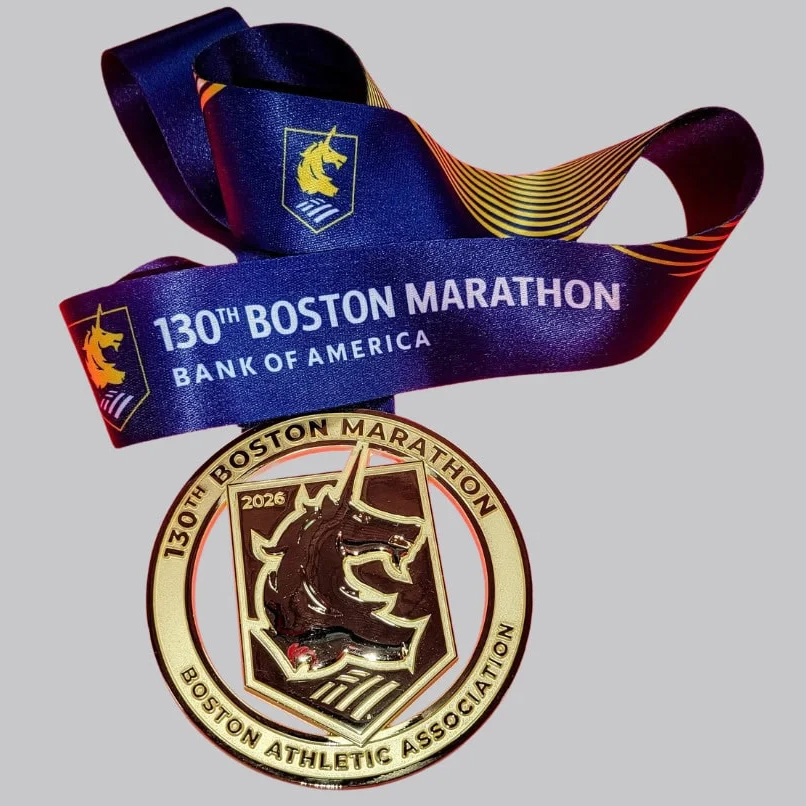
It even involves fashion and jewelry (think blingy finisher’s medals). Medals from this year’s Boston Marathon (pictured at left) are already selling on eBay for $500 US. While this may suggest greater recognition of the value of the sport, it also points to what I see as a major threat—commercialism.

Commercialism has led to myths and misconceptions, mainly among new runners. There’s the “real runner” myth. There are fractures in the running community, along the lines of which races one “has done”. In my view, this puts pressure on runners to prove they belong. What nonsense! If you run, you are a runner. It’s not for me to dictate which races anyone should run, let alone races with a peculiar distance of 42.195 kilometres.

Worse is what I call the “holy grail” myth. This is an unfortunate result of the higher demand for race entries. If you increase demand for something unique and in short supply—like a race bib for the Boston Marathon—its value will increase. Runners setting their sights on Route 135 between Hopkinton and Boylston Street feel pressure to perform, to spend, to always have the latest shoe and the best nutritional supplements. Race entries, coaching, physiotherapy, travel.

What happened to just enjoying running for its own sake? I think we’ve let our competitive nature—the human need to strive, to achieve, and then to recognize our achievements—overtake our common sense. Even small, local races now have large, shiny finisher’s medals.

I put some of the blame on the Abbott World Marathon Majors, a series that has turned marathoning into a medal treasure hunt. I concede that the Abbott Majors has had some beneficial impact, by increasing awareness and interest in marathon running. Fortunately, it’s also spawned trends like the boom in trail running and the minimalist Parkrun.

What are the Abbott World Marathon Majors?

Starting in the mid-2000s, five big city marathons (Boston, New York, Chicago, London and Berlin) got together, and declared that they had special status owing to their size and reputation amongst runners. The World Marathon Majors was born. It was a novel idea. At the time it was almost certainly true.

Some years later, Abbott entered the picture, recognizing that an annual marathon series was a novel marketing opportunity. Their goal was to foster elite competition, but it quickly morphed into an enticement to average runners.

Not surprisingly, the Abbott series has grown—Tokyo was added as the sixth major in 2012, then Sydney in 2024. More majors are coming, and Cape Town (eight) and Shanghai (nine) are next.

And the ugly

If your circumstances allow you to travel the world, to always own the latest carbon-plated supershoe, to enter and train and compete in marathons in some of the leading cities of the world—go right ahead. I hope people who are on this path are there for good and valid reasons.

But what if you can’t manage it? What if the wear and tear on your body from even one marathon is too much? What if wearing the same $500 superlight shoe that Sawe wore to set his record is actually hurting you? Here’s where the problems start.

Anyone who commits to a marathon—or any race—should do so because they intend to compete. That is easier said than done. If you are happier running your local Parkrun or 10k, with no consideration of your pace, wearing ordinary running shoes, then that’s what you should do. You’ll be better off in the long run.

The worst consequences of this pressure are becoming clear. There’s cheating aimed at securing valuable race entries—runners who will do anything to secure a Boston Qualifier, a BQ. Reports of bib swapping, course cutting and “bib mules” are now fairly common.

Then there’s the significant environmental toll from “marathon tourism”, as people fly around the world to compete in marquee races, when there are so many other events closer to home. Some would downplay the seriousness of these issues, but I don’t. How valuable is a finisher’s medal if it wasn’t earned fairly?

I want to mention the so-called running influencers, whose interest in Boston, New York or London seems to be in checking these races off a list. They use their online platform to bring their followers along with them. It’s the marathoning equivalent of snapping a selfie at the Eiffel Tower and the Grand Canyon.

What happens next? Look to Boston

I think explosive growth in demand is eroding some of the goodwill that exists around a sport fundamentally based on fitness. Even Boston, the premier marathon in the world, has become the focus of online angst. Why? For the very reason that it is so prestigious. Boston is the race with the most challenging entry criteria—a BQ is coveted more than any other credential in the marathoning world. For decades, Boston has simply been out of reach for many runners, even serious competitive runners. With limited exceptions for charity spots, if you weren’t fast enough, you couldn’t get in.

Interestingly, I see this feature putting Boston into a position of conflict with the other Abbott races. Clearly, a runner can’t complete their six-star commitment unless they can run Boston. So, isn’t it structurally unfair to those runners for the BAA to enforce Boston’s traditionally stringent entry standards?

I say NO, for one simple reason: Entry to Boston is a privilege, not a right.

I would hate to see Boston’s status as the world’s leading marathon diluted to satisfy essentially infinite demand for entries. In fact, I see the BAA facing an imminent dilemma—stick to their principles (limiting entries as much as necessary to put on a world-leading event) or find a way to accommodate the call on entries by non-qualifying Abbott runners. If it comes to this, there can be only one answer. I’m optimistic that the BAA will do the right thing, and I’m sure Boston would do just fine alongside and apart from the Abbott series. If that means some incomplete six-star medals, so be it.

The final word

The sport of marathoning is thriving, and I’m confident it will get past its current challenges. For those who enjoy running for its own sake, my advice will never change—find your own way in the sport. If that happens to include marathons, that’s awesome. I wish you great success. Just don’t let anyone dictate what races you must run, or that you must race at all. Remember, if you run, you are a runner, and you can be content with that.

Until next time, be well and BE FAST!
On Running Streaks

A running streak is pretty much what it sounds like—run every day until you can’t. And while it’s up to each runner to set their own parameters, the Streak Runners International, Inc. and the United States Running Streak Association, Inc. (yes, there is a governing body for this activity) have set out some helpful guidelines. Here’s a quote from the SRI/USRSA website:

The official definition of a running streak, as adopted by the Streak Runners International, Inc., and United States Running Streak Association, Inc., is to run at least one mile (1.61 kilometers) within each calendar day. Running may occur on either the roads, a track, over hill and dale, or on a treadmill.

-SRI/USRSA website

So that’s it. Sounds simple enough, right? The longest active run streak, as reported recently in Canadian Running, belongs to Jim Pearson of Marysville, WA. As of September 24, 2025, he has run for 20,310 consecutive days. Over that time—more than 55 years—Pearson has run 305,000 kilometres. Now that’s impressive!

Is a running streak a good idea?

As I wrote in my memoir, Stroke of Luck, I’ve never bought into the idea that runners, even highly competitive runners, need to run every day. Of course, regular exercise is hugely beneficial, and running streaks are as consistent as you can get. So, the routine of getting out the door every day will pay dividends in overall health and cardiovascular fitness. From my own experience, regular running seems to increase resistance to seasonal bugs. It may reduce susceptibility to injuries (or it may not). And perhaps most important—streaking instills a feeling of mental toughness, given all the challenges that must be overcome to keep one going.

But there are downsides. The most obvious is that sometimes, when we are injured or feeling under the weather, the best thing we should do is rest. Forcing ourselves out the door, just to check a box and continue a streak, may be making a bad situation worse.

Although streaks aren’t really my thing, I will admit to a certain fascination with runners who can and do carry on long streaks. My brother Paul completed a decades-long streak, as did my old running partner in Calgary, Rick Webb. Rick used to regale me with stories about how he kept his streak alive. One of my heroes is the late Ron Hill, a fascinating man, a legendary runner, and a running streaker. I wrote this in Stroke of Luck:

“… I appreciate what it takes to carry on a running streak. I have known a number of streakers through the years. This evolutionary branch of the running population is an eccentric lot. Most serious runners of the last few decades would have heard of Ron Hill, the great British marathoner and Olympian, whose 52-year streak—which ended in 2017—is legendary. To running streakers, Ron Hill is a patron saint, a person who is universally admired and spoken of with great reverence. He died in 2021.”

Strides Run Streak, 2025 edition

With that background, there should be no surprise that I’ve once again taken on the challenge of the annual Strides Run Streak (SRS). The challenge is simple: run at least one mile every day in December. Kudos to Jeremy and his team at Strides for giving us a manageable goal, one that will help keep us motivated over the holidays.

I’ve been a regular participant in the SRS. In fact, there is a connection between the SRS and my stroke story, which goes all the way back to 2012. I explained in Stroke of Luck how I extended the 2012 streak from a month-long event into one that lasted more than four years. This became my longest personal running streak, even though it paled in comparison to Hill or Pearson. I joked in the book that I might be able to make a case to the RSI/USRSA for the most interesting END to a running streak.

I’ll leave my story there, but if you’d like to know how things turned out, why not get a copy of my book? In doing so, you’ll be supporting a great cause—the stroke unit at the Foothills Medical Centre in Calgary. The book would be a great gift for the runner on your Christmas list!

Now, as some of my followers on Strava will know, I give myself the added challenge of finding a worthy photo while I’m completing my daily run. Sometimes that is a bigger test than the running part, particularly with the days getting shorter and winter setting in. There aren’t many great photos taken on a treadmill!

So far in 2025, my commitment is strong, and the weather has been agreeable. There are a few hurdles, mostly a nagging soreness in my right Achilles tendon. Fortunately, that seems to loosen up after a couple of kilometres. Worse for me is that my training partner is still sidelined with a sore hip. That means my running is mostly solo.

Enough words. Here are some images from the 2025 SRS, which started while we were in Toronto. It’s obviously a work in progress, and I hope to send out another batch of pictures by month-end:

Copyright for all images is mine.

While it’s always nice to capture the festive spirit, I don’t consider it essential. As I’ve said before, my goal is to find images that transport me back to that time and place. I like visiting different neighbourhoods during the month. For me, a good photo run is thrilling; a way of adding meaning to my runs. It doesn’t replace the excitement of competition in a road race, but it’s sure better than nothing. And while there are no governing bodies for photo runs, I can recommend the Ricoh GR III—portable, capable, and durable. It’s been a constant companion on my outings.

Merry, Merry!

Wrapping Up

I hope you’re finding your own source of motivation at this time of year. While it’s easy to avoid going outside, especially when the temperature is -18c, as it is in Calgary today, I always feel better for having made the effort. So, whether it’s a month-long run streak, a walk with your dog, or a jog on a treadmill, I highly recommend a daily dose of activity. Having a camera with me is a reminder to keep things informal, and if I’m lucky, I’ll come home with a memento of the day.

Happy Holidays! And until next time, be well and BE FAST…

Book Review: “Today We Die A Little”

Today We Die a Little: Emil Zatopek, Olympic Legend to Cold War Hero, by British journalist and author Richard Askwith, tells the fascinating story of the great Czech runner, Emil Zatopek.

Zatopek was an enigma. His life paralleled his country’s history and is intertwined with the Second World War and the rise and fall of the Soviet Union. Askwith did a thorough job of researching his subject.

The Czech Locomotive

Today, if people know anything about Zatopek, it’s likely because of his ungainly running style. Videos of his great performances are easily found, and worth a look. But his rolling head, flailing arms and gnashing teeth may be the least interesting part of his story.

Emil was a true sportsman. His nickname comes from a front-running style that left his competitors strung out behind him. He befriended those same runners and maintained contact with them well into old age. His training techniques were unorthodox. For instance, he was known to train in army boots, or in deep snow. Any of us who have done interval workouts can thank Zatopek—he may have invented 400m repeats. The difference? He did 60, 80, even 100 of them—every day.

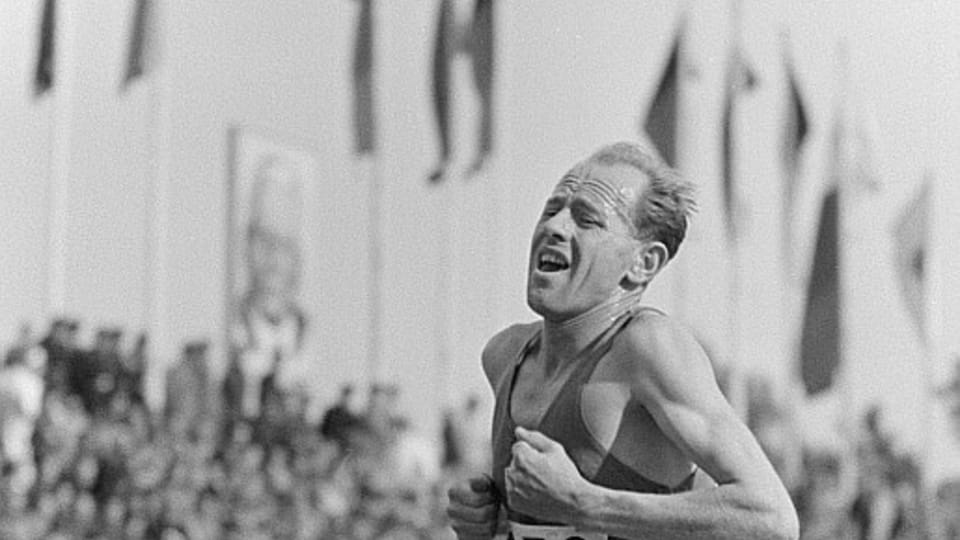
Emil Zatopek, giving it his all (Photo: Roger Rössing, Deutsche Fotothek)

There are so many anecdotes about Zatopek that it’s nearly impossible to separate fact from fiction. I give Askwith credit for trying. Some things are undisputed. Emil taught himself 8 or 9 languages by reading dictionaries. He and his wife, Dana, won four gold medals at the 1952 Helsinki Olympics—a count that was second only to the US. Emil won the 5000m, 10000m and marathon, a record likely never to be repeated. Dana won the women’s javelin competition.

Socialist icon or misunderstood hero?

Zatopek may have been the most famous athlete in the world in the late 1940s and early 1950s. Few could match his talent and charisma—he was the Muhammad Ali of his generation. Even after his competitors copied his tactics and started surpassing him, he remained a national hero. It seemed everyone wanted to meet him and feel the warmth of his personality. 

The story that best demonstrates Zatopek’s generosity has him handing a small package to Australian runner Ron Clarke after Clarke visited Emil in Prague in 1966. Clarke competed at a high level internationally but had always come up empty-handed. Zatopek was the perfect host, readily sharing his training advice. Clarke assumed Zatopek had given him something he wanted smuggled out of the Iron Curtain. In fact, it was one of Zatopek’s 1952 Olympic gold medals. “Because you deserve it,” read the inscription. 

Despite the constraints imposed by the Czech regime, Zatopek travelled the world. In fact, he became a sort of role model for socialist ideals. And it’s here where his story gets a bit hazy. Depending on who one believes, Zatopek was either a naive pawn of the regime or a committed agent. He was an officer in the Czech army, so it’s hard to totally accept the former view. However, he had managed to tread a fine line for a long time, apparently avoiding any suspicion of his commitment just by being his gregarious self. Or perhaps by mouthing the words that were expected of him.

Some things may never be known about Zatopek, but it is clear he believed in the concept of socialism. After all, it was how he had tried to live. When Soviet tanks moved in to crush the Prague Spring in 1968, he spoke up for compromise, possibly hoping his celebrity would save him from retribution. Soon after, he was expelled from the army, stripped of his status as a sporting hero, and exiled to years of manual labour in remote work camps. Through it all, he maintained a positive attitude. He was a broken man when he was finally allowed to return to his modest home. Then he suffered several strokes and was all but forgotten when he died in 2000.

Lessons far beyond the track

Askwith is sympathetic to Zatopek, and I found that his enthusiasm for the man sometimes clouds his judgment. If Askwith is to be faulted, it is for trying too hard. I came to accept Askwith’s case—that there is reason to doubt the worst accusations against Zatopek—but I found it unnecessary that he keep making it.

As for Zatopek, there is no reason to fault him for his eccentricities. He was an intelligent, independent and humble man. I found myself wondering how any of us would have managed in his situation; if our homeland had been first taken by the Nazis, then by the Communists. Zatopek lived and competed bravely, and left us lessons that apply beyond the realm of amateur competition. 

The “Czech Locomotive” was a complex figure, a great athlete, and a gentleman. Askwith’s book is an homage to Zatopek, and there is much to commend it, not least so the reader can decide for themselves how they view the man. I started the book and put it aside for a while. When I persevered, I was rewarded with a complete picture of an astonishing athlete. It’s a worthwhile read.

By the way, the title of the book comes from the comment Zatopek made to his fellow competitors on the start line of the 1956 Olympic Marathon in Melbourne. By then, Zatopek was well past his best form. The day was brutally hot, and he made his remark just as the runners set off for what they all knew would be an extreme physical test. It was a noble gesture. Anyone who has set a challenging goal for themselves and worked hard to achieve it will relate to the sentiment.

Until next time, be well and BE FAST!

Vancouver Marathon – 2015 to 2025

What follows is a story separated by exactly ten years—and a generation.

The Opening Act

The marathon was never my favourite distance, but over the decades of my amateur running career, I ran plenty of them. It was a love-hate thing. By 2014, I had sworn off marathons, and not for the first time. Then, I let myself be talked into signing up for the 2015 Vancouver race. I’ll leave the specifics of that part of the story for another time.

I had run the Vancouver Marathon once before, in 1993. I finished the race one minute on the wrong side of 3 hours, and I remember being quite disappointed. Why? Well, 1992 had been a year of personal bests. Naturally, I came into 1993 full of optimism. After the Vancouver race, I worried that I might have already peaked. And that was more than 30 years ago!

Heading into the 2015 race, I had been through a minor crisis of confidence. You see, I’d run a very poor Around the Bay Race in March 2014, and I was finding the preparation for a spring marathon during another of our nasty Calgary winters more than I could handle. All credit goes to my awesome training partners, Allison B and Ken S, who kept me going week in and week out. They deserve kudos for helping get me to the start line on May 3, 2015.

As for my race tactics, I had worked out a novel plan with coach Janice. The idea was to get me around the deceptively tough Vancouver course while avoiding the slow-motion crashes I’d experienced in some previous marathons. We decided on a series of four mid-race pickups, each 3k with a 1k easy recovery. Janice knew me well enough to realize that a series of tasks would help keep my mind from wandering.

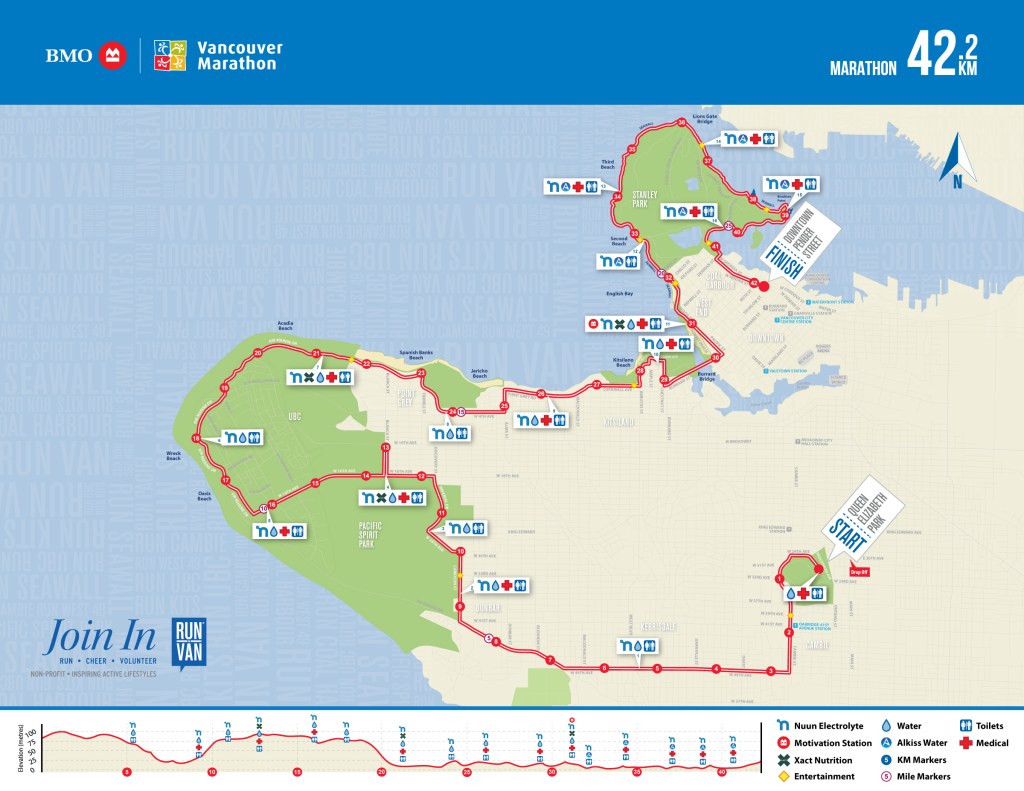
I had modest expectations. I could foresee some challenges on the 2015 course—still in use today—which was very different from the route I’d run years before. The first ten kilometres were mostly downhill. There was the Burrard Bridge at 30k. Of course, there was the 42.2k distance to contend with.

Our race plan worked like a charm. The 3k pickups were effective, and I got to 38k before my quads seized up—no doubt the price to be paid for the early downhills. Being a veteran of four decades, I didn’t panic. Instead, I managed my effort over the last few kilometres. Afer all, it was only a few minutes until the finish. Worst case, I might be a little outside my target range.

I finished in 3:18:04. Not bad. My age-graded time was the same as my PB, set many years earlier. It was a satisfying outing, and a prelude to the eventful years that followed. Again, I’ll leave those details for another time.

Daniel Delivers!

Fast forward ten years… to the best part of this story.

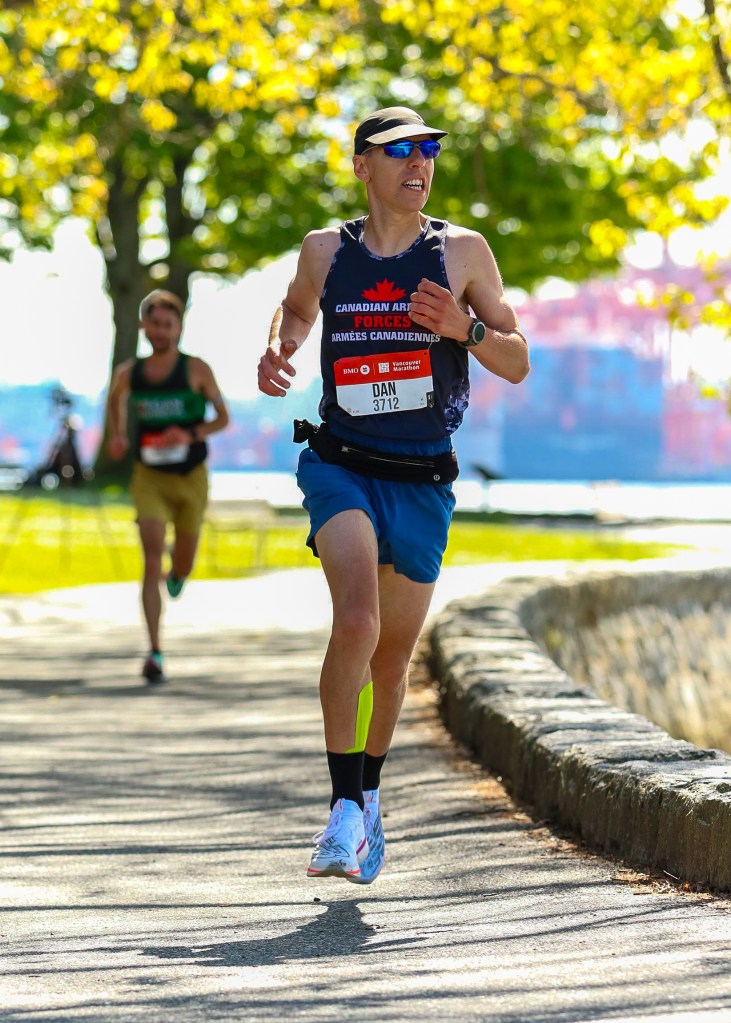
By the spring of 2025, our son Daniel had been a serious runner for at least 12 years. He ran his first marathon in Montreal, in 2014. Even as a rookie he methodically attacked the distance. In the intervening years, he’s taken on many different running challenges. The last couple of years have been especially rewarding for him. He’s been honing his technique and working on strength, speed and flexibility. So, when he set his sights on the 2025 Vancouver race, it was with the goal of improving his PB… significantly.

All signs were positive during his training cycle, and a speedy 1:12 half marathon in April hinted at something special. He overcame a niggling overuse injury to make it to the start line in Queen Elizabeth Park on May 4, 2025.

Major marathons now feature online tracking for spectators. As a result, it was a nervous morning for Deborah and me, as we watched the little dot that represented Dan work its way around the course. It seemed that I was reliving every step with him, through Pacific Spirit Park and the UBC campus (where he reached the half in 1:15:44), then through Kitsilano, over the Burrard Bridge and into Stanley Park for a lap of the seawall.

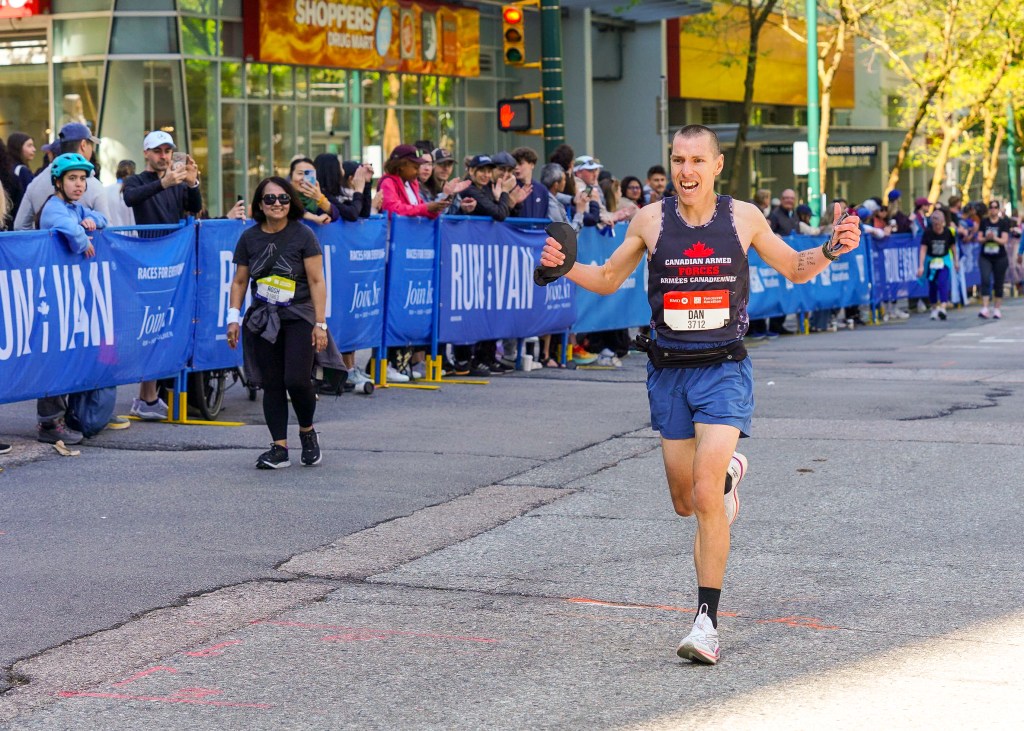
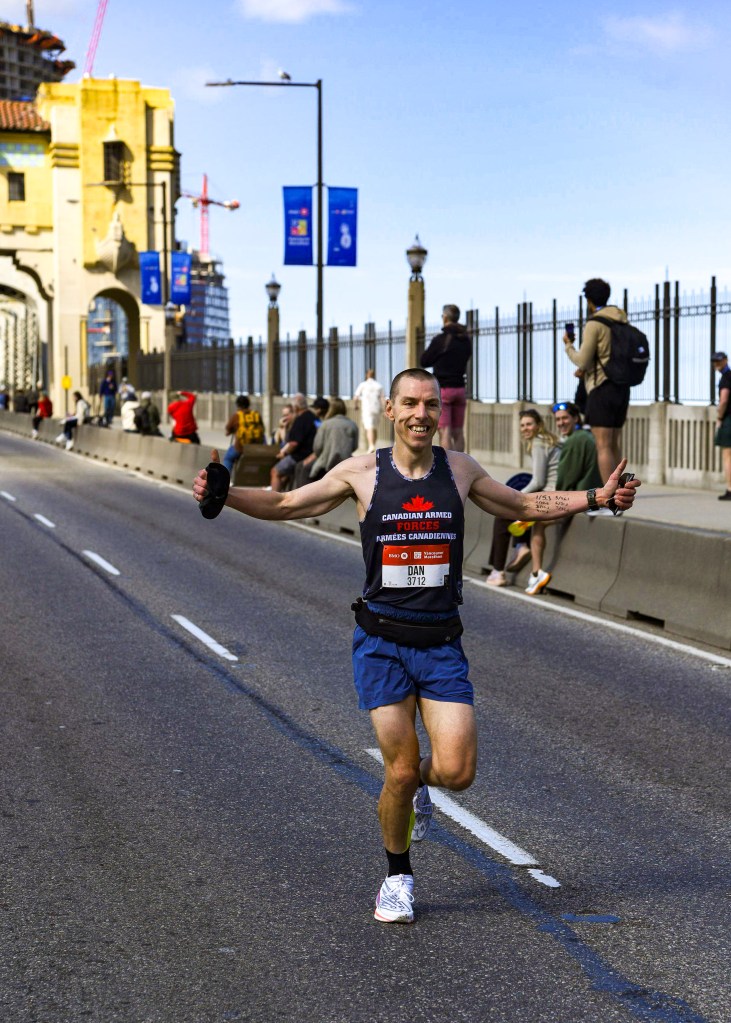
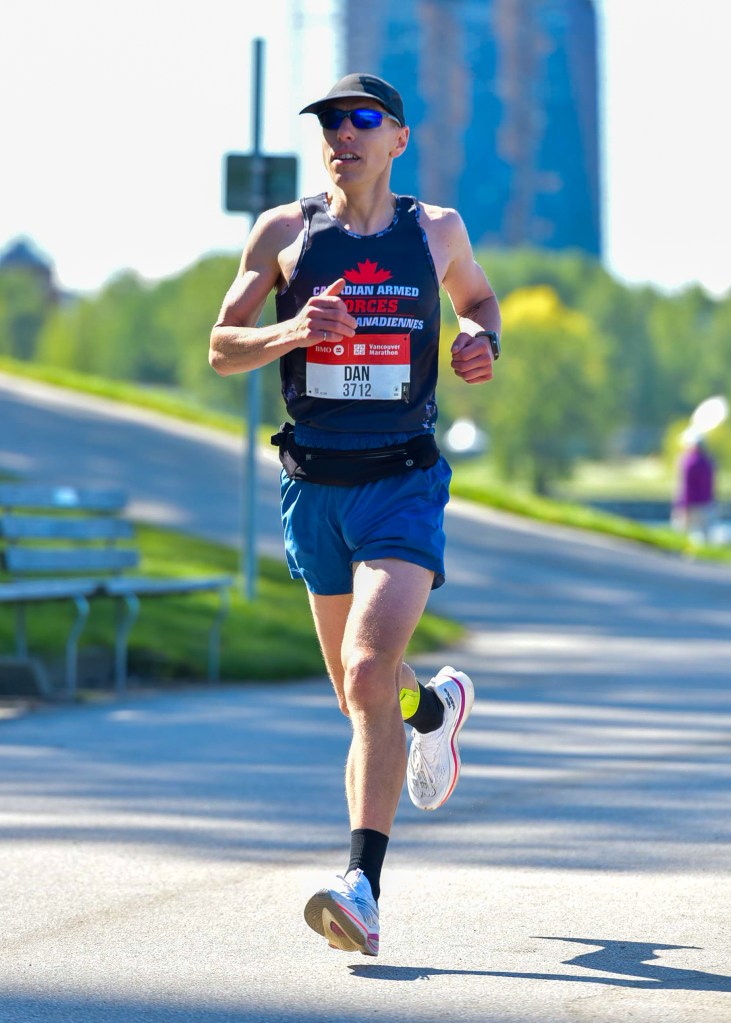
Dan’s early splits were speedy, but by 30k he seemed to be slowing. Was there a problem? We could only watch and wait, holding our breath. Once he got to 40k in 2:27:16, everything was looking good for a superb finish. He brought it home in 2:35:52. By that point I was yelling encouragement at my phone. He placed 21st overall in a strong field of nearly 7,000 runners. Amazing!

Here are some pictures from his awe-inspiring run (all from Marathon Photos):

When we talked to him shortly after he finished, he was full of energy, relief and joy. He had been cheerleading with the crowds along the route. And his apparent slowdown? He had the presence of mind to ease off his pace slightly at 24k, to avoid aggravating his calf. Not only fast running but smart too!

It’s hard to find words to express what I’ve been feeling this week. Of course, I’m filled with awe and pride, as I consider what Dan has accomplished. Seeing my son reach a personal goal with determination and purpose makes me very happy. I know he earned this result—including the massive 15-minute improvement in his PB. Being a runner myself, I have a good idea how hard he worked for this. Running 2:35 puts him in the top 1 percent of marathon runners. I have often said he’s never set a foot wrong in his life, and that was perhaps never truer than in this race.

I wrote about the relative arc of our lives in Stroke of Luck, and while I may eventually think of something more profound to say, for now, I’m just relieved he finished and that he did so well. While I understand that a small part of this might be attributed to lessons he learned from me—from us—early in his life, this triumph is all his doing. If life were a relay race, I would be content knowing that the handoff has been made and the baton is safely headed to the finish.

And that might be an apt analogy, as the next challenge Dan will tackle is the annual Cabot Trail Relay on May 24, with a team called the Iron Lungs out of Toronto. He has run the race with them several times, and they (like us) know he will be a worthy addition to their squad.

We can’t wait to see what’s next for him.

Until next time, be well and BE FAST!
Boston Marathon Musings

I’m looking forward to visiting Cafe Books in beautiful Canmore in a few weeks, for an in-store book event.

If you can make it on May 17, I’d love to see you there, for a chat about running, my stroke journey, and of course, my book!

Speaking of running, I’ve almost let the week go by without a blog post, but this week—Boston Marathon week—is too special to pass up. A gutsy performance by one of my teammates, who demonstrated character by overcoming injuries to finish the race, prompted me to start writing—congratulations Jason!

If there is one road race that stands above all others, it is the Boston Marathon. There are many reasons for this, and it would take much more than one short piece to go through them. I can already see more posts being needed!

Why Boston Matters

Boston is a celebration of tradition and history. The race is a tribute to athletic excellence, with many of the great runners having won in Boston—Tom Longboat, Johnny Miles, Ron Hill, Bill Rodgers, Jerome Drayton. It’s a unique sporting event, where the best professional runners compete on the same road, at the same time, with the most devoted amateurs. The crescendo of support—from the quiet country roads of Ashland, to the enthusiastic women of Wellesley College at the halfway point, to the screaming crowds in Kenmore Square—makes every inch of the route special.

Devotion doesn’t begin to describe what it takes to earn an entry to Boston. Talent, dedication, and good luck are also needed. Then, just to get to the start line in Hopkinton on the third Monday in April takes extraordinary commitment, focused training, and more good luck. Those fortunate enough to reach the historic finish line on Boylston Street will have dealt with one of the most devilish, net downhill, point-to-point race courses anywhere in the world; and unpredictable weather conditions that can include everything from torrential rain to blistering heat.

What all the fuss is about… the Boston Marathon route and elevation map

Some context might be helpful. Today, running a marathon is seen by many beginners as part of a natural progression, as an achievement that lets someone call themselves a runner. (That isn’t true, by the way.) For many years, the 42.195km distance was the domain of the sport’s fringe players: tough, sinewy, hard men. Yes, they were almost all men. And while it may have been debated, the Boston Marathon was at, or at least near, the pinnacle of the world’s top marathons.

I think of two eras for the Boston Marathon: pre- and post-1996. You see, 1996 was the 100th anniversary of the race. Compared to prior years, the field that year was huge. Since then, demand for entries has ballooned, as more runners add Boston to their bucket list. To their credit, the Boston Athletic Association (the BAA) found a way to squeeze more runners onto the narrow roads of Route 135 by adding wave starts (and by upping their game on the organization side).

I will add an opinion that may not be popular with some readers. The BAA will never be able to accommodate the demand for entries to this most desirable race. And that is fine with me. Boston has always been (and in my view, should remain) exclusive… it should be an event set aside for those who can earn a place. Opening it up to any and all participants would only dilute what makes the race special.

Personal Connections

I’ve run Boston three times. It’s been such an integral part of my running life—my first running life, that is—that I can’t really remember a time when I didn’t want to run it. Through the 1980s and 1990s, the race was an enigma and a vague aspiration. It was an event that I read about on the back page of the sports section. If I wanted to know more, I would have to dig deep. And I did. But in the days before social media, I had more questions than answers: Where should I even begin? How would I qualify… or enter? My god, assuming I did enter, how would I run the damn thing?

Let’s just say I worked my way up to the race. I call it doing my apprenticeship. Finally, in 2001, for the 105th running, I felt ready to tackle the challenge. It helped that I qualified by a comfortable margin in another of my favourite races, the 2000 Royal Victoria Marathon.

I wrote extensively about my first Boston Marathon experience in Stroke of Luck. It is, quite simply, one of the defining events of my life. My family made the trek to Boston with me, having sacrificed much to make my 25-year dream possible. The race itself was a personal triumph. I planned well and I executed well. I met my optimistic goal by going under three hours. I even put aside my competitive instincts—a little—to smile and wave at the best marathon fans in the world. In short, I finished knowing I had done everything humanly possible to achieve this result. As I said in the book:

“The numbers were impressive and satisfying, but they were only numbers. I was at a loss for words to describe what I was feeling. Years later, I still have trouble. It was exceptional. Momentous. Transcendent. It was everything I had hoped it would be.”

That magical day in April 2001 was the culmination of a long personal journey. I believe that putting substance to my childhood dream, working towards it, and finally achieving it, says more about me than words can ever do.

I’ve been back to run Boston twice more. The experiences were each different and in their own way, worth writing about. There’s no question that for sheer emotional intensity, nothing could compare to the first time I made those famous turns, the ones every Boston finisher will recognize—“right on Hereford, left on Boylston”. Look for more in future posts.

For now, I’ll ride the annual Marathon Monday wave for a little while longer.

Until next time, be well and BE FAST!
What’s Gone Wrong With Athletics?

I like to keep up with news from the wonderful sport of athletics, but I’ll admit to some recent frustration. I regularly scan the headlines from online sources, having largely given up on print media. I’m always interested in results from major road races and track meets around the world. To a lesser extent, I follow developments in equipment, training techniques and nutrition.

Lately, it seems that all I’ve read about is controversy. Some examples…

  • Twelve years after the race, competitors in the women’s 1,500m final at the 2012 London Olympics are still being disqualified for doping infractions. The race has been called the “dirtiest of all time”, with five of the 12 racers now banned. Maybe the last three finishers shouldn’t give up hope for a medal yet.
  • Two competitors in a collegiate 5,000m event were disqualified for wearing shoes that didn’t meet NCAA regulations for “stack height”. One racer set a massive PB in the shoes, the swift-sounding Nike Streakfly 2.  If only they’d stuck with the lowly (and lower?) Streakfly 1…
  • A runner and social media influencer was banned for life from the Chinese Half-Marathon Championships after she was discovered to have worn a fake race bib. Not surprisingly, the perpetrator claimed she had been duped. The race is clearly popular: it received more than 150,000 applications, of which less than 10 percent were accepted.
The dirtiest race in history? (Photo from Daily Mail Online)
The Nike VF2. Too stacked? (Photo from Canadian Running Magazine)

I could go on, but you get the idea. It’s all rather depressing. In my opinion, these stories detract from what I believe is STILL the greatest of sports. Athletics is getting harder to love.

The Problem

I’ll explain what I think the problem is, and it starts at the top echelon of the sport. It’s money. Pure and simple. Athletics has become a big, commercial business. There’s a lot at stake in the Olympics and other major championships. As a result, exciting races and great individual performances (and there are many) frequently get lost in controversy.

Cheating seems to affect athletics more directly than other sports. And I believe that stems from athletics being the most accessible of sports. Comparatively speaking, while none of us will make it to the NHL, any of us can lace up a pair of running shoes and find a road or trail to run on.

The accessibility of running is both good and bad. It’s good because of the health benefits that accrue from an active lifestyle. The negative part is that we can become overly influenced by other people’s opinions about what defines success in this sport. Today, influencers are everywhere. Technology imbues every aspect of the sport: race results are micro-analyzed, every kilometre is measured, workouts are instantly posted to Strava. Heck, our watches even estimate our recovery time… can anyone tell me why this is necessary?

Do I need this? (Photo from Garmin, for the Enduro 3)

All of this creates extraordinary pressure to always be improving. There’s a trickle-down effect, from elite athletes to self-appointed experts to average runners. We can wear the same carbon-plated shoe, use the same GPS watch, and gulp down the same gel as Eliud Kipchoge, while we chase every second in the marathon. And why not? What’s a few hundred bucks for the latest super shoe, if we would gladly spend thousands more once the shoes earn us that elusive race entry we’re seeking? (That reminds me of another recent headline. The 2025 New York Marathon received a record 200,000 applications for lottery entry… that’s up 22 percent from 2024. Good luck!)

I need to emphasize that the vast majority of runners compete fairly, and there is nothing wrong with taking advantage of the available technology. We have to recognize that some will be tempted to cross the line; many more will lose sight of what’s really important.

The Way Forward

A quest for constant improvement and achievement might make sense if we were professional athletes. (Not the doping stuff, of course.) But the fact is, we’re not.

From my perspective, which is that of an average runner… a pure amateur… with his best days behind him, let me offer a few thoughts on how we move on from these challenges.

First, recognizing that most of us will never make it to the top tier of the sport, we should celebrate rather than fight against this reality. To do that, we should define where running fits within our specific life puzzle. How you balance work, family and running is unique to you. Success in the sport should mean different things to different people. Give yourself permission to do your best, to let your performances ebb and flow, and most importantly, be content with the results.

I’ve written about the joy I now get from what I call photo runs… where I swap a GPS watch for a camera. For me, it’s been a way to get back to the carefree days when I took up running as a teenager. Then, I was an open book. I loved the freedom that came with running on a wooded trail or a quiet road. I ran in the shoes I had, and I used a cheap Timex watch. I discovered the rich history of the sport and followed great runners… true role models… before anyone had heard of doping.

If you are willing to ditch the influencers and find your own path (I call it finding your why) I think you might be better off. If that path becomes a journey to finish all six (sorry, seven) Abbott World Major Marathons, that’s fine. But if it means enjoying easy runs around a local park with friends, while wearing budget shoes, that’s fine too. Maybe better, in fact.

And me? I should stop scanning the headlines.

Until next time, be well and BE FAST!