The Longview Photo Run

The Black Friday Sale ends soon!

Time is running out for an unbeatable deal on a running story you don’t want to miss!

Stroke of Luck is available on Amazon at a marathon-inspired 26.2 % discount—but only until the end of November.

Get your copy today!

Longview: A Short History

For as long as I’ve been in Calgary, the Village of Longview has been my idea of what makes Alberta special. It’s a quiet village in an idyllic setting. The views of the foothills to the west are spectacular, and that’s because Longview sits just outside Kananaskis Country. Highway 22 (the Cowboy Trail) is the town’s main street. I’ve often told Deb that I want to move to a ranch in Longview, although I wouldn’t have a clue what to do once I actually got there. No matter.

I learned about Longview’s fascinating history when I did my research for this piece. The village is named for brothers Thomas and Oliver Long, who homesteaded in the area at the beginning of the 20th century. Given its location, Longview has a long connection with farming and ranching. When oil was discovered in nearby Turner Valley in the late 1930s, Longview boomed—so much so that it earned the nickname Little New York. Of course, booms tend to go bust, and that’s what happened a few years later. For most of the last 60 years, the village’s population has been around 300.  

One of Longview’s claims to fame is that the annual Kananaskis 100 Mile Relay starts there, early on a Saturday morning in late June, just after the Highwood Pass opens up. There are some fond memories there, I can tell you! I wrote about the race earlier this year—check it out here.

And if anyone needs another reason to visit Longview, here’s one: Flic Film is a business that caters to those of us who can’t quite give up film photography. I used to have a convenient option for film development near my house, until “my guy”—that was Paul Stack—wrapped up his business and retired to Nova Scotia. I’ve been wondering what to do with my film since then, so I was thrilled to learn about Flic Film. I met Dalton on my visit to Longview, and left him with my order.

Feeling slightly nostalgic, here’s a contact sheet, which (if you’ve never seen one) is a handy way to identify any “keepers” on a roll of film. There’s something real about flipping through a binder of negatives.

A Short Jog Through the Village

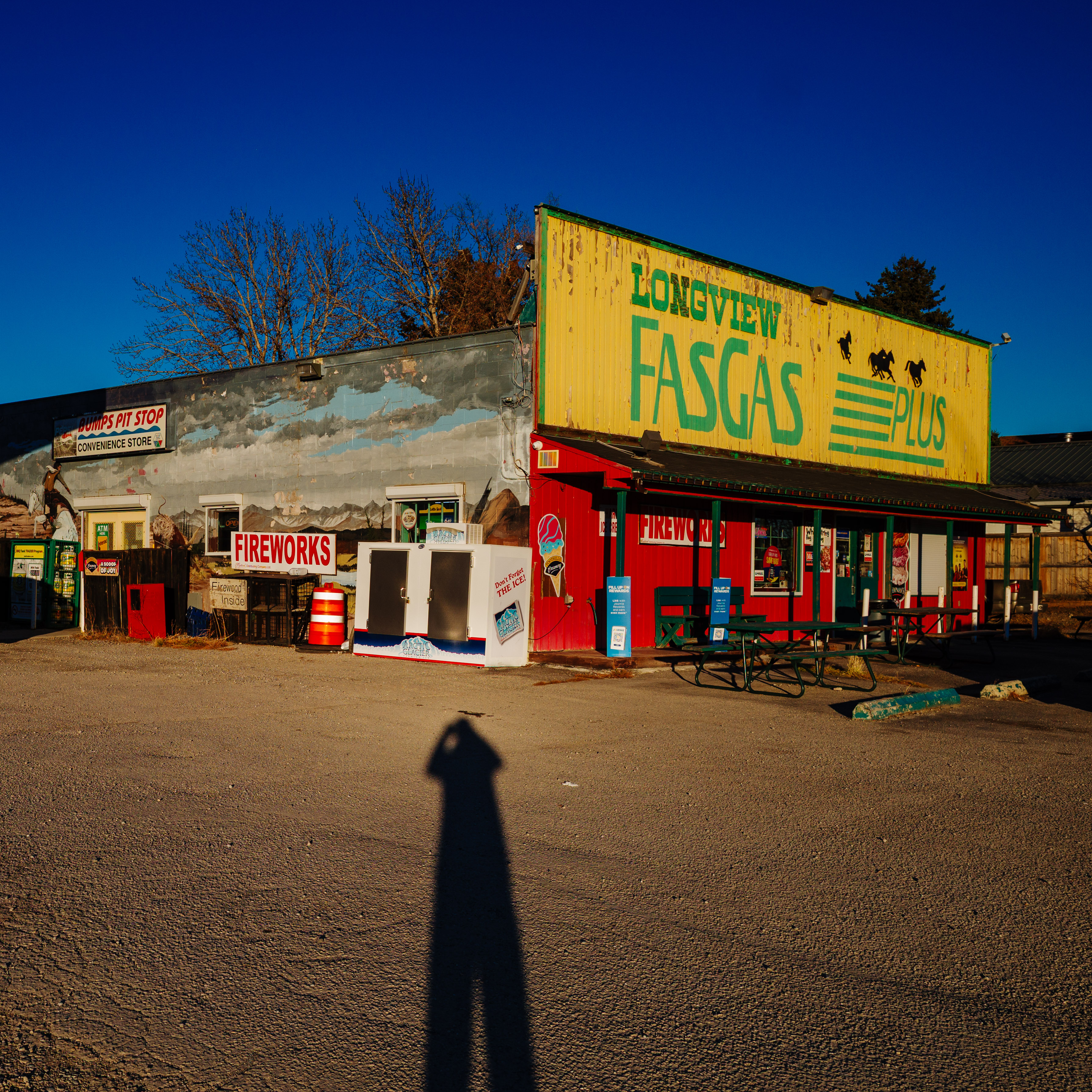
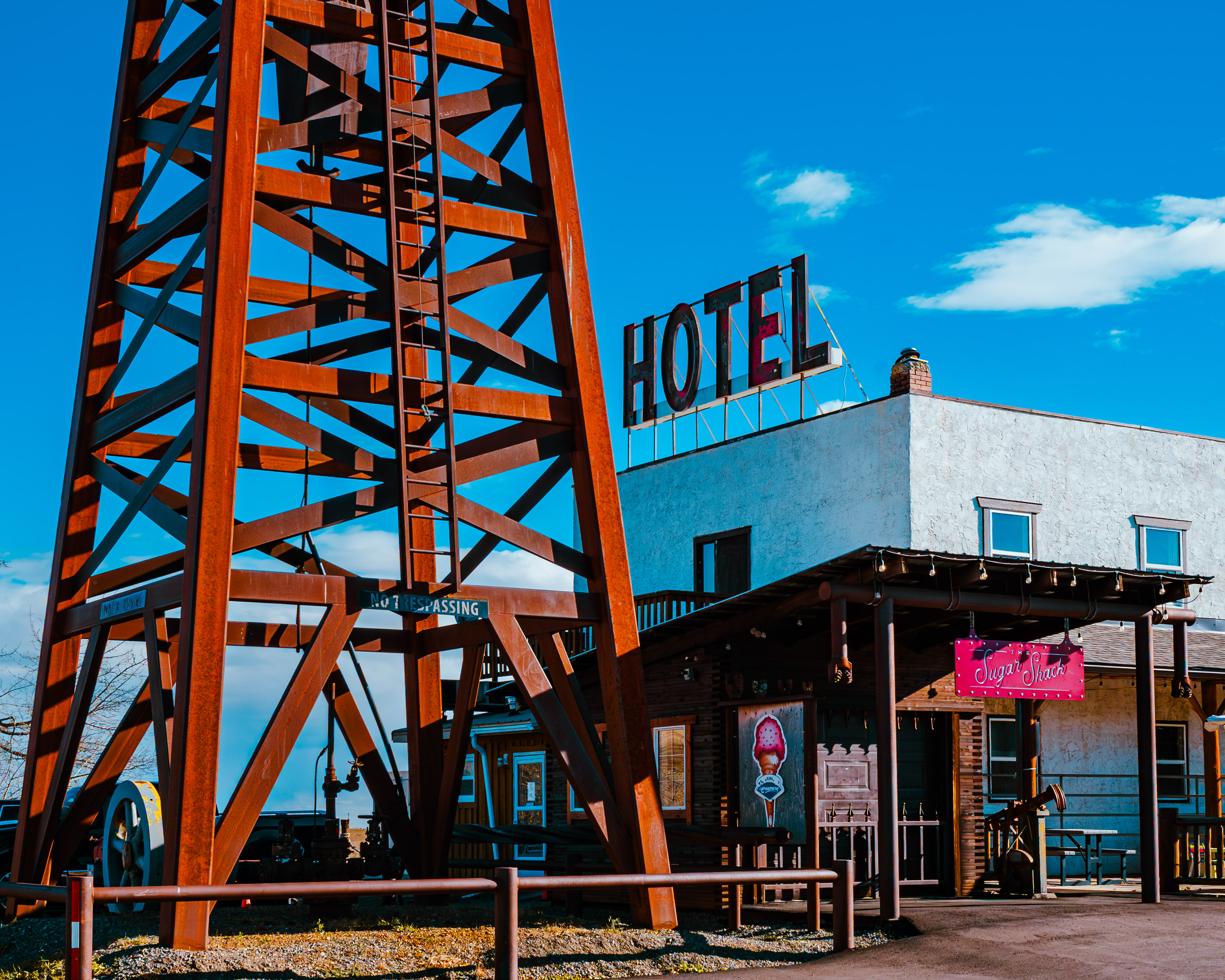
Since I knew I’d be back to pick up my negatives, I decided to add a short photo run through the village on my return visit. I already knew there would be a lot of interesting material along the main street (Morrison Street), like the iconic Twin Cities Hotel. When I’m faced with that situation on a photo run, I try to get a few kilometres under my belt so I’m not starting and stopping too much.

Here’s my running route, courtesy of Garmin:

I did end up with a few worthwhile images, carrying the venerable (but now discontinued) Ricoh GR III. I learned a lesson, though. At this time of year, the sun sets quickly. If you see it, shoot it, because it might not be there a few minutes later!

Enjoy these images (copyright is mine):

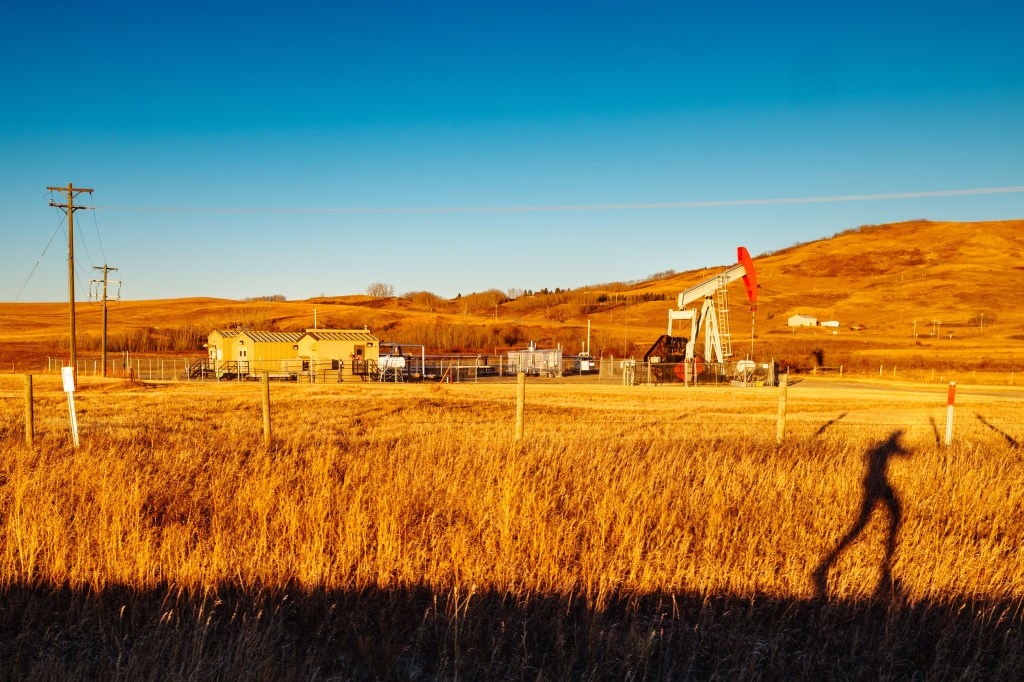
After an out-and-back run to the Highwood River at the south end of the village, including a decent hill, I headed out on Highway 541 towards K-Country. I was thinking about some of my past adventures on the relay. Running the first couple of kilometres was great, and being able to turn around was even better. Here’s a selfie, where I did my best imitation of the pump jack in the background.
Heading for Home

After I got home and started putting this piece together, I read about a bit of Alberta history that I was completely unaware of. A few kilometres north of Longview is a historic site marker, which I have driven by and wondered about, since there doesn’t seem to actually be anything there.

Well, it turns out to be a commemorative plaque and display for Little Chicago. Apparently, the boom that fueled growth in Longview led to another town springing up, just up the road. That’s where the Twin Cities Hotel got its name. The name Little Chicago was changed to Royalties, as it caused confusion with, you know, that other Chicago. At the peak in the late 1930s, the population of the two towns was about 3,200. As things turned sour economically, all traces of Little Chicago disappeared, except for the plaque that tells the story. I’ll definitely stop for a look—and a photo—on my next film drop.

Until next time, be well and BE FAST!

Urban Sustainability? Hardly!

We live in interesting times in Calgary. I’ve formed strong opinions about what I see happening in my city. For many reasons, I think we’re on the wrong track. From what I’ve seen recently in other large Canadian cities, the same things are happening there, too.

One of the first pieces I wrote for this blog was on the topic of sustainability. You can find it here. My focus then was on objects that are perfectly designed for their intended purpose. They are sustainable, in that they can be expected to work perfectly for a lifetime (or longer) if properly maintained.

As I walk around inner-city neighbourhoods in Calgary, I’m bothered by a pattern that I see being repeated over and over again. Homes that have stood for decades are being levelled and replaced by one of two things: large, contemporary boxes or large, multi-family boxes. And it’s not just homes. Commercial buildings are being torn down and replaced by high-rise residential towers full of small (you guessed it) boxes.

Boxes, boxes and more boxes…

Why is this happening? Well, it is now presented as common knowledge that housing is a critical problem in Calgary. City administration has prepared or commissioned studies to explain the situation and how dire it is. I’ve read their material, and I’m willing to admit that I don’t know. I’m not an urban planner or a sociologist. Maybe it’s a crisis, or maybe it isn’t.

What I do know is that if I exercise my right to ask questions or comment on proposed developments that directly affect me, by writing letters to my councillor and city planners, the usual response consists of boilerplate talking points about housing supply and affordability challenges. I used to write such letters, but I don’t do so anymore. When a response starts with the words “because we are in a housing crisis…“, then it will include justification for all sorts of irrational actions.

As I said, I have many problems with this trend, but let me come back to that word, sustainability. I define sustainability as encompassing the social, environmental and economic aspects of a project. In my view, nothing in the current teardown and build cycle is sustainable. I’ve noticed that the experts who tout densification and the bureaucrats who facilitate it—the same people who are quick to extol its benefits—tend to be silent on this point. This isn’t an oversight; it’s because the facts don’t fit their narrative.

How about an illustration?

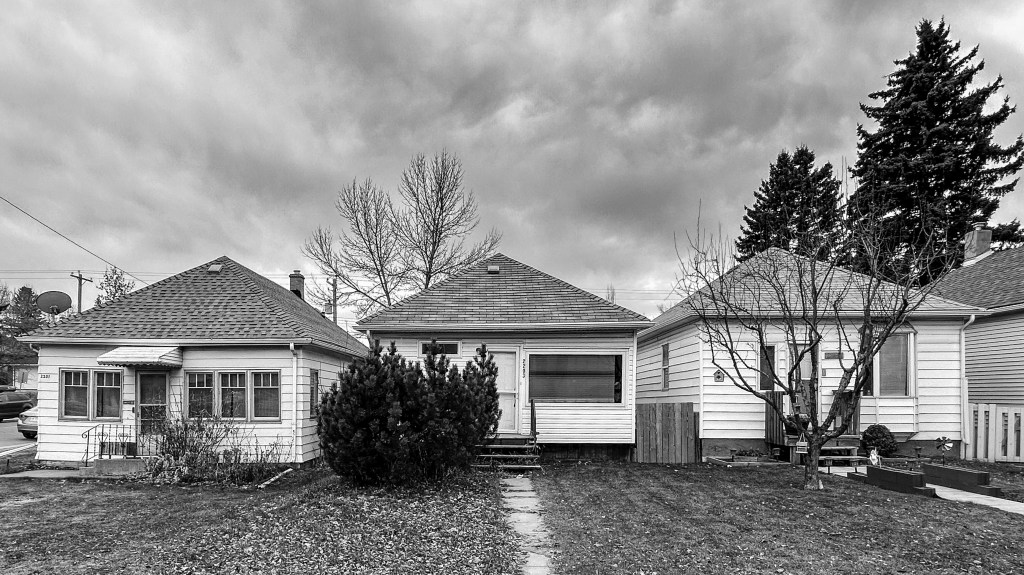
Yesterday, I walked by a row of three post-war houses. All were small, neat and well-kept. They have been standing for decades, so we know they have survived many brutal Calgary winters. The owners of these homes have replaced roofs, tended lawns, and done the hundreds of other routine tasks needed to keep them functioning. They have put their personal touches on them. These houses are not flashy, large, or modern, but they definitely are sustainable. On the evidence, these are the type of structures that stand in the way of solutions to our housing problem.

The impediments to solving our housing crisis… really?

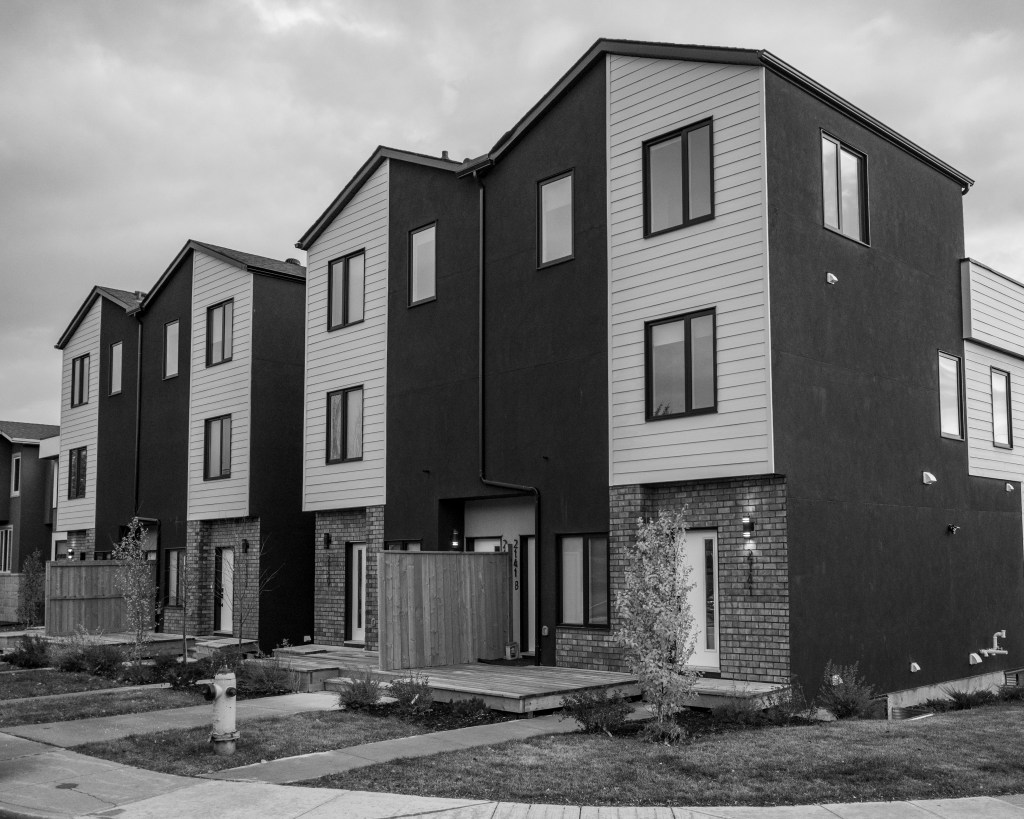
Let’s contrast this scene with another, where a transition has already occurred. The houses that used to stand in this location were like the ones pictured above. They have been replaced by multiple, multi-family dwellings; in this case, four fourplexes.

Tell me, what problem is this solving?

To get to this point, three houses were demolished and carted to the landfill. I estimate this would have generated 400 cubic metres (200 tonnes) of waste. That’s without consideration of the concrete foundations, which represent more waste to the landfill, and heavy waste at that.

Pouring new foundations generates significant GHG emissions, because cement manufacturing is one of the most GHG-intensive industries. Of course, there will be a continuous stream of waste while construction is in progress. And our lush urban tree canopy? Gone.

What are the main development scenarios for inner city locations?

If we see a custom contemporary house going up, it’s usually large and built to serve the needs of a couple or a small family. In other words, there will be a lot of space dedicated to a few people. Don’t get me wrong. This is a free country, and people can build to their own taste and budget. But on a full lifecycle basis, it’s hardly sustainable.

If it’s a multi-family dwelling, it’s almost certainly going to be built by a developer who will target the minimum building standards. There will be pressed board exterior walls, thin insulation and interior walls, plastic pipe and cheap finishings. Unlike the post-war houses pictured above, nothing built today will last. We can be sure of two more things: the developer will realize a healthy margin, and the finished units will not be affordable.

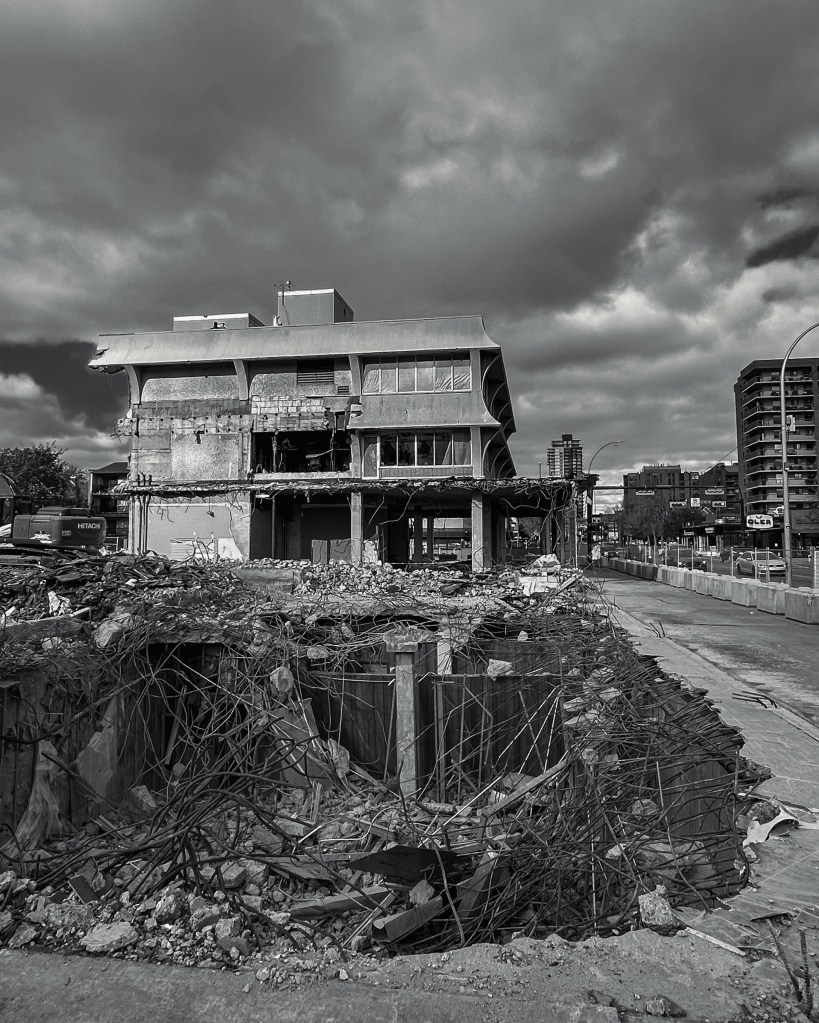
What about commercial properties? To round out my review, I checked the progress on the long-planned demolition of the Jimmie Condon Building at the corner of 17th Avenue and 14th Street. Some would say the building is (sorry, was) historic, and others would say its pagoda-style roofline was an eyesore. Either way, if a picture is worth a thousand words, then this one is a mouthful.

Off to the landfill, Jimmie!

We hear a lot these days about the need to build more “climate resilient” infrastructure. In response, I’ll note that I’ve seen plenty of buildings shrouded in tarps a few years after construction, presumably to repair deficiencies in exterior construction or incorrect materials. That is neither resilient nor sustainable.

I’ll leave for another day related questions—like whether multi-family dwellings (or high-rise towers) will solve the apparent housing crisis that led to their construction in the first place. Or who ultimately pays for luxury condo units that sit on the market unsold, or peddled as short-term rentals. Or whether we should be replacing our city’s already small inventory of historic buildings with characterless, cheaply-built boxes.

To conclude, there’s a saying that a good crisis should never be wasted. I think our municipal government and administration are doing just that with their housing crisis. Their logic is simple: the more housing units that are built, the more tax revenue will be generated. So inner city buildings are being demolished at a rapid pace, with no consideration of what makes our neighbourhoods unique or desirable.

This is a trend that’s hard to justify if one is thinking sustainably. We’re targeting one objective—increasing the supply of housing units—at all costs. In this context, “at all costs” means neglecting environmental stewardship and economic sensibility.

Fortunately, the market has a way of correcting irrational behaviour. I hope we will soon see evidence that a much-needed correction is underway.