A Different Perspective on Sustainability

I just picked up my 1954 Leica M3 from a routine but overdue service. I couldn’t wait to get it home and load it with film. Yes, 1954. Yes, film.

Holding this remarkable machine in my hands, feeling the impressive weight of its all-metal construction, is an experience. But looking through its now clean and perfectly clear rangefinder to compose a picture and pressing its silky-smooth shutter is something else entirely. And don’t get me started on the feel of its double-stroke film advance. I hope I haven’t lost anyone yet.

Some would suggest that my nearly seven-decade-old camera, totally manual and without any kind of exposure metering, is the best camera ever made. Others might take one look and scoff at it as a worthless anachronism.

It got me thinking about how much we have lost, in our seemingly endless quest for the latest gadget. When did we get on this treadmill? The more relevant question is, why?

There are other examples of devices that seem to have reached a point of perfection, before sliding down a slippery slope on the back of consumerism. Italian racing bicycles are a good example. There are few things more suited to their purpose than steel-framed bicycles from Bianchi or Colnago, especially when kitted out with high-end components from manufacturers like Campagnolo. Just like my camera, they are perfectly suited to one job, and they were built to last.

The curious thing is that the apex for many such devices was reached at about the same time. The mid-to-late 1970s seem to have been a watershed period. After that time, something changed. An endless push for profit ensured ever-decreasing quality. Offshoring of production and substitution of parts with (usually) plasticky alternatives sealed the fate of manufacturers who had built their reputation by designing equipment that could last indefinitely.

From the consumer point of view, we came to accept this trend, because rapidly changing tastes made it less likely we would want to hold onto one product for a lifetime anyway. Fashion, which has always been at the forefront of the throwaway mindset, became a model for how other goods were marketed.

No one stops to ask if there is an alternative to the mania that accompanies each new release of the latest iPhone or the newest gee-whiz electronic gadget. To my mind, it does nothing but ensure that we will be putting a lot of material in landfills, as last year’s devices are cast aside just before they fail.

All of this makes it more satisfying that I can still pick up a camera that is older than I am and take pictures that are every bit as impactful as those coming out of the latest high-resolution, high-frame speed digital monster. Maybe more so, in fact.

Posing for her portrait, Leica M3 and Ilford Delta 100 film, 2022

When I travel with my M3, I don’t have to worry about chargers or SD cards. When I estimate the exposure with my brain, and when I get it right, there is no feeling that can compare. Sure, not all my shots are keepers, but that’s the quest that makes it worthwhile. Even the wait for my film to be processed seems to enhance the experience.

And when I’m done, I will be able to pass this wonderful machine onto my sons, knowing that with a bit of care it will serve them well for their lifetime too. How’s that for sustainability?

Running and Thermodynamics

In his book, “Running with the Pack”, philosopher Mark Rowlands makes some interesting observations about evolution. His essay, “The Serpent of Eden” starts by explaining the first and second laws of thermodynamics. While this immediately caught my attention as a chemical engineer, it may not resonate with everyone.

Basically, the preposition of the first law is that energy can neither be created nor destroyed; it can only be converted from one form into another. The second law states that any closed system (like the universe, or like us as entities within it) tends towards maximum disorder.

So, what does this have to do with running?

Well, Rowlands makes a rather neat argument that can be paraphrased as follows: because we evolved as creatures in a world where our stores of energy rely on us converting it from another source, there is a predisposition for us, as conscious beings, to focus on the competitive forces that allow us to continue living. Human beings are highly complex, closed systems, and for us to survive (that is, to avoid maximum disorder) we must compete for energy. And to do that, we must get it from another source.

Said another way, we tend to focus on those things that affect our ability to continue the competition… to stay alive. This is nothing more than the natural result of our evolutionary makeup. (Of course, the end game is predetermined, but let’s put that aside for a minute.)

Think about this. When you are running, and things are going especially well, what do you notice? Are you conscious of your heart and lungs and legs all doing their job efficiently, just as they were designed to do? No, of course not. They just get on with their job, and you enjoy the intrinsic benefits without even thinking about it.

Instead, what we tend to notice, as conscious, competitive beings, are the things that aren’t going so well. That niggling pain in your knee, or the stitch in your side, or any number of other ailments is what gets your attention. You do notice these things because, as Rowlands suggests, our brains have evolved to notice when things aren’t going well.

Rowlands gives further depth to his argument, with reference to the work of the great philosopher, Schopenhauer. And frankly, some of his observations are a bit depressing. Schopenhauer observes that because we are so highly evolved, with cognitive abilities like memory and anticipation, abilities that other creatures don’t possess, we are especially sensitive to our place in the grand thermodynamic scheme of things.

If the universe is destined to end up with maximum disorder, we might rightly ask ourselves why we bother. After all, what’s the point if we will all end up as worm food?

That’s where the Rowlands piece shines. He points out that as human beings, we have evolved as social creatures precisely because that improves our odds in the unrelenting competition for energy. The bonds that keep us together… mutual recognition, affection, love… can be seen as small bits of defiance against overwhelming odds, in a universe where the rules of the game are stacked firmly against us.

My advice is that the next time you are out running, you should spare a thought for the amazing confluence of conditions that had to go well for you to even be out there at all. The very fact that you exist is in defiance of the laws of thermodynamics, at least for the time being.

And the next time you are out running with your gang, give some consideration to them, as what Schopenhauer referred to as, “my fellow sufferers”. Since we are all in this together, it is only right that we should have some tolerance and patience with each other. As Rowlands says, “Every act of kindness we show to someone or something is a defiance of the spirit of the laws that made us”. Defiance may be futile, but it is still valuable.

Four Ways Running Has Changed

  1. Technology

These days, most runners take for granted that they will have a permanent record of every kilometre they run. Some obsess over it. But the availability of all this information and more is a relatively recent phenomenon. For much of my time in the sport, that is to say, the last half-century, there was almost no information available on pace or distance, let alone heart rate, recovery time or anything else.

I used to check the time on the kitchen clock before I left my house for a run, so I could have some idea of how long I had been running when I got back. Pace? Forget about it. That started to change when GPS watches came into the market. Of course, they are now ubiquitous.

I still think of my Timex Ironman watch as something special. This reminds me, there is something liberating about setting off for a run with no watch of any kind. Try it sometime.

2. Gear

As I plodded through fresh, wet snow on a 16k run yesterday, I thought about how fortunate we are to have tights, high-tech base layers, and Gore-Tex jackets to get us through the worst of our Canadian winter weather. We finished with slightly wet feet, but otherwise we were warm and comfortable. And in the summer, breathable fabrics magically shed water to keep us dry.

Am I the only one that remembers Adidas tracksuits from the 1970s? You know, the gymnast-style pants with the loops that went under your foot? They were made of some strange synthetic fibre whose only attribute was to guarantee to chafe. Or how about cotton T-shirts and sweatpants, which held water like a sponge? Then there were the cringeworthy Dolfin running shorts from the early 1980s. Richard Simmons had nothing on me. Some things are best forgotten – forever.

3. Races

This is probably the category where I’ve seen the biggest changes. Some are good and some are not. I’m thrilled to see so many more races on the calendar than we ever had in the early days. Not only that, races are almost always well-organized now, with proper timing and accurate course measurement. Gone are the days of haphazard planning and poor execution by well-meaning but inexperienced race directors.

But I have to say, there are downsides. I object to shelling out $75 for a race that is, frankly, a pretty minor event. I don’t need a technical T-shirt and a finisher’s medal from each race I run. Sometimes, I’m just there for a quicker pace run, or to get a bit of competition. I’d much rather have the choice of whether to buy the shirt, and I really could do without the medal. Maybe that sentiment underlies the growing Parkrun trend, where runners can show up and run/race, without all the trappings.

4. Participation

For years, the only participants in road races were gaunt, sinewy veterans of the circuit. Even the big races were sparsely attended, and the runners who did show up were all of a certain demographic. Many races went through an existential crisis in the late 1970s, when it became clear that small fields of young adult males didn’t bode particularly well for the future of the sport.

It was the salvation of the sport that running became mainstream starting in the 1980s and 1990s. Frank Shorter is often given credit for enticing a whole generation of new runners to put on a pair of newfangled Nike Waffle Trainers and give it a try. (I think there was more to it, but that’s fine.) Whatever the reason, we should all be thankful, because we are now enjoying the benefits. The starting grid for just about any road race is a healthy cross-section of society, including people of all ages. We’re all better off for it.

It’s Collateral

By any reasonable measure, I shouldn’t be writing this. I shouldn’t be able to do much of anything. And yet, here I sit, thinking and typing. My typing is certainly no worse than it was five years ago. That was before my first running life abruptly ended.

Over the last month, I’ve had an opportunity to push against the limits of my compromised vertebral artery system. Vertebral arteries – “verts” – are the second major set of arteries that supply blood to the brain; the back of the brain to be precise. The verts account for about 20 percent of the total blood supply to the brain. When they are blocked, like mine were, the result is an ischemic stroke.

In 2017, I had a number of transient ischemic attacks, or TIAs, which are often called mini-strokes. The strokes were due to a blockage in my left vertebral artery. The result was a long stay in the Foothills stroke ward in Calgary.

I’ll repeat what I’ve said many times since then: the doctors that deal with stroke patients every day are heroes. I know this firsthand because the Foothills heroes stabilized me and saved my life.

The blockage in my left vertebral artery remains untreated. This is only possible because my body has made a rather ingenious adaptation to the blockage, by building secondary arterial connections to keep blood flowing to my brain. We were able to watch this in real time, on a video taken from an angiogram procedure. It makes for fascinating viewing.

As I pushed through a 16k run in the snow yesterday, or a 20k run in fine weather the Sunday before, I realized that I am a real-life experiment. While I am apparently able to cover these distances without too much trouble, it has not been a straight-line recovery. Just after my hospital stay, I had trouble walking around the block. Slowly but surely, I put my life back together. As you’ll gather from the title of this blog, I call it my second running life.

I barely managed a 500m walk/jog a month after my last TIA. A year later I finished a 5k race side-by-side with my wife. Last year we ran the First Half Half Marathon in Vancouver.  

Now I’m at what I think is my upper limit. I can get through 20k, but not without discomfort. I know I’m at my threshold because my neck/shoulder are generally screaming for me to stop by the end.

Curiously, this is the same symptom I experienced before my strokes, when I was training at a much higher level. The pain was most severe during marathon buildups, and I’m certain that it was the first warning sign of the arterial problems I would have a few years later.

It occurred to me that I could perhaps use these pre- and post-stroke data points to estimate the change (if not the absolute amount) in blood flow to my brain. My assumption is that by comparing the usual measure of maximum oxygen uptake – the “VDOT” – I could arrive at an estimate of the amount of damage done to my vascular system by the strokes.

Before my hospitalization, I was training at a VDOT of between 50-52, based on my being able to run 1:25 to 1:30 for the half marathon. Last year, my wife and I completed a half marathon in 2:06, which suggests a VDOT of about 35. In both circumstances, I would consider myself to have been at my oxygen uptake limit.

Based on these empirical results, it would seem that I’ve experienced a reduction of between 30-35 percent in my ability to process oxygen in competitive running situations.

I’m not sure these estimates would have any value in a clinical setting, or whether it would be useful information in determining the next (if any) course of medical action. But it does make some sense, when you consider that I cannot come close to the kinds of performances I could manage five years ago. Even so, the fact that I can get through a strenuous run or race at all validates what I’ve come to see as the silver lining from this whole episode: I’ve been given a second chance, thanks to the remarkable machine that is my body. I know I mustn’t waste it.

On Racing and Recovering

Yesterday’s long run turned into a bit of a slog. Deb woke up with a pinched nerve in her neck, and I was feeling, well, crappy. Fatigued. Lethargic. We started with a walk, thinking that might be enough. Once we were warmed up, we slowly added some pace, but our run ended up being well short of what we planned to do, both in distance and pace. It was one of those runs best forgotten.

There may be more to the story than bad luck. You see, Sunday was two weeks on from a half-marathon that we ran in Vancouver. (Incidentally, it was the fantastic and well-organized First Half Half. Highly recommended!)

Although two weeks should be an adequate recovery period for a half, it got me thinking about how much downtime is enough after a race. I’ve always subscribed to an easy-to-remember formula that I learned years ago. It goes like this: treat yourself to one easy day for each mile you race.

Spelling it out, for a 10k race that means (more or less) a week of easy running; for a half marathon, two weeks; and for a marathon, a month.

There is a tendency to want to shorten these recovery periods. After all, if we had a positive race experience, why wouldn’t we want to get back in the saddle as soon as possible?

For me, that has usually not been an option. Inevitably, racing has taken more out of me than I’m willing to admit. Even after the immediate post-race soreness had cleared, the residual fatigue was too much to overcome in a few days. My effort in interval workouts or long runs during the recovery period, if I could do them at all, had to be scaled back significantly.

Add in the effects of aging, and whatever issues come along with it, and the rule-of-thumb recovery periods should get even longer. It makes sense that we aren’t as quick to bounce back as we used to be.

So, whether or not our recent experience was tied to an inadequate recovery or just bad luck, it’s worth remembering that a race puts major stress on our bodies. In summary, we should always respect the need for a full recovery.

A Special Race

For the second consecutive year, Debbie and I were in beautiful Vancouver, to run in the “First Half” Half Marathon (sponsored by RunVan). It was a special weekend. For me, just to compete in the race felt like an achievement. To run with Deb made it even sweeter. We met our goals for the race, after a long winter of training in Calgary. Several of our teammates and training partners were there with us. Even better was to spend the weekend with our son Matt.

Race Day, 2023

As satisfying as the race was for us, it was also a bittersweet weekend. You can read my race report from the 2022 race to find out why. I’ve reproduced it below. You will see why the First Half is a race that has special memories for me.

2022 First Half Race Report

We each have races that hold special meaning. The First Half Half Marathon in Vancouver is one such race for me. In 2011, it was the first race I ran as a new member of my club, Adrenaline Rush. That winter was harsh, even by Alberta standards, but my teammates and I survived some truly epic long runs on the path to race day.

The First Half is hugely popular. It regularly sells out in a day, so I felt lucky to secure an entry in 2013. In 2016, in a steady rain, I put together a solid performance and finished third in my age group. It was one of my best race results ever. My fondness for the race grew.

In 2017, things went from strange to scary. My wife Debbie and I travelled to Vancouver on Valentine’s Day weekend, only to have a freak snowstorm shut the city down. The race was cancelled. Then in July, my life was turned upside down by a series of strokes. Running at all became an open question. It looked unlikely that I would ever run in the First Half again.

But life has continued. And even better, it includes running. My return to the sport has been cautious. It now includes the pleasant option of running often with Debbie. I have started doing solo runs. And in addition to watching my teammates from the sidelines as an assistant coach, I now benefit from our interval training sessions.

Debbie, too, has ramped up her training. The idea of running the 2022 First Half was mostly hers, and while I wasn’t opposed to it, I wasn’t sure I would even make it to the start line. Knowing her as well as I do, I had no doubt she would put in the necessary hard work.

Our confidence grew through another tough winter as our long runs stretched out. We got to that inevitable point where we couldn’t wait for the taper. The weather outlook was for perfect racing conditions.

Finally, race day arrived. My phone rang as we got ready. Our sister-in-law, who had been bravely battling cancer, had passed away a few hours earlier. We knew this day was coming, but it was still hard to hear the news. As we had already put on our race kit, and knowing that Shelley was a great supporter of my brother’s running, we knew we had to carry on.

We got through the unusual rolling start and settled into our target pace. Through 17k, when my watch blacked out, this was a case study in good race execution. We handled the many distractions with ease: turns, fuelling, and traffic. Deb was in great form and running well. I was feeling good too. As always, the scenery in Stanley Park was a welcome diversion.

We felt the pull of the finish line in the last few kilometres. I could tell that both of us were in the same place mentally. I had warned Debbie about a hill in the last kilometre. She overcame it like just one more interval repeat. Our cruise into the finish felt smooth and effortless.

It was amazing to be in Vancouver again for an actual race. Our performance leaves me optimistic about the season ahead. I’m proud of Debbie, who trained diligently and delivered perfectly on her race plan. And me? I was happy just to have another chance at this race that I enjoy so much. Even though I ran with very different goals this time, I can report that the satisfaction is the same. Finally, on a sad day, we had another reason to experience this unique event, buoyed by memories of our late sister-in-law.

Leicaphilia Loses its Creative Force

Tim Vanderweert passed away in early January. I need to say a few words about him, and the impact he had on me. In this digital world, it seems a stretch to say Tim was a friend because I never met him. I only knew him through his online presence and a bit of interaction we had through his blog, Leicaphilia. One thing is certain – I wasn’t the only person who was influenced by Tim.

It’s funny how things go sometimes. About five years ago, I was putting my life back together after a medical episode that left me wondering what my future would look like. Competitive running, which had been a constant presence in my life for more than four decades, looked like it might be taken away forever. I wasn’t sure I could cope with that prospect.

I had always had a passing interest in photography, but to be fair, it had never gone beyond a teenager’s early fascination with the gear and amateurish attempts to emulate the great landscape photographer, Ansel Adams. Boxes of family snapshots, as great as they are, attest to the fact that I focused more on quantity than quality. And that was fine, as I had limited time for hobbies, for all the usual reasons.

Fast forward to 2017. Adrift after a lengthy hospital stay and amid much uncertainty, I picked up my old Canon AT-1–that’s a totally manual film camera by the way–and started carrying it with me on my slow recovery walks around the neighbourhood. For years, I had cruised through the same streets at a faster pace – apparently fast enough that I hadn’t seen things that were right in front of my eyes.

My interest in photography was being rekindled but I was rusty. So rusty that I had missed the whole transition to digital photography, which had made film cameras obsolete. At least that was the conventional wisdom.

And then I discovered Leicaphilia, and its creative force, Tim vdW. Here was a guy, about my age, who had dedicated as much of his life and energy to photography – Leica-based film photography no less – as I had dedicated to competitive running. Different hobby, same passion. I liked him immediately.

The more I delved into Tim’s writing and creative output, the more our connection grew. I especially liked the fact that he steadfastly defended the turf of film photography against the onslaught of digital. Pixels didn’t matter an iota to him. It was more about the emotional impact, the art, than about the technical features of the latest camera. And on that point, Tim had the knowledge (and the courage) to state his views and share his thoughts. He wrote eloquently about the philosophical underpinnings of photography, about topics like aesthetics. His knowledge spanned centuries.

I had never read articles that tied the Greek philosophers to this hobby. But as a returning student, I was more than willing to learn. His lucid posts entertained me (and his other devotees) while they educated me, complete with photographs from his archives and his bike rides around North Carolina. He put together a book of his photographs taken from inside cars – it was called Car Sick – and I bought not one but two copies. (You see, he had made it abundantly clear to his readers that he had lost his shirt on the production of the book. I wanted him to keep going.)

When Tim announced to his readers that he had cancer, we all held our breaths. It looked bad. For a time, he stopped posting. Eventually, he informed us that he was in hospice care, with only a few days to live. Except he didn’t die. He got better, at least for a while.

In the last few months of his life, he gifted his anxious audience with constant posts, full of clear writing about his situation, and yes, some excellent photography. With a creative flourish, he turned his attention to developing the hundreds of rolls of film that had accumulated in his house. He even put together an exhibition of his life’s work.

And now he is gone. Tim showed us all how we might try to face the grim prospect of our own impending death, with grace and purpose, and good humour. As we go through the ups and downs of our own lives, we should all hope to have as much positive impact on those around us.

My first reaction to the news of his passing was to load a roll of his favourite film (Kodak Tri-X) into my Leica M6 and shoot some street photographs, hoping for his spirit to walk with me as my muse.

Tim will be missed.

“Look out below”, inspired by Tim vdW (Leica M6 and Kodak Tri-X, 2023)

The Amazing Ricoh GR III

Let me say at the outset that I approach camera equipment from a strictly amateur perspective. I’m an enthusiast, not a professional. I know what I’m doing when it comes to the gear, but I don’t chase pixels or specifications.

With that proviso, here is my review of a camera that I am very enthusiastic about: the Ricoh GR III.

I should explain that I predominantly use this camera for a different purpose than many other shooters. I bought the GR III to carry with me on what I call “photo runs”, easy runs of 5-15 kilometres. For that purpose, I needed a small, light, and fast-to-operate camera. Extra weight was a deal-breaker. Cameras with wide zoom ranges or fast lenses are generally bulky, so I eliminated those immediately.

I quickly got down to a shortlist, and a few features of the GR III won the day. At 257 grams, it met my weight criteria. Its f2.8 maximum aperture and 24MP resolution APS-C sensor are more than capable.

Where the GR III really shines is in the “fast and easy” category. It is faster to operate than most cameras, and easier to shoot than a cell phone. The camera’s form factor makes it easy to grip, and its snap focus feature makes it very quick to shoot. Since I carry the camera in a waistbelt (I use the excellent Salomon S-Lab belt, by the way) I can grab it with my right hand and be shooting one-handed in a matter of a second or so. That makes a difference when you are pulling over to get a shot, especially if you are out with your running mates. (Strangely, they don’t like to stop or even slow down to let me get back into the group.)

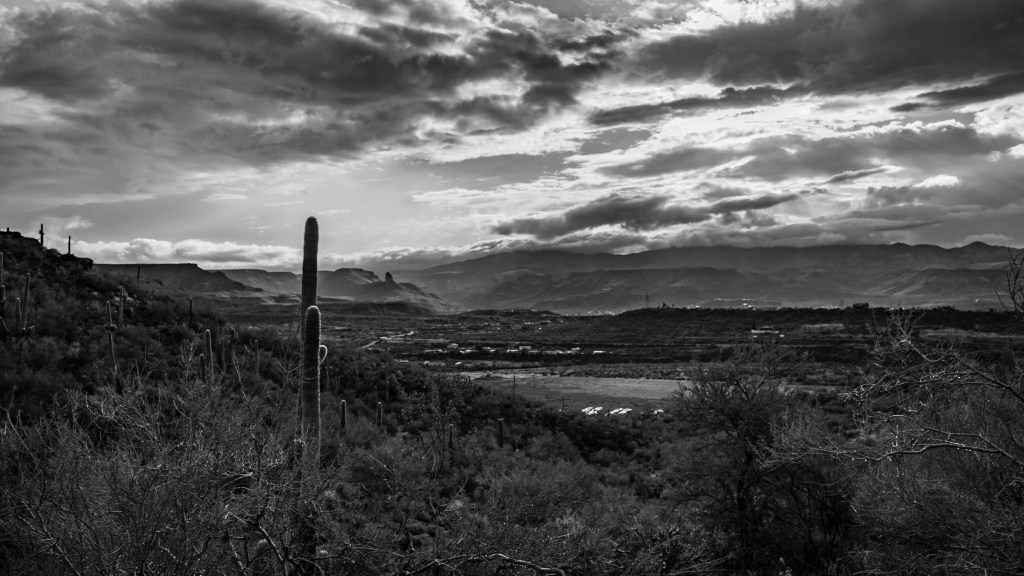
The GR III is ideal for the type of shooting I do on the run. Landscape shots are a good example, and a frequent subject if I’m running along Calgary’s picturesque river pathway system. I like being able to easily select different exposure settings with the top mode dial (most often a switch between Aperture Priority or Program mode).

Exposure compensation is a breeze with a quick sideways press of the ADJ lever. By pushing the same lever in, I can call up pre-set image control settings. The “high contrast monochrome” mode is one I often use for capturing afternoon clouds over the river or a piece of interesting architecture that I pass on my run. I’m also fond of the “positive film” mode for a Kodachrome look while running on the city streets.

I like being able to change a setting while I’m moving, and for that reason, I really appreciate the GR III’s accessible controls and the intuitive menu system. Because speed is my top priority, an even better solution was to program a couple of “run-friendly” shooting modes into the User programmable slots.

Another thing I really appreciate is the easy access to the multiple drive mode. It’s a simple toggle on the 4-way control dial, which is perfect if I decide to capture a sequence of my running partners in motion.

There’s one other thing that turns out to be essential for me. The Ricoh has proved that it can handle the worst of an Alberta winter. Consider this: I carried the GR III on my belt every day in December, while I participated in a running streak challenge organized by our local running store, Strides. That meant it was outside, sometimes exposed to a -30C wind chill, for up to 90 minutes. As long as I put a fully charged battery into it before leaving the house, it went on shooting for as long as I needed it. I should say, for as long as I could stand taking off my outer mitt to actually shoot it. Some of those runs were, in a word, brutal. And this camera kept up. Amazing!

As for things I don’t like, it’s a short list. Given its small form factor, I do find the GR III controls a bit finicky, especially with frozen hands. And the fixed 28mm focal length can sometimes be a constraint.

I’m willing to accept these limitations given all the positives that this camera delivers. What else would I expect but small controls on a camera of this size? And I find the standard JPG files out of the camera give me more than enough resolution if I need to crop and quickly edit a shot for posting on Strava or sharing with my partners after our run. Most of these shots aren’t fine art.

That said, if I do get a shot worthy of more attention, the in-camera stabilization helps me capture sharp images, which leaves me the latitude to work with the ample 24MP RAW file and crop it later in post-processing. It’s a nice option and one I’ve used many times.

Incidentally, that’s why the GR III has filled more voids than I ever expected it to. It is often the camera I reach for if I’m out walking around, as it is an excellent street shooter… unobtrusive to the subject and highly intuitive for the photographer. In fact, I carry it even if I’m bringing another camera with a 50mm or longer lens, in case I decide the 28mm viewpoint is more to my liking.

Overall, the Ricoh GR III has proven itself worthy of being a constant companion on my runs. It has exceeded my expectations, and that’s why I’m putting so many miles on it.