Strokes, Streaks and Snow

Now for a post dedicated to the core subjects on this site: strokes, running, and of course photography. Covering all of that might seem like a tall order, but the last month has provided me with plenty of material on all three subjects. So, without further ado…

CanStroke Congress

In late November, Calgary hosted the 2024 Canadian Stroke Congress, which is described as “a forum for stroke researchers, trainees, clinicians, allied health, administrators, policymakers, and People With Lived Experience of stroke (PWLE) to share new discoveries and innovations, the latest science and therapies, and to build relationships for future collaboration.”

I learned about the congress in a recent conversation with representatives of the Heart and Stroke Foundation. By registering as a PWLE, I was able to attend any of the main sessions at a very reasonable cost. It was a unique opportunity to participate in an exceptional event.

Several workshops were offered on the day before the congress, and I attended one on patient engagement. We heard from scientists and advocates on a range of topics, all focused on ways that PWLE can become involved in stroke research and advocacy. Breakout sessions addressed the practicalities of various engagement paths. The workshop was a good chance to meet other people and share our respective stroke journeys.

I was so impressed with the workshop that I returned the next day to attend a couple of the main sessions. Dr. Andrew Demchuk, the hero of my own stroke story, and Dr. Thalia Field from UBC led a discussion, “What’s New in Stroke Prevention?” It was standing room only for this session. While much of the discussion was over my head, I was so impressed by the depth and breadth of the presentation, and the knowledge and confidence of the speakers. It reinforced my opinion that world-class stroke care is available in Canada.

Another session (“What’s New in Acute Stroke?”) had three eminent stroke neurologists discuss developments in stroke diagnostics and therapies, including some that I touched on in a recent post. It turns out I have a connection to all three of the speakers:

  • Dr. Michael Hill was one of the physicians involved in my care at the Foothills Stroke Unit in 2017. He kindly wrote the foreword for Stroke of Luck.
  • I’ve never met Dr. Mayank Goyal, but he would have been the physician responsible for inserting a stent into my blocked vertebral artery, should the decision have been made to follow this treatment route for me.
  • Finally, Dr. Aristeidis Katsanos is an eminent stroke neurologist at my alma mater, McMaster University.

My takeaway from attending the congress is that while stroke incidence is increasing and our healthcare system is under severe pressure, we should be encouraged by many significant advancements that are being made in stroke diagnostics and therapy. There is reason to be optimistic about the future.

A Blast of Winter

Coincident with the stroke congress was Calgary’s first blast of winter. This likely gave the conference organizers fits. It was quite a wallop. I think we got something like three times our usual November snowfall in one day. Now, while that did complicate a lot of things, it also provided for some great photography. Here are some shots from around the city… with a reminder that the copyright for all images is mine.

Strides Run Streak

Here we are, already halfway through December. Cue the usual observations about where the year has gone. December is also when many Calgary runners take on the annual Strides Run Streak. The challenge is simple: run at least one mile every day during the month.

I have some meaningful connections to this event, so whatever else is going on at this time of year, I like to sign up for it. One mile a day is an achievable goal. I give myself the added challenge of finding a worthy photo or two while I’m completing my run. Sometimes that is a bigger test, particularly with the days getting shorter and shorter!

This year, my commitment is strong, but the challenges are not insignificant. We started the month with plenty of snow on the roads and sidewalks, which have slowly turned into skating rinks. Ah, Calgary weather! I’m also doing most of my running solo these days, as my favourite training partner is sidelined with a sore hip. We are both hoping for some improvement soon.

Two weeks into December, my streak is intact, and I have managed to accumulate a few images. Maybe more images than miles, if I’m honest. While it is nice to capture the festive spirit… the snow does help with that… it isn’t essential. Rather, my goal is to find images that can transport me back into that time and place. It’s a way of adding meaning to my runs. When it comes together, it’s a nice feeling. Here’s a sample.

And while I did say the images don’t have to be festive, there is one that has the potential to put even a Grinch like me into the Christmas spirit. See what you think.

Look for more images soon. I have ideas for other posts before I shut things down for the holidays. In case that doesn’t happen, I will take this opportunity to offer my best wishes for a Merry Christmas to one and all.

Be well and BE FAST!

A Tribute to Gerard Rejskind

I don’t have hard rules for the topics on this blog, and there are times when I feel I need to write about something of importance to me. Or someone. This is one of those times.

Gerard Rejskind passed away a year ago to the day that I’m writing these words. I suspected something may have happened to him. As I’ve done occasionally if I’m unsure about someone’s personal situation, I reluctantly typed his name and “obituary” into Google. I was right… he died peacefully in Montreal in December 2023 after a short illness.

So who was Gerard?

It would not be true to say he was a friend. But as I wrote in a similar tribute piece almost two years ago, it is possible in our highly connected world to feel close to someone even if you’ve only spoken to them a few times on the phone. Through his writing, I came to know Gerard and understand him quite well.

Gerard wrote with passion, and he was the driving force behind an independent audio publication (UHF Magazine) that had a small but dedicated following. Through his reviews of audio equipment and recorded music, Gerard influenced many people, including me.

Let me first make a connection, between a subject that I do post about on this site… photography… and music. It isn’t a stretch to say that both these art forms have much in common. They are subjective; that is, they are things that cannot be quantified. If done well, they evoke an emotional response in us. And at their best, they are timeless.

When I found out that Gerard had passed away, I thought about the many ways he had influenced me over more than twenty years. Initially, I had been looking to upgrade my entry-level Sony CD player, a tinny-sounding thing. A colleague lent me a few back issues of UHF, and I was immediately hooked.

UHF (now defunct) was a publication unlike anything else I’d seen. With a modest budget and a small crew, Gerard managed to produce a magazine that bettered any of the big, commercial publications. It did so with a rare offering: totally honest reviews. There were none of the filtered, biased reviews that I read elsewhere. My favourite feature was a short, subjective paragraph from each of the review panelists about a particular piece of gear. This was invaluable for someone like me, who was new to the hobby.

Besides the magazine, Gerard also wrote a couple of books about “hi-fi”. Again, in plain language, he explained what the equipment did (or should do) and how it ought to be designed. This hit a chord with my engineering sensibilities. I found myself coming back to these books time and time again.

My wife will attest that I dropped everything when the latest print issue of UHF showed up in the mail. Because of their shoestring operation, the frequency of publication was, shall I say, variable. Gerard kept UHF going through COVID and his own health challenges. Those things only increased the appeal of the enterprise. I read every word of every issue, and I would save Gerard’s editorial page on the inside of the back cover until last. There, he would offer another nugget of audio wisdom, in his usual style… self-effacing, but with the authority he had earned over a lifetime of experience.

I’ve bought quite a lot of audio equipment and recorded music since I first encountered Gerard and UHF. In all that time, I wouldn’t think about buying anything unless I had checked to see if Gerard had reviewed the gear in question. If he liked it, that was good enough for me. If he really liked an item, he would become a distributor, which said a lot about his motivation. It was also quite convenient. I can honestly say he never steered me wrong.

Beyond all that, he made sure I and his other readers became more self-sufficient, by writing frequent articles and opinion pieces that educated us. In fact, the last edition of UHF, the 101st, consists of a series of introductory “101” pieces (in the usual nomenclature of first-year university courses) on various audio gear. It seems a fitting legacy to Gerard. The final paragraph of his last “State of the Art” piece is worth repeating here:

“The final rule is to do what we do: take notes, with details on
what you liked and what you didn’t. Concentrate on the music,
which is the purpose of the system in the first place.”

Gerard was a rare person: an honest businessman; a knowledgeable and generous resource; and above all, a gentleman. He will be missed.

Now I think I will go and put on a record and re-read some of his pieces.

“So It Goes”

Anyone who has read Slaughterhouse-Five (SH5) by Kurt Vonnegut will recognize this phrase. It stays with you after reading the most famous (or is it infamous?) and arguably the most representative of Vonnegut’s novels.

I’m not sure if SH5 is still required reading in high school English courses… I know it used to be. (I’d be reluctant to guess what required reading might be in high school these days, but that’s another topic.) For my part, I missed the opportunity to read SH5 when I was in school. Perhaps the book wasn’t considered appropriate fare for a Catholic school curriculum.

I’ve only come around to Vonnegut’s works in the last few years. I did read Galapagos in my early twenties, but I found it to be quite forgettable… it certainly didn’t convince me to read anything more by him. Maybe I wasn’t ready for the author’s unique style and keen critical eye.

Something must have changed, because I’ve read three of his books in rapid succession. In this post, I offer my thoughts on what may be his best-known novels. My comments are organized in my order of reading, which just happened to be in reverse order of their publishing date.

Kurt Vonnegut

The author of the books I’m going to discuss is worthy of some discussion himself. Kurt Vonnegut, Jr. (1922-2007) was born in Indianapolis, to German immigrants. He attended Cornell University but dropped out in 1943 after being placed on academic probation. He enlisted in the US Army and was deployed to Europe in 1944 as an intelligence scout. After the war, he pursued academic and technical career paths, never quite succeeding at anything. Vonnegut had a couple of stories published in the early 1950s, which persuaded him to give up other opportunities to pursue writing full-time. His success as a writer did not happen overnight.

Slaughterhouse-Five (1969)

It’s a challenge to summarize SH5. At its core, the story is an account of the Allied fire-bombing of Dresden, Germany in the final months of the Second World War. What genre is the book? Good question. There is an element of historical fiction, but it could just as easily be classified as science fiction. Given that the book was influenced by Vonnegut’s time in the US military, we could even label it as a biography. The author was captured by the Germans, and as a POW he witnessed the destruction of the city firsthand.

In Vonnegut’s signature style, there is a sharp satirical edge to the book. Vonnegut makes no secret of his disdain for “military intelligence”. The casual disregard for life in wartime is a theme repeated often in the book… almost sickeningly so. I think that’s exactly the response Vonnegut wants to elicit from us. That’s where the phrase “so it goes” comes from. SH5 was published at the height of the anti-war movement in the US, and it was the book that made Vonnegut a household name.

The main character in SH5 is Billy Pilgrim, a US draftee. The science fiction element to the story is that Pilgrim experiences time travel. He calls it coming “unstuck in time.” I think the message here is that history is bound to repeat itself. I found this to be a very effective tool; one that shows Vonnegut exercising his full prowess as a mature storyteller.

To summarize, I thought SH5 was brilliant. An amazing creative piece… forceful in its social commentary and totally original. Considering the current events in the world, it is as timely now as when it was written. Very highly recommended!

Cat’s Cradle (1960)

Where to begin in explaining this novel?

Cat’s Cradle is a first-person account of the narrator, Jonah, who travels to San Lorenzo, a fictitious and extremely poor island nation. Through an unbelievable sequence of events, Jonah becomes president of the country. At the subsequent inauguration ceremony, an unfortunate incident results in mass destruction on a global scale, when a material called “ice-nine” accidentally comes into contact with seawater.

The book deals with two important themes and manages to touch on several others besides. One major subplot in the book is a fictitious, hedonistic religion called Bokonism. It is the dominant religion in San Lorenzo, seemingly a response by the poor citizens of the country to their dire socioeconomic circumstances.

The book is also a biting commentary on the risks of technology. Ice-nine was invented for military purposes by a brilliant scientist who has complete and callous indifference to the great risks it poses. The obvious parallel is to the proliferation of nuclear weapons, which would have been in Vonnegut’s mind when he wrote Cat’s Cradle in 1960. The story takes the idea of a manmade technological threat to its logical and tragic conclusion.

Only someone with a vivid imagination, black humour and a gift for sharp insight… someone like Vonnegut… could have created Cat’s Cradle. It was a fascinating read, and like SH5, very relevant to the unstable world we find ourselves in.

Player Piano (1952)

Player Piano was Vonnegut’s first novel. It tells the story of Paul Proteus, an engineer and manager of the Ilium Works, one of many large industrial complexes that have radically revamped American society. Machines have replaced human beings in every facet of life. For his part, Proteus becomes increasingly uncomfortable as he is being groomed for an expanded role in the system he helped create. The story turns on a clever “double agent” plot, as Proteus finds himself aligned with other, like-minded rebels.

As compared to the other novels, I found the storyline in Player Piano to be the least risky… maybe even simplistic. There are no tricks with time travel here. I suspect Vonnegut was still finding his voice and his style when he wrote the book. Even so, it is a well-constructed story of an all-too-possible dystopian future. Such a future may have been easy to imagine in the early 1950s, as post-war innovations began to change American society; at least it was for Vonnegut.

Of the three novels, Player Piano had the most impact on me. I accept that as a result of my own work as an engineer and manager. Did my career path make me more sensitive to the sharp commentary that Vonnegut dishes out for these vocations in his grim novel? Probably. I don’t take any of it personally, but I do relate to his criticism of an unbridled drive for efficiency.

The world Vonnegut imagines in Player Piano is devoid of almost all pleasure, at least for the average citizen. For the elite (that is to say, the politically savvy) the upside is limitless, as long as the growing majority of displaced citizens are kept notionally busy and marginally employed. It’s a novel that heads to an inevitable tipping point.

The fatal flaw exposed in Player Piano is a conflation of an unstoppable quest for perfection (in countless industrial processes and even in human interactions) with human happiness. I found myself making connections to recent opinion pieces that assess the risks of the increasing use of Artificial Intelligence in our society. Again, Vonnegut’s story seems eerily relevant to our current circumstances.

I can recommend all three of these Vonnegut novels. In my view, his social commentary is timeless, and that keeps the books current. I want to continue my exploration of his work, to see how well his insights have held up in other areas.

Until next time, be well and BE FAST!

Stroke News Digest

I haven’t written much about strokes lately, so it was time to scan the recent headlines. It turns out there is quite a lot to report on, and much of it (but not all) is good news. I always prefer to start with the positives, so here goes…

Announcing the Black Friday Sale!
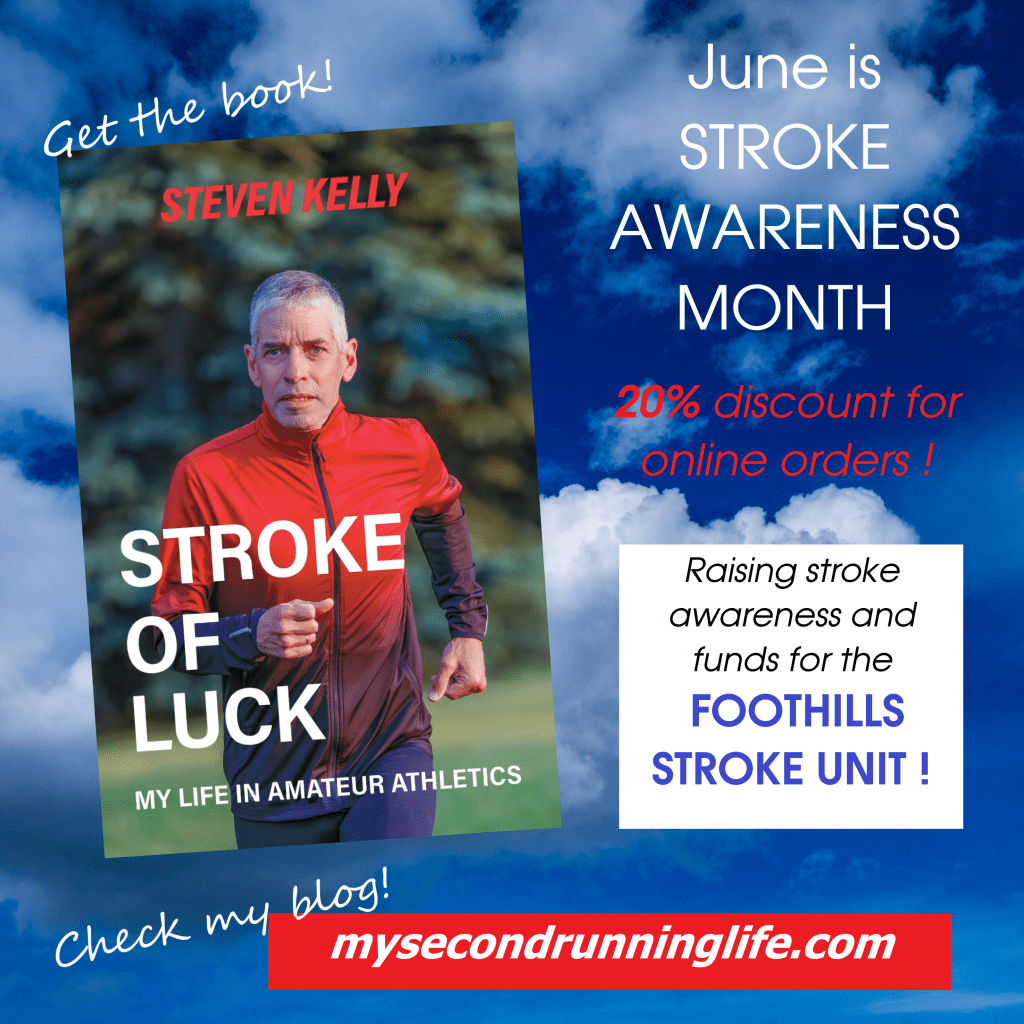
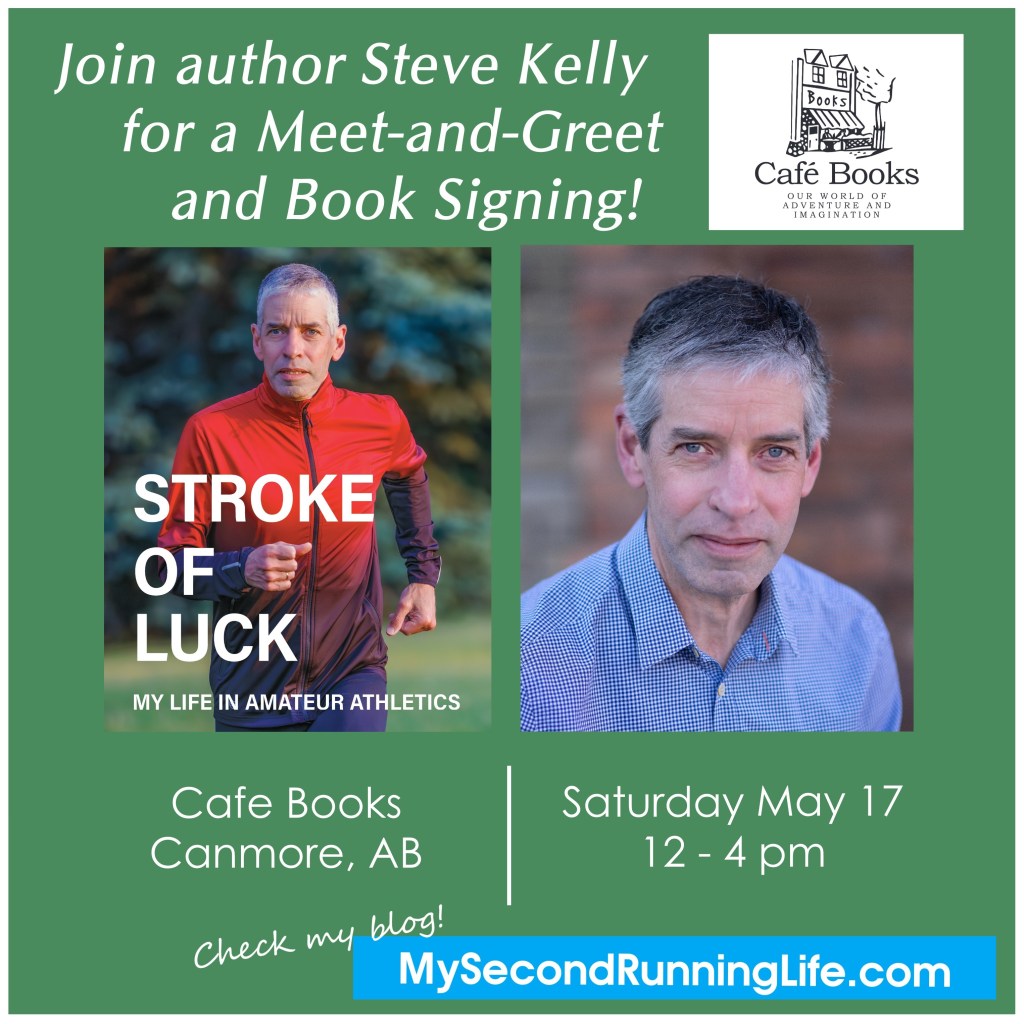
If you’ve been waiting to order your copy of Stroke of Luck: My Life in Amateur Athletics, now’s the perfect time. I’ve reduced prices for e-book and print editions by a marathon-inspired 26.2 percent. These are the best prices you’ll see in 2024. The book would be a great gift for a runner… or non-runner… on your holiday gift list!

Order your copy of Stroke of Luck on Amazon today!

Sale prices will be in effect until December 1.

Awareness Campaigns are Working

June is Stroke Awareness Month in Canada. Heart and Stroke is committed to helping improve the lives of people at risk for and living with heart disease and stroke. When it comes to stroke, much has changed in the last several decades. The keys are increased awareness of the signs of stroke, and some revolutionary changes in stroke diagnostics and treatment.

Promoting stroke awareness is a priority for Heart and Stroke. Their media campaigns rely on an easy-to-remember acronym… F-A-S-T. By now, most of us will have seen the television ads and billboards, which remind us of the major signs of stroke, as follows:

  • F is for FACE… Is it drooping?
  • A is for ARMS… Is the person unable to lift both?
  • S is for SPEECH… Is it slurred or incoherent?
  • T is for TIME… Call 9-1-1 if any of these conditions exist!

Heart and Stroke notes that awareness campaigns have been successful. For example, 4 in 10 Canadians surveyed can name at least 2 signs of stroke. Women and older Canadians are more likely to recognize stroke symptoms. Of course, there is always more that can be done.

At this point, I will add a caveat about stroke awareness, because my symptoms did not fall into the F-A-S-T framework. It’s an 80-20 situation. I encourage everyone to read my blog pieces where I describe the less frequent symptoms. These include problems with balance and eyes/ears. So, if you can, please remember BE FAST, to cover off all the signs of stroke.

U of Calgary – Leading in Stroke Research

While there can never be a good time or place to have a stroke, it’s been said that Calgary is the place to be if is going to happen to you. I do have some direct experience in this regard, but I didn’t fully appreciate how much innovation is happening here.

A couple of March 2024 articles in Arch, the University of Calgary magazine (here and here) highlight advancements in diagnosis and treatment that originated at the Calgary Stroke Program (CSP). Here are just a few:

(1) A Calgary-based clinical trial led to a procedure known as EVT (endovascular thrombectomy), which is drastically reducing the death rate from one of the most common types of strokes. EVT is a procedure that can disrupt large clots in the brain. If done promptly after the onset of symptoms, EVT can triple a patient’s chance of making a full recovery from certain strokes.

(2) The Alberta Stroke Program Early CT Score (ASPECTS) is a grading system for strokes. This tool, which is based on a brain CT scan, has been adopted around the world as a way of measuring changes in a patient’s condition.

(3) A clinical trial of a clot-busting drug called Tenecteplase (TNKase™) compared it to the standard drug used for dissolving blood clots in brain arteries with acute ischemic stroke. As a result, TNKase™ is becoming the standard of care in hospitals around the world.

I could go on. The innovations originating in Calgary cover diagnostic processes, treatment options and rehabilitative therapies. It is a remarkable success story. On a personal note, I have come to know several of the doctors involved in these research programs. They are truly miracle workers.

Stroke Incidence is Increasing

A study in The Lancet Neurology found that the global prevalence of cardiovascular disease, including stroke, increased from 271 million in 1990 to 523 million in 2019. The study found that population growth and aging account for this increase. While stroke mortality rates had been declining in the latter part of the twentieth century, some countries have actually seen a reversal in this trend since 2010. Unfortunately, the US and UK are two countries that have seen an increase in stroke numbers.

A study on stroke prevalence by the Centers for Disease Control and Prevention fills in some of the details for the US. Here are a couple of headlines: stroke is the fifth leading cause of death in the US and it costs the economy about $56 billion annually. Digging deeper, the CDC study confirms the trend in stroke incidence. Overall US stroke prevalence increased by about 8 percent from 2011-2013 to 2020-22. The increase was slightly higher in females than males. There was an inverse relationship between education level and stroke prevalence. Perhaps most worrying was a significant increase in adults aged 18-64. As you might guess, obesity is a leading risk factor for stroke.

Not surprisingly, the trends in Canada are similar. Stroke is the fifth leading cause of death in Canada, accounting for about 13,000 deaths annually. There are more than 108,000 strokes in Canada each year… that’s one every five minutes. And nearly 900,000 Canadians are living with the outcome of strokes. As in other countries, it’s a result of our aging population.

Fortunately, when strokes do happen, more people are recognizing them and taking action.

Before signing off, I couldn’t help but include a photograph taken on yesterday’s short walk along the Elbow River in Calgary. The picture has nothing to do with strokes, but I liked it. Yes, winter is here!

Elbow River (November 20, 2024)

Thanks for reading. Be well, and BE FAST…

Head Hunting

The Art of Jaume Plensa

I was looking for an excuse to go into downtown Calgary for some photography, and I thought about the “big head” sculpture that sits in front of The Bow building. Like the building, the sculpture is iconic; it’s a monumental and very popular piece of public art. I’ve photographed the sculpture many times, but it seems to always have more to offer, depending on the season, the time of day and of course, the light.

First, some background. The sculpture’s official name is Wonderland and it’s by the Spanish artist, Jaume Plensa. Plensa was born in 1955 in Barcelona. He studied art in his home city. Over several decades he has lived, worked and exhibited his art in cities across Europe and the United States. Plensa has received international recognition for his exhibitions and installation pieces. His diverse works include sculpture, fountains and graphic arts.

Wonderland (2012), Calgary

Wonderland is one of many sculptures that Plensa has created for public spaces around the world. When I looked into the origin of Wonderland, I learned that he has installed similar large-scale pieces across Europe, Asia and North America.

Wonderland is ideally situated in the curved façade of The Bow, where it’s been since 2013. The sculpture depicts the head of a young girl. It’s about 12 metres high, and it’s made of bent steel wire. I think the piece is so popular because it has openings at ground level, which let visitors enter the sculpture’s inner space. Plensa invites us to contemplate Calgary’s downtown from the perspective of the subject. It’s a thought-provoking piece, for sure.

Here are several of the many shots of Wonderland I’ve taken over the years.

Julia (2018), Madrid

I realized that Debbie and I had seen other Plensa pieces in our travels. Most recently, we stayed a couple of blocks from a monumental sculpture in the Plaza de Colón in Madrid, called Julia. About the same size as the Calgary piece, Julia is also a sculpture of a young woman’s head. The subject’s eyes are closed as if she is meditating.

Julia is typical of Plensa’s large, elongated and flattened busts. When you look at them straight on, they give the impression of being on an angle. It’s an impressive optical illusion. The Madrid piece is made of polyester resin and white marble dust. It’s stunning.

We passed Julia several times a day while we were in the city, and each time I took a few photos. While Julia has been in her current location since 2018, it turns out that she may not be installed permanently… it’s a good thing I took so many photos while we were nearby. Here are a couple of my favourites:

Sanna (2013), Bordeaux

As I did more research into the artist, I realized we had seen another sculpture similar to Julia in Bordeaux, France some years earlier. Sure enough, it was another Plensa piece called Sanna. That one sits in the Theatre Square (the Place de la Comédie) in the heart of the city. Its perspective has been manipulated in the same way as the Madrid piece, and the subject is also shown in a quiet, contemplative pose. Unlike Julia, Sanna is made of cast iron. She is 7 metres high.

The story of Sanna coming to be in Bordeaux is that in 2013 the city hosted an exposition of Plensa’s pieces. The event was popular, so much so that residents initiated a movement to acquire Sanna permanently. As far as I know, it will remain in place until at least 2027.

We have very fond memories of our visit to Bordeaux. The square where Sanna sits is busy with cafes and shops. If we ever make it back there, I hope Sanna will still be there.

Source (2017), Montreal

The final Plensa sculpture I want to highlight is installed on a terrace in Rue Wellington, just at the entrance to downtown Montreal. Somewhat in the same style as Wonderland, Source is a three-dimensional piece within an open outer frame. It’s a stainless-steel sculpture formed from a random pattern of letters taken from different alphabets, which depict a sitting figure.

The Montreal piece symbolizes the many cultures that have come together over the city’s long history. Fittingly, it was installed for the 375th anniversary of Montreal’s founding in 2017. Like the Calgary piece, Source is open, so it invites visitors to enter the inner space of the piece.

Our stop at the Source was short, and I only have one photo of the piece. Rest assured, I will take more time to check it out next time we are in Montreal.

Concluding thoughts

So what is my take on Plensa, and his large public art pieces?

In a 2019 interview with Forbes, Plensa discusses his use of altered perspective and open gridwork sculptural elements. He described using these techniques as a way of exploring his interest in the way humans communicate, and how different cultures use language.

For me, Plensa’s sculptures seem designed to invite close inspection and discussion. We want to get close to these sculptures. We want to walk around them and even into them. The large scale of his head sculptures could be intimidating, but Plensa defuses this by the way he plays with perspective, and by his use of serene and peaceful subjects.

Having seen four of his works in person, and looked at many others on his website, I find them to be beautiful and innovative. It’s clear from Plensa’s vast catalogue that his formula is a success: there are literally dozens of his pieces installed around the world. I don’t take this as evidence of an overworked theme. Rather, I would say that Plensa has achieved his goal: his works encourage us to get together in pleasant locations and talk. For this reason alone, his art is well suited to the public spaces in which we find it.

Signal Hill Photo Run

A recent errand led me to an unexpected trail of discovery through Calgary’s military history. I had stopped at the busy Westhills shopping district, the usual collection of big box stores. As I walked back to my car, I noticed the battalion numbers preserved on the side of the hill below the Signal Hill neighbourhood.

I knew about the battalion markers but hadn’t thought much about their significance. My first reaction when I saw the whitewashed stones was how small they looked, sandwiched in between the RONA store and Calgary’s residential sprawl just above. I made a point to return soon for a closer look.

Military history squeezed into the urban landscape

A couple of days later, I was jogging through North Glenmore Park, along the crest of the bluff. I ran by a monument at the west end of the park, one that I had passed hundreds of times. I decided to stop and check it out. The plaque indicated that this was a 1967 memorial to the 137th Battalion of the Canadian Expeditionary Force (the CEF) in World War I. I remembered that “137” was also one of the battalion numbers on Signal Hill.

The 1967 memorial to the 137th Battalion

I guessed, correctly, that this was the same 137th battalion immortalized on the hillside. Now I definitely had to make my way over to Signal Hill. I figured it would be a great excuse for a photo run.

I grabbed my camera (the Ricoh GR III of course) and parked at Battalion Park on Signal Hill Drive. Here’s the Strava entry for my easy run. It was a beautiful day and I did an enjoyable 6-kilometre loop around the neighbourhood.

The story of Sarcee Camp is well explained in a series of plaques next to the stairs that wind through the markers. I learned that the camp was established in 1914. It was in a section of the Sarcee Indian reserve (now Tsuu T’ina) that was leased by the Canadian militia as a training site.

Sarcee Camp was a busy place. As many as 45,000 military personnel from 30 battalions trained at the site during the war. It was customary for each battalion to construct a “geoglyph” (that’s a design or motif created by humans and built into the natural landscape) with their unit number. They did this using stones hauled by hand from the riverbed, which is two kilometres away from the hill. 

The 113 is the oldest of the four stone markers on Signal Hill. The 113th Battalion was formed as the Lethbridge Highlanders in 1915. The battalion relocated to Sarcee Camp in May 1916 and sailed for England in September of that year. The 113th was broken up for replacements, with most of the men transferred to France. The battalion never saw action as a unit and was disbanded in 1917.

The other numbers on the hillside were constructed by battalions of the CEF that trained at the Sarcee Camp, including the following:

  • The 137th Infantry Battalion of Calgary began recruiting in late 1915. After sailing to England in August 1916, the battalion was absorbed into the 21st Reserve Battalion.  It’s worth noting that the King’s Own Calgary Regiment (RCAC) perpetuates the 137th Battalion. Members of the 137th Battalion CEF Association erected the memorial to the unit in Glenmore Park.
  • The 151st Central Alberta Battalion began recruiting in 1915. It sailed to England in October 1916 and was absorbed into several reserve battalions.
  • The 51st Canadian Infantry Battalion was recruited in Edmonton. It sailed to England in April 1916 and provided reinforcements for the Canadian Corps until it was reorganized in November 1916.

Although there were approximately 20 geoglyphs built, most were destroyed in the 1950s during the construction of a mess hall.

When we first moved to Calgary in the early 1990’s, the battalion markers were just about the only thing in the area. Over time, residential development nearly swallowed up the geoglyphs. Fortunately, there was enough recognition of the significance of these markers that they were preserved. In fact, three of the markers (137, 151 and 51) were meticulously moved a short distance from their original locations.

You can see a few photos I took during my cooldown walk. I found it quite challenging to get any perspective on the geoglyphs when I was right next to them. In that respect, the parking lot of the RONA store isn’t a bad place to stop and admire this unique piece of Canada’s military history. Even so, with Remembrance Day just around the corner, I recommend getting closer and doing more exploration if you have the time.

On the Street with Hektor

This is a review of a camera lens that nobody uses. It might make sense to add up front that I’m not a reviewer of camera equipment. So, if there are no readers of this piece, the only loss will be the time I spent writing it. That said, I hope to introduce an unusual piece of equipment in an approachable way, even for non-photographers. 

So, what’s the story?

I have what might be described as a diverse collection of cameras and lenses. I don’t chase the latest equipment, and I don’t change my gear often. A lot of my gear is, well, old. The oldest and probably the oddest lens I own is a 70-year-old telephoto, made by Leica. It’s a lens that can be used on any M-series Leica camera made in the last seven decades. That’s quite remarkable when you think about it. It speaks to a solid legacy of product design.

For those who don’t fuss over cameras, Leica equipment is held in high regard… it’s considered to be an elite brand. In Leica’s rangefinder cameras (their “M” range), the products have a reputation for being practical, solidly built and efficient.

Except maybe for Hektor.

The Hektor is a medium telephoto lens, with maximum aperture of f/4 and focal length of 135mm. (That is the extent of the technical lingo in this review.)

The 1954 Leica Hektor 135mm f4

First off, 135mm happens to be a difficult… some would say unusable… focal length on Leica M rangefinders. Given my intention to keep this piece readable, I won’t explain why that is. But it is a serious knock against the lens. 

I’m going to lump a few other points together because they collectively contribute to the look of the lens. And how would I describe its looks? In a word, it’s unattractive. Okay, ugly. (That reminds me of the story that the Hektor is named after Leica lens designer Max Berek‘s dog. I wonder what that says about the dog.)

Anyway, the lens design, meaning the arrangement of glass elements inside the tube that forms the lens, is simple. In photographic terms, the f/4 aperture makes this a “slow” lens. This combination of design decisions means that the lens itself is long and skinny. I don’t really like the look (or the feel) of the lens when I’m walking around with it over my shoulder. 

As a further negative point, the Hektor is awkward to use. It is well-made and solid. After all, it IS a Leica lens. Still, when taking a photo, it’s hard to focus because it requires a lot of rotation of the lens barrel. This isn’t a lens for action photography.

With all those flaws, I might be advised to end my review here. But here’s the problem. I think it actually takes good pictures. Check out these examples:

These pictures all came out of the camera with soft contrast, kind of a “mid-century” look. Could that be the result of whatever combination of optics and coatings was put into the lens in 1954? Maybe. It isn’t necessarily a bad look. In fact, it may be exactly what one is looking for, especially for portraits. After some editing, the results look fine, at least to me. (I should add that the Hektor’s colour rendition isn’t good, so I usually use it for B&W shooting.)

I’ve used the lens for street photography, and it’s best for distant subjects… shots across a street, like “VW Girl”, above. Shooting with Hektor brings all the shortcomings I mentioned earlier into play. For that reason, if I’m using this lens I have to get my settings ready and wait for subjects to enter the scene.

The lens is quite sharp across the aperture range, even shooting wide open. Again, it should work well in portraiture. Given how slow it is, maybe outdoor portraiture would be the best bet.

I’ve read a few other reviews of this lens. Most bash it quite harshly. One review by a well-known online source is very negative. However, when one reads the full review, the reviewer concedes the many strong points the lens has going for it when taking pictures. And isn’t that what matters?

Wrapping up, the Hektor is a lens I rarely reach for. There are good reasons for that. But every so often, when I feel like giving myself a photographic challenge, I put it on a Leica M camera and take it out for a spin. I marvel at the fact that I can do that at all, with such an ancient piece of equipment. And if I’m patient, I usually come home with a shot or two that convince me to keep this oddball in my kit. 

Auroras and Other Distractions

Good news! I’ve extended my Dedication Sale through the end of October. It’s a nod to our Thanksgiving holiday.

Print and e-book versions are available on Amazon at a 20% discount.

There’s a hard stop on the sale on November 1!

In what was a fairly chaotic week, I did manage to capture a few interesting images. There was no shortage of subject matter. I only had to force myself out the door with a camera.

Auroras a-plenty!

This year has been unmatched for solar activity. I read that it’s all because the cycle of solar activity is at its peak. (Sounds like a topic for a future blog piece!)

I’ve always been interested in photographing the aurora borealis (the “Northern Lights”) but frankly, I wasn’t up to what I assumed was the significant effort needed to make it happen. What gear did I need? How much work would it be to get to a good location, and to do so in the middle of winter when the aurora are most active?

It turns out, this year at least, all one has to do is put an iPhone on a tripod (or maybe not), walk to the nearest park, and look up. I started seeing IG posts from friends who were taking pictures from their backyards, so I figured I could make a similar commitment.

I found a great website (Alberta Aurora Status) that estimates the combination of solar and atmospheric conditions necessary for good viewing. Lately, even that much science may not have been needed.

As for the photos, those took a few nights of experimentation. Fortunately, our recent weather has been agreeable and the skies have been mainly clear. I tried some shots with a “real” camera and soon learned that my iPhone 14 was more than adequate to land some decent shots. I plan to try again soon with other cameras… it looks like the good viewing isn’t finished yet.

The iPhone has a “Night Mode”, which uses a long exposure and some noise reduction. Later, it took some trial and error to get the best result with my photo editor… mainly I adjusted the exposure and added some saturation. Overall, I think the results are pretty good, considering how easy it all was.

Here are some of my edited shots from Lightroom.

Fall Colours and Intervals

Knowing that our daylight hours are in rapid decline, I made sure to join our weekly group run at Carburn Park on Thursday evening. It was a perfect outing, and it may turn out to be our last outdoor session for the season. A small group showed up since many of our teammates were in recovery mode after a recent target race. Jason G led us through some sets of 500m – 500m – 1k.

We headed over to the west side of the Bow River and turned north. The views back across the river were spectacular. The setting sun lit up the fall colours, with most of the leaves still on the trees. I used our short 1-minute breaks to good effect, snapping as many pictures as I could before the light show ended. I couldn’t have asked for better training partners than Doreen and Elidh. All pictures with the unbeatable Ricoh GR III.

A-B-C’s

A is for Art and B is for Borduas. What? Who?

On Saturday, Deb and I made our way to Masters Gallery, to catch the last day of a David Thauberger exhibit. He’s a Saskatchewan painter who’s been active for 50 years. The gallery had an interesting selection of works from his long career.

We always enjoy stopping into the gallery on 4th Street SW to chat with Ryan Green (@ryngreen on IG) and visit with his sidekick. This visit was no exception.

The sidekick I’m referring to is Borduas, aka “Bordy”. Bordy is a wonderful British Bulldog. He’s named after the Canadian artist, Paul-Émile Borduas (1905-1960), and he (the dog) is a fixture in the gallery. I snapped a few pictures of Ryan and Bordy because I had to. You’ll see what I mean.

And what about C? This week, C was for Competition, as in racing. After a long hiatus, I signed up for a 5k. This was largely due to peer pressure, from the same Jason I referenced earlier. He had signed up for the 5k as part of the Calgary Police Half Marathon… one of the longest-running, best-organized races in Calgary… and encouraged me to do the same. Thanks for the push, Jason!

I had no illusions of running with Jason, but I set as my goal to run a steady effort at a challenging pace. In other words, I wanted this to be a race, even though it was at my current (reduced) capabilities. I figured I might have a shot at a podium finish in the M60-69 age group, but it was no problem if it didn’t happen. I was just happy to be over my recent calf/Achilles tendon problem.

All photos by Deb Kelly:

Conditions were ideal for racing, and it was a successful outing for Adrenaline Rush runners. Jason flew to a 10th-place overall finish and set a personal best in the process. His time of 19:13 easily placed him first in his age group, by several minutes. Scott did very well in the 10k, running 53:43 and finishing 4th in his age group. Alistair (no photo) cruised to a second-place overall finish in the main event (the half marathon), running 1:22:34. That was impressive enough, but consider that he was taken off course by the lead cyclist, a miscue that added 500m to his race distance. Way to go, guys!

And me? I finished the 5k in 25:55. It was a solid effort. I was happy and maybe a bit surprised with it. I ran smart. I did miss the podium by one spot, and I missed running with Deb even more. Maybe next time!

Catching Up

It’s been a couple of weeks since I posted anything, so this will be a quick effort to catch up. I’ve been wrestling with some more pithy pieces. Those aren’t really coming together, and I needed an excuse to park them for a while.

The first thing I wanted to mention is that my Dedication Sale is still on.

For the rest of September, you can pick up a copy of Stroke of Luck on Amazon, at a 20% discount, in either print or e-book format.

Don’t miss out!

A Major Milestone

Deb and I marked a special occasion in early September: our 40th wedding anniversary. Although the day seemed to come up quickly… it’s been that kind of year… we did enjoy a quiet dinner together.

Apparently, the 40th anniversary gift is ruby. I can assure you that no rubies were exchanged. Maybe we will plan a vacation for early 2025 to mark the occasion.

It was fun to pull out our wedding album and confirm how little (?) we’ve changed over the years. No comments, please!

Street Scenes

Last week, I was reminded why it’s a good idea to always carry a camera. (I still don’t count the one in my phone.) I happened to be in the East Village during what would usually be the commuting hour. Good thing that I don’t have to bother with that anymore. It was a beautiful morning. The light was so amazing that I had to stop the car. I was at the corner of Centre Street at 11th Avenue SW.

I hadn’t seen a specific image, but I felt there might be some good shots for the taking. I didn’t have far to go. Overnight rain had conveniently left some puddles on the sidewalk. Looking east down 11th Avenue, the buildings were perfectly framed, with the sunrise reflected in the building across the street. I crouched down and snapped a couple of shots. Here’s the result.

East Village, morning commute (13 September, Ricoh GR III)

Two days later, I was driving north on Crowchild Trail with no real plans. Every time I pass the Eamon’s Bungalow Camp sign at the Tuscany LRT station, I think about stopping to have a look. As that isn’t my part of town, it took me a few minutes to actually find the station. The reason I’ve wanted to stop is that I remember the sign from our earliest years in Calgary. We used to take the kids to Butterfield Acres, and we would see the sign on our way up there.

I did some digging on the internet. The Eamon’s Tourist Centre was in operation from 1949 to 1961. It was basically a gas station and restaurant, with some motel-style bungalows. The place had some good years before the TransCanada Highway changed traffic patterns. The business declined and the restaurant was destroyed by fire. Of course, as Calgary expanded north, the whole area was eventually absorbed by urban sprawl. Fortunately, the city preserved the sign and incorporated it (rather nicely I think) into the architecture of the C-Train station.

My shot was taken on a sunny afternoon. The vibe was decidedly mid-century, so my photo had to be monochrome. The clouds added some interest. I even lucked out when a transit patron came into the shot, holding an umbrella.

Tuscany LRT Station, homage to Eamon’s (15 September, Ricoh GR III)

Always Grateful

I’ve missed several of our regular Thursday evening interval sessions at Carburn Park, and for a variety of reasons. I think I’m over the worst of my tight calf/Achilles tendon issue, thanks to Jenna Nichol at Alpine Sports Therapy. Then it was recovery from my tooth implant, and one missed session due to torrential rain.

Finally, this past Thursday, I was ready to give it a try. We had a good turnout, on a perfect late summer evening. I can almost hear the AC/DC soundtrack playing when I look at this photo.

Ready for business, Carburn Park (19 September, Ricoh GR III) Photo by Jason Gurevitch

Our workout called for mile repeats, with an option of some shorter stuff for those targeting shorter races or just returning to form. That last part suited me. I set my sights on 2 sets of 1 mile-800m-400m. I wasn’t sure I would even be able to achieve that.

I’ve gotten used to bringing up the rear among my talented teammates. Still, given that several of them are in the final stages of marathon training, and I am at a very different point, it promised to be a humbling experience.

In fact, it was a great workout. I surprised myself by managing to hang on the back of the bunch, but only just. My mind did its usual thing of wandering while I ran. I wondered, is there a running equivalent for the “lanterne rouge” of the Tour de France?

Given that I was doing a shorter version of the workout, I was back to our starting point with a bit of time before the thoroughbreds made it there. I had a few minutes to check out the lagoon and snap a couple of pictures of the peaceful scene in the fading light. Beautiful!

Carburn Park Lagoon, sunset (19 September, Ricoh GR III)

It was the kind of evening that makes me very grateful, for all the blessings I’ve had. I hope you may also be so fortunate.

Until next time, all the best.

Thoughts on Dedication… and a sale!

I’ve been thinking about the word DEDICATION recently; two quite different meanings of the same word, in fact. The following definitions are from the Collins English Dictionary:

dedication n. 2. an inscription… prefixed to a book… dedicating it to a person… 3. complete and wholehearted devotion, esp. to a career, ideal, etc.

Let me share some thoughts on these different but related meanings. Be sure to read through to the end of the piece for a sale announcement…

The Inscription to Stroke of Luck

Here’s what I wrote last year as the dedication of my memoir, Stroke of Luck:

“To the strong and resilient women I’ve been blessed to have in my life: Mom, Nonna and Grandma, Kathleen and Carolyn, Lisa, and for always, Deb”

It’s been a tough summer. My mother died in July. I wrote a piece about her, which you can find here. Naturally, she’s been on my mind a lot lately. What’s more, my late sister Carolyn’s birthday was in late August and we are coming up to the anniversary of her passing. It’s still hard to believe she’s gone. These two amazing women are missed and will continue to be missed.

Not all the news has been negative though. My sister Kathleen continues to be an inspiration to me. In a few days, my wife Deborah and I will celebrate a milestone anniversary. I know I don’t deserve her, and I count myself lucky every day. I can only hope she sees her way to keeping me around so we can enjoy many more years together.

The words I wrote about my mom, my sisters, my wife and the other important women in my life ring true, perhaps this year more than most.

I truly have been blessed.

Complete and Wholehearted Devotion

For many people, Labour Day is the first reminder that the end of summer is near. The rapidly shortening days are hard to ignore. For me, there is inevitably one night in August when the temperature drops enough to wake me up, freezing under a thin summer blanket. That has already happened… a couple of weeks ago!

So, fall is approaching. And even though I’m mostly on the sidelines now, I still think of September as the beginning of the fall racing season.

I’m in awe of runners who continue to show such dedication to our sport. I haven’t forgotten the feelings. There’s nothing quite as daunting, or as satisfying, as finishing a long training run in July, with a goal race still months away. Building up a base of fitness, day by day and workout by workout, resonates with me.

Speaking of goal races, what’s on the calendar this year? Quite a lot.

Several of my club mates are closing in on the St. George Marathon or the Portland Marathon (October 5 and 6, respectively). One of the world’s premier races, the Chicago Marathon, goes a week later. I recently met a couple of Calgary runners who have been preparing for Chicago. I’m so proud of all these great athletes, and I can’t wait to track their progress on race day!

In Canada, one of my all-time favourite races, the Royal Victoria Marathon, is also on October 13, our Thanksgiving weekend. Other upcoming events are the Marathon Beneva de Montreal (September 22) and the Toronto Waterfront Marathon (October 20).

Besides the marquee races, September also marks the start of the cross-country season. On the local scene, the Calgary Roadrunners organize an annual XC Grand Prix Series. The series includes ten races at various locations around town.

In short, it’s a great time of the year for runners or fans of athletics.

Anyone gearing up for a goal race will be anxious for the payoff, with months of preparation now in the rear-view mirror. All that remains are a few more weeks of targeted training before a well-earned taper. The final weeks before race day can be challenging: staying healthy and focused is key. Even the taper can be nerve-wracking, as we reluctantly scale back from the workload our bodies have become accustomed to.

It really does take extraordinary dedication. So, to all racers… I salute you. Best of luck!

And so, a Dedication Sale…

Maybe you are thinking about the important people in your life.

Or maybe you are gearing up for a fall race and need some extra motivation.

I’ve got just the thing for you… a Dedication Sale!

For the rest of September, you can purchase print and e-book versions of my memoir, Stroke of Luck: My Life in Amateur Athletics, at a special online price. Act fast, as the 20% discount applies only for a limited time.

Who knows, Stroke of Luck might be the secret sauce for a big race result. If you’re not a runner, I’m sure you will relate to my story. Why not order your copy today?

Until next time,