Favourite Hikes: Lake O’Hara Alpine Circuit

One of our current home projects is a decluttering exercise. And one of the major targets for cleanup is our collection of photographs. Like many families, we have a box—make that several boxes—full of snapshots. The work of identifying and digitizing keepers is challenging. Still, there is always the element of surprise, as we rediscover treasures from the past.

Archiving “vintage” photographs gave me an idea for a new series—let’s call it Favourite Hikes. Deborah and I have enjoyed the mountain parks for 40 years. We are not the most avid hikers, but we have many fond memories of time spent in the mountains. This series will be a chance to revisit some of our personal highlights.

The Alpine Circuit

Near the top of our list of favourite Rocky Mountain hikes is the Lake O’Hara Alpine Circuit. And we’re not alone. This hike is widely regarded as one of the classic alpine circuits in the Canadian Rockies. By extension, it surely ranks among the best mountain hikes in the world.

Starting at the historic Lake O’Hara Lodge, the Alpine Circuit is a picturesque 11-kilometre loop, which touches several of the highlights of this exclusive region of Yoho National Park. Deb and I have done the hike twice, roughly 25 years apart (last in August 2014). I think we agree that it was a bit more challenging the second time!

Wiwaxy Gap and Huber Ledges

Done in the usual clockwise direction, the Alpine Circuit hike makes the most of the elevation gained from a strenuous 500-metre climb from the lake up to Wiwaxy Gap. Because this climb consumes the first hour of the hike, it makes the rest of the outing that much more enjoyable. Make no mistake though, there are plenty of elevation gains and losses to come.

The climbing begins soon after leaving the shoreline. Hearts will be pounding by the time the col at the base of Wiwaxy Peak is reached. The word “Wiwaxy” means “windy” in the Stoney Nakoda language, and it is an accurate description. The winds can be strong in the gap. If you aren’t breathless when you arrive, the views of Victoria and Huber Glaciers to the north should do the trick!

Although it means a slow loss of elevation, the next segment is a 2-kilometre traverse of the Huber Ledges to Lake Oesa. Finding the trail is easy, with blue and yellow patches marking the way. As we found on a late-season hike on the ledges in 2013, wet or snowy conditions can make the footing tricky.

There are glimpses of the lake as you progress along the ledges, and the feeling of anticipation is palpable.

Lake Oesa and Yukness Ledges

If there is a better spot for a picnic lunch anywhere in the Rockies than Lake Oesa, I’d like to know where that is. Oesa is another Stoney Nakoda word—it means “corner”. There’s some debate about whether the lake’s name is pronounced “oh-EE-sa” or “oh-ESS-a”. However you pronounce it, Oesa is a place you feel you could stay for hours. But, remembering that there is more to see, you finish your lunch, cinch up your boots, and get back on the trail.

Now it’s some easy scrambling on the scree slopes of Yukness Mountain. There are some short exposed sections as you work your way around the Yukness Ledges toward the next major stop at Opabin Lake. The route becomes less scrambly as you approach the lake. There are amazing views of Lake O’Hara along this section of the route, and Opabin is another perfect spot to take a breather.

Opabin Plateau and All Souls Prospect

Opabin Plateau is another area worth exploring—it’s a hanging valley, with plenty of small pools and of course, great views. There’s a short climb up to Opabin Prospect if you are feeling strong. The stone steps crossing the plateau were constructed decades ago by Lawrence Grassi, a legendary trail builder who left his mark all over the Lake O’Hara region.

If the Alpine Circuit is your goal, there’s more work to do—a climb from Opabin to All Souls Prospect. On the scree trail above Opabin Plateau, the route to All Souls may be the toughest part of the hike. Again, the blue and yellow markers are a big help. The viewpoint itself is a scraggly spot on the flank of Mount Schaffer. The spectacular views over Schaffer Lake and the Odaray Plateau make the effort of getting there worthwhile.

From All Souls Prospect, just when your quads least want to know about it, there’s some downclimbing needed, as you pick your way through boulder fields and a larch forest. There’s a gentle stroll past the Elizabeth Parker Hut and the Le Relais campsite before reaching the finish at Lake O’Hara.

Summing Up

It’s worth mentioning that any of the trails that connect to form the Alpine Circuit can be done on their own. There are also many offshoots and logical connections between trails. In fact, the Lake O’Hara region has so many great hikes that I’m already thinking of another piece.

Much has been written about Lake O’Hara. It’s one of those places that’s hard to describe unless you’ve been there. Pictures don’t do it justice. And in this area that’s defined by superlatives, there’s one hike that seems to capture the magic of Lake O’Hara best—the Alpine Circuit. Deb and I feel fortunate to have completed the Circuit, twice.

Until next time, happy trails. Be well, and BE FAST!

More BUMP and Run

We had a brief return to winter weather last week, which was a good excuse for me to dig through more Beltline mural pictures. This piece is not a lesson in how to hit a “bump and run”… a crafty shot that will be familiar to golfers… it’s a mash-up of pictures from several recent photo runs.

Like the first post in this series, I scouted out Beltline Urban Mural Project (BUMP) murals and did background research on the artists. Routes for all my urban photo runs are “organic”… dictated by red lights, convenient turns, and whatever street scenes catch my eye.

This post highlights murals in the large area from 17th Avenue SW to the downtown core. There are so many pieces in this area, with more coming in 2025, that there will certainly be more posts in the future.

Some of my favourites:

  • Seeroro (Carolyn Wong, @seeroro_ ) is a Chinese-Canadian artist from Vancouver. “Euphoria” is a colourful, three-sided mural inspired by the Tortoise and Hare folktale and the year of the water rabbit in the lunar calendar. Wong’s mural is tucked in between the buildings at 625 11 Avenue SW. Well worth the search!
  • birdO (Jerry Rugg, @jerryrugg ) is a multidisciplinary artist based in Toronto. He is well-known for large-scale murals on walls and buildings. His spectacular untitled piece at 441 5th Avenue SW is of a peregrine falcon, with the city skyline reflected in the bird’s eye. I’ve photographed this piece often.
  • Fluke ( @fluke.art ) is based in Montreal. His work as a street artist has roots in graffiti going back to the mid-1990s. Working with photographers, Fluke merges street art and contemporary imagery to create his pieces. His untitled mural on the west face of 1039 17th Avenue SW was glowing in the setting sun when I shot my photo.
  • Hanna Reimer ( @hannaclare ) is a Treaty 1 artist from Winnipeg, whose works emphasize texture and pattern. Hanna’s interest in fabric was the inspiration for her mural at 739 11 Avenue SW. She chose colours and patterns to make the wall appear to be flowing like sheer fabric. I found the juxtaposition with the angular Cybertruck jarring, but too good to pass up.

And a few more:

While I was thinking about murals, I paged through my files and came up with more pictures and stories. These fall a bit outside the topic of this post as they weren’t taken “on the run”, but that’s okay.

In 2019, I was walking around the Beltline with a newly repaired Voigtlander Vitessa T. I had picked the camera up on eBay with low expectations. It was 70 years old and non-operational. The camera is unique: it’s a rangefinder, and it has a plunger instead of the usual film advance lever. (Perhaps not surprisingly, this is a weak element of the design. It’s probably why this feature didn’t find its way into other cameras!) Fortunately, I found a fellow in Calgary who patiently (and cheaply) sourced the required spring to get it going again.

My first shots with the Voigtlander were of the multicultural artist Fathima Mohiuddin ( @fatspatrol ), as she was finishing her mural at 708 11 Avenue SW. We chatted for a few minutes and I took photos of her in front of the mural. It’s in her signature graphic style, and it’s awesome!

I had no idea if I’d get anything out of the Vitessa, but I was very happy with the result. I never saw Fathima again, so I hope she will see this picture.

The following pictures were taken within a minute of each other. I had been walking around 17th Avenue SW with my Ricoh GR III, on the lookout for interesting people or street scenes. On that day, I remember being disappointed that I had not seen much that caught my eye.

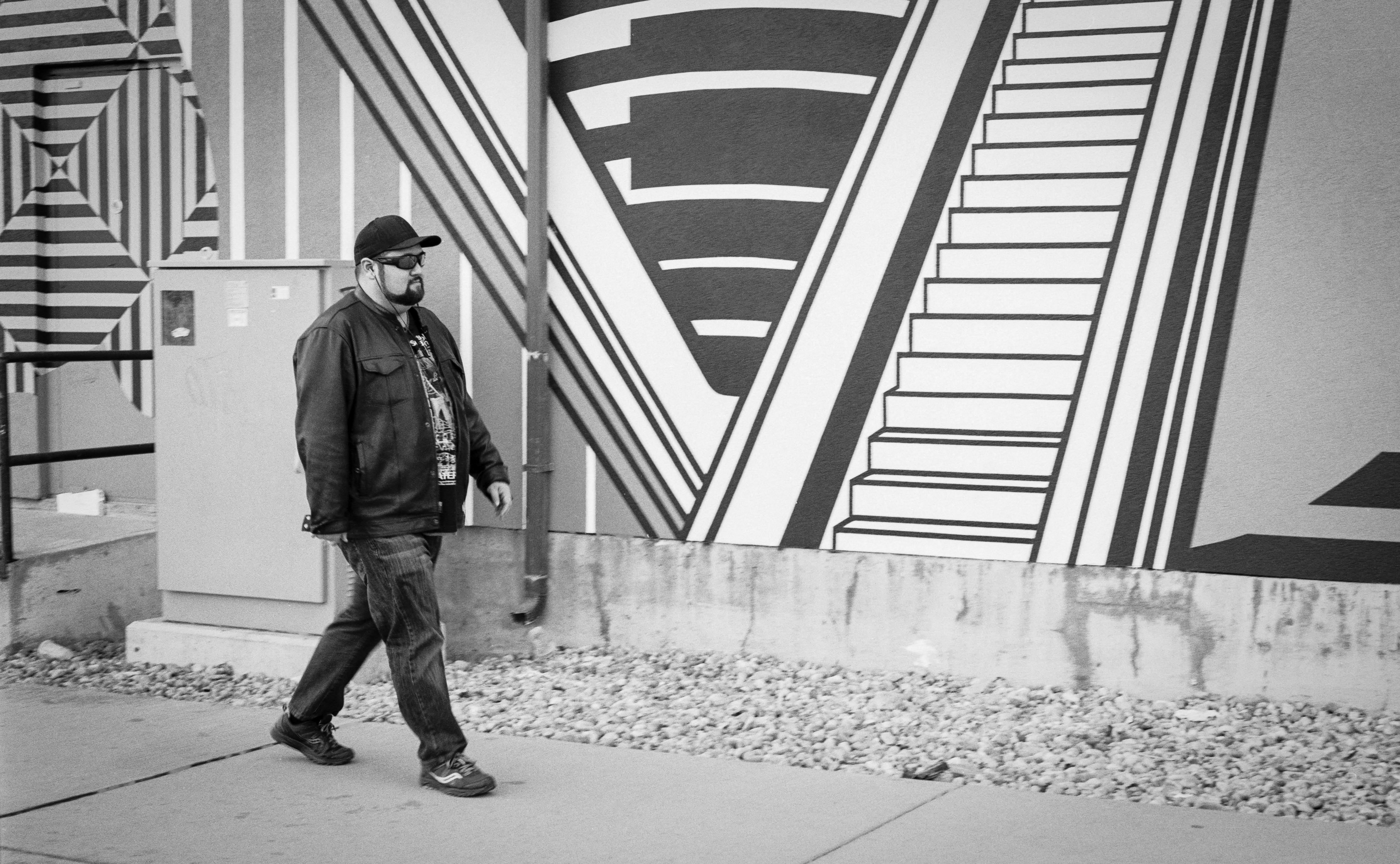
I walked down 13th Street, past the alley behind Calgary Jewellery, and snapped a quick shot of a fellow walking by Alex Kwong‘s huge (and hugely impressive) 2021 piece. Unfortunately, I don’t have many details about the mural. It doesn’t appear to be part of the BUMP series. Alex has done other pieces around the city, including a couple for BUMP. Check out his website and Instagram ( @_alexkwong ).

After I snapped this picture I turned onto 17th Avenue, and I noticed a stylish guy approaching me. An obvious picture was coming together… I just had to wait for him to pass in front of the colourful mural at 1137 17th Avenue SW. The bright elements in the mural complement his confident personal style.

In my research, I learned that the mural is by Calgary artist Toner ( @bravotoner ). The piece is titled Companion and it was painted in 2020. I realized I wasn’t being totally fair to Toner by having the best part of his mural obscured, so I went back and photographed it on its own to reveal a beautiful parrot. Here’s the whole image. Nice work Toner!

“Companion” by Toner, 1137 17th Avenue SW, painted in 2020

An interesting fact is that Toner and Kwong have collaborated on pieces around the city. I’ll be back soon with more in my next post.

Until then, be well and BE FAST!

February News Roundup – UPDATED

This is a short post, with the latest news. I’ve been busy compiling and editing photographs for my new BUMP Photo Run series. If you aren’t familiar with BUMP, it’s the Beltline Urban Mural Project, a vibrant project that has been brightening up our city since 2017. Check out my first piece here. You can read about the background of the project while enjoying photographs of some amazing art. Look for more posts very soon!

Canmore Public Library Event, Feb 12

UPDATED!

It was a wonderful evening in Canmore. The venue in Elevation Place was beautiful, we had a great turnout for our talk and an engaged audience. What more could we ask for?

Thanks to my friend, Don Crowe, for taking on MC duties, to Carey Lees of the Canmore Public Library for her flawless organization, and to all who attended. Thanks too, to Kylie and Tim at Strides Canmore, for their generous support of this event!

Here’s a synopsis of the talk:

  • A brief personal introduction
  • A collage of my running adventures (see below)
  • Discussion of my stroke journey, including the useful phrase to remember stroke symptoms (readers of this blog will already be familiar with BE FAST)

Of course, I shared my three main messages, listed below:

  • The importance of an active lifestyle
  • Awareness of ALL the symptoms of stroke
  • Raising funds to support the great work being done every day on stroke prevention and care at the Foothills Stroke Unit
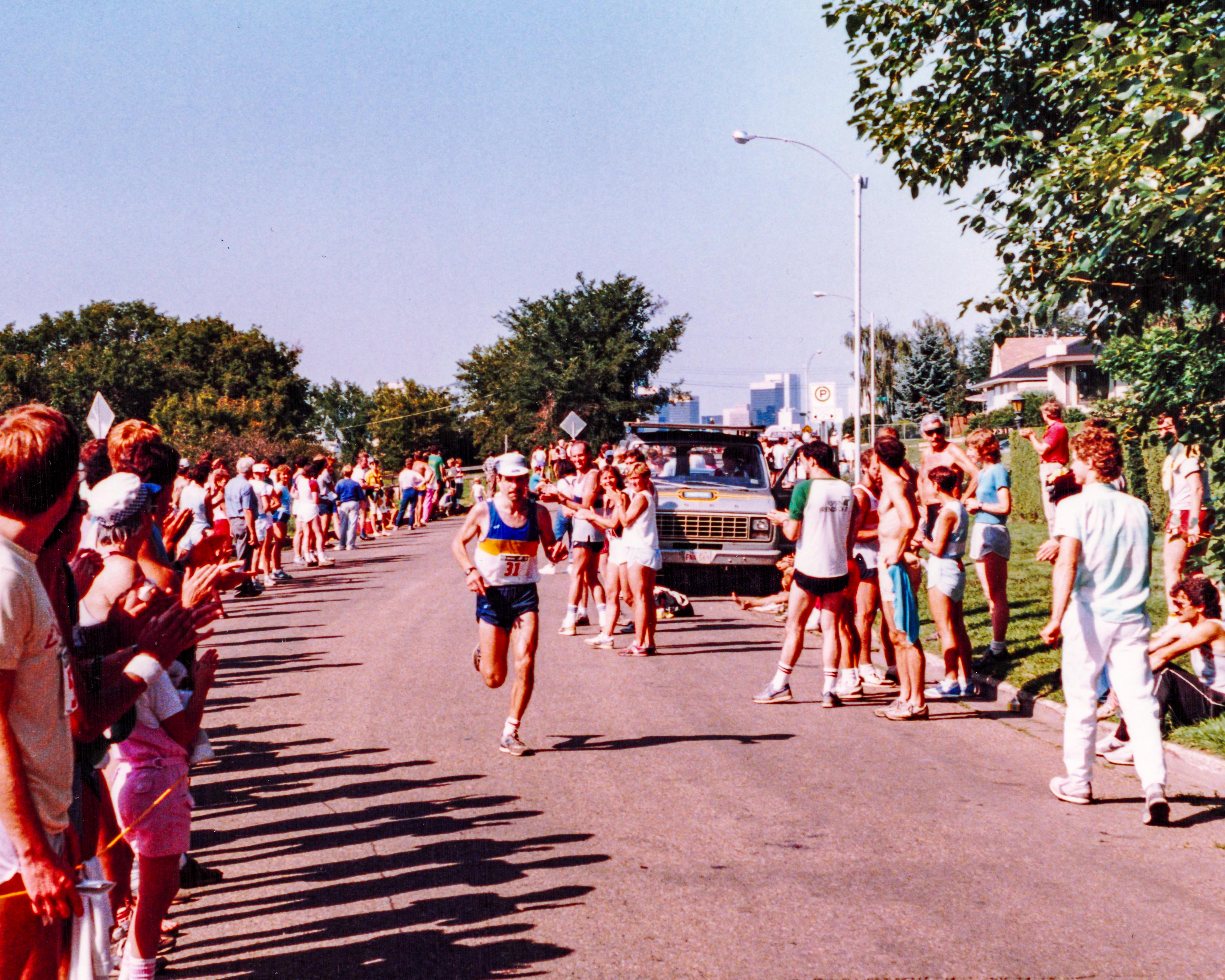
This is what 50 years of running memories look like on one page!

You can read all the details in Stroke of Luck: My Life in Amateur Athletics. And there’s some news on that front: Cafe Books in Canmore will be carrying the book. So, if you live in Canmore, please drop into this unique bookstore and grab your copy!


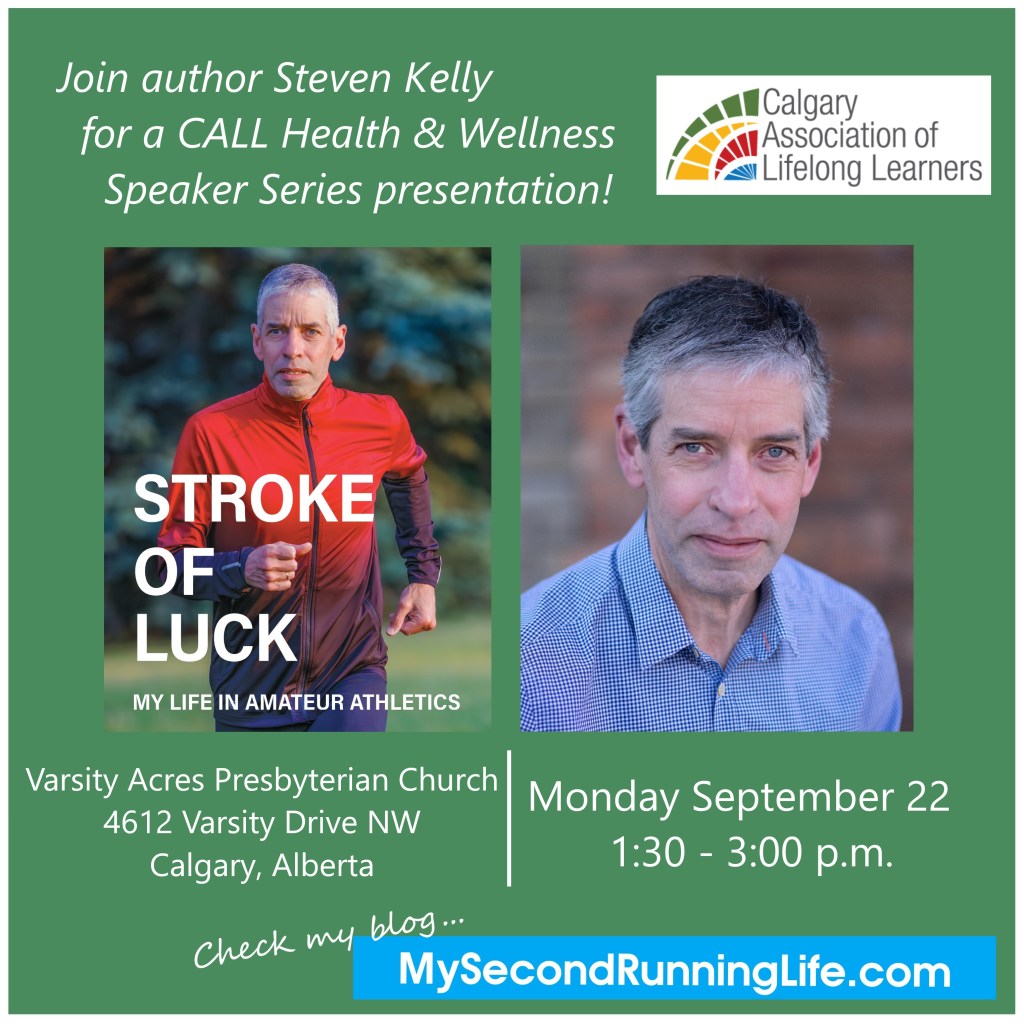
For anyone in the Canmore area this Wednesday (February 12), I’ll be speaking at an Author Event at the Canmore Public Library at 6:30 p.m. Join me if you can, for an informal (and informative) presentation of my story, as told in Stroke of Luck: My Life in Amateur Athletics. There will be a short presentation, a Q&A session, and some draw prizes. I’ll have copies of the book available for purchase, at a special event price. Proceeds from book sales support the great work being done every day in the Foothills Stroke Unit.

I’d like to thank the staff at the library for hosting us in your wonderful facility. Also, to my friends at Strides Canmore, thank you for spreading the word about this event, and for your ongoing support of my book project. I feel blessed to be part of the tremendous local running community… it’s second to none!

Finally, thanks to Dianne Deans, whom I had the pleasure of meeting at the CanStroke Congress in November. Dianne is an enthusiastic patient support volunteer for stroke victims at the Foothills Medical Centre. She kindly connected me with the Canmore library staff, which led to this event coming together. Thank you, Dianne!

Heart Month Sale Still On!

What better way to mark Heart Month than a healthy discount for online sales of Stroke of Luck?

Order your copy on Amazon, and save 20%. The sale will run through the end of February.

Until next time, be well and BE FAST!

BUMP Photo Runs – Part 1

I was jogging around Calgary’s Beltline, feeling a bit short of ideas for my next urban run/photo adventure. As I rounded the corner from 7th Street onto 15th Avenue, I glanced up at the side of the building. What I saw stopped me in my tracks, and instantly gave me the inspiration I needed.

What’s BUMP?

There’s a program called the Beltline Urban Mural Project… BUMP… that has been making Calgary’s inner city streets more interesting and colourful for years. I had to find out more.

From the BUMP website, I learned that the project started in 2017, and has grown significantly since then. Seeing all the artwork in one run would be challenging, if not impossible. There are dozens of sites, spread throughout the core. I needed a plan. I often start my runs near Lougheed House, so I decided to use that location as my base. I could get a good overview of the murals (and hopefully some worthy photos) by concentrating on different neighbourhoods over several runs. This is the first of what is likely to be an ongoing series.

Run 1 – BUMP in the Beltline

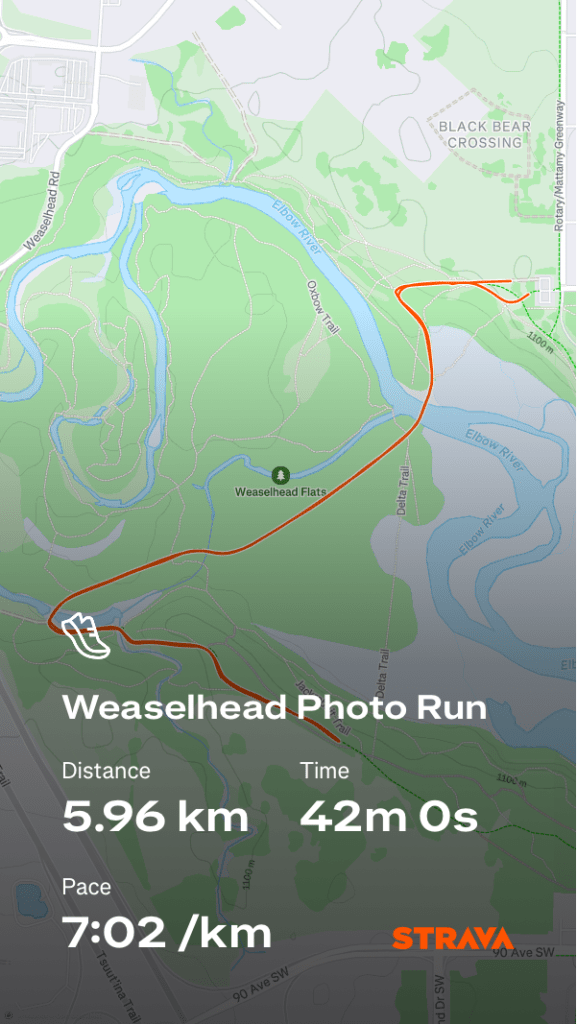
Run 1 focused on the Beltline itself… bounded roughly by 15th and 10th Avenue, and 1st and 10th Street. Here’s my Strava map:

Turning to the art, let me start with the mural that prompted this idea. It’s a large, striking piece in green, called “The Last Maple Leaf”. It was painted in 2023 by the Colombian artist Wosnan. This is from the mural description:

“Rising from nature an ancient guardian of the forest who merges the realms of magic, other worlds and dimensions, spirit and space stands tall, looking over our city…”

Wosnan, “The Last Maple Leaf”, 1411 7th Street SW

This was an apt description of the mysterious tree-like being that loomed over me, guarding his/her corner of the neighbourhood while pondering (no surprise) the last maple leaf. Stirring stuff! I studied the mural carefully, with my stopwatch running. The magnitude of the challenge I had taken on dawned on me. Maybe I should make this a slow photo walk…

No! I resumed my run, with my goal of at least five kilometres in mind. I tried to ignore the glimpses of colour that I started to notice down every alley.

Bottom line? I finished with lots of pictures and a feeling that I had made a small dent in the many Beltline murals. For full disclosure, while I saw all these murals on BUMP Run 1, some of the photos are from previous runs because I liked the shot more. Light is everything, you know!

Here’s a short summary of the pieces in the photographs. I recommend following the links to the map on the BUMP website to find out more.

Mural Making – A Layman’s Perspective

Imagine painting a mural on a wall 60 feet wide by 30 feet high. How does one even begin? Laying out a piece at that size and scale must be extremely difficult. And the execution would bring very different challenges. I marvel at the way the artists manage the intricate details, while still capturing their vision for the whole piece.

I had a front-row seat for the creation of sôhkâtisiwin (that’s Canadian artist Kevin Ledo’s striking mural at 340 10 Avenue SW). The title means “strength/power” in the Cree language. The image is taken from a picture of B-Girl and traditional hoop dancer, Angela Gladue. I watched the beautiful portrait of this young Indigenous woman come to life in 2018, from the comfort of my office across the street. Kevin and his helpers toiled away in the hot summer sun on a stage lift, going up and down endlessly over several weeks to complete the image, which now livens up the west side of a parking garage. I made sure to give them a thumbs-up every time I walked by.

Here’s a rough timelapse of the process (I had many more pictures on my phone, but I recently deleted most of them). You get the idea though.

Impressions

This is an amazing initiative. To state the obvious, BUMP is a diverse selection of art. I’m impressed by the sheer number and quality of the murals. It’s great to have artists from around the world come to Calgary and share their talent. I hope the project continues and expands its reach across the city.

This is the kind of project that invites us to slow down and take a closer look at the art. Sure, we can (and most often, do) pass by these murals in our daily routine. Maybe we glance at them, maybe we don’t. But this first photo run has already prompted many questions… Who is this artist? What is their message? Do I think they succeeded? What does this piece make me feel?

The BUMP website helpfully lets the user select pieces they would like to see on a walking tour, and this is probably the correct way to see them. I will persevere with my photo run idea, knowing I will still see and learn a lot along the way.

My early impressions are very positive. I already have some favourites. I will defer any thoughts about that question until I’ve done more exploration. There will eventually be a personal top 10 list, but even that will be subject to change as I see more of the contenders. Look for more posts on my BUMP photo runs soon.

Thanks for reading. Please drop me a comment. Let me know if you have a favourite BUMP mural that you think I should see.

Until next time, be well and BE FAST!
Prairie Mountain Sunrise Hike 2024

In mid-December, my friend Tim announced the details of what can now be called the Annual Prairie Mountain Winter Sunrise Hike. This would be the third (or was it the fourth?) consecutive trek. Whatever the number, it’s still a great idea.

After consulting his celestial tables, Tim determined that the morning of December 30 would align us with the latest sunrise of the season, plus or minus a few seconds.

If you haven’t seen my posts on last year’s hike, I recommend you check out Part 1: The Hike and Part 2: The Science. (Tim even organized a Prairie Mountain summer solstice hike in June 2024 for the real early risers. You can read about that one here.)

For those who aren’t familiar with Prairie Mountain in Kananaskis, it is the most accessible mountain for Calgary hikers. Conditions on the trail and at the summit can be quite variable, so it’s important to check the weather and prepare for anything. Of course, allowance for the drive and the ascent were critical to getting us to the summit in good time for the sun’s (hopeful) appearance at 8:39 a.m.

This year, our party consisted of eight hikers. We had seven regulars and one PM rookie… welcome Ken! We woke up to snowy conditions in Calgary, a big change from the prevailing weather pattern of the previous month. What awaited us at the summit?

Dan and I joined the convoy that left Calgary at 6:10 a.m. We reached the trailhead at around 7 and were off and climbing just a few minutes later.

The conditions (or maybe it was my conditioning) made for a tougher hike than what I remember in 2023. After last year’s outing, I knew what to expect on the revamped (and in my opinion, significantly improved) Prairie Mountain trail. I put my head down and tried to dole out my energy efficiently. I knew that counting three one-kilometre beeps from my Garmin would just about put us on the summit ridge. I welcomed a couple of short breaks, first to shut off our headlamps and then to regroup at the lower viewpoint.

On this morning, there was only the dimmest of dawn light to guide us. Clouds socked in the summit as we arrived. There would be no repeat of last year’s glorious sunrise show. But no matter. Fortunately, there was little wind. We all grabbed a quick snack, posed for a couple of group photos, and got organized for the descent. I was thankful for my Kahtoola Microspikes, which were a necessity as we got to some slippery sections lower on the mountain.

Here’s my activity summary from Strava. One thing is clear: Prairie Mountain is always a good workout!

I was impressed by the calibre of our hiking group. What a hardy and enthusiastic bunch… including our youngest hiker, who didn’t even need a hat! Here are a few photos from this year’s hike, taken with my constant companion, the invincible Ricoh GR III.

And the sun? It made only the briefest of appearances, as if to tease us, just before we arrived back at the trailhead.

Too little, too late (December 30, 2024)

So, even though the sun didn’t show up to the party, it was still an enjoyable outing and a good way to close out 2024. I look forward to more adventures in the new year.

On that note, Happy New Year to all. Be well, and BE FAST!

Strokes, Streaks and Snow

Now for a post dedicated to the core subjects on this site: strokes, running, and of course photography. Covering all of that might seem like a tall order, but the last month has provided me with plenty of material on all three subjects. So, without further ado…

CanStroke Congress

In late November, Calgary hosted the 2024 Canadian Stroke Congress, which is described as “a forum for stroke researchers, trainees, clinicians, allied health, administrators, policymakers, and People With Lived Experience of stroke (PWLE) to share new discoveries and innovations, the latest science and therapies, and to build relationships for future collaboration.”

I learned about the congress in a recent conversation with representatives of the Heart and Stroke Foundation. By registering as a PWLE, I was able to attend any of the main sessions at a very reasonable cost. It was a unique opportunity to participate in an exceptional event.

Several workshops were offered on the day before the congress, and I attended one on patient engagement. We heard from scientists and advocates on a range of topics, all focused on ways that PWLE can become involved in stroke research and advocacy. Breakout sessions addressed the practicalities of various engagement paths. The workshop was a good chance to meet other people and share our respective stroke journeys.

I was so impressed with the workshop that I returned the next day to attend a couple of the main sessions. Dr. Andrew Demchuk, the hero of my own stroke story, and Dr. Thalia Field from UBC led a discussion, “What’s New in Stroke Prevention?” It was standing room only for this session. While much of the discussion was over my head, I was so impressed by the depth and breadth of the presentation, and the knowledge and confidence of the speakers. It reinforced my opinion that world-class stroke care is available in Canada.

Another session (“What’s New in Acute Stroke?”) had three eminent stroke neurologists discuss developments in stroke diagnostics and therapies, including some that I touched on in a recent post. It turns out I have a connection to all three of the speakers:

  • Dr. Michael Hill was one of the physicians involved in my care at the Foothills Stroke Unit in 2017. He kindly wrote the foreword for Stroke of Luck.
  • I’ve never met Dr. Mayank Goyal, but he would have been the physician responsible for inserting a stent into my blocked vertebral artery, should the decision have been made to follow this treatment route for me.
  • Finally, Dr. Aristeidis Katsanos is an eminent stroke neurologist at my alma mater, McMaster University.

My takeaway from attending the congress is that while stroke incidence is increasing and our healthcare system is under severe pressure, we should be encouraged by many significant advancements that are being made in stroke diagnostics and therapy. There is reason to be optimistic about the future.

A Blast of Winter

Coincident with the stroke congress was Calgary’s first blast of winter. This likely gave the conference organizers fits. It was quite a wallop. I think we got something like three times our usual November snowfall in one day. Now, while that did complicate a lot of things, it also provided for some great photography. Here are some shots from around the city… with a reminder that the copyright for all images is mine.

Strides Run Streak

Here we are, already halfway through December. Cue the usual observations about where the year has gone. December is also when many Calgary runners take on the annual Strides Run Streak. The challenge is simple: run at least one mile every day during the month.

I have some meaningful connections to this event, so whatever else is going on at this time of year, I like to sign up for it. One mile a day is an achievable goal. I give myself the added challenge of finding a worthy photo or two while I’m completing my run. Sometimes that is a bigger test, particularly with the days getting shorter and shorter!

This year, my commitment is strong, but the challenges are not insignificant. We started the month with plenty of snow on the roads and sidewalks, which have slowly turned into skating rinks. Ah, Calgary weather! I’m also doing most of my running solo these days, as my favourite training partner is sidelined with a sore hip. We are both hoping for some improvement soon.

Two weeks into December, my streak is intact, and I have managed to accumulate a few images. Maybe more images than miles, if I’m honest. While it is nice to capture the festive spirit… the snow does help with that… it isn’t essential. Rather, my goal is to find images that can transport me back into that time and place. It’s a way of adding meaning to my runs. When it comes together, it’s a nice feeling. Here’s a sample.

And while I did say the images don’t have to be festive, there is one that has the potential to put even a Grinch like me into the Christmas spirit. See what you think.

Look for more images soon. I have ideas for other posts before I shut things down for the holidays. In case that doesn’t happen, I will take this opportunity to offer my best wishes for a Merry Christmas to one and all.

Be well and BE FAST!
Head Hunting

The Art of Jaume Plensa

I was looking for an excuse to go into downtown Calgary for some photography, and I thought about the “big head” sculpture that sits in front of The Bow building. Like the building, the sculpture is iconic; it’s a monumental and very popular piece of public art. I’ve photographed the sculpture many times, but it seems to always have more to offer, depending on the season, the time of day and of course, the light.

First, some background. The sculpture’s official name is Wonderland and it’s by the Spanish artist, Jaume Plensa. Plensa was born in 1955 in Barcelona. He studied art in his home city. Over several decades he has lived, worked and exhibited his art in cities across Europe and the United States. Plensa has received international recognition for his exhibitions and installation pieces. His diverse works include sculpture, fountains and graphic arts.

Wonderland (2012), Calgary

Wonderland is one of many sculptures that Plensa has created for public spaces around the world. When I looked into the origin of Wonderland, I learned that he has installed similar large-scale pieces across Europe, Asia and North America.

Wonderland is ideally situated in the curved façade of The Bow, where it’s been since 2013. The sculpture depicts the head of a young girl. It’s about 12 metres high, and it’s made of bent steel wire. I think the piece is so popular because it has openings at ground level, which let visitors enter the sculpture’s inner space. Plensa invites us to contemplate Calgary’s downtown from the perspective of the subject. It’s a thought-provoking piece, for sure.

Here are several of the many shots of Wonderland I’ve taken over the years.

Julia (2018), Madrid

I realized that Debbie and I had seen other Plensa pieces in our travels. Most recently, we stayed a couple of blocks from a monumental sculpture in the Plaza de Colón in Madrid, called Julia. About the same size as the Calgary piece, Julia is also a sculpture of a young woman’s head. The subject’s eyes are closed as if she is meditating.

Julia is typical of Plensa’s large, elongated and flattened busts. When you look at them straight on, they give the impression of being on an angle. It’s an impressive optical illusion. The Madrid piece is made of polyester resin and white marble dust. It’s stunning.

We passed Julia several times a day while we were in the city, and each time I took a few photos. While Julia has been in her current location since 2018, it turns out that she may not be installed permanently… it’s a good thing I took so many photos while we were nearby. Here are a couple of my favourites:

Sanna (2013), Bordeaux

As I did more research into the artist, I realized we had seen another sculpture similar to Julia in Bordeaux, France some years earlier. Sure enough, it was another Plensa piece called Sanna. That one sits in the Theatre Square (the Place de la Comédie) in the heart of the city. Its perspective has been manipulated in the same way as the Madrid piece, and the subject is also shown in a quiet, contemplative pose. Unlike Julia, Sanna is made of cast iron. She is 7 metres high.

The story of Sanna coming to be in Bordeaux is that in 2013 the city hosted an exposition of Plensa’s pieces. The event was popular, so much so that residents initiated a movement to acquire Sanna permanently. As far as I know, it will remain in place until at least 2027.

We have very fond memories of our visit to Bordeaux. The square where Sanna sits is busy with cafes and shops. If we ever make it back there, I hope Sanna will still be there.

Source (2017), Montreal

The final Plensa sculpture I want to highlight is installed on a terrace in Rue Wellington, just at the entrance to downtown Montreal. Somewhat in the same style as Wonderland, Source is a three-dimensional piece within an open outer frame. It’s a stainless-steel sculpture formed from a random pattern of letters taken from different alphabets, which depict a sitting figure.

The Montreal piece symbolizes the many cultures that have come together over the city’s long history. Fittingly, it was installed for the 375th anniversary of Montreal’s founding in 2017. Like the Calgary piece, Source is open, so it invites visitors to enter the inner space of the piece.

Our stop at the Source was short, and I only have one photo of the piece. Rest assured, I will take more time to check it out next time we are in Montreal.

Concluding thoughts

So what is my take on Plensa, and his large public art pieces?

In a 2019 interview with Forbes, Plensa discusses his use of altered perspective and open gridwork sculptural elements. He described using these techniques as a way of exploring his interest in the way humans communicate, and how different cultures use language.

For me, Plensa’s sculptures seem designed to invite close inspection and discussion. We want to get close to these sculptures. We want to walk around them and even into them. The large scale of his head sculptures could be intimidating, but Plensa defuses this by the way he plays with perspective, and by his use of serene and peaceful subjects.

Having seen four of his works in person, and looked at many others on his website, I find them to be beautiful and innovative. It’s clear from Plensa’s vast catalogue that his formula is a success: there are literally dozens of his pieces installed around the world. I don’t take this as evidence of an overworked theme. Rather, I would say that Plensa has achieved his goal: his works encourage us to get together in pleasant locations and talk. For this reason alone, his art is well suited to the public spaces in which we find it.

Signal Hill Photo Run

A recent errand led me to an unexpected trail of discovery through Calgary’s military history. I had stopped at the busy Westhills shopping district, the usual collection of big box stores. As I walked back to my car, I noticed the battalion numbers preserved on the side of the hill below the Signal Hill neighbourhood.

I knew about the battalion markers but hadn’t thought much about their significance. My first reaction when I saw the whitewashed stones was how small they looked, sandwiched in between the RONA store and Calgary’s residential sprawl just above. I made a point to return soon for a closer look.

Military history squeezed into the urban landscape

A couple of days later, I was jogging through North Glenmore Park, along the crest of the bluff. I ran by a monument at the west end of the park, one that I had passed hundreds of times. I decided to stop and check it out. The plaque indicated that this was a 1967 memorial to the 137th Battalion of the Canadian Expeditionary Force (the CEF) in World War I. I remembered that “137” was also one of the battalion numbers on Signal Hill.

The 1967 memorial to the 137th Battalion

I guessed, correctly, that this was the same 137th battalion immortalized on the hillside. Now I definitely had to make my way over to Signal Hill. I figured it would be a great excuse for a photo run.

I grabbed my camera (the Ricoh GR III of course) and parked at Battalion Park on Signal Hill Drive. Here’s the Strava entry for my easy run. It was a beautiful day and I did an enjoyable 6-kilometre loop around the neighbourhood.

The story of Sarcee Camp is well explained in a series of plaques next to the stairs that wind through the markers. I learned that the camp was established in 1914. It was in a section of the Sarcee Indian reserve (now Tsuu T’ina) that was leased by the Canadian militia as a training site.

Sarcee Camp was a busy place. As many as 45,000 military personnel from 30 battalions trained at the site during the war. It was customary for each battalion to construct a “geoglyph” (that’s a design or motif created by humans and built into the natural landscape) with their unit number. They did this using stones hauled by hand from the riverbed, which is two kilometres away from the hill. 

The 113 is the oldest of the four stone markers on Signal Hill. The 113th Battalion was formed as the Lethbridge Highlanders in 1915. The battalion relocated to Sarcee Camp in May 1916 and sailed for England in September of that year. The 113th was broken up for replacements, with most of the men transferred to France. The battalion never saw action as a unit and was disbanded in 1917.

The other numbers on the hillside were constructed by battalions of the CEF that trained at the Sarcee Camp, including the following:

  • The 137th Infantry Battalion of Calgary began recruiting in late 1915. After sailing to England in August 1916, the battalion was absorbed into the 21st Reserve Battalion.  It’s worth noting that the King’s Own Calgary Regiment (RCAC) perpetuates the 137th Battalion. Members of the 137th Battalion CEF Association erected the memorial to the unit in Glenmore Park.
  • The 151st Central Alberta Battalion began recruiting in 1915. It sailed to England in October 1916 and was absorbed into several reserve battalions.
  • The 51st Canadian Infantry Battalion was recruited in Edmonton. It sailed to England in April 1916 and provided reinforcements for the Canadian Corps until it was reorganized in November 1916.

Although there were approximately 20 geoglyphs built, most were destroyed in the 1950s during the construction of a mess hall.

When we first moved to Calgary in the early 1990’s, the battalion markers were just about the only thing in the area. Over time, residential development nearly swallowed up the geoglyphs. Fortunately, there was enough recognition of the significance of these markers that they were preserved. In fact, three of the markers (137, 151 and 51) were meticulously moved a short distance from their original locations.

You can see a few photos I took during my cooldown walk. I found it quite challenging to get any perspective on the geoglyphs when I was right next to them. In that respect, the parking lot of the RONA store isn’t a bad place to stop and admire this unique piece of Canada’s military history. Even so, with Remembrance Day just around the corner, I recommend getting closer and doing more exploration if you have the time.

On the Street with Hektor

This is a review of a camera lens that nobody uses. It might make sense to add up front that I’m not a reviewer of camera equipment. So, if there are no readers of this piece, the only loss will be the time I spent writing it. That said, I hope to introduce an unusual piece of equipment in an approachable way, even for non-photographers. 

So, what’s the story?

I have what might be described as a diverse collection of cameras and lenses. I don’t chase the latest equipment, and I don’t change my gear often. A lot of my gear is, well, old. The oldest and probably the oddest lens I own is a 70-year-old telephoto, made by Leica. It’s a lens that can be used on any M-series Leica camera made in the last seven decades. That’s quite remarkable when you think about it. It speaks to a solid legacy of product design.

For those who don’t fuss over cameras, Leica equipment is held in high regard… it’s considered to be an elite brand. In Leica’s rangefinder cameras (their “M” range), the products have a reputation for being practical, solidly built and efficient.

Except maybe for Hektor.

The Hektor is a medium telephoto lens, with maximum aperture of f/4 and focal length of 135mm. (That is the extent of the technical lingo in this review.)

The 1954 Leica Hektor 135mm f4

First off, 135mm happens to be a difficult… some would say unusable… focal length on Leica M rangefinders. Given my intention to keep this piece readable, I won’t explain why that is. But it is a serious knock against the lens. 

I’m going to lump a few other points together because they collectively contribute to the look of the lens. And how would I describe its looks? In a word, it’s unattractive. Okay, ugly. (That reminds me of the story that the Hektor is named after Leica lens designer Max Berek‘s dog. I wonder what that says about the dog.)

Anyway, the lens design, meaning the arrangement of glass elements inside the tube that forms the lens, is simple. In photographic terms, the f/4 aperture makes this a “slow” lens. This combination of design decisions means that the lens itself is long and skinny. I don’t really like the look (or the feel) of the lens when I’m walking around with it over my shoulder. 

As a further negative point, the Hektor is awkward to use. It is well-made and solid. After all, it IS a Leica lens. Still, when taking a photo, it’s hard to focus because it requires a lot of rotation of the lens barrel. This isn’t a lens for action photography.

With all those flaws, I might be advised to end my review here. But here’s the problem. I think it actually takes good pictures. Check out these examples:

These pictures all came out of the camera with soft contrast, kind of a “mid-century” look. Could that be the result of whatever combination of optics and coatings was put into the lens in 1954? Maybe. It isn’t necessarily a bad look. In fact, it may be exactly what one is looking for, especially for portraits. After some editing, the results look fine, at least to me. (I should add that the Hektor’s colour rendition isn’t good, so I usually use it for B&W shooting.)

I’ve used the lens for street photography, and it’s best for distant subjects… shots across a street, like “VW Girl”, above. Shooting with Hektor brings all the shortcomings I mentioned earlier into play. For that reason, if I’m using this lens I have to get my settings ready and wait for subjects to enter the scene.

The lens is quite sharp across the aperture range, even shooting wide open. Again, it should work well in portraiture. Given how slow it is, maybe outdoor portraiture would be the best bet.

I’ve read a few other reviews of this lens. Most bash it quite harshly. One review by a well-known online source is very negative. However, when one reads the full review, the reviewer concedes the many strong points the lens has going for it when taking pictures. And isn’t that what matters?

Wrapping up, the Hektor is a lens I rarely reach for. There are good reasons for that. But every so often, when I feel like giving myself a photographic challenge, I put it on a Leica M camera and take it out for a spin. I marvel at the fact that I can do that at all, with such an ancient piece of equipment. And if I’m patient, I usually come home with a shot or two that convince me to keep this oddball in my kit. 

Auroras and Other Distractions

Good news! I’ve extended my Dedication Sale through the end of October. It’s a nod to our Thanksgiving holiday.
Print and e-book versions are available on Amazon at a 20% discount.

There’s a hard stop on the sale on November 1!

In what was a fairly chaotic week, I did manage to capture a few interesting images. There was no shortage of subject matter. I only had to force myself out the door with a camera.

Auroras a-plenty!

This year has been unmatched for solar activity. I read that it’s all because the cycle of solar activity is at its peak. (Sounds like a topic for a future blog piece!)

I’ve always been interested in photographing the aurora borealis (the “Northern Lights”) but frankly, I wasn’t up to what I assumed was the significant effort needed to make it happen. What gear did I need? How much work would it be to get to a good location, and to do so in the middle of winter when the aurora are most active?

It turns out, this year at least, all one has to do is put an iPhone on a tripod (or maybe not), walk to the nearest park, and look up. I started seeing IG posts from friends who were taking pictures from their backyards, so I figured I could make a similar commitment.

I found a great website (Alberta Aurora Status) that estimates the combination of solar and atmospheric conditions necessary for good viewing. Lately, even that much science may not have been needed.

As for the photos, those took a few nights of experimentation. Fortunately, our recent weather has been agreeable and the skies have been mainly clear. I tried some shots with a “real” camera and soon learned that my iPhone 14 was more than adequate to land some decent shots. I plan to try again soon with other cameras… it looks like the good viewing isn’t finished yet.

The iPhone has a “Night Mode”, which uses a long exposure and some noise reduction. Later, it took some trial and error to get the best result with my photo editor… mainly I adjusted the exposure and added some saturation. Overall, I think the results are pretty good, considering how easy it all was.

Here are some of my edited shots from Lightroom.

Fall Colours and Intervals

Knowing that our daylight hours are in rapid decline, I made sure to join our weekly group run at Carburn Park on Thursday evening. It was a perfect outing, and it may turn out to be our last outdoor session for the season. A small group showed up since many of our teammates were in recovery mode after a recent target race. Jason G led us through some sets of 500m – 500m – 1k.

We headed over to the west side of the Bow River and turned north. The views back across the river were spectacular. The setting sun lit up the fall colours, with most of the leaves still on the trees. I used our short 1-minute breaks to good effect, snapping as many pictures as I could before the light show ended. I couldn’t have asked for better training partners than Doreen and Elidh. All pictures with the unbeatable Ricoh GR III.

A-B-C’s

A is for Art and B is for Borduas. What? Who?

On Saturday, Deb and I made our way to Masters Gallery, to catch the last day of a David Thauberger exhibit. He’s a Saskatchewan painter who’s been active for 50 years. The gallery had an interesting selection of works from his long career.

We always enjoy stopping into the gallery on 4th Street SW to chat with Ryan Green (@ryngreen on IG) and visit with his sidekick. This visit was no exception.

The sidekick I’m referring to is Borduas, aka “Bordy”. Bordy is a wonderful British Bulldog. He’s named after the Canadian artist, Paul-Émile Borduas (1905-1960), and he (the dog) is a fixture in the gallery. I snapped a few pictures of Ryan and Bordy because I had to. You’ll see what I mean.

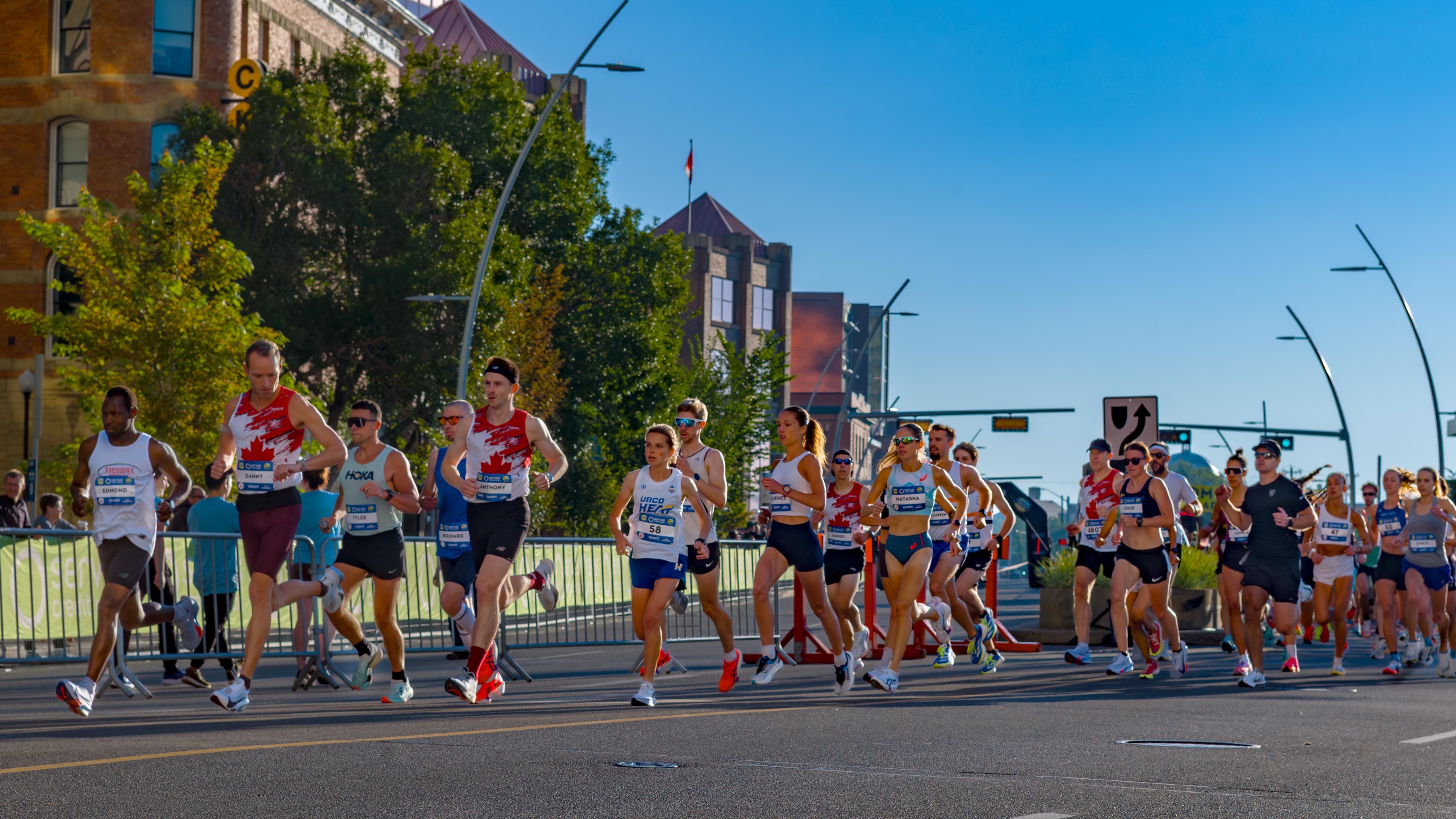
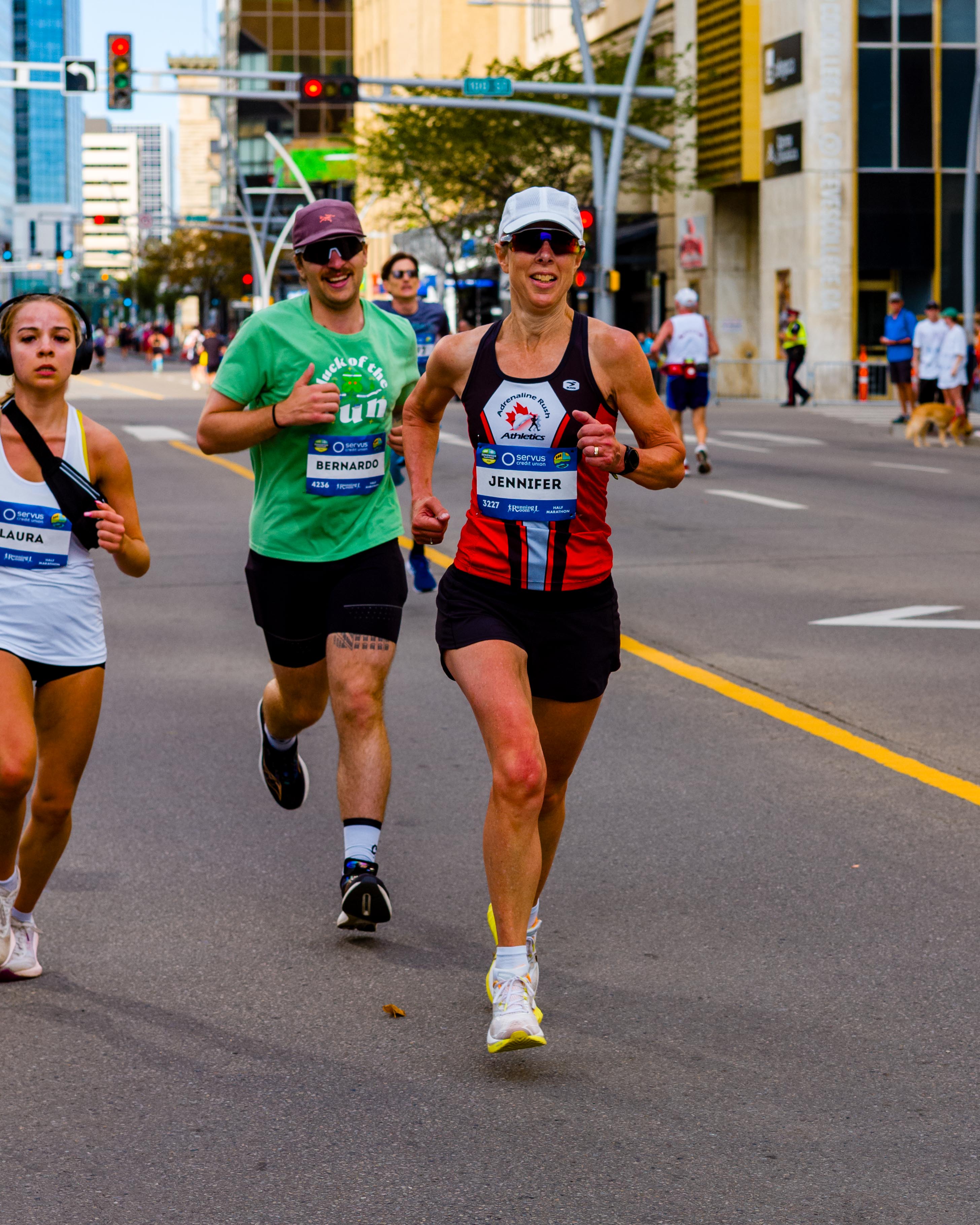
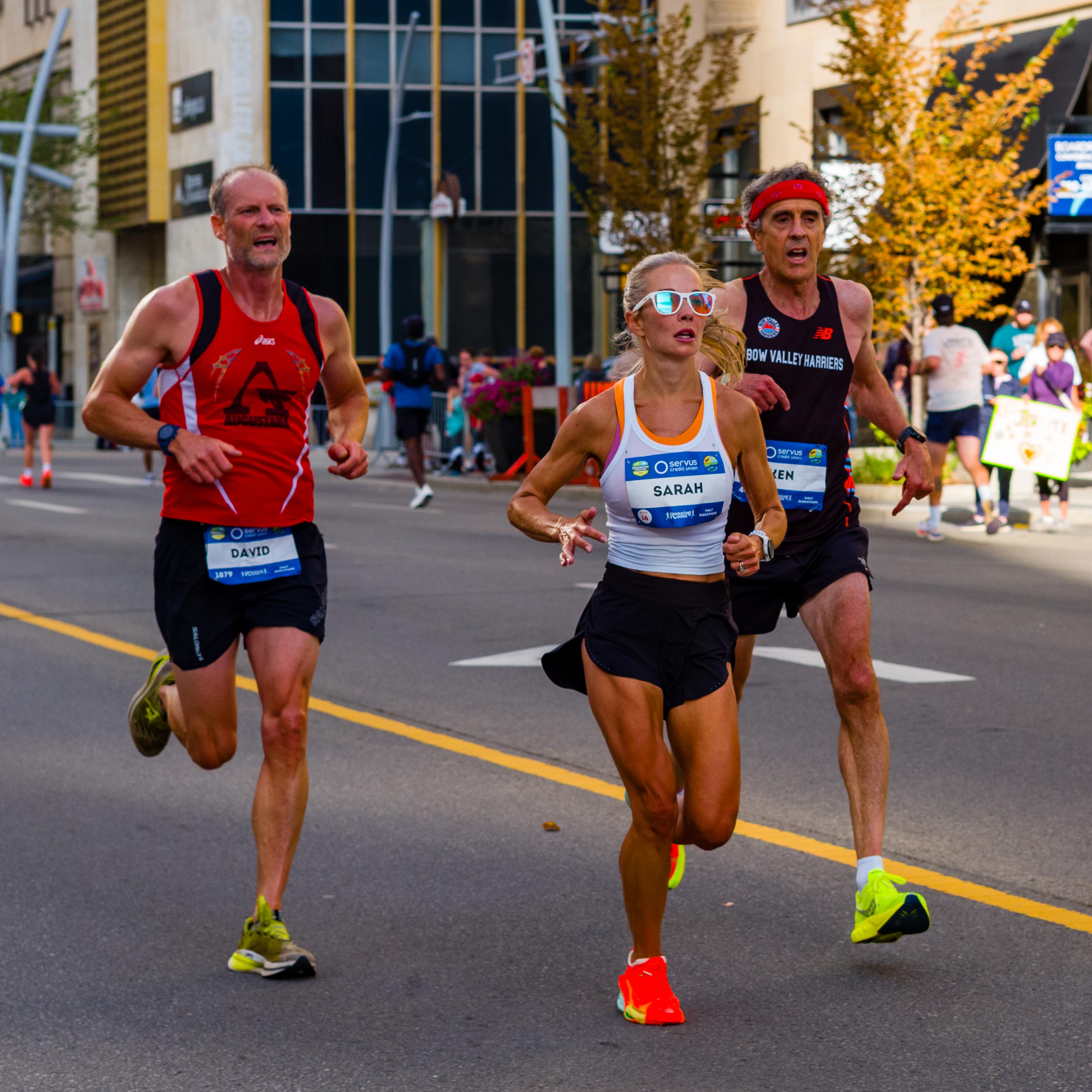
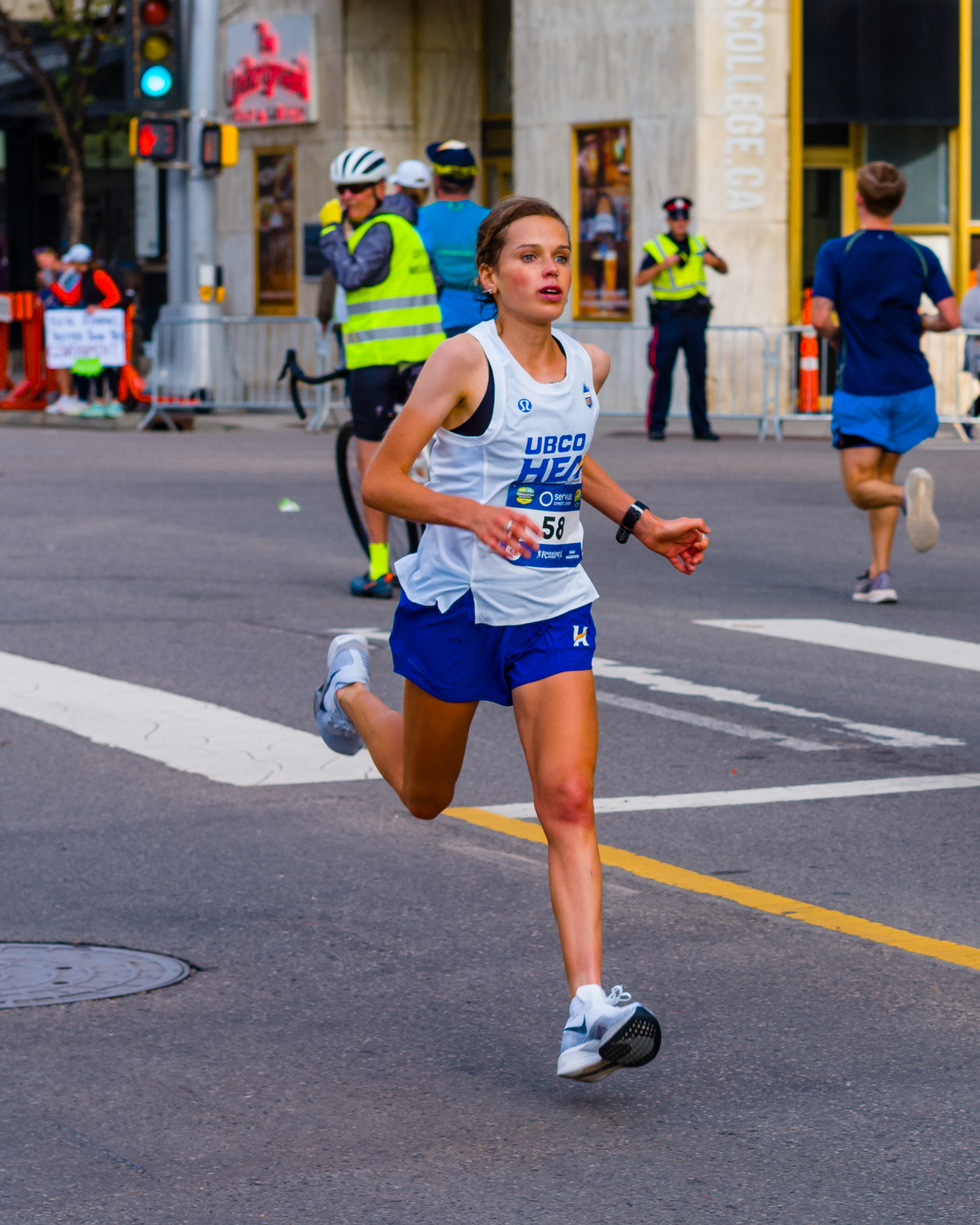
And what about C? This week, C was for Competition, as in racing. After a long hiatus, I signed up for a 5k. This was largely due to peer pressure, from the same Jason I referenced earlier. He had signed up for the 5k as part of the Calgary Police Half Marathon… one of the longest-running, best-organized races in Calgary… and encouraged me to do the same. Thanks for the push, Jason!

I had no illusions of running with Jason, but I set as my goal to run a steady effort at a challenging pace. In other words, I wanted this to be a race, even though it was at my current (reduced) capabilities. I figured I might have a shot at a podium finish in the M60-69 age group, but it was no problem if it didn’t happen. I was just happy to be over my recent calf/Achilles tendon problem.

All photos by Deb Kelly:

Conditions were ideal for racing, and it was a successful outing for Adrenaline Rush runners. Jason flew to a 10th-place overall finish and set a personal best in the process. His time of 19:13 easily placed him first in his age group, by several minutes. Scott did very well in the 10k, running 53:43 and finishing 4th in his age group. Alistair (no photo) cruised to a second-place overall finish in the main event (the half marathon), running 1:22:34. That was impressive enough, but consider that he was taken off course by the lead cyclist, a miscue that added 500m to his race distance. Way to go, guys!

And me? I finished the 5k in 25:55. It was a solid effort. I was happy and maybe a bit surprised with it. I ran smart. I did miss the podium by one spot, and I missed running with Deb even more. Maybe next time!