A Foggy parkrun and a Larchy Hike

What a weekend!

Saturday.

parkrun is a worldwide phenomenon. It started in 2004 in the UK, when a small group of runners got together for an informal 5k run. There are now more than 3 million registered runners who can show up at any weekly parkrun around the world.

As a historical aside, park runs were a thing decades ago. That was in the late 1970s, at the dawn of the running boom. I remember doing 1, 3 or 5 mile runs around Gage Park in Hamilton, which were organized by the local YMCA. Like parkrun, those runs were free and informal. But I digress…

We now have several parkruns to choose from in the Calgary area. My friend Tim (a veteran of 100 parkruns) encouraged us to give it a try, so Deb and I decided to join for our first Nose Hill parkrun, and the 285th weekly edition.

Nose Hill Parkrun 285

Fog settled over the park as we did an easy warm-up jog. The field was large, with over 150 runners. It included a large number of airline employees from around the world. They were in town to participate in the World Airline Road Race, a large race that was scheduled for the next day.

Our run went well. We handled the two laps of mixed terrain without much trouble. That said, we saw almost nothing, due to the thick fog. It did make for some interesting photos, with runners disappearing off in the misty distance.

Fog and mystery on Nose Hill

We finished in 30 minutes, and thanks to a modern technological touch, we scanned our personal parkrun barcodes against our finisher’s chips. An hour later we had an email with our age-graded results and our updated parkrun record.

We’ll be back for another parkrun soon!

Sunday. Another day, another early start. This time it was for a trip to the mountains.

Tim (yes, that’s parkrun Tim) and his wife Judi proposed the Pocaterra Ridge in Kananaskis. This moderately strenuous, point-to-point, 10-kilometre hike is renowned for its larches. And given that this weekend would see the larches at their golden peak, we knew the trail would be busy.

Despite our early start, the parking situation was already very tight when we arrived at the north trailhead. We carpooled to the south end of the trail at the Highwood Pass, got ourselves organized, and set off.

The well-trodden, muddy trail began climbing immediately. We admired the magnificent golden larches as we toiled through the first couple of kilometres of the hike.

Reaching the first summit on Pocaterra Ridge

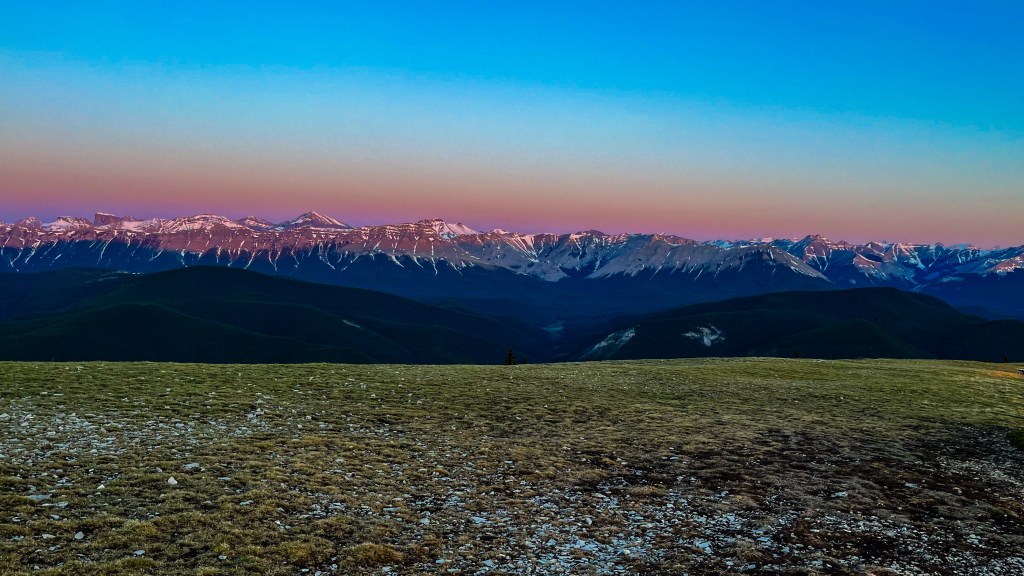
The first of three peaks along the ridge hike maxes out at an elevation of 2722m. The views of the entire Kananaskis Valley to the north were spectacular, when we had views. This being an Alberta autumn, it had begun to snow. The temperature dropped and we reached for our toques and extra layers.

We made good time coming down from the summit. We timed our lunch stop perfectly, to coincide with a brief interlude of sunny and calm weather. By this point, the crowds were much thinner. Many hikers had clearly focused on the lower reaches of the trail, but they may have missed the best part of the hike. Our high altitude paid huge dividends, in the form of incredible views, as we walked along the well-defined ridge trail.

Larches and great views on Pocaterra Ridge

The last hour of the hike was a steep descent back through the larches to the highway. We gingerly made our way down, with quads burning.

Overall, it was a memorable day in the mountains, made better with good friends and magical views.

Running, Across the Iberian Peninsula

Our trip to Portugal and Spain offered ample opportunities for us to explore the region on foot, and we did just that. Working our way from Lisbon to Barcelona, we made sure to include a run in each location. As many readers will attest, there is no better way to see a new place than at running speed. We had some memorable runs (camera in hand, of course) and faced only a few minor challenges along the way. Here’s a summary.

  1. Lisbon

The Portuguese capital was a charming place to start our Iberian tour. The Praça do Comércio and the Tagus River were just steps from the Pousada Lisboa Hotel. We did an easy out-and-back run to the Ponte 25 de Abril, enjoying magnificent views along the way. We decided to turn around before reaching the impressive modern Museum of Art, Architecture and Technology (MAAT) in Belém. We knew that we wanted to visit the area later in the day so we could explore the sights more fully. We were thrilled to see so many fast and fit runners on the (cobbled!) pathway.

Ponte 25 de Abril
The cobbled path along the Tagus River

And here’s what we saw later in Belém (but not running):

The spectacular Museum of Art, Architecture and Technology
The Jerónimos Monastery

2. Faro

We fit in a short run during our stopover in Faro, the capital city of the Algarve district in southern Portugal, which let us see the morning activity along the waterfront. Fishing boats were returning to port, and clamdiggers were taking full advantage of the low tide as the sun rose. The temperature was already climbing as we returned to our comfortable room among the narrow, cobbled streets of the old town.

Early morning, Faro harbour

3. Seville

Our first stop in Spain was a revelation. The capital of Andalucia is brimming with Spanish character. Our apartment was a few blocks from the historic Puente de Isabel on the beautiful Guadalquivir River. We were treated to many sights on our early morning seven-kilometre run. Rowers and runners were out in force, all with the same thought of avoiding the heat of the day. Unique public art, several famous monuments and contemporary architecture were all to be found along the route. Our turnaround point was the lush Maria Luisa Park, the gardens next to Plaza de España, and one of the many features in Seville that were constructed for the 1929 Ibero-American Exhibition.

We started from the historic Ponte Isabel II in Sevilla
Torre del Oro, one of the sights along the Guadalquivir River

4. Granada

Our challenge in this historic city was to find a flat spot to run. From our apartment in the Albaicin neighbourhood we had a panoramic view of the most famous feature of the city (the Alhambra, a massive Moorish fortress and palace), but it was also a steep, twisty and cobbled kilometre away from the city centre. As a result, we decided to enjoy a leisurely walk down to the Avenida de la Constitución before starting our run. A few laps of this pedestrian-friendly mall made for a pleasant outing. We didn’t see many other runners during our early morning run, but we did get a chance to say hello to statues of many famous people from the region.

Sunrise over the Alhambra, Granada
Good morning Granada

5. Madrid

We were impressed by the capital city of Spain as soon as we arrived at the handsome and historic Estación de Atocha. This very walkable city of 3.2 million people is crammed with sights, including the world-famous Prado Museum. We found surprises around every corner. When it came to planning our run, we were pleased to see that the Hotel Fénix Gran Meliá in the Salamanca district was a few minutes away from the Parque de Buen Retiro, possibly the most beautiful urban park in Europe. A lap of the gravel path around the park was 4.5 kilometres, leaving us with enough energy to check out the Estanque del Retiro, a spectacular artificial pond and monument. Aside from the Retiro, there are many other green spaces to explore in Madrid. We were disappointed to learn that a hugely popular 10k race (Corre por Madrid) was taking place on the morning we left the city. Maybe next time!

Julia, a monumental sculpture by Jaume Plensa
Just one of many picturesque spots in el Retiro, Madrid

6. Barcelona

Our stay at the Hotel Casa Fuster in the Gracia district of Barcelona was a highlight of the trip. Our fifth-floor view was dominated by the Sagrada Familia, Gaudi’s Modernist masterpiece. We intended to run an out-and-back route on via Diagonal, a pedestrian avenue near the hotel, but road construction and a close call with a taxi changed our plans. While looking for an easier route, we took a couple of wrong turns and found ourselves staring up at the iconic church. Breathtaking! We thoroughly enjoyed our stay in the capital city of the Catalonia region. The Sagrada and the Picasso Museum were well worth a visit.  Overall, it was a fitting end to our travels.

Navigating the roads in Barcelona
Sagrada Familia, Gaudi’s masterpiece

Skyline Trail: One Less Bucket List Item

We were halfway into our Skyline Trail hike when Dan asked me a question. 

“So, how long have you wanted to do this hike?

I had to think for a minute. 

“I don’t know exactly, but it was long before you were born. Let’s say 40 years.”

Day 1, Lorraine Lake

To be truthful, I’d given up the idea of tackling this epic 45km trail in Jasper National Park. It seemed less likely after my health problems, and considering how much effort it would take to organize the required overnight backcountry camping. 

That was before I mentioned my bucket list item to my son, Dan. Next thing I knew he had sent me an email with possible itineraries and dates, complete with a packing list and even his menu suggestions. He’d already booked the campsites. 

I realized I had no reason to say no. We were going to Jasper on the August long weekend! 

I went into rapid preparation mode, starting with some shorter hikes and an actual backpack (my old Arc’teryx Bora 65). I bought some missing gear, which was almost as much fun as the hiking. Deb did us a huge favour by organizing our food into about a thousand convenient Ziploc bags. We were off!

We would do the hike in 3 days, in the typical south-to-north direction, from Maligne Lake to Signal Lake. The trail crosses three passes and gains 1,400 metres of elevation. Our days would increase from 8 km to 13 km to 26 km. I was secretly worried about that last day; I didn’t want to be the guy they had to rescue by helicopter. 

Day 2, Big Shovel Pass

As it turned out, I got more comfortable with my pack each day. The trail was perfectly maintained. I handled it all well. Dan was an amazing trail companion and a totally confident backpacker. He did all the planning, all the cooking (including the most unexpected and awesome birthday cake ever), and most of the hauling. There were only a couple of times I felt I was holding him back. I did decline his offer of a quick side scramble up Curator Mountain though. 

The scenery was spectacular, especially on either side of the third pass, The Notch, which at 2,500 metres is the highest point on the trail. We had an early start on day 3, and my mantra was “Notch by nine”. I told myself the climb was just another tough interval workout. It was fascinating to see how each pass opened up very different vistas and microclimates; from lush green valleys to moonscapes. There were great B&W landscapes everywhere you looked. (I had the capable and compact Ricoh GR III with me.)

Day 3, Descending from The Notch

We knew there was a chance of thunderstorms as we approached the final campsite, Signal. Suddenly, the sky darkened around us. I forgot all about my aching feet, as our attention shifted to one goal… getting to a lower elevation. 

Fortunately, the sky cleared, after dropping some large but harmless raindrops on us. That left us only with the monotony of an 8-km fire road to finish the hike. 

Overall, it was the fulfillment of a lifelong dream, and best of all, a chance to spend a few memorable days with a wonderful person. 

Day 3, The Notch, 2,500m

An Ideal Photo Run

Today’s photo run was perfect.

The weather in Calgary has taken a turn. I was about to write “for the worse” but since this is a blog about running, I’ll leave that comment off. Let’s say that we have seen a change, from something approaching “too hot” to “good running weather”.

Cool temperatures and drizzle often have a way of dampening (pun intended) my enthusiasm for a run. But one thing I’ve learned is that I need to look beyond those feelings and get myself out the door. Today was no exception.

After a block or two, I knew I had made the right call. The Elbow River pathway was quiet, and the river was looking fine. The sun was trying its best to make an appearance. I knew the light would be good for photographs, so I brought along my trusty Ricoh GR III.

One spot I’ve gone by a thousand times but have had trouble capturing is the small garden on Elbow Drive at 30 Avenue SW. It’s an attractive little spot but I’ve always found something challenging about the composition. Today, though, the combination of the soft lighting, misty conditions, and the new foliage was magical. I stopped and grabbed a couple of shots without a second thought. Later, I tried Lightroom’s infrared preset and got a result that I think was very cool. I hope you’ll agree

Almost back home, and content with the run (and the photos), I passed a leafy corner and noticed two eyes peeking out from between the hedges. Closer inspection revealed that it was, in fact, the headlights of a Triumph TR3 sportscar. At least I think it was a TR3. Maybe a car expert reading this piece can confirm its pedigree. In any case, it was a scene that made me smile, and a fitting way to end my run.

Enjoy.

A Different Perspective on Sustainability

I just picked up my 1954 Leica M3 from a routine but overdue service. I couldn’t wait to get it home and load it with film. Yes, 1954. Yes, film.

Holding this remarkable machine in my hands, feeling the impressive weight of its all-metal construction, is an experience. But looking through its now clean and perfectly clear rangefinder to compose a picture and pressing its silky-smooth shutter is something else entirely. And don’t get me started on the feel of its double-stroke film advance. I hope I haven’t lost anyone yet.

Some would suggest that my nearly seven-decade-old camera, totally manual and without any kind of exposure metering, is the best camera ever made. Others might take one look and scoff at it as a worthless anachronism.

It got me thinking about how much we have lost, in our seemingly endless quest for the latest gadget. When did we get on this treadmill? The more relevant question is, why?

There are other examples of devices that seem to have reached a point of perfection, before sliding down a slippery slope on the back of consumerism. Italian racing bicycles are a good example. There are few things more suited to their purpose than steel-framed bicycles from Bianchi or Colnago, especially when kitted out with high-end components from manufacturers like Campagnolo. Just like my camera, they are perfectly suited to one job, and they were built to last.

The curious thing is that the apex for many such devices was reached at about the same time. The mid-to-late 1970s seem to have been a watershed period. After that time, something changed. An endless push for profit ensured ever-decreasing quality. Offshoring of production and substitution of parts with (usually) plasticky alternatives sealed the fate of manufacturers who had built their reputation by designing equipment that could last indefinitely.

From the consumer point of view, we came to accept this trend, because rapidly changing tastes made it less likely we would want to hold onto one product for a lifetime anyway. Fashion, which has always been at the forefront of the throwaway mindset, became a model for how other goods were marketed.

No one stops to ask if there is an alternative to the mania that accompanies each new release of the latest iPhone or the newest gee-whiz electronic gadget. To my mind, it does nothing but ensure that we will be putting a lot of material in landfills, as last year’s devices are cast aside just before they fail.

All of this makes it more satisfying that I can still pick up a camera that is older than I am and take pictures that are every bit as impactful as those coming out of the latest high-resolution, high-frame speed digital monster. Maybe more so, in fact.

Posing for her portrait, Leica M3 and Ilford Delta 100 film, 2022

When I travel with my M3, I don’t have to worry about chargers or SD cards. When I estimate the exposure with my brain, and when I get it right, there is no feeling that can compare. Sure, not all my shots are keepers, but that’s the quest that makes it worthwhile. Even the wait for my film to be processed seems to enhance the experience.

And when I’m done, I will be able to pass this wonderful machine onto my sons, knowing that with a bit of care it will serve them well for their lifetime too. How’s that for sustainability?

Leicaphilia Loses its Creative Force

Tim Vanderweert passed away in early January. I need to say a few words about him, and the impact he had on me. In this digital world, it seems a stretch to say Tim was a friend because I never met him. I only knew him through his online presence and a bit of interaction we had through his blog, Leicaphilia. One thing is certain – I wasn’t the only person who was influenced by Tim.

It’s funny how things go sometimes. About five years ago, I was putting my life back together after a medical episode that left me wondering what my future would look like. Competitive running, which had been a constant presence in my life for more than four decades, looked like it might be taken away forever. I wasn’t sure I could cope with that prospect.

I had always had a passing interest in photography, but to be fair, it had never gone beyond a teenager’s early fascination with the gear and amateurish attempts to emulate the great landscape photographer, Ansel Adams. Boxes of family snapshots, as great as they are, attest to the fact that I focused more on quantity than quality. And that was fine, as I had limited time for hobbies, for all the usual reasons.

Fast forward to 2017. Adrift after a lengthy hospital stay and amid much uncertainty, I picked up my old Canon AT-1–that’s a totally manual film camera by the way–and started carrying it with me on my slow recovery walks around the neighbourhood. For years, I had cruised through the same streets at a faster pace – apparently fast enough that I hadn’t seen things that were right in front of my eyes.

My interest in photography was being rekindled but I was rusty. So rusty that I had missed the whole transition to digital photography, which had made film cameras obsolete. At least that was the conventional wisdom.

And then I discovered Leicaphilia, and its creative force, Tim vdW. Here was a guy, about my age, who had dedicated as much of his life and energy to photography – Leica-based film photography no less – as I had dedicated to competitive running. Different hobby, same passion. I liked him immediately.

The more I delved into Tim’s writing and creative output, the more our connection grew. I especially liked the fact that he steadfastly defended the turf of film photography against the onslaught of digital. Pixels didn’t matter an iota to him. It was more about the emotional impact, the art, than about the technical features of the latest camera. And on that point, Tim had the knowledge (and the courage) to state his views and share his thoughts. He wrote eloquently about the philosophical underpinnings of photography, about topics like aesthetics. His knowledge spanned centuries.

I had never read articles that tied the Greek philosophers to this hobby. But as a returning student, I was more than willing to learn. His lucid posts entertained me (and his other devotees) while they educated me, complete with photographs from his archives and his bike rides around North Carolina. He put together a book of his photographs taken from inside cars – it was called Car Sick – and I bought not one but two copies. (You see, he had made it abundantly clear to his readers that he had lost his shirt on the production of the book. I wanted him to keep going.)

When Tim announced to his readers that he had cancer, we all held our breaths. It looked bad. For a time, he stopped posting. Eventually, he informed us that he was in hospice care, with only a few days to live. Except he didn’t die. He got better, at least for a while.

In the last few months of his life, he gifted his anxious audience with constant posts, full of clear writing about his situation, and yes, some excellent photography. With a creative flourish, he turned his attention to developing the hundreds of rolls of film that had accumulated in his house. He even put together an exhibition of his life’s work.

And now he is gone. Tim showed us all how we might try to face the grim prospect of our own impending death, with grace and purpose, and good humour. As we go through the ups and downs of our own lives, we should all hope to have as much positive impact on those around us.

My first reaction to the news of his passing was to load a roll of his favourite film (Kodak Tri-X) into my Leica M6 and shoot some street photographs, hoping for his spirit to walk with me as my muse.

Tim will be missed.

“Look out below”, inspired by Tim vdW (Leica M6 and Kodak Tri-X, 2023)

The Amazing Ricoh GR III

Let me say at the outset that I approach camera equipment from a strictly amateur perspective. I’m an enthusiast, not a professional. I know what I’m doing when it comes to the gear, but I don’t chase pixels or specifications.

With that proviso, here is my review of a camera that I am very enthusiastic about: the Ricoh GR III.

I should explain that I predominantly use this camera for a different purpose than many other shooters. I bought the GR III to carry with me on what I call “photo runs”, easy runs of 5-15 kilometres. For that purpose, I needed a small, light, and fast-to-operate camera. Extra weight was a deal-breaker. Cameras with wide zoom ranges or fast lenses are generally bulky, so I eliminated those immediately.

I quickly got down to a shortlist, and a few features of the GR III won the day. At 257 grams, it met my weight criteria. Its f2.8 maximum aperture and 24MP resolution APS-C sensor are more than capable.

Where the GR III really shines is in the “fast and easy” category. It is faster to operate than most cameras, and easier to shoot than a cell phone. The camera’s form factor makes it easy to grip, and its snap focus feature makes it very quick to shoot. Since I carry the camera in a waistbelt (I use the excellent Salomon S-Lab belt, by the way) I can grab it with my right hand and be shooting one-handed in a matter of a second or so. That makes a difference when you are pulling over to get a shot, especially if you are out with your running mates. (Strangely, they don’t like to stop or even slow down to let me get back into the group.)

The GR III is ideal for the type of shooting I do on the run. Landscape shots are a good example, and a frequent subject if I’m running along Calgary’s picturesque river pathway system. I like being able to easily select different exposure settings with the top mode dial (most often a switch between Aperture Priority or Program mode).

Exposure compensation is a breeze with a quick sideways press of the ADJ lever. By pushing the same lever in, I can call up pre-set image control settings. The “high contrast monochrome” mode is one I often use for capturing afternoon clouds over the river or a piece of interesting architecture that I pass on my run. I’m also fond of the “positive film” mode for a Kodachrome look while running on the city streets.

I like being able to change a setting while I’m moving, and for that reason, I really appreciate the GR III’s accessible controls and the intuitive menu system. Because speed is my top priority, an even better solution was to program a couple of “run-friendly” shooting modes into the User programmable slots.

Another thing I really appreciate is the easy access to the multiple drive mode. It’s a simple toggle on the 4-way control dial, which is perfect if I decide to capture a sequence of my running partners in motion.

There’s one other thing that turns out to be essential for me. The Ricoh has proved that it can handle the worst of an Alberta winter. Consider this: I carried the GR III on my belt every day in December, while I participated in a running streak challenge organized by our local running store, Strides. That meant it was outside, sometimes exposed to a -30C wind chill, for up to 90 minutes. As long as I put a fully charged battery into it before leaving the house, it went on shooting for as long as I needed it. I should say, for as long as I could stand taking off my outer mitt to actually shoot it. Some of those runs were, in a word, brutal. And this camera kept up. Amazing!

As for things I don’t like, it’s a short list. Given its small form factor, I do find the GR III controls a bit finicky, especially with frozen hands. And the fixed 28mm focal length can sometimes be a constraint.

I’m willing to accept these limitations given all the positives that this camera delivers. What else would I expect but small controls on a camera of this size? And I find the standard JPG files out of the camera give me more than enough resolution if I need to crop and quickly edit a shot for posting on Strava or sharing with my partners after our run. Most of these shots aren’t fine art.

That said, if I do get a shot worthy of more attention, the in-camera stabilization helps me capture sharp images, which leaves me the latitude to work with the ample 24MP RAW file and crop it later in post-processing. It’s a nice option and one I’ve used many times.

Incidentally, that’s why the GR III has filled more voids than I ever expected it to. It is often the camera I reach for if I’m out walking around, as it is an excellent street shooter… unobtrusive to the subject and highly intuitive for the photographer. In fact, I carry it even if I’m bringing another camera with a 50mm or longer lens, in case I decide the 28mm viewpoint is more to my liking.

Overall, the Ricoh GR III has proven itself worthy of being a constant companion on my runs. It has exceeded my expectations, and that’s why I’m putting so many miles on it.