Four Ways Running Has Changed

  1. Technology

These days, most runners take for granted that they will have a permanent record of every kilometre they run. Some obsess over it. But the availability of all this information and more is a relatively recent phenomenon. For much of my time in the sport, that is to say, the last half-century, there was almost no information available on pace or distance, let alone heart rate, recovery time or anything else.

I used to check the time on the kitchen clock before I left my house for a run, so I could have some idea of how long I had been running when I got back. Pace? Forget about it. That started to change when GPS watches came into the market. Of course, they are now ubiquitous.

I still think of my Timex Ironman watch as something special. This reminds me, there is something liberating about setting off for a run with no watch of any kind. Try it sometime.

2. Gear

As I plodded through fresh, wet snow on a 16k run yesterday, I thought about how fortunate we are to have tights, high-tech base layers, and Gore-Tex jackets to get us through the worst of our Canadian winter weather. We finished with slightly wet feet, but otherwise we were warm and comfortable. And in the summer, breathable fabrics magically shed water to keep us dry.

Am I the only one that remembers Adidas tracksuits from the 1970s? You know, the gymnast-style pants with the loops that went under your foot? They were made of some strange synthetic fibre whose only attribute was to guarantee to chafe. Or how about cotton T-shirts and sweatpants, which held water like a sponge? Then there were the cringeworthy Dolfin running shorts from the early 1980s. Richard Simmons had nothing on me. Some things are best forgotten – forever.

3. Races

This is probably the category where I’ve seen the biggest changes. Some are good and some are not. I’m thrilled to see so many more races on the calendar than we ever had in the early days. Not only that, races are almost always well-organized now, with proper timing and accurate course measurement. Gone are the days of haphazard planning and poor execution by well-meaning but inexperienced race directors.

But I have to say, there are downsides. I object to shelling out $75 for a race that is, frankly, a pretty minor event. I don’t need a technical T-shirt and a finisher’s medal from each race I run. Sometimes, I’m just there for a quicker pace run, or to get a bit of competition. I’d much rather have the choice of whether to buy the shirt, and I really could do without the medal. Maybe that sentiment underlies the growing Parkrun trend, where runners can show up and run/race, without all the trappings.

4. Participation

For years, the only participants in road races were gaunt, sinewy veterans of the circuit. Even the big races were sparsely attended, and the runners who did show up were all of a certain demographic. Many races went through an existential crisis in the late 1970s, when it became clear that small fields of young adult males didn’t bode particularly well for the future of the sport.

It was the salvation of the sport that running became mainstream starting in the 1980s and 1990s. Frank Shorter is often given credit for enticing a whole generation of new runners to put on a pair of newfangled Nike Waffle Trainers and give it a try. (I think there was more to it, but that’s fine.) Whatever the reason, we should all be thankful, because we are now enjoying the benefits. The starting grid for just about any road race is a healthy cross-section of society, including people of all ages. We’re all better off for it.

On Racing and Recovering

Yesterday’s long run turned into a bit of a slog. Deb woke up with a pinched nerve in her neck, and I was feeling, well, crappy. Fatigued. Lethargic. We started with a walk, thinking that might be enough. Once we were warmed up, we slowly added some pace, but our run ended up being well short of what we planned to do, both in distance and pace. It was one of those runs best forgotten.

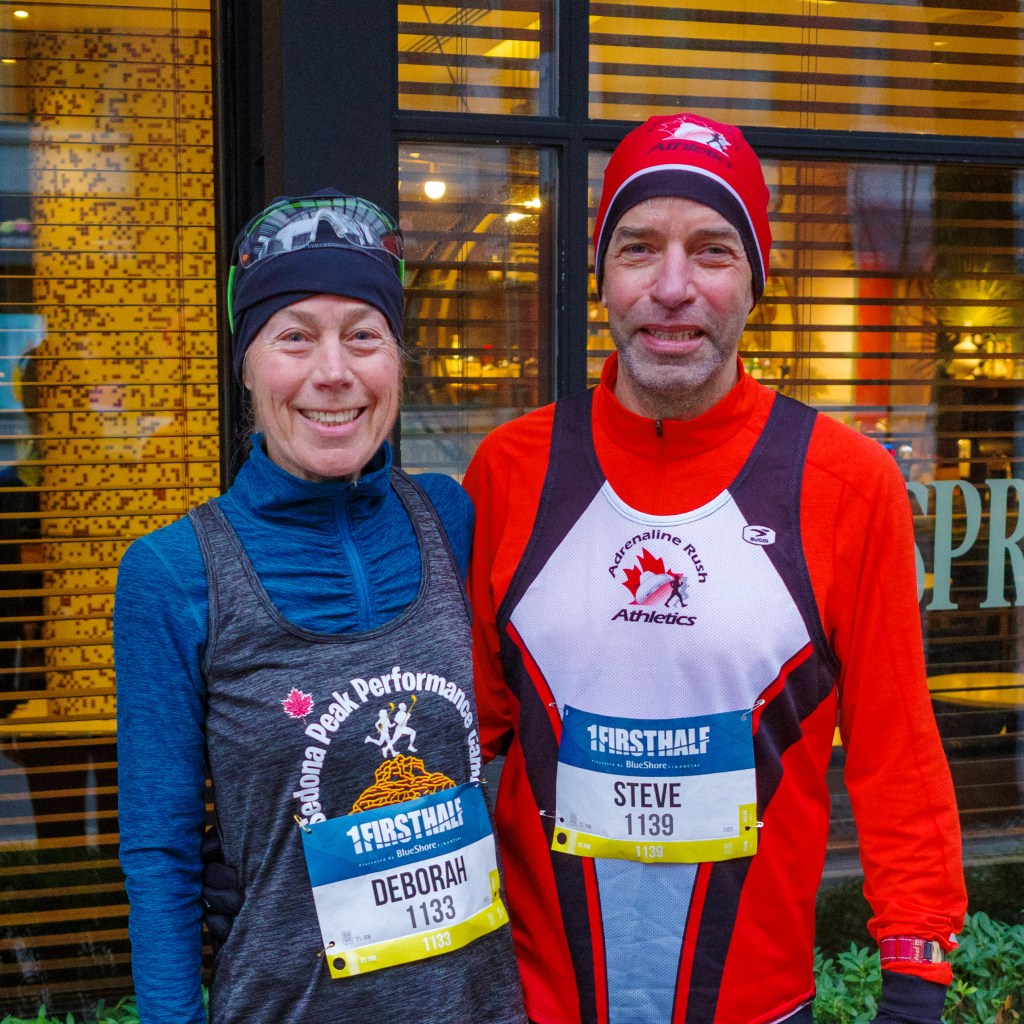
There may be more to the story than bad luck. You see, Sunday was two weeks on from a half-marathon that we ran in Vancouver. (Incidentally, it was the fantastic and well-organized First Half Half. Highly recommended!)

Although two weeks should be an adequate recovery period for a half, it got me thinking about how much downtime is enough after a race. I’ve always subscribed to an easy-to-remember formula that I learned years ago. It goes like this: treat yourself to one easy day for each mile you race.

Spelling it out, for a 10k race that means (more or less) a week of easy running; for a half marathon, two weeks; and for a marathon, a month.

There is a tendency to want to shorten these recovery periods. After all, if we had a positive race experience, why wouldn’t we want to get back in the saddle as soon as possible?

For me, that has usually not been an option. Inevitably, racing has taken more out of me than I’m willing to admit. Even after the immediate post-race soreness had cleared, the residual fatigue was too much to overcome in a few days. My effort in interval workouts or long runs during the recovery period, if I could do them at all, had to be scaled back significantly.

Add in the effects of aging, and whatever issues come along with it, and the rule-of-thumb recovery periods should get even longer. It makes sense that we aren’t as quick to bounce back as we used to be.

So, whether or not our recent experience was tied to an inadequate recovery or just bad luck, it’s worth remembering that a race puts major stress on our bodies. In summary, we should always respect the need for a full recovery.

A Special Race

For the second consecutive year, Debbie and I were in beautiful Vancouver, to run in the “First Half” Half Marathon (sponsored by RunVan). It was a special weekend. For me, just to compete in the race felt like an achievement. To run with Deb made it even sweeter. We met our goals for the race, after a long winter of training in Calgary. Several of our teammates and training partners were there with us. Even better was to spend the weekend with our son Matt.

Race Day, 2023

As satisfying as the race was for us, it was also a bittersweet weekend. You can read my race report from the 2022 race to find out why. I’ve reproduced it below. You will see why the First Half is a race that has special memories for me.

2022 First Half Race Report

We each have races that hold special meaning. The First Half Half Marathon in Vancouver is one such race for me. In 2011, it was the first race I ran as a new member of my club, Adrenaline Rush. That winter was harsh, even by Alberta standards, but my teammates and I survived some truly epic long runs on the path to race day.

The First Half is hugely popular. It regularly sells out in a day, so I felt lucky to secure an entry in 2013. In 2016, in a steady rain, I put together a solid performance and finished third in my age group. It was one of my best race results ever. My fondness for the race grew.

In 2017, things went from strange to scary. My wife Debbie and I travelled to Vancouver on Valentine’s Day weekend, only to have a freak snowstorm shut the city down. The race was cancelled. Then in July, my life was turned upside down by a series of strokes. Running at all became an open question. It looked unlikely that I would ever run in the First Half again.

But life has continued. And even better, it includes running. My return to the sport has been cautious. It now includes the pleasant option of running often with Debbie. I have started doing solo runs. And in addition to watching my teammates from the sidelines as an assistant coach, I now benefit from our interval training sessions.

Debbie, too, has ramped up her training. The idea of running the 2022 First Half was mostly hers, and while I wasn’t opposed to it, I wasn’t sure I would even make it to the start line. Knowing her as well as I do, I had no doubt she would put in the necessary hard work.

Our confidence grew through another tough winter as our long runs stretched out. We got to that inevitable point where we couldn’t wait for the taper. The weather outlook was for perfect racing conditions.

Finally, race day arrived. My phone rang as we got ready. Our sister-in-law, who had been bravely battling cancer, had passed away a few hours earlier. We knew this day was coming, but it was still hard to hear the news. As we had already put on our race kit, and knowing that Shelley was a great supporter of my brother’s running, we knew we had to carry on.

We got through the unusual rolling start and settled into our target pace. Through 17k, when my watch blacked out, this was a case study in good race execution. We handled the many distractions with ease: turns, fuelling, and traffic. Deb was in great form and running well. I was feeling good too. As always, the scenery in Stanley Park was a welcome diversion.

We felt the pull of the finish line in the last few kilometres. I could tell that both of us were in the same place mentally. I had warned Debbie about a hill in the last kilometre. She overcame it like just one more interval repeat. Our cruise into the finish felt smooth and effortless.

It was amazing to be in Vancouver again for an actual race. Our performance leaves me optimistic about the season ahead. I’m proud of Debbie, who trained diligently and delivered perfectly on her race plan. And me? I was happy just to have another chance at this race that I enjoy so much. Even though I ran with very different goals this time, I can report that the satisfaction is the same. Finally, on a sad day, we had another reason to experience this unique event, buoyed by memories of our late sister-in-law.