
Urban Sustainability? Hardly!

We live in interesting times in Calgary. I’ve formed strong opinions about what I see happening in my city. For many reasons, I think we’re on the wrong track. From what I’ve seen recently in other large Canadian cities, the same things are happening there, too.

One of the first pieces I wrote for this blog was on the topic of sustainability. You can find it here. My focus then was on objects that are perfectly designed for their intended purpose. They are sustainable, in that they can be expected to work perfectly for a lifetime (or longer) if properly maintained.

As I walk around inner-city neighbourhoods in Calgary, I’m bothered by a pattern that I see being repeated over and over again. Homes that have stood for decades are being levelled and replaced by one of two things: large, contemporary boxes or large, multi-family boxes. And it’s not just homes. Commercial buildings are being torn down and replaced by high-rise residential towers full of small (you guessed it) boxes.

Boxes, boxes and more boxes…

Why is this happening? Well, it is now presented as common knowledge that housing is a critical problem in Calgary. City administration has prepared or commissioned studies to explain the situation and how dire it is. I’ve read their material, and I’m willing to admit that I don’t know. I’m not an urban planner or a sociologist. Maybe it’s a crisis, or maybe it isn’t.

What I do know is that if I exercise my right to ask questions or comment on proposed developments that directly affect me, by writing letters to my councillor and city planners, the usual response consists of boilerplate talking points about housing supply and affordability challenges. I used to write such letters, but I don’t do so anymore. When a response starts with the words “because we are in a housing crisis…“, then it will include justification for all sorts of irrational actions.

As I said, I have many problems with this trend, but let me come back to that word, sustainability. I define sustainability as encompassing the social, environmental and economic aspects of a project. In my view, nothing in the current teardown and build cycle is sustainable. I’ve noticed that the experts who tout densification and the bureaucrats who facilitate it—the same people who are quick to extol its benefits—tend to be silent on this point. This isn’t an oversight; it’s because the facts don’t fit their narrative.

How about an illustration?

Yesterday, I walked by a row of three post-war houses. All were small, neat and well-kept. They have been standing for decades, so we know they have survived many brutal Calgary winters. The owners of these homes have replaced roofs, tended lawns, and done the hundreds of other routine tasks needed to keep them functioning. They have put their personal touches on them. These houses are not flashy, large, or modern, but they definitely are sustainable. On the evidence, these are the type of structures that stand in the way of solutions to our housing problem.

The impediments to solving our housing crisis… really?

Let’s contrast this scene with another, where a transition has already occurred. The houses that used to stand in this location were like the ones pictured above. They have been replaced by multiple, multi-family dwellings; in this case, four fourplexes.

Tell me, what problem is this solving?

To get to this point, three houses were demolished and carted to the landfill. I estimate this would have generated 400 cubic metres (200 tonnes) of waste. That’s without consideration of the concrete foundations, which represent more waste to the landfill, and heavy waste at that.

Pouring new foundations generates significant GHG emissions, because cement manufacturing is one of the most GHG-intensive industries. Of course, there will be a continuous stream of waste while construction is in progress. And our lush urban tree canopy? Gone.

What are the main development scenarios for inner city locations?

If we see a custom contemporary house going up, it’s usually large and built to serve the needs of a couple or a small family. In other words, there will be a lot of space dedicated to a few people. Don’t get me wrong. This is a free country, and people can build to their own taste and budget. But on a full lifecycle basis, it’s hardly sustainable.

If it’s a multi-family dwelling, it’s almost certainly going to be built by a developer who will target the minimum building standards. There will be pressed board exterior walls, thin insulation and interior walls, plastic pipe and cheap finishings. Unlike the post-war houses pictured above, nothing built today will last. We can be sure of two more things: the developer will realize a healthy margin, and the finished units will not be affordable.

What about commercial properties? To round out my review, I checked the progress on the long-planned demolition of the Jimmie Condon Building at the corner of 17th Avenue and 14th Street. Some would say the building is (sorry, was) historic, and others would say its pagoda-style roofline was an eyesore. Either way, if a picture is worth a thousand words, then this one is a mouthful.

Off to the landfill, Jimmie!

We hear a lot these days about the need to build more “climate resilient” infrastructure. In response, I’ll note that I’ve seen plenty of buildings shrouded in tarps a few years after construction, presumably to repair deficiencies in exterior construction or incorrect materials. That is neither resilient nor sustainable.

I’ll leave for another day related questions—like whether multi-family dwellings (or high-rise towers) will solve the apparent housing crisis that led to their construction in the first place. Or who ultimately pays for luxury condo units that sit on the market unsold, or peddled as short-term rentals. Or whether we should be replacing our city’s already small inventory of historic buildings with characterless, cheaply-built boxes.

To conclude, there’s a saying that a good crisis should never be wasted. I think our municipal government and administration are doing just that with their housing crisis. Their logic is simple: the more housing units that are built, the more tax revenue will be generated. So inner city buildings are being demolished at a rapid pace, with no consideration of what makes our neighbourhoods unique or desirable.

This is a trend that’s hard to justify if one is thinking sustainably. We’re targeting one objective—increasing the supply of housing units—at all costs. In this context, “at all costs” means neglecting environmental stewardship and economic sensibility.

Fortunately, the market has a way of correcting irrational behaviour. I hope we will soon see evidence that a much-needed correction is underway.

A Tribute to Gerard Rejskind

I don’t have hard rules for the topics on this blog, and there are times when I feel I need to write about something of importance to me. Or someone. This is one of those times.

Gerard Rejskind passed away a year ago to the day that I’m writing these words. I suspected something may have happened to him. As I’ve done occasionally if I’m unsure about someone’s personal situation, I reluctantly typed his name and “obituary” into Google. I was right… he died peacefully in Montreal in December 2023 after a short illness.

So who was Gerard?

It would not be true to say he was a friend. But as I wrote in a similar tribute piece almost two years ago, it is possible in our highly connected world to feel close to someone even if you’ve only spoken to them a few times on the phone. Through his writing, I came to know Gerard and understand him quite well.

Gerard wrote with passion, and he was the driving force behind an independent audio publication (UHF Magazine) that had a small but dedicated following. Through his reviews of audio equipment and recorded music, Gerard influenced many people, including me.

Let me first make a connection, between a subject that I do post about on this site… photography… and music. It isn’t a stretch to say that both these art forms have much in common. They are subjective; that is, they are things that cannot be quantified. If done well, they evoke an emotional response in us. And at their best, they are timeless.

When I found out that Gerard had passed away, I thought about the many ways he had influenced me over more than twenty years. Initially, I had been looking to upgrade my entry-level Sony CD player, a tinny-sounding thing. A colleague lent me a few back issues of UHF, and I was immediately hooked.

UHF (now defunct) was a publication unlike anything else I’d seen. With a modest budget and a small crew, Gerard managed to produce a magazine that bettered any of the big, commercial publications. It did so with a rare offering: totally honest reviews. There were none of the filtered, biased reviews that I read elsewhere. My favourite feature was a short, subjective paragraph from each of the review panelists about a particular piece of gear. This was invaluable for someone like me, who was new to the hobby.

Besides the magazine, Gerard also wrote a couple of books about “hi-fi”. Again, in plain language, he explained what the equipment did (or should do) and how it ought to be designed. This hit a chord with my engineering sensibilities. I found myself coming back to these books time and time again.

My wife will attest that I dropped everything when the latest print issue of UHF showed up in the mail. Because of their shoestring operation, the frequency of publication was, shall I say, variable. Gerard kept UHF going through COVID and his own health challenges. Those things only increased the appeal of the enterprise. I read every word of every issue, and I would save Gerard’s editorial page on the inside of the back cover until last. There, he would offer another nugget of audio wisdom, in his usual style… self-effacing, but with the authority he had earned over a lifetime of experience.

I’ve bought quite a lot of audio equipment and recorded music since I first encountered Gerard and UHF. In all that time, I wouldn’t think about buying anything unless I had checked to see if Gerard had reviewed the gear in question. If he liked it, that was good enough for me. If he really liked an item, he would become a distributor, which said a lot about his motivation. It was also quite convenient. I can honestly say he never steered me wrong.

Beyond all that, he made sure I and his other readers became more self-sufficient, by writing frequent articles and opinion pieces that educated us. In fact, the last edition of UHF, the 101st, consists of a series of introductory “101” pieces (in the usual nomenclature of first-year university courses) on various audio gear. It seems a fitting legacy to Gerard. The final paragraph of his last “State of the Art” piece is worth repeating here:

“The final rule is to do what we do: take notes, with details on
what you liked and what you didn’t. Concentrate on the music,
which is the purpose of the system in the first place.”

Gerard was a rare person: an honest businessman; a knowledgeable and generous resource; and above all, a gentleman. He will be missed.

Now I think I will go and put on a record and re-read some of his pieces.

“So It Goes”

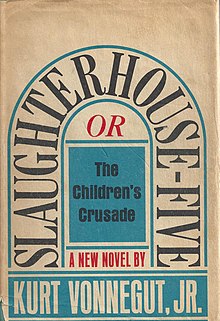
Anyone who has read Slaughterhouse-Five (SH5) by Kurt Vonnegut will recognize this phrase. It stays with you after reading the most famous (or is it infamous?) and arguably the most representative of Vonnegut’s novels.

I’m not sure if SH5 is still required reading in high school English courses… I know it used to be. (I’d be reluctant to guess what required reading might be in high school these days, but that’s another topic.) For my part, I missed the opportunity to read SH5 when I was in school. Perhaps the book wasn’t considered appropriate fare for a Catholic school curriculum.

I’ve only come around to Vonnegut’s works in the last few years. I did read Galapagos in my early twenties, but I found it to be quite forgettable… it certainly didn’t convince me to read anything more by him. Maybe I wasn’t ready for the author’s unique style and keen critical eye.

Something must have changed, because I’ve read three of his books in rapid succession. In this post, I offer my thoughts on what may be his best-known novels. My comments are organized in my order of reading, which just happened to be in reverse order of their publishing date.

Kurt Vonnegut

The author of the books I’m going to discuss is worthy of some discussion himself. Kurt Vonnegut, Jr. (1922-2007) was born in Indianapolis, to German immigrants. He attended Cornell University but dropped out in 1943 after being placed on academic probation. He enlisted in the US Army and was deployed to Europe in 1944 as an intelligence scout. After the war, he pursued academic and technical career paths, never quite succeeding at anything. Vonnegut had a couple of stories published in the early 1950s, which persuaded him to give up other opportunities to pursue writing full-time. His success as a writer did not happen overnight.

Slaughterhouse-Five (1969)

It’s a challenge to summarize SH5. At its core, the story is an account of the Allied fire-bombing of Dresden, Germany in the final months of the Second World War. What genre is the book? Good question. There is an element of historical fiction, but it could just as easily be classified as science fiction. Given that the book was influenced by Vonnegut’s time in the US military, we could even label it as a biography. The author was captured by the Germans, and as a POW he witnessed the destruction of the city firsthand.

In Vonnegut’s signature style, there is a sharp satirical edge to the book. Vonnegut makes no secret of his disdain for “military intelligence”. The casual disregard for life in wartime is a theme repeated often in the book… almost sickeningly so. I think that’s exactly the response Vonnegut wants to elicit from us. That’s where the phrase “so it goes” comes from. SH5 was published at the height of the anti-war movement in the US, and it was the book that made Vonnegut a household name.

The main character in SH5 is Billy Pilgrim, a US draftee. The science fiction element to the story is that Pilgrim experiences time travel. He calls it coming “unstuck in time.” I think the message here is that history is bound to repeat itself. I found this to be a very effective tool; one that shows Vonnegut exercising his full prowess as a mature storyteller.

To summarize, I thought SH5 was brilliant. An amazing creative piece… forceful in its social commentary and totally original. Considering the current events in the world, it is as timely now as when it was written. Very highly recommended!

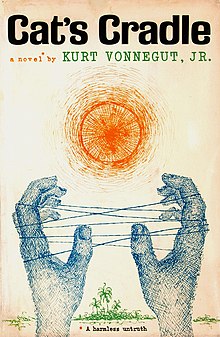
Cat’s Cradle (1960)

Where to begin in explaining this novel?

Cat’s Cradle is a first-person account of the narrator, Jonah, who travels to San Lorenzo, a fictitious and extremely poor island nation. Through an unbelievable sequence of events, Jonah becomes president of the country. At the subsequent inauguration ceremony, an unfortunate incident results in mass destruction on a global scale, when a material called “ice-nine” accidentally comes into contact with seawater.

The book deals with two important themes and manages to touch on several others besides. One major subplot in the book is a fictitious, hedonistic religion called Bokonism. It is the dominant religion in San Lorenzo, seemingly a response by the poor citizens of the country to their dire socioeconomic circumstances.

The book is also a biting commentary on the risks of technology. Ice-nine was invented for military purposes by a brilliant scientist who has complete and callous indifference to the great risks it poses. The obvious parallel is to the proliferation of nuclear weapons, which would have been in Vonnegut’s mind when he wrote Cat’s Cradle in 1960. The story takes the idea of a manmade technological threat to its logical and tragic conclusion.

Only someone with a vivid imagination, black humour and a gift for sharp insight… someone like Vonnegut… could have created Cat’s Cradle. It was a fascinating read, and like SH5, very relevant to the unstable world we find ourselves in.

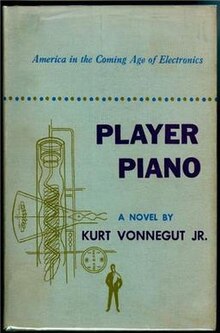
Player Piano (1952)

Player Piano was Vonnegut’s first novel. It tells the story of Paul Proteus, an engineer and manager of the Ilium Works, one of many large industrial complexes that have radically revamped American society. Machines have replaced human beings in every facet of life. For his part, Proteus becomes increasingly uncomfortable as he is being groomed for an expanded role in the system he helped create. The story turns on a clever “double agent” plot, as Proteus finds himself aligned with other, like-minded rebels.

As compared to the other novels, I found the storyline in Player Piano to be the least risky… maybe even simplistic. There are no tricks with time travel here. I suspect Vonnegut was still finding his voice and his style when he wrote the book. Even so, it is a well-constructed story of an all-too-possible dystopian future. Such a future may have been easy to imagine in the early 1950s, as post-war innovations began to change American society; at least it was for Vonnegut.

Of the three novels, Player Piano had the most impact on me. I accept that as a result of my own work as an engineer and manager. Did my career path make me more sensitive to the sharp commentary that Vonnegut dishes out for these vocations in his grim novel? Probably. I don’t take any of it personally, but I do relate to his criticism of an unbridled drive for efficiency.

The world Vonnegut imagines in Player Piano is devoid of almost all pleasure, at least for the average citizen. For the elite (that is to say, the politically savvy) the upside is limitless, as long as the growing majority of displaced citizens are kept notionally busy and marginally employed. It’s a novel that heads to an inevitable tipping point.

The fatal flaw exposed in Player Piano is a conflation of an unstoppable quest for perfection (in countless industrial processes and even in human interactions) with human happiness. I found myself making connections to recent opinion pieces that assess the risks of the increasing use of Artificial Intelligence in our society. Again, Vonnegut’s story seems eerily relevant to our current circumstances.

I can recommend all three of these Vonnegut novels. In my view, his social commentary is timeless, and that keeps the books current. I want to continue my exploration of his work, to see how well his insights have held up in other areas.

Until next time, be well and BE FAST!
Carmela Kelly (1931-2024)

My mother passed away on July 6, 2024. The world was a better place while she was in it. Now comes the tough part.

Here’s some text from her obituary, which was published in today’s Hamilton Spectator.

With heavy hearts, we announce the passing of Carmela Mary Kelly (née Celi) in her 93rd year. Carm’s birth in a house on MacNab Street was made more joyous to her parents Giuseppe and Rosa Celi by the unexpected arrival of a twin sister, Concetta (Connie), who survives her. She is also survived by a brother, Anthony, and predeceased by a sister, Mary. Carm married the late Kenneth Kelly in 1958, and they had four children. Carm’s grandchildren … were a constant source of joy. Birthdays and holidays were better (and livelier) when celebrated at Gramma’s house, her home for many years. Carm was an avid crossword solver, a keen knitter, and an enthusiastic Tiger-Cats supporter. She enjoyed these activities most from her favourite pink chair. Her cookie tins were never empty, and her spaghetti & meatballs were legendary. She had an eye for fashion, and for years she enjoyed watching the Oscars. Carm was dedicated to her family, for whom she made countless sacrifices. Her generous spirit enriched many lives. Carm found great comfort in her faith, and she faced life’s many challenges with grace. We will struggle to deal with the loss of our beloved mother, grandmother, sister and friend. …

Carmela Mary Kelly (1931 – 2024) Photo: Shelley K

I wrote quite a bit about my mother in Stroke of Luck, and there’s a good reason for that. She was an inspiration. By doing nothing more than being herself, she made the lives of her family, friends, coworkers and neighbours better. That is quite a legacy.

My mother’s eyes are unmistakable in photographs from her youth. Her shy smile hints at her quiet, introverted personality, and tells the story of her growing up during the Depression and the Second World War. She worked as a secretary at Stelco for a while after high school but put aside her own ambitions once she was married. Years later, when we were all grown, she would take a job as a receptionist at a long-term care facility. She soon became indispensable to the staff and residents there. Of course, we knew that would happen because she already was indispensable to us. It was a small step, and one that let her regain some of the self-confidence that had been eroded by too much time and too much worrying about other people.

Mom has handled difficult times with grace and resilience, and she has faced more than her fair share of difficult times. Pain and grief entered our lives when I was in my early teens. This happened in two separate but related ways. At least they are related in my mind. What I know is that nothing was ever quite the same afterwards, and nothing could ever be taken for granted again. Had we crossed some kind of a dividing line, a transition from the innocence of youth to whatever was to come next? I’m not sure. As for my mother, I never heard her complain or shirk from what she had already accepted as her duty. Given her upbringing, I suspect she had never taken anything for granted as it was.

Goodbye mom. We will miss you terribly. May God bless you and welcome you.

Don’t Stop Believing

Sometimes life is hard.

It will be obvious from the long gap between posts that I haven’t been thinking much about the blog lately. It has been a difficult time on the personal front. I don’t feel like going into the specifics… maybe I will someday. 

Several times, I’ve tried putting my feelings into words, never sure if the result would end up in a blog post. Each time I’ve tried, it has been a failure. It’s frustrating, especially since I’m usually not at a loss for words. 

Music seems to help. As I write this, I’m listening to Car Wheels on a Gravel Road, a classic album by Lucinda Williams. This is melancholic music. It suits my mood and I think it makes me feel better… it’s hard to say. The lyrics of one of my favourite songs, Time from Pink Floyd’s Dark Side of the Moon, have been stuck in my head. This verse seems appropriate. 

Every year is getting shorter
Never seem to find the time
Plans that either come to naught
Or half a page of scribbled lines

My half pages (not literal, of course… they’re typed on my iPad) have been piling up, as I’ve grappled with anxiety. I’ve been feeling helpless against our overwhelming insignificance. Our impermanence. Our mortality.

North Glenmore Park pathway, April 2024

Then came a breakthrough of sorts. It was in a situation that might not be conducive to finding inspiration. But it was no surprise to me because I was running at the time. Anyone familiar with my story (Stroke of Luck is still available, by the way) will know that running has often been a source of consolation and positivity in my life.

To set the scene, I met a small but hardy group of my teammates at Carburn Park in Calgary for an interval workout. It was a ladder workout, which for those who aren’t familiar, is a session with increasing length intervals. This workout, with intervals of 400m up to 2000m, looked daunting. Each set totaled 5.4k, and Coach Janice had specified 2-3 sets. I had to go back to her to confirm the details because it seemed that she must have miscalculated. This was TOO MUCH!

To add another degree of difficulty, the weather was awful. The threatening sky opened up just as we finished our warmup jog around the lagoon. Clouds turned to rain, then snow. My eyes were being pelted with icy crystals. We were soaked in no time. The temperature hovered just above freezing. 

We ran south beside the steel-blue water of the Bow River, and I began to wonder what on earth we were doing. It didn’t help that I was the slowest runner in our group, meaning I also had the pleasure of watching my friends stretch out and away from me as the first set wore on. 

As I approached the turnaround point, now miles from my warm car, my mood lightened. I was enjoying this. Even as my vision was being obscured by sleet, my thoughts were becoming clearer. Then, as if on cue, the sun peeked out briefly, casting a warm glow on the wet pathway in front of me. (I didn’t bring a camera on this run… it would have been waterlogged… so I can’t even show you a picture of that special but fleeting moment.)

By now, I was totally on my own. My teammates were out of sight and the pathway was deserted. I was enjoying the feeling of movement, of being in control. Running was proof of life. I was thriving in what had just a few minutes earlier seemed an impossible task. 

Then the following thoughts came into my head, without any prompting:

  • I don’t have all the answers
  • Sometimes there are no answers to find
  • All I have to offer is my best effort
  • I can only control what I do, not what anyone else does 

I eventually made my way back to Carburn, where I caught up with my teammates. They had waited for me… how nice! We were soaked, shivering, and content. We patted each other on the back for getting through this monstrous workout on a rotten night, together. On that day, we were all heroes. Of course, even heroes need to dry off and warm up, so we said our short goodbyes and headed home. 

With my mind clear, even if temporarily, I was ready to face whatever challenges were still waiting for me. Running and music and writing can help me figure things out, even if the answers themselves remain elusive. 

Look for more pieces and photography soon. 

Peace.

Two Recommended Short Novels

I read two short but impactful novels with similar themes over the weekend. It helped that our weather was more suited to reading than outdoor pursuits. I’d been looking for something quick to read, and the books I chose were the thinnest ones on my shelf. (I know, not the best way to choose a book.) By coincidence, my selections turned out to be profoundly complementary. 

The Old Man and the Sea

First up was The Old Man and the Sea, Ernest Hemingway’s Nobel Prize-winning 1952 novel. I read this book in high school, but that was long enough ago that it seemed timely to read it again. I’m glad I did.

The book tells the compelling story of Santiago, an old Cuban fisherman who has had a long stretch of bad luck. He and his young apprentice, a boy named Manolin, share a tender friendship, even though the boy’s family has forbidden him from working with Santiago due to his lack of success.

Santiago’s luck changes all at once, alone and far out at sea. He hooks a huge marlin, the biggest one he has ever seen. He spends more than two days landing the fish, against all odds. It is so large it has to be lashed to the side of his skiff. His triumph soon turns to despair as sharks consume the fish, leaving him with only a carcass by the time he reaches his home port. 

The story resonated with me, for several reasons. Santiago’s optimism never wavers. His lifetime of experience equips him with the confidence to face his many challenges as they arise. Even the loss of his prize fish does not defeat him; his lifelong dedication to his craft allows him to transcend this tragic event. For me, the lesson is clear: we must never give up.

Here’s a passage I thought summed up the whole story:

“I wish I had a stone for the knife,” the old man said after he had checked the lashing on the oar butt. “I should have brought a stone.” You should have brought many things, he thought. But you did not bring them, old man. Now is the time to think of what you do have. Think of what you can do with what there is.

Ernest Hemingway, The Old Man and the Sea

In my own memoir, Stroke of Luck, I use the phrase “be curious, be diligent, be humble” to describe my approach to life. It was gratifying to read that Santiago relied on these same traits to get through his ordeal. Existence is fleeting, and we must never lose sight of what we have in the here and now.

Train Dreams

My second book of the weekend was Denis Johnson’s novella, Train Dreams. In just 116 pages, Johnson takes readers on a broad sweep of American history, across the rugged frontier of the Pacific Northwest. The main character, Robert Grainier, is a labourer and woodsman who works on some defining projects in the region.

Grainier suffers the unbearable loss of his wife and infant daughter in a catastrophic forest fire, and lives the rest of his long life in the woods as a solitary figure. He struggles with the guilt of surviving, and only through his dreams does he come to accept his loss.

As readers, we experience the loss of the frontier that is rapidly being transformed… consumed… to feed an expanding American economy. Grainier himself becomes the symbol of a disappearing way of life.  

I found some striking similarities in these two books. Hemingway is well known for his clear and direct writing. Johnson’s prose is sparse and powerful too. He conveys horrific and sometimes funny scenes with an economic writing style. Here’s a particularly evocative passage:

All his life Robert Grainier would remember vividly the burned valley at sundown, the most dreamlike business he’d ever witnessed waking- the brilliant pastels of the last light overhead, some clouds high and white, catching daylight from beyond the valley, others ribbed gray and pink… and beneath this wondrous sky the black valley, utterly still, the train moving through it making a great noise but unable to wake this dead world.

Denis Johnson, Train Dreams

The protagonists of these novels, Santiago and Grainier, are both strong and solitary figures, who face hardship with dignity and ultimately find a way to carry on. 

The men in these stories are engaged in very different struggles against nature, on opposite sides of the continent. It occurred to me that in the current zeal for “cancelling” books on topics deemed to be incompatible with contemporary values, these two could well be targets. I hope that doesn’t happen, as the books reinforce several key messages: having strength of character is a good thing; hard work and aspiration for success are to be celebrated; and accepting personal responsibility for one’s actions is a sign of maturity.

I highly recommend both of these books!