It’s Relay Season!

June 20 Update

I wrote this piece to celebrate the relay races we enjoy here in the mountain parks. We’ve had a reminder in the last few days of the awesome power of Mother Nature. Heavy precipitation and strong winds are expected over southern Alberta this weekend, and that has led to the cancellation of the 2025 Kananaskis 100 Mile Relay. A tough call, but the right one by Cheryl and her team at Be There Races. It’s a shame that we’ll be deprived of this classic race this year… see you in 2026!


Time is short to get your copy of Stroke of Luck for a discounted price. Order on Amazon and save! Sale ends on June 30.

Help me raise funds for the essential work of the doctors and staff at Foothills Stroke Unit!


While we tend to think of running as a solitary activity, some of my fondest memories are from races where I competed as part of a relay team. I’m not referring to just any relays though. We are fortunate to have some world-class multi-stage relay races in Canada. And some of the best races take place in the Rocky Mountains—perhaps not surprising given the majestic scenery available here. 

With our variable weather, June is the unofficial start of road relay season. Here’s a short personal history of my connection to the best mountain relays. I’ve also mentioned a couple of other major road relays in Canada and the US.

History of Multi-stage Relay Races

The Japanese have a long tradition of races based on the ekiden, which is an age-old method of staged courier transmission across long distances. “Eki” translates to “station” and “den” means “to communicate, to convey”. For more than 100 years, ekiden has been a popular sport in Japan, and this may have been the origin of similar races in Canada. The popularity of multistage road races has grown, and there are now events around the world. Of course, relays can be on roads or trails, although my focus is on road races.   

Jasper Banff (later Banff Jasper) Relay

I’m not a historian, just an amateur athlete with a long resume and a keen interest in the sport. I think of the Jasper Banff Relay (JBR) as the grand-daddy of Canadian distance relays. Much of the race course follows the Icefields Parkway (Highway 93), so it certainly offers the most magnificent scenery.

The original race (contested from 1980 to 2000) started at noon in Jasper on the first Saturday in June. It ran continuously towards Banff, over 258 km and 17 stages of varying length and difficulty. Needless to say, there were some tough stages, like the climbs up to the Columbia Icefields and the high point at Bow Summit (2,088 m).

My research suggests that this is the oldest multistage race in Canada. I might be wrong—I don’t know of any others with such longevity. The race had a hiatus from 2000 to 2005 before it was relaunched in a new format. 

My first experience of multistage relay races goes back nearly 40 years, to the 1988 JBR. I wrote about this specific race in Stroke of Luck, because that weekend in the national parks made an indelible impression on me. The JBR was a huge event in its heyday—just the sight of 120 teams of 17 runners converging on the small mountain town of Jasper was awesome.

I ran stage 13 in 1988. Bad luck? Well, yes. I coped with a bear warning and a drenching nighttime thunderstorm while running 20 km in pitch darkness. It was daunting, but also one of the most memorable running experiences of my life. Our team of 12 men and 5 women battled hard for 19 hours and 10 minutes to a 2nd-place finish in the mixed category and 15th overall.

I went on to run the JBR twice more, in 1990 and 1991. Then, in 2008, I was asked to run in Stage N14 of the revamped Banff Jasper Relay. (The race now consists of simultaneous South (S1-S6) and North (N7-N15) races to avoid overnight running.) We placed well that year, but I was NOT in race fitness. While these were all thrilling and exhausting races, none could match the 1988 race for sheer excitement.

Kananaskis 100 Mile Relay

The success of the JBR spawned competitors, and the most prominent of these is the Kananaskis 100 Mile Relay (known to all as the “K-100”). The K-100 has run annually since 1987. It starts in the foothills, in the small town of Longview, Alberta early on a Saturday in late June, and follows Highway 40 to the Nakiska ski lodge. The race covers (surprise!) 100 miles in 10 stages, including one trail stage. There was an individual 50-mile ultra on the same route for a few years.  

My records are a little sketchy when it comes to the K-100. I think I’ve participated eight times. I’ve run on club teams and corporate teams, going back to the late 1980s: first the Fort Saskatchewan Kilomilers, then a couple of Shell Canada teams, and more recently for Adrenaline Rush Athletics. I last raced in 2017, a couple of weeks before my hospitalization for strokes (and that is definitely a story for another time!) 

At its peak in the early 2000s, the race was limited to 180 teams. Now, the race is capped at 80 teams. There were 40 finishers in 2024. I remember the corporate and open divisions being intensely competitive. I will venture a guess that the decline in race numbers is due to the fortunes of the Calgary business community, and limitations imposed by Alberta Parks.  

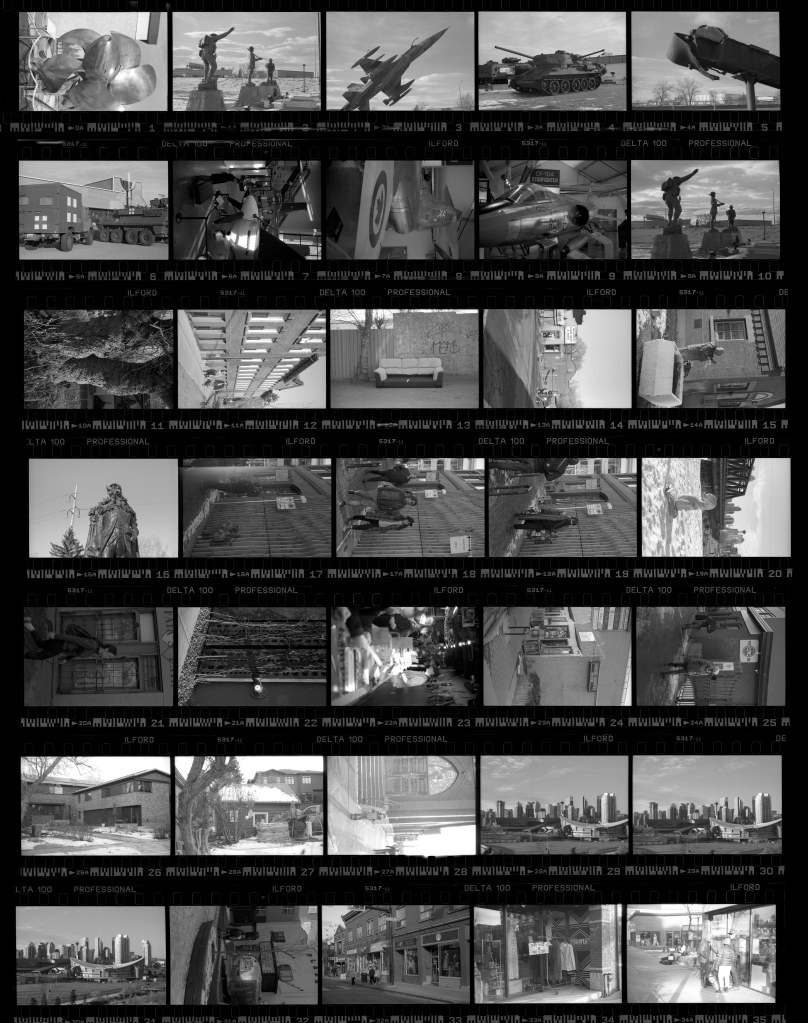
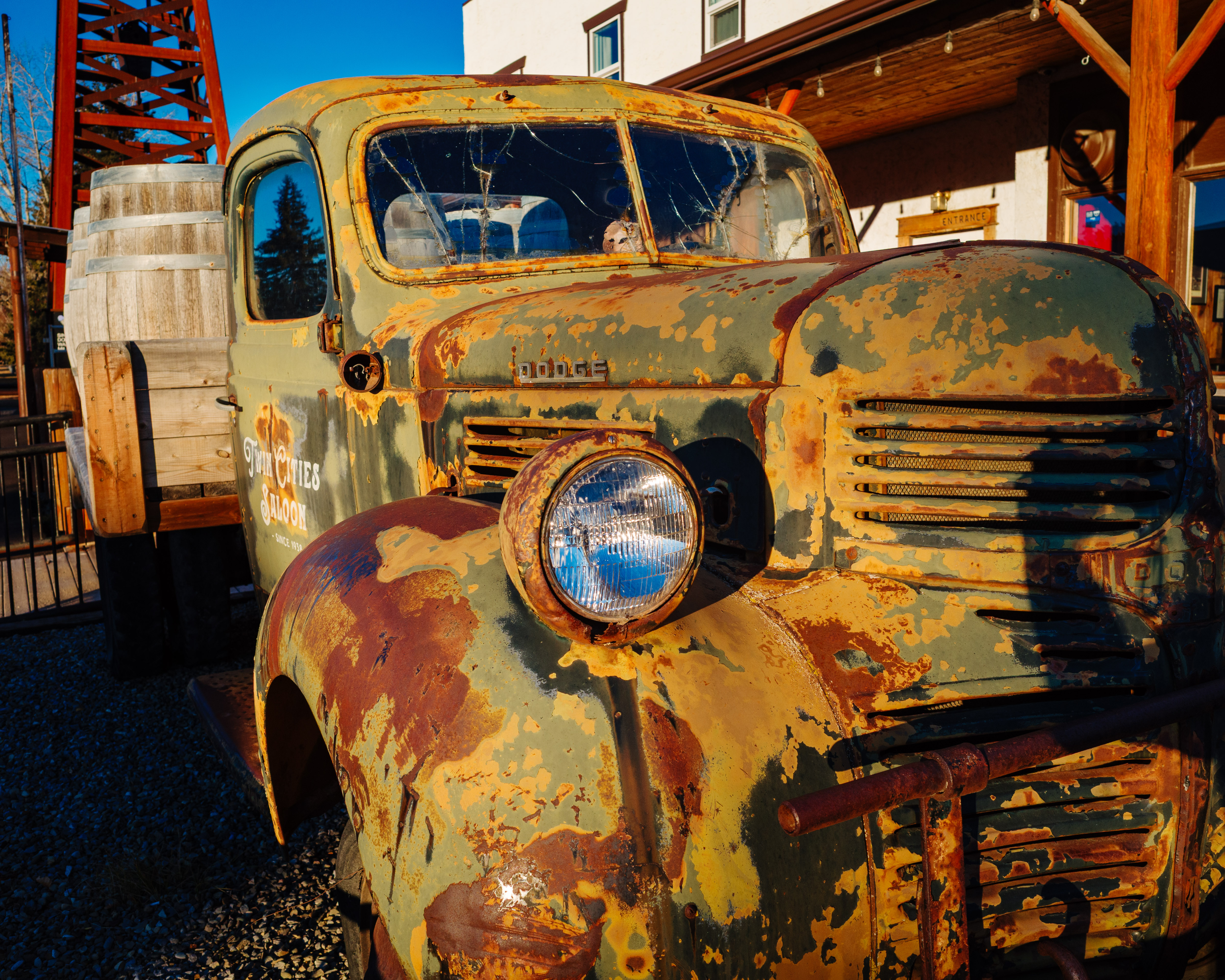
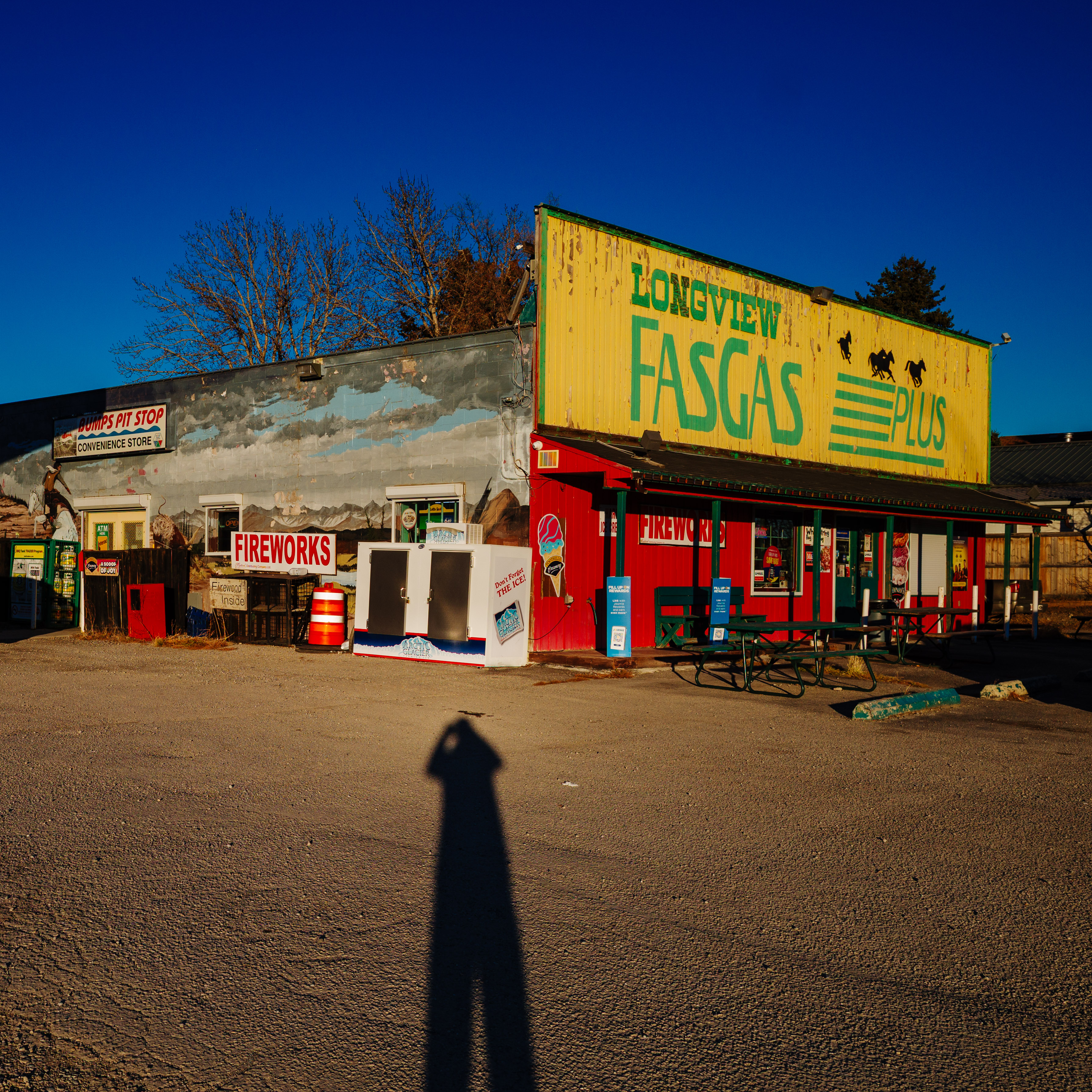
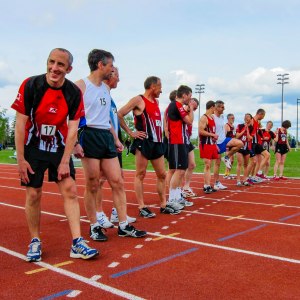
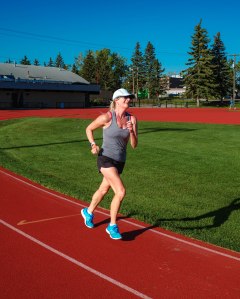
Over the years, I’ve run stages 2, 4, 8 and 9 of the K-100. I like stage 8 best. It’s kind of a Goldilocks stage—not too long or too short, not too flat or hilly. I’ve had many good memories and a good track record at the K-100, coming home with a podium placing several times. I like the race a lot, not least because it wraps up in one long day. There’s lots of variety and challenge over the 100 miles, including a summit of the Highwood Pass. Here are a few pictures:

Other Road Relays

There are other multi-stage road relays. Some have come and gone, and new ones are popping up. The following races have endured:

Concluding Thoughts

I’ve had many great adventures and some success as part of road relay teams. If you haven’t tried one, I would highly recommend that you do. There is something special about sharing a race experience with a group of friends, adding a team dynamic and plenty of unknowns to your ordinary running. Long, unbelievably beautiful and sometimes lonely stages (think time trials), and daunting course profiles intensify the experience. You can feel the anticipation (and exhaustion) build as the race carries on. It can be especially exciting if you are locked in a tight competitive battle. In short, it’s a lot of fun!

Until next time, be well and BE FAST!

Calgary Marathon Action!

Did you know that June is Stroke Awareness Month in Canada?

To raise awareness of the prevalence of stroke, I’m once again offering my memoir—Stroke of Luck: My Life in Amateur Athletics—for a special price in June. Order your copy on Amazon and save 20%.

Help me raise funds for the essential work of the doctors and staff at Foothills Stroke Unit!

Calgary Marathon Weekend

It was a great weekend for racing, and this year a record number of runners laced up for the 61st edition of the Calgary Marathon. Across several races, more than 17,000 runners turned out. Race distances were from 1k (toddlers only I’m told) right up to the marathon.

The Calgary Marathon is the oldest in Canada. It’s only a few years younger than me. Speaking of being younger, I dug into my archives to share with readers my own history with this storied race. Then, I’ll share some highlights from the 2025 races, where I was strictly a spectator!

1987 – A milestone is reached!

It’s hard to believe, but I first ran the Calgary Marathon in 1987—I had to check my math to verify that it was 38 years ago. At the time, Deborah and I were living in Edmonton, which means we made the trek to Calgary in an underpowered Honda Civic.

The race route is shown below, copied from my well-preserved race entry.

The race entry fee, for those who are used to paying over $100 now, was $12. And that included a cotton singlet, which has curiously not survived—I don’t even remember it. The NB 990 shoes I wore are also long gone. However, I was a proud member of the Edmonton Roadrunners in those days, and my club singlet is still around, buried in a drawer somewhere.

The 1987 Calgary race was my fourth marathon, and it turns out that race bib 13 was not unlucky. In fact, it was a notable race, because I managed to go under 3 hours for the first time—2:58:30 to be precise.

You can see my relief in this finish-line picture. I finished 42nd overall, and 7th in the (yikes!) 18-29 age group. And yes, that last bit makes me feel old!

1992 – Another milestone

I’ve had a long love-hate relationship with the marathon. As evidence, it was five years before I would tackle the distance again. In July 1992, I came into the race—called the Calgary Miracle Marathon that year—in what may have been the best shape of my life. We had moved to Calgary in 1991, so I felt I had a home-field advantage. What’s more, in the two months before the race, I had set PB’s in the half marathon and 10k, so I was full of confidence.

In Stroke of Luck, I wrote about how my careful race preparations were almost upset by unplanned events on race morning. Here’s an excerpt:

“I went through my final planning for race day. Then everything just about fell apart. Our son Daniel, who was by then nearly a year old, had been a sound sleeper most of the time. However, on this night, he had some unknown issue that kept him up until the early hours. I was reduced to lying in bed with my eyes open, thinking about what this would do to my marathon in a few hours. … Finally, Daniel quieted down, and I fell asleep. Too soundly, as it turned out. In addition to my other troubles, I had set my alarm incorrectly and it didn’t wake me up when I had planned. The only thing that saved me was my decision to take a cab to the race. The sound of the driver honking his horn was my alarm. At first, the sound was part of a dream, but as the cobwebs slowly cleared it dawned on me what had happened. I leapt out of bed, totally skipped my normal race day breakfast, and jumped into the car for the short ride downtown. Still half asleep, I stowed my bag and headed to the start line, believing that my day was ruined.”

It turns out I need not have worried. While I did run well, setting a PB by 7 minutes, I remember being disappointed at the finish. Over time, that disappointment has softened, to the point where I’m now quite content with my 2:51:39 result. I finished 20th overall, and fourth in the 30-39 age group.

Unfortunately, no photographic evidence or T-shirts have survived from that momentous 1992 race, and there were no finisher’s medals. But that’s okay, as I’ll never forget that day. I can still relive the entire race in my mind.

One thing I did keep is the scrap of paper where I scribbled all my race splits. Like me, my friend John has a few more gray hairs now than he did in 1992.

And yes, my last mile (7:53) was extremely slow!

To show how much things have changed in the last 30+ years, here’s a scan from the Calgary Herald article on the 1992 race. My friends and training partners—Dave Purcell (4th) and Rick Webb (6th)—had a very good race.

2001/2010 – Nothing to see here

I ran the 2001 and 2010 marathons. Neither was my best outing. We can move on…

2025 – Strictly spectating

As has become my custom, I like to find a convenient spot on the race route to watch the action and take pictures of the runners. This year was no different, other than the fact that the races are now split between Saturday (5k and 10k) and Sunday (half and full marathon). So, yes, it means getting up early both days on the weekend, but I wouldn’t want to miss the fun.

I was watching for teammates and friends and I had to be alert. I find it particularly hard to spot familiar faces AND take their picture, which is too bad, as that is the whole point!

Anyway, here is a collage of photos from the races. I ended up with a lot of good pictures, so it looks like I’ll be sifting through them for a while. Starting with the 10k, where I set up at the 7k mark, just as the runners came off the Centre Street Bridge:

And here’s an album from the half/full marathon. For this route, I set up on 14th Street, just around the 14k mark. This year, the morning light was amazing, even though it meant the conditions were a bit warm for the runners:

I have to make special mention of John Bird, who ran the half marathon in his pilot uniform while pulling a roller suitcase. John set a Guinness World Record for the fastest half marathon in this outfit, and he is raising money for Dreams Take Flight, a very worthy cause. Congratulations John!

Finally, there were some cool non-running scenes, for example at the 11th Avenue water station. It was a bit chaotic, but that’s what makes it fun.

As always, if you want to use/distribute any of these photos, please give me a photo credit.

Until next time, be well and BE FAST!

Book Review: “Today We Die A Little”

Today We Die a Little: Emil Zatopek, Olympic Legend to Cold War Hero, by British journalist and author Richard Askwith, tells the fascinating story of the great Czech runner, Emil Zatopek.

Zatopek was an enigma. His life paralleled his country’s history and is intertwined with the Second World War and the rise and fall of the Soviet Union. Askwith did a thorough job of researching his subject.

The Czech Locomotive

Today, if people know anything about Zatopek, it’s likely because of his ungainly running style. Videos of his great performances are easily found, and worth a look. But his rolling head, flailing arms and gnashing teeth may be the least interesting part of his story.

Emil was a true sportsman. His nickname comes from a front-running style that left his competitors strung out behind him. He befriended those same runners and maintained contact with them well into old age. His training techniques were unorthodox. For instance, he was known to train in army boots, or in deep snow. Any of us who have done interval workouts can thank Zatopek—he may have invented 400m repeats. The difference? He did 60, 80, even 100 of them—every day.

Emil Zatopek, giving it his all (Photo: Roger Rössing, Deutsche Fotothek)

There are so many anecdotes about Zatopek that it’s nearly impossible to separate fact from fiction. I give Askwith credit for trying. Some things aren’t in dispute though. Emil taught himself 8 or 9 languages by reading dictionaries. He and his wife, Dana, won 4 gold medals at the 1952 Helsinki Olympics—a count that was second only to the US. Emil won the 5000m, 10000m and marathon, a record likely never to be repeated. Dana won the women’s javelin competition.

Socialist icon or misunderstood hero?

Zatopek may have been the most famous athlete in the world in the late 1940s and early 1950s. Few could match his talent and charisma—he was the Muhammad Ali of his generation. Even after his competitors copied his tactics and started surpassing him, he remained a national hero. It seemed everyone wanted to meet him and feel the warmth of his personality. 

The story that best demonstrates Zatopek’s generosity has him handing a small package to Australian runner Ron Clarke after Clarke visited Emil in Prague in 1966. Clarke had competed at a high level internationally but had come away empty-handed. Zatopek had been the perfect host, readily sharing his training advice. Clarke assumed Zatopek had given him something he wanted smuggled out of the Iron Curtain. In fact, it was one of Zatopek’s 1952 Olympic gold medals. “Because you deserve it,” read the simple inscription. 

Despite the constraints imposed by the Czech regime, Zatopek travelled the world. In fact, he became a sort of role model for socialist ideals. And it’s here where his story gets a bit hazy. Depending on who one believes, Zatopek was either a naive pawn of the regime or a committed agent. He was an officer in the Czech army, so it’s hard to totally accept the former view. However, he had managed to tread a fine line for a long time, apparently avoiding any suspicion of his commitment just by being his gregarious self. Or perhaps by mouthing the words that were expected of him.

Some things may never be known about Zatopek, but it is clear he believed in the concept of socialism. After all, it was how he had tried to live. When Soviet tanks moved in to crush the Prague Spring in 1968, he spoke up for compromise, possibly hoping his celebrity would save him from retribution. Soon after, he was expelled from the army, stripped of his status as a sporting hero, and exiled to years of manual labour in remote work camps. Through it all, he maintained a positive attitude. He was a broken man when he was finally allowed to return to his modest home. Then he suffered several strokes and was all but forgotten when he died in 2000.

Lessons far beyond the track

Askwith is sympathetic to Zatopek, and I found that his enthusiasm for the man clouded his judgment at times. If Askwith is to be faulted, it is for trying too hard. I came to accept Askwith’s case—that there is reason to doubt the worst accusations against Zatopek—and I found it unnecessary that he keep making it.

As for Zatopek, there is no reason to fault him for his eccentricities. He was an intelligent, independent and humble man. I found myself wondering how any of us would have managed in his situation; if our homeland had been first taken by the Nazis, then by the Communists. Zatopek lived and competed bravely, and left us lessons that go well beyond the realm of amateur competition. 

The “Czech Locomotive” was a complex figure, a great athlete, and a gentleman. Askwith’s book is an homage to Zatopek, and there is much to commend it—not least so the reader can decide for themselves how they view the man. I started the book and put it aside for a while. When I persevered, I was rewarded with a complete picture of an astonishing athlete. I’m glad I did.

By the way, the title of the book comes from the comment Zatopek made to his fellow competitors on the start line of the 1956 Olympic Marathon in Melbourne. By then, Zatopek was well past his best form. The day was brutally hot, and he made his remark just as the runners set off for what they all knew would be an extreme physical test. It was a noble gesture. Anyone who has set a challenging goal for themselves and worked hard to achieve it will relate to the sentiment.

Until next time, be well and BE FAST!
Vancouver Marathon – 2015 to 2025

What follows is a story separated by exactly ten years—and a generation.

The Opening Act

The marathon was never my favourite distance, but over the decades of my amateur running career, I ran plenty of them. It was a love-hate thing. By 2014, I had sworn off marathons, and not for the first time. Then, I let myself be talked into signing up for the 2015 Vancouver race. I’ll leave the specifics of that part of the story for another time.

I had run the Vancouver Marathon once before, in 1993. I finished the race one minute on the wrong side of 3 hours, and I remember being quite disappointed. Why? Well, 1992 had been a year of personal bests. Naturally, I came into 1993 full of optimism. After the Vancouver race, I worried that I might have already peaked. And that was more than 30 years ago!

Heading into the 2015 race, I had been through a minor crisis of confidence. You see, I’d run a very poor Around the Bay Race in March 2014, and I was finding the preparation for a spring marathon during another of our nasty Calgary winters more than I could handle. All credit goes to my awesome training partners, Allison B and Ken S, who kept me going week in and week out. They deserve kudos for helping get me to the start line on May 3, 2015.

As for my race tactics, I had worked out a novel plan with coach Janice. The idea was to get me around the deceptively tough Vancouver course while avoiding the slow-motion crashes I’d experienced in some previous marathons. We decided on a series of four mid-race pickups, each 3k with a 1k easy recovery. Janice knew me well enough to realize that a series of tasks would help keep my mind from wandering.

I had modest expectations. I could foresee some challenges on the 2015 course—still in use today—which was very different from the route I’d run years before. The first ten kilometres were mostly downhill. There was the Burrard Bridge at 30k. Of course, there was the 42.2k distance to contend with.

Our race plan worked like a charm. The 3k pickups were effective, and I got to 38k before my quads seized up—no doubt the price to be paid for the early downhills. Being a veteran of four decades, I didn’t panic. Instead, I managed my effort over the last few kilometres. Afer all, it was only a few minutes until the finish. Worst case, I might be a little outside my target range.

I finished in 3:18:04. Not bad. My age-graded time was the same as my PB, set many years earlier. It was a satisfying outing, and a prelude to the eventful years that followed. Again, I’ll leave those details for another time.

Daniel Delivers!

Fast forward ten years… to the best part of this story.

By the spring of 2025, our son Daniel had been a serious runner for at least 12 years. He ran his first marathon in Montreal, in 2014. Even as a rookie he methodically attacked the distance. In the intervening years, he’s taken on many different running challenges. The last couple of years have been especially rewarding for him. He’s been honing his technique and working on strength, speed and flexibility. So, when he set his sights on the 2025 Vancouver race, it was with the goal of improving his PB… significantly.

All signs were positive during his training cycle, and a speedy 1:12 half marathon in April hinted at something special. He overcame a niggling overuse injury to make it to the start line in Queen Elizabeth Park on May 4, 2025.

Major marathons now feature online tracking for spectators. As a result, it was a nervous morning for Deborah and me, as we watched the little dot that represented Dan work its way around the course. It seemed that I was reliving every step with him, through Pacific Spirit Park and the UBC campus (where he reached the half in 1:15:44), then through Kitsilano, over the Burrard Bridge and into Stanley Park for a lap of the seawall.

Dan’s early splits were speedy, but by 30k he seemed to be slowing. Was there a problem? We could only watch and wait, holding our breath. Once he got to 40k in 2:27:16, everything was looking good for a superb finish. He brought it home in 2:35:52. By that point I was yelling encouragement at my phone. He placed 21st overall in a strong field of nearly 7,000 runners. Amazing!

Here are some pictures from his awe-inspiring run (all from Marathon Photos):

When we talked to him shortly after he finished, he was full of energy, relief and joy. He had been cheerleading with the crowds along the route. And his apparent slowdown? He had the presence of mind to ease off his pace slightly at 24k, to avoid aggravating his calf. Not only fast running but smart too!

It’s hard to find words to express what I’ve been feeling this week. Of course, I’m filled with awe and pride, as I consider what Dan has accomplished. Seeing my son reach a personal goal with determination and purpose makes me very happy. I know he earned this result—including the massive 15-minute improvement in his PB. Being a runner myself, I have a good idea how hard he worked for this. Running 2:35 puts him in the top 1 percent of marathon runners. I have often said he’s never set a foot wrong in his life, and that was perhaps never truer than in this race.

I wrote about the relative arc of our lives in Stroke of Luck, and while I may eventually think of something more profound to say, for now, I’m just relieved he finished and that he did so well. While I understand that a small part of this might be attributed to lessons he learned from me—from us—early in his life, this triumph is all his doing. If life were a relay race, I would be content knowing that the handoff has been made and the baton is safely headed to the finish.

And that might be an apt analogy, as the next challenge Dan will tackle is the annual Cabot Trail Relay on May 24, with a team called the Iron Lungs out of Toronto. He has run the race with them several times, and they (like us) know he will be a worthy addition to their squad.

We can’t wait to see what’s next for him.

Until next time, be well and BE FAST!
Boston Marathon Musings

I’m looking forward to visiting Cafe Books in beautiful Canmore in a few weeks, for an in-store book event.

If you can make it on May 17, I’d love to see you there, for a chat about running, my stroke journey, and of course, my book!

Speaking of running, I’ve almost let the week go by without a blog post, but this week—Boston Marathon week—is too special to pass up. A gutsy performance by one of my teammates, who demonstrated character by overcoming injuries to finish the race, prompted me to start writing—congratulations Jason!

If there is one road race that stands above all others, it is the Boston Marathon. There are many reasons for this, and it would take much more than one short piece to go through them. I can already see more posts being needed!

Why Boston Matters

Boston is a celebration of tradition and history. The race is a tribute to athletic excellence, with many of the great runners having won in Boston—Tom Longboat, Johnny Miles, Ron Hill, Bill Rodgers, Jerome Drayton. It’s a unique sporting event, where the best professional runners compete on the same road, at the same time, with the most devoted amateurs. The crescendo of support—from the quiet country roads of Ashland, to the enthusiastic women of Wellesley College at the halfway point, to the screaming crowds in Kenmore Square—makes every inch of the route special.

Devotion doesn’t begin to describe what it takes to earn an entry to Boston. Talent, dedication, and good luck are also needed. Then, just to get to the start line in Hopkinton on the third Monday in April takes extraordinary commitment, focused training, and more good luck. Those fortunate enough to reach the historic finish line on Boylston Street will have dealt with one of the most devilish, net downhill, point-to-point race courses anywhere in the world; and unpredictable weather conditions that can include everything from torrential rain to blistering heat.

What all the fuss is about… the Boston Marathon route and elevation map

Some context might be helpful. Today, running a marathon is seen by many beginners as part of a natural progression, as an achievement that lets someone call themselves a runner. (That isn’t true, by the way.) For many years, the 42.195km distance was the domain of the sport’s fringe players: tough, sinewy, hard men. Yes, they were almost all men. And while it may have been debated, the Boston Marathon was at, or at least near, the pinnacle of the world’s top marathons.

I think of two eras for the Boston Marathon: pre- and post-1996. You see, 1996 was the 100th anniversary of the race. Compared to prior years, the field that year was huge. Since then, demand for entries has ballooned, as more runners add Boston to their bucket list. To their credit, the Boston Athletic Association (the BAA) found a way to squeeze more runners onto the narrow roads of Route 135 by adding wave starts (and by upping their game on the organization side).

I will add an opinion that may not be popular with some readers. The BAA will never be able to accommodate the demand for entries to this most desirable race. And that is fine with me. Boston has always been (and in my view, should remain) exclusive… it should be an event set aside for those who can earn a place. Opening it up to any and all participants would only dilute what makes the race special.

Personal Connections

I’ve run Boston three times. It’s been such an integral part of my running life—my first running life, that is—that I can’t really remember a time when I didn’t want to run it. Through the 1980s and 1990s, the race was an enigma and a vague aspiration. It was an event that I read about on the back page of the sports section. If I wanted to know more, I would have to dig deep. And I did. But in the days before social media, I had more questions than answers: Where should I even begin? How would I qualify… or enter? My god, assuming I did enter, how would I run the damn thing?

Let’s just say I worked my way up to the race. I call it doing my apprenticeship. Finally, in 2001, for the 105th running, I felt ready to tackle the challenge. It helped that I qualified by a comfortable margin in another of my favourite races, the 2000 Royal Victoria Marathon.

I wrote extensively about my first Boston Marathon experience in Stroke of Luck. It is, quite simply, one of the defining events of my life. My family made the trek to Boston with me, having sacrificed much to make my 25-year dream possible. The race itself was a personal triumph. I planned well and I executed well. I met my optimistic goal by going under three hours. I even put aside my competitive instincts—a little—to smile and wave at the best marathon fans in the world. In short, I finished knowing I had done everything humanly possible to achieve this result. As I said in the book:

“The numbers were impressive and satisfying, but they were only numbers. I was at a loss for words to describe what I was feeling. Years later, I still have trouble. It was exceptional. Momentous. Transcendent. It was everything I had hoped it would be.”

That magical day in April 2001 was the culmination of a long personal journey. I believe that putting substance to my childhood dream, working towards it, and finally achieving it, says more about me than words can ever do.

I’ve been back to run Boston twice more. The experiences were each different and in their own way, worth writing about. There’s no question that for sheer emotional intensity, nothing could compare to the first time I made those famous turns, the ones every Boston finisher will recognize—“right on Hereford, left on Boylston”. Look for more in future posts.

For now, I’ll ride the annual Marathon Monday wave for a little while longer.

Until next time, be well and BE FAST!
Favourite Hikes: Lake O’Hara Alpine Circuit

One of our current home projects is a decluttering exercise. And one of the major targets for cleanup is our collection of photographs. Like many families, we have a box—make that several boxes—full of snapshots. The work of identifying and digitizing keepers is challenging. Still, there is always the element of surprise, as we rediscover treasures from the past.

Archiving “vintage” photographs gave me an idea for a new series—let’s call it Favourite Hikes. Deborah and I have enjoyed the mountain parks for 40 years. We are not the most avid hikers, but we have many fond memories of time spent in the mountains. This series will be a chance to revisit some of our personal highlights.

The Alpine Circuit

Near the top of our list of favourite Rocky Mountain hikes is the Lake O’Hara Alpine Circuit. And we’re not alone. This hike is widely regarded as one of the classic alpine circuits in the Canadian Rockies. By extension, it surely ranks among the best mountain hikes in the world.

Starting at the historic Lake O’Hara Lodge, the Alpine Circuit is a picturesque 11-kilometre loop, which touches several of the highlights of this exclusive region of Yoho National Park. Deb and I have done the hike twice, roughly 25 years apart (last in August 2014). I think we agree that it was a bit more challenging the second time!

Wiwaxy Gap and Huber Ledges

Done in the usual clockwise direction, the Alpine Circuit hike makes the most of the elevation gained from a strenuous 500-metre climb from the lake up to Wiwaxy Gap. Because this climb consumes the first hour of the hike, it makes the rest of the outing that much more enjoyable. Make no mistake though, there are plenty of elevation gains and losses to come.

The climbing begins soon after leaving the shoreline. Hearts will be pounding by the time the col at the base of Wiwaxy Peak is reached. The word “Wiwaxy” means “windy” in the Stoney Nakoda language, and it is an accurate description. The winds can be strong in the gap. If you aren’t breathless when you arrive, the views of Victoria and Huber Glaciers to the north should do the trick!

Although it means a slow loss of elevation, the next segment is a 2-kilometre traverse of the Huber Ledges to Lake Oesa. Finding the trail is easy, with blue and yellow patches marking the way. As we found on a late-season hike on the ledges in 2013, wet or snowy conditions can make the footing tricky.

There are glimpses of the lake as you progress along the ledges, and the feeling of anticipation is palpable.

Lake Oesa and Yukness Ledges

If there is a better spot for a picnic lunch anywhere in the Rockies than Lake Oesa, I’d like to know where that is. Oesa is another Stoney Nakoda word—it means “corner”. There’s some debate about whether the lake’s name is pronounced “oh-EE-sa” or “oh-ESS-a”. However you pronounce it, Oesa is a place you feel you could stay for hours. But, remembering that there is more to see, you finish your lunch, cinch up your boots, and get back on the trail.

Now it’s some easy scrambling on the scree slopes of Yukness Mountain. There are some short exposed sections as you work your way around the Yukness Ledges toward the next major stop at Opabin Lake. The route becomes less scrambly as you approach the lake. There are amazing views of Lake O’Hara along this section of the route, and Opabin is another perfect spot to take a breather.

Opabin Plateau and All Souls Prospect

Opabin Plateau is another area worth exploring—it’s a hanging valley, with plenty of small pools and of course, great views. There’s a short climb up to Opabin Prospect if you are feeling strong. The stone steps crossing the plateau were constructed decades ago by Lawrence Grassi, a legendary trail builder who left his mark all over the Lake O’Hara region.

If the Alpine Circuit is your goal, there’s more work to do—a climb from Opabin to All Souls Prospect. On the scree trail above Opabin Plateau, the route to All Souls may be the toughest part of the hike. Again, the blue and yellow markers are a big help. The viewpoint itself is a scraggly spot on the flank of Mount Schaffer. The spectacular views over Schaffer Lake and the Odaray Plateau make the effort of getting there worthwhile.

From All Souls Prospect, just when your quads least want to know about it, there’s some downclimbing needed, as you pick your way through boulder fields and a larch forest. There’s a gentle stroll past the Elizabeth Parker Hut and the Le Relais campsite before reaching the finish at Lake O’Hara.

Summing Up

It’s worth mentioning that any of the trails that connect to form the Alpine Circuit can be done on their own. There are also many offshoots and logical connections between trails. In fact, the Lake O’Hara region has so many great hikes that I’m already thinking of another piece.

Much has been written about Lake O’Hara. It’s one of those places that’s hard to describe unless you’ve been there. Pictures don’t do it justice. And in this area that’s defined by superlatives, there’s one hike that seems to capture the magic of Lake O’Hara best—the Alpine Circuit. Deb and I feel fortunate to have completed the Circuit, twice.

Until next time, happy trails. Be well, and BE FAST!

Around the Bay – A Personal Journey

When it comes to running history, few races can match Hamilton’s 30k Around the Bay Race. Many greats of the sport have competed in this event since it was first held in 1894, three years before the Boston Marathon. The late Jerome Drayton, one of Canada’s greatest runners, won the race in 1973 and 1974.

It occurs to me that this historic race deserves to have a book written about it. Short of that lofty goal, on this, the eve of the 131st edition of the race, I will add a retrospective piece to share what the “Bay Race” means for me.

The Around the Bay Race

For those unfamiliar with the race, it starts and finishes in downtown Hamilton. The course was measured in imperial units for almost 90 years, before being standardized at 30 kilometres in 1982. To this day, it is one of the few races contested at this distance. It’s a perfect tuneup for anyone planning a spring marathon. Even though the distance has varied, the roughly triangular course has remained the same.

The course has three distinct sections. Really, it’s three distinct personalities. The first 10k skirts Hamilton’s north end, the gritty industrial district that many people associate with the city. The middle third includes a narrow, exposed stretch on Beach Boulevard, between Hamilton Harbour and Lake Ontario. The final 10k through suburban Burlington is notable for rolling hills, which are a test for already tired legs.

As if that wasn’t enough, we must remember that we live in Canada and the race is held the last weekend of March. To state the obvious, weather can be a factor for ATB competitors. (It looks like that might be the case for this year’s edition, but forecasts can be wrong!)

1977 – Into the fray

My personal connection to the ATB goes back to my earliest days in the sport. I first ran the race in 1977, as a novice 16-year-old runner. I wrote extensively about the race in my memoir, Stroke of Luck. Here’s an excerpt:

“That same year, our coach proposed that several of us tackle a unique challenge, the annual Around the Bay Race. Even now it would seem odd to put teenagers through the kind of training needed to attempt this race. His logic was sound—he wanted us to build a base of fitness for the longer track races. … Three of us were signed up for the race. Our training program was simple but surprisingly effective. A couple of times each week, our coach would drive us eight or ten miles from the school and drop us off, and we would run back.”

One of my most vivid running memories is captured in this photo. It was taken by my high school track coach, somewhere along Beach Boulevard. My teammate Mark Orzel and I were battling the elements. Behind us, whitecaps are visible on Lake Ontario. Keen observers might recognize my Tiger Jayhawk racing flats.

According to my handwritten notes on the back of my race bib—showing how much the sport has changed, it’s a stencil on the back of a scrap of floral wallpaper—I would go on to finish in 2:16:19, in 116th place. I was the only one of the three of us to finish. It was a tough day.

Around the Bay, a rich part of Hamilton’s history (Photo: Hamilton Spectator, March 1977)

My impact on the race may have been minimal, but its impact on me was not. In fact, it solidified my growing commitment to the sport. I would go on to try the marathon a few years later and have a lifetime of running adventures after that.

2012 – A virtual showdown

The gap between my first and second ATB race was 35 years. I don’t know where I got the idea to go back and compete against my younger self. Maybe it wasn’t so far-fetched though: Hamilton is my hometown, and I had been a keen follower of the race for years.

The race itself had gone through some lean years in the 1980s and 1990s but was enjoying a renaissance. By the early 2010s, the ATB had pride of place as one of the jewels in the Ontario race calendar. Entries ballooned to the thousands and the 30k race sold out every year. To me, this reflected what was happening to the sport in general, and it was terrific to see.

My plan was to go back and beat my time from 1977. By then, I had decades of running experience. Even though I was a “mature” runner, I thought my chances were good. Quoting again from my book:

“I managed to eke out a small victory in the virtual head-to-head match up, running 2:14:51 but finishing well down in the age group results. As I plodded through the latter stages of the race, I felt myself being transported back to that cold day in March so many years earlier. My exhausted legs seemed to relive every rolling hill on North Shore Boulevard. … I laughed as I ran by a costumed Grim Reaper at the crest of Valley Inn Road who was yelling at us to “D‑I‑E a little out there!” I let this amusing encounter be the beginning of my celebration of this wonderful day. I was overcome by the gamut of emotions. Where had all the time gone?”

It was a momentous day, and not only because I had proven I still had what it took to compete. I treasure the memory of my mother and my sister Carolyn—sadly, both now gone—meeting me at the finish inside the Copps Coliseum. Thinking about them in the context of the race, and the place running has long had in my family, is quite emotional.

2014 – A generation gap opens

Perhaps pushing the envelope of my involvement with the Bay Race, I went back again in 2014. However, this time I had no expectations other than finishing. In fact, the main reason for returning was to share the experience with our son, Daniel. He was rounding into form as a fine runner, and decided he’d like to run this historic race.

I had a tough day. I somehow let myself be psyched out by an adverse race day weather forecast. The thought of howling winds on Beach Boulevard undermined my plans before I’d taken a step. Talk about rookie mistakes! As it happened, race day weather was fine, but by then the damage was done.

The best I can say about the race is that I survived it. Even though I thought I had kept enough in reserve for the rolling hills, they still beat me up. It was a lesson in humility, as I laboured from start to finish. Our ATB rookie, Dan, ran an astonishing 1:54:59. What a performance! I was so proud of him, and I couldn’t wait to see what else he would accomplish.

And me? I was comfortable in the knowledge that I would be an ATB race spectator from then on.

Summing Up

Some races have more impact than others, and Hamilton’s Around The Bay Race is about as impactful as they come. It has a unique place in the history of our sport. It has more than its share of challenges for those brave enough to take it on.

This post has been an opportunity to share a little of my personal connection to the race. I could write so much more!

In short, the Around the Bay Race was instrumental in steering me to a life characterized by dedication to fitness, exploration of my own potential, and fellowship with other runners. It will always be special to me. Maybe that book isn’t such a bad idea…

Until next time, be well and BE FAST!

More BUMP and Run

We had a brief return to winter weather last week, which was a good excuse for me to dig through more Beltline mural pictures. This piece is not a lesson in how to hit a “bump and run”… a crafty shot that will be familiar to golfers… it’s a mash-up of pictures from several recent photo runs.

Like the first post in this series, I scouted out Beltline Urban Mural Project (BUMP) murals and did background research on the artists. Routes for all my urban photo runs are “organic”… dictated by red lights, convenient turns, and whatever street scenes catch my eye.

This post highlights murals in the large area from 17th Avenue SW to the downtown core. There are so many pieces in this area, with more coming in 2025, that there will certainly be more posts in the future.

Some of my favourites:

  • Seeroro (Carolyn Wong, @seeroro_ ) is a Chinese-Canadian artist from Vancouver. “Euphoria” is a colourful, three-sided mural inspired by the Tortoise and Hare folktale and the year of the water rabbit in the lunar calendar. Wong’s mural is tucked in between the buildings at 625 11 Avenue SW. Well worth the search!
  • birdO (Jerry Rugg, @jerryrugg ) is a multidisciplinary artist based in Toronto. He is well-known for large-scale murals on walls and buildings. His spectacular untitled piece at 441 5th Avenue SW is of a peregrine falcon, with the city skyline reflected in the bird’s eye. I’ve photographed this piece often.
  • Fluke ( @fluke.art ) is based in Montreal. His work as a street artist has roots in graffiti going back to the mid-1990s. Working with photographers, Fluke merges street art and contemporary imagery to create his pieces. His untitled mural on the west face of 1039 17th Avenue SW was glowing in the setting sun when I shot my photo.
  • Hanna Reimer ( @hannaclare ) is a Treaty 1 artist from Winnipeg, whose works emphasize texture and pattern. Hanna’s interest in fabric was the inspiration for her mural at 739 11 Avenue SW. She chose colours and patterns to make the wall appear to be flowing like sheer fabric. I found the juxtaposition with the angular Cybertruck jarring, but too good to pass up.

And a few more:

While I was thinking about murals, I paged through my files and came up with more pictures and stories. These fall a bit outside the topic of this post as they weren’t taken “on the run”, but that’s okay.

In 2019, I was walking around the Beltline with a newly repaired Voigtlander Vitessa T. I had picked the camera up on eBay with low expectations. It was 70 years old and non-operational. The camera is unique: it’s a rangefinder, and it has a plunger instead of the usual film advance lever. (Perhaps not surprisingly, this is a weak element of the design. It’s probably why this feature didn’t find its way into other cameras!) Fortunately, I found a fellow in Calgary who patiently (and cheaply) sourced the required spring to get it going again.

My first shots with the Voigtlander were of the multicultural artist Fathima Mohiuddin ( @fatspatrol ), as she was finishing her mural at 708 11 Avenue SW. We chatted for a few minutes and I took photos of her in front of the mural. It’s in her signature graphic style, and it’s awesome!

I had no idea if I’d get anything out of the Vitessa, but I was very happy with the result. I never saw Fathima again, so I hope she will see this picture.

The following pictures were taken within a minute of each other. I had been walking around 17th Avenue SW with my Ricoh GR III, on the lookout for interesting people or street scenes. On that day, I remember being disappointed that I had not seen much that caught my eye.

I walked down 13th Street, past the alley behind Calgary Jewellery, and snapped a quick shot of a fellow walking by Alex Kwong‘s huge (and hugely impressive) 2021 piece. Unfortunately, I don’t have many details about the mural. It doesn’t appear to be part of the BUMP series. Alex has done other pieces around the city, including a couple for BUMP. Check out his website and Instagram ( @_alexkwong ).

After I snapped this picture I turned onto 17th Avenue, and I noticed a stylish guy approaching me. An obvious picture was coming together… I just had to wait for him to pass in front of the colourful mural at 1137 17th Avenue SW. The bright elements in the mural complement his confident personal style.

In my research, I learned that the mural is by Calgary artist Toner ( @bravotoner ). The piece is titled Companion and it was painted in 2020. I realized I wasn’t being totally fair to Toner by having the best part of his mural obscured, so I went back and photographed it on its own to reveal a beautiful parrot. Here’s the whole image. Nice work Toner!

“Companion” by Toner, 1137 17th Avenue SW, painted in 2020

An interesting fact is that Toner and Kwong have collaborated on pieces around the city. I’ll be back soon with more in my next post.

Until then, be well and BE FAST!

An Important Visit With CHF

I had the pleasure of dropping into the Calgary Health Foundation office today. The purpose of my visit was to present CHF with a donation cheque, on behalf of everyone who has supported my Stroke of Luck book project.

When I first considered writing a book about my stroke journey, it was a daunting prospect. I was indebted to the doctors, nurses and staff at the Foothills Medical Centre, Unit 100 (“the Stroke Unit“) for their care during my stroke journey. As a grateful patient, it was ultimately an easy decision to go ahead with the project, once I realized that my book could be a platform for helping them in their invaluable work.

I’ve committed to sharing with the Stroke Unit proceeds from book sales, plus all other direct donations I receive. With the help of Laurel Williams (Philanthropy Advisor) and Ashley Oakley (Communications Advisor), these funds will go directly toward the ongoing needs of the Stroke Unit. It’s the least I can do.

Thanks again to all who have bought the book or have contributed to the cause. Your support is greatly appreciated!

With Laurel Williams, CHF Philanthropy Advisor, March 2025 (Photo by Ashley Oakley)

While I’m writing, I will take the opportunity to remind my readers about my three main messages:

  • The importance of an active lifestyle
  • Awareness of ALL the symptoms of stroke, and of course…
  • Raising funds to support the great work being done every day on stroke prevention and care at the Foothills Medical Centre’s Stroke Unit

Finally, if you have not already read the story that Ashley wrote about my stroke journey, you can find it here.

Until next time, be well and BE FAST!
Tribute to Gord Hobbins

We heard yesterday that Gord Hobbins had passed away. Deb and I are gutted by the news. The Calgary running community has lost one of its greatest supporters, and we’ve lost a friend of many years. It will take a long time to come to terms with his loss.

Coincidentally, Deb and I were walking near Gord’s Running Store a few days ago. We hadn’t been in that part of town for a while. As we passed the familiar storefront, tucked in a strip mall just off Centre Street NW, we chatted about him. I mentioned that the store was celebrating its 35th anniversary. Gord’s Instagram account had been featuring photos from the 1990s, when the hair was longer and the running shorts were shorter. Okay, too short. We had a laugh about that and recounted a few of our many stories about Gord. But our time was limited and we decided not to drop in. Now I wish we had.

My connection to the local running scene goes back more than three decades. We moved here in 1991, and it would have been shortly after that that I first stepped into Gord’s store. I immediately felt his personal warmth, his enthusiasm for the sport, and his passion for customer service. Of course, Gord’s customers soon became his friends, and that never changed. No matter how long since our previous visit, Gord was the same: genuine, kind, inquisitive. He always took time to chat. Visits to the shop were often stretched, so we could get caught up on each other’s family news. He was totally devoted to Cathy and their kids, Ailsa and Gareth.

Gord coached me for a few years, and he was a natural. He had a hand in preparing me for my first Boston Marathon. His trackside cues at the Talisman Centre… “Steve, relax your shoulders!”… were in my ears on race day in April 2001, and helped me to one of the most memorable achievements of my life. Later, I took up a coaching role in my own club, and Gord was a mentor. When he organized group runs from the store, he was invariably the perfect host, making sure all his sheep got back safely.

Gord and I even shared a similar medical history, having both gone through serious cardiovascular issues. We could each credit a lifetime devotion to the sport we loved for getting us through our unique and challenging episodes.

There was a good reason for the longevity of Gord’s store in the tough retail business: he was the best at what he did. He generously shared his vast knowledge of the latest shoes and running gear. I lost track of the number of times I referred people to him. “Go see Gord,” I would say. “There’s no one who knows more about fitting you for running shoes.”

Gord’s own running resume was impressive too. I first saw his name in race results in Edmonton (his hometown and our first stop in Alberta) in the mid-1980s. At the time, he was running road 10k’s and half marathons. But it would be in ultramarathons that he later made a name for himself.

Gord’s success in ultra trail races was attested to by memorabilia in his store. In fact, the last time I saw him, he told me he was looking forward to completing his collection of carved finisher’s stones from the Lethbridge Lost Soul Ultra. He had run the race many times, so it was no surprise when he finished the 50k in an impressive time last September. (Photo by Mark Moland.)

I’ll miss Gord like a brother. His commitment to the sport ensures his legacy in the Calgary running community. More than that, his passion for making everyone around him better, fitter and happier is what I will remember most. Rest in peace, my friend. We wish his family, friends and staff peace and comfort in the difficult days ahead.