Meet “The Flâneur”

Introduction

I’ve been writing this blog for nearly three years. Over that time, I’ve thought about whether the site is achieving what I intended when I wrote the first pieces. Indeed, it’s worth asking whether my initial objectives have changed—and if so, how.

My soul-searching is timely because my friend Phil Davies recently approached me with some thoughts on the blog and my other social media content. Phil has a keen eye and a strong artistic sensibility. He volunteered his opinion that my Instagram profile may not be totally accurate:

Phil questioned my use of the word observer. At first, I wasn’t sure what he meant, because he had always been complimentary about my photo runs. For those unfamiliar, photo runs are a cornerstone of My Second Running Life—they make this blog what it is. As an example, here’s a piece I wrote about my run in Longview a few weeks ago.

For me, there’s nothing better than going out for an easy run with no worries about time and pace, seeking only a memorable photograph. I look for different things—colour, pattern, contrast, human interaction, irony—and observer was the word I settled on to describe what I do on these runs.

Phil went on to explain that there might be more to this process than observation. He even jotted down some thoughts, which I present here as my first guest submission on the blog. The photographs are mine, but Phil selected the pictures he wanted to accompany his writing.


In nineteenth-century Paris, the flâneur was a stroller who transformed the act of walking into an art form; moving leisurely through the city, observing its ebb and flow with an artist’s eye and a philosopher’s curiosity. Armed with nothing more than time and attention, he understood the city itself to be a living canvas, constantly repainting itself.
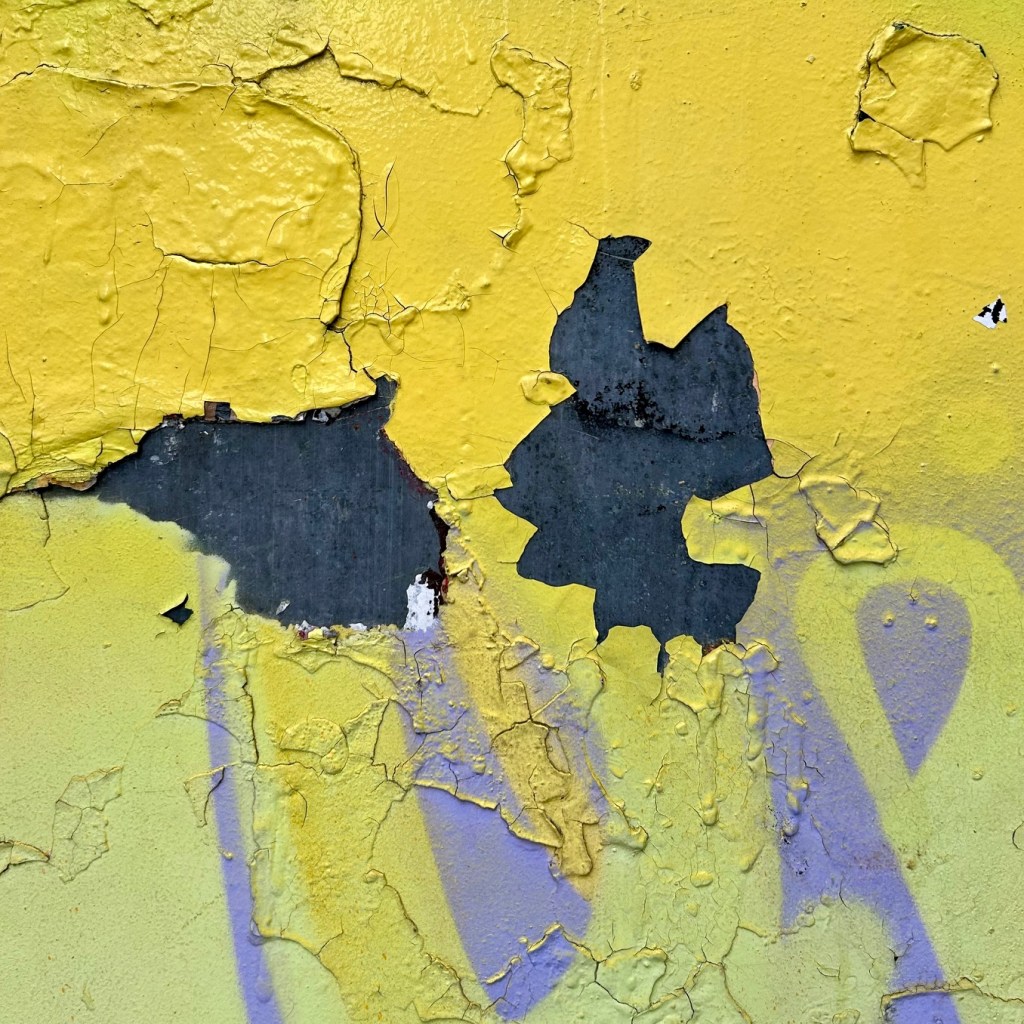
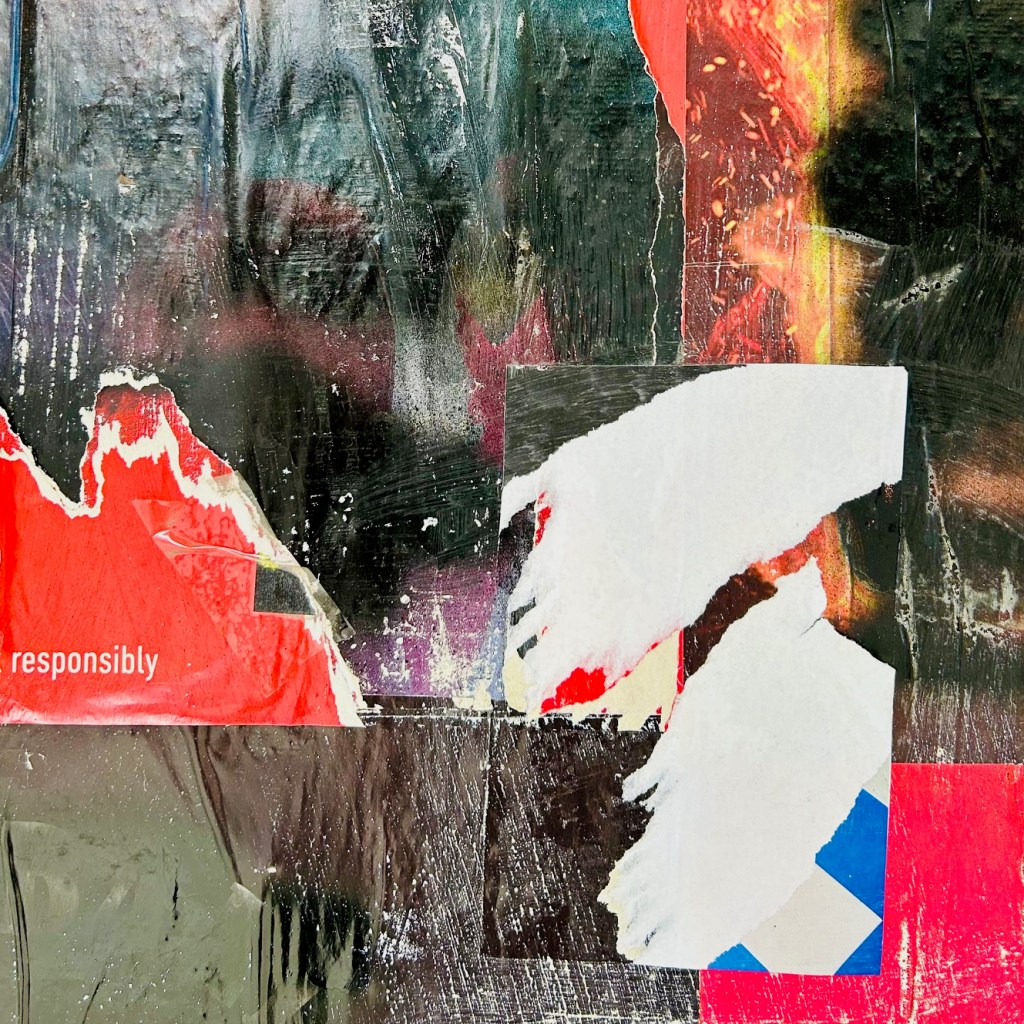
Steve’s approach to running and photography is a modern embodiment of this classic figure—using movement through the city as a form of creative engagement rather than mere exercise or transit. His curiosity and his keen eye allow him to see the extraordinary within the ordinary.
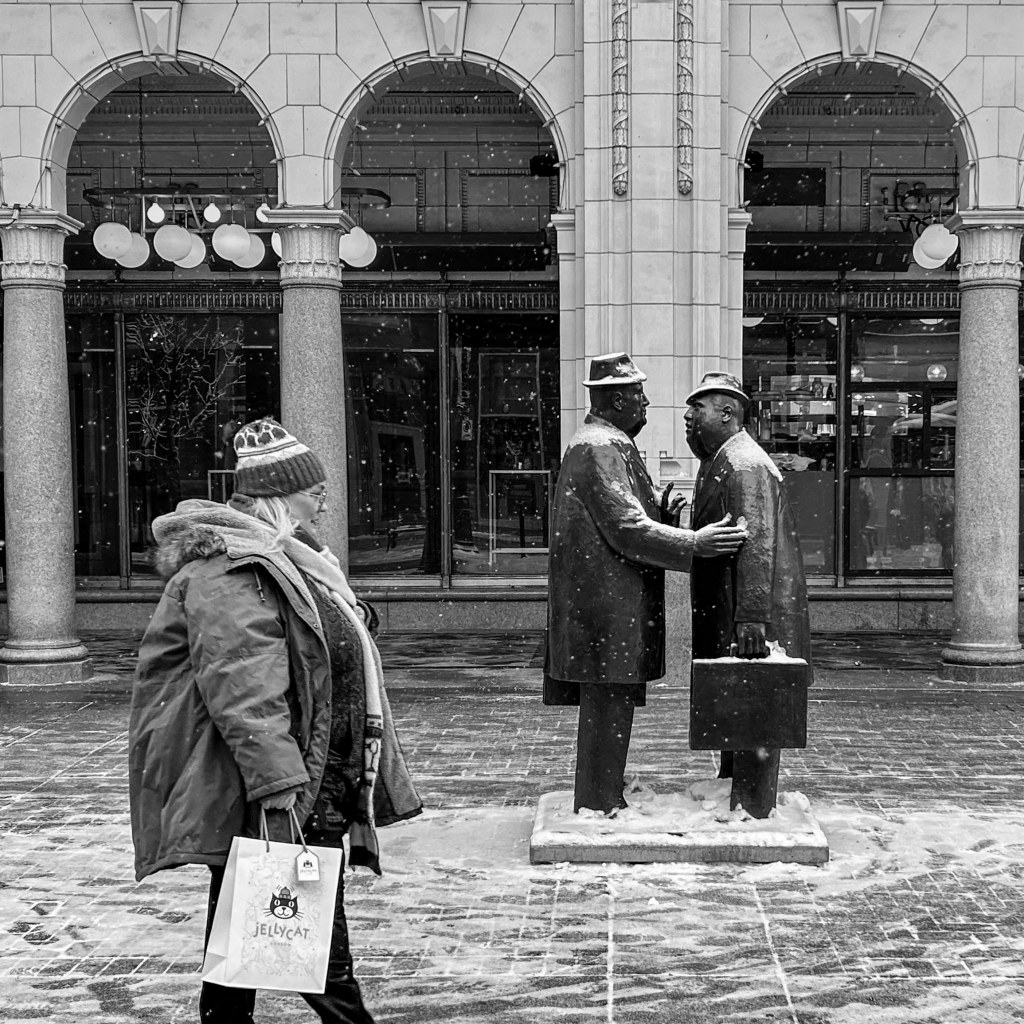
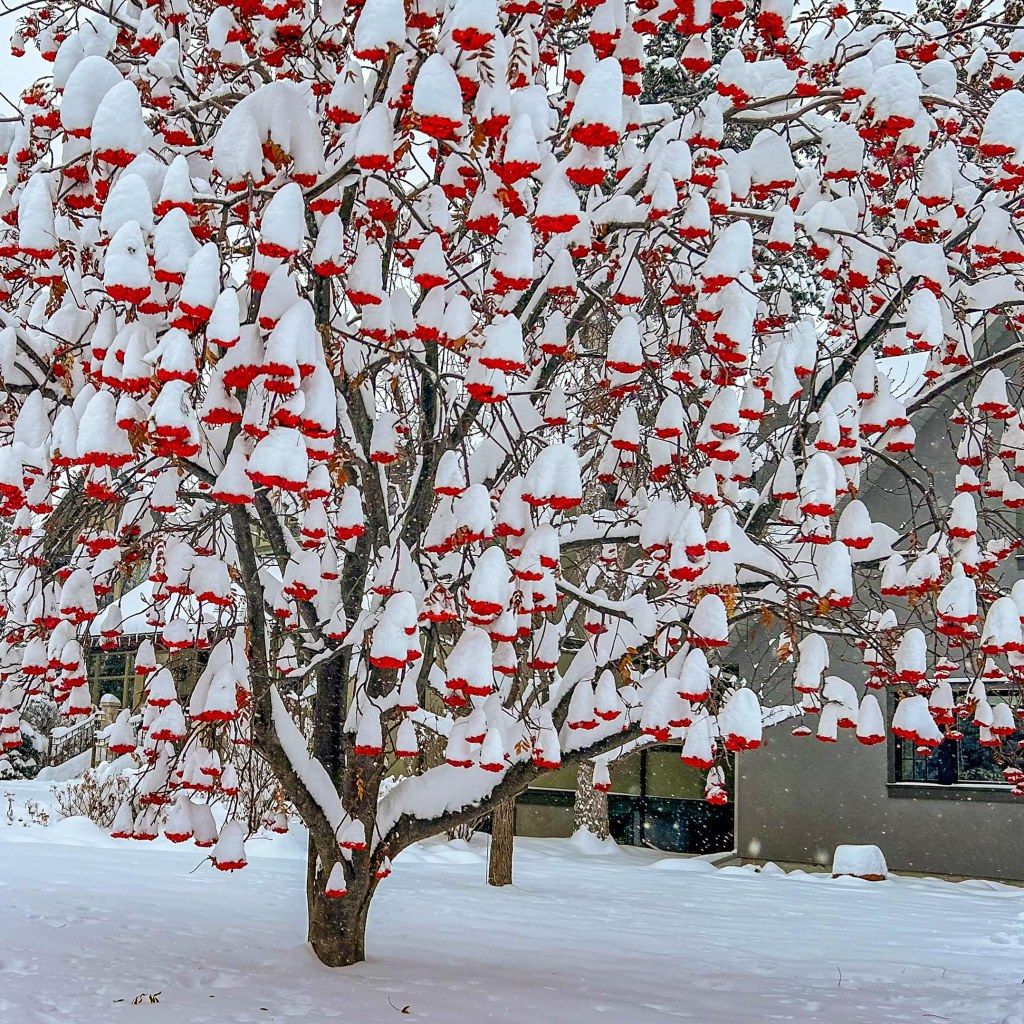
The flâneur’s genius lies not in destination but in observation—he reads the city like a complex novel, deciphering the social codes written in architecture, fashion, and gesture. In the Parisian context, this meant lingering in the arcades, studying the interplay of commerce and desire, watching how different classes of people navigated the same spaces with entirely different purposes. The flâneur sees what others miss because he moves at human speed rather than the hurried pace of those bent on efficiency. 

Transported to Calgary among the gleaming downtown towers and the sprawling neighbourhoods stretching toward the Rockies, the flâneur’s eye discovers different rhythms and revelations. He might capture the interplay between the city’s frontier heritage and its contemporary energy—perhaps pausing to photograph how the morning light catches the glass of a modern office building while casting shadows on a historic sandstone church. My friend Steve embodies this Parisian tradition, combining the flâneur’s contemplative wandering with the practical purpose of his runs. His camera serves the same function as the flâneur’s notebook—a tool for capturing the moments that define urban life; transforming the ordinary act of moving through space into a form of creative observation.  In calling Steve a flâneur, I celebrate something valuable but increasingly rare in our hurried world—the importance of moving through our environment with alertness, engagement and appreciation.
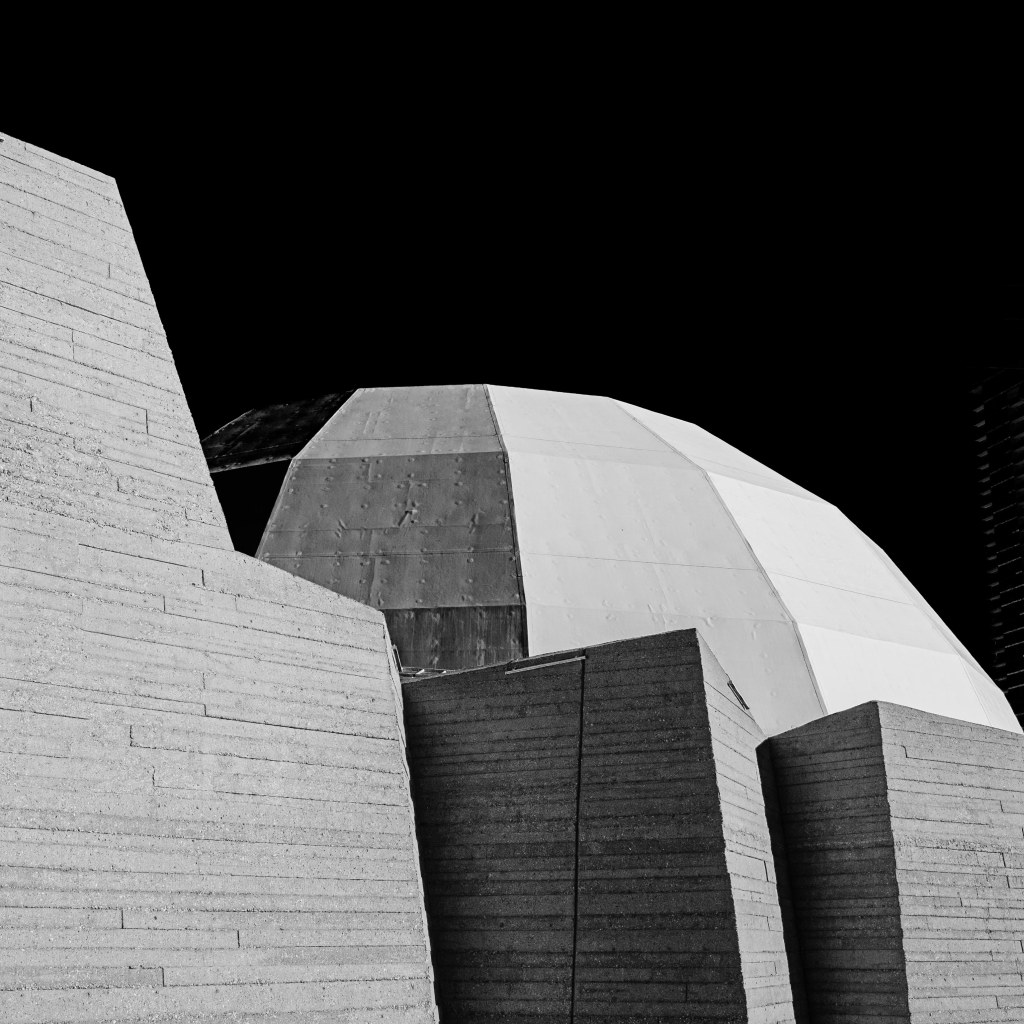
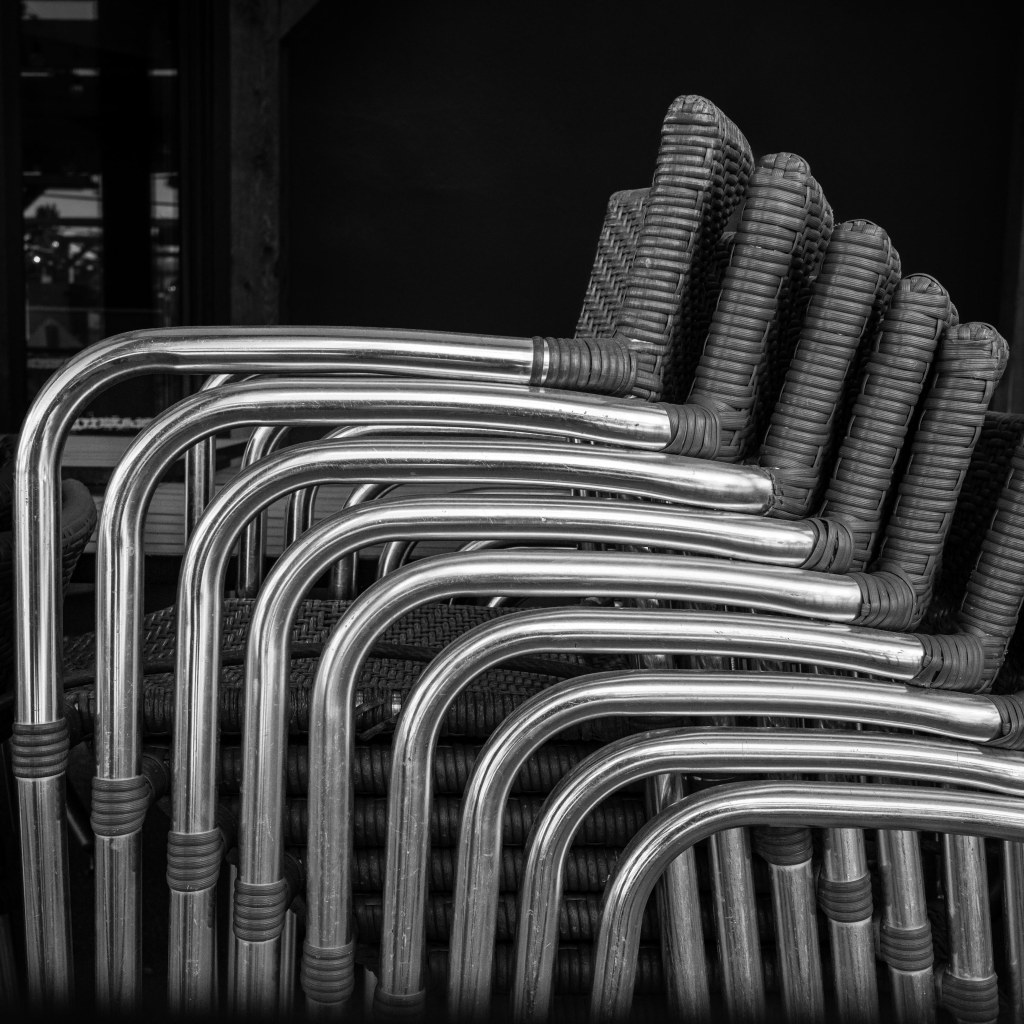
– Phil Davies, December 2025

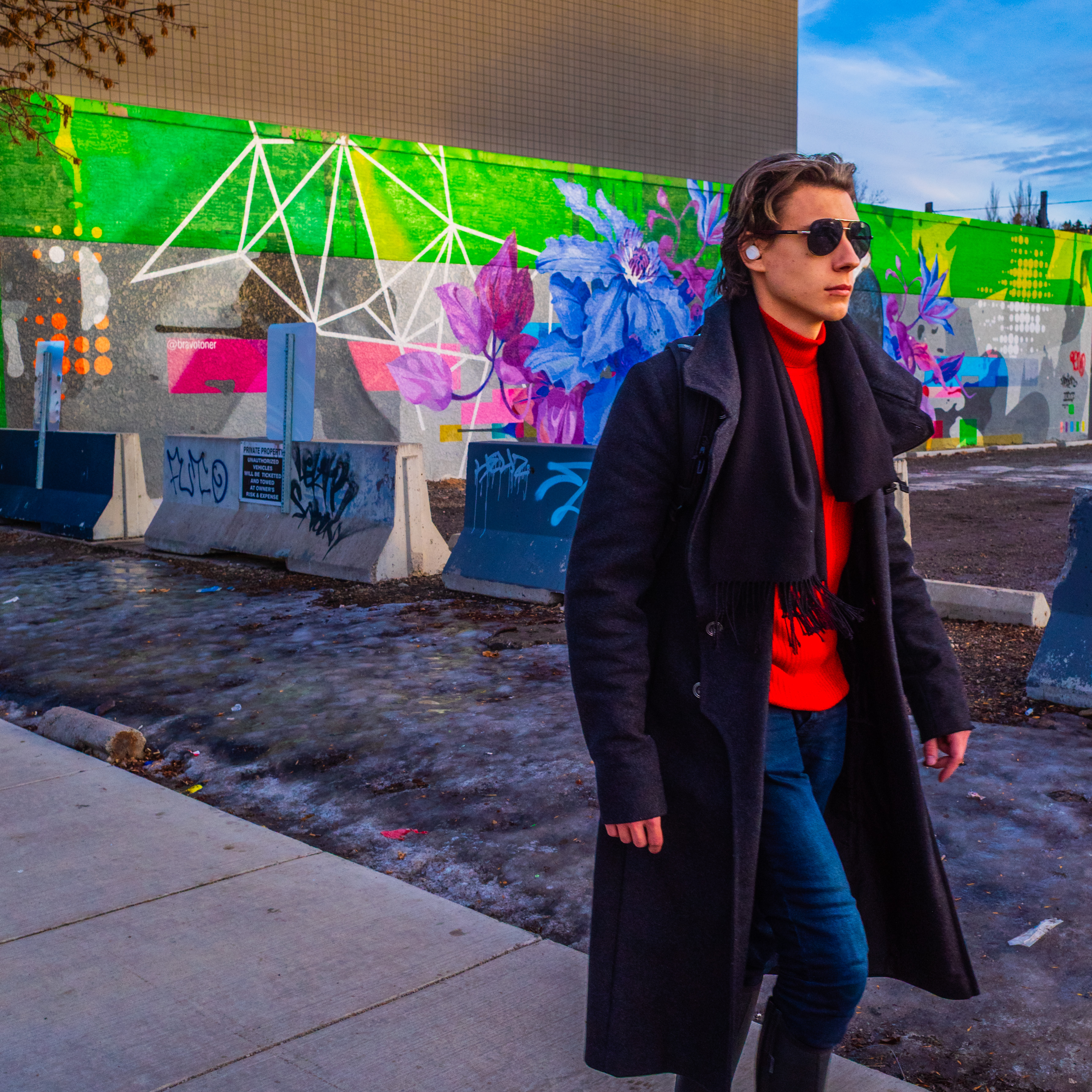
These boots were made for walkin’…! (Calgary, December 2022)

Concluding thoughts

Until my discussion with Phil, I would have said that I wasn’t doing anything different from any other street photographer, except that I’m moving faster than most of them. When I’m cruising the streets, I do so with thoughts of my photography idols in mind; people like Fred Herzog, Elliott Erwitt, and Saul Leiter. I wish I could be one-tenth the photographer that they were.

I also move through the streets with a clear purpose. I welcome the creative tension that comes with choosing a location and then watching for promising scenes to develop in front of me as I’m running. Many times and for many reasons, I’ve missed a shot that I wish I’d captured. But that’s alright, because sometimes I come home with a treasure. I can’t ever be too hard on myself about this, given the parameters I’ve set for myself.

In the end, it may not matter what label I use—flâneur, observer, or something else. Phil, you’ve helped me see that this process of roving exploration is well worth the effort.

More BUMP and Run

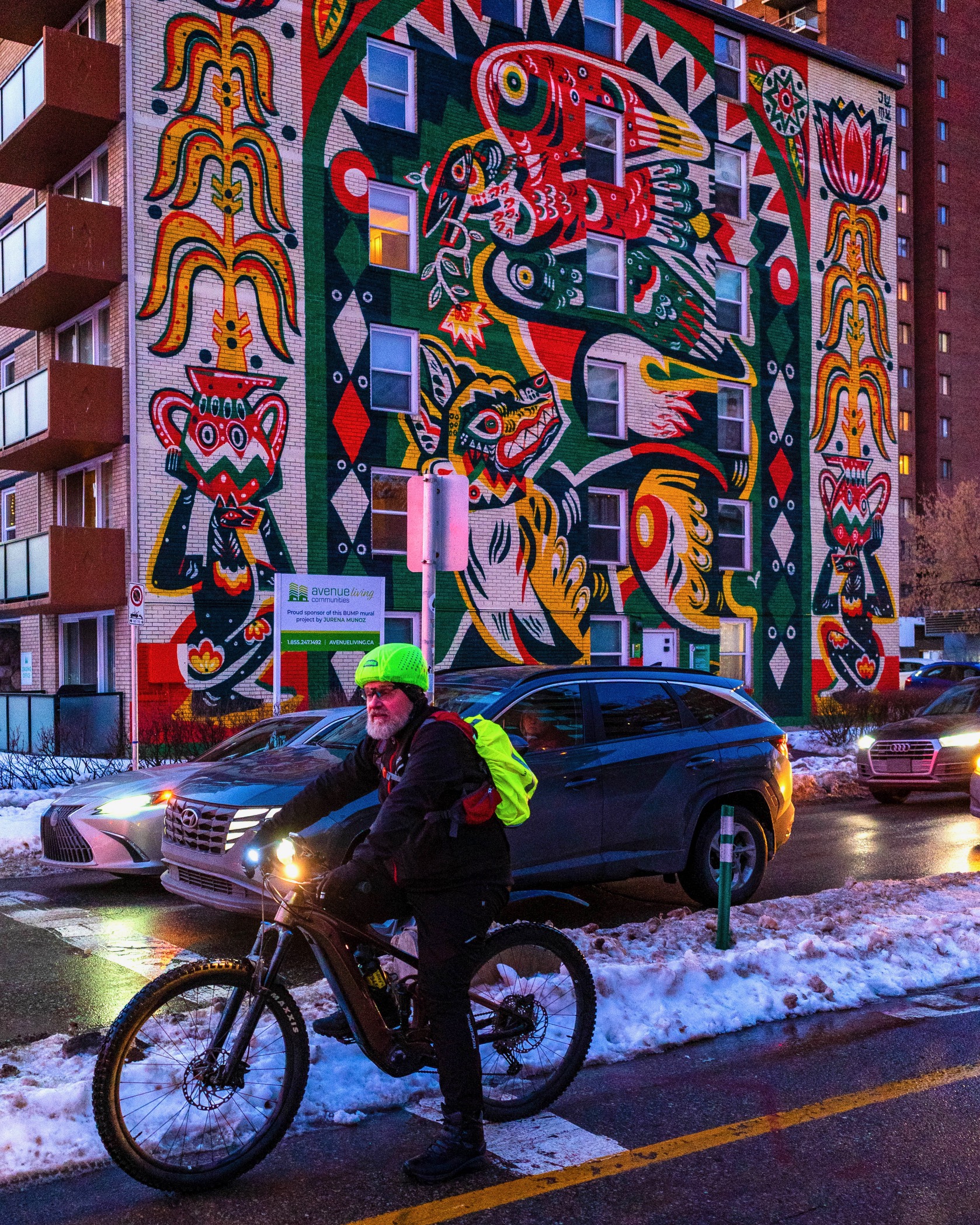
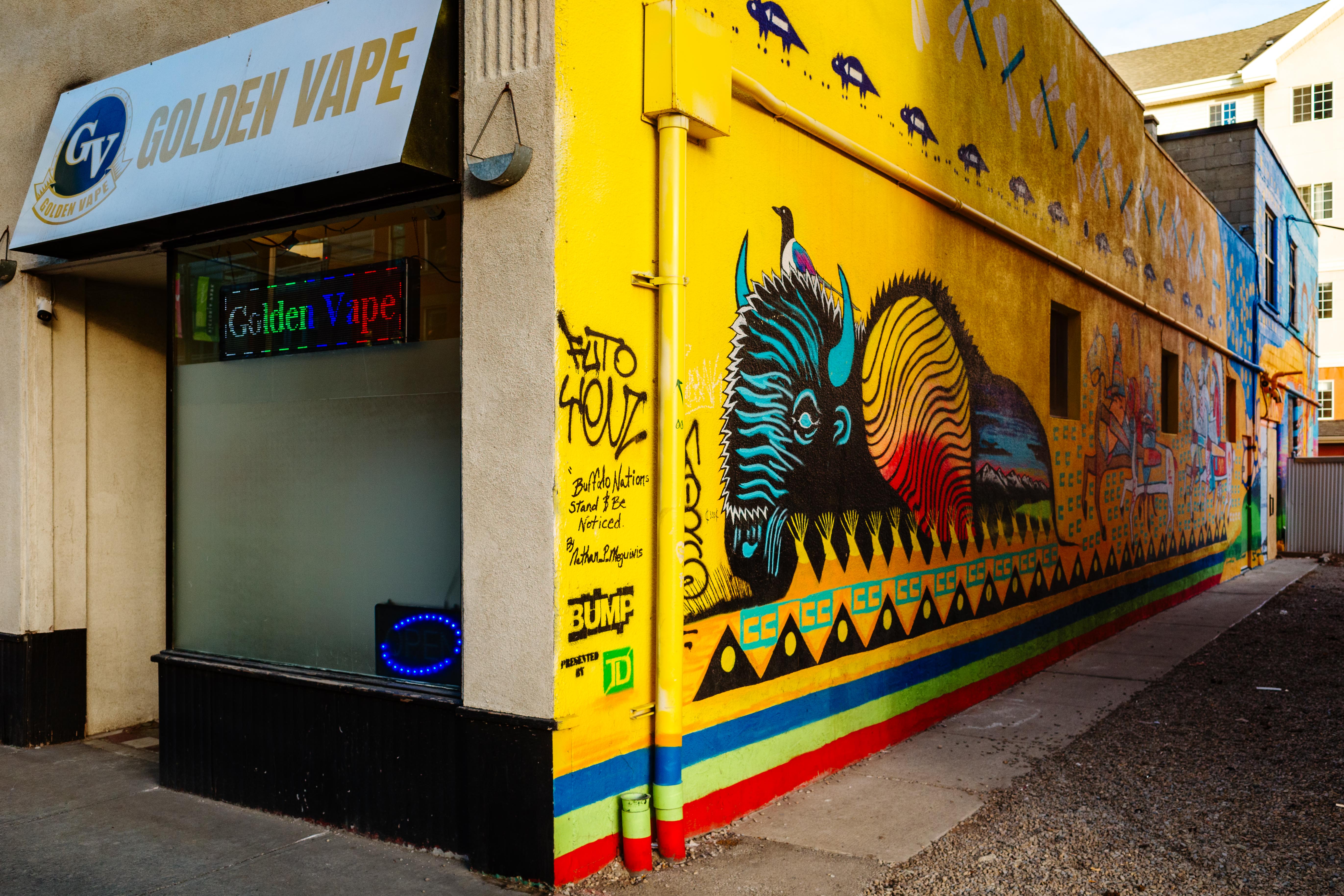
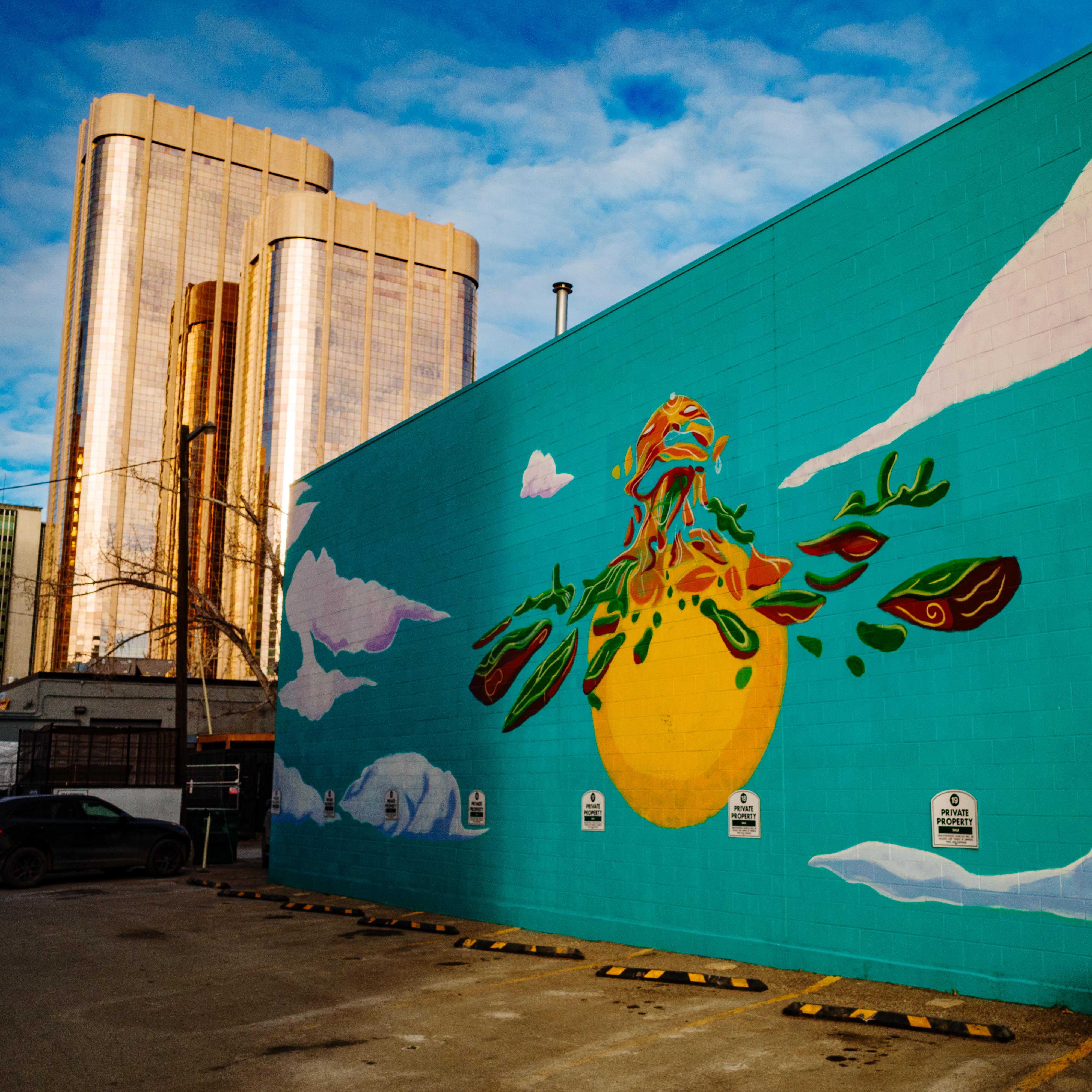
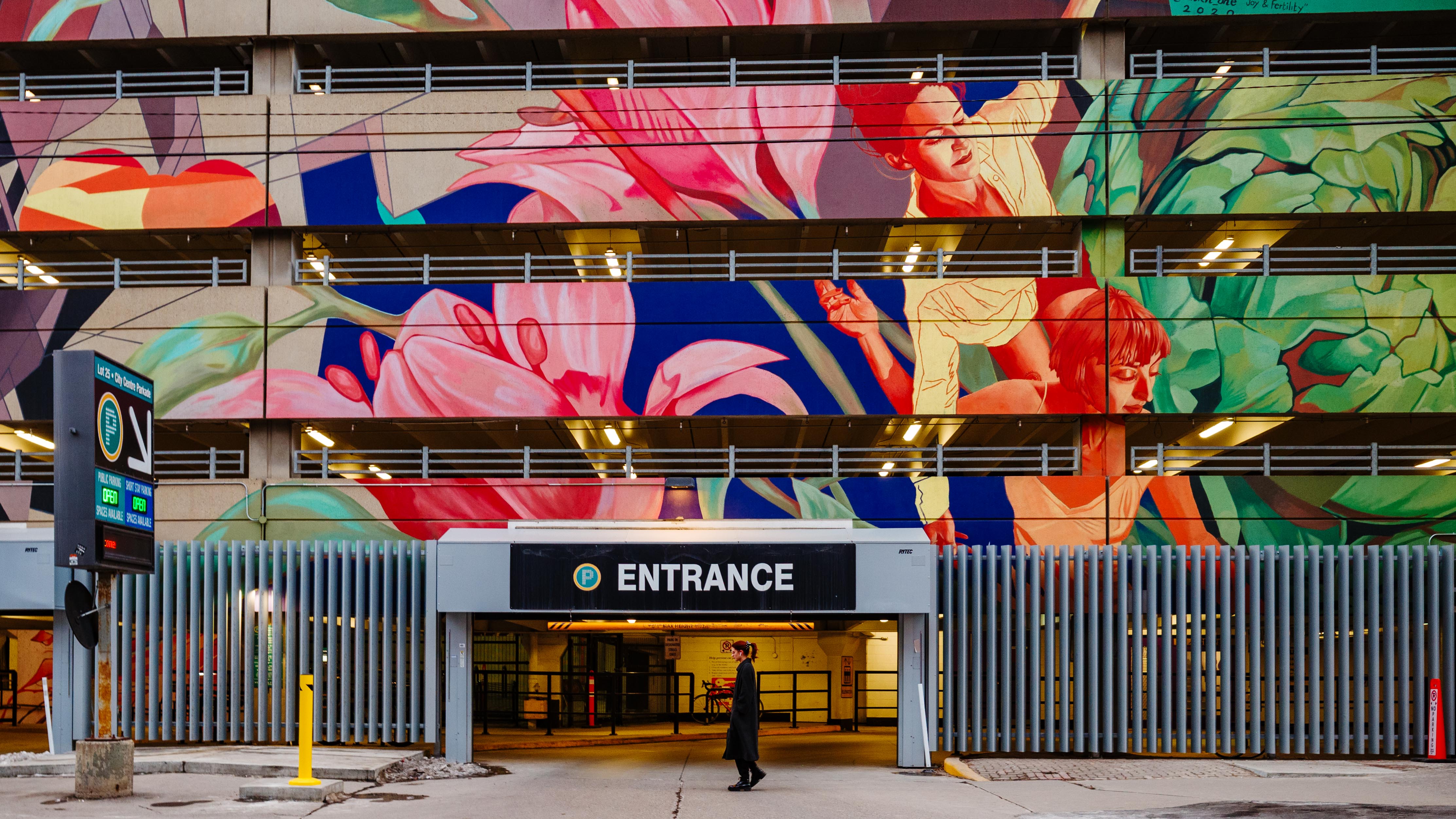
We had a brief return to winter weather last week, which was a good excuse for me to dig through more Beltline mural pictures. This piece is not a lesson in how to hit a “bump and run”… a crafty shot that will be familiar to golfers… it’s a mash-up of pictures from several recent photo runs.

Like the first post in this series, I scouted out Beltline Urban Mural Project (BUMP) murals and did background research on the artists. Routes for all my urban photo runs are “organic”… dictated by red lights, convenient turns, and whatever street scenes catch my eye.

This post highlights murals in the large area from 17th Avenue SW to the downtown core. There are so many pieces in this area, with more coming in 2025, that there will certainly be more posts in the future.

Some of my favourites:

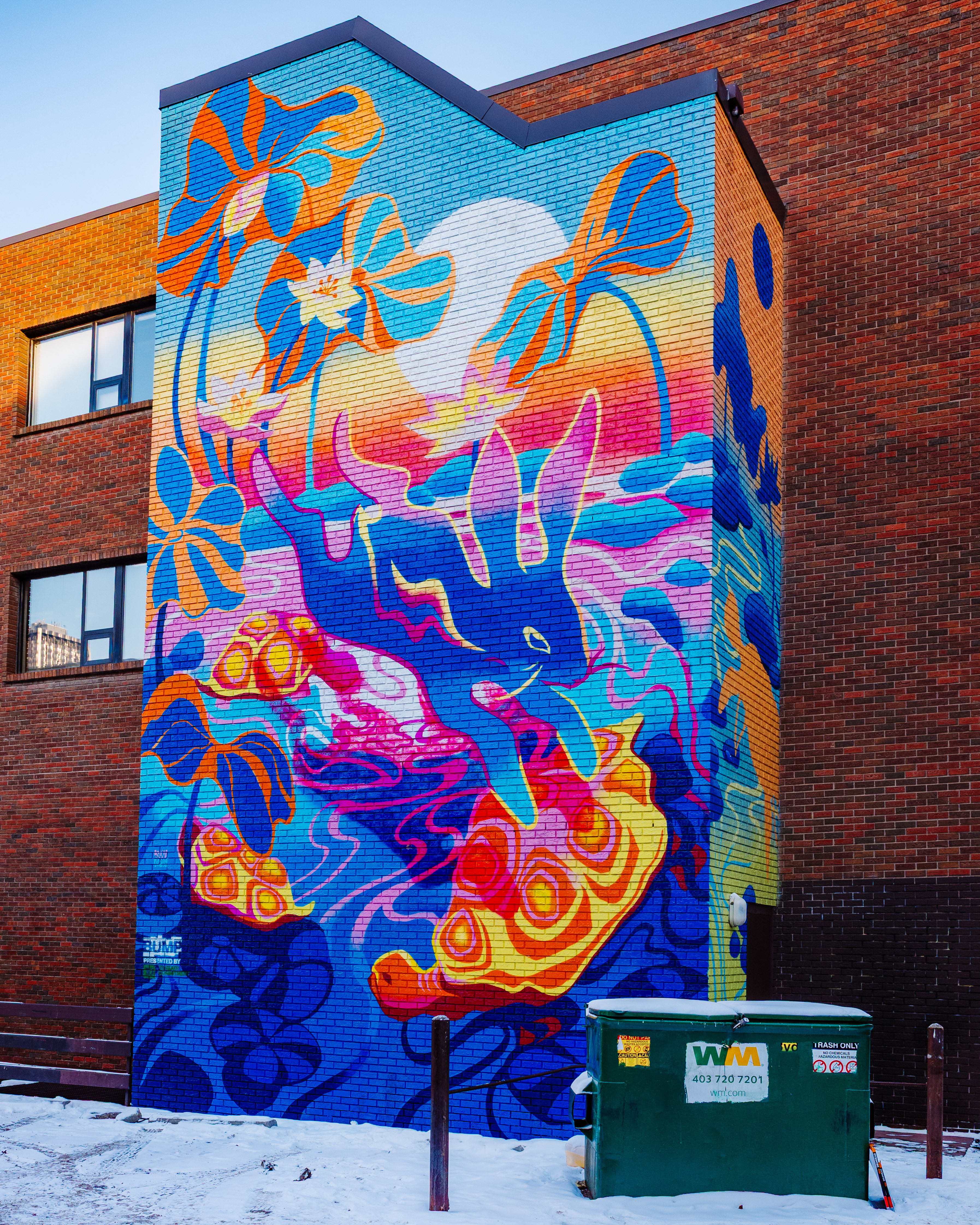
  • Seeroro (Carolyn Wong, @seeroro_ ) is a Chinese-Canadian artist from Vancouver. “Euphoria” is a colourful, three-sided mural inspired by the Tortoise and Hare folktale and the year of the water rabbit in the lunar calendar. Wong’s mural is tucked in between the buildings at 625 11 Avenue SW. Well worth the search!
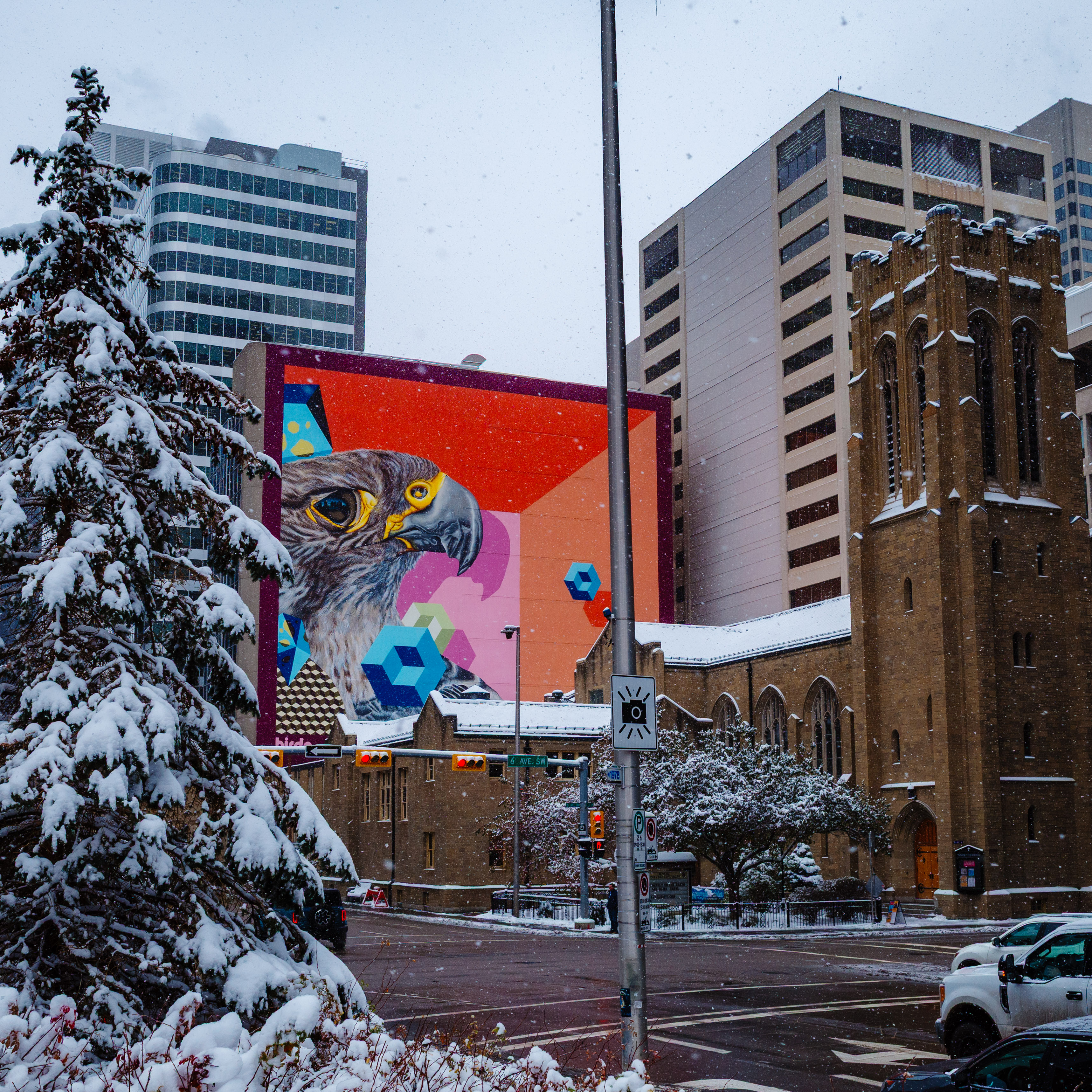
  • birdO (Jerry Rugg, @jerryrugg ) is a multidisciplinary artist based in Toronto. He is well-known for large-scale murals on walls and buildings. His spectacular untitled piece at 441 5th Avenue SW is of a peregrine falcon, with the city skyline reflected in the bird’s eye. I’ve photographed this piece often.
  • Fluke ( @fluke.art ) is based in Montreal. His work as a street artist has roots in graffiti going back to the mid-1990s. Working with photographers, Fluke merges street art and contemporary imagery to create his pieces. His untitled mural on the west face of 1039 17th Avenue SW was glowing in the setting sun when I shot my photo.
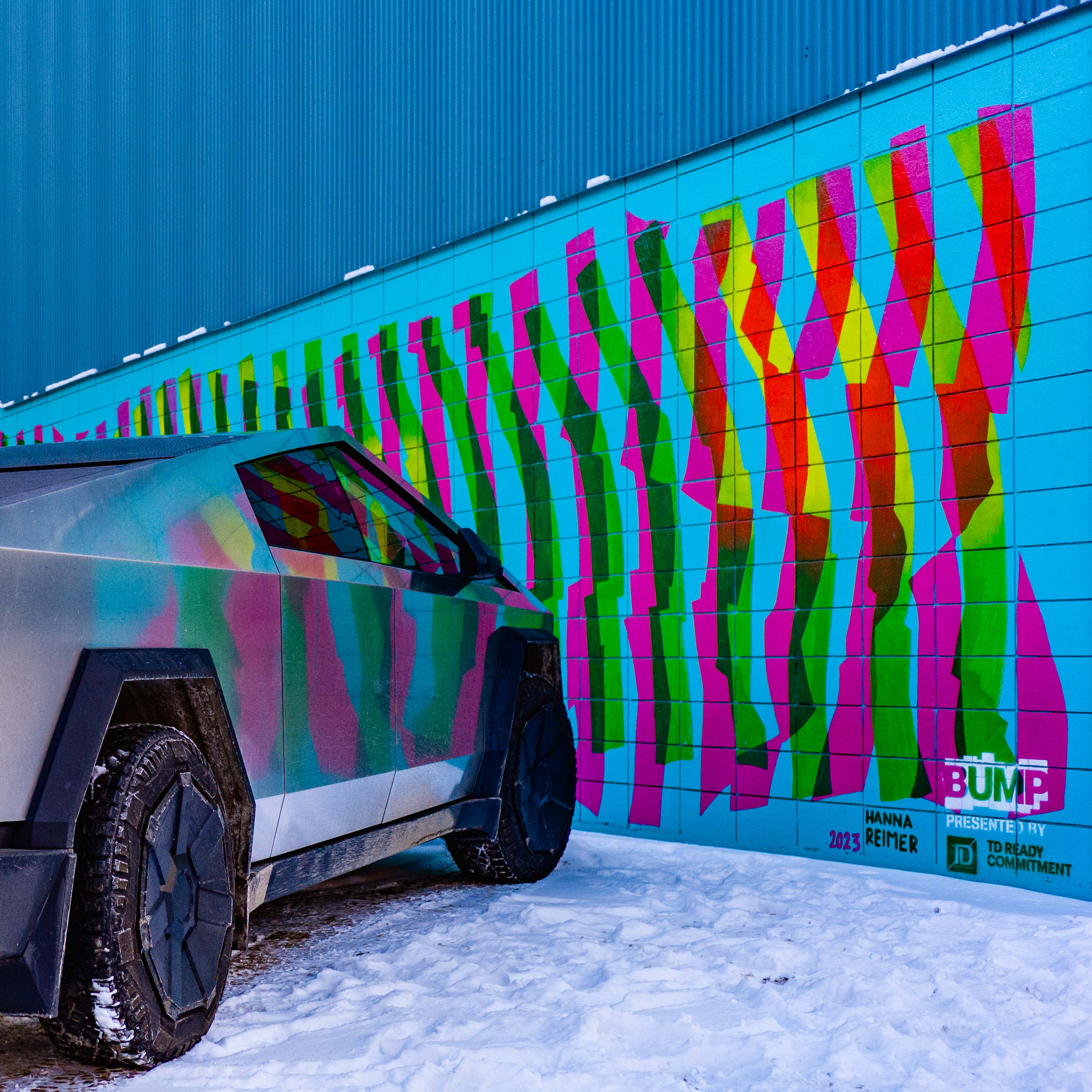
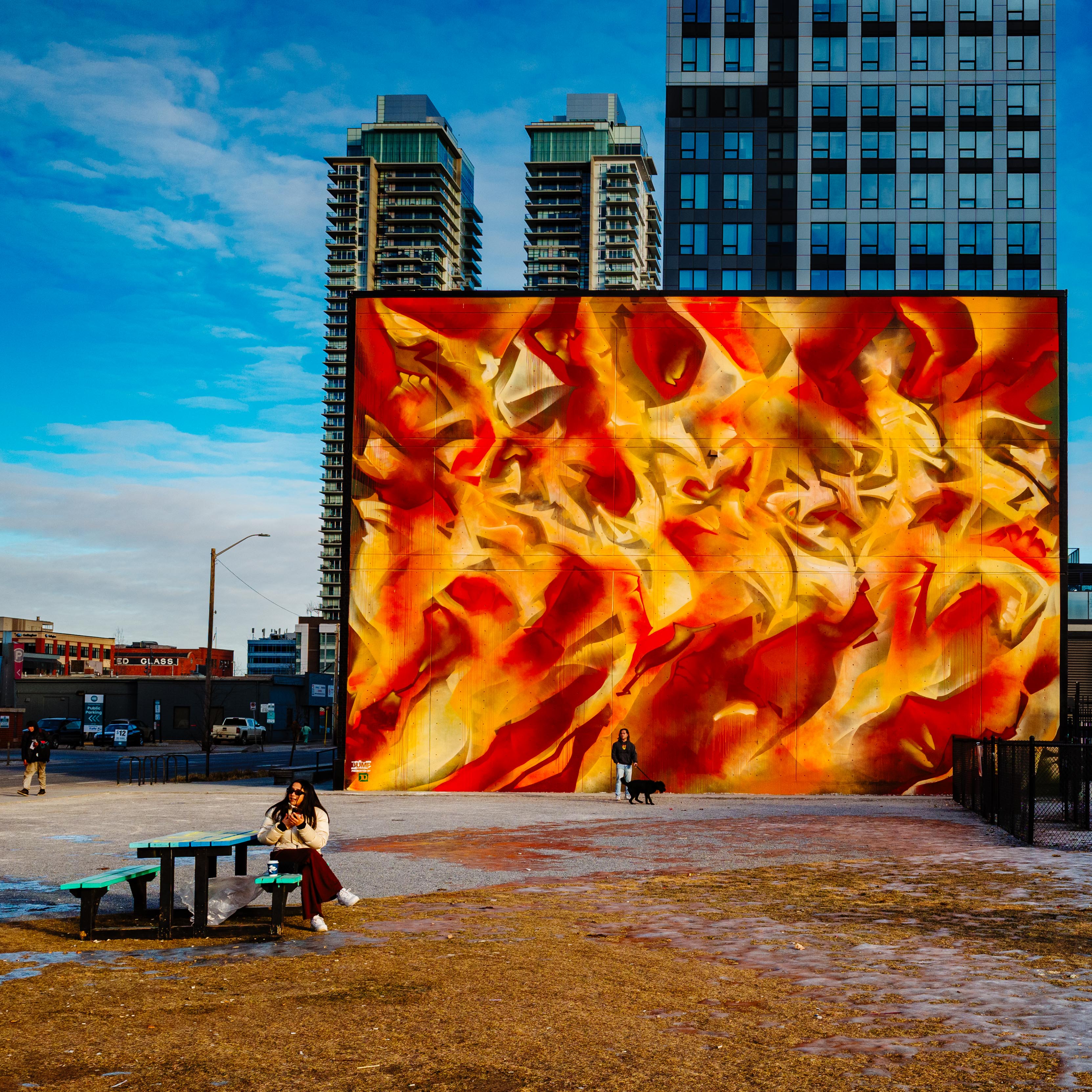
  • Hanna Reimer ( @hannaclare ) is a Treaty 1 artist from Winnipeg, whose works emphasize texture and pattern. Hanna’s interest in fabric was the inspiration for her mural at 739 11 Avenue SW. She chose colours and patterns to make the wall appear to be flowing like sheer fabric. I found the juxtaposition with the angular Cybertruck jarring, but too good to pass up.

And a few more:

While I was thinking about murals, I paged through my files and came up with more pictures and stories. These fall a bit outside the topic of this post as they weren’t taken “on the run”, but that’s okay.

In 2019, I was walking around the Beltline with a newly repaired Voigtlander Vitessa T. I had picked the camera up on eBay with low expectations. It was 70 years old and non-operational. The camera is unique: it’s a rangefinder, and it has a plunger instead of the usual film advance lever. (Perhaps not surprisingly, this is a weak element of the design. It’s probably why this feature didn’t find its way into other cameras!) Fortunately, I found a fellow in Calgary who patiently (and cheaply) sourced the required spring to get it going again.

My first shots with the Voigtlander were of the multicultural artist Fathima Mohiuddin ( @fatspatrol ), as she was finishing her mural at 708 11 Avenue SW. We chatted for a few minutes and I took photos of her in front of the mural. It’s in her signature graphic style, and it’s awesome!

I had no idea if I’d get anything out of the Vitessa, but I was very happy with the result. I never saw Fathima again, so I hope she will see this picture.

The following pictures were taken within a minute of each other. I had been walking around 17th Avenue SW with my Ricoh GR III, on the lookout for interesting people or street scenes. On that day, I remember being disappointed that I had not seen much that caught my eye.

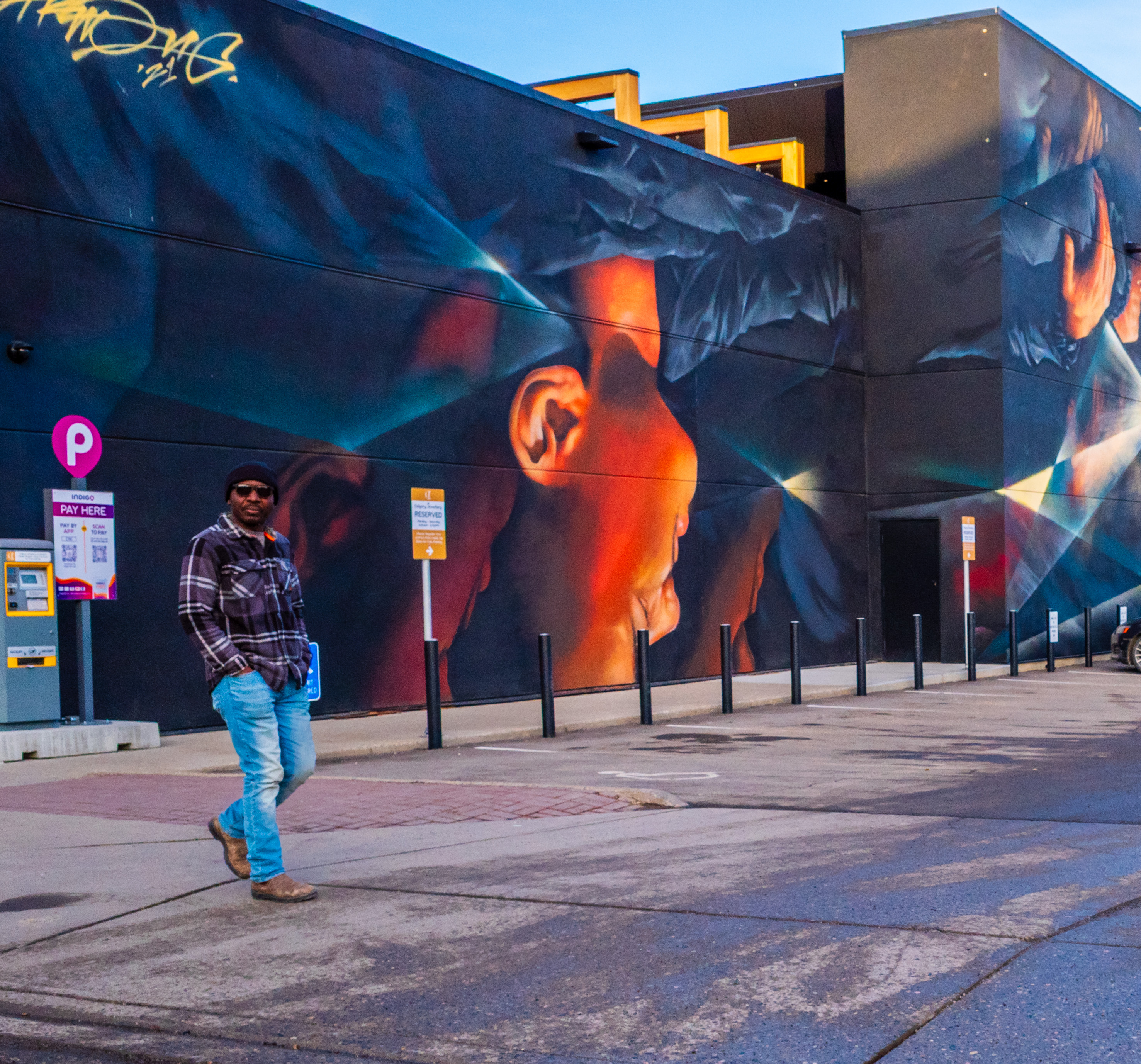
I walked down 13th Street, past the alley behind Calgary Jewellery, and snapped a quick shot of a fellow walking by Alex Kwong‘s huge (and hugely impressive) 2021 piece. Unfortunately, I don’t have many details about the mural. It doesn’t appear to be part of the BUMP series. Alex has done other pieces around the city, including a couple for BUMP. Check out his website and Instagram ( @_alexkwong ).

After I snapped this picture I turned onto 17th Avenue, and I noticed a stylish guy approaching me. An obvious picture was coming together… I just had to wait for him to pass in front of the colourful mural at 1137 17th Avenue SW. The bright elements in the mural complement his confident personal style.

In my research, I learned that the mural is by Calgary artist Toner ( @bravotoner ). The piece is titled Companion and it was painted in 2020. I realized I wasn’t being totally fair to Toner by having the best part of his mural obscured, so I went back and photographed it on its own to reveal a beautiful parrot. Here’s the whole image. Nice work Toner!

“Companion” by Toner, 1137 17th Avenue SW, painted in 2020

An interesting fact is that Toner and Kwong have collaborated on pieces around the city. I’ll be back soon with more in my next post.

Until then, be well and BE FAST!

BUMP Photo Runs – Part 1

I was jogging around Calgary’s Beltline, feeling a bit short of ideas for my next urban run/photo adventure. As I rounded the corner from 7th Street onto 15th Avenue, I glanced up at the side of the building. What I saw stopped me in my tracks, and instantly gave me the inspiration I needed.

What’s BUMP?

There’s a program called the Beltline Urban Mural Project… BUMP… that has been making Calgary’s inner city streets more interesting and colourful for years. I had to find out more.

From the BUMP website, I learned that the project started in 2017, and has grown significantly since then. Seeing all the artwork in one run would be challenging, if not impossible. There are dozens of sites, spread throughout the core. I needed a plan. I often start my runs near Lougheed House, so I decided to use that location as my base. I could get a good overview of the murals (and hopefully some worthy photos) by concentrating on different neighbourhoods over several runs. This is the first of what is likely to be an ongoing series.

Run 1 – BUMP in the Beltline

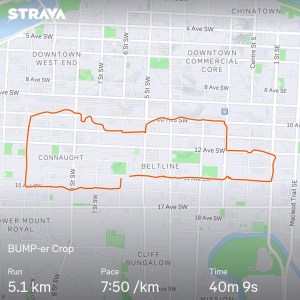
Run 1 focused on the Beltline itself… bounded roughly by 15th and 10th Avenue, and 1st and 10th Street. Here’s my Strava map:

Turning to the art, let me start with the mural that prompted this idea. It’s a large, striking piece in green, called “The Last Maple Leaf”. It was painted in 2023 by the Colombian artist Wosnan. This is from the mural description:

“Rising from nature an ancient guardian of the forest who merges the realms of magic, other worlds and dimensions, spirit and space stands tall, looking over our city…”

Wosnan, “The Last Maple Leaf”, 1411 7th Street SW

This was an apt description of the mysterious tree-like being that loomed over me, guarding his/her corner of the neighbourhood while pondering (no surprise) the last maple leaf. Stirring stuff! I studied the mural carefully, with my stopwatch running. The magnitude of the challenge I had taken on dawned on me. Maybe I should make this a slow photo walk…

No! I resumed my run, with my goal of at least five kilometres in mind. I tried to ignore the glimpses of colour that I started to notice down every alley.

Bottom line? I finished with lots of pictures and a feeling that I had made a small dent in the many Beltline murals. For full disclosure, while I saw all these murals on BUMP Run 1, some of the photos are from previous runs because I liked the shot more. Light is everything, you know!

Here’s a short summary of the pieces in the photographs. I recommend following the links to the map on the BUMP website to find out more.

Mural Making – A Layman’s Perspective

Imagine painting a mural on a wall 60 feet wide by 30 feet high. How does one even begin? Laying out a piece at that size and scale must be extremely difficult. And the execution would bring very different challenges. I marvel at the way the artists manage the intricate details, while still capturing their vision for the whole piece.

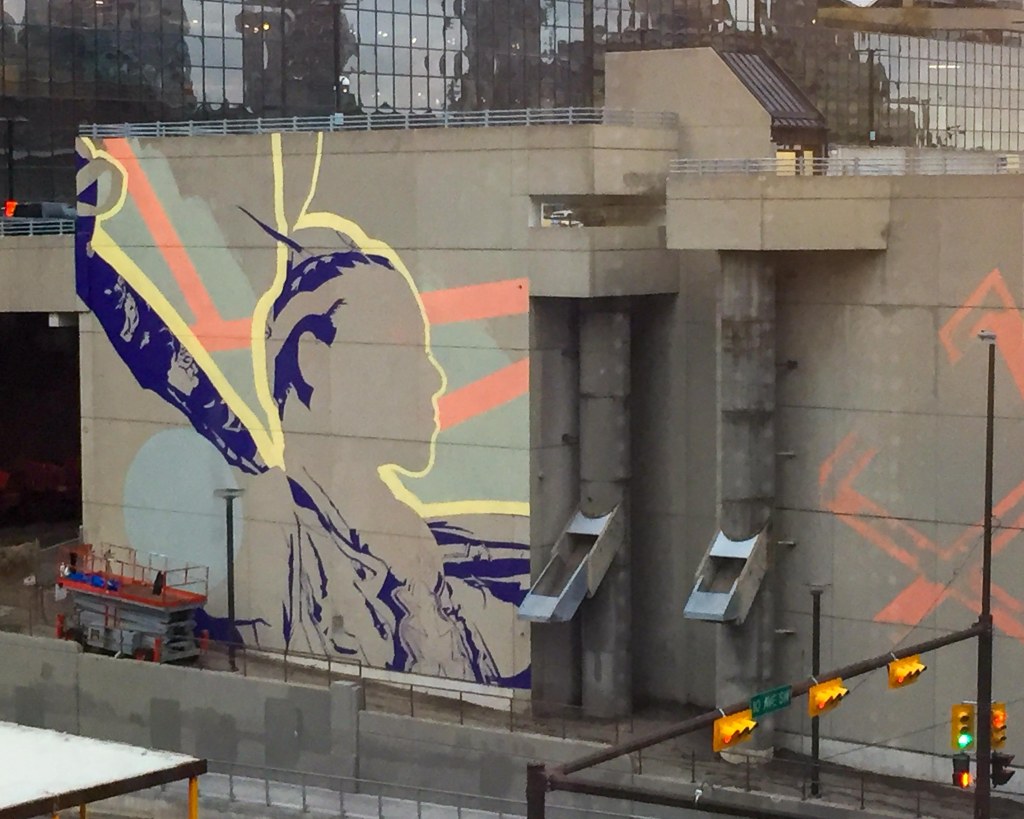
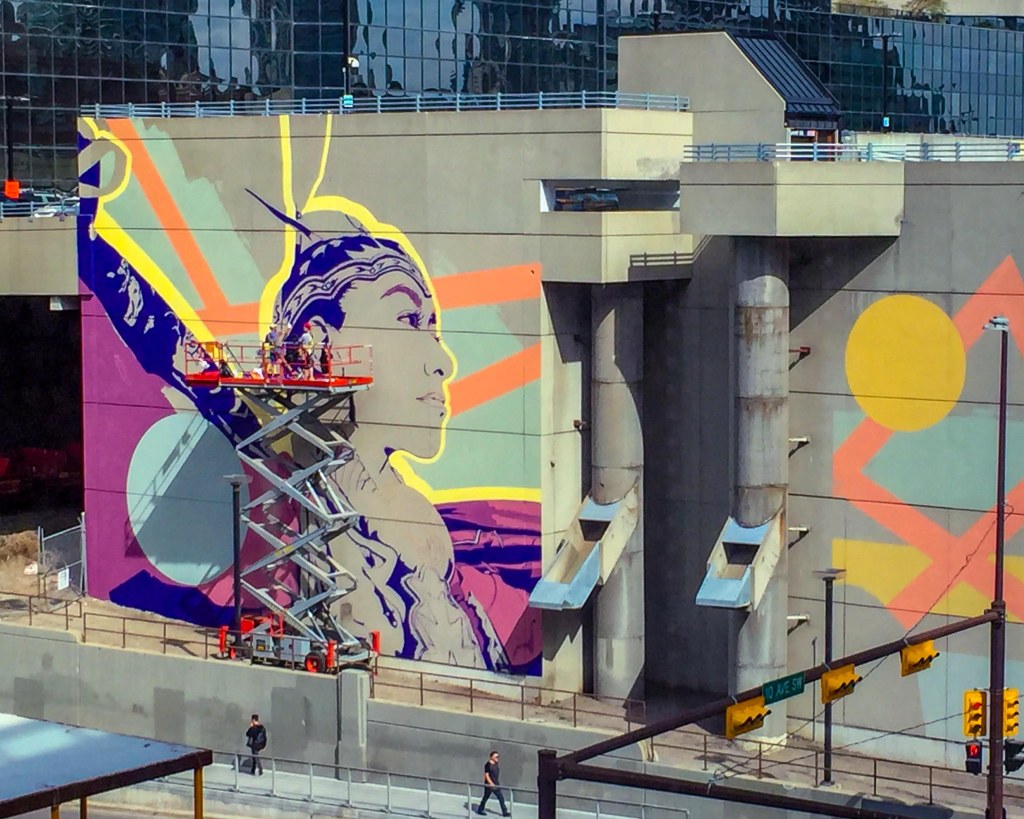
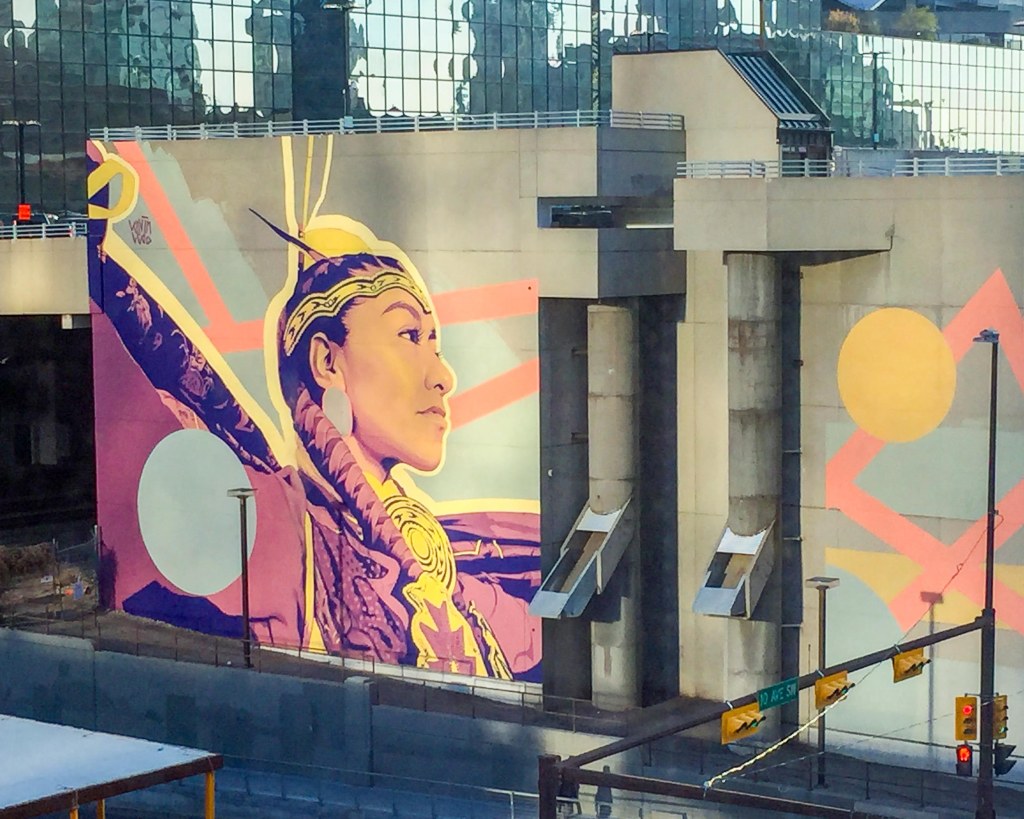
I had a front-row seat for the creation of sôhkâtisiwin (that’s Canadian artist Kevin Ledo’s striking mural at 340 10 Avenue SW). The title means “strength/power” in the Cree language. The image is taken from a picture of B-Girl and traditional hoop dancer, Angela Gladue. I watched the beautiful portrait of this young Indigenous woman come to life in 2018, from the comfort of my office across the street. Kevin and his helpers toiled away in the hot summer sun on a stage lift, going up and down endlessly over several weeks to complete the image, which now livens up the west side of a parking garage. I made sure to give them a thumbs-up every time I walked by.

Here’s a rough timelapse of the process (I had many more pictures on my phone, but I recently deleted most of them). You get the idea though.

Impressions

This is an amazing initiative. To state the obvious, BUMP is a diverse selection of art. I’m impressed by the sheer number and quality of the murals. It’s great to have artists from around the world come to Calgary and share their talent. I hope the project continues and expands its reach across the city.

This is the kind of project that invites us to slow down and take a closer look at the art. Sure, we can (and most often, do) pass by these murals in our daily routine. Maybe we glance at them, maybe we don’t. But this first photo run has already prompted many questions… Who is this artist? What is their message? Do I think they succeeded? What does this piece make me feel?

The BUMP website helpfully lets the user select pieces they would like to see on a walking tour, and this is probably the correct way to see them. I will persevere with my photo run idea, knowing I will still see and learn a lot along the way.

My early impressions are very positive. I already have some favourites. I will defer any thoughts about that question until I’ve done more exploration. There will eventually be a personal top 10 list, but even that will be subject to change as I see more of the contenders. Look for more posts on my BUMP photo runs soon.

Thanks for reading. Please drop me a comment. Let me know if you have a favourite BUMP mural that you think I should see.

Until next time, be well and BE FAST!

A Tribute to Gerard Rejskind

I don’t have hard rules for the topics on this blog, and there are times when I feel I need to write about something of importance to me. Or someone. This is one of those times.

Gerard Rejskind passed away a year ago to the day that I’m writing these words. I suspected something may have happened to him. As I’ve done occasionally if I’m unsure about someone’s personal situation, I reluctantly typed his name and “obituary” into Google. I was right… he died peacefully in Montreal in December 2023 after a short illness.

So who was Gerard?

It would not be true to say he was a friend. But as I wrote in a similar tribute piece almost two years ago, it is possible in our highly connected world to feel close to someone even if you’ve only spoken to them a few times on the phone. Through his writing, I came to know Gerard and understand him quite well.

Gerard wrote with passion, and he was the driving force behind an independent audio publication (UHF Magazine) that had a small but dedicated following. Through his reviews of audio equipment and recorded music, Gerard influenced many people, including me.

Let me first make a connection, between a subject that I do post about on this site… photography… and music. It isn’t a stretch to say that both these art forms have much in common. They are subjective; that is, they are things that cannot be quantified. If done well, they evoke an emotional response in us. And at their best, they are timeless.

When I found out that Gerard had passed away, I thought about the many ways he had influenced me over more than twenty years. Initially, I had been looking to upgrade my entry-level Sony CD player, a tinny-sounding thing. A colleague lent me a few back issues of UHF, and I was immediately hooked.

UHF (now defunct) was a publication unlike anything else I’d seen. With a modest budget and a small crew, Gerard managed to produce a magazine that bettered any of the big, commercial publications. It did so with a rare offering: totally honest reviews. There were none of the filtered, biased reviews that I read elsewhere. My favourite feature was a short, subjective paragraph from each of the review panelists about a particular piece of gear. This was invaluable for someone like me, who was new to the hobby.

Besides the magazine, Gerard also wrote a couple of books about “hi-fi”. Again, in plain language, he explained what the equipment did (or should do) and how it ought to be designed. This hit a chord with my engineering sensibilities. I found myself coming back to these books time and time again.

My wife will attest that I dropped everything when the latest print issue of UHF showed up in the mail. Because of their shoestring operation, the frequency of publication was, shall I say, variable. Gerard kept UHF going through COVID and his own health challenges. Those things only increased the appeal of the enterprise. I read every word of every issue, and I would save Gerard’s editorial page on the inside of the back cover until last. There, he would offer another nugget of audio wisdom, in his usual style… self-effacing, but with the authority he had earned over a lifetime of experience.

I’ve bought quite a lot of audio equipment and recorded music since I first encountered Gerard and UHF. In all that time, I wouldn’t think about buying anything unless I had checked to see if Gerard had reviewed the gear in question. If he liked it, that was good enough for me. If he really liked an item, he would become a distributor, which said a lot about his motivation. It was also quite convenient. I can honestly say he never steered me wrong.

Beyond all that, he made sure I and his other readers became more self-sufficient, by writing frequent articles and opinion pieces that educated us. In fact, the last edition of UHF, the 101st, consists of a series of introductory “101” pieces (in the usual nomenclature of first-year university courses) on various audio gear. It seems a fitting legacy to Gerard. The final paragraph of his last “State of the Art” piece is worth repeating here:

“The final rule is to do what we do: take notes, with details on
what you liked and what you didn’t. Concentrate on the music,
which is the purpose of the system in the first place.”

Gerard was a rare person: an honest businessman; a knowledgeable and generous resource; and above all, a gentleman. He will be missed.

Now I think I will go and put on a record and re-read some of his pieces.

Head Hunting

The Art of Jaume Plensa

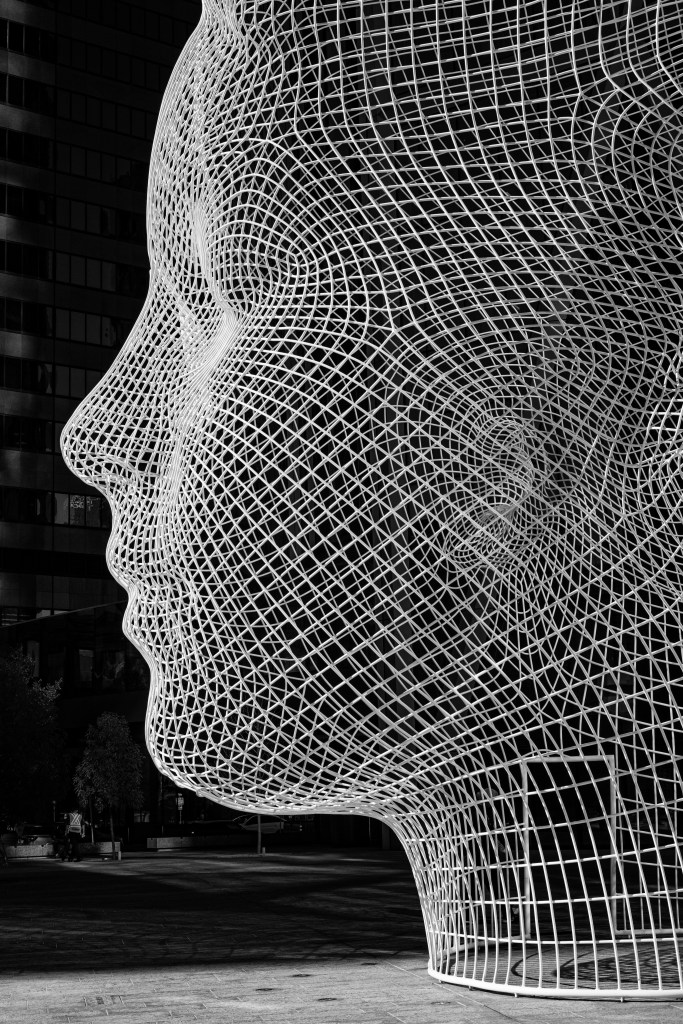
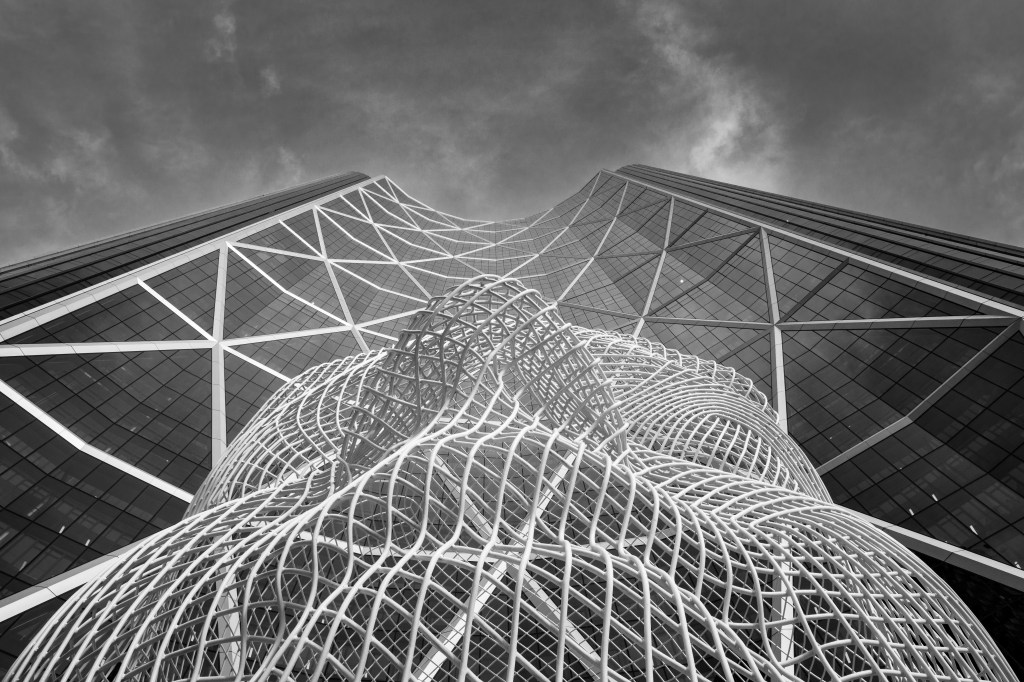
I was looking for an excuse to go into downtown Calgary for some photography, and I thought about the “big head” sculpture that sits in front of The Bow building. Like the building, the sculpture is iconic; it’s a monumental and very popular piece of public art. I’ve photographed the sculpture many times, but it seems to always have more to offer, depending on the season, the time of day and of course, the light.

First, some background. The sculpture’s official name is Wonderland and it’s by the Spanish artist, Jaume Plensa. Plensa was born in 1955 in Barcelona. He studied art in his home city. Over several decades he has lived, worked and exhibited his art in cities across Europe and the United States. Plensa has received international recognition for his exhibitions and installation pieces. His diverse works include sculpture, fountains and graphic arts.

Wonderland (2012), Calgary

Wonderland is one of many sculptures that Plensa has created for public spaces around the world. When I looked into the origin of Wonderland, I learned that he has installed similar large-scale pieces across Europe, Asia and North America.

Wonderland is ideally situated in the curved façade of The Bow, where it’s been since 2013. The sculpture depicts the head of a young girl. It’s about 12 metres high, and it’s made of bent steel wire. I think the piece is so popular because it has openings at ground level, which let visitors enter the sculpture’s inner space. Plensa invites us to contemplate Calgary’s downtown from the perspective of the subject. It’s a thought-provoking piece, for sure.

Here are several of the many shots of Wonderland I’ve taken over the years.

Julia (2018), Madrid

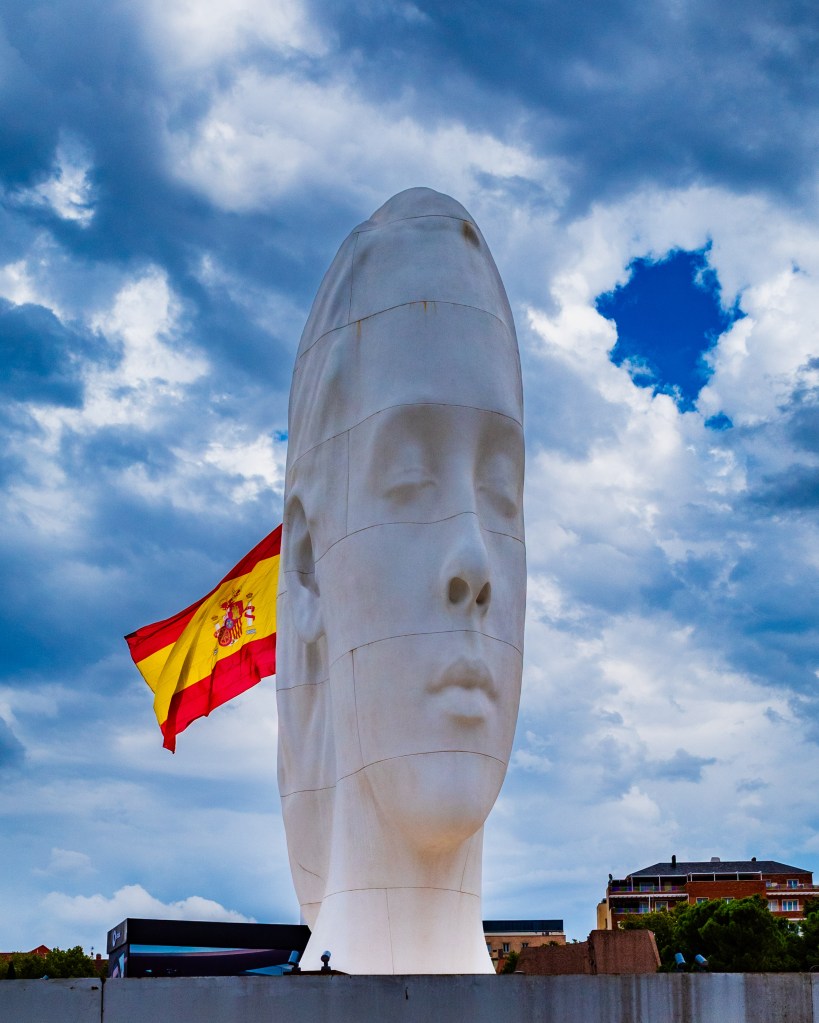
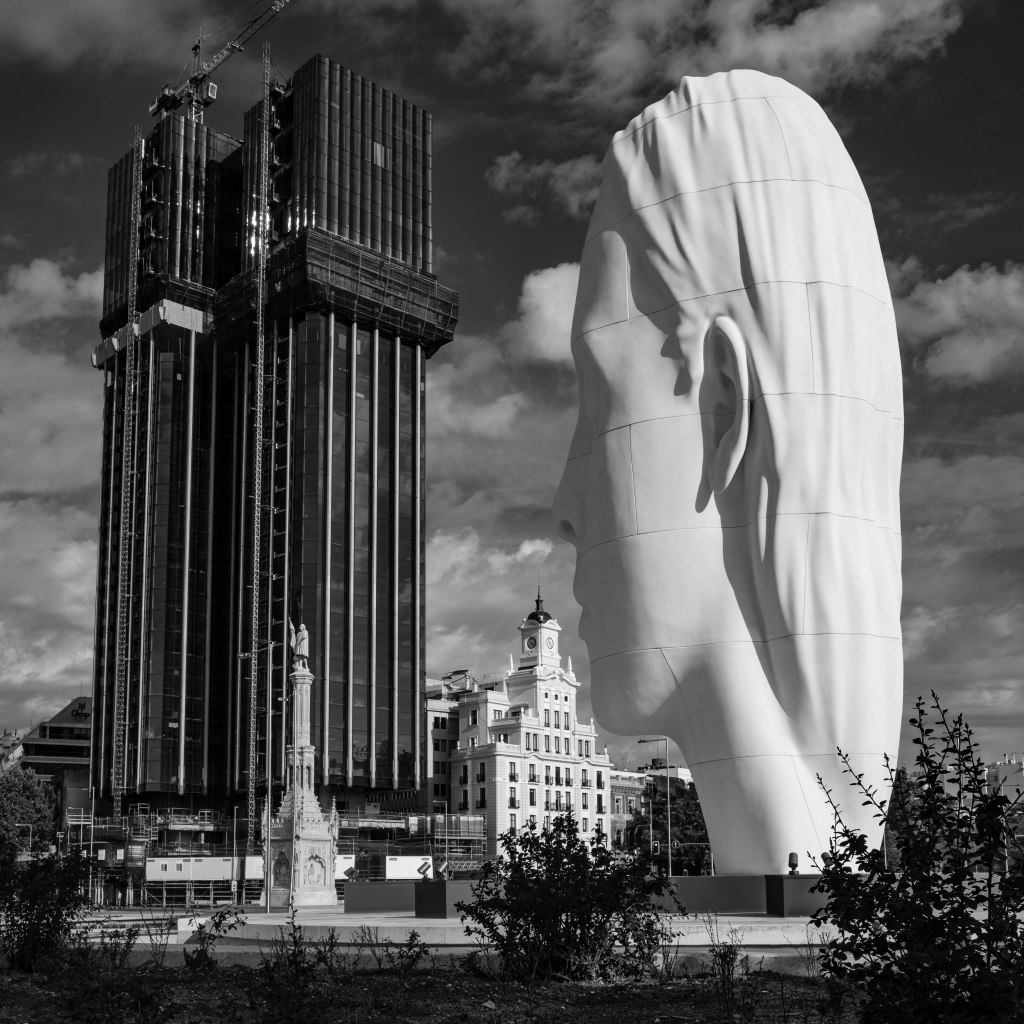
I realized that Debbie and I had seen other Plensa pieces in our travels. Most recently, we stayed a couple of blocks from a monumental sculpture in the Plaza de Colón in Madrid, called Julia. About the same size as the Calgary piece, Julia is also a sculpture of a young woman’s head. The subject’s eyes are closed as if she is meditating.

Julia is typical of Plensa’s large, elongated and flattened busts. When you look at them straight on, they give the impression of being on an angle. It’s an impressive optical illusion. The Madrid piece is made of polyester resin and white marble dust. It’s stunning.

We passed Julia several times a day while we were in the city, and each time I took a few photos. While Julia has been in her current location since 2018, it turns out that she may not be installed permanently… it’s a good thing I took so many photos while we were nearby. Here are a couple of my favourites:

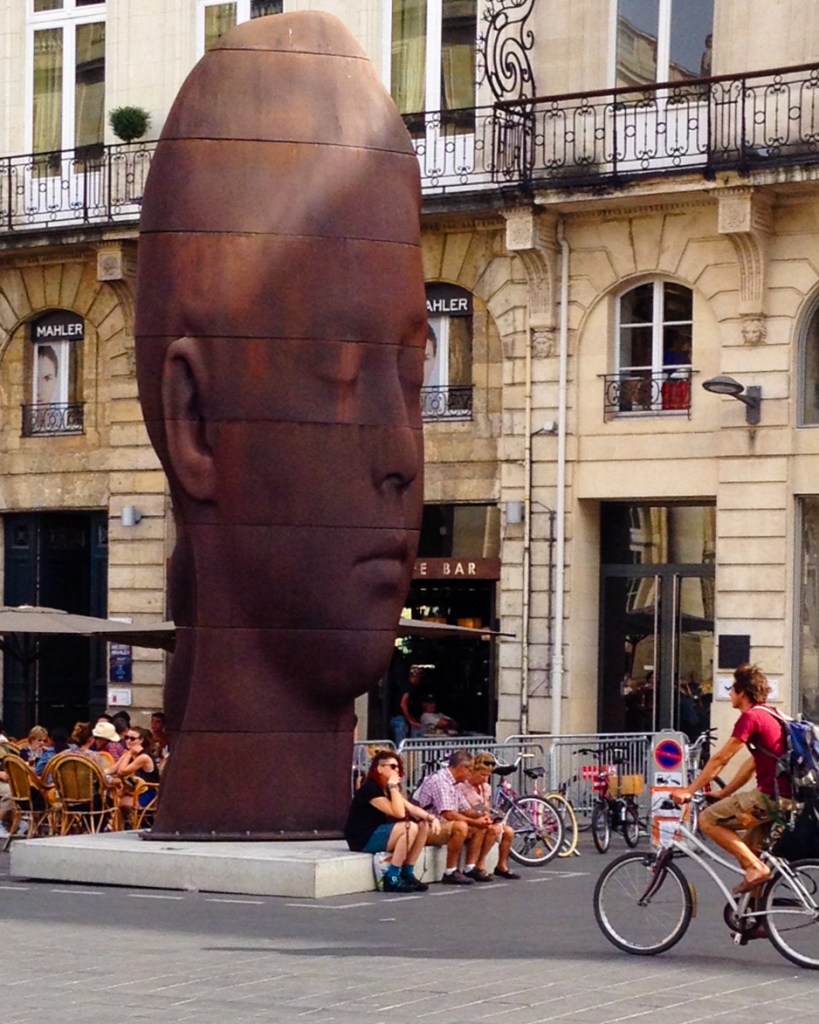
Sanna (2013), Bordeaux

As I did more research into the artist, I realized we had seen another sculpture similar to Julia in Bordeaux, France some years earlier. Sure enough, it was another Plensa piece called Sanna. That one sits in the Theatre Square (the Place de la Comédie) in the heart of the city. Its perspective has been manipulated in the same way as the Madrid piece, and the subject is also shown in a quiet, contemplative pose. Unlike Julia, Sanna is made of cast iron. She is 7 metres high.

The story of Sanna coming to be in Bordeaux is that in 2013 the city hosted an exposition of Plensa’s pieces. The event was popular, so much so that residents initiated a movement to acquire Sanna permanently. As far as I know, it will remain in place until at least 2027.

We have very fond memories of our visit to Bordeaux. The square where Sanna sits is busy with cafes and shops. If we ever make it back there, I hope Sanna will still be there.

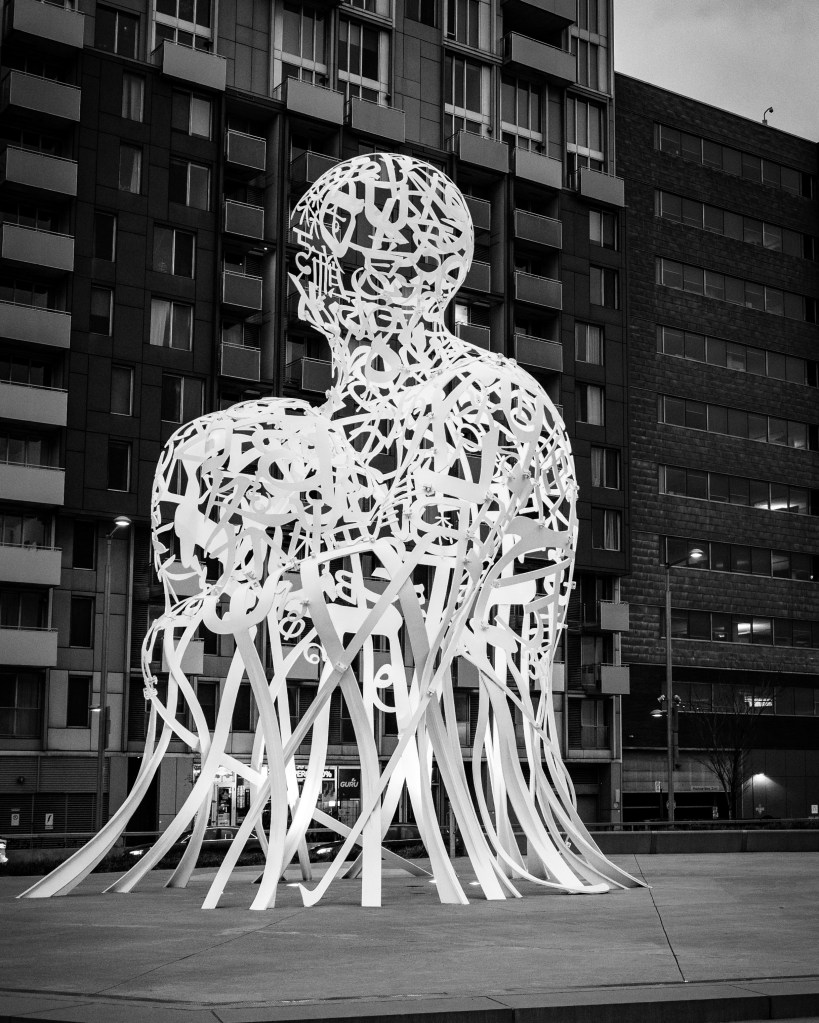
Source (2017), Montreal

The final Plensa sculpture I want to highlight is installed on a terrace in Rue Wellington, just at the entrance to downtown Montreal. Somewhat in the same style as Wonderland, Source is a three-dimensional piece within an open outer frame. It’s a stainless-steel sculpture formed from a random pattern of letters taken from different alphabets, which depict a sitting figure.

The Montreal piece symbolizes the many cultures that have come together over the city’s long history. Fittingly, it was installed for the 375th anniversary of Montreal’s founding in 2017. Like the Calgary piece, Source is open, so it invites visitors to enter the inner space of the piece.

Our stop at the Source was short, and I only have one photo of the piece. Rest assured, I will take more time to check it out next time we are in Montreal.

Concluding thoughts

So what is my take on Plensa, and his large public art pieces?

In a 2019 interview with Forbes, Plensa discusses his use of altered perspective and open gridwork sculptural elements. He described using these techniques as a way of exploring his interest in the way humans communicate, and how different cultures use language.

For me, Plensa’s sculptures seem designed to invite close inspection and discussion. We want to get close to these sculptures. We want to walk around them and even into them. The large scale of his head sculptures could be intimidating, but Plensa defuses this by the way he plays with perspective, and by his use of serene and peaceful subjects.

Having seen four of his works in person, and looked at many others on his website, I find them to be beautiful and innovative. It’s clear from Plensa’s vast catalogue that his formula is a success: there are literally dozens of his pieces installed around the world. I don’t take this as evidence of an overworked theme. Rather, I would say that Plensa has achieved his goal: his works encourage us to get together in pleasant locations and talk. For this reason alone, his art is well suited to the public spaces in which we find it.

Auroras and Other Distractions

Good news! I’ve extended my Dedication Sale through the end of October. It’s a nod to our Thanksgiving holiday.

Print and e-book versions are available on Amazon at a 20% discount.

There’s a hard stop on the sale on November 1!

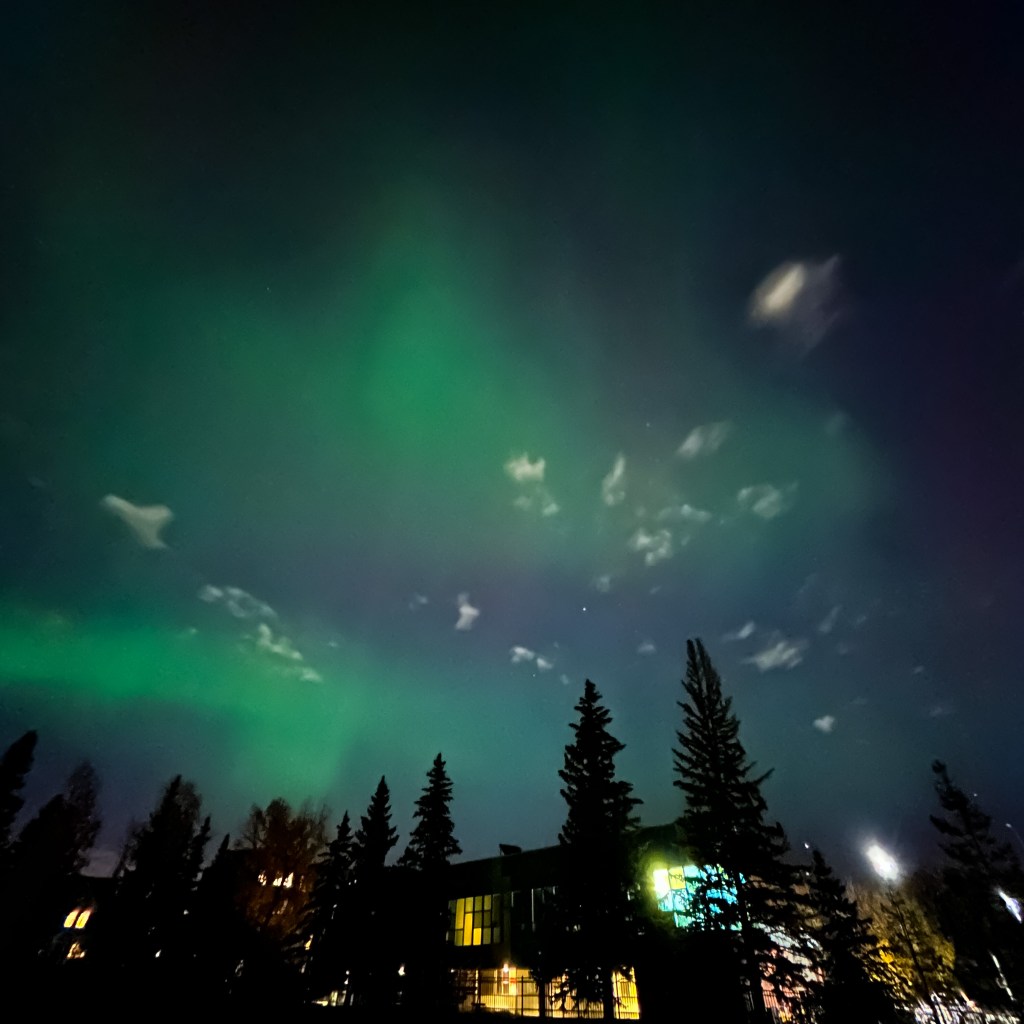
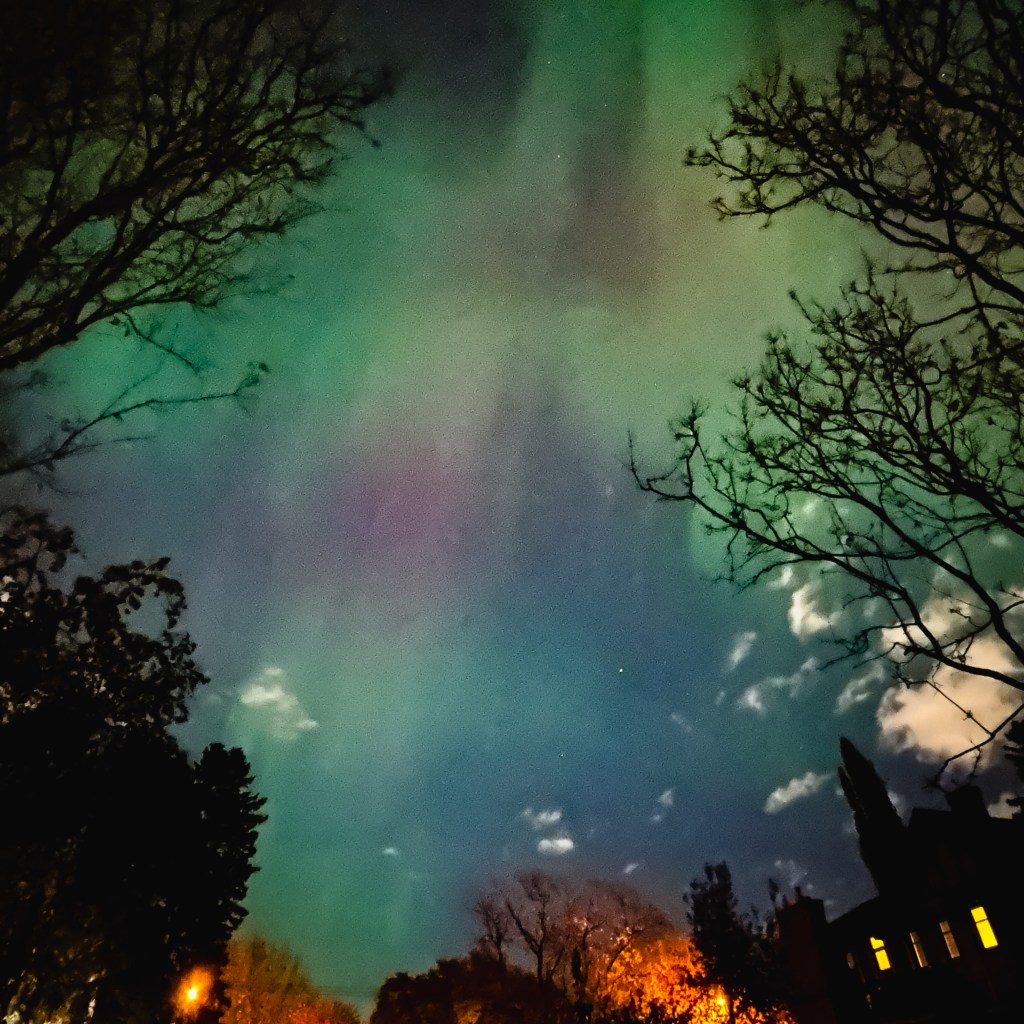
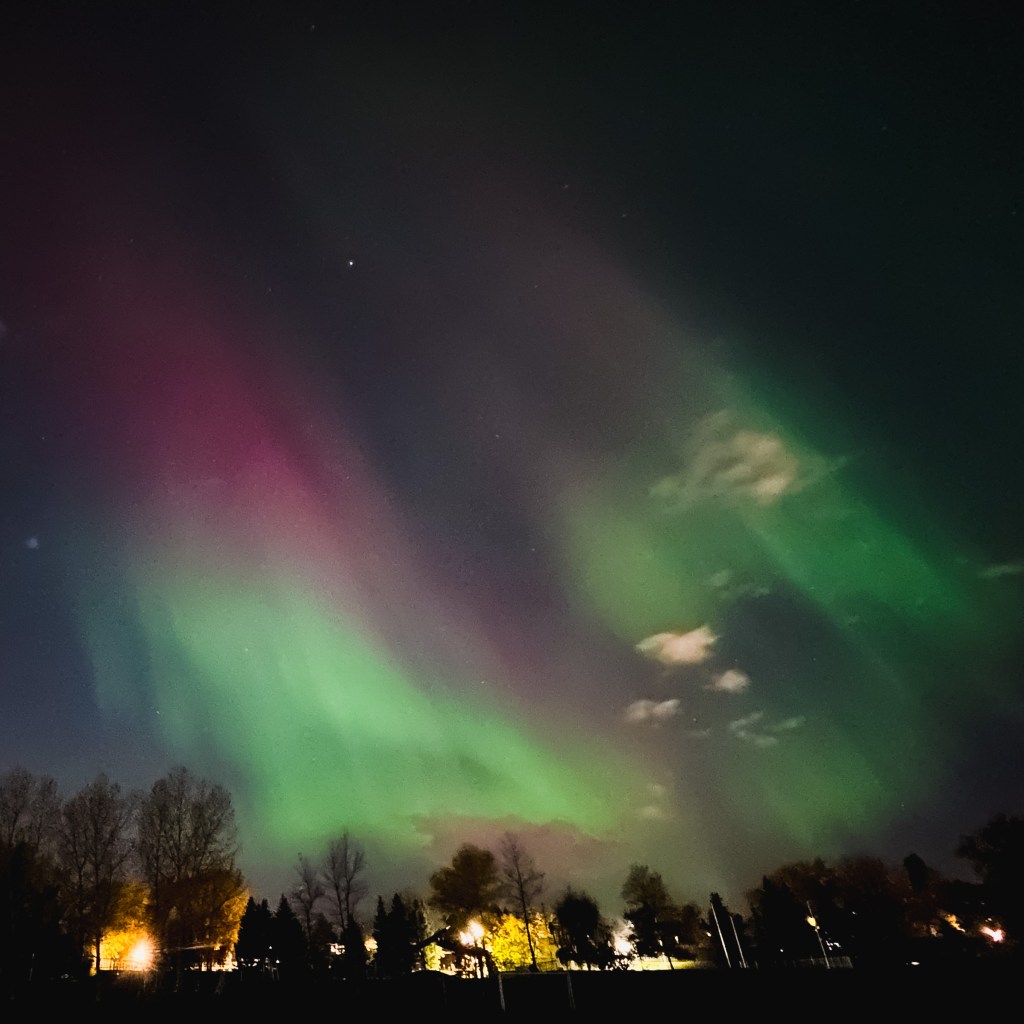
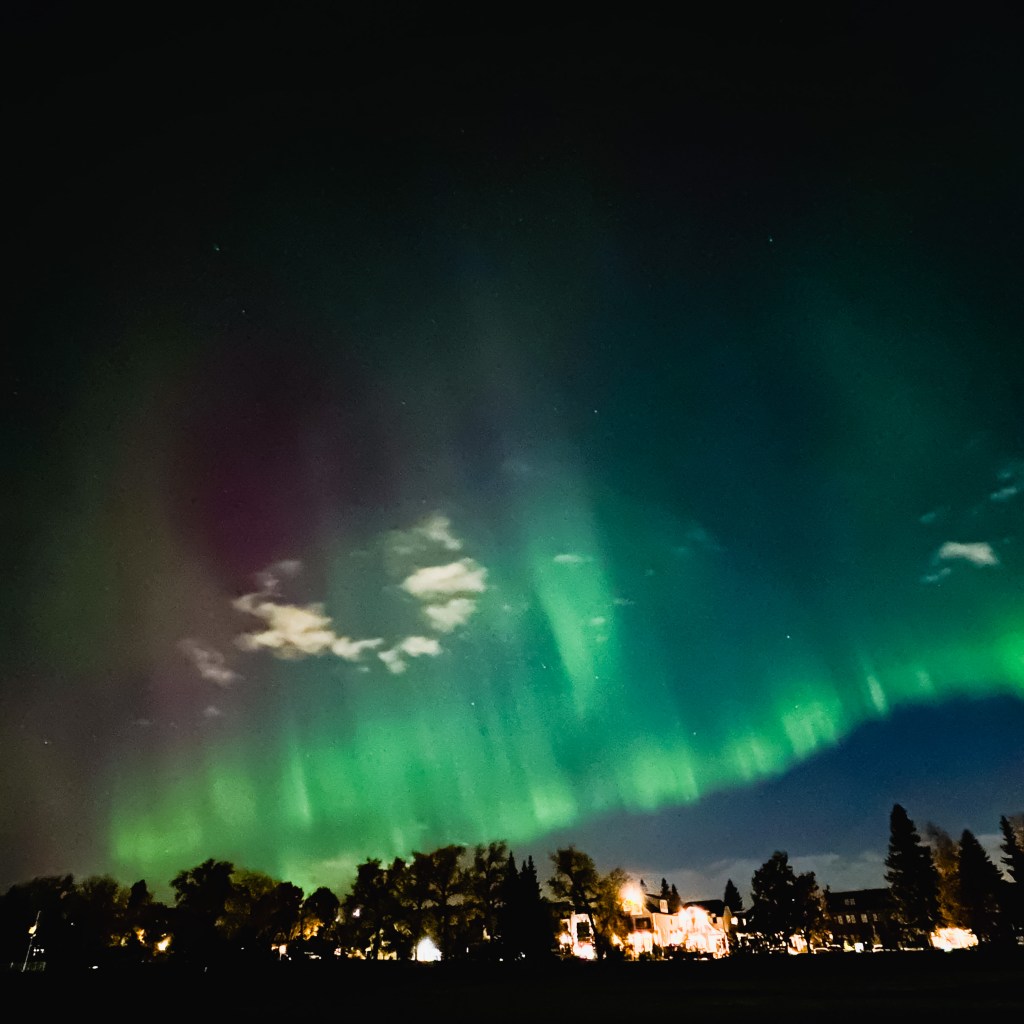
In what was a fairly chaotic week, I did manage to capture a few interesting images. There was no shortage of subject matter. I only had to force myself out the door with a camera.

Auroras a-plenty!

This year has been unmatched for solar activity. I read that it’s all because the cycle of solar activity is at its peak. (Sounds like a topic for a future blog piece!)

I’ve always been interested in photographing the aurora borealis (the “Northern Lights”) but frankly, I wasn’t up to what I assumed was the significant effort needed to make it happen. What gear did I need? How much work would it be to get to a good location, and to do so in the middle of winter when the aurora are most active?

It turns out, this year at least, all one has to do is put an iPhone on a tripod (or maybe not), walk to the nearest park, and look up. I started seeing IG posts from friends who were taking pictures from their backyards, so I figured I could make a similar commitment.

I found a great website (Alberta Aurora Status) that estimates the combination of solar and atmospheric conditions necessary for good viewing. Lately, even that much science may not have been needed.

As for the photos, those took a few nights of experimentation. Fortunately, our recent weather has been agreeable and the skies have been mainly clear. I tried some shots with a “real” camera and soon learned that my iPhone 14 was more than adequate to land some decent shots. I plan to try again soon with other cameras… it looks like the good viewing isn’t finished yet.

The iPhone has a “Night Mode”, which uses a long exposure and some noise reduction. Later, it took some trial and error to get the best result with my photo editor… mainly I adjusted the exposure and added some saturation. Overall, I think the results are pretty good, considering how easy it all was.

Here are some of my edited shots from Lightroom.

Fall Colours and Intervals

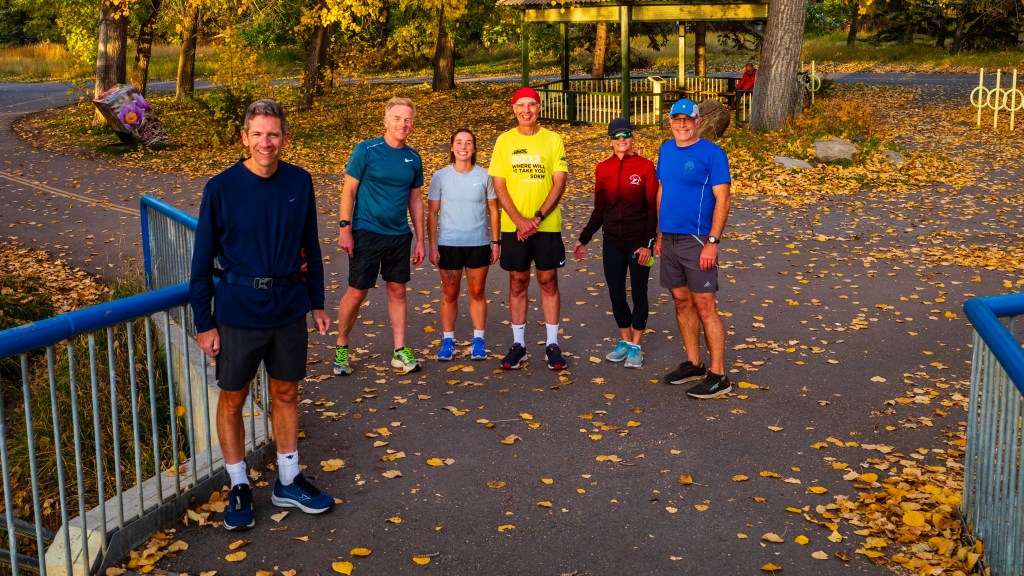
Knowing that our daylight hours are in rapid decline, I made sure to join our weekly group run at Carburn Park on Thursday evening. It was a perfect outing, and it may turn out to be our last outdoor session for the season. A small group showed up since many of our teammates were in recovery mode after a recent target race. Jason G led us through some sets of 500m – 500m – 1k.

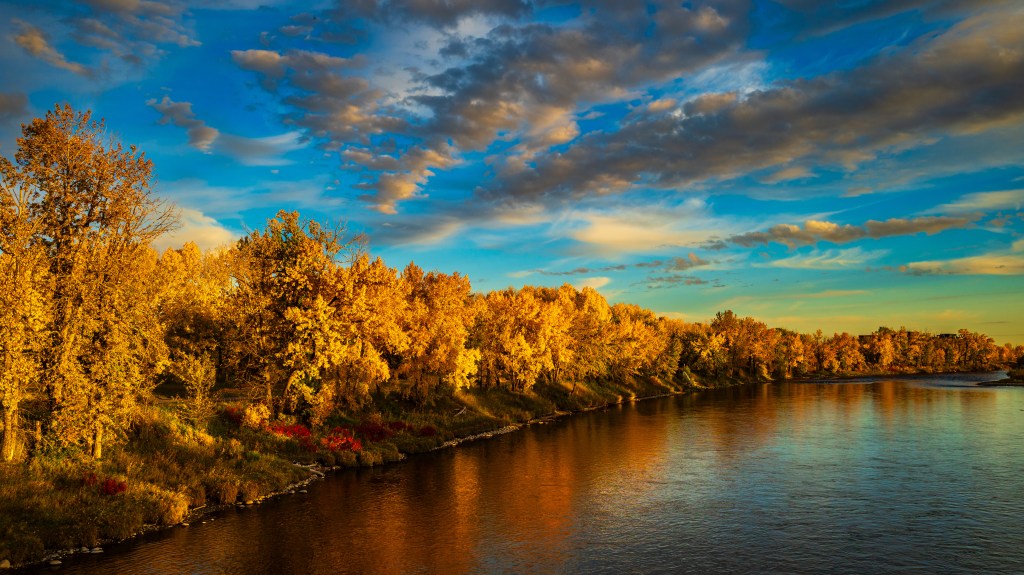
We headed over to the west side of the Bow River and turned north. The views back across the river were spectacular. The setting sun lit up the fall colours, with most of the leaves still on the trees. I used our short 1-minute breaks to good effect, snapping as many pictures as I could before the light show ended. I couldn’t have asked for better training partners than Doreen and Elidh. All pictures with the unbeatable Ricoh GR III.

A-B-C’s

A is for Art and B is for Borduas. What? Who?

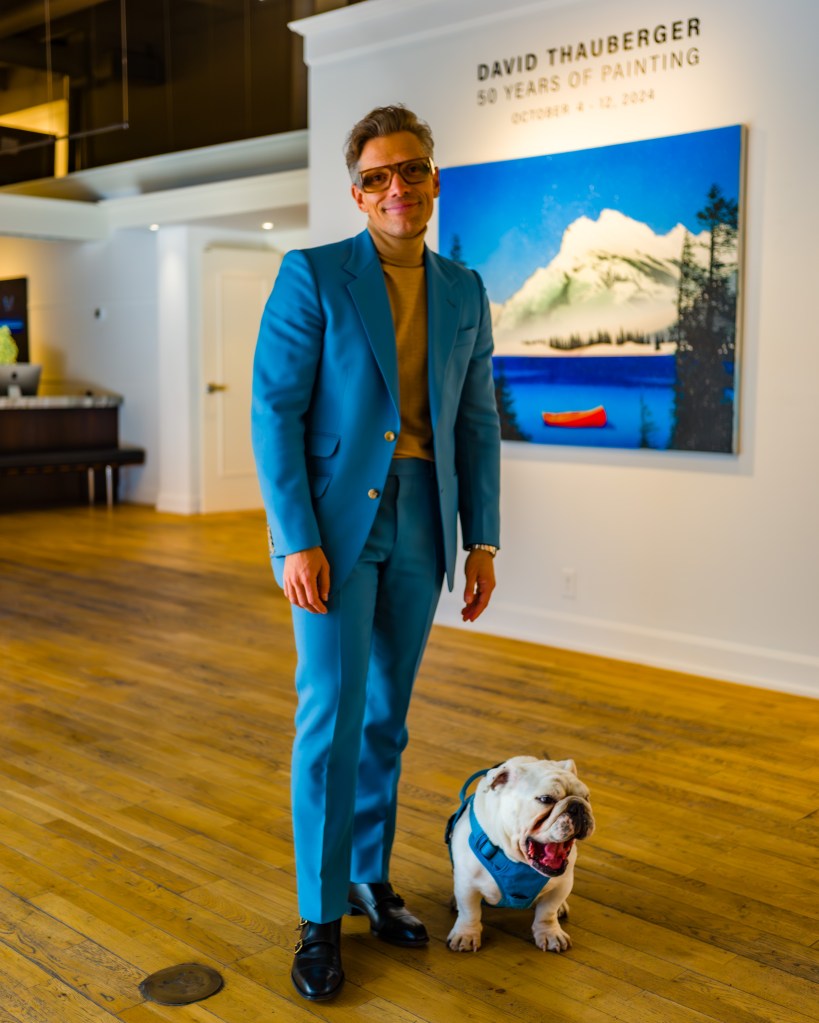
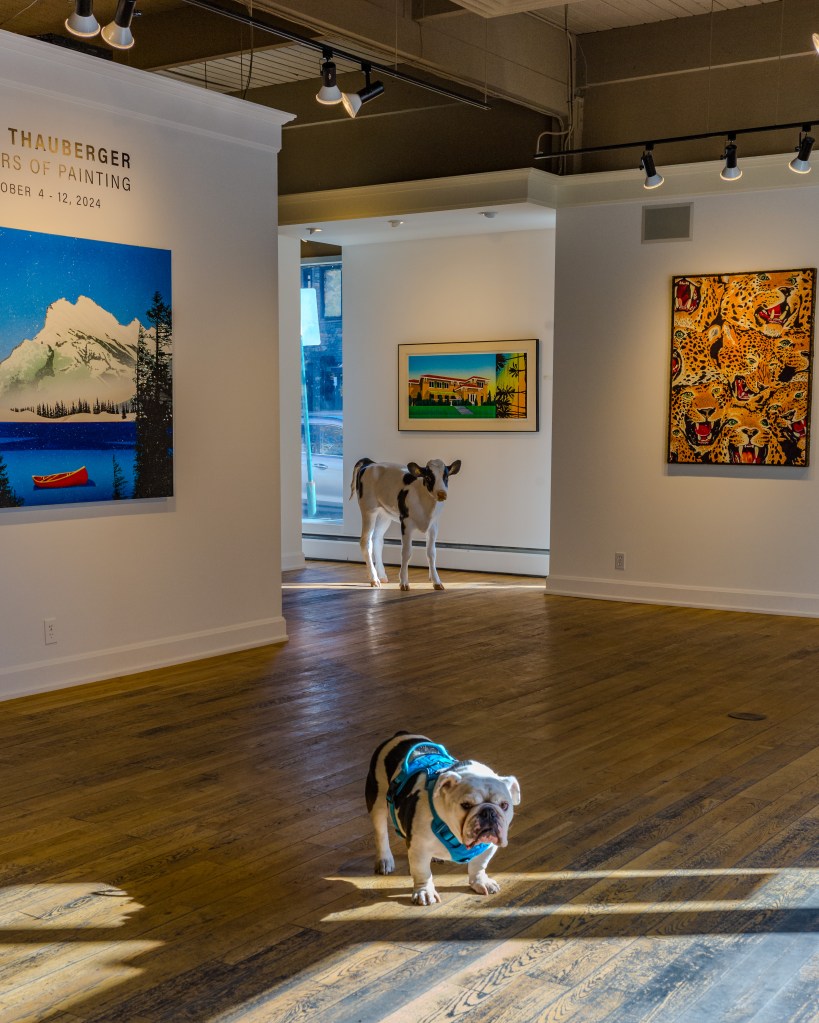
On Saturday, Deb and I made our way to Masters Gallery, to catch the last day of a David Thauberger exhibit. He’s a Saskatchewan painter who’s been active for 50 years. The gallery had an interesting selection of works from his long career.

We always enjoy stopping into the gallery on 4th Street SW to chat with Ryan Green (@ryngreen on IG) and visit with his sidekick. This visit was no exception.

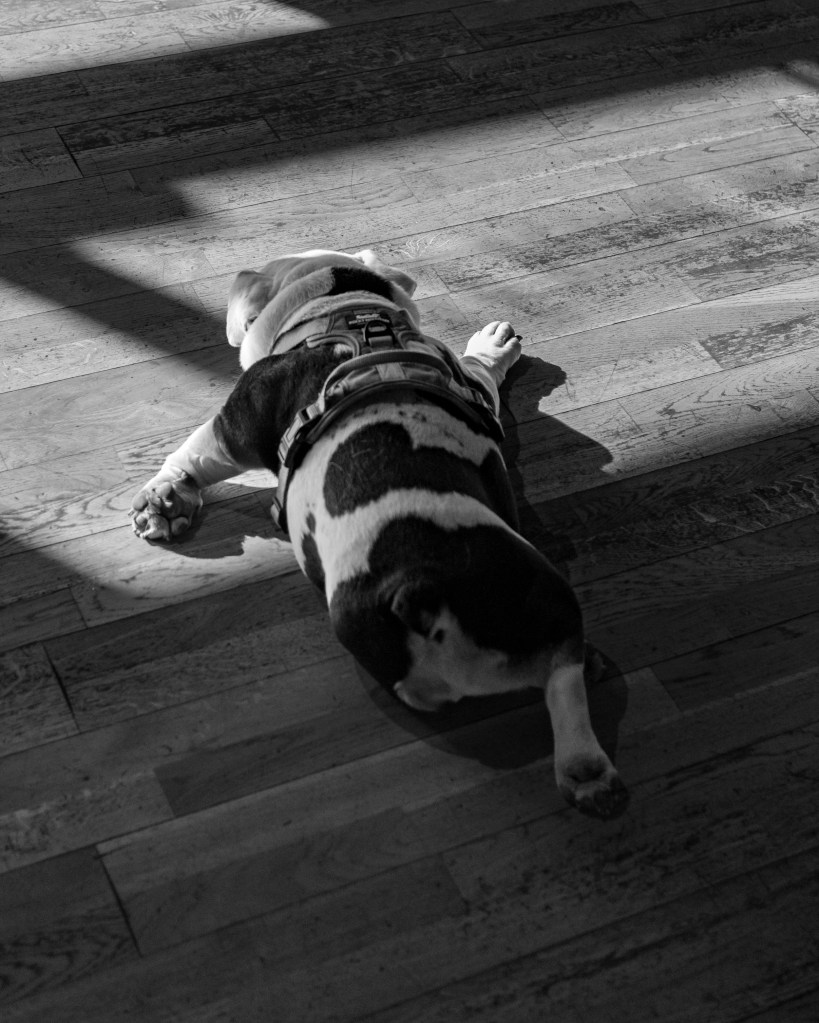
The sidekick I’m referring to is Borduas, aka “Bordy”. Bordy is a wonderful British Bulldog. He’s named after the Canadian artist, Paul-Émile Borduas (1905-1960), and he (the dog) is a fixture in the gallery. I snapped a few pictures of Ryan and Bordy because I had to. You’ll see what I mean.

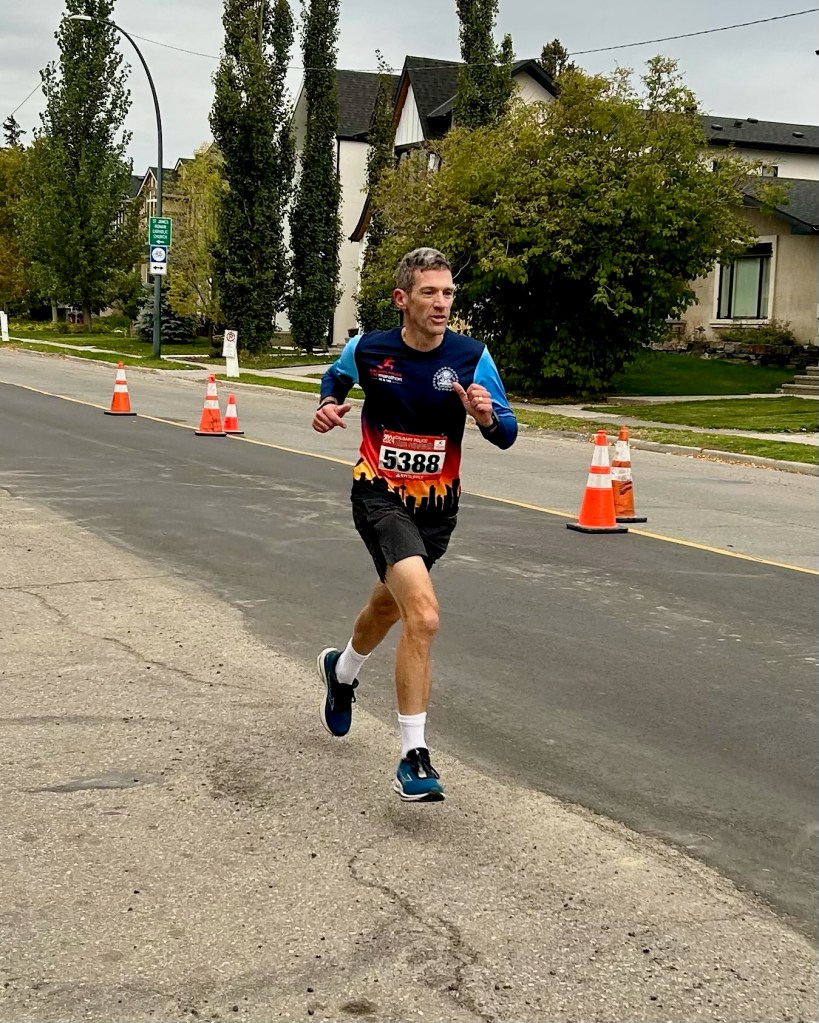
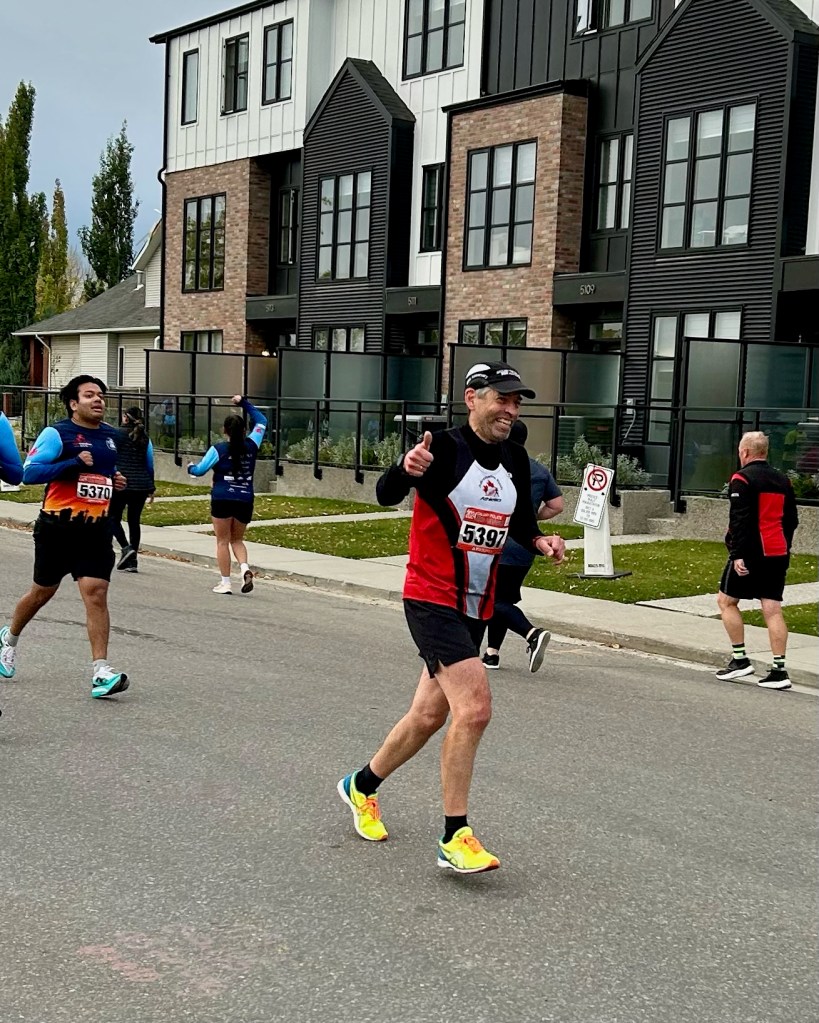
And what about C? This week, C was for Competition, as in racing. After a long hiatus, I signed up for a 5k. This was largely due to peer pressure, from the same Jason I referenced earlier. He had signed up for the 5k as part of the Calgary Police Half Marathon… one of the longest-running, best-organized races in Calgary… and encouraged me to do the same. Thanks for the push, Jason!

I had no illusions of running with Jason, but I set as my goal to run a steady effort at a challenging pace. In other words, I wanted this to be a race, even though it was at my current (reduced) capabilities. I figured I might have a shot at a podium finish in the M60-69 age group, but it was no problem if it didn’t happen. I was just happy to be over my recent calf/Achilles tendon problem.

All photos by Deb Kelly:

Conditions were ideal for racing, and it was a successful outing for Adrenaline Rush runners. Jason flew to a 10th-place overall finish and set a personal best in the process. His time of 19:13 easily placed him first in his age group, by several minutes. Scott did very well in the 10k, running 53:43 and finishing 4th in his age group. Alistair (no photo) cruised to a second-place overall finish in the main event (the half marathon), running 1:22:34. That was impressive enough, but consider that he was taken off course by the lead cyclist, a miscue that added 500m to his race distance. Way to go, guys!

And me? I finished the 5k in 25:55. It was a solid effort. I was happy and maybe a bit surprised with it. I ran smart. I did miss the podium by one spot, and I missed running with Deb even more. Maybe next time!
The Van Gogh to Van Gogh Photo Run

My photo run was bookended by two very different pieces of public art in Calgary. The pieces have a couple of things in common. Both are large, impressive sculptural works. And both have Vincent Van Gogh as their subject.

What a coincidence! I decided to do some research after I got home. But first, it was time to explore on foot. Here’s my route from Strava:
The Van Gogh Photo Run

And here’s what I found out about the artworks and the artists.

Van Gogh Observes, by Joe Fafard

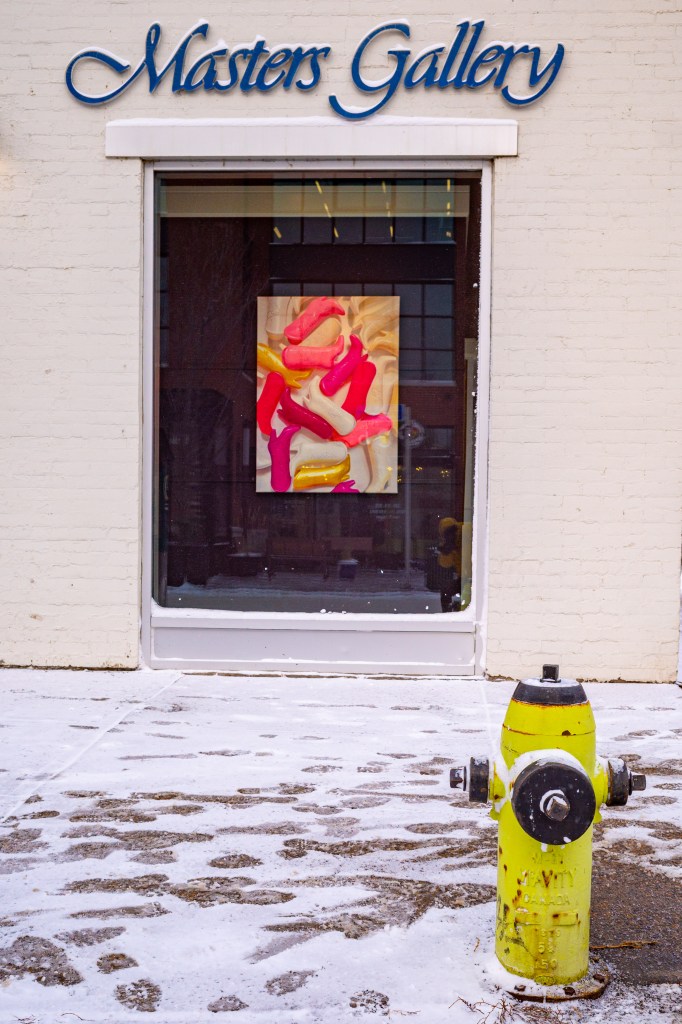
I parked on 4th Street SW in Mission, near Masters Gallery, for the start of my easy run. I always like checking out what’s on display in their windows. Whatever else I happen to see, I can stop to admire the large piece installed just outside the gallery.

That piece, Van Gogh Observes (VGO), is a major sculpture by the late Joe Fafard. I wrote about Fafard last fall, when I photographed Do Re Mi Fa Sol La Si Do, his sculpture comprising eight stampeding horses. That piece is installed in Harley Hotchkiss Park in downtown Calgary.

Fafard’s piece is big and colourful. It’s fantastic. Van Gogh silently watches everything going on outside the gallery… hence the title. And from his vantage point, he’s seen a lot since the piece was unveiled in 2019. Van Gogh Observes was one of Fafard’s last major works… he died in March of the same year.

Although it wasn’t taken during my recent run, here’s one of my favourite pictures at that location. This couple seems to be deep in conversation with Vincent.

“Hello Vincent!”

Fafard was famous for his sculptural works, which often have a highly animated look. He sculpted livestock, people and other subjects, in bronze or laser-cut steel. His work is always visually appealing. This is certainly true of VGO. I think Fafard’s use of bold yellow and blue was a nod to Van Gogh’s frequent use of the same colours. It’s a piece that brightens up bleak winter days in Calgary.

Even from the back, it’s an amazing piece to look at.

Van Gogh Observes (Joe Fafard), from the rear

Van Gogh Monumental, by Bruno Catalano

I made my way to the UPTEN building at 10 Avenue and 1 Street SE to see Bruno Catalano’s 2020 painted bronze statue, Van Gogh Monumental. The four-metre-tall statue on the southeast corner of the intersection presents the artist walking purposefully while holding a well-used suitcase and carrying a painting on his back. He walks in the direction of the downtown core.

Van Gogh Monumental (Bruno Catalano)

The statue is part of Catalano’s Les Voyageurs series, all of which depict characters in motion. Many of Catalano’s sculptures, including this one, have a large diagonal gap, really a gash, at mid-torso. The sculptures seem to defy physics… they shouldn’t be standing, but they do. Catalano’s bio tells us he discovered this technique when he had a casting accident with an earlier piece. He liked the result, and he incorporated it into many of his subsequent works. It’s become his trademark.

Catalano’s sculpture invites speculation about its meaning. What is Van Gogh searching for? Where is he headed? Maybe there are clues in Catalano’s own story. He was born in Morocco. His French-Italian family moved to Marseille when he was ten. Catalano has Jewish ancestors, who were expelled from Spain in the 15th century, and eventually settled in North Africa. The theme of travelling, of searching nomadically, seems to fit naturally into his art. 

I find it interesting that Catalano chose Van Gogh for this sculpture, because most of his subjects are anonymous people. Here, he has chosen one of the world’s most famous and troubled artists. We shouldn’t be surprised to see Van Gogh searching for something while carrying his worldly possessions and his art. The gap in the statue is visually startling, but it also reinforces the idea that the subject has lost something quite fundamental.

Conclusion

As I jogged back to my car, I pondered the two art pieces I had just seen. I like both the Fafard and the Catalano pieces, even though they give us very different takes on an artist we all have some familiarity with.

The Fafard piece is approachable. Its animated look and bright colours give us an optimistic Van Gogh. Like the couple pictured above, we feel we could have a conversation with the man in the statue. That might explain why the statue is a huge attraction. I often see pedestrians stopping to admire it (or have a chat.)

On the other hand, the Catalano piece is more aligned with how we usually think of Van Gogh. It is a darker piece. The burdens Van Gogh is carrying and the cut across his body seem to portend his death by suicide. These are effective techniques to tell us something about the subject, but also about the artist. If Catalano relates to Van Gogh’s trials, he has done a great job of telling us.

I am most moved by the Catalano piece. What about you? Whichever piece you prefer, we are fortunate to have these important artworks in the city. It’s even better that they are just an easy jog apart.

Seeing Double?

Yesterday’s run along the Bow River was nice, but for the ice. And the wind. Otherwise, it was perfect! Good company, bright sunshine, and lots of runners out. Thanks, Deb and Sherrey for getting me to 13k, which was more than I expected to do.  

Given the conditions, we decided to head east from Eau Claire. Better to warm up a bit before facing the breeze. We reached the 12th St bridge in Inglewood before turning around, 3k into our run. Even after so many years, passing the confluence of the Bow and Elbow Rivers always feels special to me.

Our crossing point happens to be the location of a unique statue. Or maybe not so unique. But more on that shortly. 

The statue I’m referring to is called Wolfe and the Sparrows. It was sculpted in bronze by Brandon Vickerd in 2019. Vickerd is a Hamilton-based artist and professor at York University.

Wolfe and the Sparrows (Vickerd, 2019)

General Wolfe was the commander of the British forces at the Battle of the Plains of Abraham. He led the British to a rather important victory there in 1759. 

As I stepped carefully around the statue… that ice!… I stopped to admire it for a few seconds. I wondered what Vickerd had in mind when he replaced Wolfe’s upper body with a flock of sparrows.

Later, I read the city’s description of the statue, which states that the community wanted something  “critical, challenging and funny”. I think Vickerd succeeded with this piece.

According to his bio, Vickerd seeks to “provoke the viewer into questioning the dominate myth of progress ingrained in Western world views.” His Wolfe statue touches on themes of indigenous reconciliation, so maybe he hit the mark there too.

Why? Apparently, in many cultures and religions, sparrows represent good fortune, happiness, and resilience. They are non-native birds in North America, which makes them a good choice for a piece meant to convey the importance of reconciliation. 

I like Vickerd’s statue a lot. I decided that whatever he intended, it works as a thought-provoking piece of public art. 

Back to our run. Continuing west along the river past 14 St, we saw many familiar faces, including some quick runners in RunCalgary‘s 12k’s of Christmas. Well done, Reinier and Mel, Matt and Jeremy!

It was a quick pace at the front of the pack

Now, what about my comment about the uniqueness of the Wolfe statue?

On the drive home, I asked Deb to make a slight detour so we could stop at Calgary’s “other” Wolfe statue. Appropriately, this one sits in Wolfe Park in Mount Royal.

This bronze statue by Scottish sculptor John Massey Rhind was completed in 1898. It was originally located in New York City and was sold to Calgary philanthropist Eric Harvie in 1966. The statue was donated as a public art piece in 2009. 

Wolfe, with no sparrows (Rhind, 1898)

You’d have to call this version of Wolfe a traditional rendering. It shows the general looking off into the distance as if contemplating the battle to come. (By the way, Wolfe didn’t survive it.) 

I like this statue too, and I’ve photographed it often. It certainly is a worthy addition to the neighbourhood. I try capturing it in different lighting conditions, as it seems to change the expression on Wolfe’s face. 

From chest level down, these two statues are identical. Vickerd chose to do this. Was it homage to Rhind’s statue? Maybe. We are left to wonder what message he was sending by adding the swallows. For me, while the original statue is handsome, it can’t match Vickerd’s version as a provocative piece of art.

In closing, we’re fortunate to have two very different Wolfe statues in Calgary. Both are impressive pieces, in their own way. 

Downtown Wildlife “Photo Run”

A reminder that Stroke of Luck is now available. Click here for details.

I often feel that I’m rewarded with photo opportunities as long as I have a camera close to hand. Last week I made a rare trip into downtown. It was a day after the first blast of winter in Alberta. The snow was still falling. 

I’d walked by the Harley Hotchkiss Plaza next to the courthouse many times, and I’ve always admired the Joe Fafard sculpture (Do, Re, Mi, Fa, Sol, La, Si, Do). It is a special installation… large, dynamic and colourful. 

Fafard (1942-2019) is known for his large sculptures, which often feature animals and play with perspective. Many of his works are humorous and they always show his keen wit.

Fafard produced the eight horses that comprise this work from powder-coated 5/8” steel plate in 2010. There is a duplicate of the piece installed in le parc Notre-Dame-de-la-Garde in Quebec City. Apparently, Fafard used laser-cut steel pieces salvaged from his other works to create the horses. Up close or at a distance, they are fantastic.

I’ve taken pictures of Fafard’s sculpture a few times, but each time I found the size and breadth of the piece (not to mention an often busy background) made it hard to photograph. On this day, though, the snowy scene was a perfect monochromatic backdrop. I stopped for a few shots with my Ricoh GR III. 

When I edited my photo, I made use of the latest masking features in Lightroom. Adobe says these are based on AI. Whatever they did, they made the process quite intuitive. It saved me a lot of time in this case, because I visualized the photo with the intricate figures separated from the background. To make the horses stand out even more, I reduced the saturation in the background. 

Here is the result. I hope you like it. (Yes, it is a slight cheat, but I figure that since the horses are running, I can officially call this session a “photo run”.)

Do, Re, Mi, Fa, Sol, La, Si, Do by Joe Fafard (2010)

A little further north on 4th Street, I stopped again. This time, it was to admire the massive mural of a peregrine falcon on the south side of the building at 441 5th Avenue SW. The piece is by Jerry Rugg, who is known in the world of muralism as birdO. Rugg is a multidisciplinary artist based in Toronto. His beautiful mural was done for the Beltline Urban Mural Project (BUMP) in 2021.

birdO works on canvas, in digital print, and installation, but he may be best known for his large-scale mural work on walls and buildings around the world. This is a great example. I love this piece, and I especially like the way it brightened up an otherwise cold, grey day.

As in the previous photo, I toned down the saturation in the background, which was admittedly already desaturated. This let the brilliant colours in birdO’s mural shine.

Peregrine Falcon, BUMP mural by birdO (2021)

Speaking of Joe Fafard, I can’t resist including a closing word about him. There are several impressive Fafard pieces around Calgary. My favourite is Van Gogh Observes, a monumental piece which can be found outside Masters Gallery on 4th Street SW in Mission. According to the gallery’s description, it is one of Fafard’s largest pieces.

This shot is from my archives. I was lucky to capture Van Gogh, apparently engaged in conversation with a passing couple in 2020.

Van Gogh Observes by Joe Fafard (2018)

Leicaphilia Loses its Creative Force

Tim Vanderweert passed away in early January. I need to say a few words about him, and the impact he had on me. In this digital world, it seems a stretch to say Tim was a friend because I never met him. I only knew him through his online presence and a bit of interaction we had through his blog, Leicaphilia. One thing is certain – I wasn’t the only person who was influenced by Tim.

It’s funny how things go sometimes. About five years ago, I was putting my life back together after a medical episode that left me wondering what my future would look like. Competitive running, which had been a constant presence in my life for more than four decades, looked like it might be taken away forever. I wasn’t sure I could cope with that prospect.

I had always had a passing interest in photography, but to be fair, it had never gone beyond a teenager’s early fascination with the gear and amateurish attempts to emulate the great landscape photographer, Ansel Adams. Boxes of family snapshots, as great as they are, attest to the fact that I focused more on quantity than quality. And that was fine, as I had limited time for hobbies, for all the usual reasons.

Fast forward to 2017. Adrift after a lengthy hospital stay and amid much uncertainty, I picked up my old Canon AT-1–that’s a totally manual film camera by the way–and started carrying it with me on my slow recovery walks around the neighbourhood. For years, I had cruised through the same streets at a faster pace – apparently fast enough that I hadn’t seen things that were right in front of my eyes.

My interest in photography was being rekindled but I was rusty. So rusty that I had missed the whole transition to digital photography, which had made film cameras obsolete. At least that was the conventional wisdom.

And then I discovered Leicaphilia, and its creative force, Tim vdW. Here was a guy, about my age, who had dedicated as much of his life and energy to photography – Leica-based film photography no less – as I had dedicated to competitive running. Different hobby, same passion. I liked him immediately.

The more I delved into Tim’s writing and creative output, the more our connection grew. I especially liked the fact that he steadfastly defended the turf of film photography against the onslaught of digital. Pixels didn’t matter an iota to him. It was more about the emotional impact, the art, than about the technical features of the latest camera. And on that point, Tim had the knowledge (and the courage) to state his views and share his thoughts. He wrote eloquently about the philosophical underpinnings of photography, about topics like aesthetics. His knowledge spanned centuries.

I had never read articles that tied the Greek philosophers to this hobby. But as a returning student, I was more than willing to learn. His lucid posts entertained me (and his other devotees) while they educated me, complete with photographs from his archives and his bike rides around North Carolina. He put together a book of his photographs taken from inside cars – it was called Car Sick – and I bought not one but two copies. (You see, he had made it abundantly clear to his readers that he had lost his shirt on the production of the book. I wanted him to keep going.)

When Tim announced to his readers that he had cancer, we all held our breaths. It looked bad. For a time, he stopped posting. Eventually, he informed us that he was in hospice care, with only a few days to live. Except he didn’t die. He got better, at least for a while.

In the last few months of his life, he gifted his anxious audience with constant posts, full of clear writing about his situation, and yes, some excellent photography. With a creative flourish, he turned his attention to developing the hundreds of rolls of film that had accumulated in his house. He even put together an exhibition of his life’s work.

And now he is gone. Tim showed us all how we might try to face the grim prospect of our own impending death, with grace and purpose, and good humour. As we go through the ups and downs of our own lives, we should all hope to have as much positive impact on those around us.

My first reaction to the news of his passing was to load a roll of his favourite film (Kodak Tri-X) into my Leica M6 and shoot some street photographs, hoping for his spirit to walk with me as my muse.

Tim will be missed.

“Look out below”, inspired by Tim vdW (Leica M6 and Kodak Tri-X, 2023)