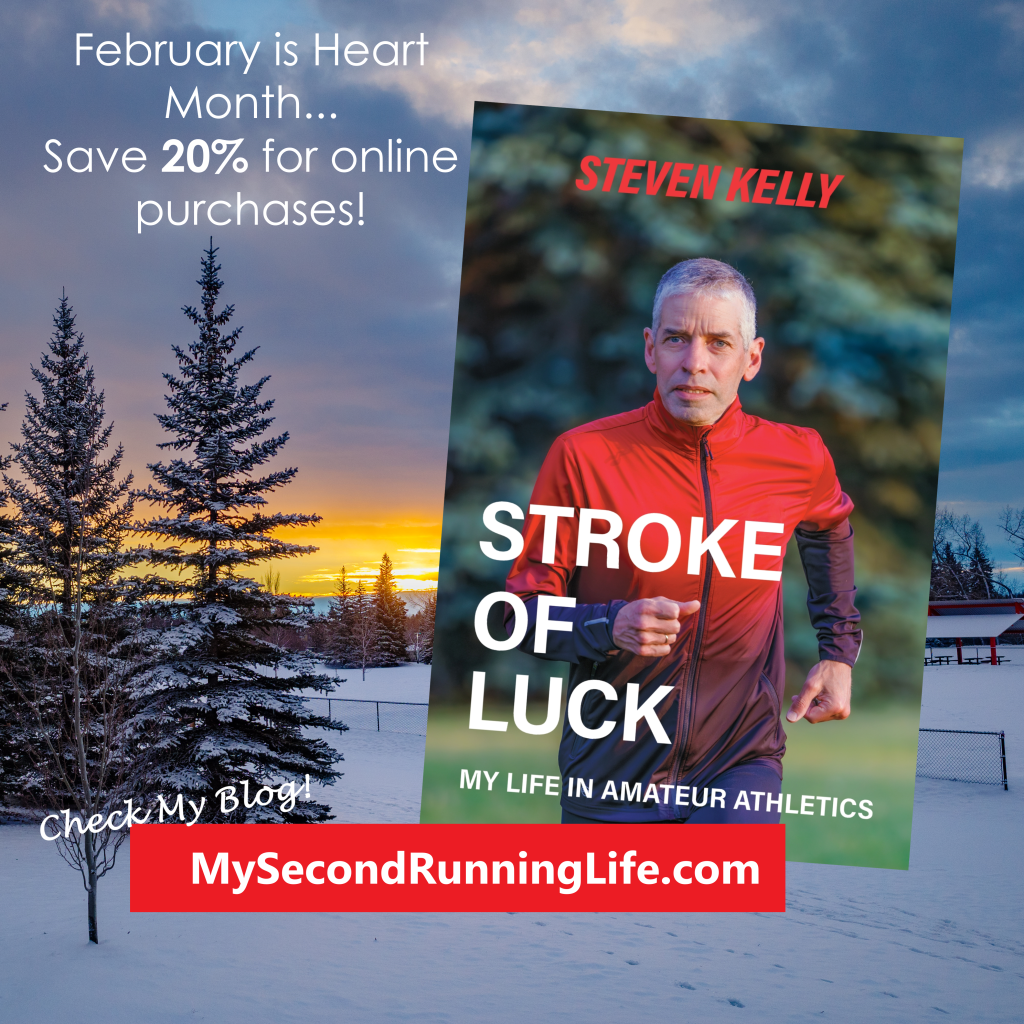
I had the pleasure of dropping into the Calgary Health Foundation office today. The purpose of my visit was to present CHF with a donation cheque, on behalf of everyone who has supported my Stroke of Luck book project.
When I first considered writing a book about my stroke journey, it was a daunting prospect. I was indebted to the doctors, nurses and staff at the Foothills Medical Centre, Unit 100 (“the Stroke Unit“) for their care during my stroke journey. As a grateful patient, it was ultimately an easy decision to go ahead with the project, once I realized that my book could be a platform for helping them in their invaluable work.
I’ve committed to sharing with the Stroke Unit proceeds from book sales, plus all other direct donations I receive. With the help of Laurel Williams (Philanthropy Advisor) and Ashley Oakley (Communications Advisor), these funds will go directly toward the ongoing needs of the Stroke Unit. It’s the least I can do.
Thanks again to all who have bought the book or have contributed to the cause. Your support is greatly appreciated!
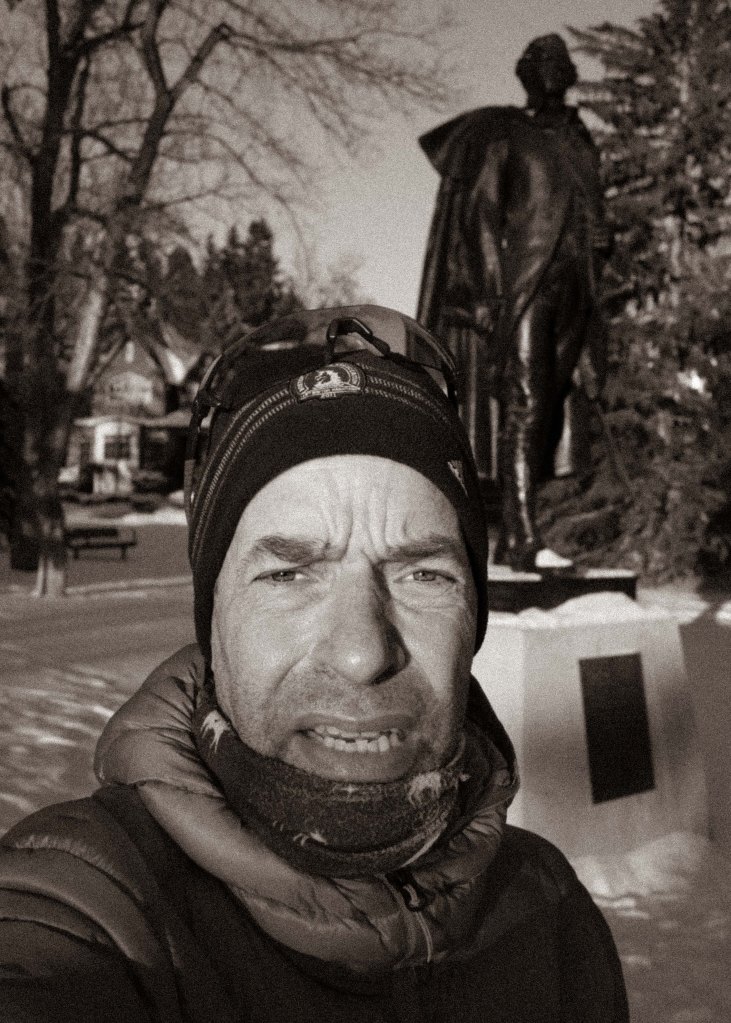
With Laurel Williams, CHF Philanthropy Advisor, March 2025 (Photo by Ashley Oakley)
While I’m writing, I will take the opportunity to remind my readers about my three main messages:
The importance of an active lifestyle
Awareness of ALL the symptoms of stroke, and of course…
Raising funds to support the great work being done every day on stroke prevention and care at the Foothills Medical Centre’s Stroke Unit
Finally, if you have not already read the story that Ashley wrote about my stroke journey, you can find it here.
We all know that February is the shortest month, at 28 (or 29) days, not the usual 30 or 31. But do you know how this came to be?
We have to go back to the Roman calendar, which divided the year into ten (not twelve) months, from March to December. These months were either 29 or 31 days, not 30, because the Romans considered even numbers to be unlucky. The early part of the year was not even named.
The second king of Rome, Numa Pompilius (ca. 753-652 BC) reformed the Roman calendar and introduced the months we know as January and February. However, it would have been problematic for these new months to have either 29 or 31 days. Why? Because the total number of days for the year (that is, the product of 12 odd-numbered months) would have ended up as an even number, not the required 365.
So, February was adjusted to make the annual math work. A couple of reasons are cited for this decision. The name itself comes from the Roman festival of purification, ‘februa’, which occurred at that time of the year. It was also the time when people mourned the departed. These factors led to February being the month that was shortened to 28 days.
Recently, I wrote a piece about several of my sporting heroes. To keep the piece to a reasonable length, I didn’t comment on another man who had certainly earned a place on my list. In fact, he had been one of my personal heroes for years. That man is Jerome Drayton. In light of his sudden passing on February 10 at the age of 80, I’m regretting that decision. It seems appropriate to talk about him now, and the impact he had on me.
Much has been written about Drayton. His personal story is one of strength and resilience. He was born in Germany to Russian-Ukranian parents, just as the war was coming to an end. His parents divorced, and he emigrated to Canada with his mother in 1956. His name at birth was Peter Buniak, and while we hear various reasons for his change of name, it was clearly his way of putting distance between his past in Europe and his future life in Canada.
He started running in high school in Toronto and found early success. More accurately, he earned it. His results speak volumes about his work ethic. I can start with his astounding mileage totals. He was a pure amateur, doing 200-mile weeks while working full-time. Mere mortals struggle to reach a quarter of that.
While I was discovering athletics in the mid-1970s, Drayton was already in the top echelon of the sport. I never met him, but I followed his exploits closely. Here’s some of what I wrote about him in Stroke of Luck:
“Coincidentally, the world around us was discovering running at the same time we were. The mid- to late-1970s marked the beginning of what is now called the running boom. Frank Shorter’s win in the 1972 Olympic Marathon for the United States is often cited as the beginning of the boom, but I wonder how strongly that event resonated in Canada. If we were following any world class distance runners, it was more likely to be the top Canadian, Jerome Drayton, or even some of the top British runners like Ron Hill, rather than the celebrated American.”
Drayton’s running resume is stellar. In an era when distance running was still seen as a fringe sport, Drayton fit the stereotype of the lone, somewhat aloof, character. Obituaries and tributes describe his single-mindedness and determination.
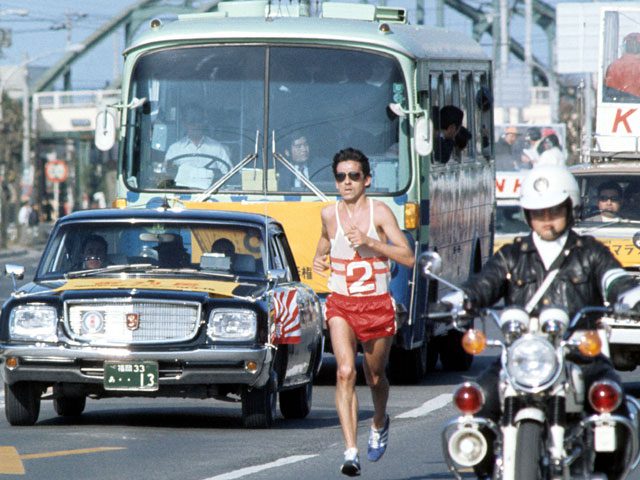
In my book, I described Drayton as an enigma, given his preference for running in dark aviator shades and a tendency to front-run against his toughest competitors. Perhaps fitting that persona, Drayton never seemed to say much. He let his running speak for itself.
Consider this: long before Boston assumed the title of “world’s premier marathon”, the Fukuoka Marathon in Japan was at the pinnacle of the sport. Entry was by invitation only. Drayton won it, THREE TIMES, in 1969, 1975 and 1976. What about Boston? Well, he won that too, in 1977. He was the last Canadian man to do so.
Drayton in the 1976 Fukuoka Marathon (Photo from Canadian Running, 2013)
Speaking of Boston, I suppose we could add “irascible” to the list of words describing Drayton. Apparently, he wasn’t the most gracious winner. Rather, he took the opportunity to point out that he had just about been mugged in the early going, and that his victory had nearly been sabotaged by the lack of water stations. Hearing this story only made me admire him more. Any of us who have run the race can thank Drayton for dragging the BAA into the modern era.
I have to mention the most durable of Drayton’s achievements, his Canadian marathon record. He set the record (2:10:08) in the 1975 Fukuoka Marathon, and it stood for an incredible 43 years until Cam Levins broke it in the 2018 Toronto Waterfront Marathon.
There was a Hamilton connection too, which cemented Drayton’s place as one of my running heroes. Here’s another passage from my book, where I talked about his victories in the Around the Bay Race:
“The history of the Boston Marathon is intertwined with that other famous race, Hamilton’s own Around the Bay Race. Both races were first contested in the 1890s. Many icons of distance running, including some legendary Canadians, had competed in both events. The lists of past winners in Boston and Hamilton include many names that I recognized, even idolized. There was Jerome Drayton, the top Canadian marathoner, the national marathon record holder, and the 1977 Boston winner. He was also a two-time winner of the Bay Race, in 1973 and 1974.”
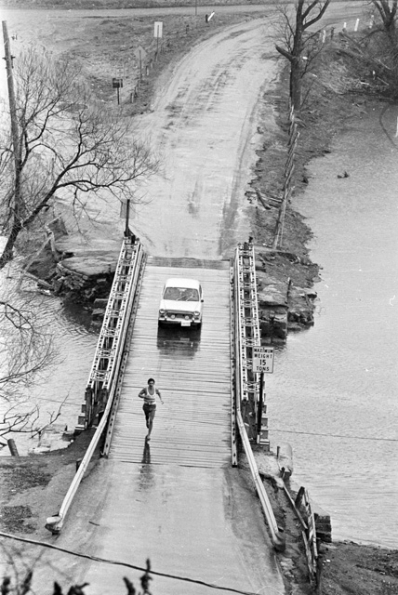
Drayton, alone in the lead at ATB (Photo from Hamilton Archives)
In the 1970s, finding any athletics news at all was tough. I scoured a lot of newspapers. Despite the sport’s relatively low profile, Drayton stood tall. His star shone brightly until his retirement in the early 1980s. When his racing days were behind him, Drayton was a reclusive role model. He appeared from time to time in interviews… this one in Canadian Running Magazine from 2009 is excellent… and when his Canadian record was finally beaten, he was gracious. He expressed surprise that it had taken so long.
In his later years, Drayton took on advisory roles with government sports agencies. He shunned publicity and lived a modest life in Toronto. Some stories mentioned his struggles with arthritis, which may have contributed to his unexpected death. The news reports I’ve read suggest his death came during knee surgery. Sadly ironic, for a man whose legs had carried him to the top of the marathon world half a century earlier.
Jerome Drayton was a true sporting legend, whose place in Canadian sporting history won’t easily be matched.
Until next time, be well and (emulating Drayton) BE FAST!
This is a short post, with the latest news. I’ve been busy compiling and editing photographs for my new BUMP Photo Run series. If you aren’t familiar with BUMP, it’s the Beltline Urban Mural Project, a vibrant project that has been brightening up our city since 2017. Check out my first piece here. You can read about the background of the project while enjoying photographs of some amazing art. Look for more posts very soon!
Canmore Public Library Event, Feb 12
UPDATED!
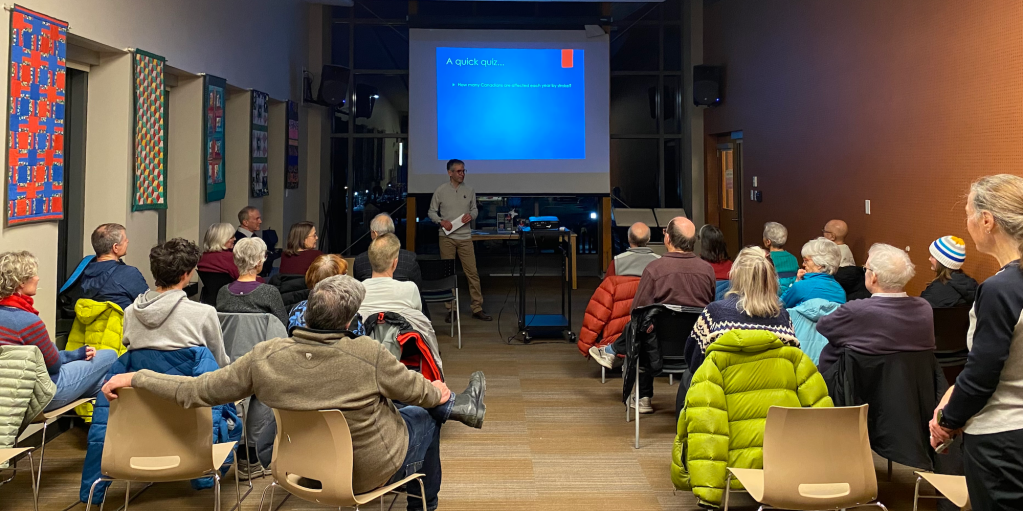
It was a wonderful evening in Canmore. The venue in Elevation Place was beautiful, we had a great turnout for our talk and an engaged audience. What more could we ask for?
Thanks to my friend, Don Crowe, for taking on MC duties, to Carey Lees of the Canmore Public Library for her flawless organization, and to all who attended. Thanks too, to Kylie and Tim at Strides Canmore, for their generous support of this event!
Here’s a synopsis of the talk:
A brief personal introduction
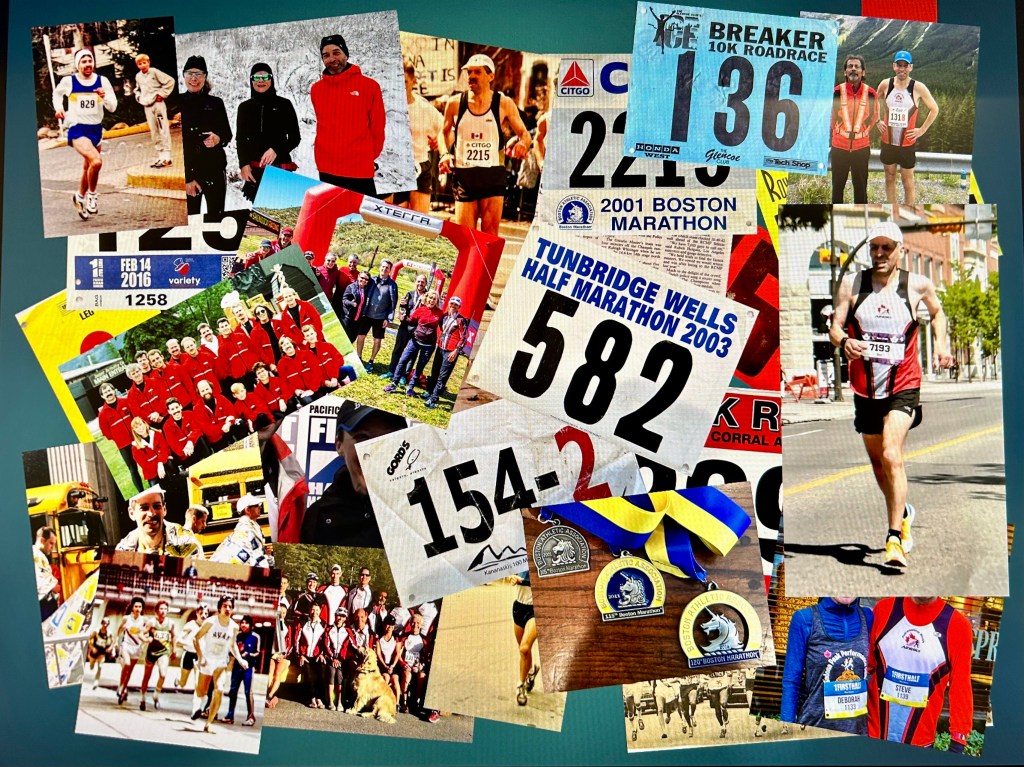
A collage of my running adventures (see below)
Discussion of my stroke journey, including the useful phrase to remember stroke symptoms (readers of this blog will already be familiar with BE FAST)
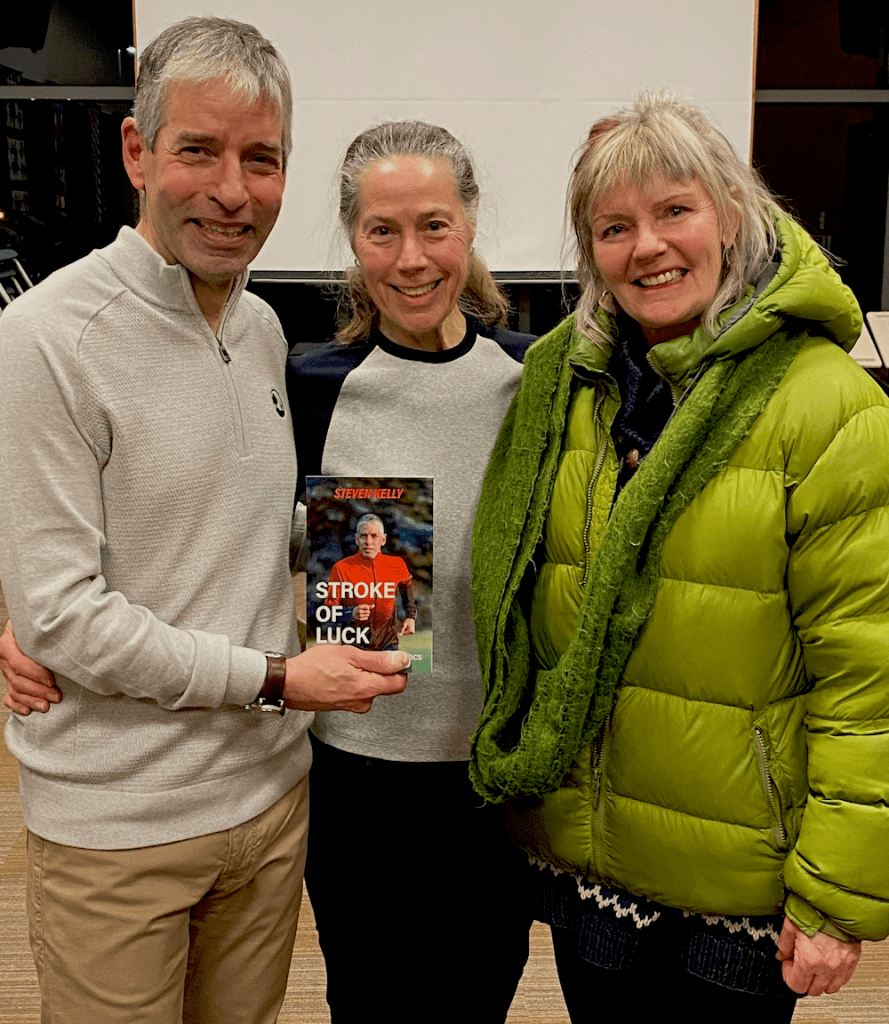
Steve and Deb greet Dianne DeansAuthor Event Feb 12Canmore Vista from Elevation Place
Of course, I shared my three main messages, listed below:
The importance of an active lifestyle
Awareness of ALL the symptoms of stroke
Raising funds to support the great work being done every day on stroke prevention and care at the Foothills Stroke Unit
This is what 50 years of running memories look like on one page!
You can read all the details in Stroke of Luck: My Life in Amateur Athletics. And there’s some news on that front: Cafe Books in Canmore will be carrying the book. So, if you live in Canmore, please drop into this unique bookstore and grab your copy!
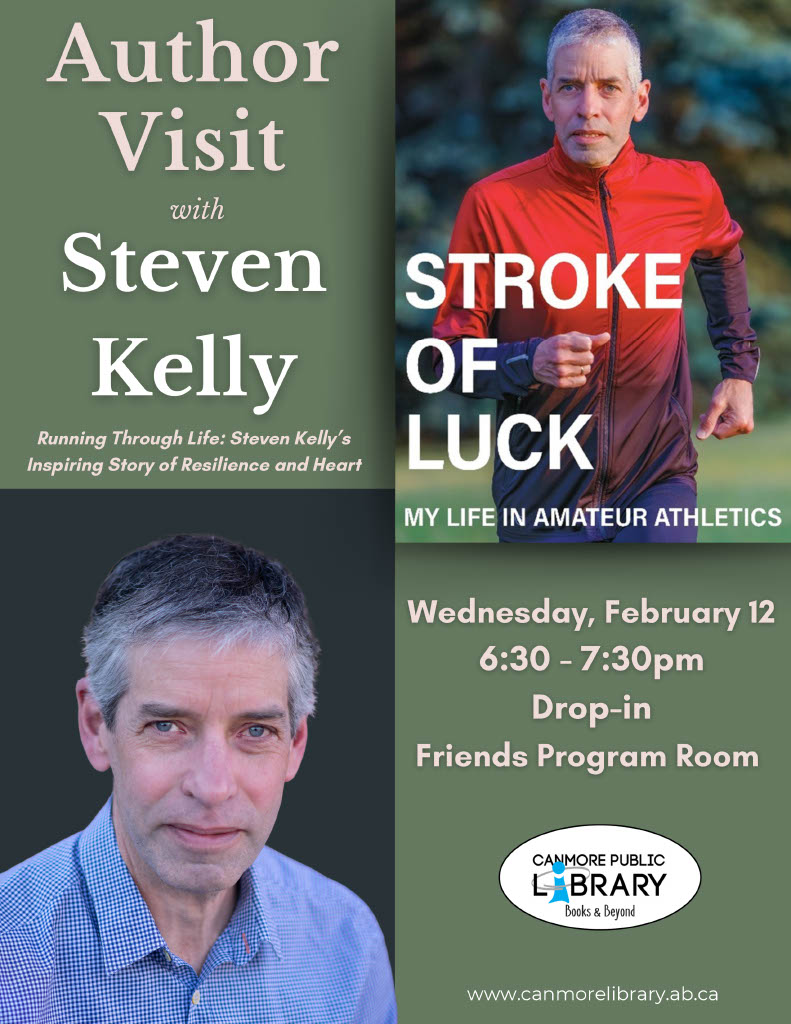
For anyone in the Canmore area this Wednesday (February 12), I’ll be speaking at an Author Event at the Canmore Public Library at 6:30 p.m. Join me if you can, for an informal (and informative) presentation of my story, as told in Stroke of Luck: My Life in Amateur Athletics. There will be a short presentation, a Q&A session, and some draw prizes. I’ll have copies of the book available for purchase, at a special event price. Proceeds from book sales support the great work being done every day in the Foothills Stroke Unit.
I’d like to thank the staff at the library for hosting us in your wonderful facility. Also, to my friends at Strides Canmore, thank you for spreading the word about this event, and for your ongoing support of my book project. I feel blessed to be part of the tremendous local running community… it’s second to none!
Finally, thanks to Dianne Deans, whom I had the pleasure of meeting at the CanStroke Congress in November. Dianne is an enthusiastic patient support volunteer for stroke victims at the Foothills Medical Centre. She kindly connected me with the Canmore library staff, which led to this event coming together. Thank you, Dianne!
Heart Month Sale Still On!
What better way to markHeart Month than a healthy discount for online sales of Stroke of Luck?
Order your copy on Amazon, and save 20%. The sale will run through the end of February.
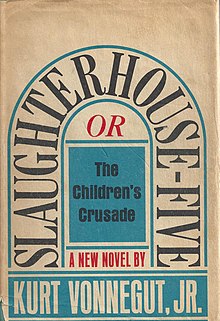
Anyone who has read Slaughterhouse-Five (SH5) by Kurt Vonnegut will recognize this phrase. It stays with you after reading the most famous (or is it infamous?) and arguably the most representative of Vonnegut’s novels.
I’m not sure if SH5 is still required reading in high school English courses… I know it used to be. (I’d be reluctant to guess what required reading might be in high school these days, but that’s another topic.) For my part, I missed the opportunity to read SH5 when I was in school. Perhaps the book wasn’t considered appropriate fare for a Catholic school curriculum.
I’ve only come around to Vonnegut’s works in the last few years. I did read Galapagos in my early twenties, but I found it to be quite forgettable… it certainly didn’t convince me to read anything more by him. Maybe I wasn’t ready for the author’s unique style and keen critical eye.
Something must have changed, because I’ve read three of his books in rapid succession. In this post, I offer my thoughts on what may be his best-known novels. My comments are organized in my order of reading, which just happened to be in reverse order of their publishing date.
Kurt Vonnegut
The author of the books I’m going to discuss is worthy of some discussion himself. Kurt Vonnegut, Jr. (1922-2007) was born in Indianapolis, to German immigrants. He attended Cornell University but dropped out in 1943 after being placed on academic probation. He enlisted in the US Army and was deployed to Europe in 1944 as an intelligence scout. After the war, he pursued academic and technical career paths, never quite succeeding at anything. Vonnegut had a couple of stories published in the early 1950s, which persuaded him to give up other opportunities to pursue writing full-time. His success as a writer did not happen overnight.
Slaughterhouse-Five (1969)
It’s a challenge to summarize SH5. At its core, the story is an account of the Allied fire-bombing of Dresden, Germany in the final months of the Second World War. What genre is the book? Good question. There is an element of historical fiction, but it could just as easily be classified as science fiction. Given that the book was influenced by Vonnegut’s time in the US military, we could even label it as a biography. The author was captured by the Germans, and as a POW he witnessed the destruction of the city firsthand.
In Vonnegut’s signature style, there is a sharp satirical edge to the book. Vonnegut makes no secret of his disdain for “military intelligence”. The casual disregard for life in wartime is a theme repeated often in the book… almost sickeningly so. I think that’s exactly the response Vonnegut wants to elicit from us. That’s where the phrase “so it goes” comes from. SH5 was published at the height of the anti-war movement in the US, and it was the book that made Vonnegut a household name.
The main character in SH5 is Billy Pilgrim, a US draftee. The science fiction element to the story is that Pilgrim experiences time travel. He calls it coming “unstuck in time.” I think the message here is that history is bound to repeat itself. I found this to be a very effective tool; one that shows Vonnegut exercising his full prowess as a mature storyteller.
To summarize, I thought SH5 was brilliant. An amazing creative piece… forceful in its social commentary and totally original. Considering the current events in the world, it is as timely now as when it was written. Very highly recommended!
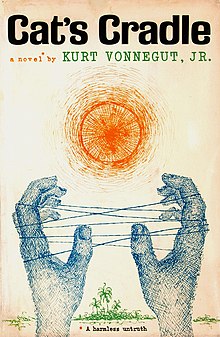
Cat’s Cradle (1960)
Where to begin in explaining this novel?
Cat’s Cradle is a first-person account of the narrator, Jonah, who travels to San Lorenzo, a fictitious and extremely poor island nation. Through an unbelievable sequence of events, Jonah becomes president of the country. At the subsequent inauguration ceremony, an unfortunate incident results in mass destruction on a global scale, when a material called “ice-nine” accidentally comes into contact with seawater.
The book deals with two important themes and manages to touch on several others besides. One major subplot in the book is a fictitious, hedonistic religion called Bokonism. It is the dominant religion in San Lorenzo, seemingly a response by the poor citizens of the country to their dire socioeconomic circumstances.
The book is also a biting commentary on the risks of technology. Ice-nine was invented for military purposes by a brilliant scientist who has complete and callous indifference to the great risks it poses. The obvious parallel is to the proliferation of nuclear weapons, which would have been in Vonnegut’s mind when he wrote Cat’s Cradle in 1960. The story takes the idea of a manmade technological threat to its logical and tragic conclusion.
Only someone with a vivid imagination, black humour and a gift for sharp insight… someone like Vonnegut… could have created Cat’s Cradle. It was a fascinating read, and like SH5, very relevant to the unstable world we find ourselves in.
Player Piano (1952)
Player Piano was Vonnegut’s first novel. It tells the story of Paul Proteus, an engineer and manager of the Ilium Works, one of many large industrial complexes that have radically revamped American society. Machines have replaced human beings in every facet of life. For his part, Proteus becomes increasingly uncomfortable as he is being groomed for an expanded role in the system he helped create. The story turns on a clever “double agent” plot, as Proteus finds himself aligned with other, like-minded rebels.
As compared to the other novels, I found the storyline in Player Piano to be the least risky… maybe even simplistic. There are no tricks with time travel here. I suspect Vonnegut was still finding his voice and his style when he wrote the book. Even so, it is a well-constructed story of an all-too-possible dystopian future. Such a future may have been easy to imagine in the early 1950s, as post-war innovations began to change American society; at least it was for Vonnegut.
Of the three novels, Player Piano had the most impact on me. I accept that as a result of my own work as an engineer and manager. Did my career path make me more sensitive to the sharp commentary that Vonnegut dishes out for these vocations in his grim novel? Probably. I don’t take any of it personally, but I do relate to his criticism of an unbridled drive for efficiency.
The world Vonnegut imagines in Player Piano is devoid of almost all pleasure, at least for the average citizen. For the elite (that is to say, the politically savvy) the upside is limitless, as long as the growing majority of displaced citizens are kept notionally busy and marginally employed. It’s a novel that heads to an inevitable tipping point.
The fatal flaw exposed in Player Piano is a conflation of an unstoppable quest for perfection (in countless industrial processes and even in human interactions) with human happiness. I found myself making connections to recent opinion pieces that assess the risks of the increasing use of Artificial Intelligence in our society. Again, Vonnegut’s story seems eerily relevant to our current circumstances.
I can recommend all three of these Vonnegut novels. In my view, his social commentary is timeless, and that keeps the books current. I want to continue my exploration of his work, to see how well his insights have held up in other areas.
I haven’t written much about strokes lately, so it was time to scan the recent headlines. It turns out there is quite a lot to report on, and much of it (but not all) is good news. I always prefer to start with the positives, so here goes…
Announcing the Black Friday Sale!
If you’ve been waiting to order your copy of Stroke of Luck: My Life in Amateur Athletics, now’s the perfect time. I’ve reduced prices for e-book and print editions by a marathon-inspired 26.2 percent. These are the best prices you’ll see in 2024. The book would be a great gift for a runner… or non-runner… on your holiday gift list!
Order your copy of Stroke of Luck on Amazon today!
Sale prices will be in effect until December 1.
Awareness Campaigns are Working
June is Stroke Awareness Month in Canada. Heart and Stroke is committed to helping improve the lives of people at risk for and living with heart disease and stroke. When it comes to stroke, much has changed in the last several decades. The keys are increased awareness of the signs of stroke, and some revolutionary changes in stroke diagnostics and treatment.
Promoting stroke awareness is a priority for Heart and Stroke. Their media campaigns rely on an easy-to-remember acronym… F-A-S-T. By now, most of us will have seen the television ads and billboards, which remind us of the major signs of stroke, as follows:
F is for FACE… Is it drooping?
A is for ARMS… Is the person unable to lift both?
S is for SPEECH… Is it slurred or incoherent?
T is for TIME… Call 9-1-1 if any of these conditions exist!
Heart and Stroke notes that awareness campaigns have been successful. For example, 4 in 10 Canadians surveyed can name at least 2 signs of stroke. Women and older Canadians are more likely to recognize stroke symptoms. Of course, there is always more that can be done.
At this point, I will add a caveat about stroke awareness, because my symptoms did not fall into the F-A-S-T framework. It’s an 80-20 situation. I encourage everyone to read my blog pieces where I describe the less frequent symptoms. These include problems with balance and eyes/ears. So, if you can, please remember BE FAST, to cover off all the signs of stroke.
U of Calgary – Leading in Stroke Research
While there can never be a good time or place to have a stroke, it’s been said that Calgary is the place to be if is going to happen to you. I do have some direct experience in this regard, but I didn’t fully appreciate how much innovation is happening here.
A couple of March 2024 articles in Arch, the University of Calgary magazine (here and here) highlight advancements in diagnosis and treatment that originated at the Calgary Stroke Program (CSP). Here are just a few:
(1) A Calgary-based clinical trial led to a procedure known as EVT (endovascular thrombectomy), which is drastically reducing the death rate from one of the most common types of strokes. EVT is a procedure that can disrupt large clots in the brain. If done promptly after the onset of symptoms, EVT can triple a patient’s chance of making a full recovery from certain strokes.
(2) The Alberta Stroke Program Early CT Score (ASPECTS) is a grading system for strokes. This tool, which is based on a brain CT scan, has been adopted around the world as a way of measuring changes in a patient’s condition.
(3) A clinical trial of a clot-busting drug called Tenecteplase (TNKase™) compared it to the standard drug used for dissolving blood clots in brain arteries with acute ischemic stroke. As a result, TNKase™ is becoming the standard of care in hospitals around the world.
I could go on. The innovations originating in Calgary cover diagnostic processes, treatment options and rehabilitative therapies. It is a remarkable success story. On a personal note, I have come to know several of the doctors involved in these research programs. They are truly miracle workers.
Stroke Incidence is Increasing
A study in The Lancet Neurology found that the global prevalence of cardiovascular disease, including stroke, increased from 271 million in 1990 to 523 million in 2019. The study found that population growth and aging account for this increase. While stroke mortality rates had been declining in the latter part of the twentieth century, some countries have actually seen a reversal in this trend since 2010. Unfortunately, the US and UK are two countries that have seen an increase in stroke numbers.
A study on stroke prevalence by the Centers for Disease Control and Prevention fills in some of the details for the US. Here are a couple of headlines: stroke is the fifth leading cause of death in the US and it costs the economy about $56 billion annually. Digging deeper, the CDC study confirms the trend in stroke incidence. Overall US stroke prevalence increased by about 8 percent from 2011-2013 to 2020-22. The increase was slightly higher in females than males. There was an inverse relationship between education level and stroke prevalence. Perhaps most worrying was a significant increase in adults aged 18-64. As you might guess, obesity is a leading risk factor for stroke.
Not surprisingly, the trends in Canada are similar. Stroke is the fifth leading cause of death in Canada, accounting for about 13,000 deaths annually. There are more than 108,000 strokes in Canada each year… that’s one every five minutes. And nearly 900,000 Canadians are living with the outcome of strokes. As in other countries, it’s a result of our aging population.
Fortunately, when strokes do happen, more people are recognizing them and taking action.
Before signing off, I couldn’t help but include a photograph taken on yesterday’s short walk along the Elbow River in Calgary. The picture has nothing to do with strokes, but I liked it. Yes, winter is here!
Did you know that June is Stroke Awareness Month in Canada?
To recognize the importance of stroke awareness, I’ve extended the online promotion for my memoir, Stroke of Luck.
Get your copy on Amazon and save 20% until July 15. And help me help the heroes at the Foothills Stroke Unit!
Stroke incidence continues to rise in Canada – more strokes are happening and more people are living with stroke due to our aging population and more younger people having strokes. There are now nearly 110,000 strokes each year in Canada. That is roughly one stroke every five minutes.
Strokes occur due to an interruption of blood flow to the brain, and most strokes originate in the carotid arteries. The carotid arteries are the large arteries at the front of the neck. They deliver most of the blood to the brain. Carotid artery strokes produce symptoms that are familiar to many people, thanks to effective public awareness campaigns:
F – Face drooping
A – Arms can’t be lifted above your head
S – Speech is slurred or jumbled
T – Time to call 9-1-1
As I learned, strokes can also occur due to an interruption of blood flow in the vertebral arteries. These arteries are at the back of the neck. They are smaller than the carotid arteries, but just as important.
The symptoms of vertebral strokes are different than those originating in the carotid arteries because they control different bodily functions. Here’s what to look for as possible signs of a vertebral artery stroke:
B – Balance and coordination problems, like vertigo
E – Eyes and Ears behaving strangely, especially if uncoordinated
Taken together, these symptoms can be remembered by the words BE FAST.
BE FAST is an appropriate phrase, because regardless of the type of stroke, time is of the essence. If there’s any doubt, call 911 right away!
BE FAST is a memory jogger that I’ve been sharing with people, because it covers the full range of stroke symptoms. Here’s what it stands for:
BE FAST – someone’s life could depend on it!
Stroke incidence continues to rise in Canada – more strokes are happening and more people are living with stroke due to our aging population and more younger people having strokes. There are now nearly 110,000 strokes each year in Canada. That is roughly one stroke every five minutes.
I’ll leave you with the words of Dr. Michael Hill, the Calgary neurologist who wrote the foreword to Stroke of Luck:
“Time is brain when it comes to stroke and everyone has a role to play. It starts with someone recognizing the signs of stroke and calling 9-1-1”
– Dr. Michael Hill, Neurologist, Calgary Stroke Program
So, during June, why not take a minute to familiarize yourself with ALL the potential signs of stroke? Even better, spread the message to those you care about. It could save a life! And if you’re looking for a bit of motivation, why not order your copy of Stroke of Luck for a discounted price?
I was thrilled to be featured in a recent story by the Calgary Health Foundation. You can read their piece here. And don’t pass up the opportunity to read some of the other motivational stories on the CHF website.
In our interview, Ashley and I talked about my running adventures and my recovery from a series of strokes in the summer of 2017. I shared my experience as a patient at the Foothills Stroke Unit, and what prompted me to write a book about it.
While I’m writing, I will say thanks to those who purchased a copy of my book, Stroke of Luck: My Life in Amateur Athletics. It’s worth reminding my readers of my main messages:
The importance of an active lifestyle
Awareness of the full range of stroke symptoms… remember, “BE FAST”
Support for world-class stroke care at the Foothills Medical Centre
If you haven’t already picked up a copy of Stroke of Luck, it isn’t too late. The book is available directly from me (if you live in the Calgary area), on Amazon, or at any independent bookstore. Speaking of which, let me give a shout-out to Owl’s Nest Books in Calgary!
I’ve been very gratified by the response to Stroke of Luck. Many families are affected by strokes, so my story is one we can all relate to. And don’t forget, funds raised from sales of the book are going directly to support the work of the Foothills Stroke Unit, through the Calgary Health Foundation. It’s a win-win situation!
I read two short but impactful novels with similar themes over the weekend. It helped that our weather was more suited to reading than outdoor pursuits. I’d been looking for something quick to read, and the books I chose were the thinnest ones on my shelf. (I know, not the best way to choose a book.) By coincidence, my selections turned out to be profoundly complementary.
The Old Man and the Sea
First up was The Old Man and the Sea, Ernest Hemingway’s Nobel Prize-winning 1952 novel. I read this book in high school, but that was long enough ago that it seemed timely to read it again. I’m glad I did.
The book tells the compelling story of Santiago, an old Cuban fisherman who has had a long stretch of bad luck. He and his young apprentice, a boy named Manolin, share a tender friendship, even though the boy’s family has forbidden him from working with Santiago due to his lack of success.
Santiago’s luck changes all at once, alone and far out at sea. He hooks a huge marlin, the biggest one he has ever seen. He spends more than two days landing the fish, against all odds. It is so large it has to be lashed to the side of his skiff. His triumph soon turns to despair as sharks consume the fish, leaving him with only a carcass by the time he reaches his home port.
The story resonated with me, for several reasons. Santiago’s optimism never wavers. His lifetime of experience equips him with the confidence to face his many challenges as they arise. Even the loss of his prize fish does not defeat him; his lifelong dedication to his craft allows him to transcend this tragic event. For me, the lesson is clear: we must never give up.
Here’s a passage I thought summed up the whole story:
“I wish I had a stone for the knife,” the old man said after he had checked the lashing on the oar butt. “I should have brought a stone.” You should have brought many things, he thought. But you did not bring them, old man. Now is the time to think of what you do have. Think of what you can do with what there is.
Ernest Hemingway, The Old Man and the Sea
In my own memoir, Stroke of Luck, I use the phrase “be curious, be diligent, be humble” to describe my approach to life. It was gratifying to read that Santiago relied on these same traits to get through his ordeal. Existence is fleeting, and we must never lose sight of what we have in the here and now.
Train Dreams
My second book of the weekend was Denis Johnson’s novella, Train Dreams. In just 116 pages, Johnson takes readers on a broad sweep of American history, across the rugged frontier of the Pacific Northwest. The main character, Robert Grainier, is a labourer and woodsman who works on some defining projects in the region.
Grainier suffers the unbearable loss of his wife and infant daughter in a catastrophic forest fire, and lives the rest of his long life in the woods as a solitary figure. He struggles with the guilt of surviving, and only through his dreams does he come to accept his loss.
As readers, we experience the loss of the frontier that is rapidly being transformed… consumed… to feed an expanding American economy. Grainier himself becomes the symbol of a disappearing way of life.
I found some striking similarities in these two books. Hemingway is well known for his clear and direct writing. Johnson’s prose is sparse and powerful too. He conveys horrific and sometimes funny scenes with an economic writing style. Here’s a particularly evocative passage:
All his life Robert Grainier would remember vividly the burned valley at sundown, the most dreamlike business he’d ever witnessed waking- the brilliant pastels of the last light overhead, some clouds high and white, catching daylight from beyond the valley, others ribbed gray and pink… and beneath this wondrous sky the black valley, utterly still, the train moving through it making a great noise but unable to wake this dead world.
Denis Johnson, Train Dreams
The protagonists of these novels, Santiago and Grainier, are both strong and solitary figures, who face hardship with dignity and ultimately find a way to carry on.
The men in these stories are engaged in very different struggles against nature, on opposite sides of the continent. It occurred to me that in the current zeal for “cancelling” books on topics deemed to be incompatible with contemporary values, these two could well be targets. I hope that doesn’t happen, as the books reinforce several key messages: having strength of character is a good thing; hard work and aspiration for success are to be celebrated; and accepting personal responsibility for one’s actions is a sign of maturity.