Stroke Awareness Sale Extended!

Did you know that June is Stroke Awareness Month in Canada?

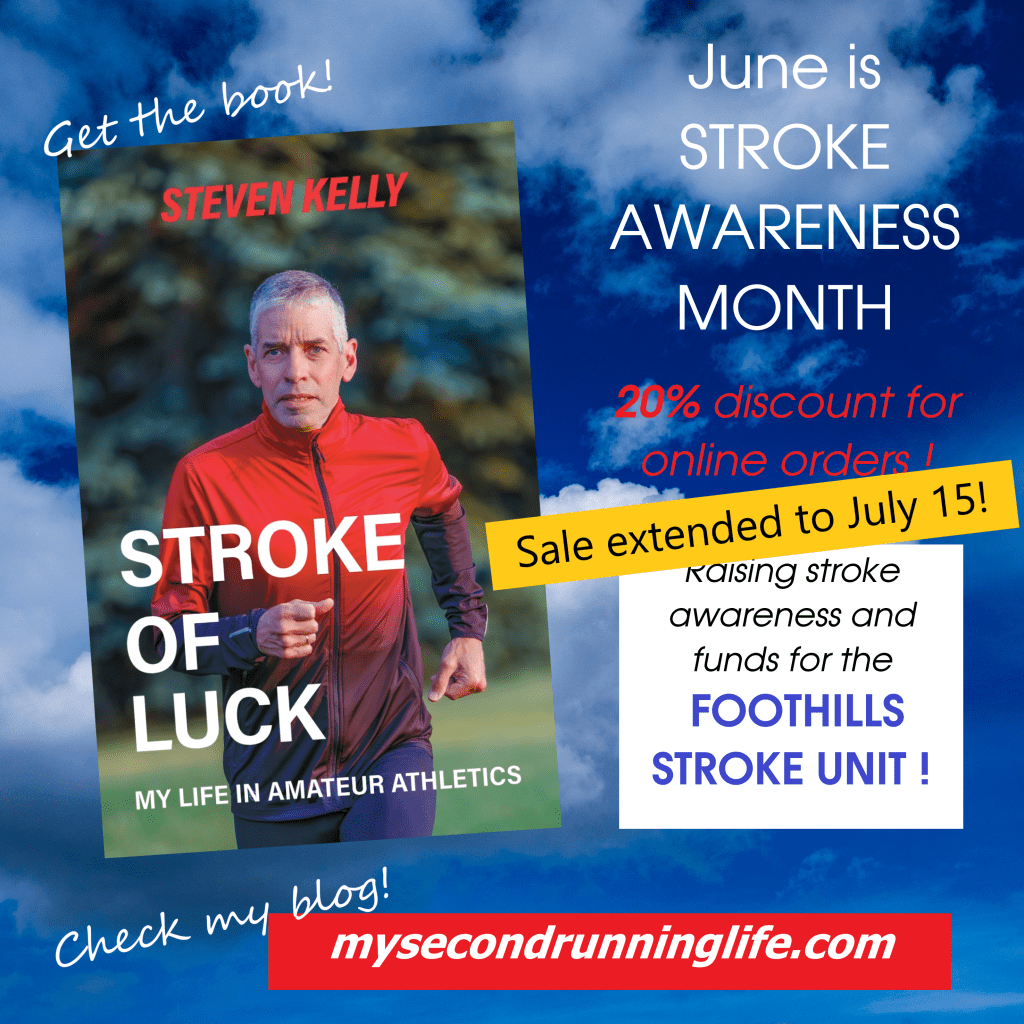
To recognize the importance of stroke awareness, I’ve extended the online promotion for my memoir, Stroke of Luck.

Get your copy on Amazon and save 20% until July 15. And help me help the heroes at the Foothills Stroke Unit!

Stroke incidence continues to rise in Canada – more strokes are happening and more people are living with stroke due to our aging population and more younger people having strokes.  There are now nearly 110,000 strokes each year in Canada. That is roughly one stroke every five minutes.

Strokes occur due to an interruption of blood flow to the brain, and most strokes originate in the carotid arteries. The carotid arteries are the large arteries at the front of the neck. They deliver most of the blood to the brain. Carotid artery strokes produce symptoms that are familiar to many people, thanks to effective public awareness campaigns:

  • FFace drooping
  • AArms can’t be lifted above your head
  • SSpeech is slurred or jumbled
  • TTime to call 9-1-1

As I learned, strokes can also occur due to an interruption of blood flow in the vertebral arteries. These arteries are at the back of the neck. They are smaller than the carotid arteries, but just as important.

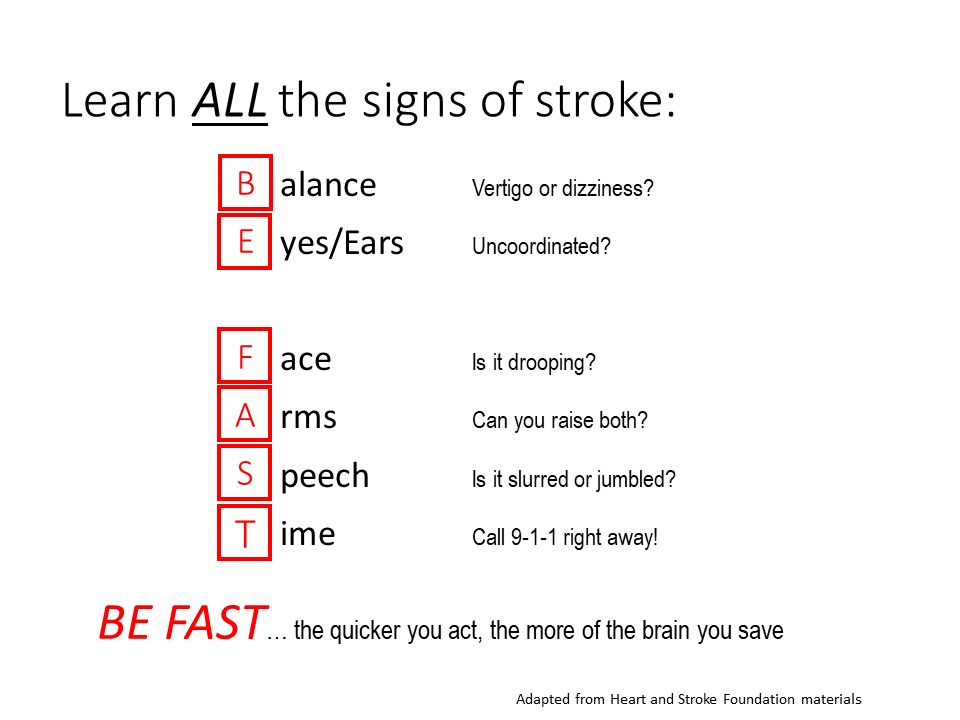
The symptoms of vertebral strokes are different than those originating in the carotid arteries because they control different bodily functions. Here’s what to look for as possible signs of a vertebral artery stroke:

  • BBalance and coordination problems, like vertigo
  • EEyes and Ears behaving strangely, especially if uncoordinated

Taken together, these symptoms can be remembered by the words BE FAST.

BE FAST is an appropriate phrase, because regardless of the type of stroke, time is of the essence. If there’s any doubt, call 911 right away!

Be well, and BE FAST!

“Stroke Awareness Month” Sale!

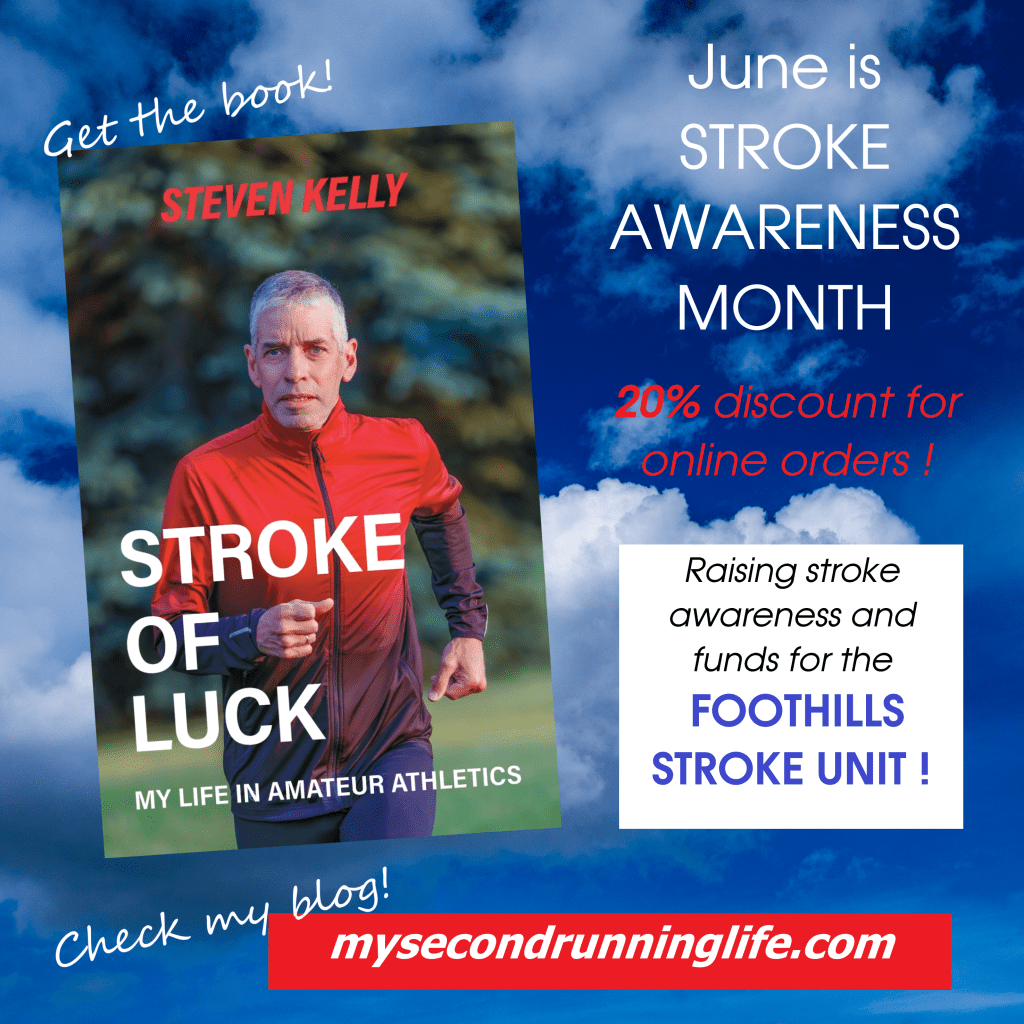
To raise awareness of the prevalence of stroke, I’m offering Stroke of Luck: My Life in Amateur Athletics for a special price in June. Order your copy on Amazon and save 20%.

Help me raise funds for the essential work of the doctors and staff at Foothills Stroke Unit!

The Heart and Stroke Foundation of Canada is celebrating 10 years of raising awareness about recognizing the signs of stroke, and the need to call 9-1-1 right away to get to the best hospital for stroke care. 

BE FAST is a memory jogger that I’ve been sharing with people, because it covers the full range of stroke symptoms. Here’s what it stands for:

BE FAST – someone’s life could depend on it!

Stroke incidence continues to rise in Canada – more strokes are happening and more people are living with stroke due to our aging population and more younger people having strokes.  There are now nearly 110,000 strokes each year in Canada. That is roughly one stroke every five minutes.

I’ll leave you with the words of Dr. Michael Hill, the Calgary neurologist who wrote the foreword to Stroke of Luck:

“Time is brain when it comes to stroke and everyone has a role to play. It starts with someone recognizing the signs of stroke and calling 9-1-1”

– Dr. Michael Hill, Neurologist, Calgary Stroke Program

So, during June, why not take a minute to familiarize yourself with ALL the potential signs of stroke? Even better, spread the message to those you care about. It could save a life! And if you’re looking for a bit of motivation, why not order your copy of Stroke of Luck for a discounted price?

BE FAST, and be well!

Steve

Featured in CHF story!

I was thrilled to be featured in a recent story by the Calgary Health Foundation. You can read their piece here. And don’t pass up the opportunity to read some of the other motivational stories on the CHF website.

In our interview, Ashley and I talked about my running adventures and my recovery from a series of strokes in the summer of 2017. I shared my experience as a patient at the Foothills Stroke Unit, and what prompted me to write a book about it.

While I’m writing, I will say thanks to those who purchased a copy of my book, Stroke of Luck: My Life in Amateur Athletics. It’s worth reminding my readers of my main messages:

  • The importance of an active lifestyle
  • Awareness of the full range of stroke symptoms… remember, “BE FAST”
  • Support for world-class stroke care at the Foothills Medical Centre

If you haven’t already picked up a copy of Stroke of Luck, it isn’t too late. The book is available directly from me (if you live in the Calgary area), on Amazon, or at any independent bookstore. Speaking of which, let me give a shout-out to Owl’s Nest Books in Calgary!

I’ve been very gratified by the response to Stroke of Luck. Many families are affected by strokes, so my story is one we can all relate to. And don’t forget, funds raised from sales of the book are going directly to support the work of the Foothills Stroke Unit, through the Calgary Health Foundation. It’s a win-win situation!

Until next time, thank you.

Steve

Two Recommended Short Novels

I read two short but impactful novels with similar themes over the weekend. It helped that our weather was more suited to reading than outdoor pursuits. I’d been looking for something quick to read, and the books I chose were the thinnest ones on my shelf. (I know, not the best way to choose a book.) By coincidence, my selections turned out to be profoundly complementary. 

The Old Man and the Sea

First up was The Old Man and the Sea, Ernest Hemingway’s Nobel Prize-winning 1952 novel. I read this book in high school, but that was long enough ago that it seemed timely to read it again. I’m glad I did.

The book tells the compelling story of Santiago, an old Cuban fisherman who has had a long stretch of bad luck. He and his young apprentice, a boy named Manolin, share a tender friendship, even though the boy’s family has forbidden him from working with Santiago due to his lack of success.

Santiago’s luck changes all at once, alone and far out at sea. He hooks a huge marlin, the biggest one he has ever seen. He spends more than two days landing the fish, against all odds. It is so large it has to be lashed to the side of his skiff. His triumph soon turns to despair as sharks consume the fish, leaving him with only a carcass by the time he reaches his home port. 

The story resonated with me, for several reasons. Santiago’s optimism never wavers. His lifetime of experience equips him with the confidence to face his many challenges as they arise. Even the loss of his prize fish does not defeat him; his lifelong dedication to his craft allows him to transcend this tragic event. For me, the lesson is clear: we must never give up.

Here’s a passage I thought summed up the whole story:

“I wish I had a stone for the knife,” the old man said after he had checked the lashing on the oar butt. “I should have brought a stone.” You should have brought many things, he thought. But you did not bring them, old man. Now is the time to think of what you do have. Think of what you can do with what there is.

Ernest Hemingway, The Old Man and the Sea

In my own memoir, Stroke of Luck, I use the phrase “be curious, be diligent, be humble” to describe my approach to life. It was gratifying to read that Santiago relied on these same traits to get through his ordeal. Existence is fleeting, and we must never lose sight of what we have in the here and now.

Train Dreams

My second book of the weekend was Denis Johnson’s novella, Train Dreams. In just 116 pages, Johnson takes readers on a broad sweep of American history, across the rugged frontier of the Pacific Northwest. The main character, Robert Grainier, is a labourer and woodsman who works on some defining projects in the region.

Grainier suffers the unbearable loss of his wife and infant daughter in a catastrophic forest fire, and lives the rest of his long life in the woods as a solitary figure. He struggles with the guilt of surviving, and only through his dreams does he come to accept his loss.

As readers, we experience the loss of the frontier that is rapidly being transformed… consumed… to feed an expanding American economy. Grainier himself becomes the symbol of a disappearing way of life.  

I found some striking similarities in these two books. Hemingway is well known for his clear and direct writing. Johnson’s prose is sparse and powerful too. He conveys horrific and sometimes funny scenes with an economic writing style. Here’s a particularly evocative passage:

All his life Robert Grainier would remember vividly the burned valley at sundown, the most dreamlike business he’d ever witnessed waking- the brilliant pastels of the last light overhead, some clouds high and white, catching daylight from beyond the valley, others ribbed gray and pink… and beneath this wondrous sky the black valley, utterly still, the train moving through it making a great noise but unable to wake this dead world.

Denis Johnson, Train Dreams

The protagonists of these novels, Santiago and Grainier, are both strong and solitary figures, who face hardship with dignity and ultimately find a way to carry on. 

The men in these stories are engaged in very different struggles against nature, on opposite sides of the continent. It occurred to me that in the current zeal for “cancelling” books on topics deemed to be incompatible with contemporary values, these two could well be targets. I hope that doesn’t happen, as the books reinforce several key messages: having strength of character is a good thing; hard work and aspiration for success are to be celebrated; and accepting personal responsibility for one’s actions is a sign of maturity.

I highly recommend both of these books!

Leap To It!

There are less than two weeks left in February, and time is running out for my online sale. Get your copy of Stroke of Luck (print or e-book) on Amazon for a tidy 24% discount.

Of course, there is one extra day to place your order, with this being a leap year.* Extra day or not, leap to it and save!

* Did You Know?

The tradition of inserting an extra day into February every four years is how the calendar is aligned to the rotational frequency of the Earth’s orbit around the sun.

But wait… one orbit takes 365.24219 days. That means if a whole day is added every four years, for an average of 365.25 days, the calendar would be lengthened a bit too much.

As a result, the schedule of leap years is adjusted slightly to reduce this mismatch. If the year is divisible by 100 and not divisible by 400, the leap year is skipped. The year 2000 was a leap year, but 1700, 1800, and 1900 were not. The next time a leap year will be skipped is the year 2100. This gives an average calendar year of 365.2425 days, almost exactly matching the orbital frequency.

Quite a Week!

Owl’s Nest Book Launch – Calgary

On Wednesday, February 7 we held a book launch event at our favourite local indie book store, Owl’s Nest Books. Sarah Pratt, the Events Director at the store (and an avid ultramarathoner) was our marvelous host for the evening.

We were thrilled to welcome a standing-room crowd of friends, neighbours, teammates and work colleagues. I was honoured that my neurologist (Dr. Demchuk) and my long-time teammate at Adrenaline Rush Athletics (Dr. Stephen Wood)… both heroes of my stroke story… joined us for the evening.

I did a short reading from Stroke of Luck: My Life in Amateur Athletics. During the lively Q&A portion of the program, I shared my main messages:

  • the importance of an active lifestyle
  • knowing ALL the signs of stroke
  • raising awareness (and funds) for the world-class stroke care provided by the doctors, nurses and staff in the Foothills Stroke Unit
Owl’s Nest book launch (February 7, 2024)

Sincere thanks to Sarah at Owl’s Nest Books and Jeremy Deere from Strides Running Store, for your support of the reading and running communities in Calgary.

It was a special evening!

First Half Marathon – Vancouver

We didn’t get much time to recover, as we headed off to Vancouver on Friday for a weekend visit with Matthew. The headline purpose of the trip was to participate in the annual First Half Marathon, put on by RunVan and sponsored by BlueShore Financial.

As usual, the race was outstanding. It sold out immediately, as it does every year. This is definitely one of the premier races in Canada; well-organized and perfectly executed. It doesn’t hurt that the scenery is second to none. The highlight is the lap of the Stanley Park seawall.

I wrote about my history with the race in a previous post. This year, our race was challenging. The weather did not cooperate, although the steady rain was little more than an inconvenience. Deb and I were both hobbled by nagging injuries, which affected our preparation. While it is often true that one can run through these things on race day, neither of us was so lucky this time.

The second half of the race was a slog. The good news is that we got through it. The finish line on Drake St. in Yaletown is always a welcome sight. And who cares if we were a few minutes slower than last year?

It was all smiles at kilometre 6 (February 11, 2024) – Photo by Matt Kelly

…and a bit of street photography

I always look forward to walking the streets of Vancouver, armed with my discrete camera, the Ricoh GR III. It is the perfect camera for street photography.

Here are a few samples of the photos from the weekend.

Ready to ride
Suki’s
Too busy to ride