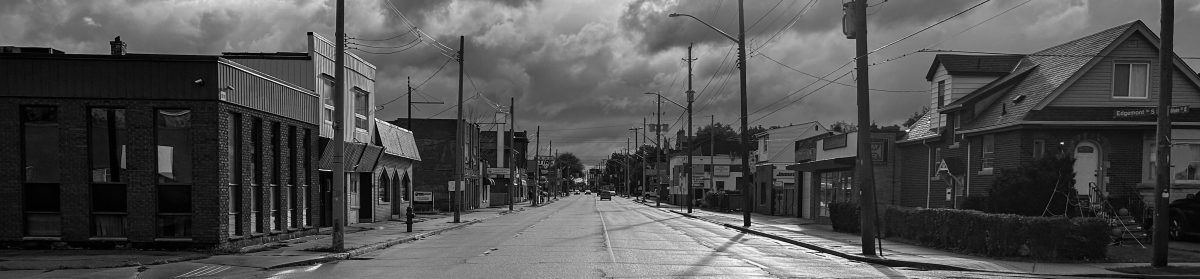
Signal Hill Photo Run

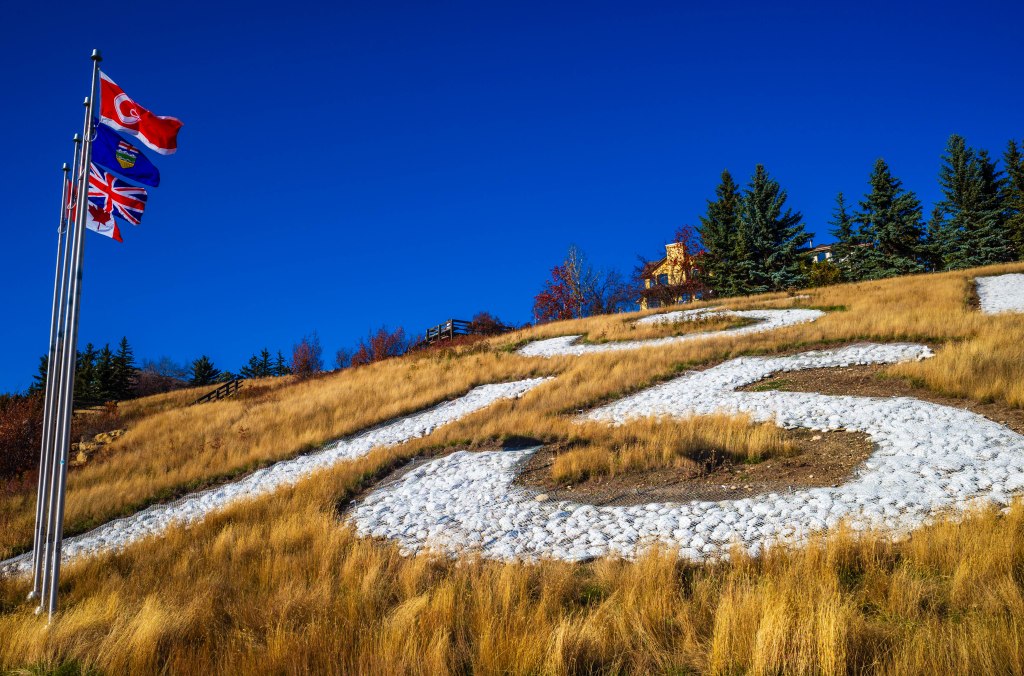
A recent errand led me to an unexpected trail of discovery through Calgary’s military history. I had stopped at the busy Westhills shopping district, the usual collection of big box stores. As I walked back to my car, I noticed the battalion numbers preserved on the side of the hill below the Signal Hill neighbourhood.

I knew about the battalion markers but hadn’t thought much about their significance. My first reaction when I saw the whitewashed stones was how small they looked, sandwiched in between the RONA store and Calgary’s residential sprawl just above. I made a point to return soon for a closer look.
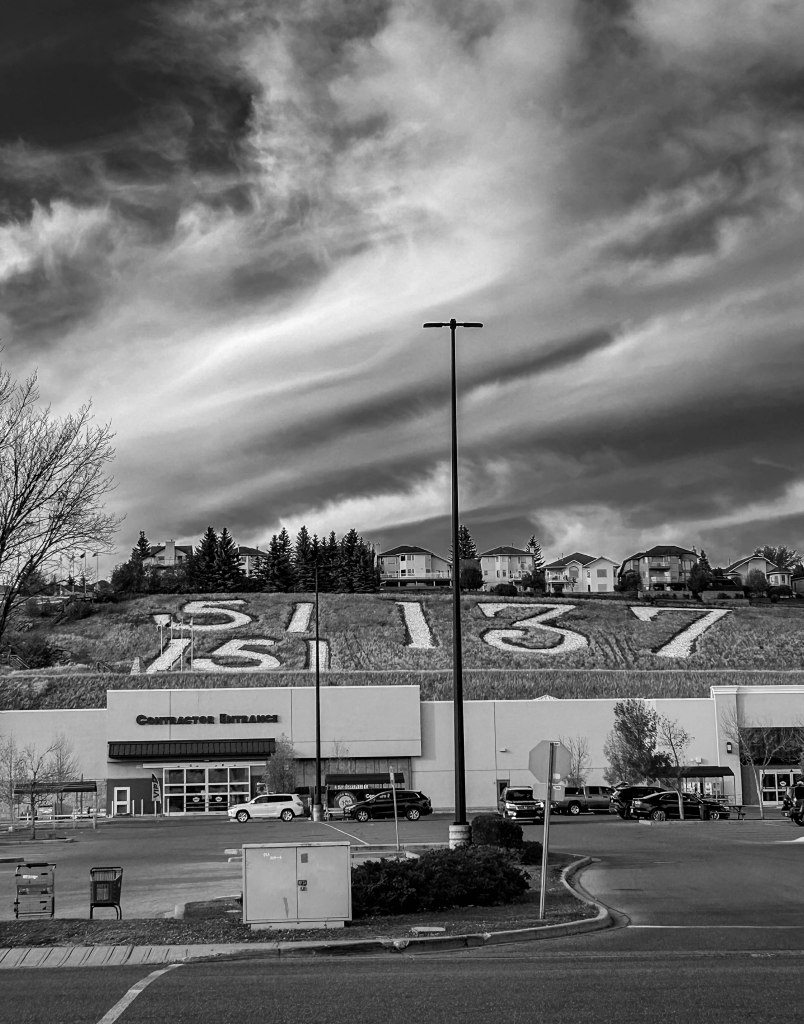
Military history squeezed into the urban landscape

A couple of days later, I was jogging through North Glenmore Park, along the crest of the bluff. I ran by a monument at the west end of the park, one that I had passed hundreds of times. I decided to stop and check it out. The plaque indicated that this was a 1967 memorial to the 137th Battalion of the Canadian Expeditionary Force (the CEF) in World War I. I remembered that “137” was also one of the battalion numbers on Signal Hill.
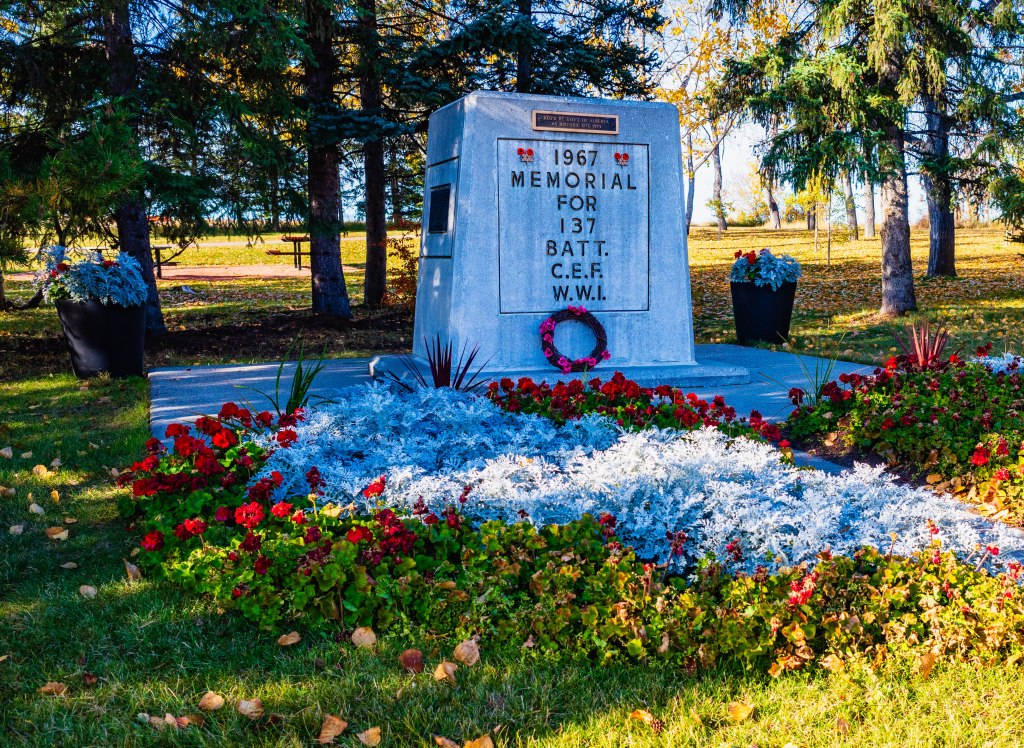
The 1967 memorial to the 137th Battalion

I guessed, correctly, that this was the same 137th battalion immortalized on the hillside. Now I definitely had to make my way over to Signal Hill. I figured it would be a great excuse for a photo run.

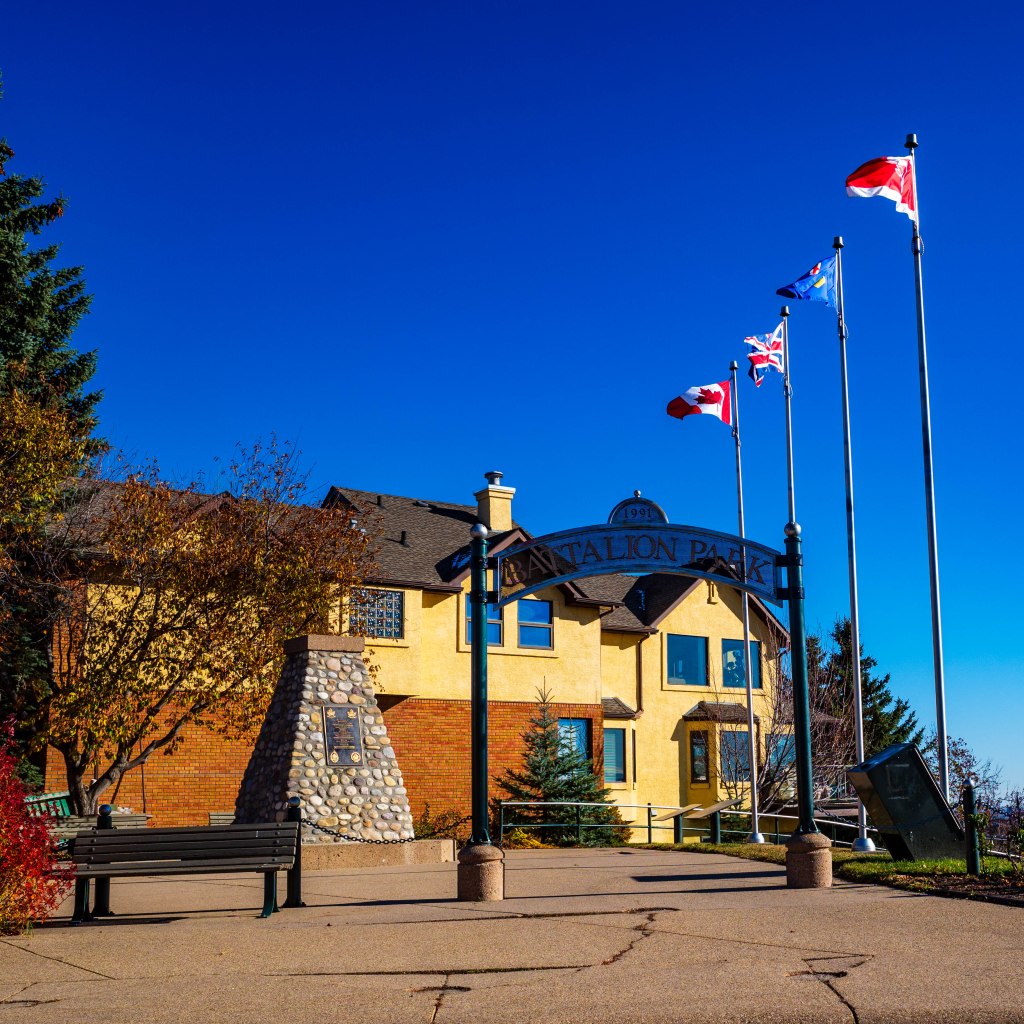
I grabbed my camera (the Ricoh GR III of course) and parked at Battalion Park on Signal Hill Drive. Here’s the Strava entry for my easy run. It was a beautiful day and I did an enjoyable 6-kilometre loop around the neighbourhood.

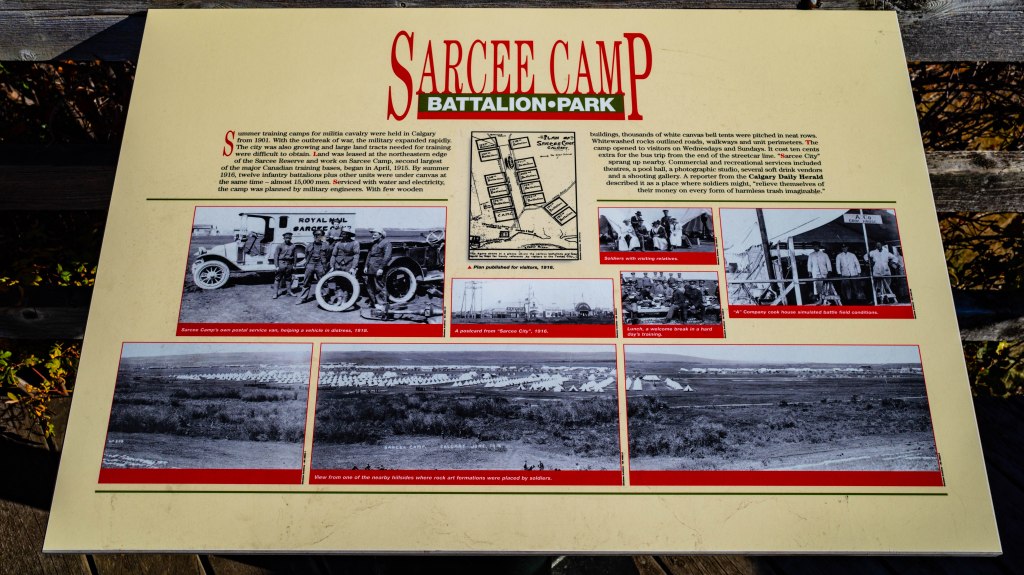
The story of Sarcee Camp is well explained in a series of plaques next to the stairs that wind through the markers. I learned that the camp was established in 1914. It was in a section of the Sarcee Indian reserve (now Tsuu T’ina) that was leased by the Canadian militia as a training site.

Sarcee Camp was a busy place. As many as 45,000 military personnel from 30 battalions trained at the site during the war. It was customary for each battalion to construct a “geoglyph” (that’s a design or motif created by humans and built into the natural landscape) with their unit number. They did this using stones hauled by hand from the riverbed, which is two kilometres away from the hill. 

The 113 is the oldest of the four stone markers on Signal Hill. The 113th Battalion was formed as the Lethbridge Highlanders in 1915. The battalion relocated to Sarcee Camp in May 1916 and sailed for England in September of that year. The 113th was broken up for replacements, with most of the men transferred to France. The battalion never saw action as a unit and was disbanded in 1917.

The other numbers on the hillside were constructed by battalions of the CEF that trained at the Sarcee Camp, including the following:

  • The 137th Infantry Battalion of Calgary began recruiting in late 1915. After sailing to England in August 1916, the battalion was absorbed into the 21st Reserve Battalion.  It’s worth noting that the King’s Own Calgary Regiment (RCAC) perpetuates the 137th Battalion. Members of the 137th Battalion CEF Association erected the memorial to the unit in Glenmore Park.
  • The 151st Central Alberta Battalion began recruiting in 1915. It sailed to England in October 1916 and was absorbed into several reserve battalions.
  • The 51st Canadian Infantry Battalion was recruited in Edmonton. It sailed to England in April 1916 and provided reinforcements for the Canadian Corps until it was reorganized in November 1916.

Although there were approximately 20 geoglyphs built, most were destroyed in the 1950s during the construction of a mess hall.

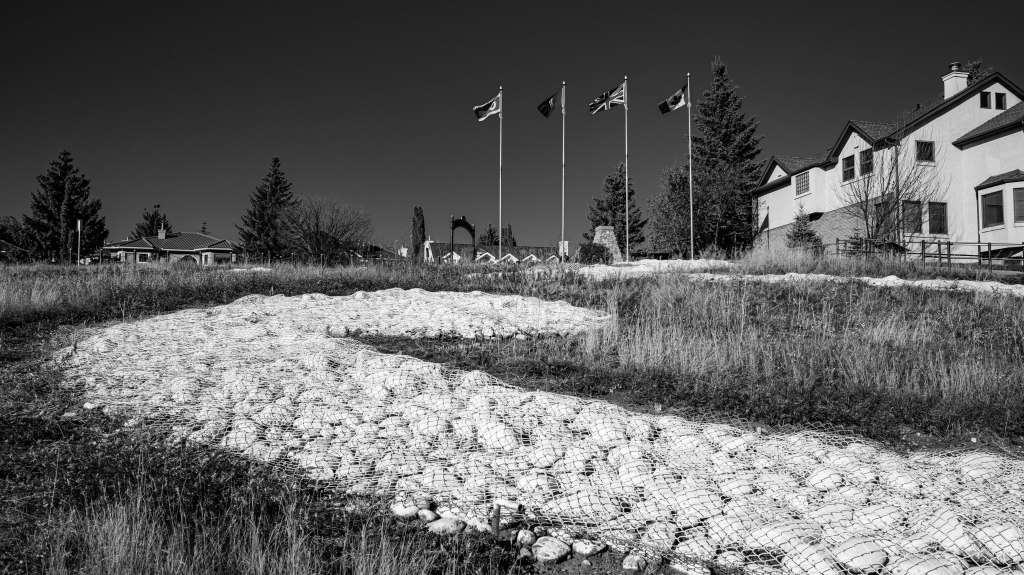
When we first moved to Calgary in the early 1990’s, the battalion markers were just about the only thing in the area. Over time, residential development nearly swallowed up the geoglyphs. Fortunately, there was enough recognition of the significance of these markers that they were preserved. In fact, three of the markers (137, 151 and 51) were meticulously moved a short distance from their original locations.
You can see a few photos I took during my cooldown walk. I found it quite challenging to get any perspective on the geoglyphs when I was right next to them. In that respect, the parking lot of the RONA store isn’t a bad place to stop and admire this unique piece of Canada’s military history. Even so, with Remembrance Day just around the corner, I recommend getting closer and doing more exploration if you have the time.

Auroras and Other Distractions

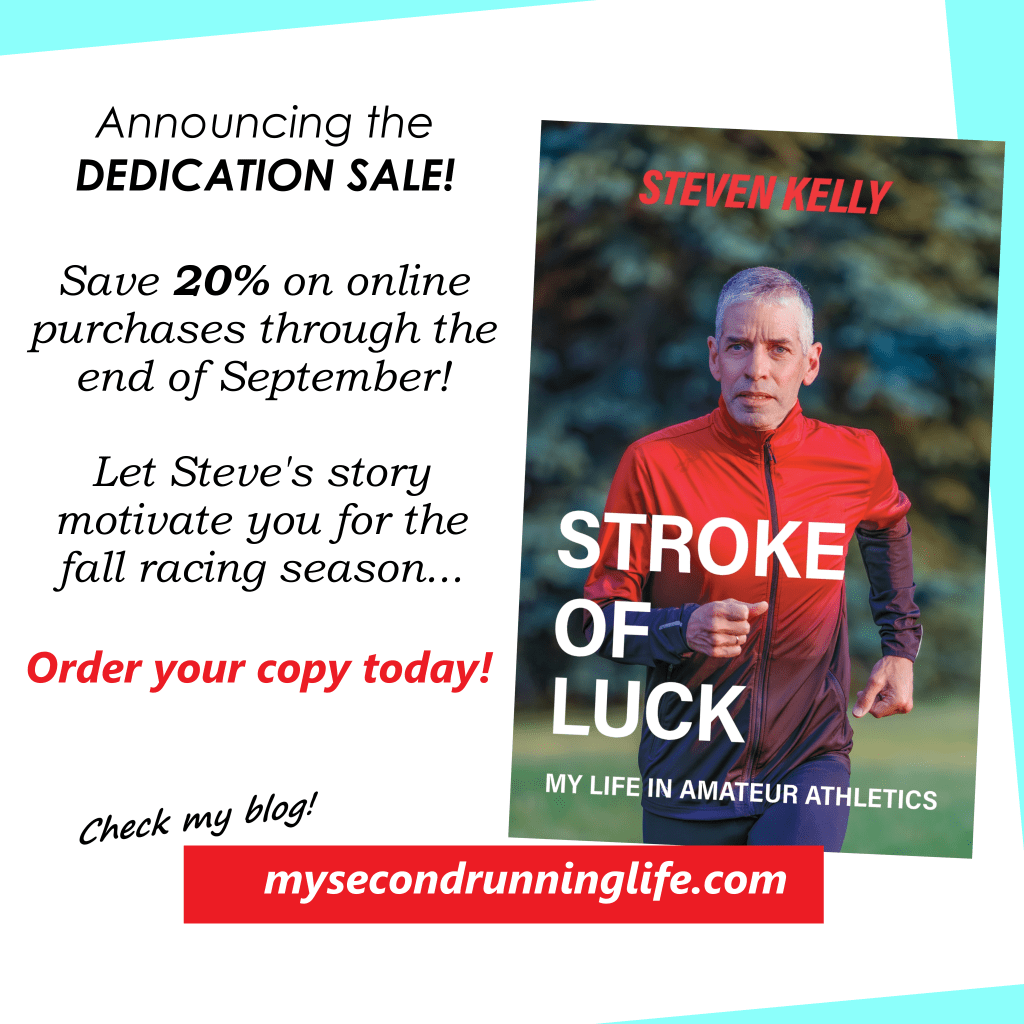
Good news! I’ve extended my Dedication Sale through the end of October. It’s a nod to our Thanksgiving holiday.

Print and e-book versions are available on Amazon at a 20% discount.

There’s a hard stop on the sale on November 1!

In what was a fairly chaotic week, I did manage to capture a few interesting images. There was no shortage of subject matter. I only had to force myself out the door with a camera.

Auroras a-plenty!

This year has been unmatched for solar activity. I read that it’s all because the cycle of solar activity is at its peak. (Sounds like a topic for a future blog piece!)

I’ve always been interested in photographing the aurora borealis (the “Northern Lights”) but frankly, I wasn’t up to what I assumed was the significant effort needed to make it happen. What gear did I need? How much work would it be to get to a good location, and to do so in the middle of winter when the aurora are most active?

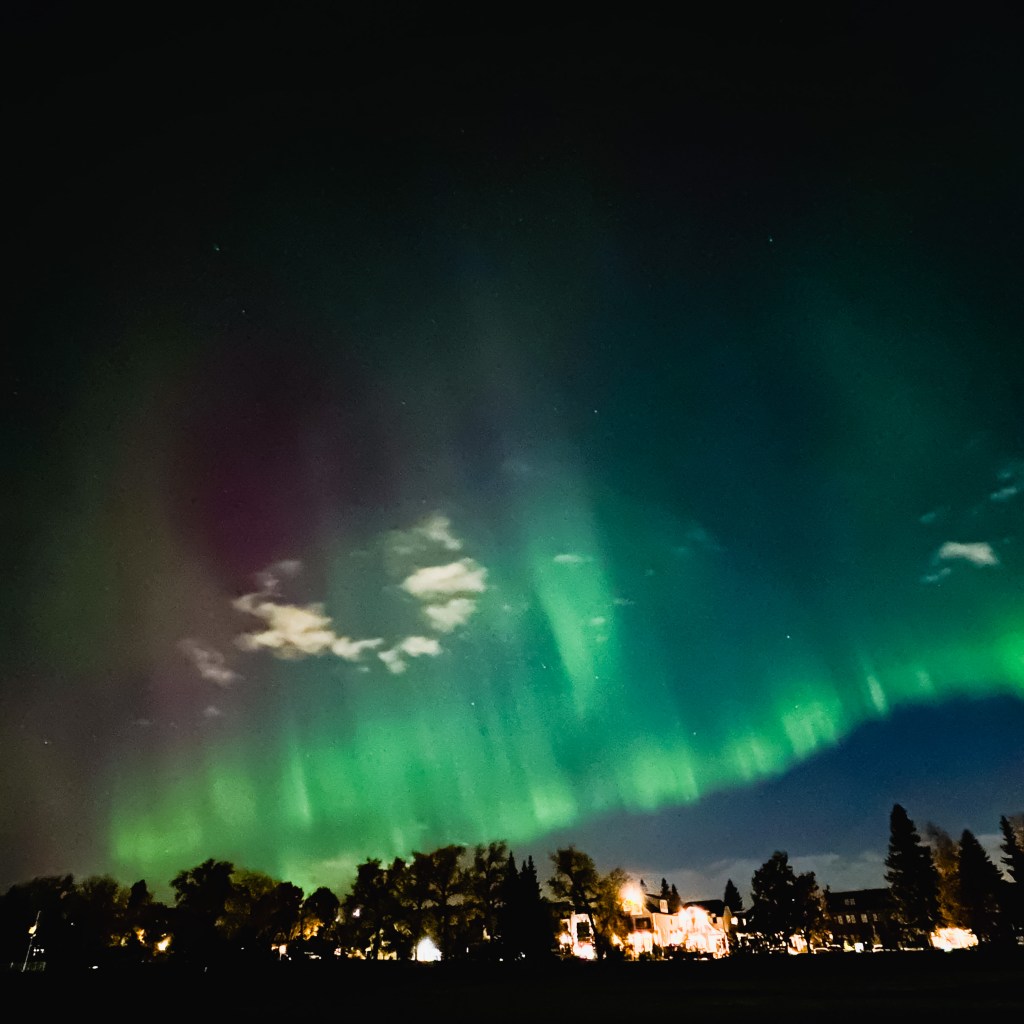
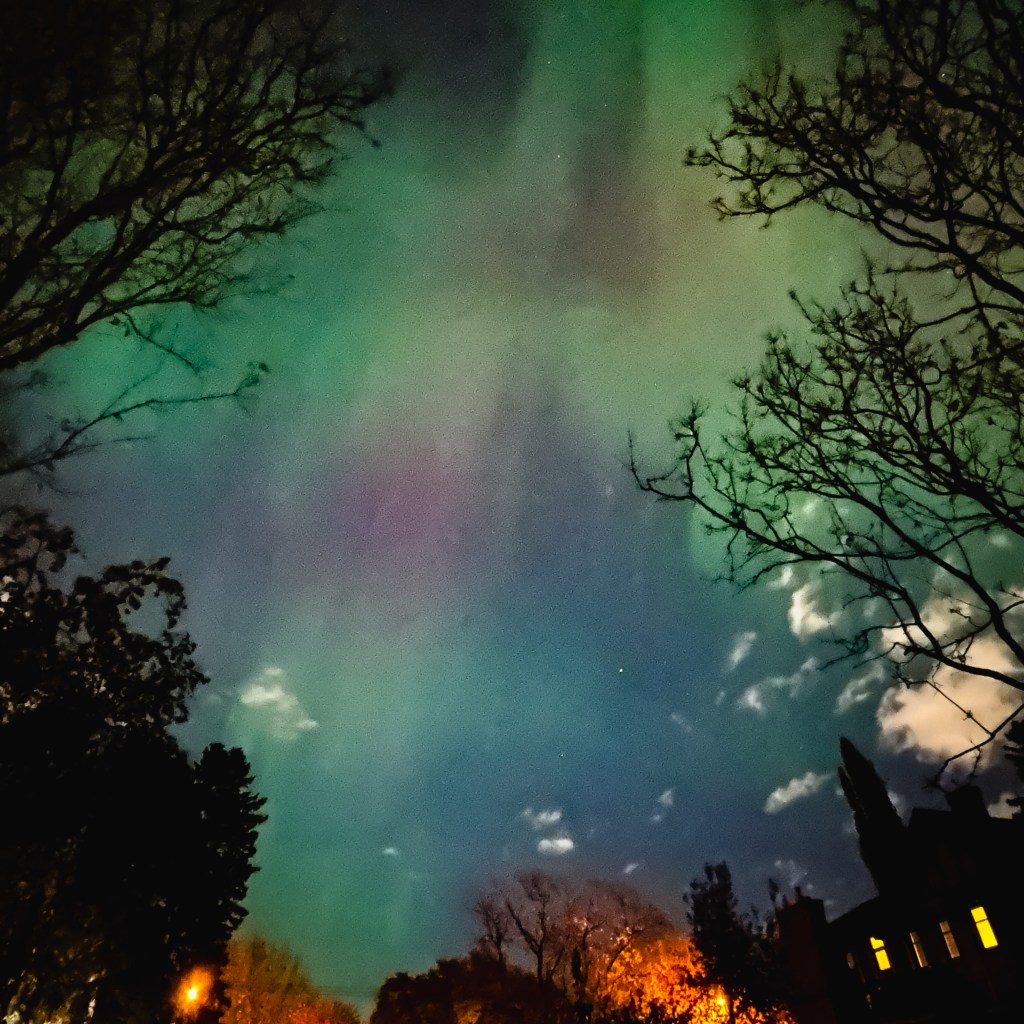
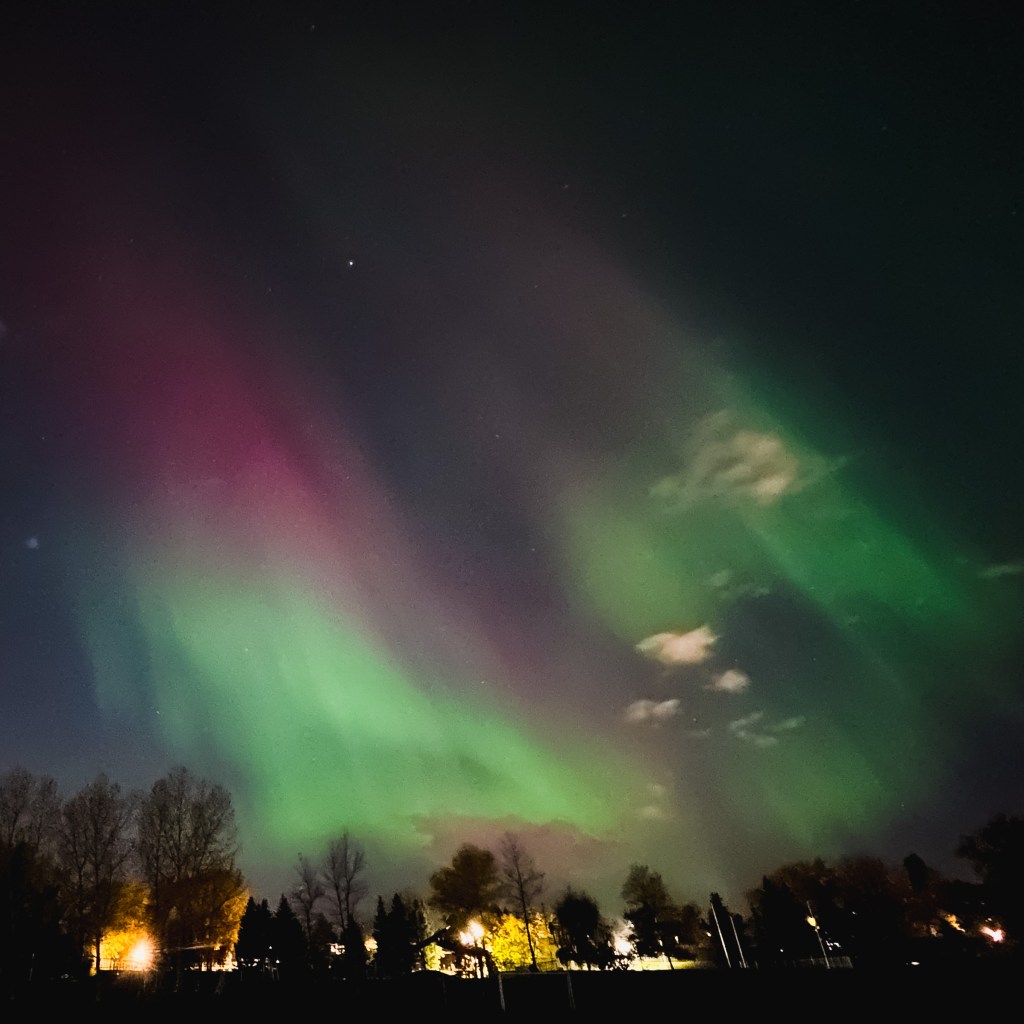
It turns out, this year at least, all one has to do is put an iPhone on a tripod (or maybe not), walk to the nearest park, and look up. I started seeing IG posts from friends who were taking pictures from their backyards, so I figured I could make a similar commitment.

I found a great website (Alberta Aurora Status) that estimates the combination of solar and atmospheric conditions necessary for good viewing. Lately, even that much science may not have been needed.

As for the photos, those took a few nights of experimentation. Fortunately, our recent weather has been agreeable and the skies have been mainly clear. I tried some shots with a “real” camera and soon learned that my iPhone 14 was more than adequate to land some decent shots. I plan to try again soon with other cameras… it looks like the good viewing isn’t finished yet.

The iPhone has a “Night Mode”, which uses a long exposure and some noise reduction. Later, it took some trial and error to get the best result with my photo editor… mainly I adjusted the exposure and added some saturation. Overall, I think the results are pretty good, considering how easy it all was.

Here are some of my edited shots from Lightroom.

Fall Colours and Intervals

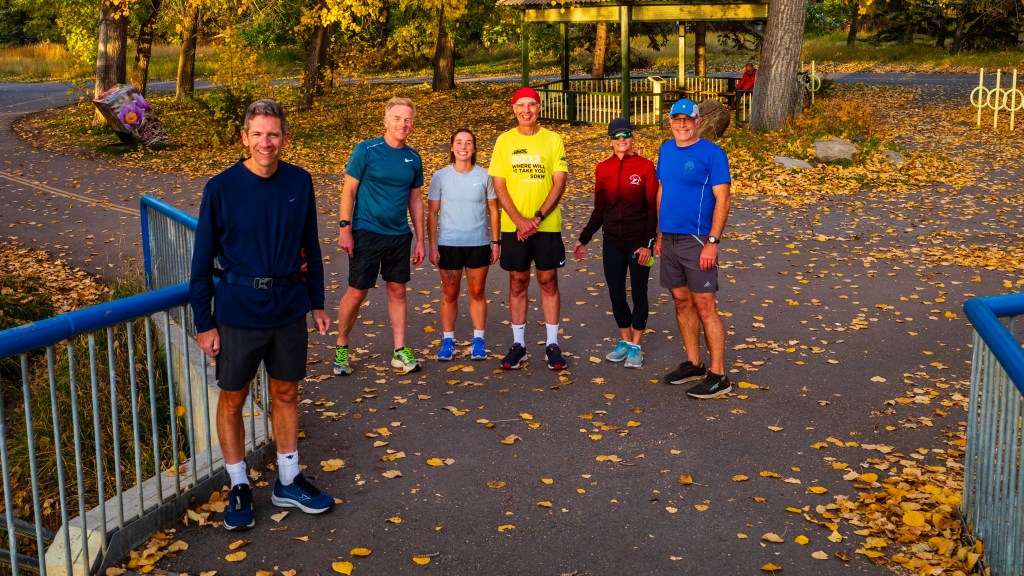
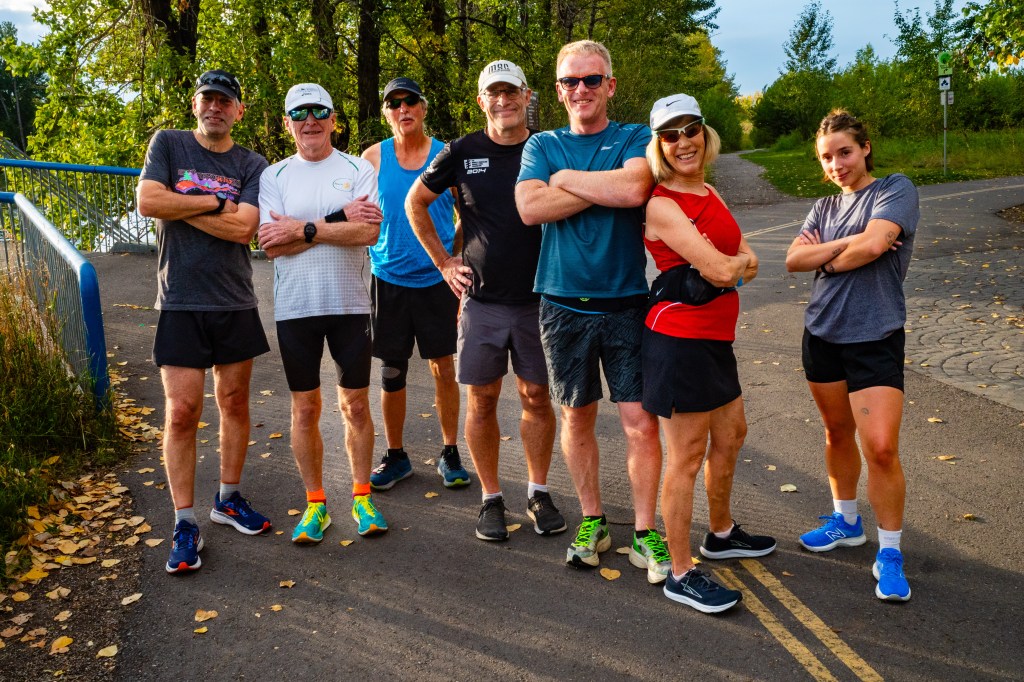
Knowing that our daylight hours are in rapid decline, I made sure to join our weekly group run at Carburn Park on Thursday evening. It was a perfect outing, and it may turn out to be our last outdoor session for the season. A small group showed up since many of our teammates were in recovery mode after a recent target race. Jason G led us through some sets of 500m – 500m – 1k.

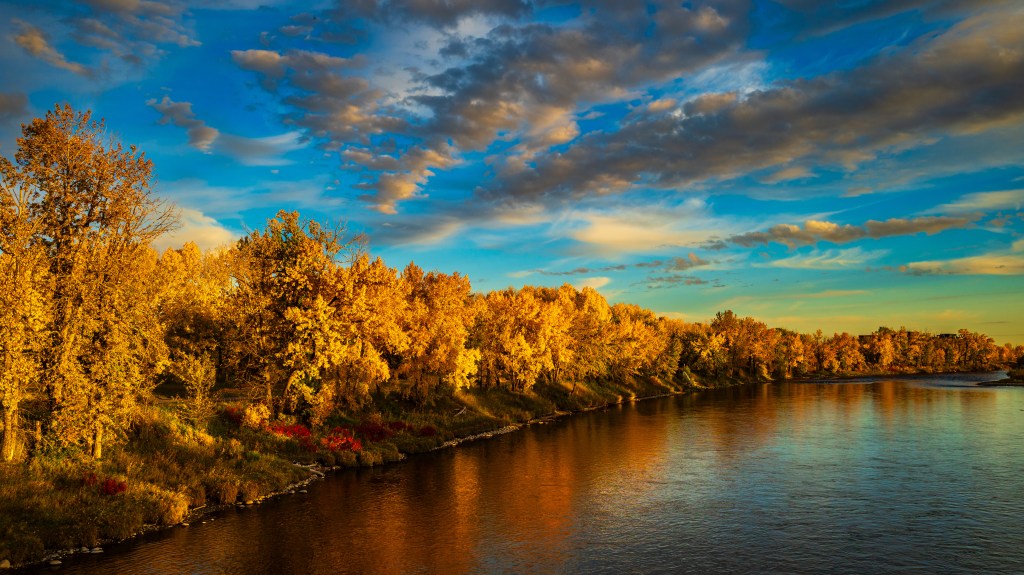
We headed over to the west side of the Bow River and turned north. The views back across the river were spectacular. The setting sun lit up the fall colours, with most of the leaves still on the trees. I used our short 1-minute breaks to good effect, snapping as many pictures as I could before the light show ended. I couldn’t have asked for better training partners than Doreen and Elidh. All pictures with the unbeatable Ricoh GR III.

A-B-C’s

A is for Art and B is for Borduas. What? Who?

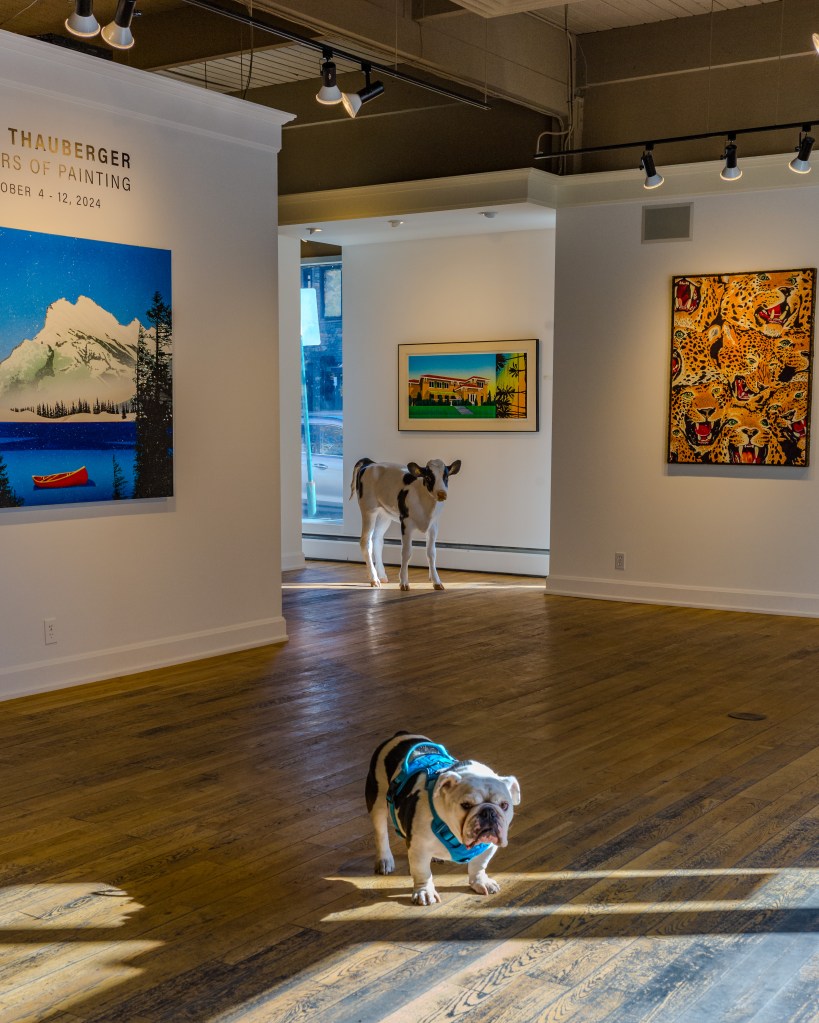
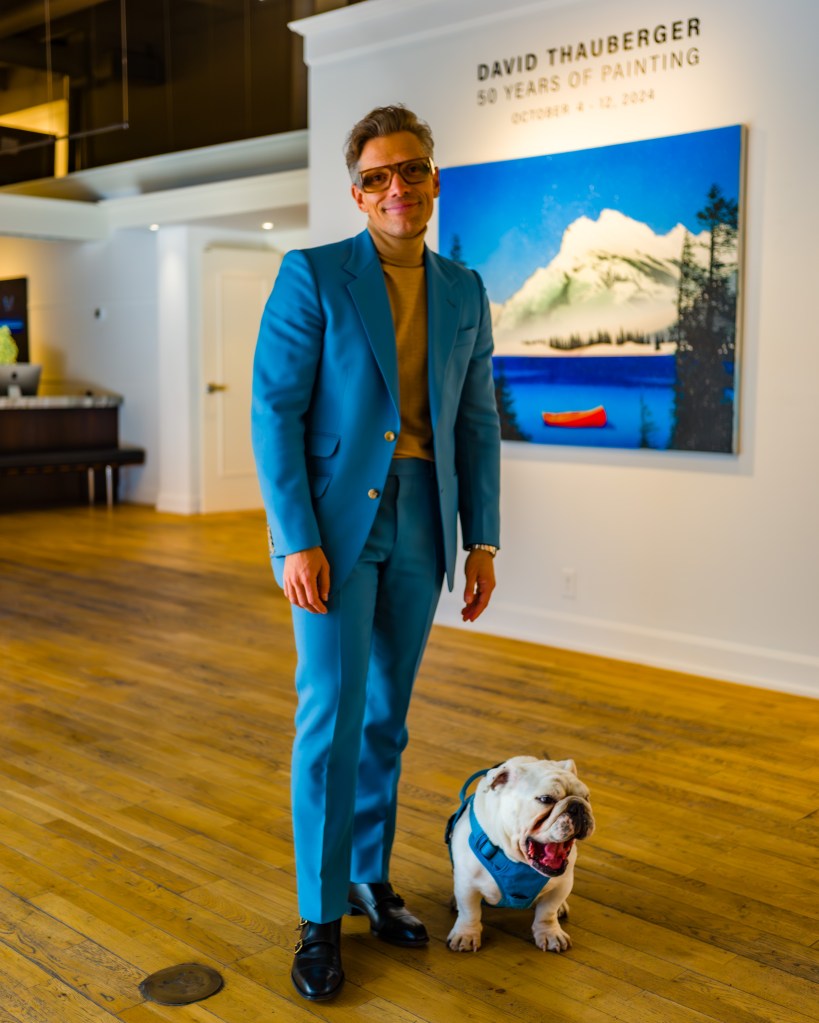
On Saturday, Deb and I made our way to Masters Gallery, to catch the last day of a David Thauberger exhibit. He’s a Saskatchewan painter who’s been active for 50 years. The gallery had an interesting selection of works from his long career.

We always enjoy stopping into the gallery on 4th Street SW to chat with Ryan Green (@ryngreen on IG) and visit with his sidekick. This visit was no exception.

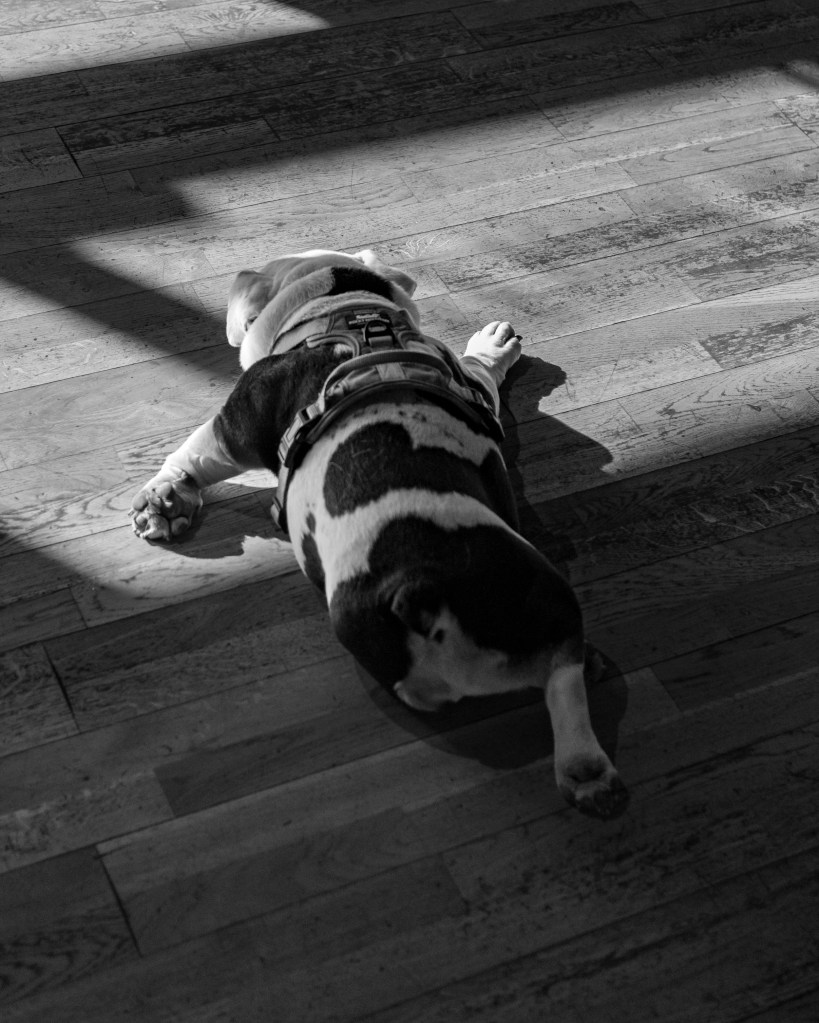
The sidekick I’m referring to is Borduas, aka “Bordy”. Bordy is a wonderful British Bulldog. He’s named after the Canadian artist, Paul-Émile Borduas (1905-1960), and he (the dog) is a fixture in the gallery. I snapped a few pictures of Ryan and Bordy because I had to. You’ll see what I mean.

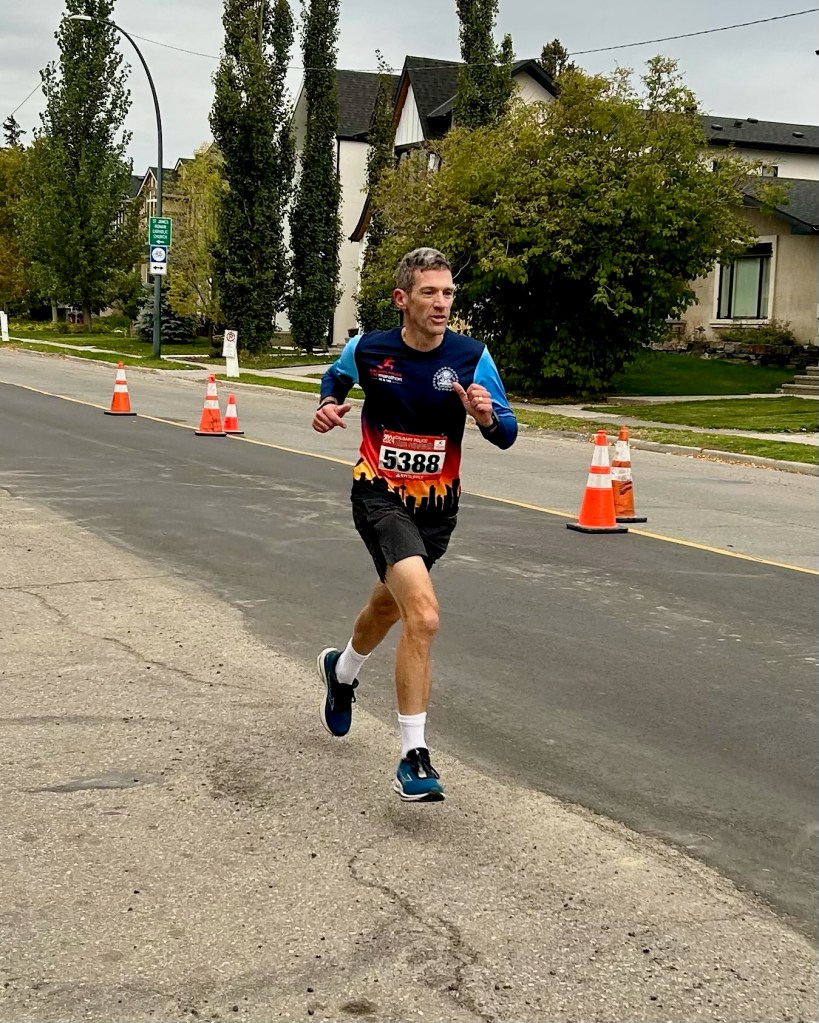
And what about C? This week, C was for Competition, as in racing. After a long hiatus, I signed up for a 5k. This was largely due to peer pressure, from the same Jason I referenced earlier. He had signed up for the 5k as part of the Calgary Police Half Marathon… one of the longest-running, best-organized races in Calgary… and encouraged me to do the same. Thanks for the push, Jason!
I had no illusions of running with Jason, but I set as my goal to run a steady effort at a challenging pace. In other words, I wanted this to be a race, even though it was at my current (reduced) capabilities. I figured I might have a shot at a podium finish in the M60-69 age group, but it was no problem if it didn’t happen. I was just happy to be over my recent calf/Achilles tendon problem.

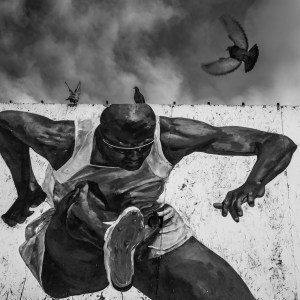
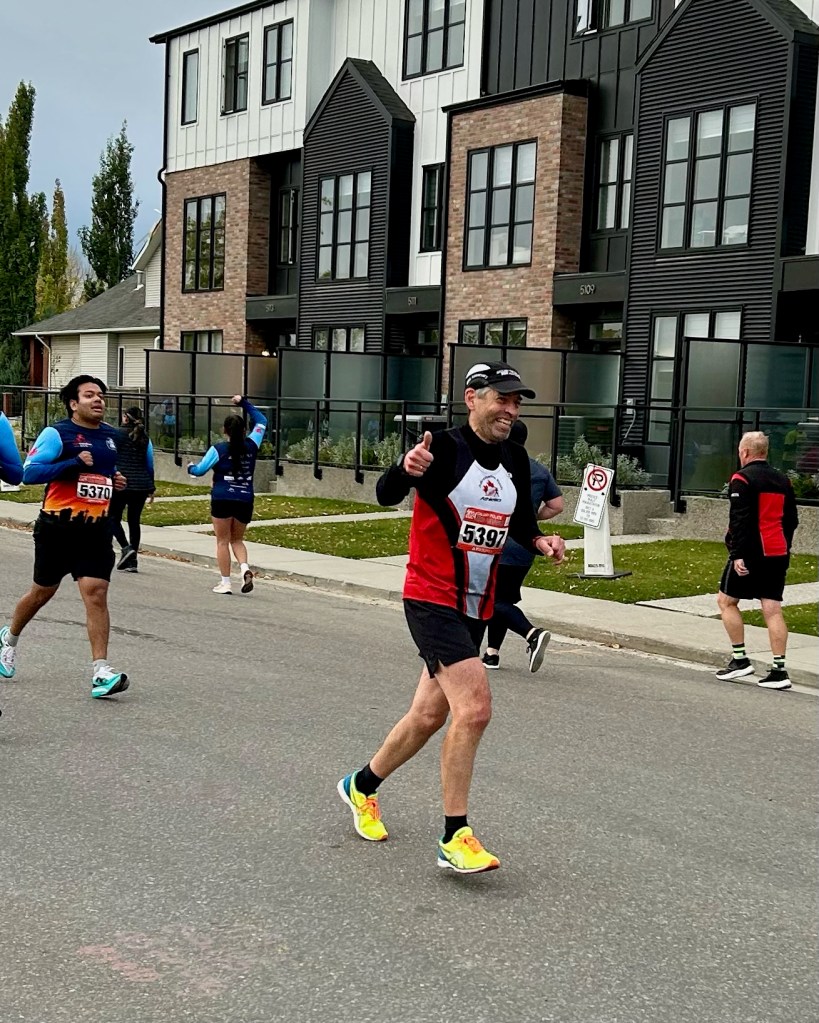
All photos by Deb Kelly:

Conditions were ideal for racing, and it was a successful outing for Adrenaline Rush runners. Jason flew to a 10th-place overall finish and set a personal best in the process. His time of 19:13 easily placed him first in his age group, by several minutes. Scott did very well in the 10k, running 53:43 and finishing 4th in his age group. Alistair (no photo) cruised to a second-place overall finish in the main event (the half marathon), running 1:22:34. That was impressive enough, but consider that he was taken off course by the lead cyclist, a miscue that added 500m to his race distance. Way to go, guys!

And me? I finished the 5k in 25:55. It was a solid effort. I was happy and maybe a bit surprised with it. I ran smart. I did miss the podium by one spot, and I missed running with Deb even more. Maybe next time!

Catching Up

It’s been a couple of weeks since I posted anything, so this will be a quick effort to catch up. I’ve been wrestling with some more pithy pieces. Those aren’t really coming together, and I needed an excuse to park them for a while.

The first thing I wanted to mention is that my Dedication Sale is still on.

For the rest of September, you can pick up a copy of Stroke of Luck on Amazon, at a 20% discount, in either print or e-book format.

Don’t miss out!

A Major Milestone

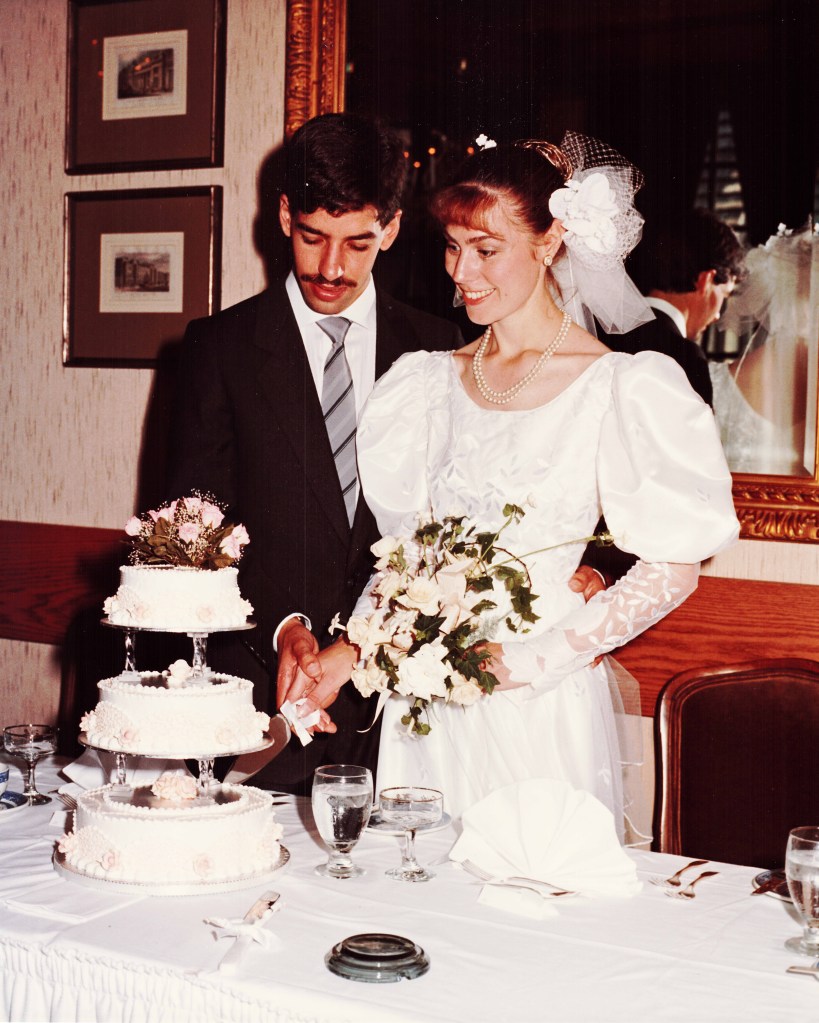
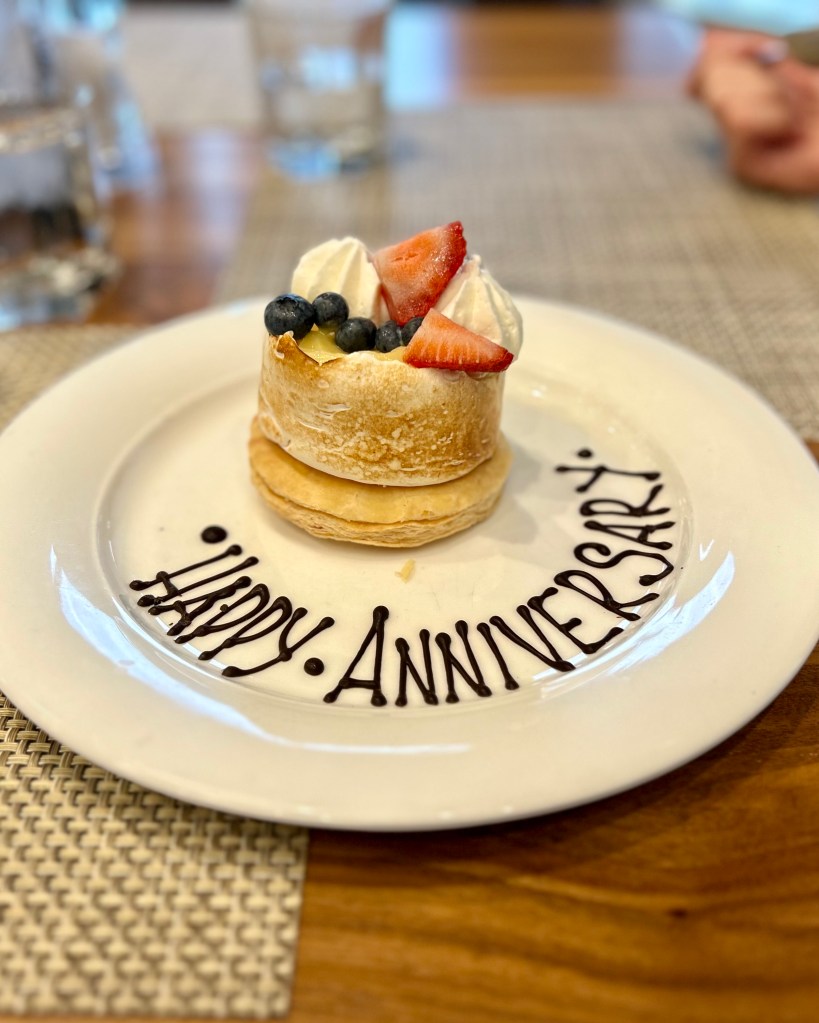
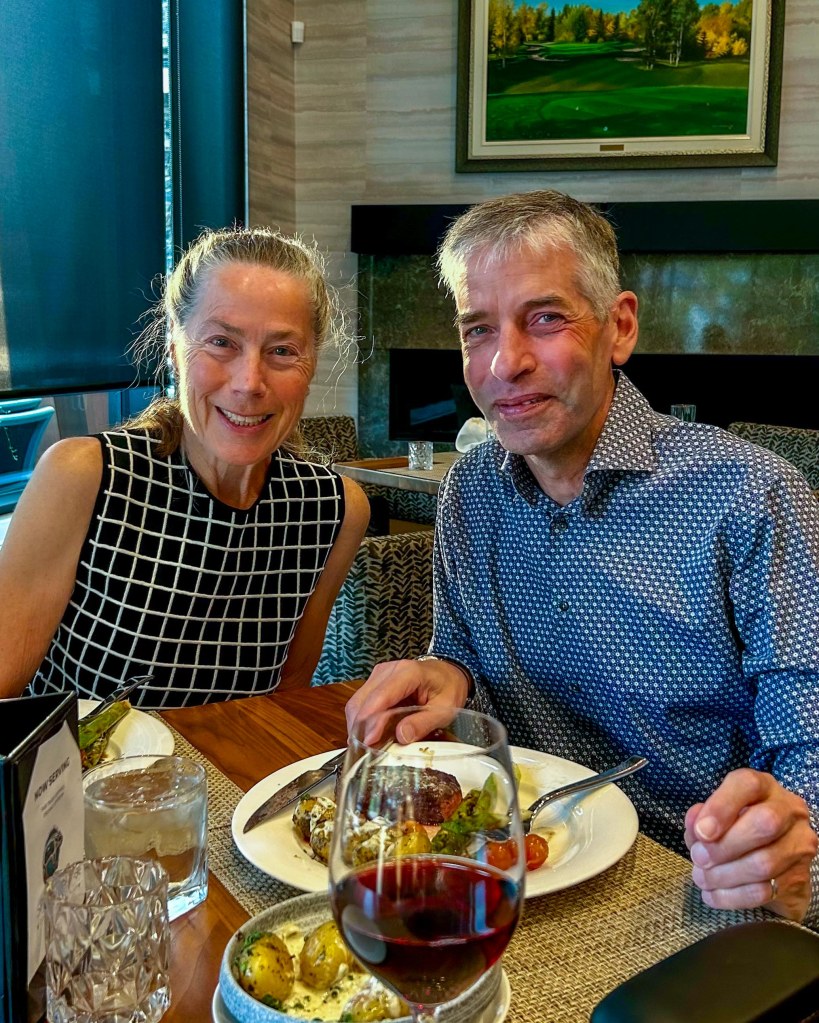
Deb and I marked a special occasion in early September: our 40th wedding anniversary. Although the day seemed to come up quickly… it’s been that kind of year… we did enjoy a quiet dinner together.

Apparently, the 40th anniversary gift is ruby. I can assure you that no rubies were exchanged. Maybe we will plan a vacation for early 2025 to mark the occasion.

It was fun to pull out our wedding album and confirm how little (?) we’ve changed over the years. No comments, please!

Street Scenes

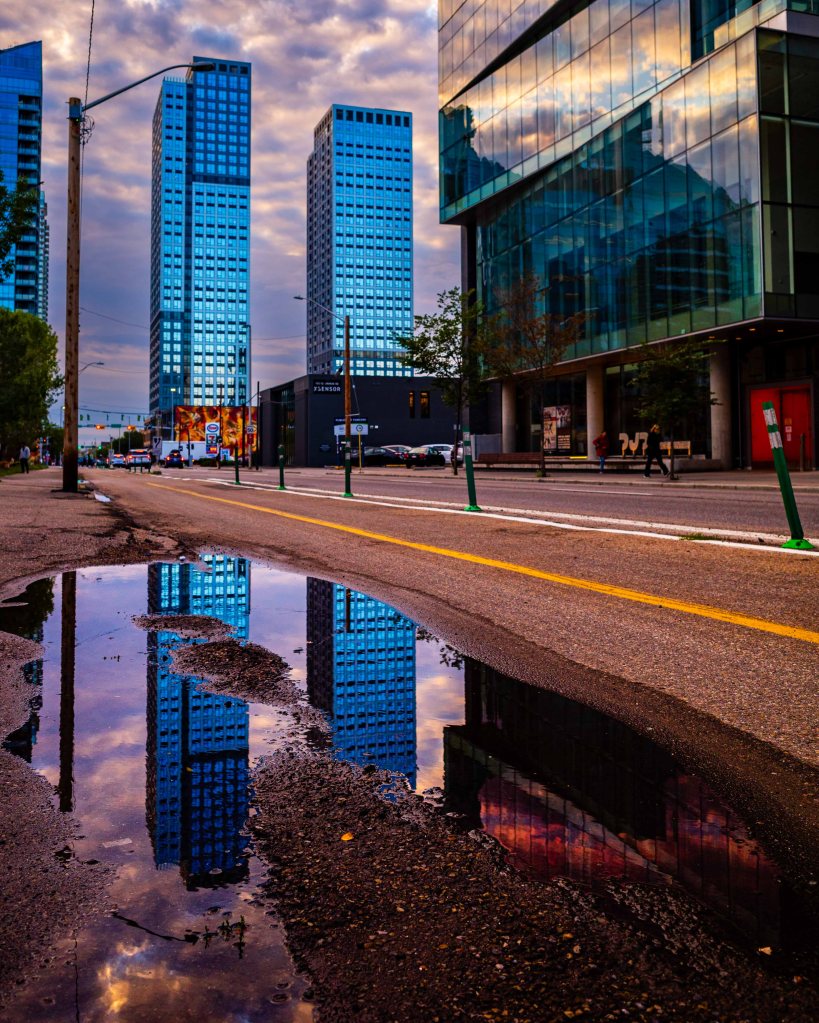
Last week, I was reminded why it’s a good idea to always carry a camera. (I still don’t count the one in my phone.) I happened to be in the East Village during what would usually be the commuting hour. Good thing that I don’t have to bother with that anymore. It was a beautiful morning. The light was so amazing that I had to stop the car. I was at the corner of Centre Street at 11th Avenue SW.

I hadn’t seen a specific image, but I felt there might be some good shots for the taking. I didn’t have far to go. Overnight rain had conveniently left some puddles on the sidewalk. Looking east down 11th Avenue, the buildings were perfectly framed, with the sunrise reflected in the building across the street. I crouched down and snapped a couple of shots. Here’s the result.

East Village, morning commute (13 September, Ricoh GR III)

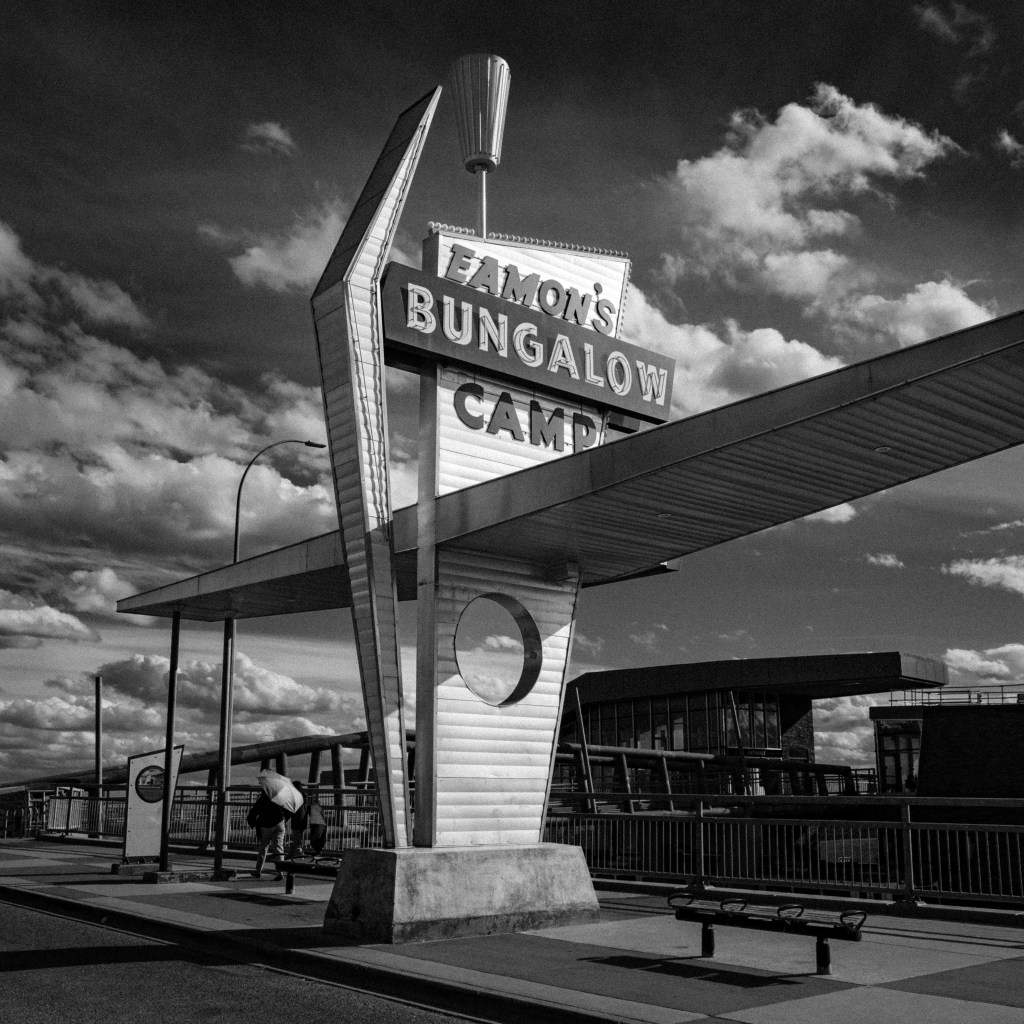
Two days later, I was driving north on Crowchild Trail with no real plans. Every time I pass the Eamon’s Bungalow Camp sign at the Tuscany LRT station, I think about stopping to have a look. As that isn’t my part of town, it took me a few minutes to actually find the station. The reason I’ve wanted to stop is that I remember the sign from our earliest years in Calgary. We used to take the kids to Butterfield Acres, and we would see the sign on our way up there.

I did some digging on the internet. The Eamon’s Tourist Centre was in operation from 1949 to 1961. It was basically a gas station and restaurant, with some motel-style bungalows. The place had some good years before the TransCanada Highway changed traffic patterns. The business declined and the restaurant was destroyed by fire. Of course, as Calgary expanded north, the whole area was eventually absorbed by urban sprawl. Fortunately, the city preserved the sign and incorporated it (rather nicely I think) into the architecture of the C-Train station.

My shot was taken on a sunny afternoon. The vibe was decidedly mid-century, so my photo had to be monochrome. The clouds added some interest. I even lucked out when a transit patron came into the shot, holding an umbrella.

Tuscany LRT Station, homage to Eamon’s (15 September, Ricoh GR III)

Always Grateful

I’ve missed several of our regular Thursday evening interval sessions at Carburn Park, and for a variety of reasons. I think I’m over the worst of my tight calf/Achilles tendon issue, thanks to Jenna Nichol at Alpine Sports Therapy. Then it was recovery from my tooth implant, and one missed session due to torrential rain.

Finally, this past Thursday, I was ready to give it a try. We had a good turnout, on a perfect late summer evening. I can almost hear the AC/DC soundtrack playing when I look at this photo.

Ready for business, Carburn Park (19 September, Ricoh GR III) Photo by Jason Gurevitch

Our workout called for mile repeats, with an option of some shorter stuff for those targeting shorter races or just returning to form. That last part suited me. I set my sights on 2 sets of 1 mile-800m-400m. I wasn’t sure I would even be able to achieve that.

I’ve gotten used to bringing up the rear among my talented teammates. Still, given that several of them are in the final stages of marathon training, and I am at a very different point, it promised to be a humbling experience.

In fact, it was a great workout. I surprised myself by managing to hang on the back of the bunch, but only just. My mind did its usual thing of wandering while I ran. I wondered, is there a running equivalent for the “lanterne rouge” of the Tour de France?

Given that I was doing a shorter version of the workout, I was back to our starting point with a bit of time before the thoroughbreds made it there. I had a few minutes to check out the lagoon and snap a couple of pictures of the peaceful scene in the fading light. Beautiful!

Carburn Park Lagoon, sunset (19 September, Ricoh GR III)

It was the kind of evening that makes me very grateful, for all the blessings I’ve had. I hope you may also be so fortunate.

Until next time, all the best.

The Van Gogh to Van Gogh Photo Run

My photo run was bookended by two very different pieces of public art in Calgary. The pieces have a couple of things in common. Both are large, impressive sculptural works. And both have Vincent Van Gogh as their subject.

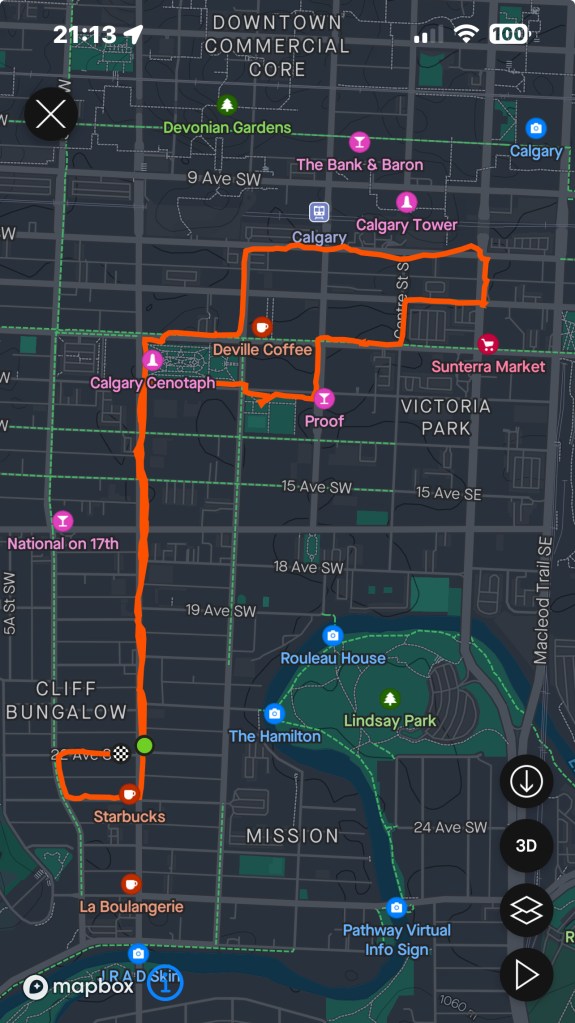
What a coincidence! I decided to do some research after I got home. But first, it was time to explore on foot. Here’s my route from Strava:

The Van Gogh Photo Run

And here’s what I found out about the artworks and the artists.

Van Gogh Observes, by Joe Fafard

I parked on 4th Street SW in Mission, near Masters Gallery, for the start of my easy run. I always like checking out what’s on display in their windows. Whatever else I happen to see, I can stop to admire the large piece installed just outside the gallery.

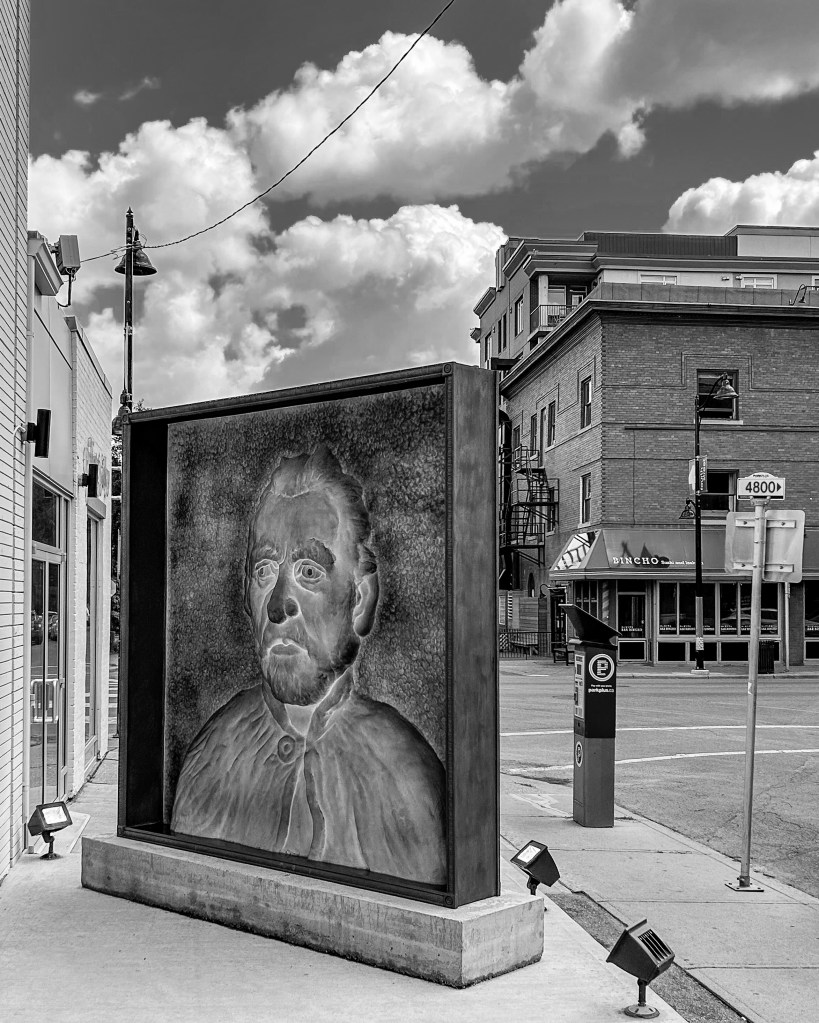
That piece, Van Gogh Observes (VGO), is a major sculpture by the late Joe Fafard. I wrote about Fafard last fall, when I photographed Do Re Mi Fa Sol La Si Do, his sculpture comprising eight stampeding horses. That piece is installed in Harley Hotchkiss Park in downtown Calgary.

Fafard’s piece is big and colourful. It’s fantastic. Van Gogh silently watches everything going on outside the gallery… hence the title. And from his vantage point, he’s seen a lot since the piece was unveiled in 2019. Van Gogh Observes was one of Fafard’s last major works… he died in March of the same year.

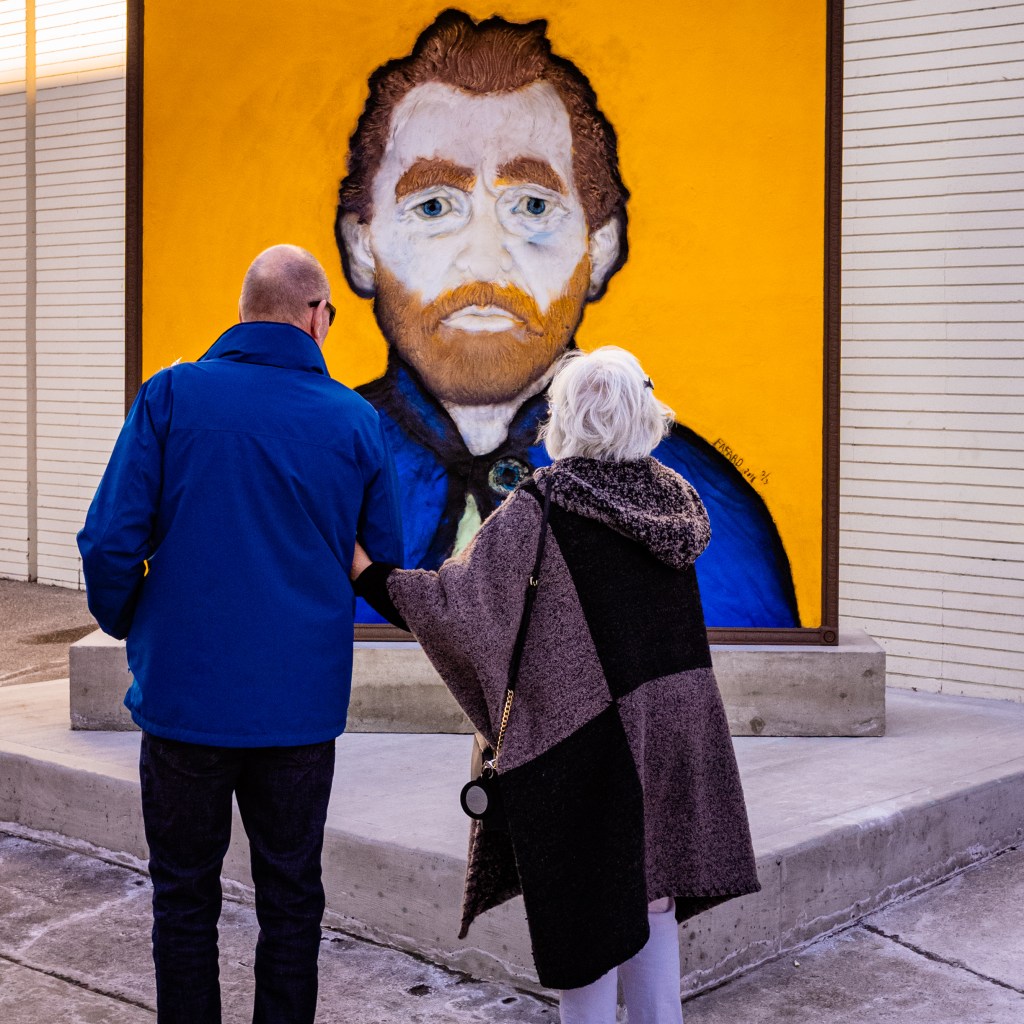
Although it wasn’t taken during my recent run, here’s one of my favourite pictures at that location. This couple seems to be deep in conversation with Vincent.

“Hello Vincent!”

Fafard was famous for his sculptural works, which often have a highly animated look. He sculpted livestock, people and other subjects, in bronze or laser-cut steel. His work is always visually appealing. This is certainly true of VGO. I think Fafard’s use of bold yellow and blue was a nod to Van Gogh’s frequent use of the same colours. It’s a piece that brightens up bleak winter days in Calgary.

Even from the back, it’s an amazing piece to look at.

Van Gogh Observes (Joe Fafard), from the rear

Van Gogh Monumental, by Bruno Catalano

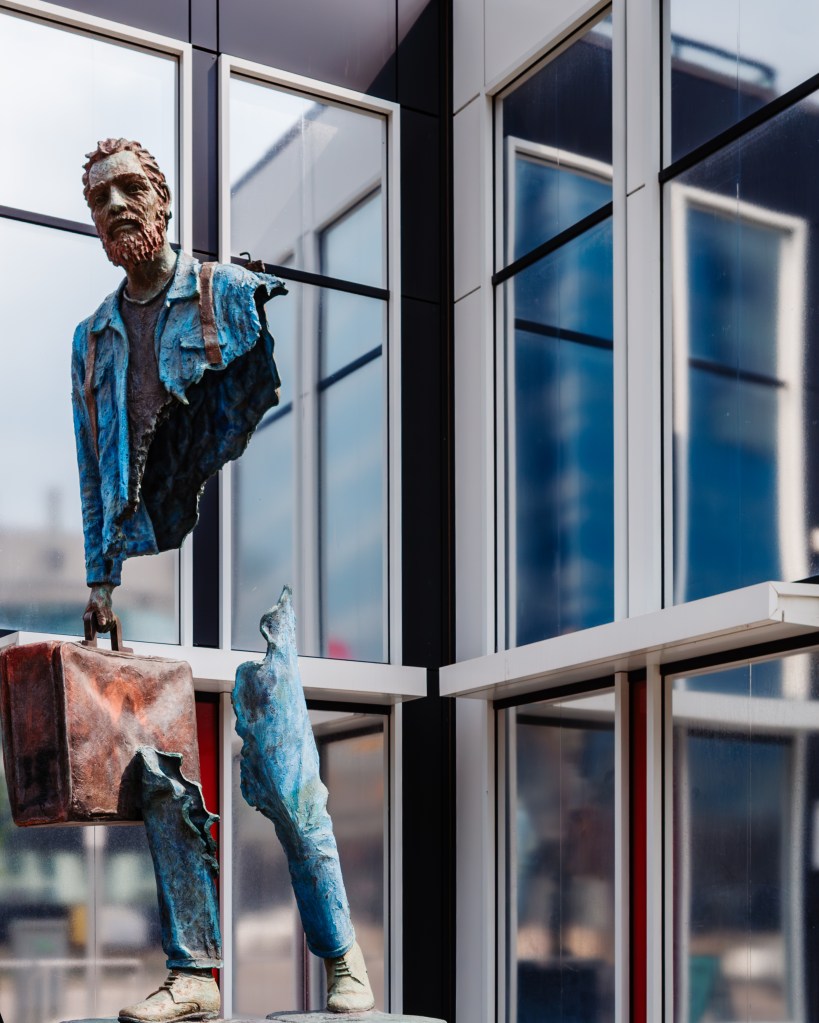
I made my way to the UPTEN building at 10 Avenue and 1 Street SE to see Bruno Catalano’s 2020 painted bronze statue, Van Gogh Monumental. The four-metre-tall statue on the southeast corner of the intersection presents the artist walking purposefully while holding a well-used suitcase and carrying a painting on his back. He walks in the direction of the downtown core.

Van Gogh Monumental (Bruno Catalano)

The statue is part of Catalano’s Les Voyageurs series, all of which depict characters in motion. Many of Catalano’s sculptures, including this one, have a large diagonal gap, really a gash, at mid-torso. The sculptures seem to defy physics… they shouldn’t be standing, but they do. Catalano’s bio tells us he discovered this technique when he had a casting accident with an earlier piece. He liked the result, and he incorporated it into many of his subsequent works. It’s become his trademark.

Catalano’s sculpture invites speculation about its meaning. What is Van Gogh searching for? Where is he headed? Maybe there are clues in Catalano’s own story. He was born in Morocco. His French-Italian family moved to Marseille when he was ten. Catalano has Jewish ancestors, who were expelled from Spain in the 15th century, and eventually settled in North Africa. The theme of travelling, of searching nomadically, seems to fit naturally into his art. 

I find it interesting that Catalano chose Van Gogh for this sculpture, because most of his subjects are anonymous people. Here, he has chosen one of the world’s most famous and troubled artists. We shouldn’t be surprised to see Van Gogh searching for something while carrying his worldly possessions and his art. The gap in the statue is visually startling, but it also reinforces the idea that the subject has lost something quite fundamental.

Conclusion

As I jogged back to my car, I pondered the two art pieces I had just seen. I like both the Fafard and the Catalano pieces, even though they give us very different takes on an artist we all have some familiarity with.

The Fafard piece is approachable. Its animated look and bright colours give us an optimistic Van Gogh. Like the couple pictured above, we feel we could have a conversation with the man in the statue. That might explain why the statue is a huge attraction. I often see pedestrians stopping to admire it (or have a chat.)

On the other hand, the Catalano piece is more aligned with how we usually think of Van Gogh. It is a darker piece. The burdens Van Gogh is carrying and the cut across his body seem to portend his death by suicide. These are effective techniques to tell us something about the subject, but also about the artist. If Catalano relates to Van Gogh’s trials, he has done a great job of telling us.

I am most moved by the Catalano piece. What about you? Whichever piece you prefer, we are fortunate to have these important artworks in the city. It’s even better that they are just an easy jog apart.

Colour or Monochrome?

While flipping through some recent pictures, I realized I was “seeing” them in either black & white or colour. This was before I had started doing any editing. My mind seemed to be jumping to conclusions about the end result. 

Maybe this was inevitable, as I must have “seen” some version of the final image before I pushed the shutter button. Was my initial visualization strong enough to override any subsequent artistic choices?

I try not to limit myself to one expression or another, and I take plenty of photos in each style. My preference is for black & white images. Many of the photographers who have made an impression on me worked mainly in monochrome. Adams. Cartier-Bresson. Schaller.

That would be a good idea for a future piece… the photographers or the images that have been most impactful for me. But for this piece, I wanted to explore the idea of initial visualization and see if that process might be acting as a barrier to my artistic ideas.  I picked several recent images, more or less at random, for the following, non-scientific analysis.

Sedona Landscape

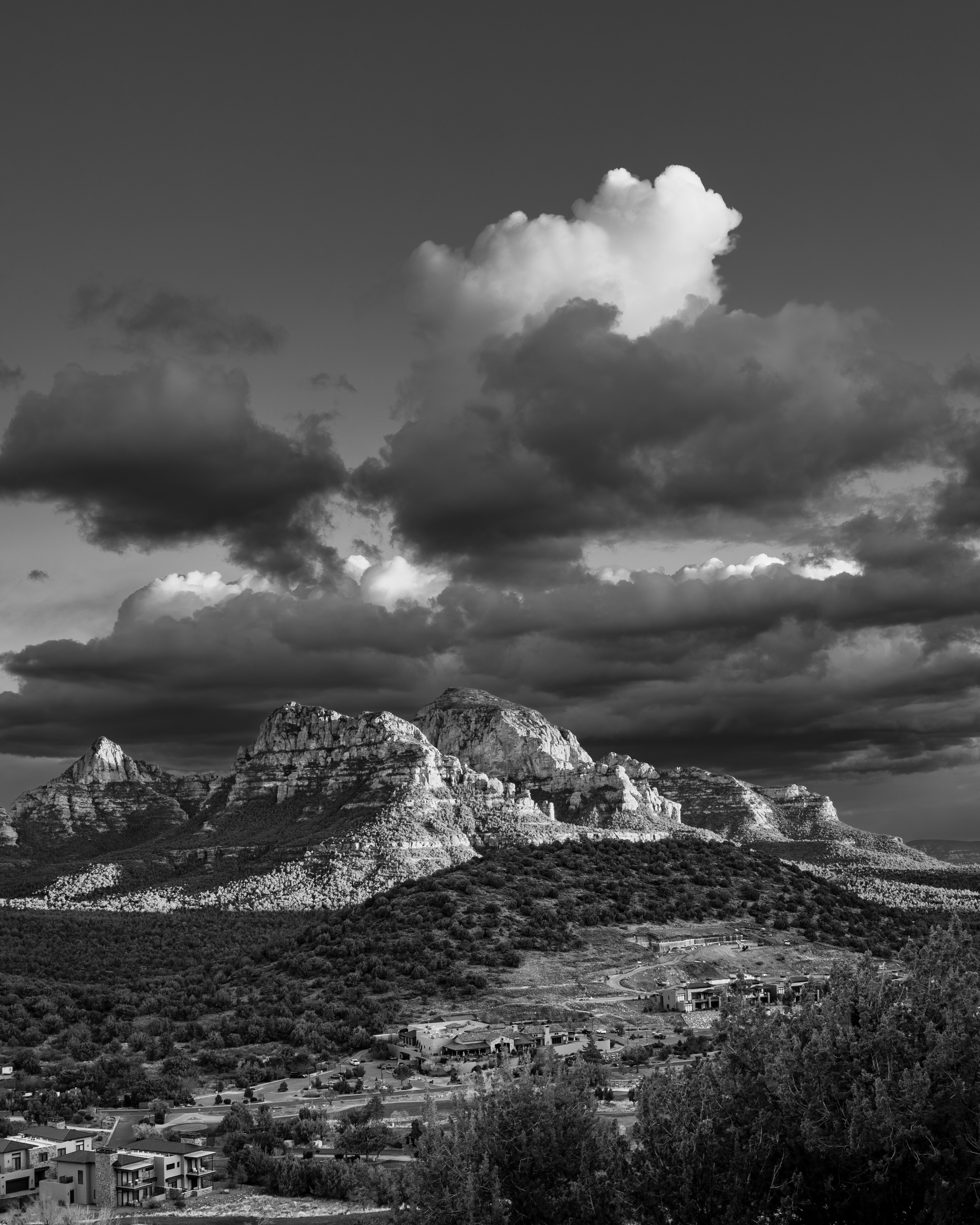
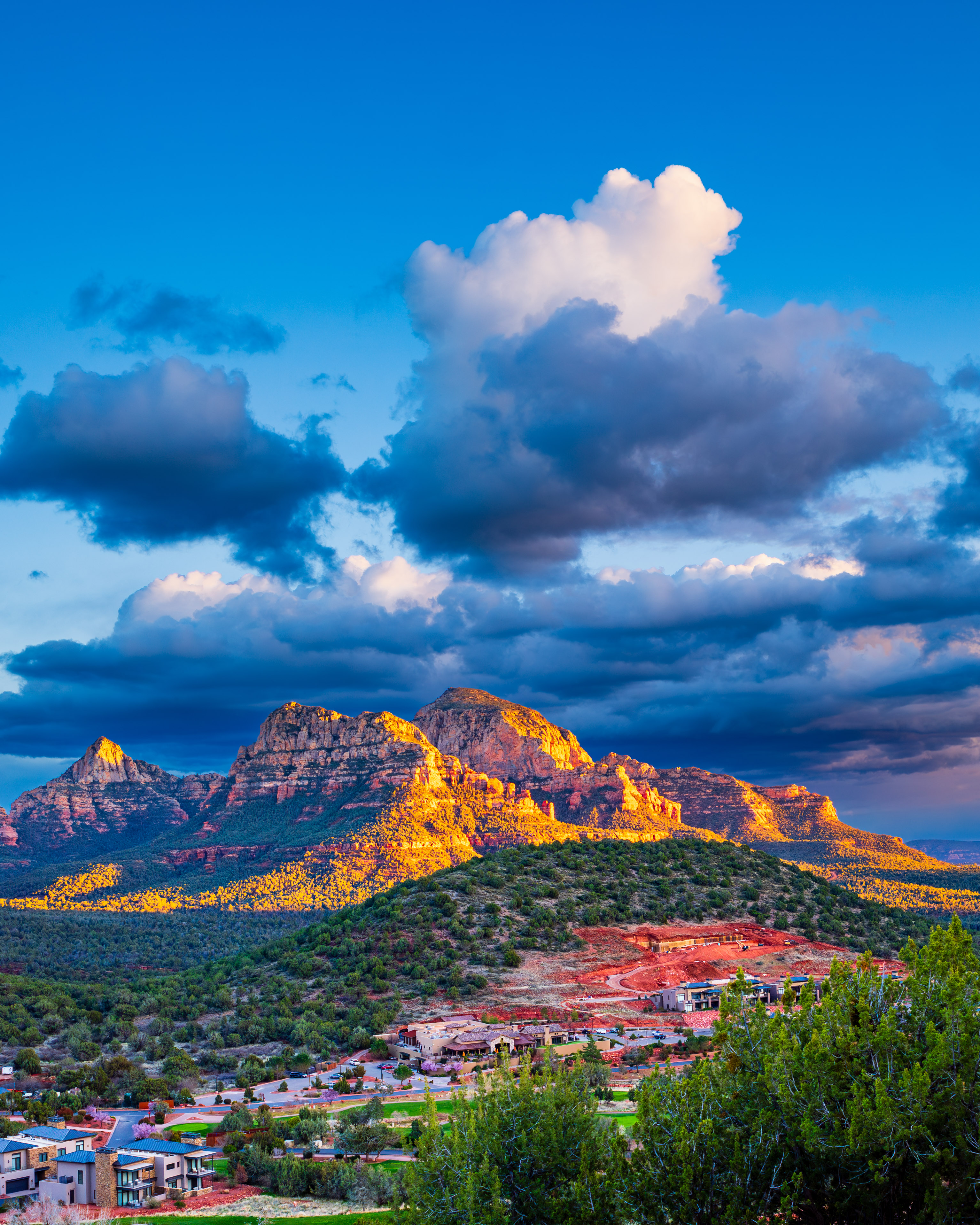
The first image was a landscape, highlighted by the setting sun and building clouds over the peaks in Sedona, Arizona. There’s no doubt I imagined this image in bold monochrome. I shot it using my favourite JPG setting in the Ricoh GR III: hard monochrome. The in-camera JPG looked promising, on the tiny 3″ viewfinder screen. I couldn’t wait to see the image in Lightroom.

I hadn’t even considered the option of a colour version of this image, but maybe I had been too hasty. I reimported the image and forced myself to ignore the monochrome button. This is a comparison of the two versions:

Evening clouds, Sedona (March 2024)

To my surprise, I found the colours in the foreground… the famous red rocks of Sedona… to be a distraction. This wasn’t the result I expected. The dramatic clouds, which I was able to set against the sky with a red filter effect, were hardly noticeable. Instead, they were competing for attention. I had to go with my first instinct. This photograph is better in monochrome. 

Cold, Icy Calgary

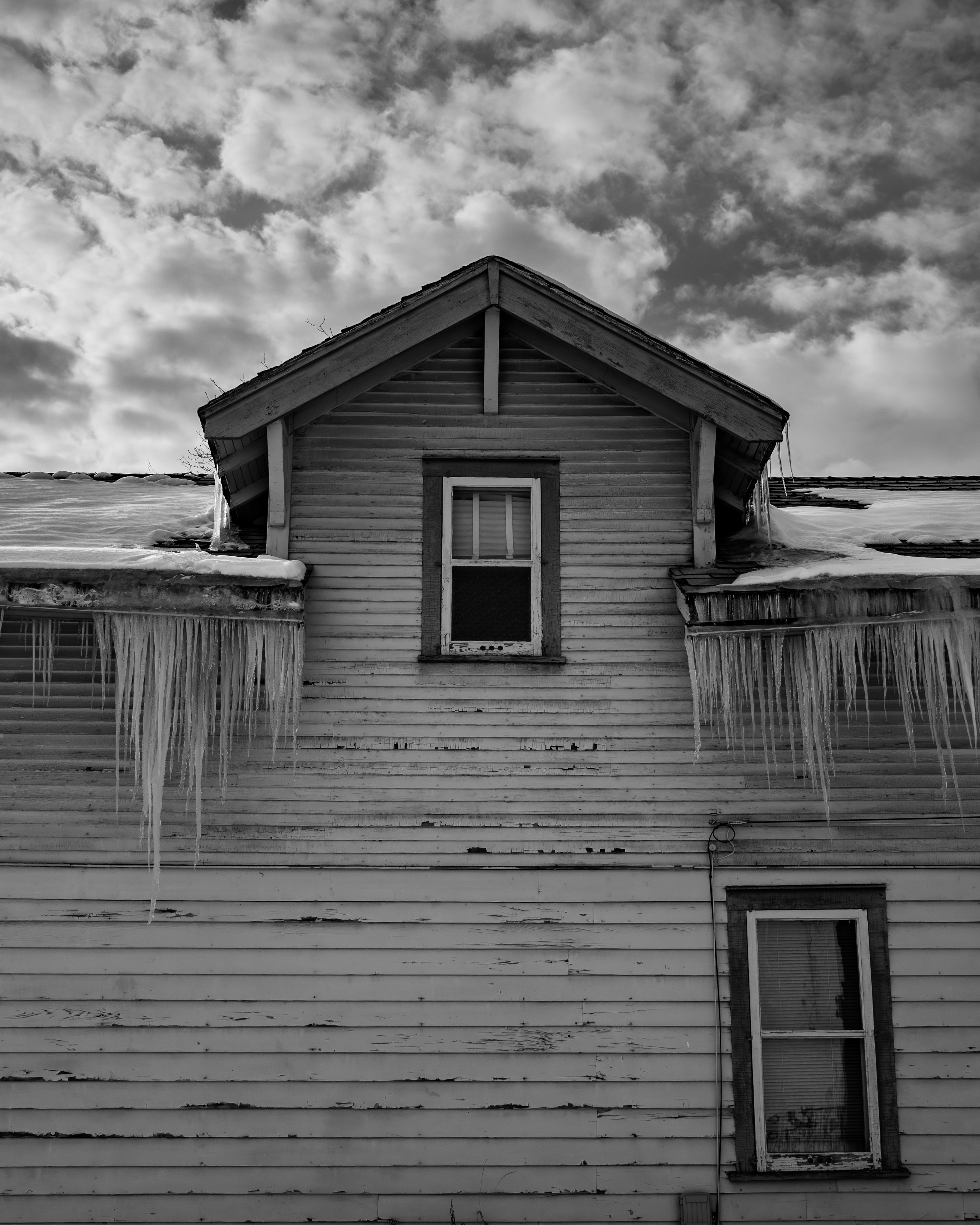
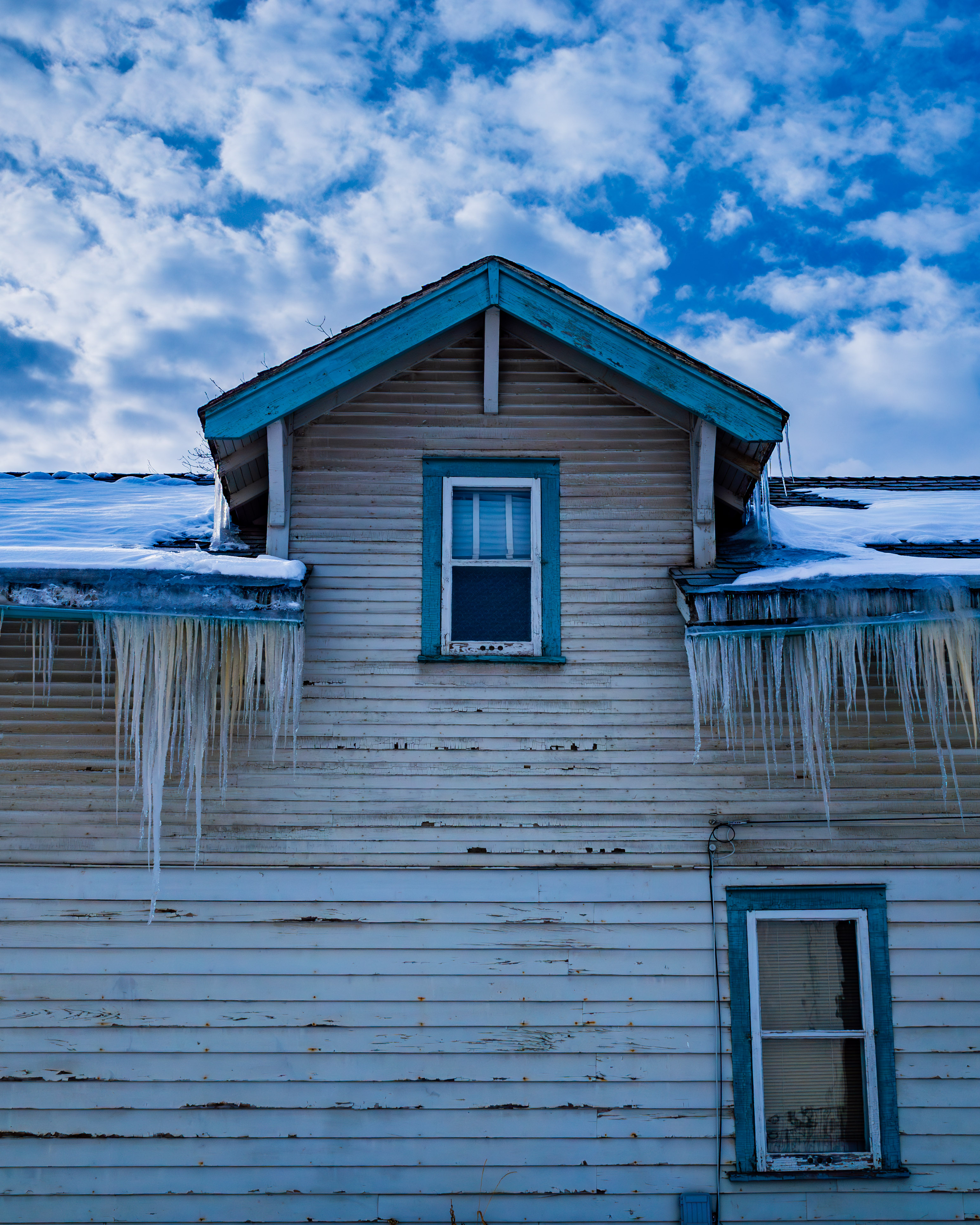
My second image was totally different from the picturesque scene in Sedona. We had returned to a late blast of winter in Calgary. It must have been some blast, based on the icicles that were hanging from every rooftop. A photo opportunity!

As with the landscape, I saw this roof and its crop of icicles in black & white. Texture and lines, contrasty clouds (where’s that red filter?) The thick icicles were a cool feature… no pun intended.  

My monochrome image needed only a few edits: an increase in contrast and darkening of the sky. I also bumped up the exposure a little, to ensure the picture wasn’t a complete wash of drab grey. And I added a bit of texture to the peeling paint. This was just about exactly what I visualized when I took the shot.

A good crop of icicles (March 2024)

But had I been too hasty? I had to find out. So I re-imported the RAW image and edited the colour version. I hadn’t even noticed the blue paint on the trim. And I missed the discolouration in the icicles from whatever had been oozing out of the eavestroughs. Time for some repairs.

What do you think?

Personally, I don’t like it at all. My mind’s eye was right to see this image in tones of grey. The colours are irrelevant to the story that this picture is telling. I wanted to put the viewer into a scene that was edgy, cold and stark. Instead, the pale blue trim on the house tempers the scene, while the brownish stuff coming out of the eaves is a distraction.

Springtime in Hamilton

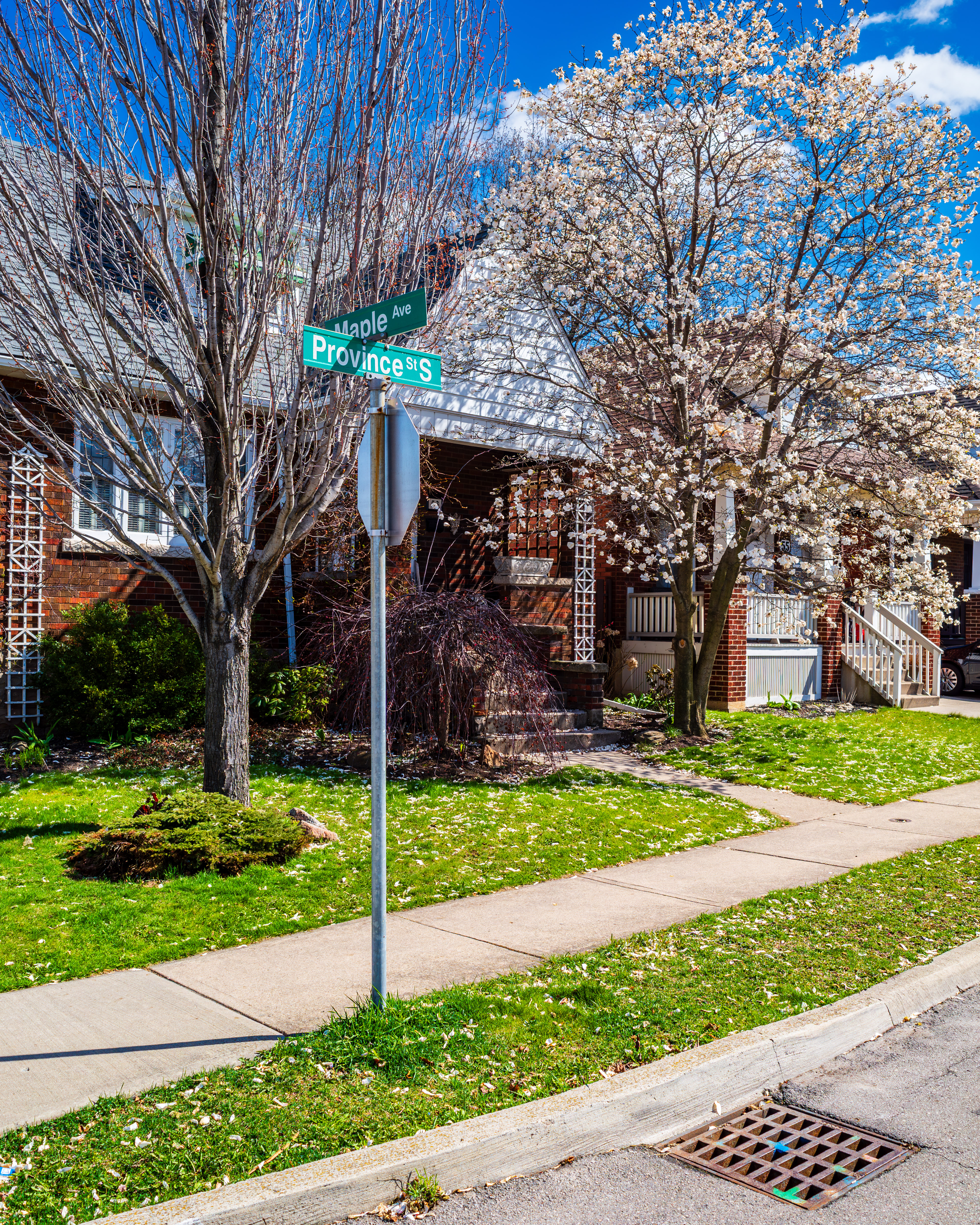
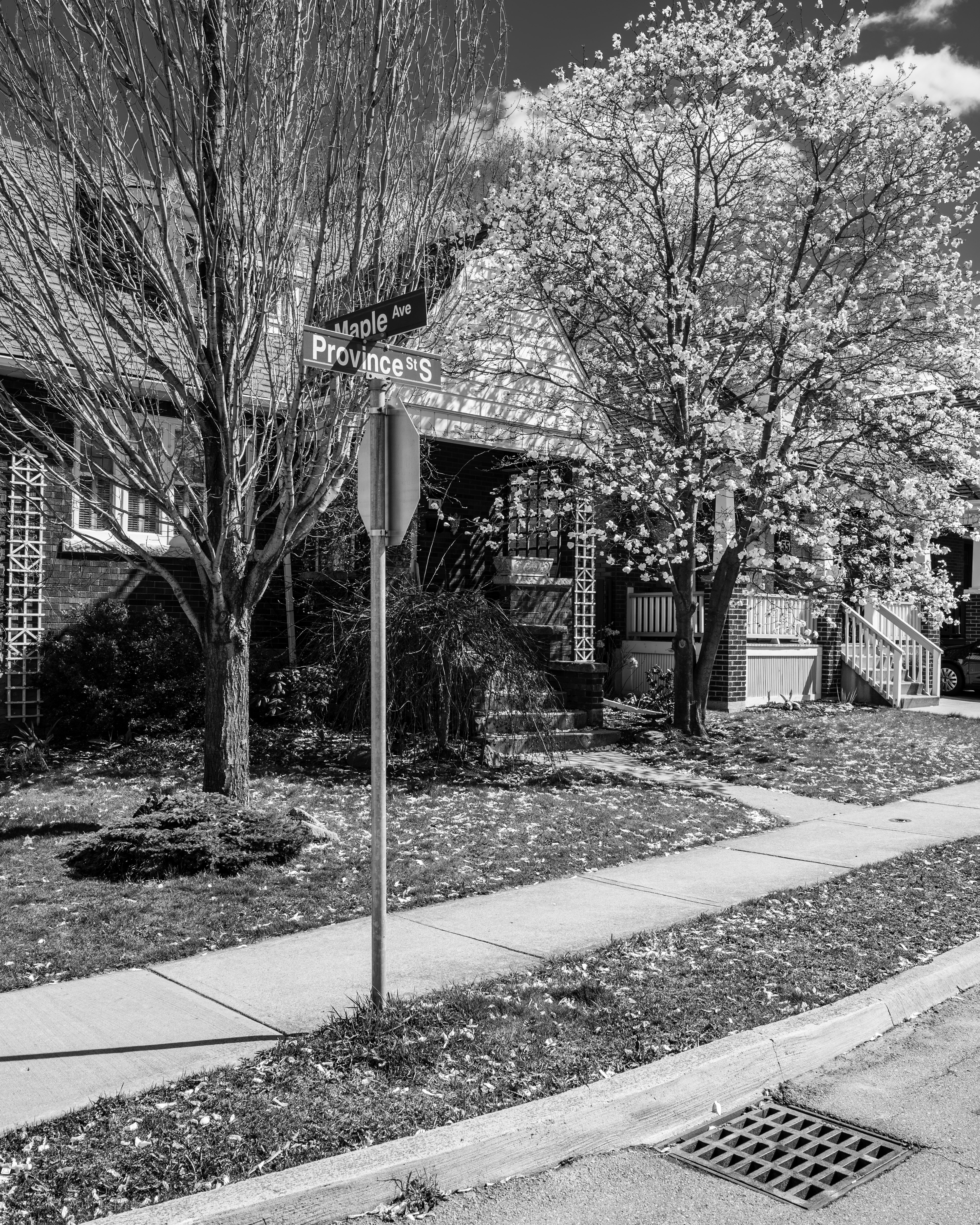
My final image is from a recent visit to Hamilton. Walking around my old neighbourhood in April was a riot for the senses. Spring was in full bloom. I snapped a picture at the corner of (obviously) Maple Avenue and Province Street. I initially saw this as a colour picture, with a sunlit magnolia tree as the highlight.

Maple and Province, Springtime (April 2024)

Even though I like the colour image, I decided to try a monochrome version. This one is more of a toss-up. I like both versions. Why? The colour version puts the viewer right in the scene. Spring has clearly sprung. On the other hand, the monochrome version shows us every detail but leaves us to imagine what colour everything is in the scene.

Of course, these are just my thoughts. Let me ask you: monochrome or colour? Leave me a reply in the comments.

Until next time, thanks for reading

Homage to GAP 1.0

Today’s run was just what I needed.

I had a late evening return flight from Ontario yesterday, so I was feeling a bit out of sorts as I parked next to the Glenmore Athletic Park (GAP) track. A high school track meet was in full swing. I watched from trackside for a few minutes, absorbing waves of energy and hearing the screams of hundreds of students as they cheered on their teammates. It motivated me to get going on my short and overdue run. 

I’d been thinking for some time about a homage post to the GAP track. I should say the original GAP track (GAP 1.0), because a spiffy new facility is being constructed by CANA, just a short distance away. I have a lot of criticism for decisions coming out of Calgary city hall but this isn’t one of them. I can’t wait for the new facility to be finished. 

The grandstands have been taken down and moved to the new track. The brilliant blue of the new surface looks magnificent and oh so ready for spiked shoes. Crews are working on the finishing touches, like landscaping. It will soon be the dawn of an exciting new era in track and field in Calgary. 

It seems timely to say a few words about GAP 1.0. I’ll be honest. The place is definitely looking worse for wear. Chunks of Lane 1 are crumbling into the infield. Patches and cracks are plentiful, thanks to our winter freeze-thaw cycles. The spotting booth on the back straight has been taken over by pigeons.

Pigeon holes on the back straight

I did a little research and found out that GAP 1.0 was built in 1962-63. It’s just a couple of years younger than me. No wonder it has cracks and wrinkles! 

Despite these blemishes, the track has also been the site of countless track meets, interval workouts and road race finishes. I’ve personally done thousands of laps of the track, in all sorts of weather. And that’s a good segue to the fact that the Calgary running community has been second to none when it comes to keeping a lane or two of GAP 1.0 open through the winter months. All it takes is willpower and a lot of shovels, as demonstrated in this shot from October 2023.

Deb, Reinier and Jeremy dig in

Here’s a shot of an interval session from late March. It was one of those Calgary spring evenings when we started with water in the far corner and ended with sheet ice. No one complained when we decided to cut things short.

Late March interval training, GAP 1.0

Or how about a photo from the 2019 Stampede Road Race? The park was a beehive of activity that morning, with lots of racing action and a pancake breakfast as our reward.

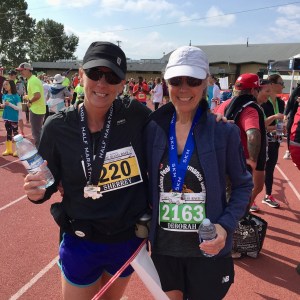
Sherrey and Deb, post-race

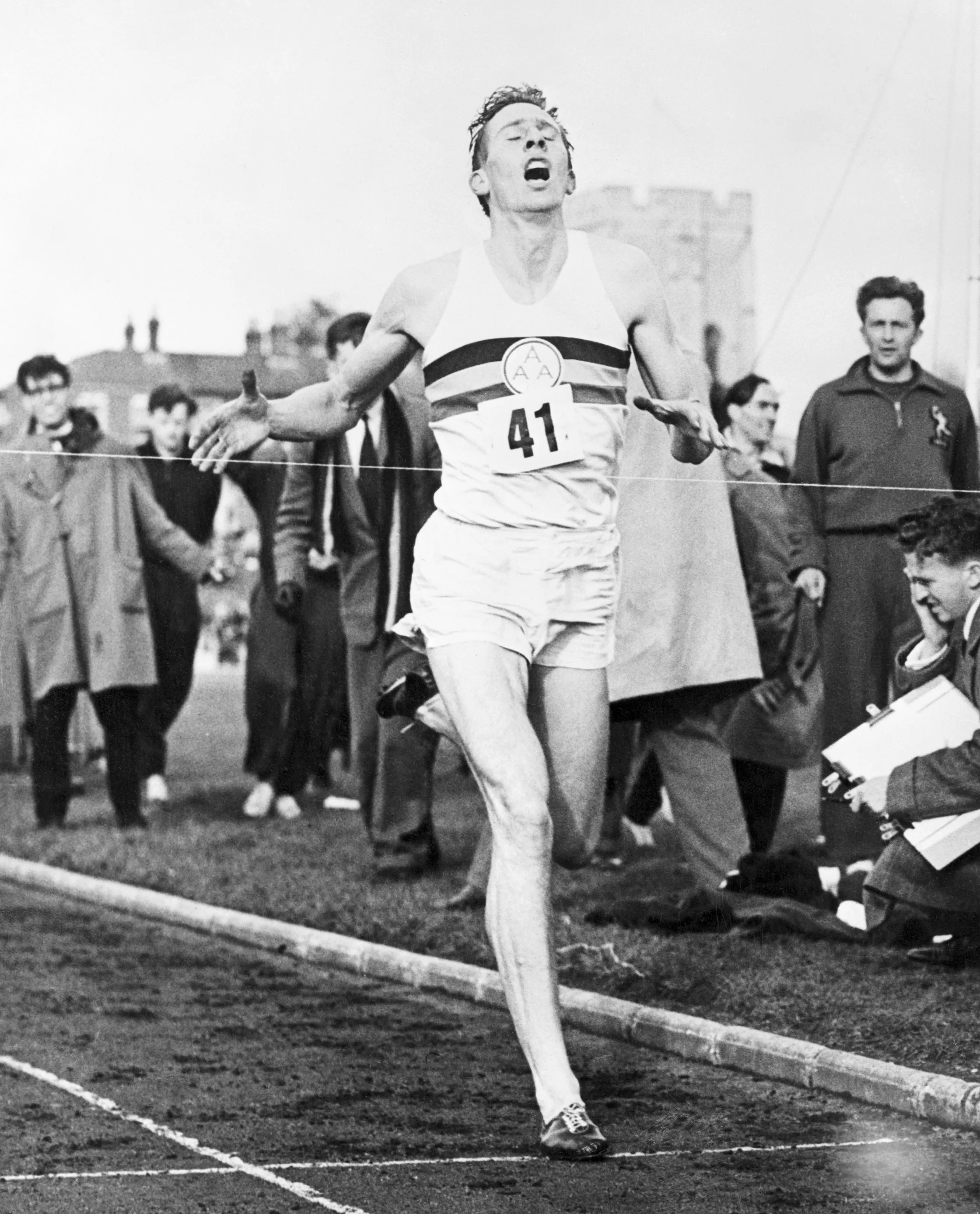
A recent track racing milestone got me thinking nostalgically about GAP 1.0. It was on May 6, 2024, the seventieth anniversary of Roger Bannister’s four-minute mile breakthrough on the Iffley Road track in Oxford, England.

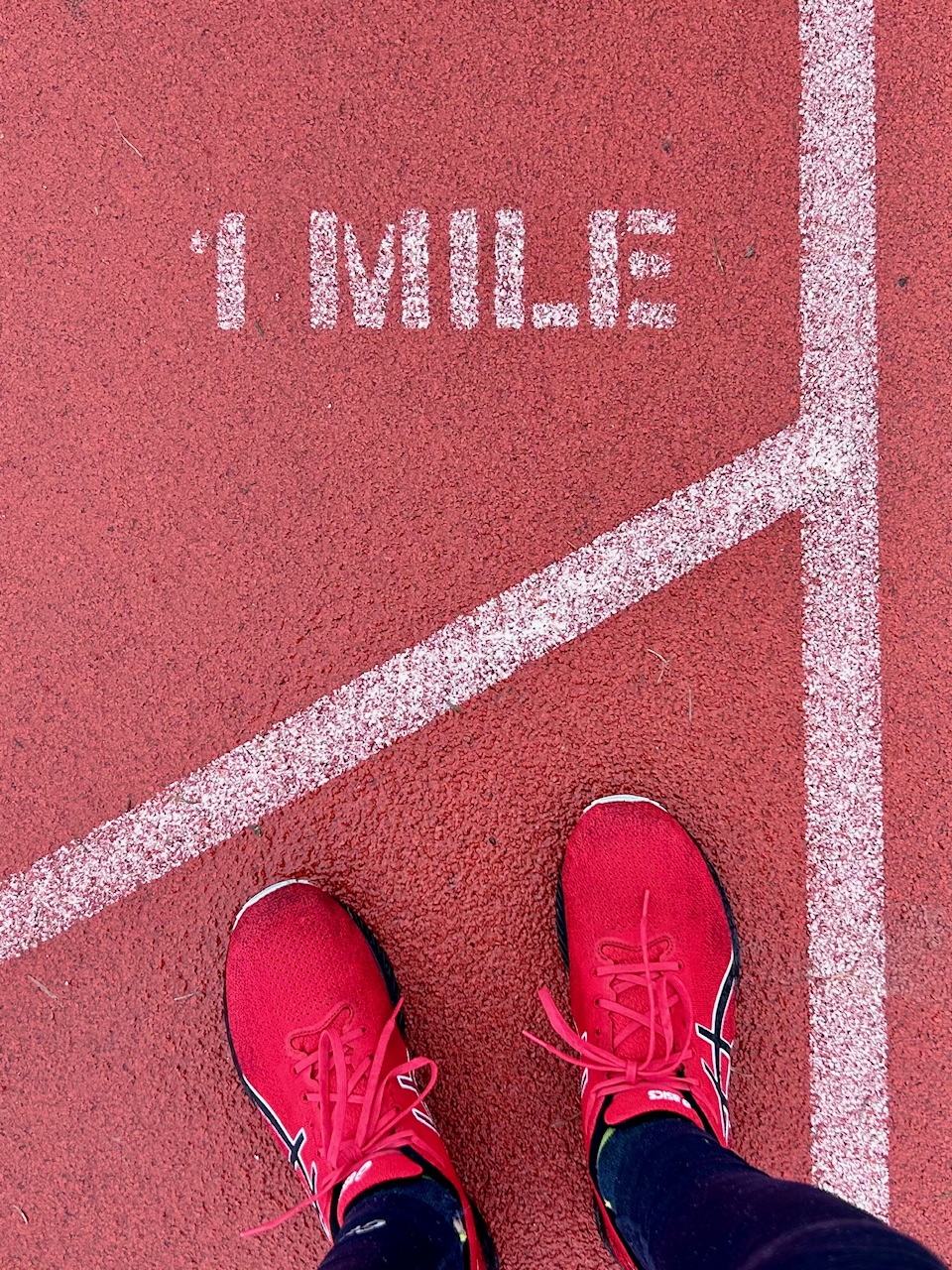
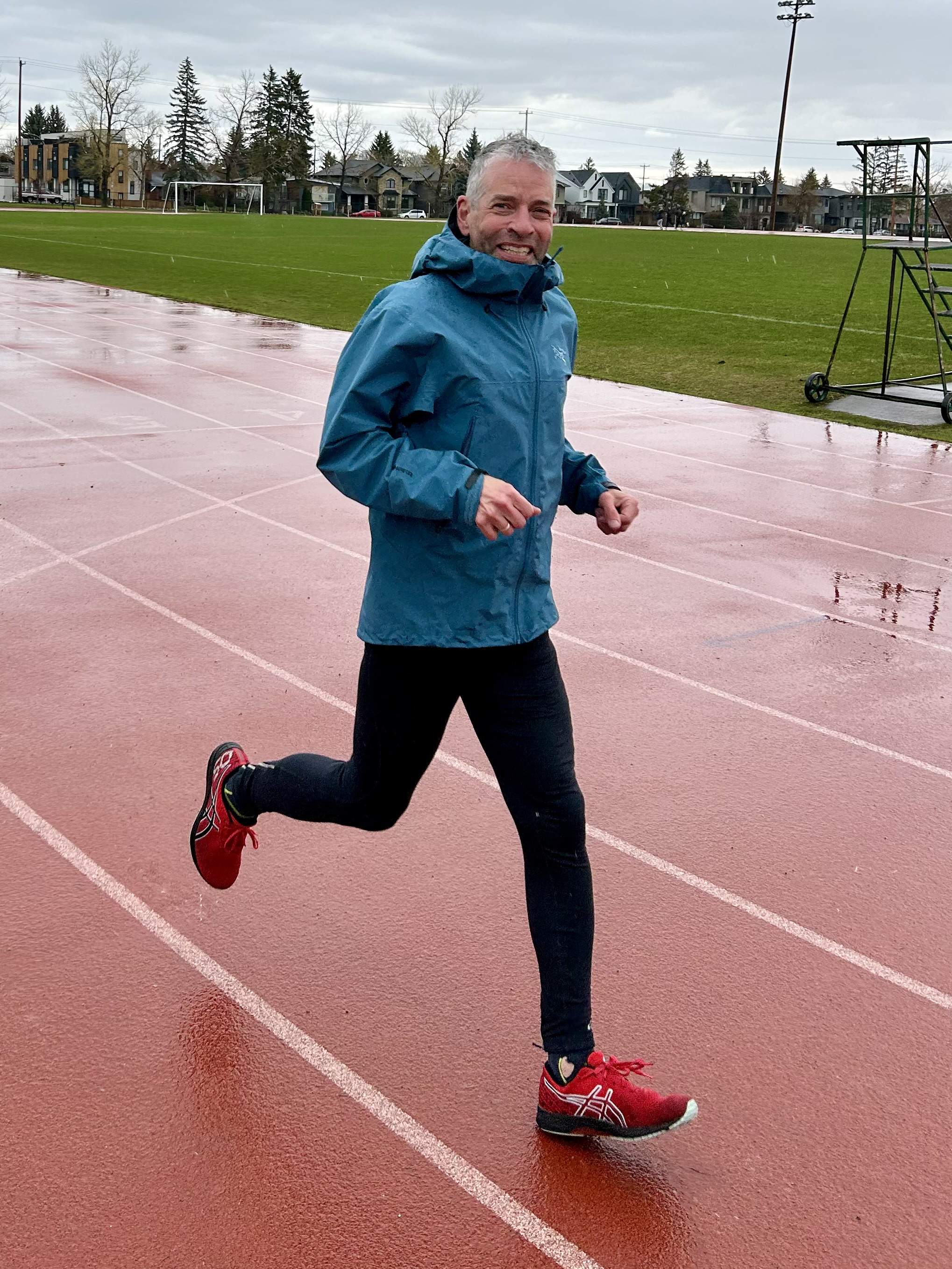
It seemed fitting to make a brief pilgrimage, in pouring rain, to run four ceremonial laps in honour of this great achievement. After all, the GAP track is only 10 years younger than Bannister’s record. I pointed out the significance of the day to a young athlete who had just finished his track workout. He gave me a polite but puzzled smile. I secretly wished for him to do the same on the hundredth anniversary in 2054, running his commemorative laps on the new track. 

In closing, I have many fond memories of running on the GAP 1.0 track. I don’t know what lies ahead, but if they do tear it down I’ll miss that familiar red surface, flaws and all. For years, it has been a great venue and meeting place for runners. It’s one of my favourite spots in the city.

So here’s to a good run for a fine old facility! And here’s to GAP 2.0… can’t wait to try out “big blue”.

Until next time, be well and BE FAST!