Hello Vancouver!

CALL Health and Wellness Speaker Series

I’m thrilled to announce an upcoming event with the Calgary Association of Lifelong Learners. I’ll be doing a presentation of my memoir on September 22, 2025, at the Varsity Acres Presbyterian Church. See the details below.
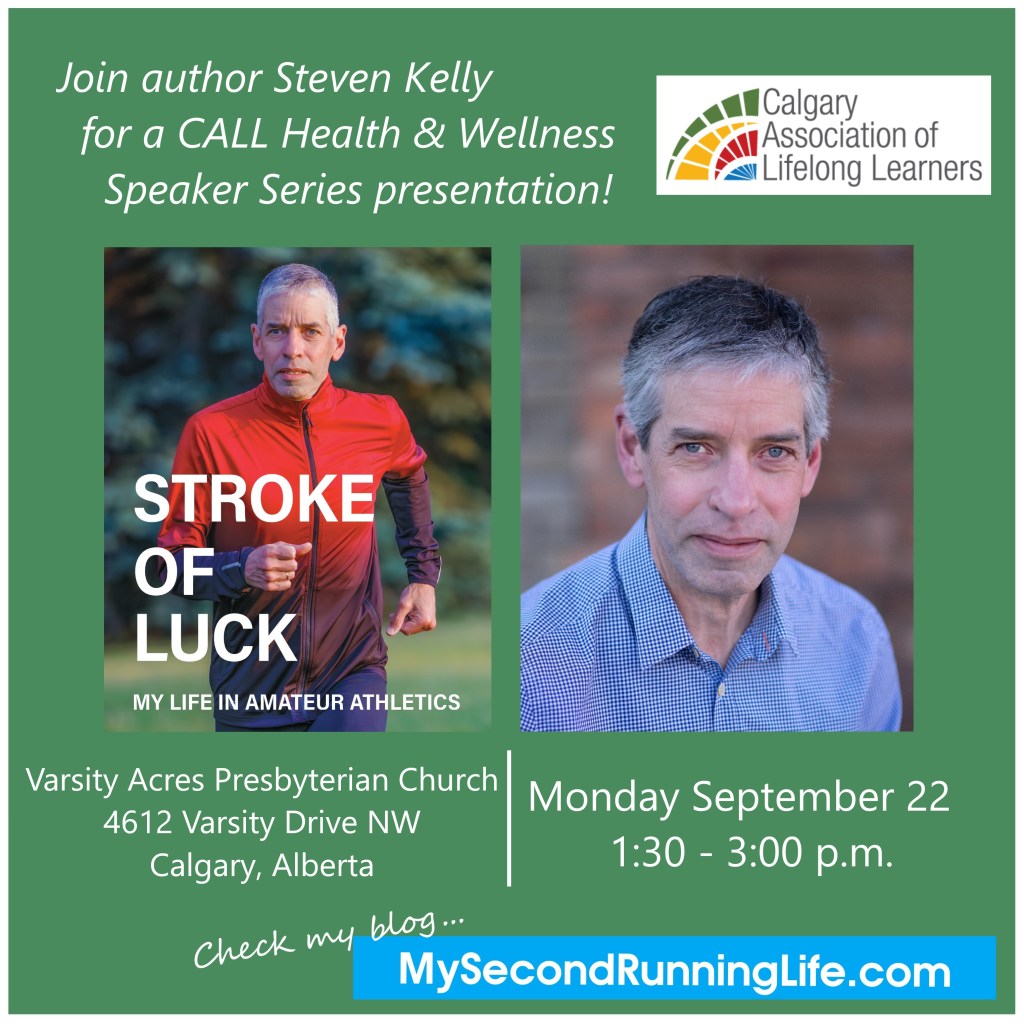
The Calgary Association of Lifelong Learners (CALL) is a member-led, non-profit organization. Their mandate is to facilitate lifelong learning for residents of Calgary and area. Programs and activities are wide-ranging, focusing on arts and culture, society and politics, and health and science.

My presentation will be part of CALL’s Health and Wellness Speaker Series. I look forward to telling the story of my lifelong connection to the great sport of athletics and my recovery from a series of strokes in 2017. As my regular readers will know, I wrote about running, health, and recovery in Stroke of Luck: My Life in Amateur Athletics. The opportunity to meet with groups and clubs is by far the best part of this project. I’m gratified to be able to share my main messages:

  • The importance of an active lifestyle
  • Awareness of the full range of stroke symptoms
  • Raising funds to support the lifesaving work at the Foothills Stroke Unit

If you are interested in joining us on the 22nd, or if you’d like to find out more about CALL, please reach out to them here. I hope to see you then!

A Quick Visit to Vancouver

Our vacation planning this year has been somewhat ad hoc. That’s resulted in a series of short trips to some unexpected locations: Moose Jaw, San Diego, and Edmonton. But rather than being a problem, it’s been an opportunity. So much so that we are looking forward to doing more of the same in the months to come.

Last week, we decided to make an impromptu, short trip to Vancouver. There’s never a bad time to visit Vancouver, but our timing was especially good. We were in the city for two perfect days. While most of our trips to the city in the last few years have had us staying in Kitsilano or Yaletown—both fine locations—we opted for downtown this time. 

Deb suggested that we stay at the new Azur Hotel on W Pender Street. The Azur is one of the Leading Hotels of the World, and she was curious about it. We’ve enjoyed stays at several LHW hotels—the Azur is one of only a few in North America. It was a great decision. Everything about our stay was excellent. The hotel feels quaint, and it exudes style. The staff were amazing. They treated us like royalty. The amenities were excellent, and the included breakfast was delicious. 

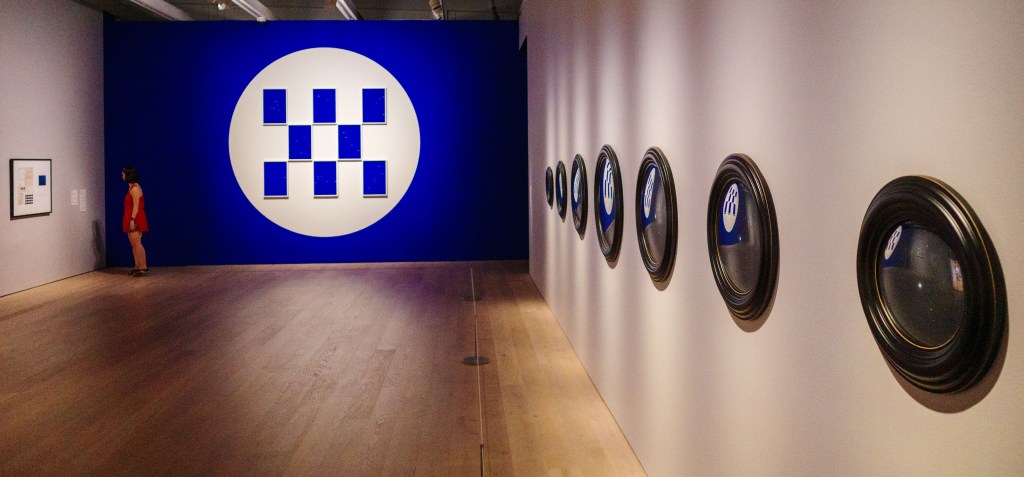
We enjoyed walking through Gastown and along the waterfront at Canada Place. Of course, watching the Harbour Air seaplanes taking off and landing is always fun. We took the SeaBus across Burrard Inlet to North Vancouver and checked out the latest exhibits at the Polygon Gallery. We both thought the large-scale astronomical photographs by Thomas Ruff, a German photographer, part of the current Star Witnesses exhibit, were a highlight.
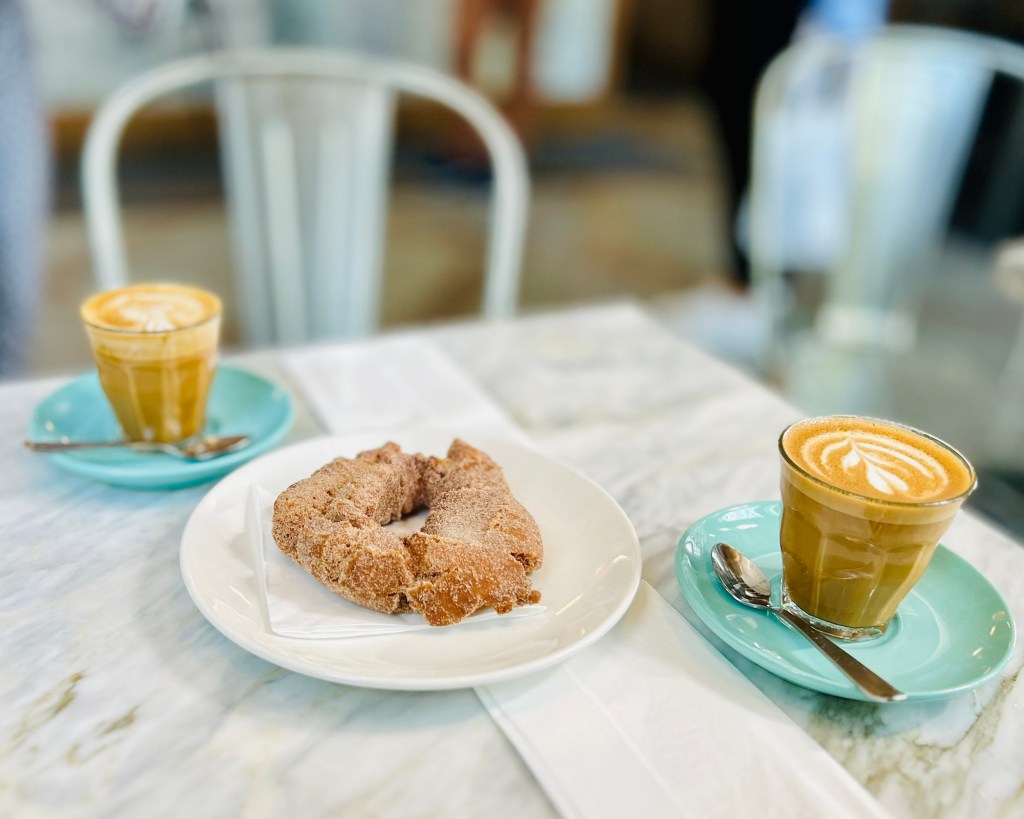
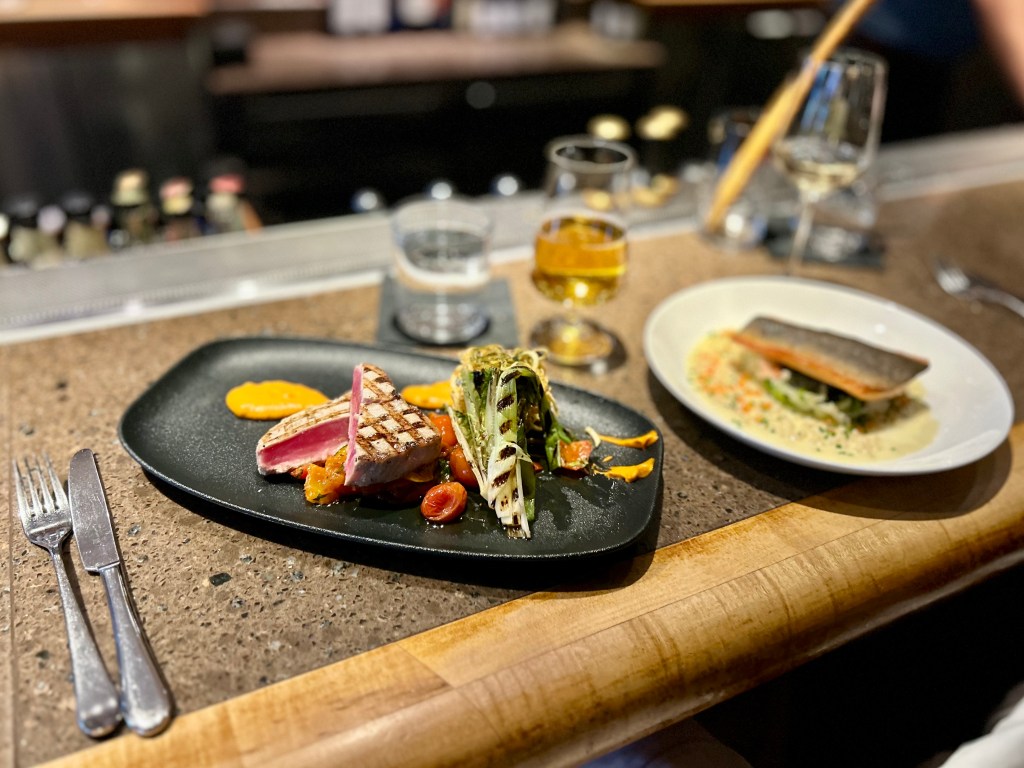
Food and drink? Well, you can’t go wrong with a coffee and doughnut from the 49th Parallel cafe on Thurlow, so we did that. And for dinner, we enjoyed a meal at the bar in the Blue Water Cafe in Yaletown. I had the Yellowfin Tuna, and Deb chose the Arctic Char. Both were delicious.
Some Vancouver Street Photography

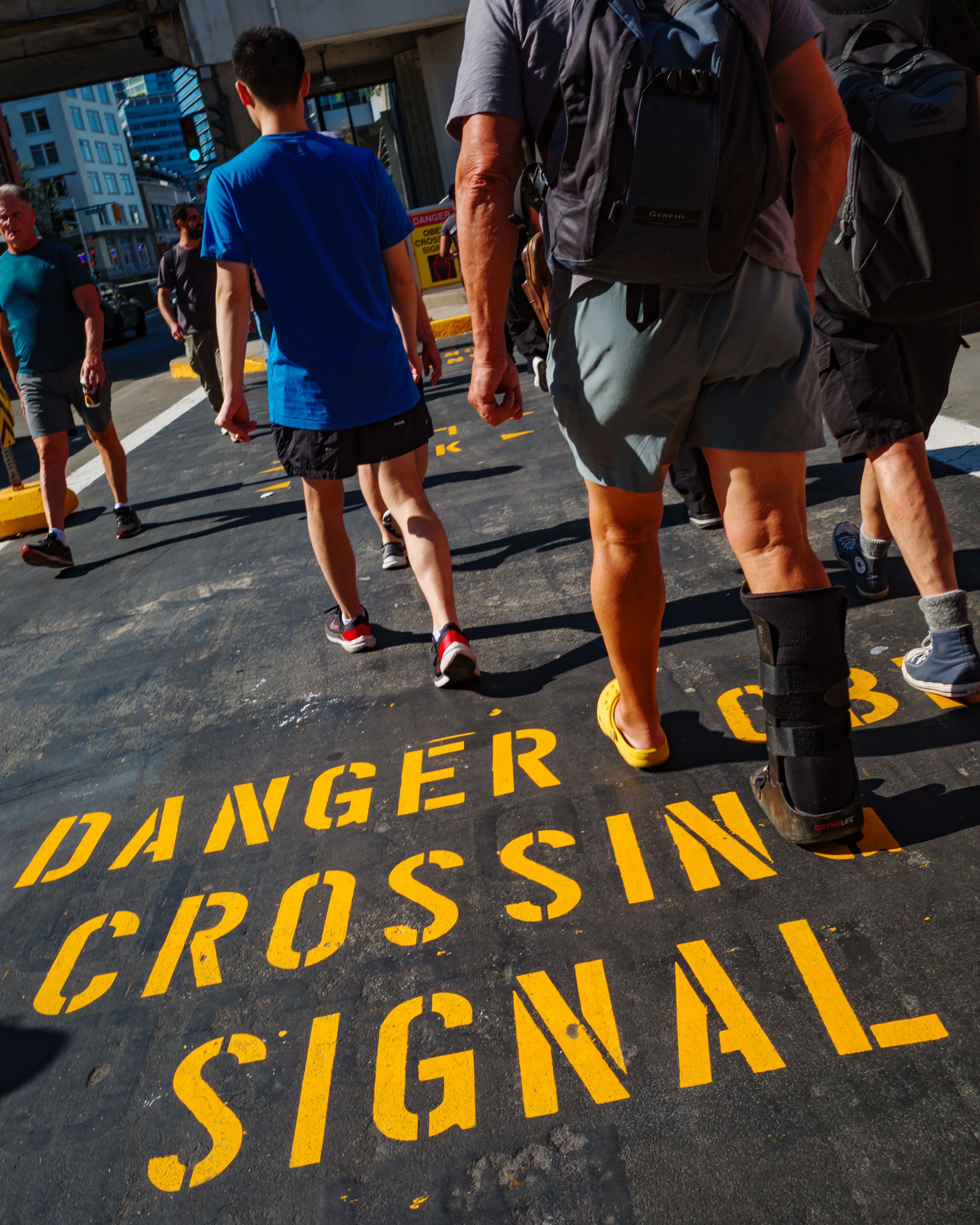
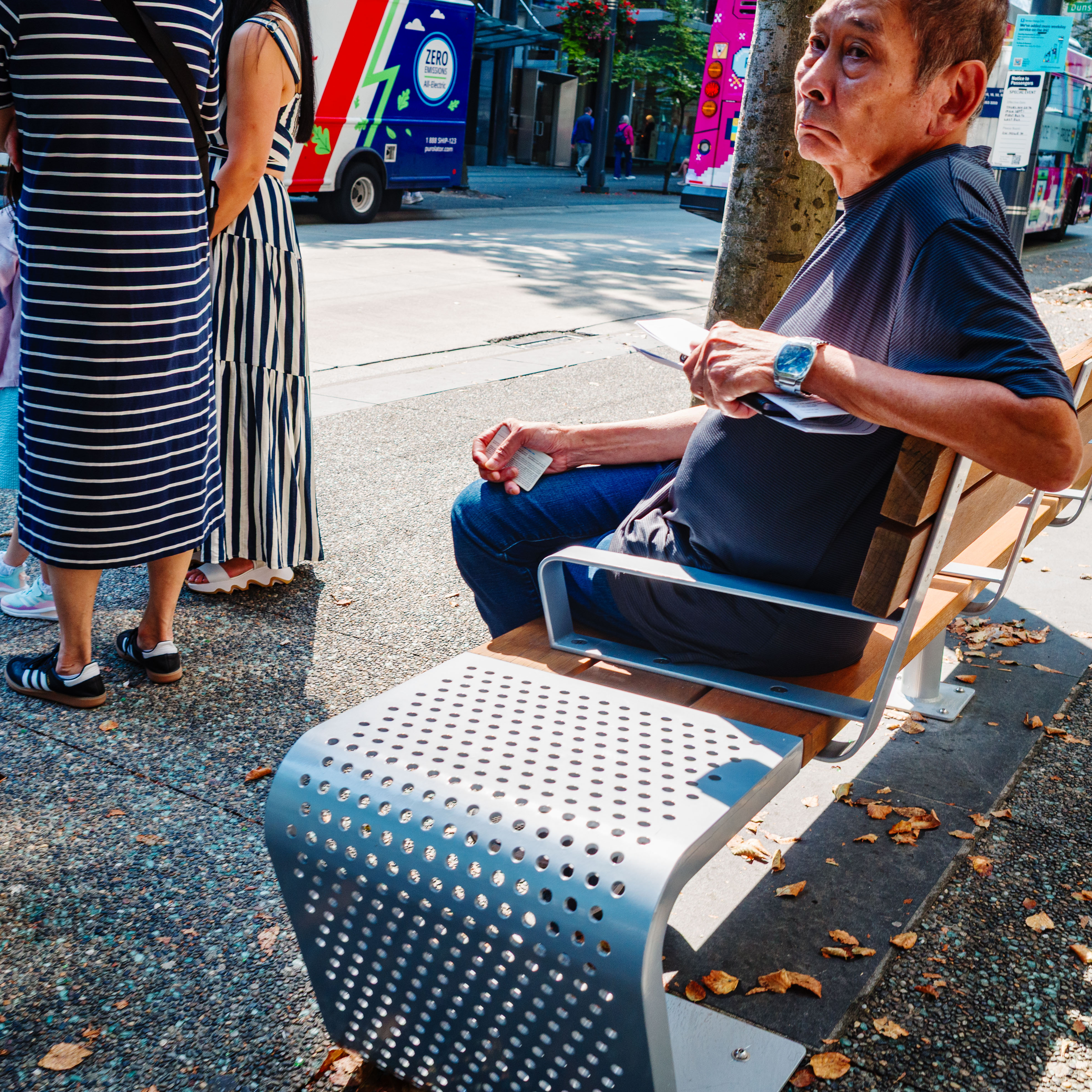
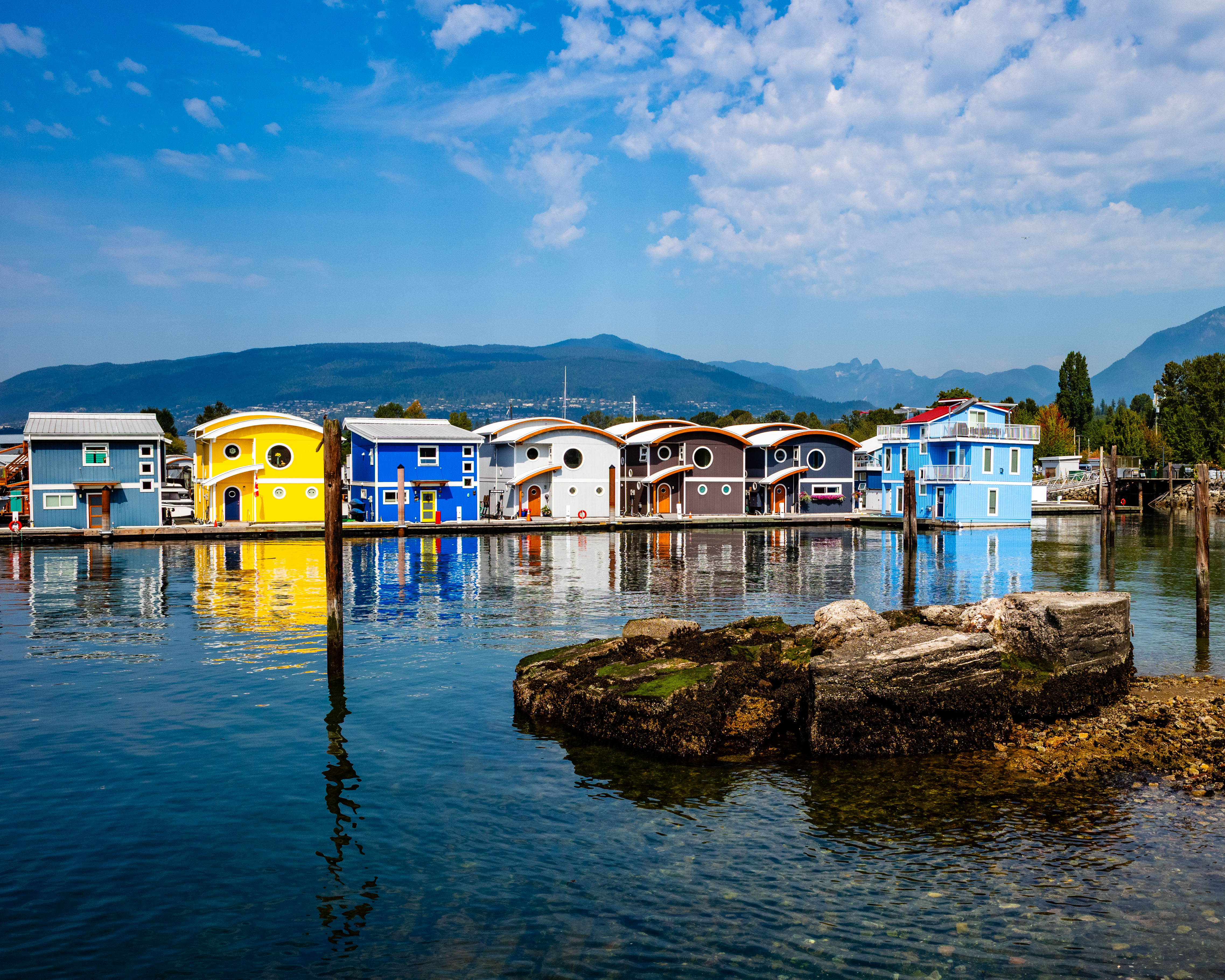
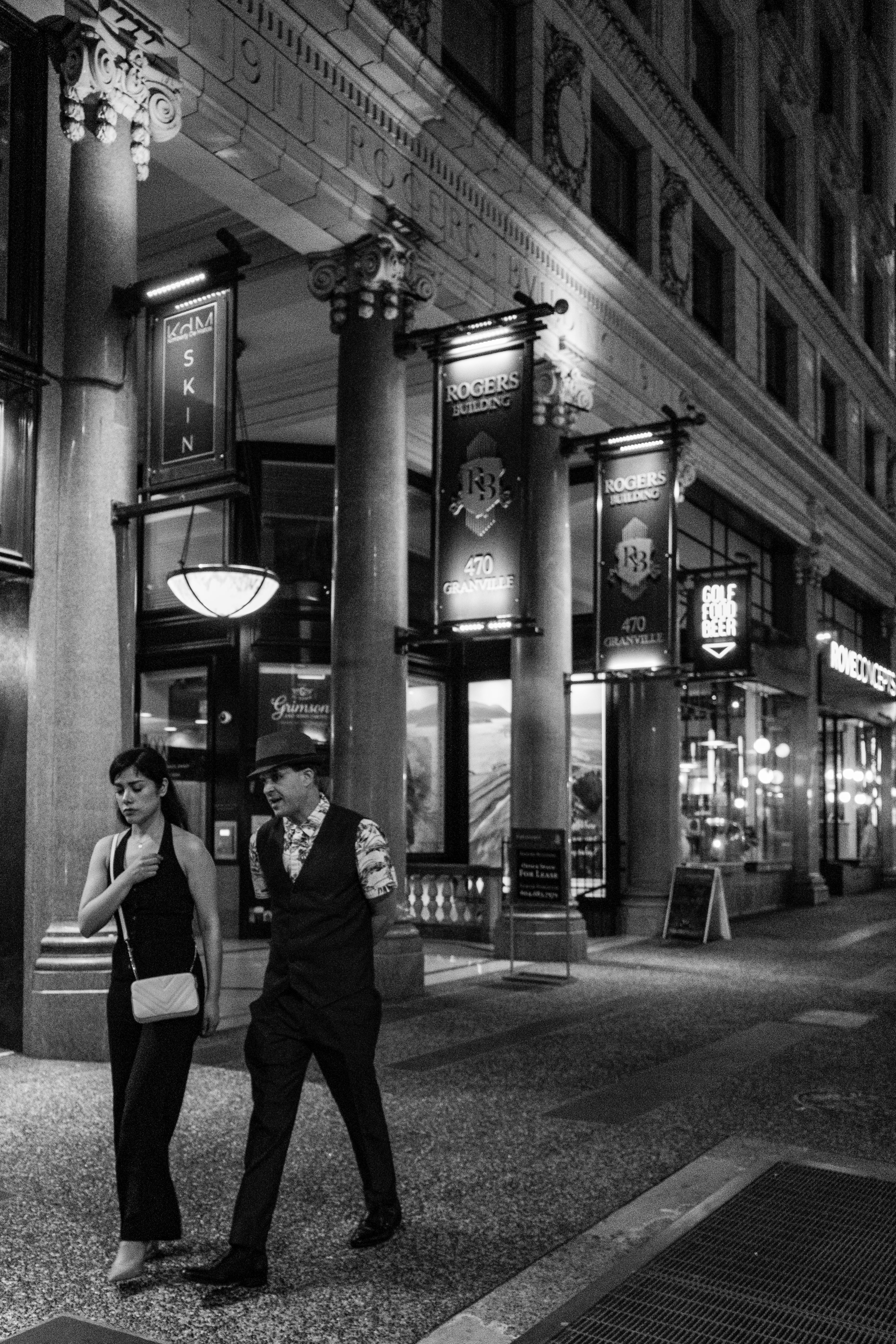
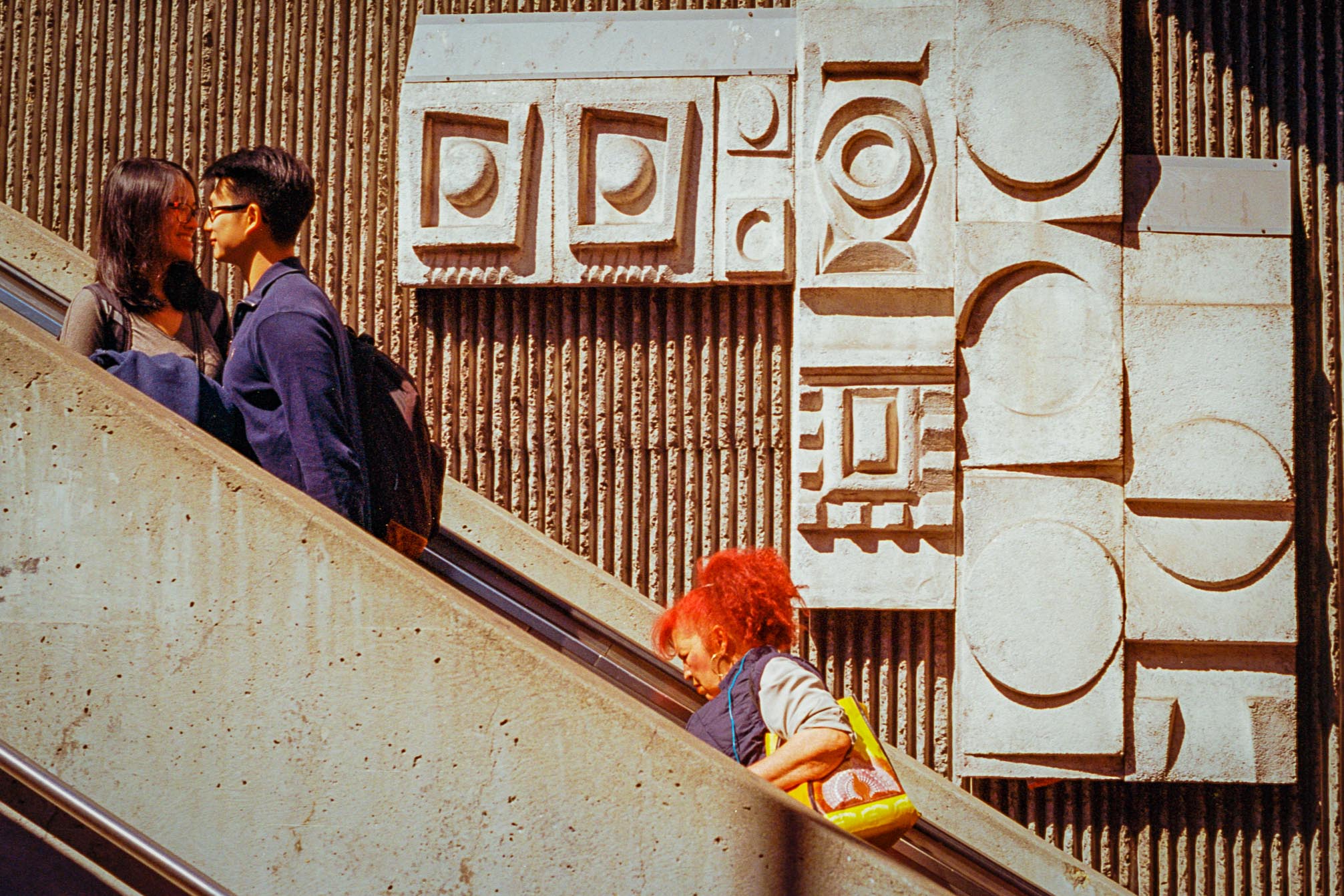
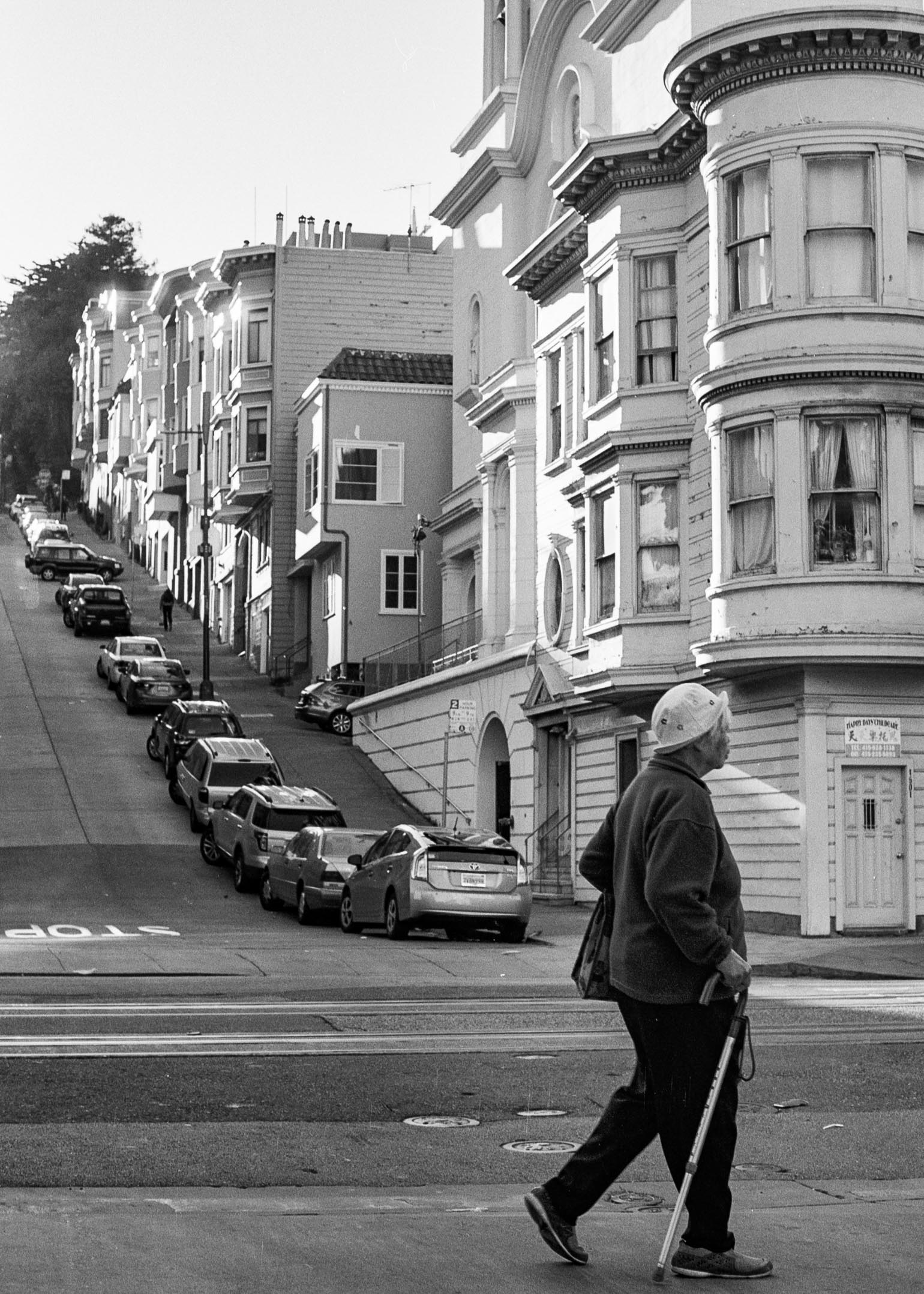
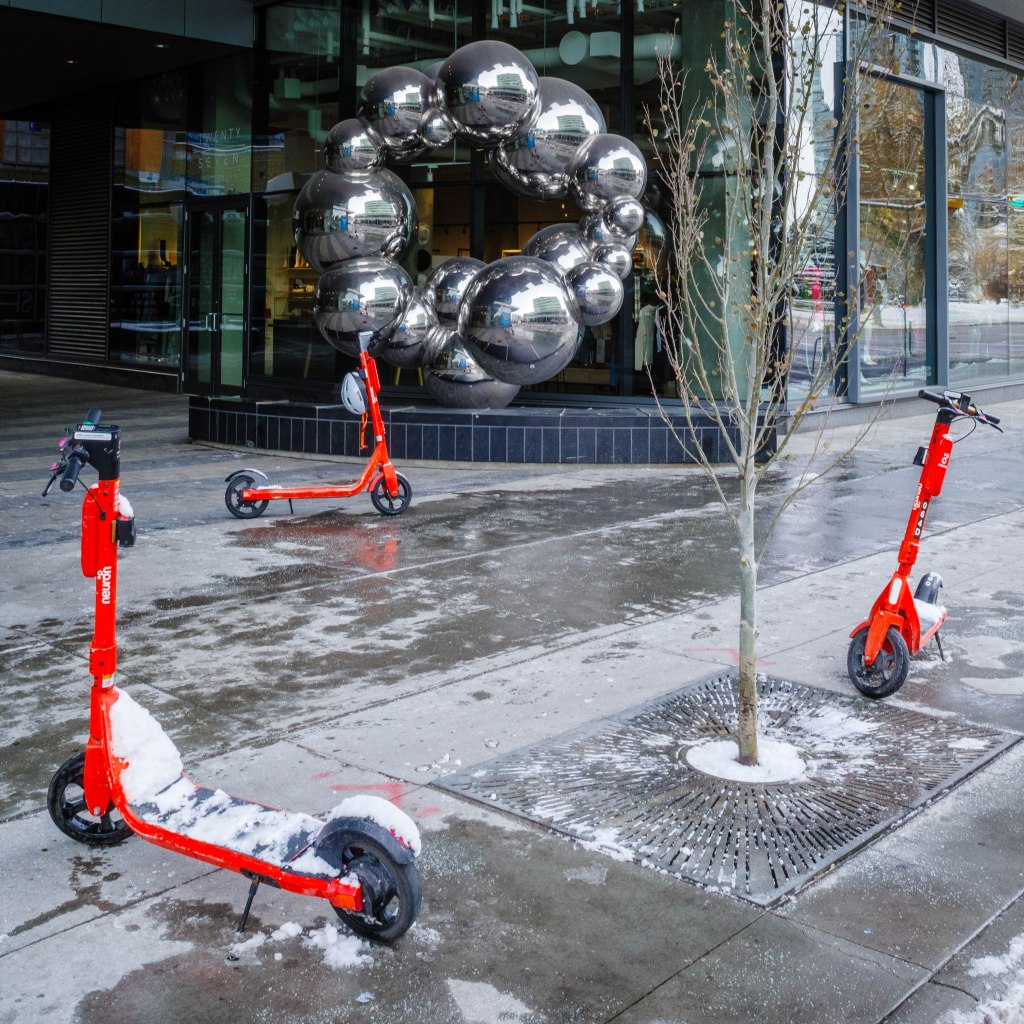
Now, it wouldn’t be an outing worth talking about if there weren’t a few photos to share. With my trusty Ricoh GR III in hand, I caught the occasional street scene. Here are some examples:
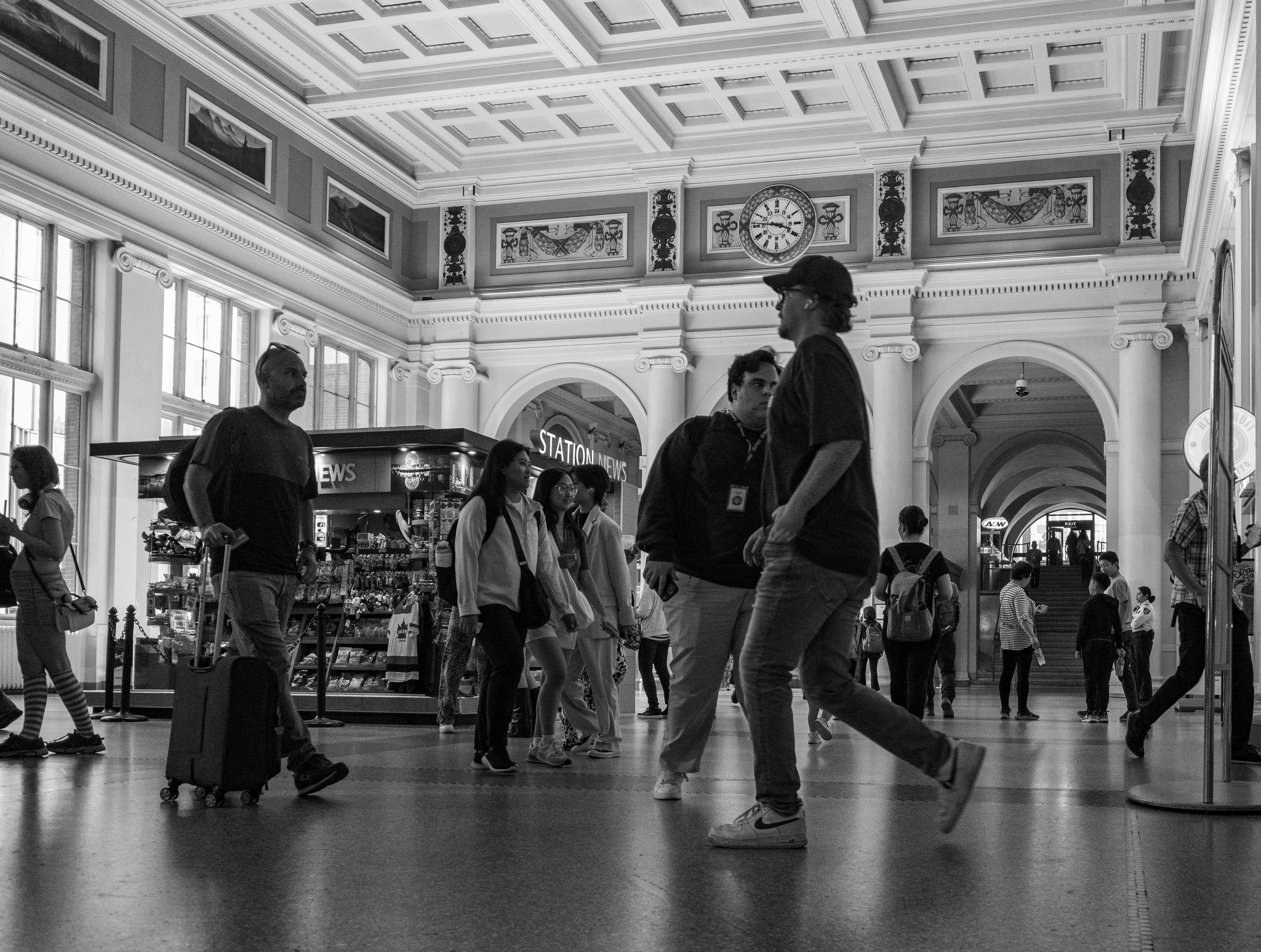
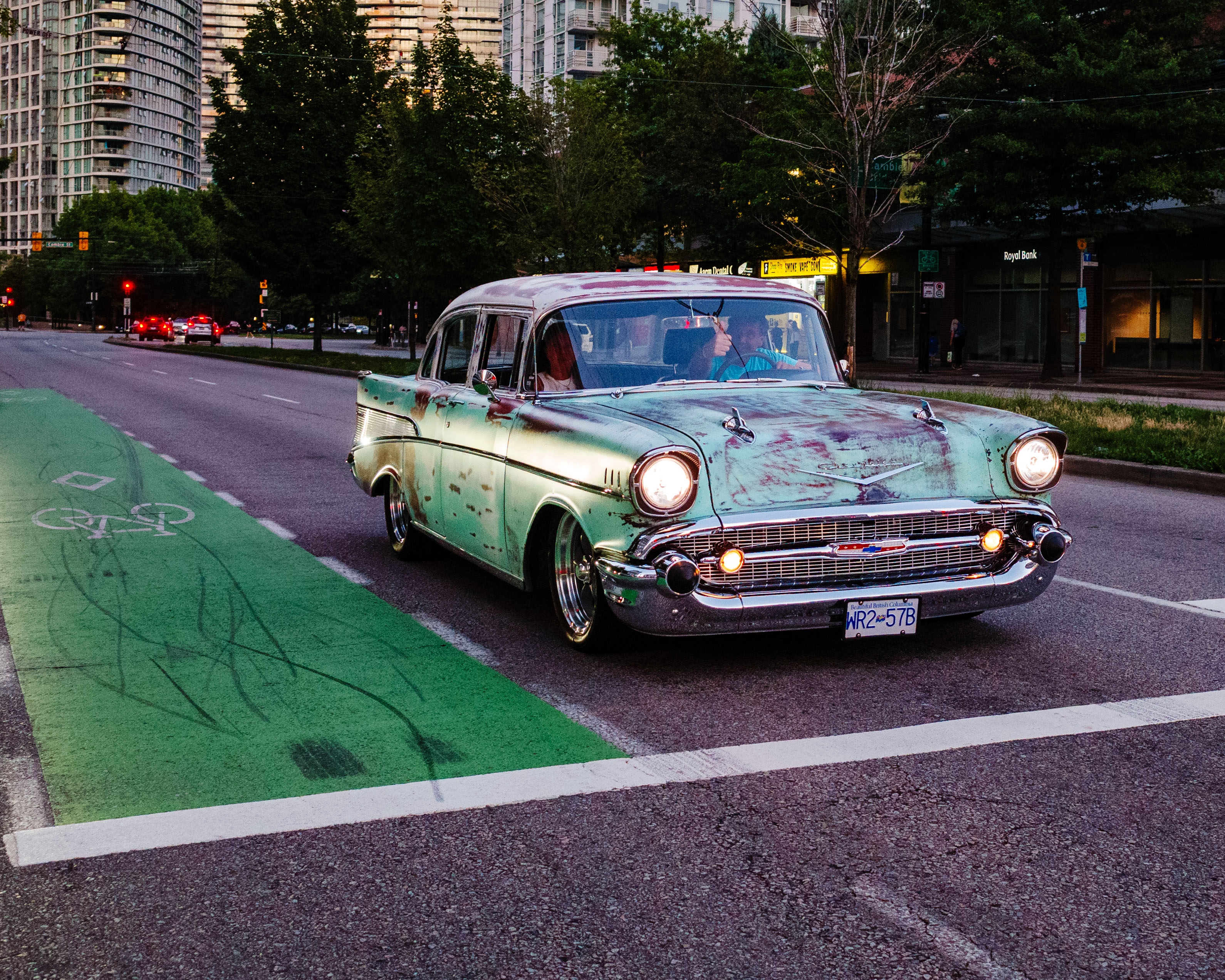
When we’re in Vancouver, we always think about Fred Herzog. For those who aren’t familiar with him, Herzog was a Vancouver-based photographer, active in the 1950s and 1960s. He’s one of our favourite photographers, and a source of inspiration when I’m walking the streets of Vancouver. Herzog mainly shot with a Leica rangefinder using Kodachrome colour film, and his photographs reveal much about the character of the city during that era.

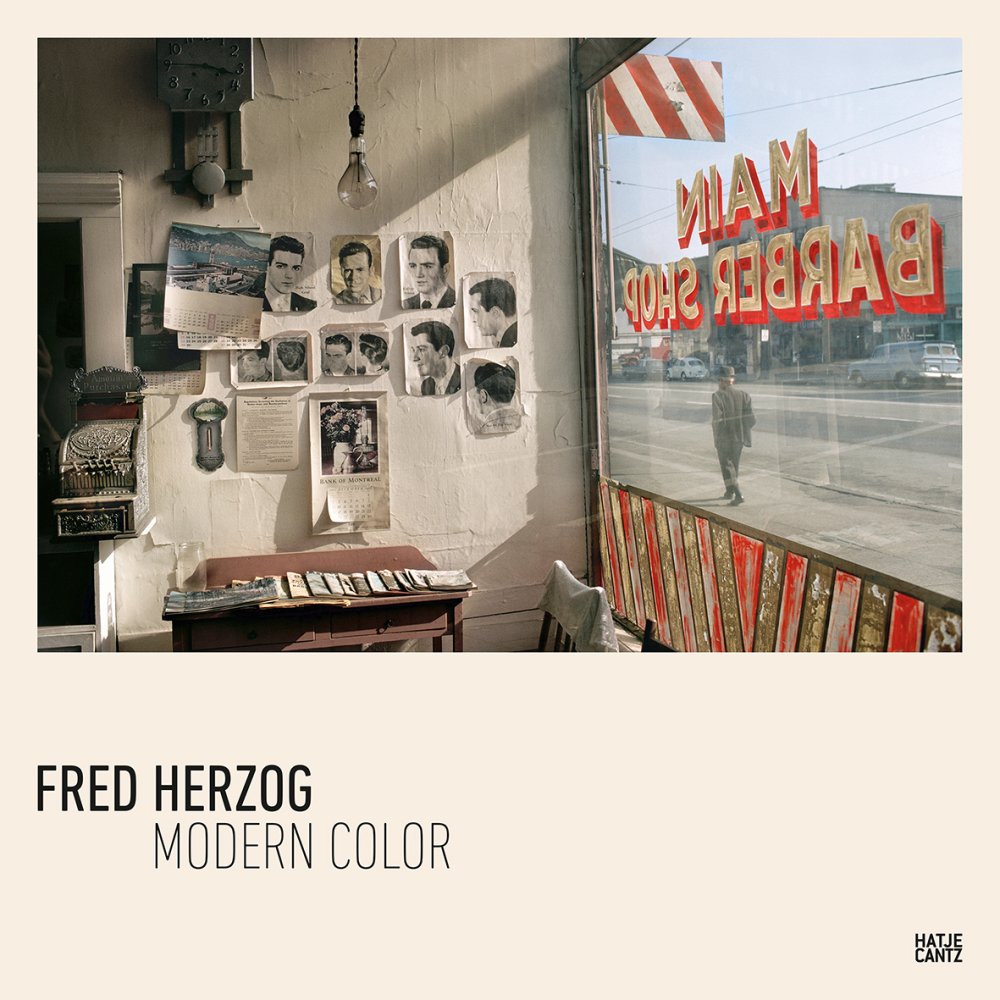
Although it isn’t fair to say Herzog was unknown during his lifetime, his work is really only getting the credit it deserves now. That’s due in large part to the efforts of the Equinox Gallery in Vancouver and the Trepanier Baer Gallery in Calgary. Here’s the cover of Fred Herzog: Modern Color. It’s a superb collection of Herzog’s photographs, published in 2017 by the Equinox Gallery. The image on the cover happens to be my favourite Herzog photograph.
This gives me an idea for a new blog series: My Favourite Photographers. I think Fred Herzog will have to be my first subject. Look for that soon! 

While writing about the GR III, I’ll mention that Ricoh has just announced the GR IV (and discontinued the GR III). I’m definitely interested, although it might be said that on first glance, the specs are only marginally better than my current one. That said, my camera is now four years old, and I’ve noticed that it seems to have accumulated a lot of dust on the sensor. This problem is a known issue for the GR III. I thought I had avoided the problem until I looked closer at my shots from Vancouver. I probably shouldn’t be surprised, given how I handle (mishandle?) this camera on my photo runs. C’est la vie!

On that note, I’ll sign off. Thanks for reading. Until next time, be well and BE FAST!

In Praise of Japanese SLR Cameras

This is a totally useless piece.

Useless, that is, if you carry a camera around with you at all times, one that is instantly available in your cell phone. Or if the link between your camera and your social media accounts is as short and quick as pressing a button. 

Some of us have a broader definition of a camera, or think of photographs for something more than their transient value.  

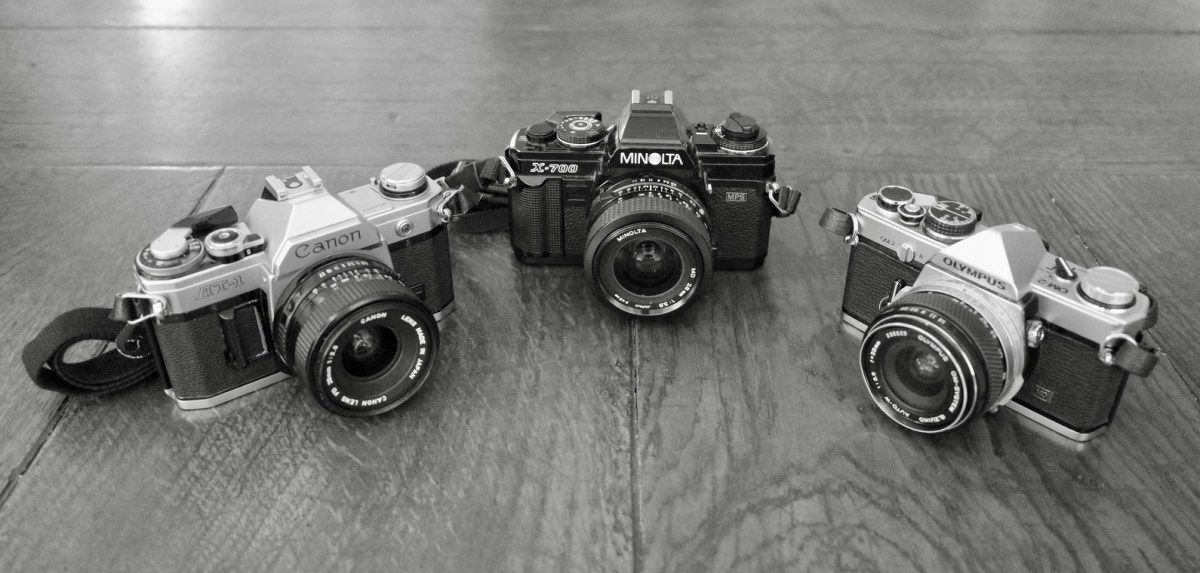
My collection from the heyday of Japanese single-lens reflex (SLR) film cameras is a small treasure. It’s unbelievable these cameras work so well after 40 or 50 years. They are flawless machines. Sure, there are foam seals I should replace. And some of the batteries are getting hard to find. But overall, they’re doing better than I am after all that time! 

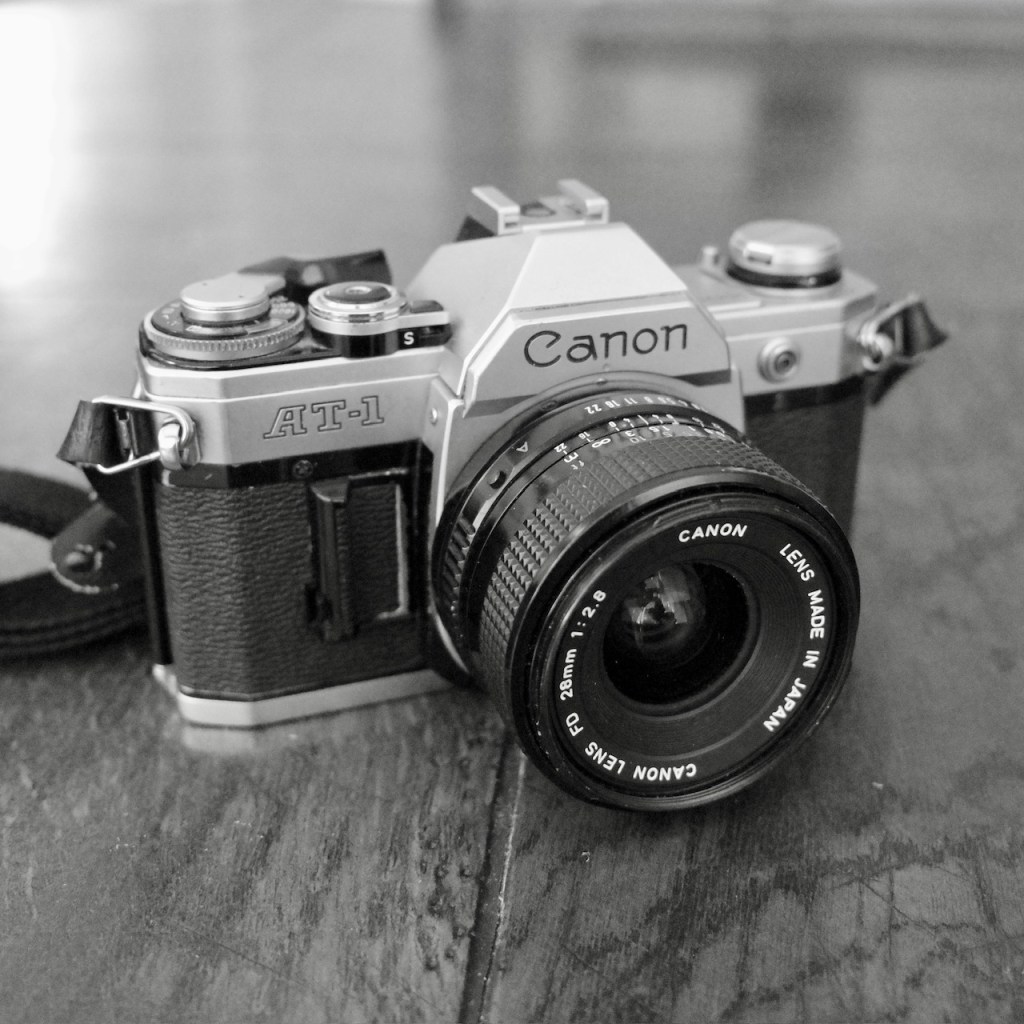
Canon AT-1

The Canon AT-1 invokes many fond memories for me. I bought mine in 1978 with savings from my first job. My aunt Connie worked at the Sears store in the Centre Mall in Hamilton, and she made the purchase so I could benefit from her employee discount. I remember paying $265. It’s odd to think that Sears used to have a photography department… but I digress.  

When I bought the AT-1, I didn’t know anything about cameras or photography. I learned the basics of shooting film—metering exposure AND focusing in a completely manual camera. (The AT-1 was never as popular as the automatic variant, the AE-1, but I was on a budget.) Once you’re used to it, manual metering is simple. It’s a bit like target practice: move the exposure needle by changing aperture and/or shutter speed until it lines up with another needle indicating the measured light. Like learning to drive a car with a manual transmission, this is a good skill to have!

Manual focusing brought its own challenges, especially if you were keen on shooting sports, as I was. Sure, I missed plenty of shots, but I also felt the thrill of getting many more.  

The AT-1 feels solid, and its viewfinder is big and bright. Canon FD lenses mount to the camera with a secure metal ring. Because it was my first camera, I’m biased towards its controls, which are accessible and well laid out. I will admit, it now feels slightly bulky compared to the other cameras in this review. 

For years after I bought the camera, I pored through photography books and magazines. When I could afford it, I added lenses to the f1.8/50mm that came standard with the camera. For a short time, when we lived in Edmonton, I even set up a darkroom in my basement. I give this humble camera a lot of credit for instilling in me a lifelong interest in photography.  

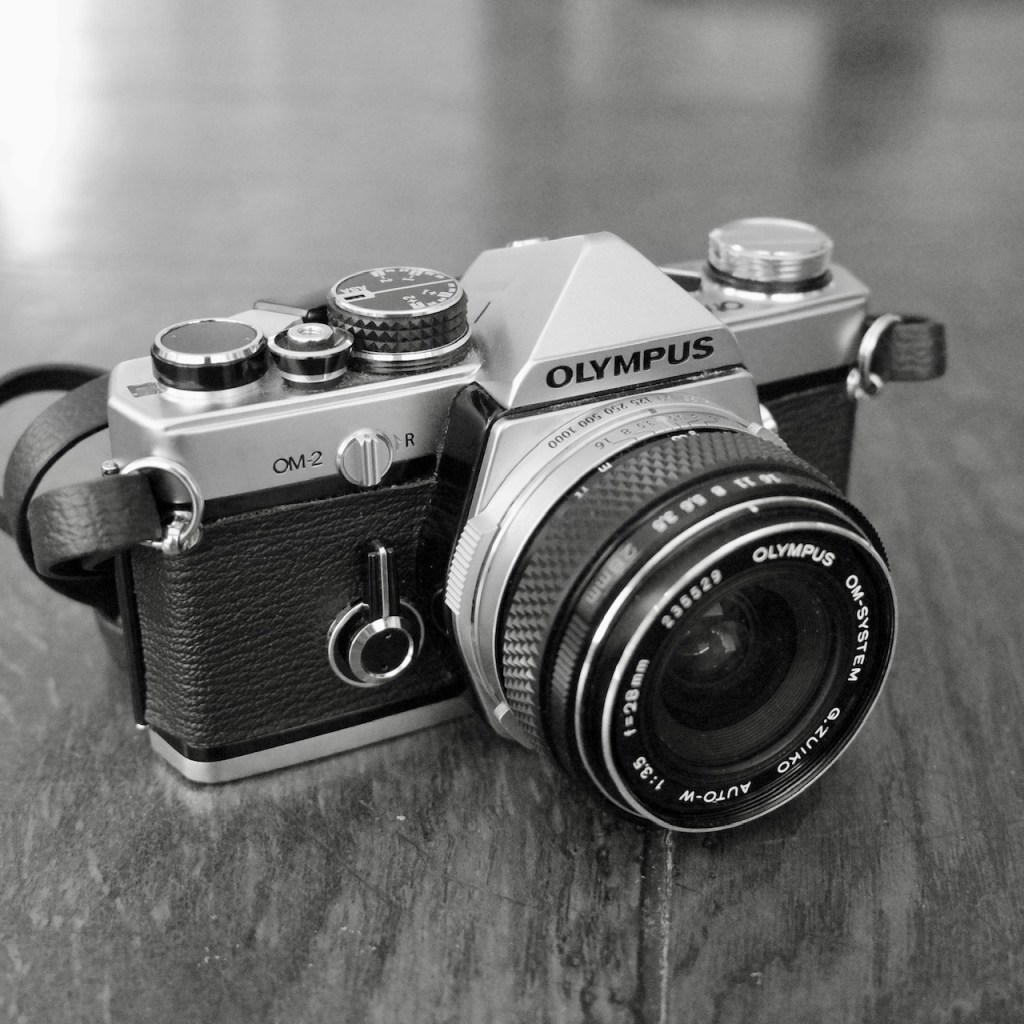
Olympus OM-2

I ended up with a parallel camera kit to my own after my father-in-law Kurt’s passing. Where I was invested in Canon, he was an Olympus guy. His outfit was built around the Olympus OM-2, a highly regarded automatic camera manufactured between 1975 and 1988. I also inherited several lenses. 

Kurt and I shared our experiences; mine with Canon and his with Olympus. He used the OM-2 a lot. He was a stickler for getting composition and lighting just so. Naturally, I think of him every time I pick up the camera.

The first and most impressive feature about the OM-2 is its small size. It’s light but doesn’t feel cheap. The OM cameras were designed by Yoshihisa Maitani, something of a legend in photographic circles. The OM-2 is noticeably smaller than the AT-1. I can see there were some compromises to make the camera and lenses so compact. For example, the aperture has only full steps rather than half steps. While I like the way the camera feels in my hands, I do find the controls slightly cramped.

From my experience, the OM-2 is close to perfect. It has a bright viewfinder and some novel features. It can be operated in Aperture Priority mode or manual mode. Did I mention I like shooting in manual mode? (I admit it’s great to have the option of setting the aperture and letting the camera do the hard work.) 

My only quibble with the OM-2 layout is that the shutter speed dial is next to the lens barrel, rather than on top of the body. I find that illogical. Or maybe it’s just different than the setup on the AT-1 (or most other SLRs). 

The OM-2 is very accurate when metering a shot. I mainly shoot B&W film with it, and I am always impressed by how well the lenses render urban scenes and street shots.

The Olympus name has mostly disappeared—it was absorbed into the “OM System” brand five years ago. Let’s call it a casualty of the cellphone camera trend. Even so, the OM-2 has earned a special place in my collection. I hope it keeps working as long as I do. 

Minolta X-700

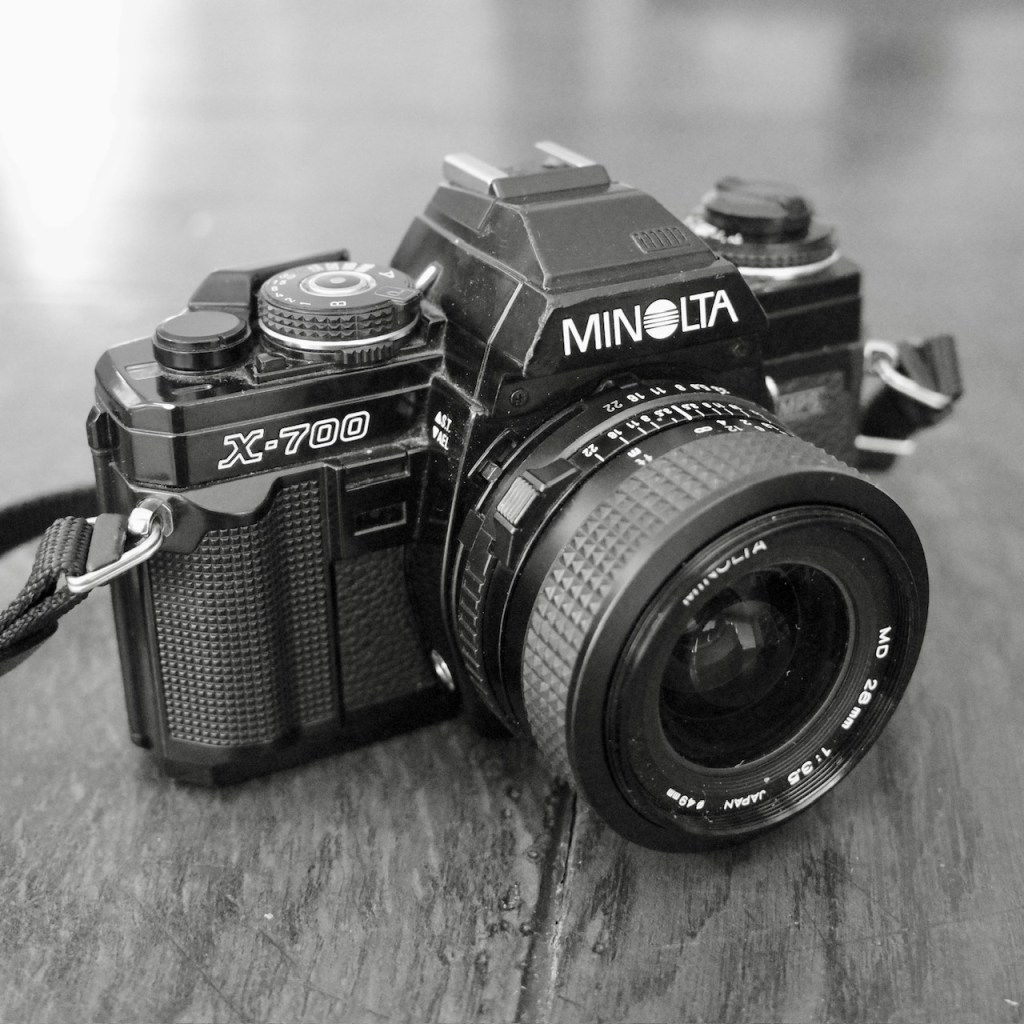
The Minolta X-700 is another small miracle. This particular one belongs to Deb. She got it from her parents as a Christmas gift. She used it for a few years, then it was relegated to a closet. Dan dusted it off for a school photography course when we lived in England. I remember buying him a 28mm lens to go with the original 50mm lens. 

The X-700 was the pinnacle of Minolta’s manual focus SLR line, and it was very popular. It was manufactured between 1981 and 1999, which is a long production run. The features of the X-700 are impressive. In addition to manual mode, it has Aperture Priority mode and a Program mode that integrates with Minolta MD lenses. It’s got a compact shape and it’s very light. The LEDs in the viewfinder are genius (with one downside). 

In my research for this piece, I learned that Minolta used plastic for some components of the camera. That goes some way to explaining its weight, and also why the camera feels less substantial than the other two in this piece. It’s also noisy when the shutter is activated. It’s worth remembering that by the mid-1980s, the SLR market was crowded, if not saturated, and autofocus cameras were starting to hit the market. No doubt that would have detracted Minolta’s attention away from their manual focus line. 

To this day, the X-700 remains a great camera. I like the feel of it in my hand, and that isn’t a coincidence. Size-wise, it fits in between the Canon and the Olympus. 

My main beef comes when using the X-700 in manual mode, where the user gets shutter speed information in the viewfinder. Why is that a problem? Well, the same LEDs I mentioned force the user to look away from the subject to see and adjust the shutter speed. It’s fine for landscapes or other static subjects, and fortunately, one can always switch into Aperture Priority mode and fire away. 

By the numbers

For what it’s worth, I did a few measurements… here are the bare facts:

Canon AT-1Olympus OM-2Minolta X-700
Weight, grams
(w/28mm lens)
780715690
Size, cm
(W x D x H)
14.5 x 10.0 x 9.013.7 x 8.3 x 8.314.0 x 9.5 x 9.0

Wrapping up

So, the obvious question… which of these cameras/systems do I like the best? That’s a tough question. If I had to choose one, it would be the OM-2. I’m a fan of small and light cameras, and this one definitely delivers. That said, I like each of the cameras for different reasons. You can tell I have emotional, physical and intellectual attachments to these marvelous machines. That’s why I make it a point to include all of them in my rotation. For me, there’s no better feeling than loading a manual SLR with a favourite film (or a new one) and heading out for a photo walk. As long as they keep working—and they are so well made, there’s no reason to expect them not to do so for a while yet—I’ll happily reach for one.

Until next time, be well and BE FAST!
Streaking through December

The pressure has been building for three weeks already. It’s nothing serious, mind you.

For the last few years, the arrival of December has meant the start of the Strides Run Streak, hosted by our wonderful neighbourhood running store. The parameters of the challenge are simple: run at least a mile a day for the full month. It’s wildly popular with the locals, including Deb and I.

I do have some history with this challenge. In 2012, I started running on December 1 and turned a one-month goal into a multi-year streak. That particular streak, which didn’t end well, isn’t the point of this post. You can read all about that adventure in my book, Stroke of Luck: My Life in Amateur Athletics. (By the way, if you hurry, you can still get your copy in time for Christmas, either at Owl’s Nest Books or directly from me. Thanks to all of you who picked up a copy. Much appreciated!)

This year’s streak has brought the usual mix of weather and physical challenges. Pathways have been notoriously icy. I’ve been dealing with a nagging calf issue lately, which fortunately seems to be on the mend. It’s looking promising that I will get through the month.

As has become my custom, I’ve added to the challenge with a photographic element. I look for a memorable photo during each run. That can be a tougher goal than the run itself, but equally rewarding. I’ve been giving my trusty Ricoh GR III a good workout. That camera is amazing!

I like the idea that I don’t know what I’ll see when I leave the house. I have a built-in incentive to explore other neighbourhoods (or even my own) with the idea of finding fresh photographic subjects (and good running).

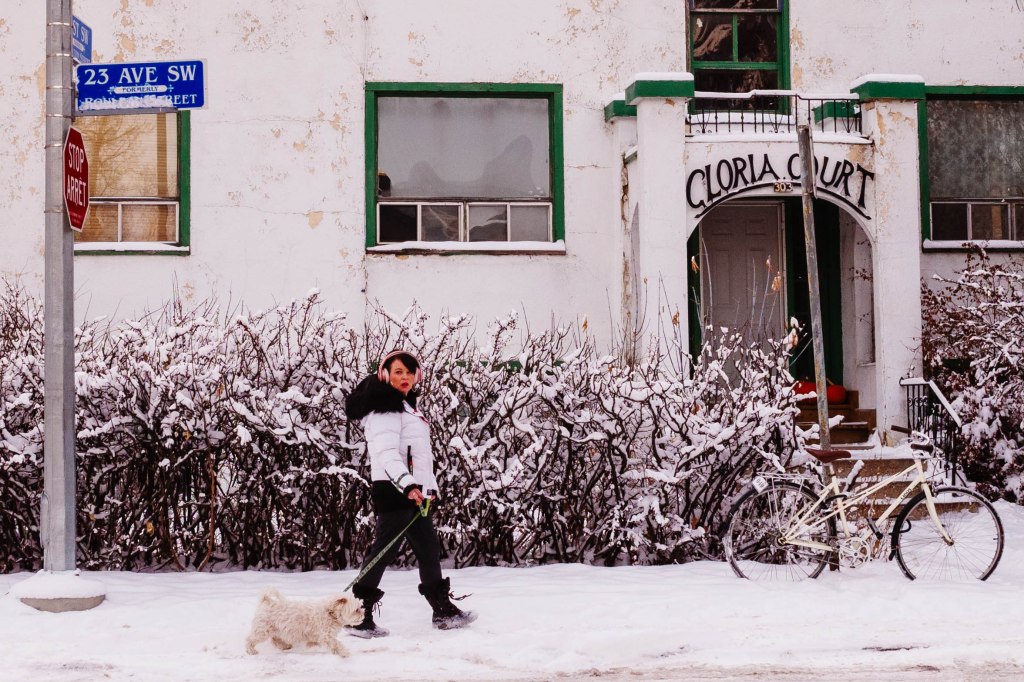
Gloria Court, Mission (December 2023)

If I’m totally honest… and I think my readers would want me to be… I feel that the results this year have been something less than stellar. Or maybe it’s just that my subjects haven’t been leaping out at me. I think my muse may already be on holiday. But as always, I find if I keep my eyes open and trust my instincts, I will be rewarded with some surprises.

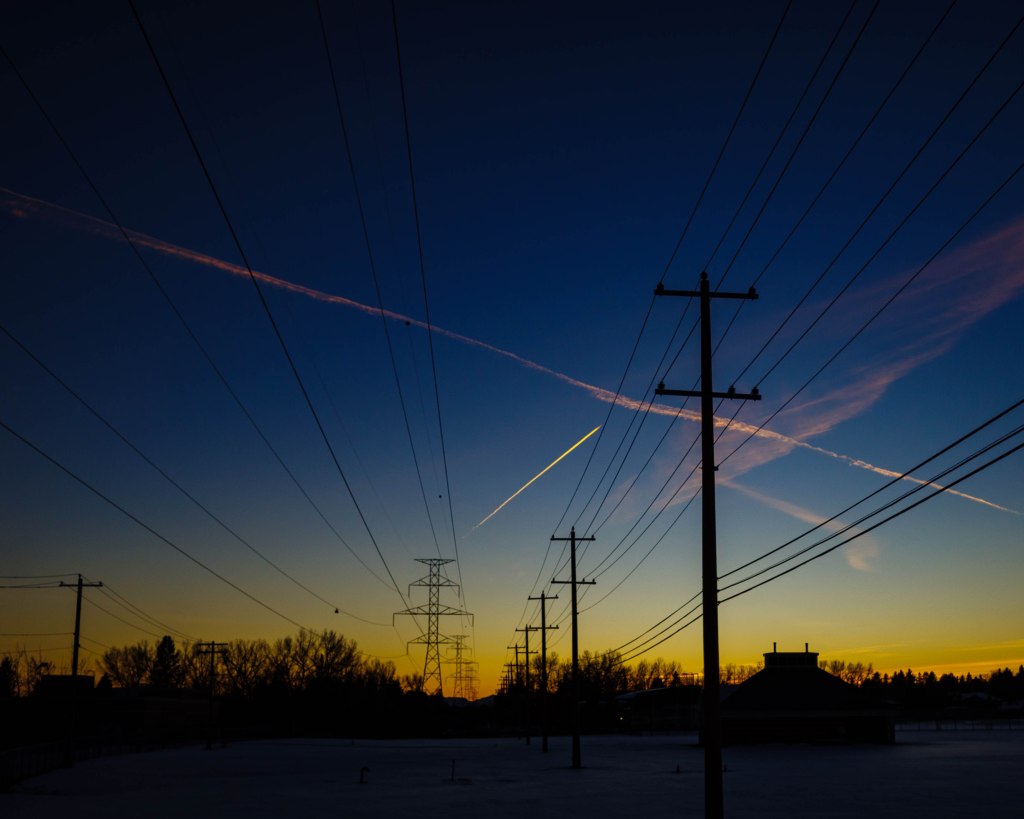
Lines in the sky, Glenmore Athletic Park (December 2023)

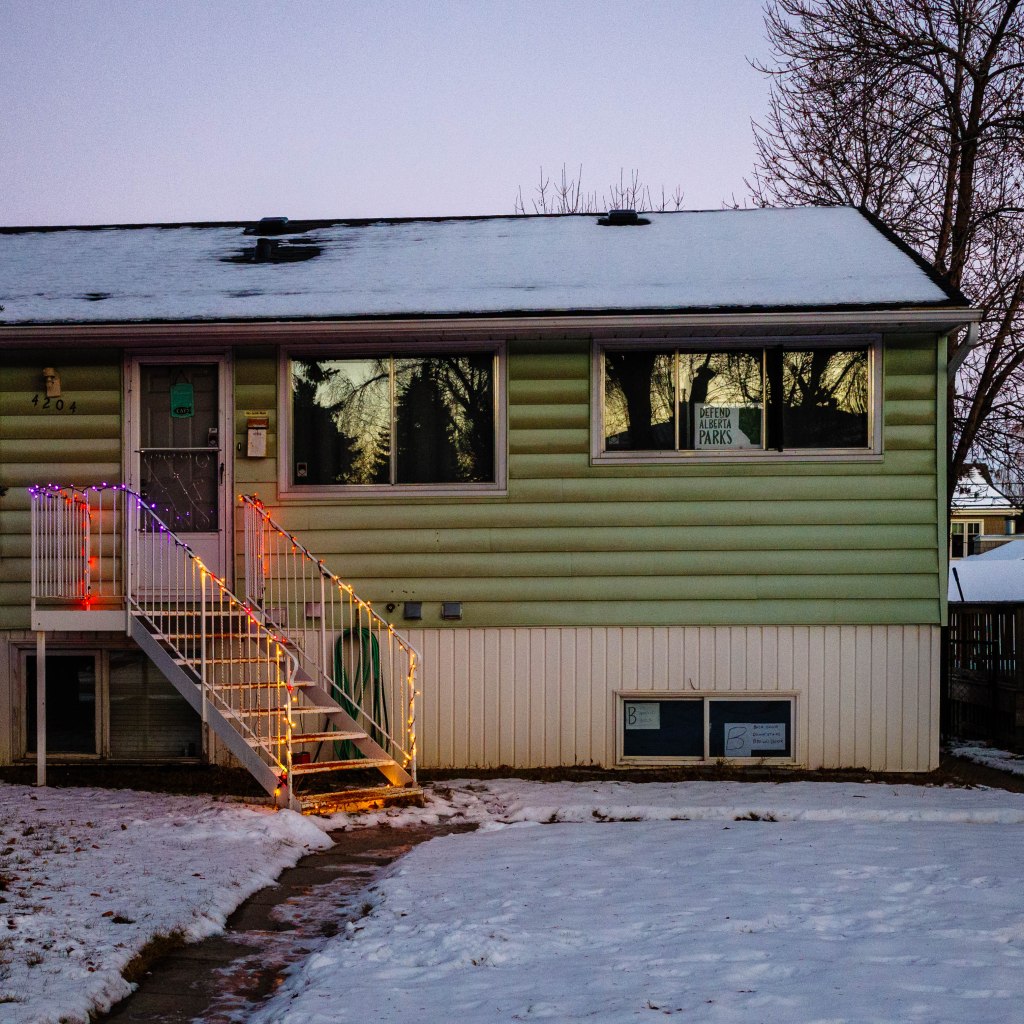
I try not to fall into the trap of snapping easy targets, like excessively decorated houses. Yes, that is a small, self-imposed constraint that makes my daily task a little tougher. That said, I find that even if some light displays don’t compare with Clark W. Griswold’s, they are still worth photographing.

Merry Merry, Altadore (December 2023)

My 2023 SRS photos may not be totally traditional, at least as defined by seasonal expectations, but when I look at them as a whole they seem to evoke a rather pleasant feeling. Is it hopefulness? Calm? Wonder?

I’ll let you decide for yourselves. I’m keen to hear from you, so do leave a comment.

Looking slightly festive, Beltline (December 2023)

Signing off for now, I’ll say Merry Christmas. Until next time, I wish you happy running, shooting, or whatever your particular passion is.

Be well and enjoy what’s around you. Peace!

Luck… and Good Light

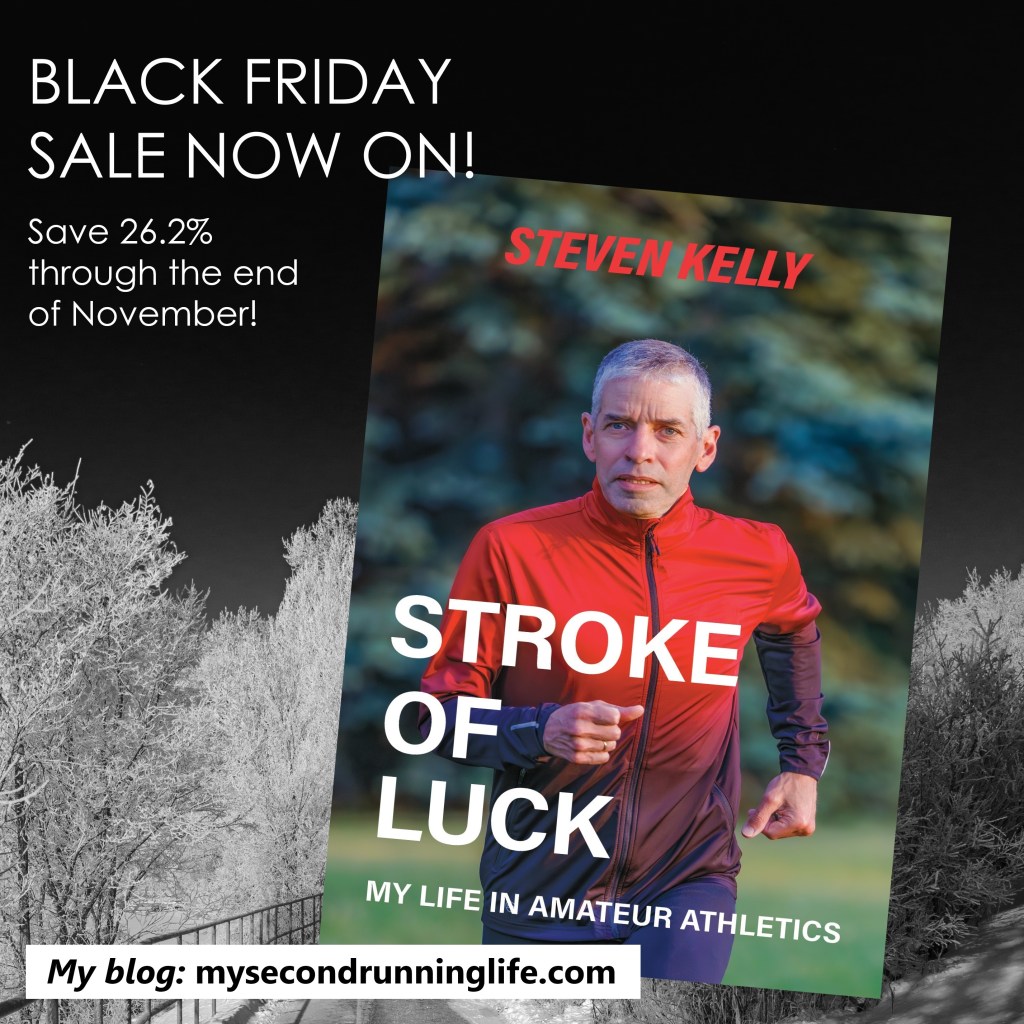
Don’t forget my Black Friday sale, through the end of November. Get your copy of Stroke of Luck: My Life in Amateur Athletics on Amazon for a marathon-inspired 26.2% discount!

Photography can be a curious hobby.

Sometimes pictures are everywhere. Other times you feel that you have lost the plot. Try as you might, it seems there are no worthwhile subjects at all. 

The last few weeks have been tough for a variety of reasons. Time hasn’t been on my side, due to work and volunteer commitments. Cameras have been sitting idle. And it doesn’t help that my motivation has been running low. Maybe it’s a seasonal thing. With the shorter days, finding an interesting scene… just finding any light at all… is difficult. 

But here’s the good news. Whatever light we have at this time of year is often stunning. Any decent sunrise or sunset can be an easy capture because you don’t have to be up at an ungodly hour to shoot it. We are blessed in Calgary to have plenty of picturesque shots, thanks to our frequent Chinook arches

As if to remind me to snap out of my little funk, I’ve had several fortunate scenes appear before my eyes in the last week. 

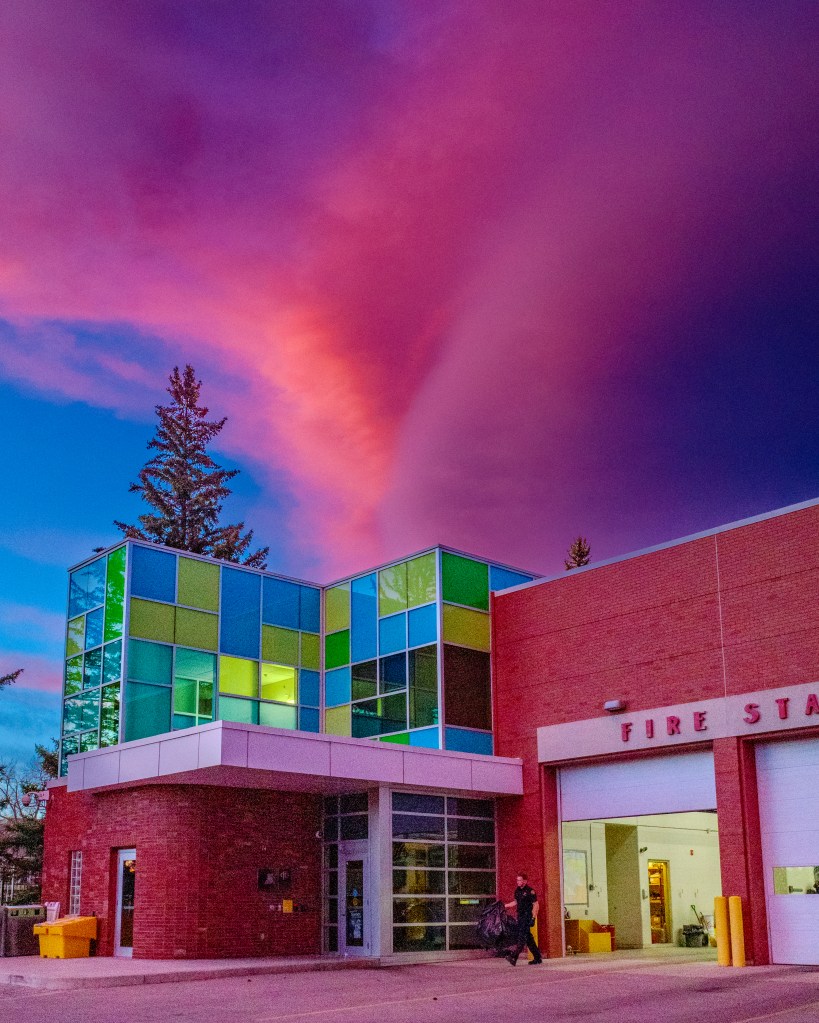
One day, the light in the house was suddenly and strangely pink in the late afternoon. I looked outside, and the sky was glowing a magnificent rosy shade.  I almost tripped down the stairs to grab my Ricoh GR III. Quick, get out there! Shoot something! 

Admittedly, the firefighter across the street at the No. 5 Fire Station was slightly surprised to be the subject of my random shot, especially as he was walking to the rubbish bin. It didn’t matter. I wasn’t looking at him but at the amazing pink clouds above his head. A firestorm above the firehall. Easy!

No. 5 Fire Station, Fiery Sunset (November 2023)

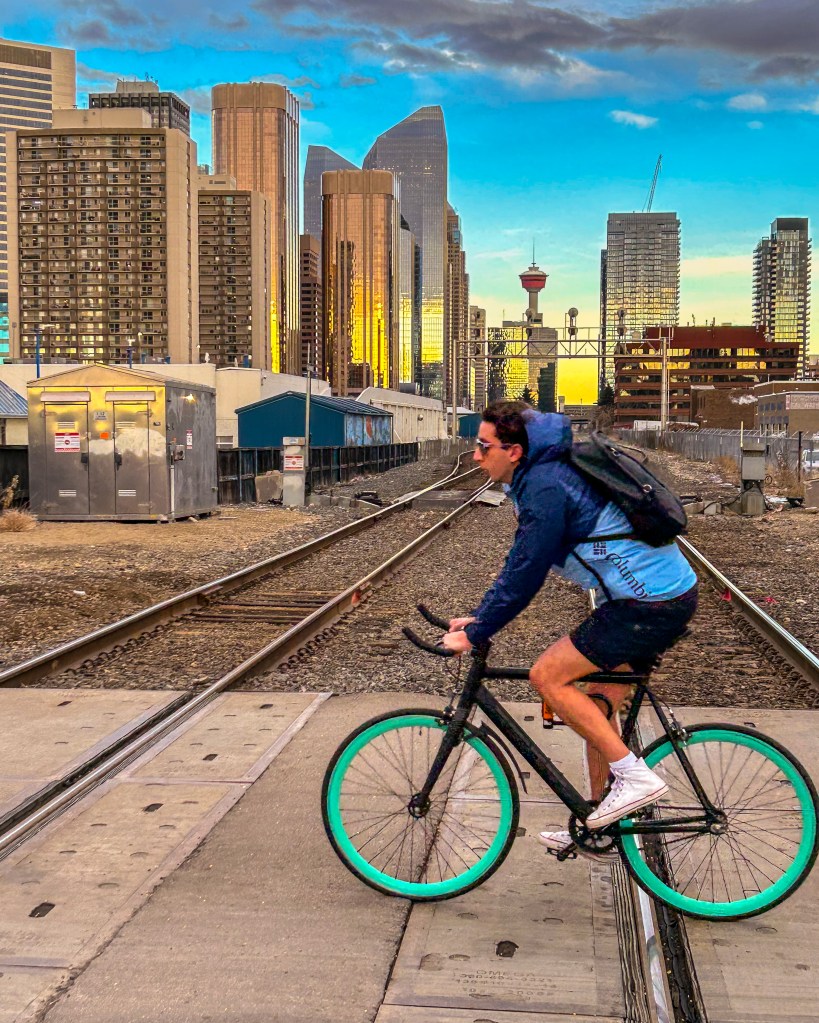
Then, a few days later, as I picked up some things at the downtown Staples, I was drawn to a scene I’d passed many times. The setting sun was dipping below a Chinook arch and casting a golden glow over the skyscrapers. More awesome light. Again, shoot something. Anything! 

Looking east along the CP rail line, the tracks make natural leading lines. My challenge in the past has been in finding something to lead to… something other than a moving train, that is. 

Then I spotted my subject. A guy on a cool fixed-gear bike with bright green wheels was heading north on 11th Street. Standing in the middle of the street, I felt a bit exposed. I fumbled for my iPhone 14. C’mon man… hurry! I snapped my picture at the last split second, just as he entered my scene. Then I hustled out of the reach of the oncoming cars. 

Later, when I sat down with my pictures, I was more than happy with the results. With what had been snap-and-dash shots, I managed to get a couple of keepers.

Green Wheels, Golden Hour (November 2023)

Luck and good light. 

Just goes to show that you have to always be ready. And never give up. 

What a Difference a Week Makes

As anyone who has lived here can tell you, Calgary doesn’t do fall very well. Sure, it can be nice one day, but we know not to be fooled. It’s only a matter of time before the weather turns into a demon.

This past week was a good case in point.

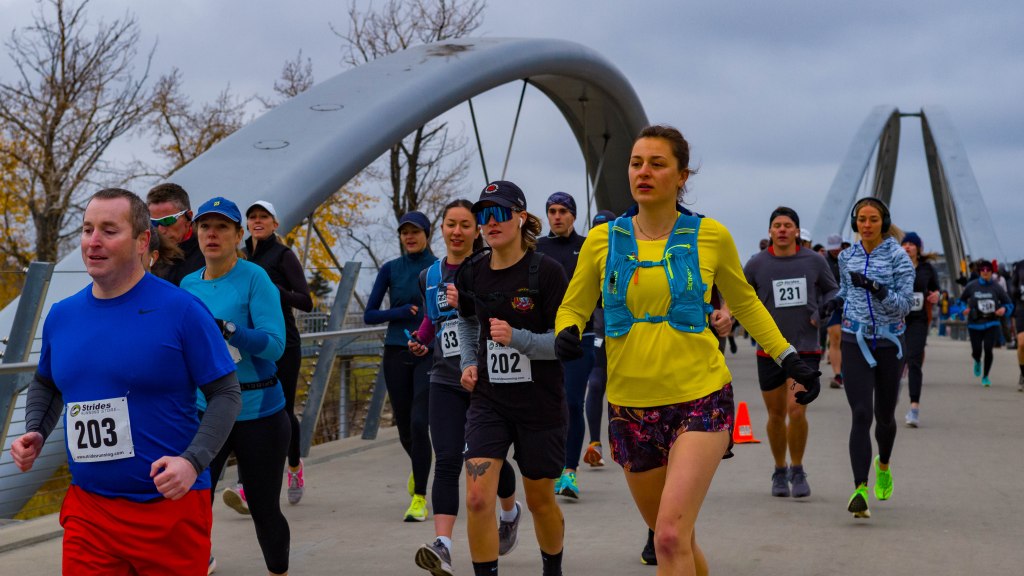
The First Responders races are hosted by Multisports Canada, in support of all first responders – police, fire, EMS and military. Races are held across Western Canada. This year, the Calgary race was held on October 22, on beautiful St. Patrick’s Island.

It was a cool day… a perfect day for racing. A good turnout for the 5k, 10k and half marathon races provided lots of opportunities for runners and spectators. Deb and I were there to cheer on some young athletes from our club. We were also fortunate to have Dan in town for the weekend. He was with members of his Cold Lake squadron, to compete in the 10k.

Overcast skies and the scenic backdrop of the island also promised some great photo opportunities. I got myself ready in a few strategic locations, with my Leica M10 and the excellent Voigtlander 75mm Heliar f1.8 lens in hand.

Competitors in the Half Marathon make their way across the George C. King Bridge

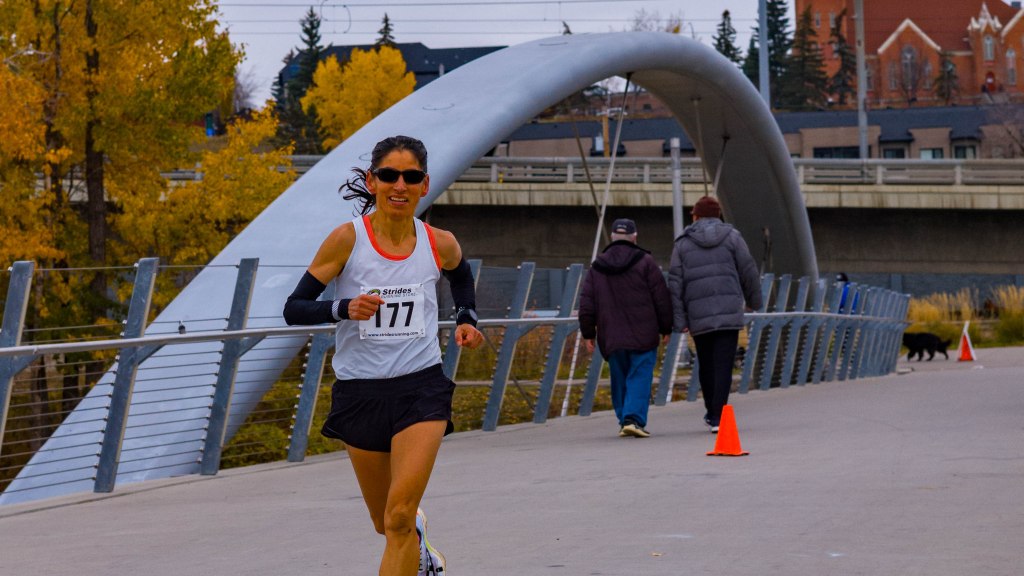
The racers didn’t disappoint. There was plenty of excitement and some terrific performances. You can find the results for all the races here. The ageless Maria Zambrano, who has been a fixture in the Calgary race scene for decades, won the 10k outright, in a sparkling time of 36:09. She isn’t getting older, she is getting faster. Amazing!

Maria Zambrano heads for home in the 10k

Providing more evidence that age is really just a number, Andrew Brown took home top honours in the half marathon, running 1:26:35. By the way, Andrew is in the 50-59 age group.

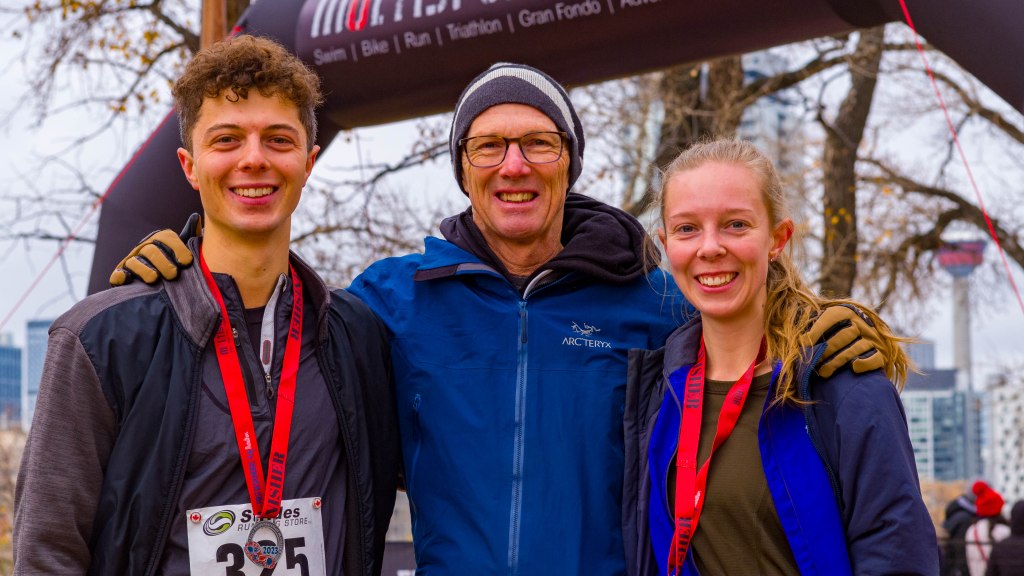
I was wearing two hats (well maybe three, given the temperature.) As an assistant coach, I was rooting for two young runners in our Adrenaline Rush club, Alison and Owen MacPherson. Both raced their plans to perfection, chalking up negative splits and looking far too comfortable at the finish. Dad Gord was there to cheer them on!

The MacPherson family celebrates two fine performances in the 5k

Now, what about the demon, you ask?

Our time ran out on Monday, with the arrival of a cold front. It was the first blast of winter. By the time it was done, 15cm of snow had fallen on Calgary, and our pleasant fall was a distant memory. We are still digging out! And running on treadmills for the most part.

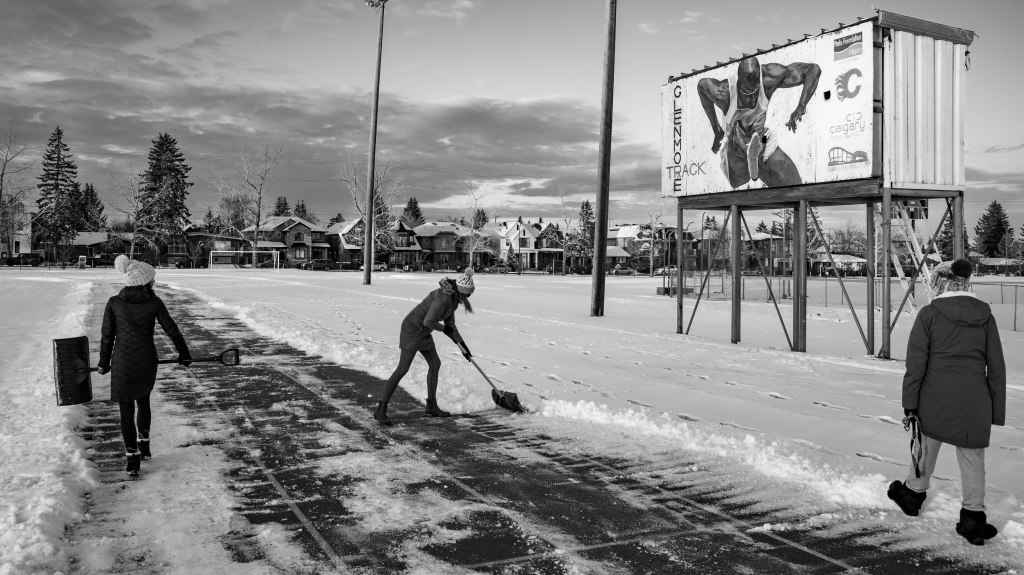
Proving the resilience of the Calgary running community, a small army of volunteers picked up their shovels and headed for the track at the Glenmore Athletic Park.

Shovels ready!

As Deb and I worked to clear a couple of lanes on the back straight, I did some math to take my mind off my aching back. It took us an hour of hard work to clear about 200m of one lane. Did you know that one lane on a standard track is 4 feet (1.2m) wide? That means each of us did about 250 square metres of shovelling.

I also had time to figure out that the total surface area of a 400m track is about 4,300 square metres. So, between Deb and I, we managed to clear about 12 percent of the total surface area of the track. Thank goodness we had a lot of help.

No wonder I’m sore today.

Deb, Reinier Paauwe and Jeremy Deere work on the first corner

It all goes to show that Calgarians are adaptable, resilient and community-minded. We runners in the southwest will have a few lanes to train in, at least until the next snowfall.

Stay warm!

A Different Perspective on Sustainability

I just picked up my 1954 Leica M3 from a routine but overdue service. I couldn’t wait to get it home and load it with film. Yes, 1954. Yes, film.

Holding this remarkable machine in my hands, feeling the impressive weight of its all-metal construction, is an experience. But looking through its now clean and perfectly clear rangefinder to compose a picture and pressing its silky-smooth shutter is something else entirely. And don’t get me started on the feel of its double-stroke film advance. I hope I haven’t lost anyone yet.

Some would suggest that my nearly seven-decade-old camera, totally manual and without any kind of exposure metering, is the best camera ever made. Others might take one look and scoff at it as a worthless anachronism.

It got me thinking about how much we have lost, in our seemingly endless quest for the latest gadget. When did we get on this treadmill? The more relevant question is, why?

There are other examples of devices that seem to have reached a point of perfection, before sliding down a slippery slope on the back of consumerism. Italian racing bicycles are a good example. There are few things more suited to their purpose than steel-framed bicycles from Bianchi or Colnago, especially when kitted out with high-end components from manufacturers like Campagnolo. Just like my camera, they are perfectly suited to one job, and they were built to last.

The curious thing is that the apex for many such devices was reached at about the same time. The mid-to-late 1970s seem to have been a watershed period. After that time, something changed. An endless push for profit ensured ever-decreasing quality. Offshoring of production and substitution of parts with (usually) plasticky alternatives sealed the fate of manufacturers who had built their reputation by designing equipment that could last indefinitely.

From the consumer point of view, we came to accept this trend, because rapidly changing tastes made it less likely we would want to hold onto one product for a lifetime anyway. Fashion, which has always been at the forefront of the throwaway mindset, became a model for how other goods were marketed.

No one stops to ask if there is an alternative to the mania that accompanies each new release of the latest iPhone or the newest gee-whiz electronic gadget. To my mind, it does nothing but ensure that we will be putting a lot of material in landfills, as last year’s devices are cast aside just before they fail.

All of this makes it more satisfying that I can still pick up a camera that is older than I am and take pictures that are every bit as impactful as those coming out of the latest high-resolution, high-frame speed digital monster. Maybe more so, in fact.

Posing for her portrait, Leica M3 and Ilford Delta 100 film, 2022

When I travel with my M3, I don’t have to worry about chargers or SD cards. When I estimate the exposure with my brain, and when I get it right, there is no feeling that can compare. Sure, not all my shots are keepers, but that’s the quest that makes it worthwhile. Even the wait for my film to be processed seems to enhance the experience.

And when I’m done, I will be able to pass this wonderful machine onto my sons, knowing that with a bit of care it will serve them well for their lifetime too. How’s that for sustainability?

Leicaphilia Loses its Creative Force

Tim Vanderweert passed away in early January. I need to say a few words about him, and the impact he had on me. In this digital world, it seems a stretch to say Tim was a friend because I never met him. I only knew him through his online presence and a bit of interaction we had through his blog, Leicaphilia. One thing is certain – I wasn’t the only person who was influenced by Tim.

It’s funny how things go sometimes. About five years ago, I was putting my life back together after a medical episode that left me wondering what my future would look like. Competitive running, which had been a constant presence in my life for more than four decades, looked like it might be taken away forever. I wasn’t sure I could cope with that prospect.

I had always had a passing interest in photography, but to be fair, it had never gone beyond a teenager’s early fascination with the gear and amateurish attempts to emulate the great landscape photographer, Ansel Adams. Boxes of family snapshots, as great as they are, attest to the fact that I focused more on quantity than quality. And that was fine, as I had limited time for hobbies, for all the usual reasons.

Fast forward to 2017. Adrift after a lengthy hospital stay and amid much uncertainty, I picked up my old Canon AT-1–that’s a totally manual film camera by the way–and started carrying it with me on my slow recovery walks around the neighbourhood. For years, I had cruised through the same streets at a faster pace – apparently fast enough that I hadn’t seen things that were right in front of my eyes.

My interest in photography was being rekindled but I was rusty. So rusty that I had missed the whole transition to digital photography, which had made film cameras obsolete. At least that was the conventional wisdom.

And then I discovered Leicaphilia, and its creative force, Tim vdW. Here was a guy, about my age, who had dedicated as much of his life and energy to photography – Leica-based film photography no less – as I had dedicated to competitive running. Different hobby, same passion. I liked him immediately.

The more I delved into Tim’s writing and creative output, the more our connection grew. I especially liked the fact that he steadfastly defended the turf of film photography against the onslaught of digital. Pixels didn’t matter an iota to him. It was more about the emotional impact, the art, than about the technical features of the latest camera. And on that point, Tim had the knowledge (and the courage) to state his views and share his thoughts. He wrote eloquently about the philosophical underpinnings of photography, about topics like aesthetics. His knowledge spanned centuries.

I had never read articles that tied the Greek philosophers to this hobby. But as a returning student, I was more than willing to learn. His lucid posts entertained me (and his other devotees) while they educated me, complete with photographs from his archives and his bike rides around North Carolina. He put together a book of his photographs taken from inside cars – it was called Car Sick – and I bought not one but two copies. (You see, he had made it abundantly clear to his readers that he had lost his shirt on the production of the book. I wanted him to keep going.)

When Tim announced to his readers that he had cancer, we all held our breaths. It looked bad. For a time, he stopped posting. Eventually, he informed us that he was in hospice care, with only a few days to live. Except he didn’t die. He got better, at least for a while.

In the last few months of his life, he gifted his anxious audience with constant posts, full of clear writing about his situation, and yes, some excellent photography. With a creative flourish, he turned his attention to developing the hundreds of rolls of film that had accumulated in his house. He even put together an exhibition of his life’s work.

And now he is gone. Tim showed us all how we might try to face the grim prospect of our own impending death, with grace and purpose, and good humour. As we go through the ups and downs of our own lives, we should all hope to have as much positive impact on those around us.

My first reaction to the news of his passing was to load a roll of his favourite film (Kodak Tri-X) into my Leica M6 and shoot some street photographs, hoping for his spirit to walk with me as my muse.

Tim will be missed.

“Look out below”, inspired by Tim vdW (Leica M6 and Kodak Tri-X, 2023)

The Amazing Ricoh GR III

Let me say at the outset that I approach camera equipment from a strictly amateur perspective. I’m an enthusiast, not a professional. I know what I’m doing when it comes to the gear, but I don’t chase pixels or specifications.

With that proviso, here is my review of a camera that I am very enthusiastic about: the Ricoh GR III.

I should explain that I predominantly use this camera for a different purpose than many other shooters. I bought the GR III to carry with me on what I call “photo runs”, easy runs of 5-15 kilometres. For that purpose, I needed a small, light, and fast-to-operate camera. Extra weight was a deal-breaker. Cameras with wide zoom ranges or fast lenses are generally bulky, so I eliminated those immediately.

I quickly got down to a shortlist, and a few features of the GR III won the day. At 257 grams, it met my weight criteria. Its f2.8 maximum aperture and 24MP resolution APS-C sensor are more than capable.

Where the GR III really shines is in the “fast and easy” category. It is faster to operate than most cameras, and easier to shoot than a cell phone. The camera’s form factor makes it easy to grip, and its snap focus feature makes it very quick to shoot. Since I carry the camera in a waistbelt (I use the excellent Salomon S-Lab belt, by the way) I can grab it with my right hand and be shooting one-handed in a matter of a second or so. That makes a difference when you are pulling over to get a shot, especially if you are out with your running mates. (Strangely, they don’t like to stop or even slow down to let me get back into the group.)

The GR III is ideal for the type of shooting I do on the run. Landscape shots are a good example, and a frequent subject if I’m running along Calgary’s picturesque river pathway system. I like being able to easily select different exposure settings with the top mode dial (most often a switch between Aperture Priority or Program mode).

Exposure compensation is a breeze with a quick sideways press of the ADJ lever. By pushing the same lever in, I can call up pre-set image control settings. The “high contrast monochrome” mode is one I often use for capturing afternoon clouds over the river or a piece of interesting architecture that I pass on my run. I’m also fond of the “positive film” mode for a Kodachrome look while running on the city streets.

I like being able to change a setting while I’m moving, and for that reason, I really appreciate the GR III’s accessible controls and the intuitive menu system. Because speed is my top priority, an even better solution was to program a couple of “run-friendly” shooting modes into the User programmable slots.

Another thing I really appreciate is the easy access to the multiple drive mode. It’s a simple toggle on the 4-way control dial, which is perfect if I decide to capture a sequence of my running partners in motion.

There’s one other thing that turns out to be essential for me. The Ricoh has proved that it can handle the worst of an Alberta winter. Consider this: I carried the GR III on my belt every day in December, while I participated in a running streak challenge organized by our local running store, Strides. That meant it was outside, sometimes exposed to a -30C wind chill, for up to 90 minutes. As long as I put a fully charged battery into it before leaving the house, it went on shooting for as long as I needed it. I should say, for as long as I could stand taking off my outer mitt to actually shoot it. Some of those runs were, in a word, brutal. And this camera kept up. Amazing!

As for things I don’t like, it’s a short list. Given its small form factor, I do find the GR III controls a bit finicky, especially with frozen hands. And the fixed 28mm focal length can sometimes be a constraint.

I’m willing to accept these limitations given all the positives that this camera delivers. What else would I expect but small controls on a camera of this size? And I find the standard JPG files out of the camera give me more than enough resolution if I need to crop and quickly edit a shot for posting on Strava or sharing with my partners after our run. Most of these shots aren’t fine art.

That said, if I do get a shot worthy of more attention, the in-camera stabilization helps me capture sharp images, which leaves me the latitude to work with the ample 24MP RAW file and crop it later in post-processing. It’s a nice option and one I’ve used many times.

Incidentally, that’s why the GR III has filled more voids than I ever expected it to. It is often the camera I reach for if I’m out walking around, as it is an excellent street shooter… unobtrusive to the subject and highly intuitive for the photographer. In fact, I carry it even if I’m bringing another camera with a 50mm or longer lens, in case I decide the 28mm viewpoint is more to my liking.

Overall, the Ricoh GR III has proven itself worthy of being a constant companion on my runs. It has exceeded my expectations, and that’s why I’m putting so many miles on it.