We heard yesterday that Gord Hobbins had passed away. Deb and I are gutted by the news. The Calgary running community has lost one of its greatest supporters, and we’ve lost a friend of many years. It will take a long time to come to terms with his loss.
Coincidentally, Deb and I were walking near Gord’s Running Store a few days ago. We hadn’t been in that part of town for a while. As we passed the familiar storefront, tucked in a strip mall just off Centre Street NW, we chatted about him. I mentioned that the store was celebrating its 35th anniversary. Gord’s Instagram account had been featuring photos from the 1990s, when the hair was longer and the running shorts were shorter. Okay, too short. We had a laugh about that and recounted a few of our many stories about Gord. But our time was limited and we decided not to drop in. Now I wish we had.
My connection to the local running scene goes back more than three decades. We moved here in 1991, and it would have been shortly after that that I first stepped into Gord’s store. I immediately felt his personal warmth, his enthusiasm for the sport, and his passion for customer service. Of course, Gord’s customers soon became his friends, and that never changed. No matter how long since our previous visit, Gord was the same: genuine, kind, inquisitive. He always took time to chat. Visits to the shop were often stretched, so we could get caught up on each other’s family news. He was totally devoted to Cathy and their kids, Ailsa and Gareth.
Gord coached me for a few years, and he was a natural. He had a hand in preparing me for my first Boston Marathon. His trackside cues at the Talisman Centre… “Steve, relax your shoulders!”… were in my ears on race day in April 2001, and helped me to one of the most memorable achievements of my life. Later, I took up a coaching role in my own club, and Gord was a mentor. When he organized group runs from the store, he was invariably the perfect host, making sure all his sheep got back safely.
Gord and I even shared a similar medical history, having both gone through serious cardiovascular issues. We could each credit a lifetime devotion to the sport we loved for getting us through our unique and challenging episodes.
There was a good reason for the longevity of Gord’s store in the tough retail business: he was the best at what he did. He generously shared his vast knowledge of the latest shoes and running gear. I lost track of the number of times I referred people to him. “Go see Gord,” I would say. “There’s no one who knows more about fitting you for running shoes.”
Gord’s own running resume was impressive too. I first saw his name in race results in Edmonton (his hometown and our first stop in Alberta) in the mid-1980s. At the time, he was running road 10k’s and half marathons. But it would be in ultramarathons that he later made a name for himself.
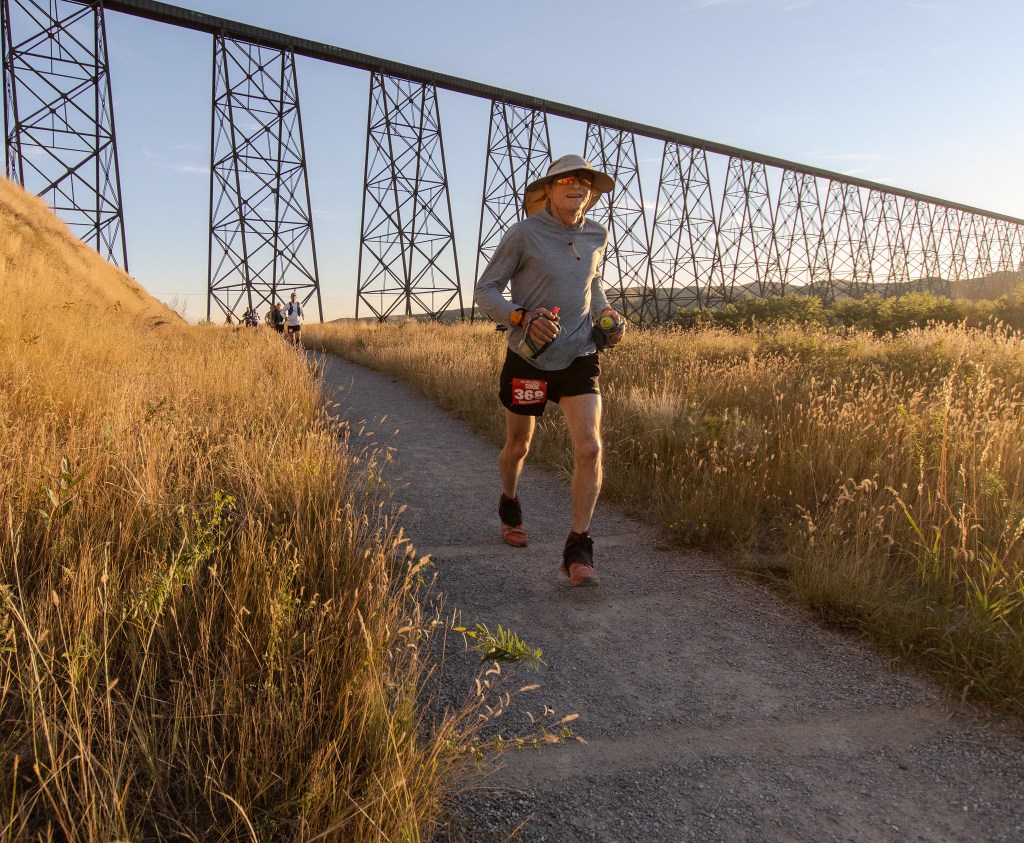
Gord’s success in ultra trail races was attested to by memorabilia in his store. In fact, the last time I saw him, he told me he was looking forward to completing his collection of carved finisher’s stones from the Lethbridge Lost Soul Ultra. He had run the race many times, so it was no surprise when he finished the 50k in an impressive time last September. (Photo by Mark Moland.)
I’ll miss Gord like a brother. His commitment to the sport ensures his legacy in the Calgary running community. More than that, his passion for making everyone around him better, fitter and happier is what I will remember most. Rest in peace, my friend. We wish his family, friends and staff peace and comfort in the difficult days ahead.
We all know that February is the shortest month, at 28 (or 29) days, not the usual 30 or 31. But do you know how this came to be?
We have to go back to the Roman calendar, which divided the year into ten (not twelve) months, from March to December. These months were either 29 or 31 days, not 30, because the Romans considered even numbers to be unlucky. The early part of the year was not even named.
The second king of Rome, Numa Pompilius (ca. 753-652 BC) reformed the Roman calendar and introduced the months we know as January and February. However, it would have been problematic for these new months to have either 29 or 31 days. Why? Because the total number of days for the year (that is, the product of 12 odd-numbered months) would have ended up as an even number, not the required 365.
So, February was adjusted to make the annual math work. A couple of reasons are cited for this decision. The name itself comes from the Roman festival of purification, ‘februa’, which occurred at that time of the year. It was also the time when people mourned the departed. These factors led to February being the month that was shortened to 28 days.
I thought it would be fun to highlight individual performances that have inspired and motivated me. As you’ll see, it isn’t necessary that the person I’m writing about won the race in question. This is all about their effort on the day.
Steve Prefontaine, Munich 5000m Final
I’ll start with a confession: on my own race mornings, I used to watch the video of this great individual performance to get myself into the right frame of mind. BBC commentator David Coleman’s description of Steve Prefontaine, the brash American, as “a sort of athletic Beatle” is classic.
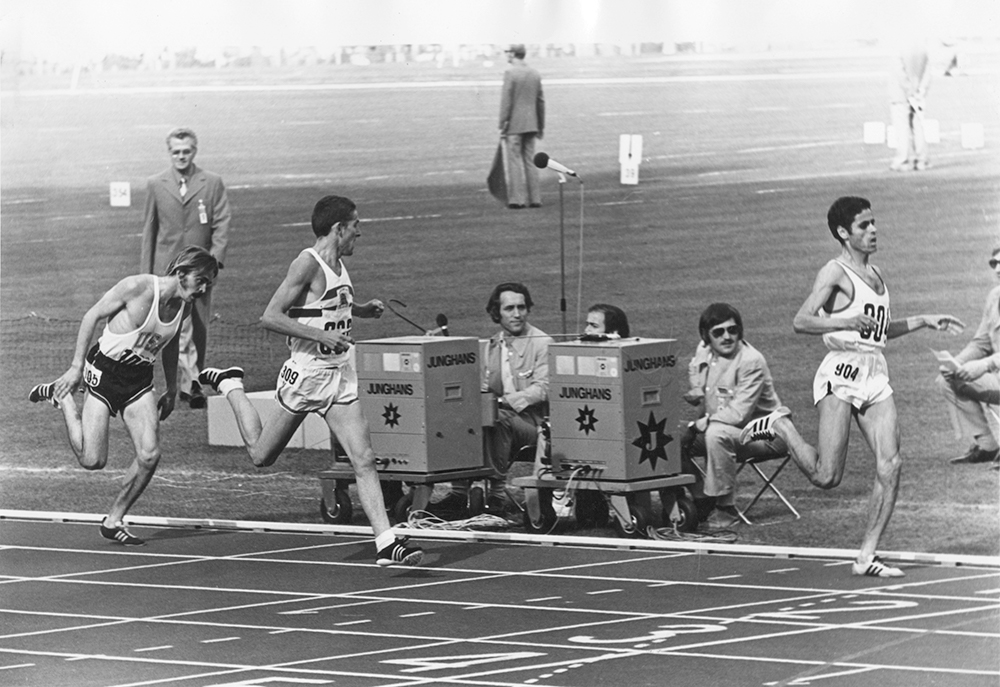
Setting the scene, Prefontaine was running in what would be his only Olympic final, against a deep field. With two slow miles behind them, Pre boldly “states his case” to lead to the finish. As a pack of five separates itself with two laps to go, the Finn Lasse Viren asserts control. Is it over? No, not with Pre in the mix. Time and again, he fights to regain the lead. Coleman’s fateful comment, with 200m to go, that “these are the medal men” would turn out to be wrong, as a totally spent Pre is passed in the last few metres by Ian Stewart. Viren won gold.
Measured by the result… fourth, and out of the medals… this could be seen as a foolish gamble by the inexperienced young American. Instead, I look at it as the epitome of racing. There was no playing it safe for Prefontaine. No wonder I get goosebumps every time I watch the video.
Prefontaine gambles it all, Munich Olympics 5000m final (Photo from Track and Field News)
Mo Ahmed, Paris 10,000m Final
At the risk of repeating myself, I’ve chosen another Olympic finals performance that left the runner out of the medals. This time, it was Canadian Mo Ahmed in the Paris 2024 Olympics 10,000m final.
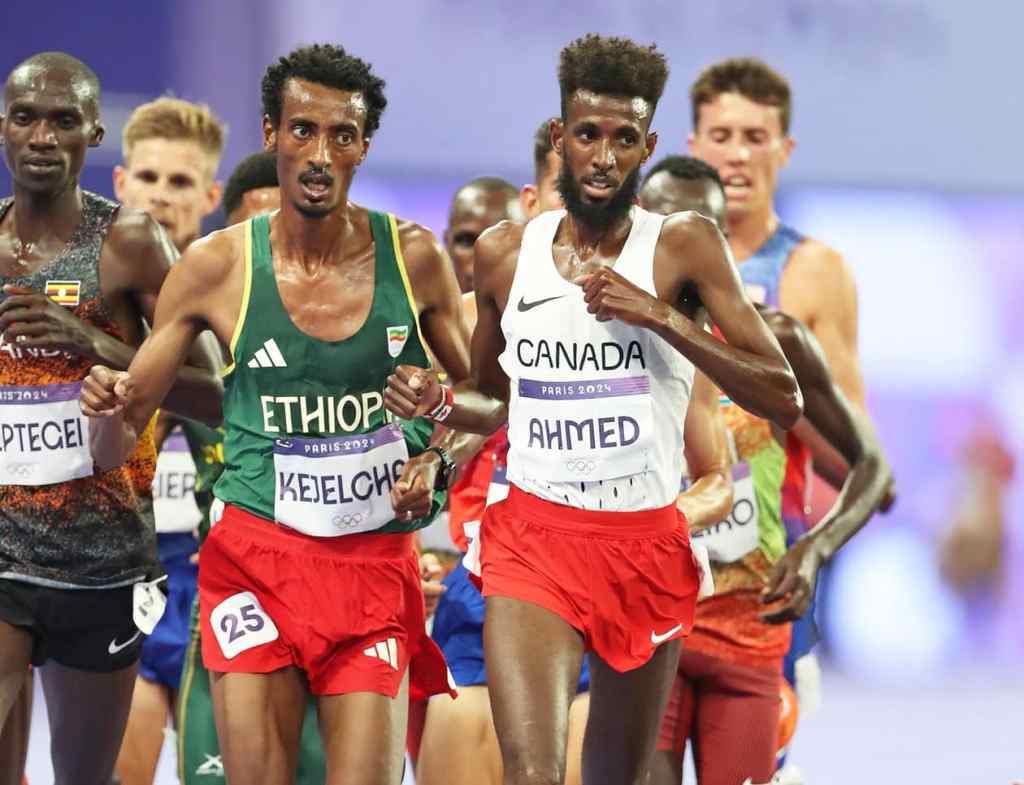
Ahmed ran what might be the smartest race I’ve ever seen. He stayed out of trouble in a top-class field, paced himself beautifully, and was in contention against team tactics of other runners until the final 30 metres. I thought I might have been the only one who noticed his deceptively smart racing, until I heard David Moorcroft (broadcasting for CBC) make the same observation.
Finishing with nothing in the tank, Ahmed’s performance (26:43.79) was good for fourth place. That he and 12 other finishers were well under the previous Olympic record attests to the quality of the field. It was a spectacular race, and one where Ahmed demonstrated that he belonged with the very best.
Mo Ahmed shines in the Paris 10,000m final (Photo from Athletics Canada)
Paula Radcliffe, 2003 London Marathon
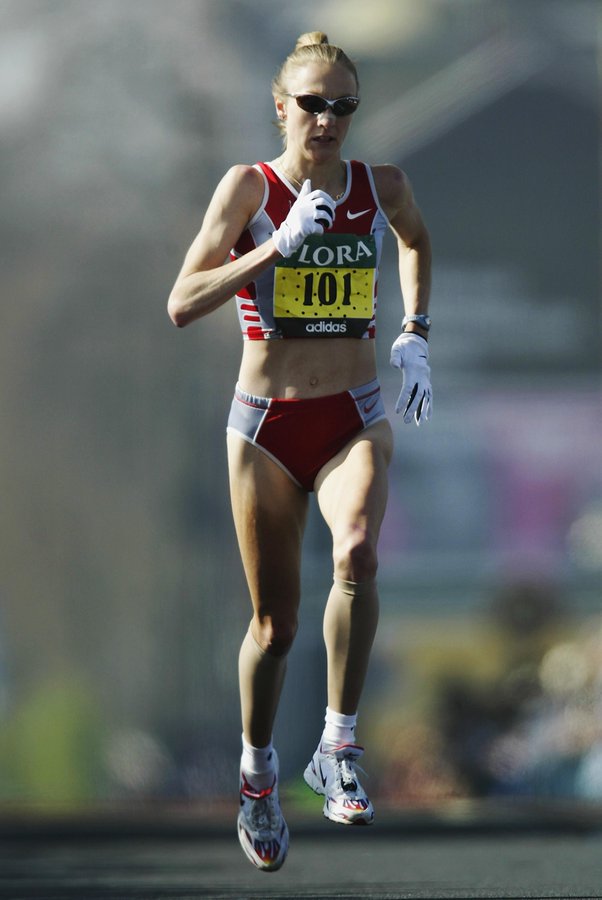
In 2002 and 2003, Paula Radcliffe was on top of the marathon world. She had set a world record in Chicago in October 2002, running 2:17:18, so there was great anticipation for her race the following spring in London. Running before her home crowd, Radcliffe didn’t disappoint. Leading from start to finish, she shattered her own world record, en route to an astonishing 2:15:25. Her nearest competitor was more than four minutes behind her.
I have a tenuous connection to Radcliffe’s race. You see, I was on the same course that sunny April morning in London. Admittedly I finished nearly an hour behind her. I’ve replayed the videos and read the stories so many times to fully grasp what Paula achieved. The strain on her face in the final few kilometres shows how much she wanted this result.
In an era before supershoes and without any team support, Radcliffe delivered a courageous performance, well deserving of being in my top 5.
Filbert Bayi, Christchurch 1,500m Final
In recent years, the Commonwealth Games have struggled to remain relevant. Competition from other mega-events (like the Olympics and the World Cup) and other *um, political* factors have led prospective host cities to back away from the Games.
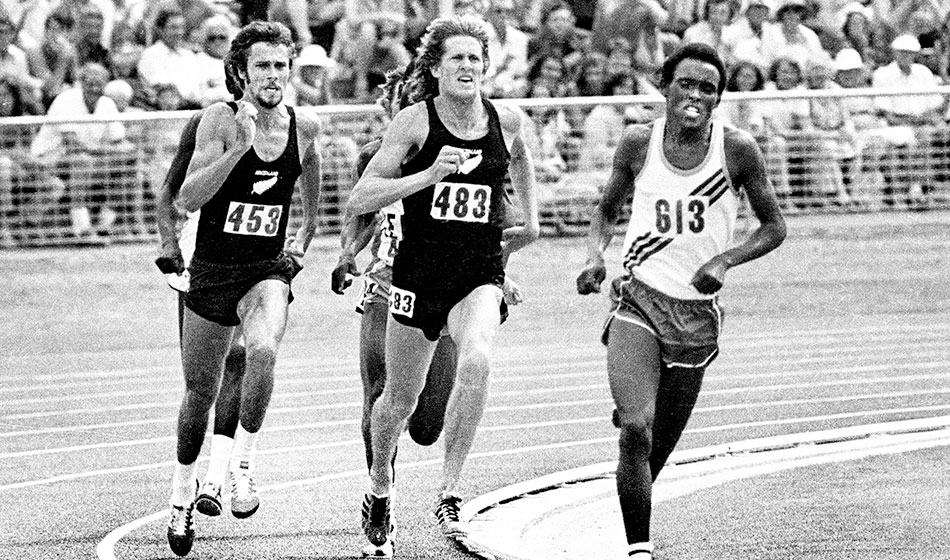
Whatever the future holds, the Games have been host to some great athletics history. Here’s a case in point. In 1974, the young Tanzanian runner, Filbert Bayi, was relatively unknown. That didn’t stop him from taking on a handful of the world’s best in the 1,500m final in Christchurch, New Zealand. His race was one of the most audacious performances of all time. He led from start to finish and set a world record of 3:32.2. Not only that, he beat the hometown favourite, Kiwi John Walker.
Bayi’s account of the race, in a wonderful Athletics Weekly article, leaves no doubt that he trusted his front-running strategy. “I was confident that anyone trying to close the gap over the last 100m or 200m would have a real fight on their hands,” he states. And with the field in a pack bearing down on him, his plans were certainly put to the test. In the end, Bayi beat Walker by a couple of strides. He knew immediately the importance of what he had achieved. It was a perfectly executed race.
Filbert Bayi leads John Walker and the rest to the finish (Photo from Athletics Weekly)
Roger Bannister, 1954 Mile Double
Even as the 1,500m has largely eclipsed the mile as the middle distance standard, it’s worth noting that the mile continues to get attention. In the last week, the men’s indoor mile record has been broken… not once, but twice. So it is worth looking back to the furor that surrounded Roger Bannister in 1954.
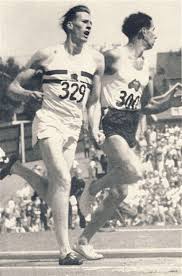
Cheating a little, I will highlight two of Sir Roger’s epic performances. His epic May 1954 run to break the four-minute barrier for the first time is the race everyone knows about. But I would suggest that with his performance in Vancouver at the then-called Empire Games in August, Bannister put an exclamation mark on his miraculous year.
By August 7, Bannister’s record time had already been beaten by Australian John Landy. The Vancouver race was the first time they competed head-to-head. The race generated global hype, and it became known as the Miracle Mile. Although Landy led most of the way, he made a fateful error on the last corner, looking to his left for the hard-charging Bannister. Sensing Landy’s weakness, Bannister passed on the right and didn’t let up. He reached the finish in 3:58.8, five yards and 0.8 seconds ahead of Landy.
I’ve written about Bannister, here and here. What impresses me most about him is that he competed as a pure amateur. As memorable as his exploits on the track were, he never considered them to be his greatest personal achievement.
So that’s my top 5. I could have easily found a top 10, but one has to draw the line somewhere! I’d be interested in any thoughts on these performances, and any that my readers are convinced I’ve missed.
Recently, I wrote a piece about several of my sporting heroes. To keep the piece to a reasonable length, I didn’t comment on another man who had certainly earned a place on my list. In fact, he had been one of my personal heroes for years. That man is Jerome Drayton. In light of his sudden passing on February 10 at the age of 80, I’m regretting that decision. It seems appropriate to talk about him now, and the impact he had on me.
Much has been written about Drayton. His personal story is one of strength and resilience. He was born in Germany to Russian-Ukranian parents, just as the war was coming to an end. His parents divorced, and he emigrated to Canada with his mother in 1956. His name at birth was Peter Buniak, and while we hear various reasons for his change of name, it was clearly his way of putting distance between his past in Europe and his future life in Canada.
He started running in high school in Toronto and found early success. More accurately, he earned it. His results speak volumes about his work ethic. I can start with his astounding mileage totals. He was a pure amateur, doing 200-mile weeks while working full-time. Mere mortals struggle to reach a quarter of that.
While I was discovering athletics in the mid-1970s, Drayton was already in the top echelon of the sport. I never met him, but I followed his exploits closely. Here’s some of what I wrote about him in Stroke of Luck:
“Coincidentally, the world around us was discovering running at the same time we were. The mid- to late-1970s marked the beginning of what is now called the running boom. Frank Shorter’s win in the 1972 Olympic Marathon for the United States is often cited as the beginning of the boom, but I wonder how strongly that event resonated in Canada. If we were following any world class distance runners, it was more likely to be the top Canadian, Jerome Drayton, or even some of the top British runners like Ron Hill, rather than the celebrated American.”
Drayton’s running resume is stellar. In an era when distance running was still seen as a fringe sport, Drayton fit the stereotype of the lone, somewhat aloof, character. Obituaries and tributes describe his single-mindedness and determination.
In my book, I described Drayton as an enigma, given his preference for running in dark aviator shades and a tendency to front-run against his toughest competitors. Perhaps fitting that persona, Drayton never seemed to say much. He let his running speak for itself.
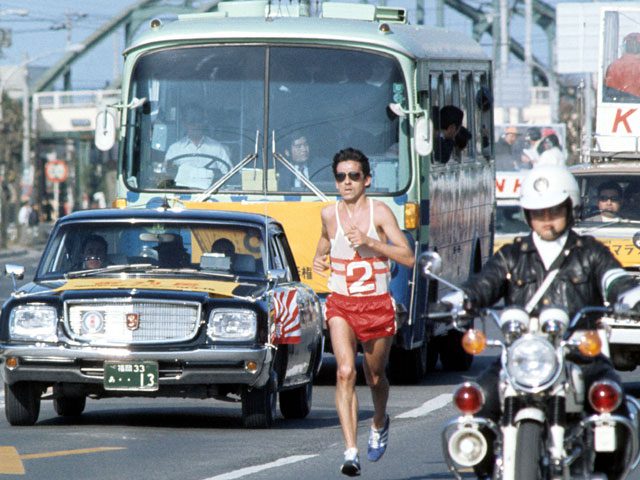
Consider this: long before Boston assumed the title of “world’s premier marathon”, the Fukuoka Marathon in Japan was at the pinnacle of the sport. Entry was by invitation only. Drayton won it, THREE TIMES, in 1969, 1975 and 1976. What about Boston? Well, he won that too, in 1977. He was the last Canadian man to do so.
Drayton in the 1976 Fukuoka Marathon (Photo from Canadian Running, 2013)
Speaking of Boston, I suppose we could add “irascible” to the list of words describing Drayton. Apparently, he wasn’t the most gracious winner. Rather, he took the opportunity to point out that he had just about been mugged in the early going, and that his victory had nearly been sabotaged by the lack of water stations. Hearing this story only made me admire him more. Any of us who have run the race can thank Drayton for dragging the BAA into the modern era.
I have to mention the most durable of Drayton’s achievements, his Canadian marathon record. He set the record (2:10:08) in the 1975 Fukuoka Marathon, and it stood for an incredible 43 years until Cam Levins broke it in the 2018 Toronto Waterfront Marathon.
There was a Hamilton connection too, which cemented Drayton’s place as one of my running heroes. Here’s another passage from my book, where I talked about his victories in the Around the Bay Race:
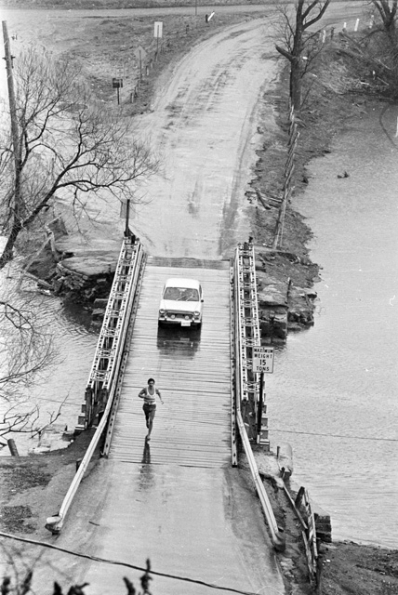
“The history of the Boston Marathon is intertwined with that other famous race, Hamilton’s own Around the Bay Race. Both races were first contested in the 1890s. Many icons of distance running, including some legendary Canadians, had competed in both events. The lists of past winners in Boston and Hamilton include many names that I recognized, even idolized. There was Jerome Drayton, the top Canadian marathoner, the national marathon record holder, and the 1977 Boston winner. He was also a two-time winner of the Bay Race, in 1973 and 1974.”
Drayton, alone in the lead at ATB (Photo from Hamilton Archives)
In the 1970s, finding any athletics news at all was tough. I scoured a lot of newspapers. Despite the sport’s relatively low profile, Drayton stood tall. His star shone brightly until his retirement in the early 1980s. When his racing days were behind him, Drayton was a reclusive role model. He appeared from time to time in interviews… this one in Canadian Running Magazine from 2009 is excellent… and when his Canadian record was finally beaten, he was gracious. He expressed surprise that it had taken so long.
In his later years, Drayton took on advisory roles with government sports agencies. He shunned publicity and lived a modest life in Toronto. Some stories mentioned his struggles with arthritis, which may have contributed to his unexpected death. The news reports I’ve read suggest his death came during knee surgery. Sadly ironic, for a man whose legs had carried him to the top of the marathon world half a century earlier.
Jerome Drayton was a true sporting legend, whose place in Canadian sporting history won’t easily be matched.
Until next time, be well and (emulating Drayton) BE FAST!
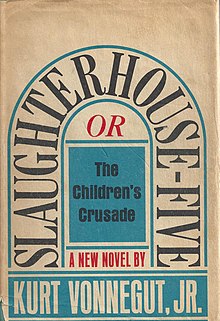
Anyone who has read Slaughterhouse-Five (SH5) by Kurt Vonnegut will recognize this phrase. It stays with you after reading the most famous (or is it infamous?) and arguably the most representative of Vonnegut’s novels.
I’m not sure if SH5 is still required reading in high school English courses… I know it used to be. (I’d be reluctant to guess what required reading might be in high school these days, but that’s another topic.) For my part, I missed the opportunity to read SH5 when I was in school. Perhaps the book wasn’t considered appropriate fare for a Catholic school curriculum.
I’ve only come around to Vonnegut’s works in the last few years. I did read Galapagos in my early twenties, but I found it to be quite forgettable… it certainly didn’t convince me to read anything more by him. Maybe I wasn’t ready for the author’s unique style and keen critical eye.
Something must have changed, because I’ve read three of his books in rapid succession. In this post, I offer my thoughts on what may be his best-known novels. My comments are organized in my order of reading, which just happened to be in reverse order of their publishing date.
Kurt Vonnegut
The author of the books I’m going to discuss is worthy of some discussion himself. Kurt Vonnegut, Jr. (1922-2007) was born in Indianapolis, to German immigrants. He attended Cornell University but dropped out in 1943 after being placed on academic probation. He enlisted in the US Army and was deployed to Europe in 1944 as an intelligence scout. After the war, he pursued academic and technical career paths, never quite succeeding at anything. Vonnegut had a couple of stories published in the early 1950s, which persuaded him to give up other opportunities to pursue writing full-time. His success as a writer did not happen overnight.
Slaughterhouse-Five (1969)
It’s a challenge to summarize SH5. At its core, the story is an account of the Allied fire-bombing of Dresden, Germany in the final months of the Second World War. What genre is the book? Good question. There is an element of historical fiction, but it could just as easily be classified as science fiction. Given that the book was influenced by Vonnegut’s time in the US military, we could even label it as a biography. The author was captured by the Germans, and as a POW he witnessed the destruction of the city firsthand.
In Vonnegut’s signature style, there is a sharp satirical edge to the book. Vonnegut makes no secret of his disdain for “military intelligence”. The casual disregard for life in wartime is a theme repeated often in the book… almost sickeningly so. I think that’s exactly the response Vonnegut wants to elicit from us. That’s where the phrase “so it goes” comes from. SH5 was published at the height of the anti-war movement in the US, and it was the book that made Vonnegut a household name.
The main character in SH5 is Billy Pilgrim, a US draftee. The science fiction element to the story is that Pilgrim experiences time travel. He calls it coming “unstuck in time.” I think the message here is that history is bound to repeat itself. I found this to be a very effective tool; one that shows Vonnegut exercising his full prowess as a mature storyteller.
To summarize, I thought SH5 was brilliant. An amazing creative piece… forceful in its social commentary and totally original. Considering the current events in the world, it is as timely now as when it was written. Very highly recommended!
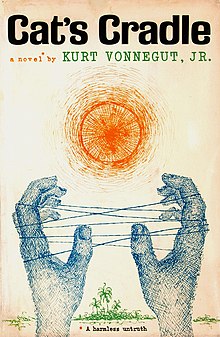
Cat’s Cradle (1960)
Where to begin in explaining this novel?
Cat’s Cradle is a first-person account of the narrator, Jonah, who travels to San Lorenzo, a fictitious and extremely poor island nation. Through an unbelievable sequence of events, Jonah becomes president of the country. At the subsequent inauguration ceremony, an unfortunate incident results in mass destruction on a global scale, when a material called “ice-nine” accidentally comes into contact with seawater.
The book deals with two important themes and manages to touch on several others besides. One major subplot in the book is a fictitious, hedonistic religion called Bokonism. It is the dominant religion in San Lorenzo, seemingly a response by the poor citizens of the country to their dire socioeconomic circumstances.
The book is also a biting commentary on the risks of technology. Ice-nine was invented for military purposes by a brilliant scientist who has complete and callous indifference to the great risks it poses. The obvious parallel is to the proliferation of nuclear weapons, which would have been in Vonnegut’s mind when he wrote Cat’s Cradle in 1960. The story takes the idea of a manmade technological threat to its logical and tragic conclusion.
Only someone with a vivid imagination, black humour and a gift for sharp insight… someone like Vonnegut… could have created Cat’s Cradle. It was a fascinating read, and like SH5, very relevant to the unstable world we find ourselves in.
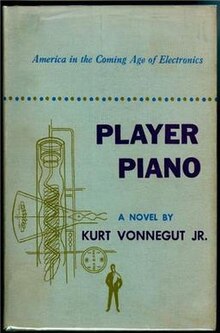
Player Piano (1952)
Player Piano was Vonnegut’s first novel. It tells the story of Paul Proteus, an engineer and manager of the Ilium Works, one of many large industrial complexes that have radically revamped American society. Machines have replaced human beings in every facet of life. For his part, Proteus becomes increasingly uncomfortable as he is being groomed for an expanded role in the system he helped create. The story turns on a clever “double agent” plot, as Proteus finds himself aligned with other, like-minded rebels.
As compared to the other novels, I found the storyline in Player Piano to be the least risky… maybe even simplistic. There are no tricks with time travel here. I suspect Vonnegut was still finding his voice and his style when he wrote the book. Even so, it is a well-constructed story of an all-too-possible dystopian future. Such a future may have been easy to imagine in the early 1950s, as post-war innovations began to change American society; at least it was for Vonnegut.
Of the three novels, Player Piano had the most impact on me. I accept that as a result of my own work as an engineer and manager. Did my career path make me more sensitive to the sharp commentary that Vonnegut dishes out for these vocations in his grim novel? Probably. I don’t take any of it personally, but I do relate to his criticism of an unbridled drive for efficiency.
The world Vonnegut imagines in Player Piano is devoid of almost all pleasure, at least for the average citizen. For the elite (that is to say, the politically savvy) the upside is limitless, as long as the growing majority of displaced citizens are kept notionally busy and marginally employed. It’s a novel that heads to an inevitable tipping point.
The fatal flaw exposed in Player Piano is a conflation of an unstoppable quest for perfection (in countless industrial processes and even in human interactions) with human happiness. I found myself making connections to recent opinion pieces that assess the risks of the increasing use of Artificial Intelligence in our society. Again, Vonnegut’s story seems eerily relevant to our current circumstances.
I can recommend all three of these Vonnegut novels. In my view, his social commentary is timeless, and that keeps the books current. I want to continue my exploration of his work, to see how well his insights have held up in other areas.
A recent errand led me to an unexpected trail of discovery through Calgary’s military history. I had stopped at the busy Westhills shopping district, the usual collection of big box stores. As I walked back to my car, I noticed the battalion numbers preserved on the side of the hill below the Signal Hill neighbourhood.
I knew about the battalion markers but hadn’t thought much about their significance. My first reaction when I saw the whitewashed stones was how small they looked, sandwiched in between the RONA store and Calgary’s residential sprawl just above. I made a point to return soon for a closer look.
Military history squeezed into the urban landscape
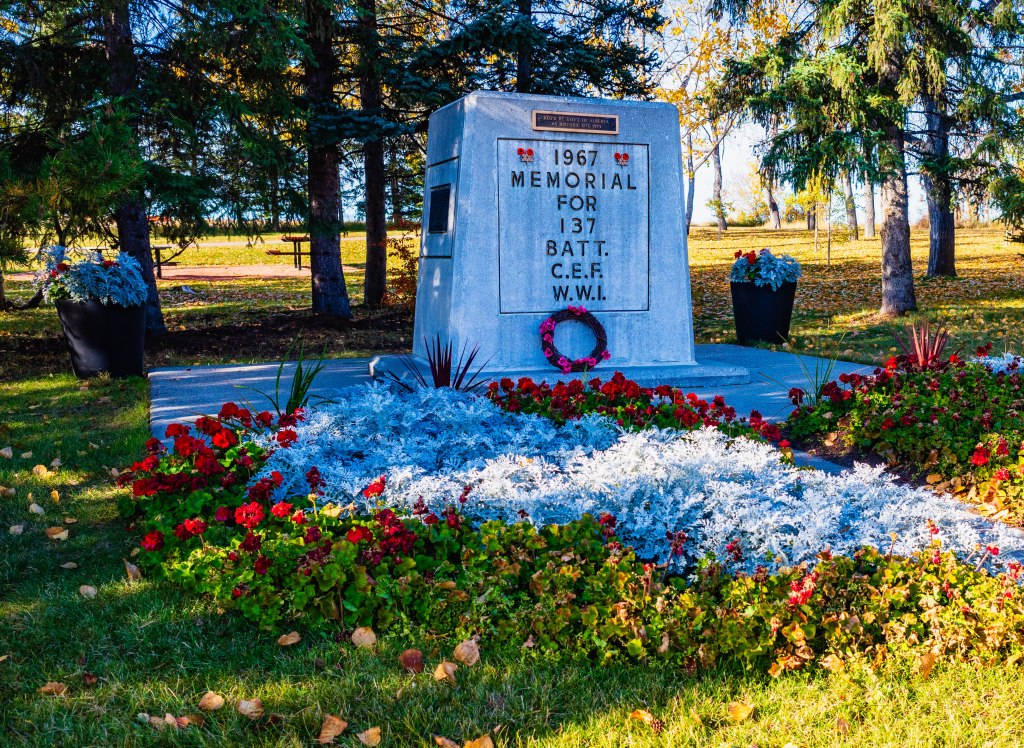
A couple of days later, I was jogging through North Glenmore Park, along the crest of the bluff. I ran by a monument at the west end of the park, one that I had passed hundreds of times. I decided to stop and check it out. The plaque indicated that this was a 1967 memorial to the 137th Battalion of the Canadian Expeditionary Force (the CEF) in World War I. I remembered that “137” was also one of the battalion numbers on Signal Hill.
The 1967 memorial to the 137th Battalion
I guessed, correctly, that this was the same 137th battalion immortalized on the hillside. Now I definitely had to make my way over to Signal Hill. I figured it would be a great excuse for a photo run.
I grabbed my camera (the Ricoh GR III of course) and parked at Battalion Park on Signal Hill Drive. Here’s the Strava entry for my easy run. It was a beautiful day and I did an enjoyable 6-kilometre loop around the neighbourhood.
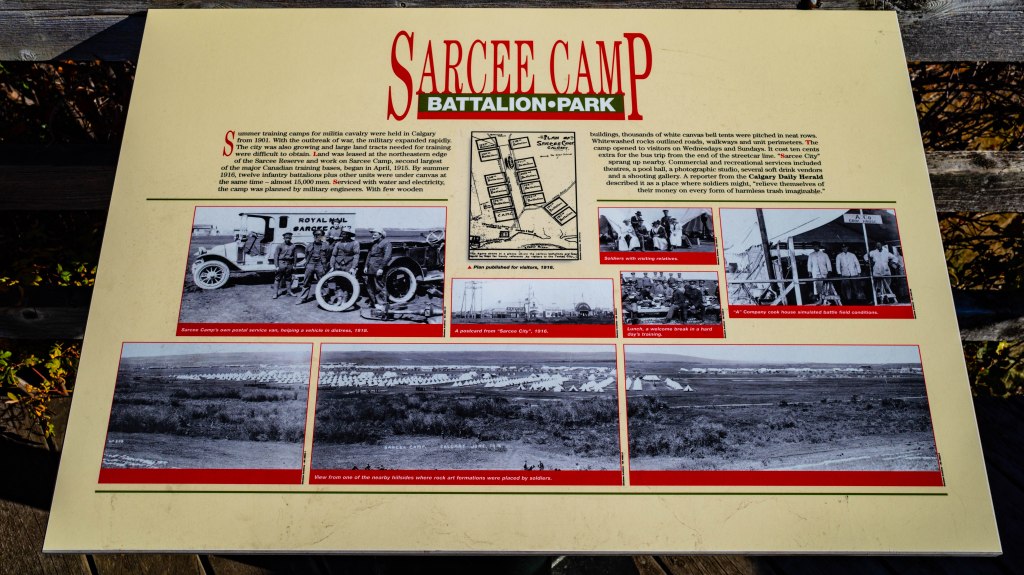
The story of Sarcee Camp is well explained in a series of plaques next to the stairs that wind through the markers. I learned that the camp was established in 1914. It was in a section of the Sarcee Indian reserve (now Tsuu T’ina) that was leased by the Canadian militia as a training site.
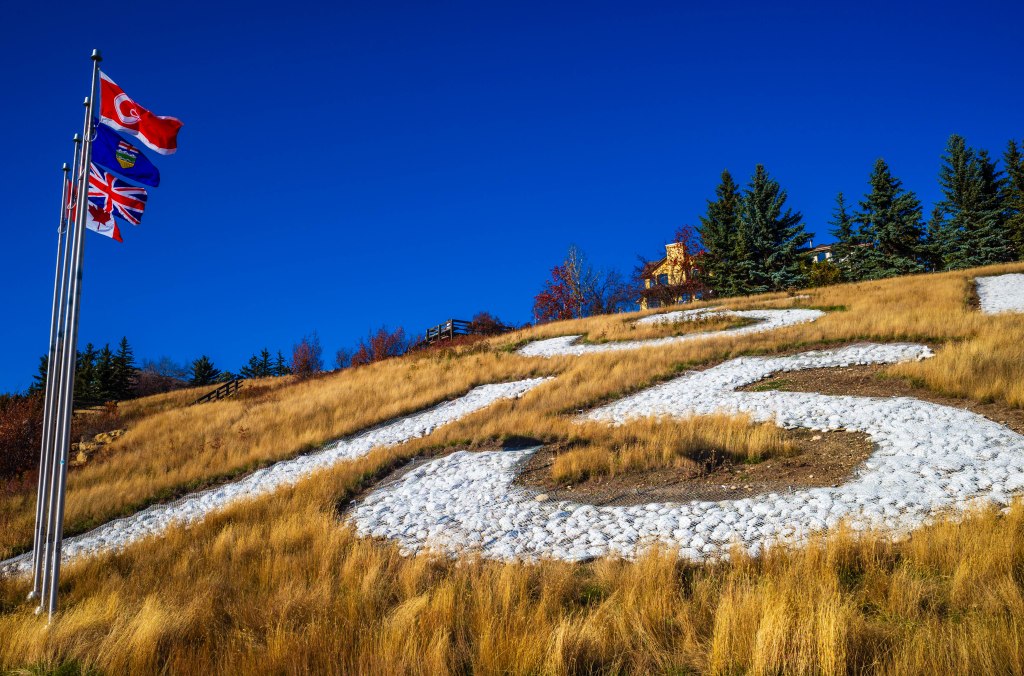
Sarcee Camp was a busy place. As many as 45,000 military personnel from 30 battalions trained at the site during the war. It was customary for each battalion to construct a “geoglyph” (that’s a design or motif created by humans and built into the natural landscape) with their unit number. They did this using stones hauled by hand from the riverbed, which is two kilometres away from the hill.
The 113 is the oldest of the four stone markers on Signal Hill. The 113th Battalion was formed as the Lethbridge Highlanders in 1915. The battalion relocated to Sarcee Camp in May 1916 and sailed for England in September of that year. The 113th was broken up for replacements, with most of the men transferred to France. The battalion never saw action as a unit and was disbanded in 1917.
The other numbers on the hillside were constructed by battalions of the CEF that trained at the Sarcee Camp, including the following:
The 137th Infantry Battalion of Calgary began recruiting in late 1915. After sailing to England in August 1916, the battalion was absorbed into the 21st Reserve Battalion. It’s worth noting that the King’s Own Calgary Regiment (RCAC) perpetuates the 137th Battalion. Members of the 137th Battalion CEF Association erected the memorial to the unit in Glenmore Park.
The 151st Central Alberta Battalion began recruiting in 1915. It sailed to England in October 1916 and was absorbed into several reserve battalions.
The 51st Canadian Infantry Battalion was recruited in Edmonton. It sailed to England in April 1916 and provided reinforcements for the Canadian Corps until it was reorganized in November 1916.
Although there were approximately 20 geoglyphs built, most were destroyed in the 1950s during the construction of a mess hall.
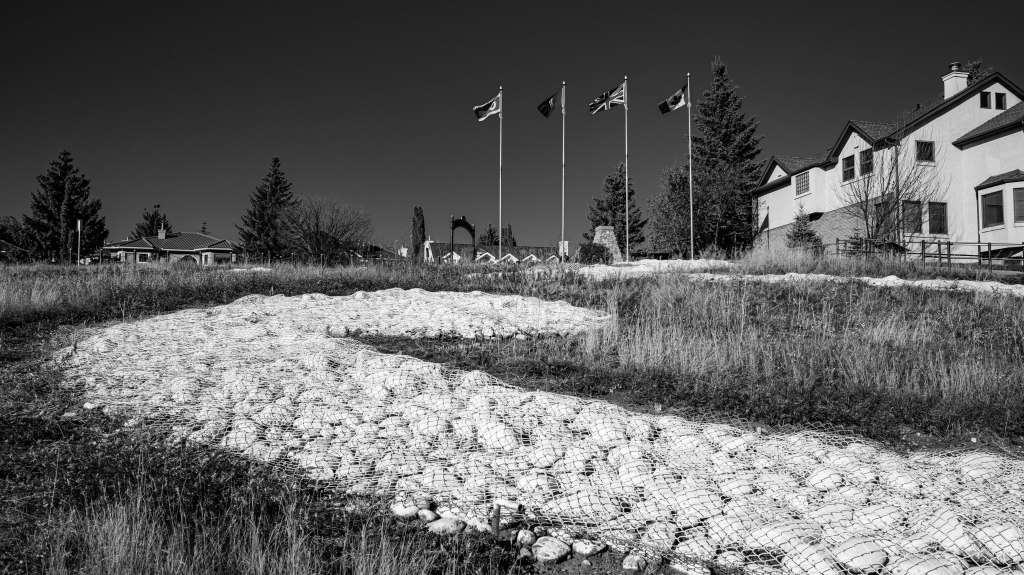
When we first moved to Calgary in the early 1990’s, the battalion markers were just about the only thing in the area. Over time, residential development nearly swallowed up the geoglyphs. Fortunately, there was enough recognition of the significance of these markers that they were preserved. In fact, three of the markers (137, 151 and 51) were meticulously moved a short distance from their original locations.
You can see a few photos I took during my cooldown walk. I found it quite challenging to get any perspective on the geoglyphs when I was right next to them. In that respect, the parking lot of the RONA store isn’t a bad place to stop and admire this unique piece of Canada’s military history. Even so, with Remembrance Day just around the corner, I recommend getting closer and doing more exploration if you have the time.











 My Second Running Life