

Today We Die a Little: Emil Zatopek, Olympic Legend to Cold War Hero, by British journalist and author Richard Askwith, tells the fascinating story of the great Czech runner, Emil Zatopek.
Zatopek was an enigma. His life paralleled his country’s history and is intertwined with the Second World War and the rise and fall of the Soviet Union. Askwith did a thorough job of researching his subject.
The Czech Locomotive
Today, if people know anything about Zatopek, it’s likely because of his ungainly running style. Videos of his great performances are easily found, and worth a look. But his rolling head, flailing arms and gnashing teeth may be the least interesting part of his story.
Emil was a true sportsman. His nickname comes from a front-running style that left his competitors strung out behind him. He befriended those same runners and maintained contact with them well into old age. His training techniques were unorthodox. For instance, he was known to train in army boots, or in deep snow. Any of us who have done interval workouts can thank Zatopek—he may have invented 400m repeats. The difference? He did 60, 80, even 100 of them—every day.
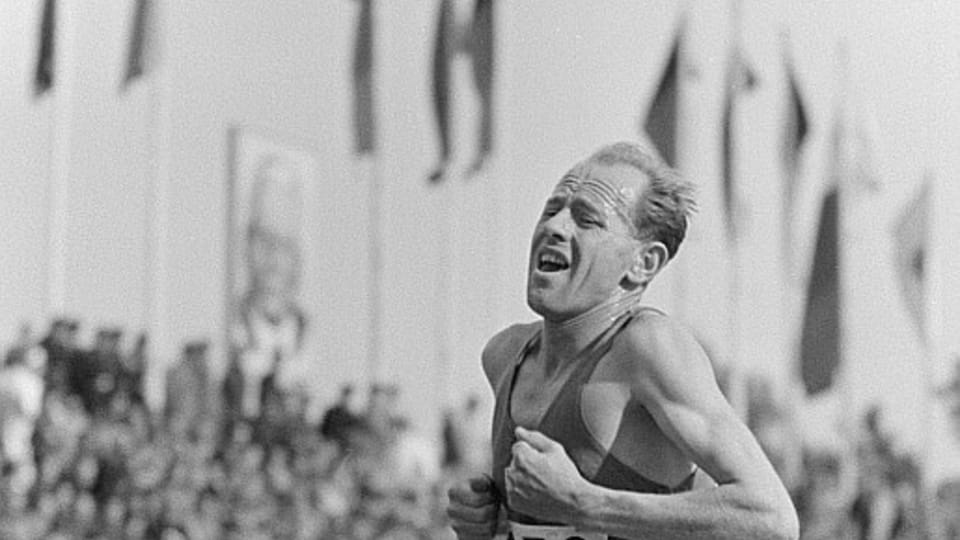
There are so many anecdotes about Zatopek that it’s nearly impossible to separate fact from fiction. I give Askwith credit for trying. Some things are undisputed. Emil taught himself 8 or 9 languages by reading dictionaries. He and his wife, Dana, won four gold medals at the 1952 Helsinki Olympics—a count that was second only to the US. Emil won the 5000m, 10000m and marathon, a record likely never to be repeated. Dana won the women’s javelin competition.
Socialist icon or misunderstood hero?
Zatopek may have been the most famous athlete in the world in the late 1940s and early 1950s. Few could match his talent and charisma—he was the Muhammad Ali of his generation. Even after his competitors copied his tactics and started surpassing him, he remained a national hero. It seemed everyone wanted to meet him and feel the warmth of his personality.
The story that best demonstrates Zatopek’s generosity has him handing a small package to Australian runner Ron Clarke after Clarke visited Emil in Prague in 1966. Clarke competed at a high level internationally but had always come up empty-handed. Zatopek was the perfect host, readily sharing his training advice. Clarke assumed Zatopek had given him something he wanted smuggled out of the Iron Curtain. In fact, it was one of Zatopek’s 1952 Olympic gold medals. “Because you deserve it,” read the inscription.
Despite the constraints imposed by the Czech regime, Zatopek travelled the world. In fact, he became a sort of role model for socialist ideals. And it’s here where his story gets a bit hazy. Depending on who one believes, Zatopek was either a naive pawn of the regime or a committed agent. He was an officer in the Czech army, so it’s hard to totally accept the former view. However, he had managed to tread a fine line for a long time, apparently avoiding any suspicion of his commitment just by being his gregarious self. Or perhaps by mouthing the words that were expected of him.
Some things may never be known about Zatopek, but it is clear he believed in the concept of socialism. After all, it was how he had tried to live. When Soviet tanks moved in to crush the Prague Spring in 1968, he spoke up for compromise, possibly hoping his celebrity would save him from retribution. Soon after, he was expelled from the army, stripped of his status as a sporting hero, and exiled to years of manual labour in remote work camps. Through it all, he maintained a positive attitude. He was a broken man when he was finally allowed to return to his modest home. Then he suffered several strokes and was all but forgotten when he died in 2000.
Lessons far beyond the track
Askwith is sympathetic to Zatopek, and I found that his enthusiasm for the man sometimes clouds his judgment. If Askwith is to be faulted, it is for trying too hard. I came to accept Askwith’s case—that there is reason to doubt the worst accusations against Zatopek—but I found it unnecessary that he keep making it.
As for Zatopek, there is no reason to fault him for his eccentricities. He was an intelligent, independent and humble man. I found myself wondering how any of us would have managed in his situation; if our homeland had been first taken by the Nazis, then by the Communists. Zatopek lived and competed bravely, and left us lessons that apply beyond the realm of amateur competition.
The “Czech Locomotive” was a complex figure, a great athlete, and a gentleman. Askwith’s book is an homage to Zatopek, and there is much to commend it, not least so the reader can decide for themselves how they view the man. I started the book and put it aside for a while. When I persevered, I was rewarded with a complete picture of an astonishing athlete. It’s a worthwhile read.
By the way, the title of the book comes from the comment Zatopek made to his fellow competitors on the start line of the 1956 Olympic Marathon in Melbourne. By then, Zatopek was well past his best form. The day was brutally hot, and he made his remark just as the runners set off for what they all knew would be an extreme physical test. It was a noble gesture. Anyone who has set a challenging goal for themselves and worked hard to achieve it will relate to the sentiment.
Until next time, be well and BE FAST!



 My Second Running Life