Prairie Mountain Sunrise, Part 2

The Science

After we returned to Calgary from our December 29 Prairie Mountain sunrise hike, I started to wonder about the small anomaly that led us to pick that day. Specifically, the fact that the day with the latest sunrise does not align with the winter solstice in the northern hemisphere. Before I get into the science, here’s another photo from that great morning.

Looking northwest from the summit (December 29, 2023)

I did some research and learned the interesting astronomical reasons for this phenomenon. I first looked up the sunrise/sunset tables for southern Alberta. The solstice occurred at 8:27pm on December 21, but the latest sunrise occurred more than a week later. Not only that, the date of our earliest sunset was well before the solstice… way back on December 12, to be exact. 

What’s going on here? After all, these differences are not small. 

While we think of the solstice as the shortest day based on sunlight hours, it isn’t the shortest “solar day”, defined as the measured time from noon on one day to noon on the next. In fact, solar days are the longest in December.

A recent article in Scientific American explains that there are two reasons for this counterintuitive result. With all credit to the excellent minutephysics video by Henry Reich (“Why December Has the Longest Days”) referenced in the article, I’ve reproduced the two reasons in the following chart.

First, the shape of the Earth’s orbit is not a circle but an oval, an ellipse. The difference between the earth’s nearest and farthest points from the sun is small, about 3% of its average orbital distance of 150 million kilometres. This matters because as the earth reaches its closest point (perihelion), it moves faster through space. The faster movement lengthens the time needed for a given line of longitude to come around the next day to align with the sun. This effect adds about eight seconds to the solar day.

Besides the eccentricity of the earth’s orbit, the tilt of the earth’s axis also contributes to the disparity between solar day and clock day. This effect, called the obliquity effect, lengthens the days by about 20 seconds around the solstices, and shortens them by about 20 seconds around the equinoxes.

The impact of these two factors on the solar day is well known. There is even an “equation of time” to relate solar time to clock time. Mathematically, the effect is represented by two sine functions. The frequency of the eccentricity curve matches the earth’s annual rotation, and the tilt curve goes through two cycles each year. The figure below was generated on PlanetCalc. It shows how adding the curves results in solar days that are shortest in February and longest in December. There is also a smaller peak in the spring and a dip in the summer.

Source: PlanetCalc Equation of Time calculator for 2024

Because perihelion occurs close to the winter solstice (on January 2), the two day-lengthening effects are additive, totalling about 30 seconds a day at the peak in November. These “extra” seconds are pushed forward to subsequent days, making solar noon later and later at that time of the year. And because sunrises and sunsets are symmetrical around solar noon, we get the observed result: the earliest sunset gets shifted backward (before the solstice) and the latest sunrise gets pushed forward (after the solstice).

Whew!

I expected the answer to this question to be simple, but it’s taken me a few tries and a lot of soak time to understand.

Somehow it seems appropriate, having just started a new year (and passed the perihelion), to recognize that the universe is full of mystery. 

Prairie Mountain Sunrise, Part 1

My friend Tim can always be counted on to organize good outings. A coffee, a lunch, a hike. He organized our excellent excursion to Pocaterra Ridge in September to see the larches.

One of Tim’s good ideas in the last few years is a sunrise hike to the summit of Prairie Mountain in Kananaskis. He’s been considerate enough to arrange the hike on the day with the latest sunrise. This year, that day was December 29. Before the hike, I didn’t independently verify Tim’s assertion on this point. More on that in Part 2 of this post. But I did enjoy the extra two minutes of sleep that I was told would be available by delaying our hike from the winter solstice by eight days. 

Dan and I joined the convoy that left Calgary at 6:20 to reach the trailhead by 7:10. A testament to the popularity of Tim’s idea is that our group was ten this year, up from five last year. Mind you, last year’s -20C temperature may have been a contributing factor. (I passed on that one.)

The hike was great. It was my first time on the new and improved Prairie Mountain trail. It’s now 8.4 km with 711 metres of elevation gain. The modifications evened out the trail’s steepest segments, added some Lawrence Grassi-like stone steps in a couple of places, and widened the trail. Even in the dark, lit by a headlamp, I liked the changes. I’m not a PM veteran or a mountain goat. I have done the hike maybe six times, in various weather conditions. And I’ve been in a couple of slippery situations on the old trail that left me wondering if we’d taken a wrong turn. It just never seemed safe to me. Now it does. 

We may have been a bit late getting started. The southeastern sky was already lit with beautiful shades of pink at the first viewpoint. We hustled onward, knowing that if we could get onto the summit ridge we would see the sun break the horizon. Our time for the ascent was about 75 minutes. 

We didn’t have long to wait once we reached the 2,210-metre summit. The light display was stunning. Sunbeams streamed around a lone cloud that was parked just above the horizon. 

First rays (December 29, 2023)

I had my Ricoh GR III with me. (Yes, I know, I say this often, but I really love this camera!) We snapped a few group shots as the sun made its appearance.

The group, on the summit

To the northwest, Moose Mountain was glowing, with snowy highlights and a rosy sky above. 

Moose Mountain looking splendid

We enjoyed the vistas and took more photos. As I reached for a snack, I realized that my fingers were freezing. It was deceptively cool, but thankfully the summit winds were moderate. That isn’t always the case on Prairie. We started down, trading our headlamps for sunglasses.

On the descent

An enjoyable coffee and treat at the Bragg Creek Cafe & Baking Co. rounded out the morning. 

Happy New Year to all!

December Run Streak, Non-festive Edition

The month is almost over, and that means the end of the Strides Run Streak. Looking forward from our December 1 start, the task seemed daunting. But here we are, already closing in on January. The persistent pattern of warm weather and the relative absence of snow in the city this year have certainly made our task much more bearable. Even so, I don’t mind saying that I’m looking forward to a day off on January 1.

Now that Christmas is in the rear-view mirror, I felt I should do a follow-up post to my last piece. That one was my attempt at a (slightly) festive piece, in keeping with the season.

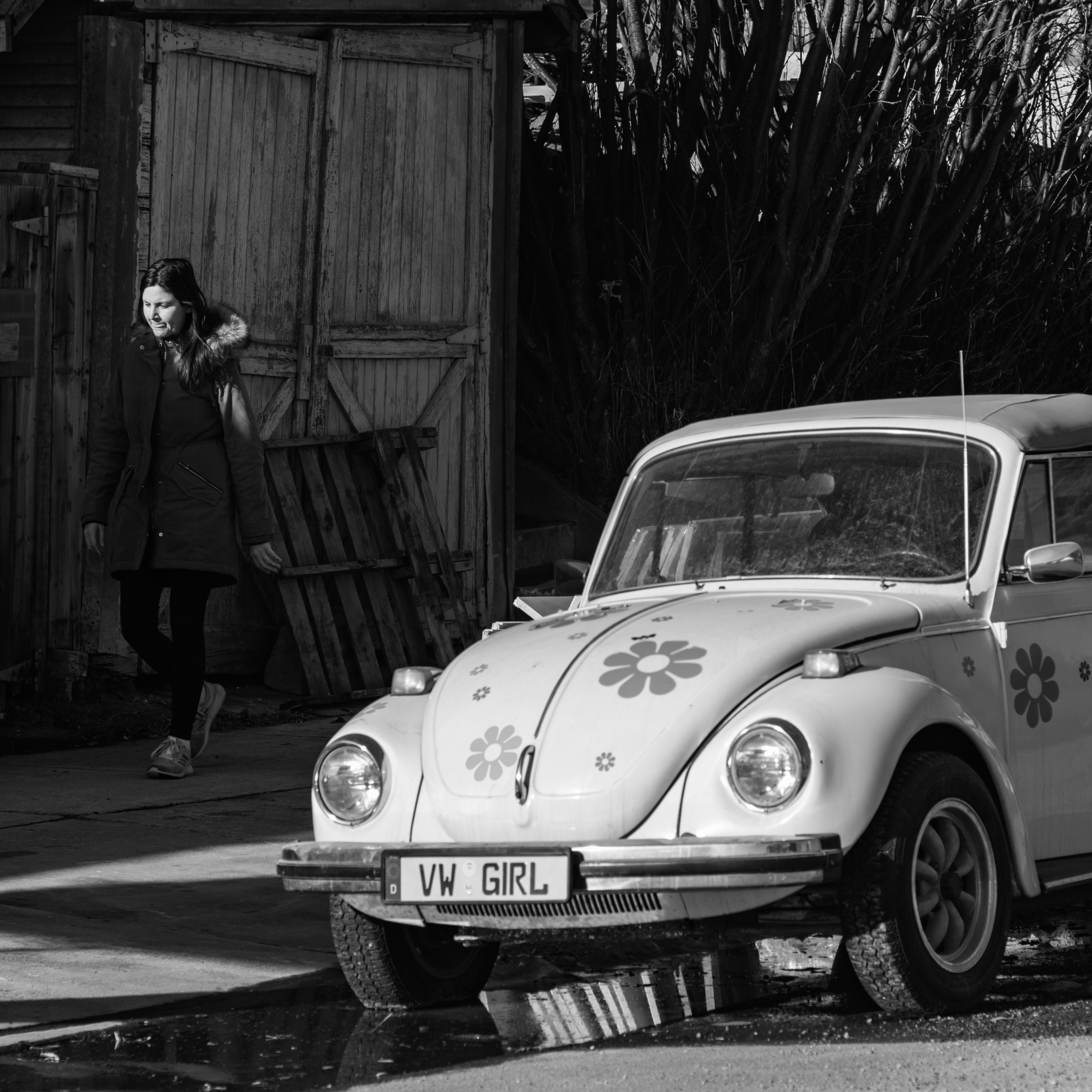
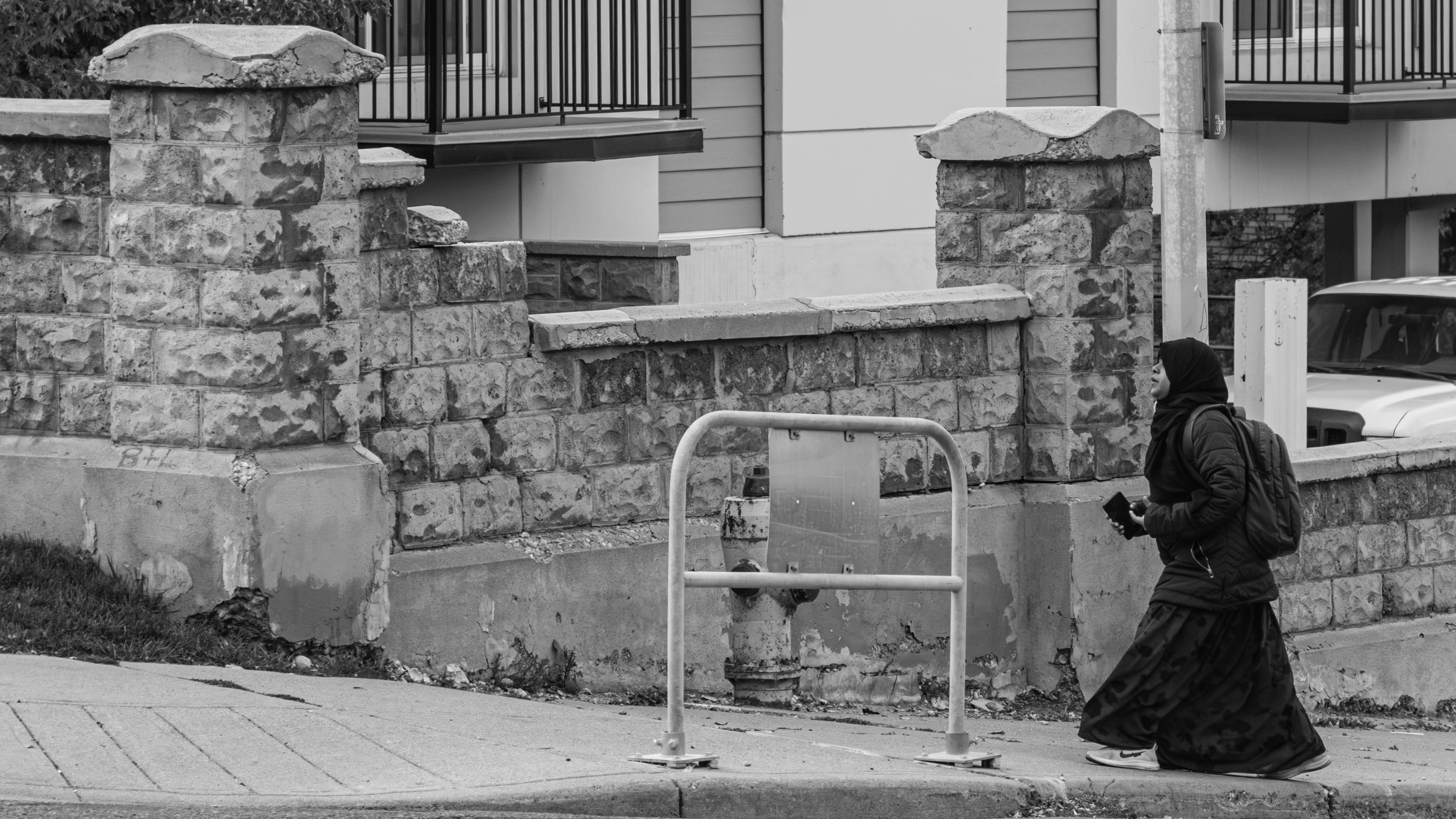
This time, I feel I can loosen up the constraints. The photos in this post were all taken while out for one of my December runs. They were all taken with the incomparable Ricoh GR III. However, the subjects are less “Santa” and more “street”. These are subjects that fall closer to what I might normally look for when I’m out and about with my camera.

So, with no explanatory text, I present… my December Run/Photography Streak, non-festive edition:

Let me know what you think. I haven’t seen much in the comments section lately.

Until next time, Happy New Year!

In closing, I’ll mention that my book, Stroke of Luck: My Life in Amateur Athletics, will be available on Amazon for a special resolution sale price, starting in January. Thanks to everyone who has already picked up a copy. It’s been great hearing your thoughts on the book.

Luck… and Good Light

Don’t forget my Black Friday sale, through the end of November. Get your copy of Stroke of Luck: My Life in Amateur Athletics on Amazon for a marathon-inspired 26.2% discount!

Photography can be a curious hobby.

Sometimes pictures are everywhere. Other times you feel that you have lost the plot. Try as you might, it seems there are no worthwhile subjects at all. 

The last few weeks have been tough for a variety of reasons. Time hasn’t been on my side, due to work and volunteer commitments. Cameras have been sitting idle. And it doesn’t help that my motivation has been running low. Maybe it’s a seasonal thing. With the shorter days, finding an interesting scene… just finding any light at all… is difficult. 

But here’s the good news. Whatever light we have at this time of year is often stunning. Any decent sunrise or sunset can be an easy capture because you don’t have to be up at an ungodly hour to shoot it. We are blessed in Calgary to have plenty of picturesque shots, thanks to our frequent Chinook arches
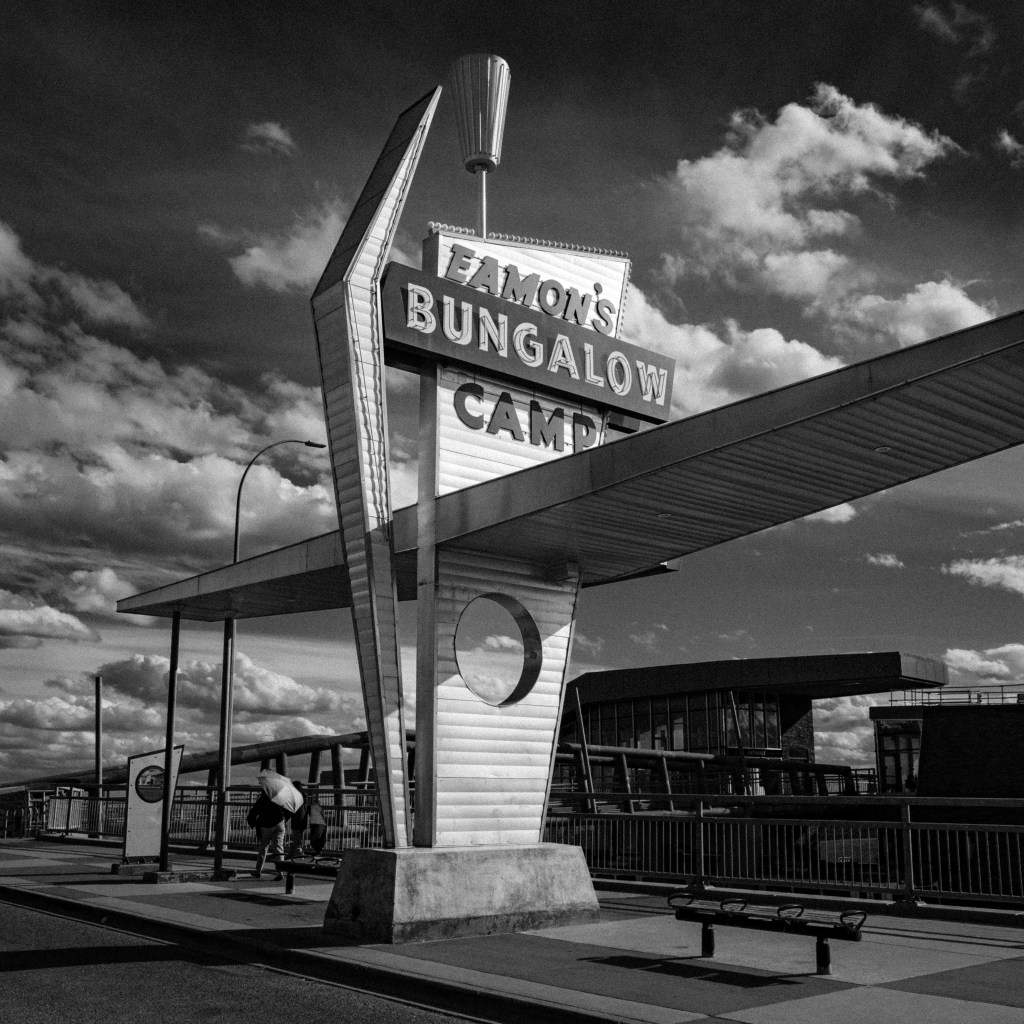
As if to remind me to snap out of my little funk, I’ve had several fortunate scenes appear before my eyes in the last week. 

One day, the light in the house was suddenly and strangely pink in the late afternoon. I looked outside, and the sky was glowing a magnificent rosy shade.  I almost tripped down the stairs to grab my Ricoh GR III. Quick, get out there! Shoot something! 

Admittedly, the firefighter across the street at the No. 5 Fire Station was slightly surprised to be the subject of my random shot, especially as he was walking to the rubbish bin. It didn’t matter. I wasn’t looking at him but at the amazing pink clouds above his head. A firestorm above the firehall. Easy!

No. 5 Fire Station, Fiery Sunset (November 2023)

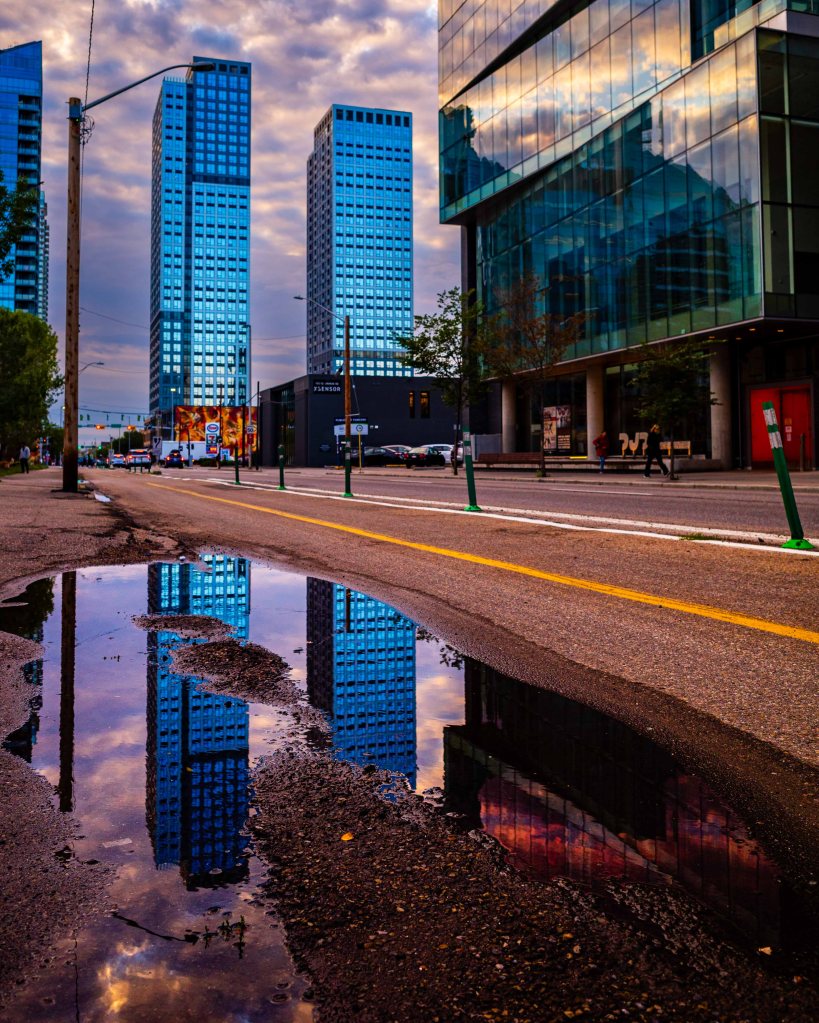
Then, a few days later, as I picked up some things at the downtown Staples, I was drawn to a scene I’d passed many times. The setting sun was dipping below a Chinook arch and casting a golden glow over the skyscrapers. More awesome light. Again, shoot something. Anything! 

Looking east along the CP rail line, the tracks make natural leading lines. My challenge in the past has been in finding something to lead to… something other than a moving train, that is. 

Then I spotted my subject. A guy on a cool fixed-gear bike with bright green wheels was heading north on 11th Street. Standing in the middle of the street, I felt a bit exposed. I fumbled for my iPhone 14. C’mon man… hurry! I snapped my picture at the last split second, just as he entered my scene. Then I hustled out of the reach of the oncoming cars. 

Later, when I sat down with my pictures, I was more than happy with the results. With what had been snap-and-dash shots, I managed to get a couple of keepers.

Green Wheels, Golden Hour (November 2023)

Luck and good light. 

Just goes to show that you have to always be ready. And never give up. 

What Makes a Good Photograph?

Most of us carry a camera around every day and make liberal use of it. There are surely more photos being generated now than at any time in history.
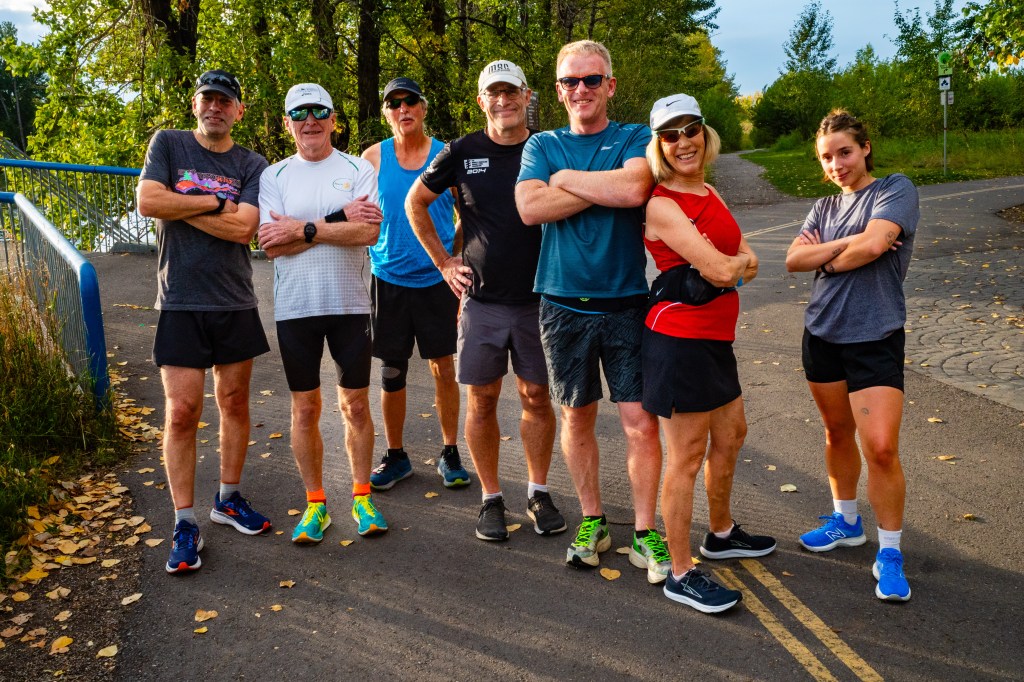
It’s obvious that the vast majority of these photos are meant for instant consumption. They aren’t expected to be great, and 99.99% of them aren’t.

Anyone who has a sincere interest in producing photographs that stand out from the crowd faces a real challenge.

So what makes a good photograph?

Maybe we can try to check a few boxes. Is the picture well composed; is it sharply focused; is it properly exposed? In other words, we might be tempted to conclude that technical quality is essential for a good photograph.

But these metrics don’t tell the whole story. On one extreme, Ansel Adams is known for technically perfect photographs. But, for every technical purist, there is a photographer who is more intuitive. Think of Robert Capa’s iconic photos from the Normandy beaches on D-Day. They aren’t perfect, but no one could deny they are iconic photographs.

If a photograph has emotional impact, then we will likely be willing to overlook any technical flaws.

One of my favourite bloggers, the late Tim Vanderweert, wrote a number of pieces on aesthetics. I went back and read some of the excellent pieces on his Leicaphilia website. Tim had the breadth of understanding of philosophical concepts that let him dig into the works of Leibniz, Hume and Kant, in order to try to explain the foundations of what we perceive as beauty.

The essence of Tim’s observations, which I’ve significantly simplified for my purpose, is that aesthetic judgements are neither objective nor subjective. (Only Tim could make the connection between the classical philosophers and our modern perceptions of art in general, and photography in particular. I’m glad he did.)

Even if they don’t resolve the question, these concepts help explain why one person’s sense of what makes a good picture is different from others.

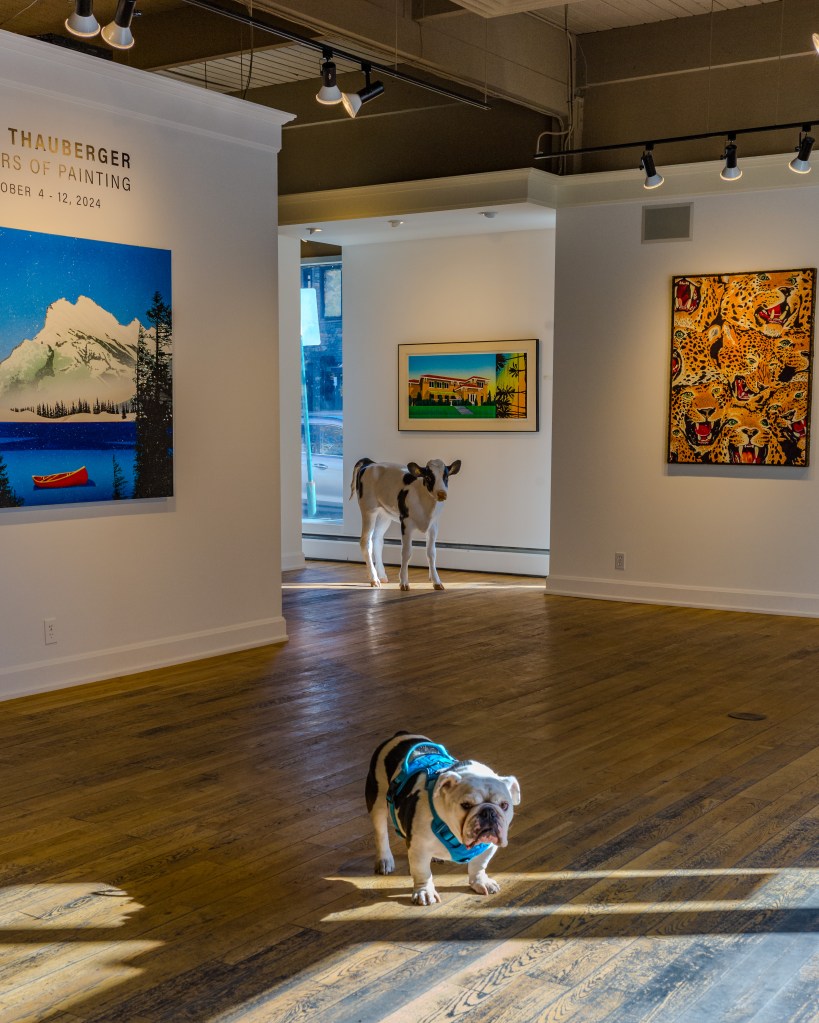
I’ve learned a few things when it comes to photography. First, I have to trust my instincts. I look around constantly. I try to be ready in case a scene develops in front of me. And most importantly, if a scene attracts my attention, I reach for a camera. This hastily taken photograph in Calgary’s Masters Gallery is an example. I’m pretty sure I didn’t do more than guess at my settings. The result is far from perfect technically, but I think it works.

Borduas and Friend (Leica M3, 2022)

Second, I’ve learned to make my best effort to get the technical bits right, then do a careful job of editing until I like what I see. Maybe it’s colour, form, a humorous scene on the street, an interesting cloud formation, or something else. Maybe I shot the picture on film or on my phone. Maybe I have to crop the original to highlight what I saw. It doesn’t matter. Whatever it was that made me take the picture, select it from among all the others, and then labour over it in Lightroom is probably worth seeing to a conclusion.

Third, I’m getting used to not seeing much of a reaction from Instagram, probably because most users on that platform (for reasons unknown) are more interested in pictures of my lunch. And that’s okay too. It’s just that I don’t usually see any merit in taking pictures of my food when there’s so much more out there.

Subway escalator, San Francisco (Olympus OM-2, 2019)

I guess I didn’t answer the question. But at least it’s fun to keep exploring.

Downtown Wildlife “Photo Run”

A reminder that Stroke of Luck is now available. Click here for details.

I often feel that I’m rewarded with photo opportunities as long as I have a camera close to hand. Last week I made a rare trip into downtown. It was a day after the first blast of winter in Alberta. The snow was still falling. 

I’d walked by the Harley Hotchkiss Plaza next to the courthouse many times, and I’ve always admired the Joe Fafard sculpture (Do, Re, Mi, Fa, Sol, La, Si, Do). It is a special installation… large, dynamic and colourful. 

Fafard (1942-2019) is known for his large sculptures, which often feature animals and play with perspective. Many of his works are humorous and they always show his keen wit.

Fafard produced the eight horses that comprise this work from powder-coated 5/8” steel plate in 2010. There is a duplicate of the piece installed in le parc Notre-Dame-de-la-Garde in Quebec City. Apparently, Fafard used laser-cut steel pieces salvaged from his other works to create the horses. Up close or at a distance, they are fantastic.

I’ve taken pictures of Fafard’s sculpture a few times, but each time I found the size and breadth of the piece (not to mention an often busy background) made it hard to photograph. On this day, though, the snowy scene was a perfect monochromatic backdrop. I stopped for a few shots with my Ricoh GR III. 

When I edited my photo, I made use of the latest masking features in Lightroom. Adobe says these are based on AI. Whatever they did, they made the process quite intuitive. It saved me a lot of time in this case, because I visualized the photo with the intricate figures separated from the background. To make the horses stand out even more, I reduced the saturation in the background. 

Here is the result. I hope you like it. (Yes, it is a slight cheat, but I figure that since the horses are running, I can officially call this session a “photo run”.)

Do, Re, Mi, Fa, Sol, La, Si, Do by Joe Fafard (2010)

A little further north on 4th Street, I stopped again. This time, it was to admire the massive mural of a peregrine falcon on the south side of the building at 441 5th Avenue SW. The piece is by Jerry Rugg, who is known in the world of muralism as birdO. Rugg is a multidisciplinary artist based in Toronto. His beautiful mural was done for the Beltline Urban Mural Project (BUMP) in 2021.

birdO works on canvas, in digital print, and installation, but he may be best known for his large-scale mural work on walls and buildings around the world. This is a great example. I love this piece, and I especially like the way it brightened up an otherwise cold, grey day.

As in the previous photo, I toned down the saturation in the background, which was admittedly already desaturated. This let the brilliant colours in birdO’s mural shine.

Peregrine Falcon, BUMP mural by birdO (2021)

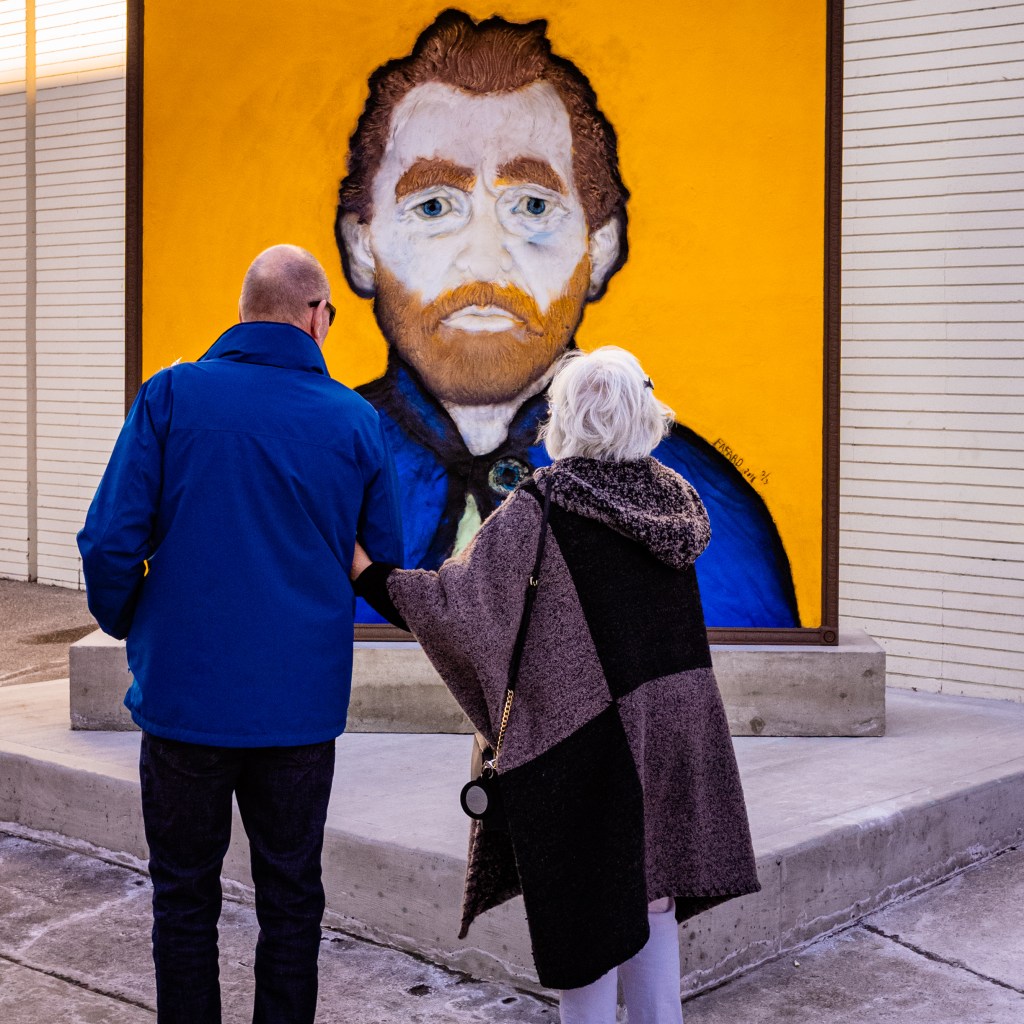
Speaking of Joe Fafard, I can’t resist including a closing word about him. There are several impressive Fafard pieces around Calgary. My favourite is Van Gogh Observes, a monumental piece which can be found outside Masters Gallery on 4th Street SW in Mission. According to the gallery’s description, it is one of Fafard’s largest pieces.

This shot is from my archives. I was lucky to capture Van Gogh, apparently engaged in conversation with a passing couple in 2020.

Van Gogh Observes by Joe Fafard (2018)

Stroke of Luck – Now Available!

I’m pleased to announce that my memoir, Stroke of Luck: My Life in Amateur Athletics, was recently published. The book is available now on Amazon (in either print or e-book format) or through independent bookstores. For those in Calgary, you can reach out to me directly for a copy. You’ll find details about the book on the dedicated page on this site. Click here.

Writing and publishing the book has been a personal journey of discovery. I hope you will enjoy reading about my lifelong connection with distance running, and the process of recovering from a number of strokes in 2017.

To my readers, and to those of you following me on the blog or on Instagram, I appreciate your interest and support. I look forward to sharing more stories and photographs with you.

Steve

Stroke of Luck: My Life in Amateur Athletics – order your copy today!