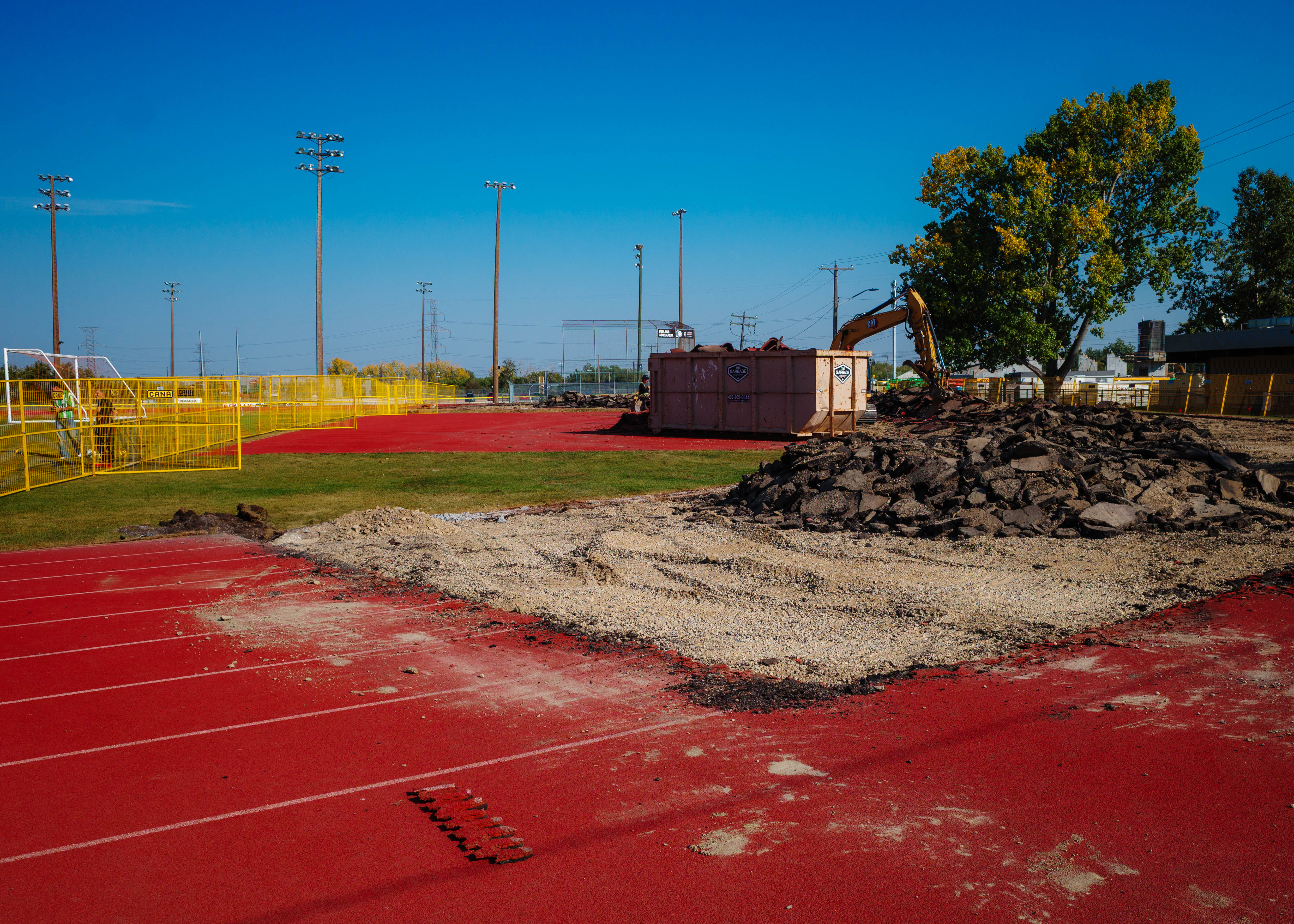
So that’s it. The end of an era. The south end of the original Glenmore Athletic Park (GAP) track—I call it GAP 1.0—is gone. Torn up.
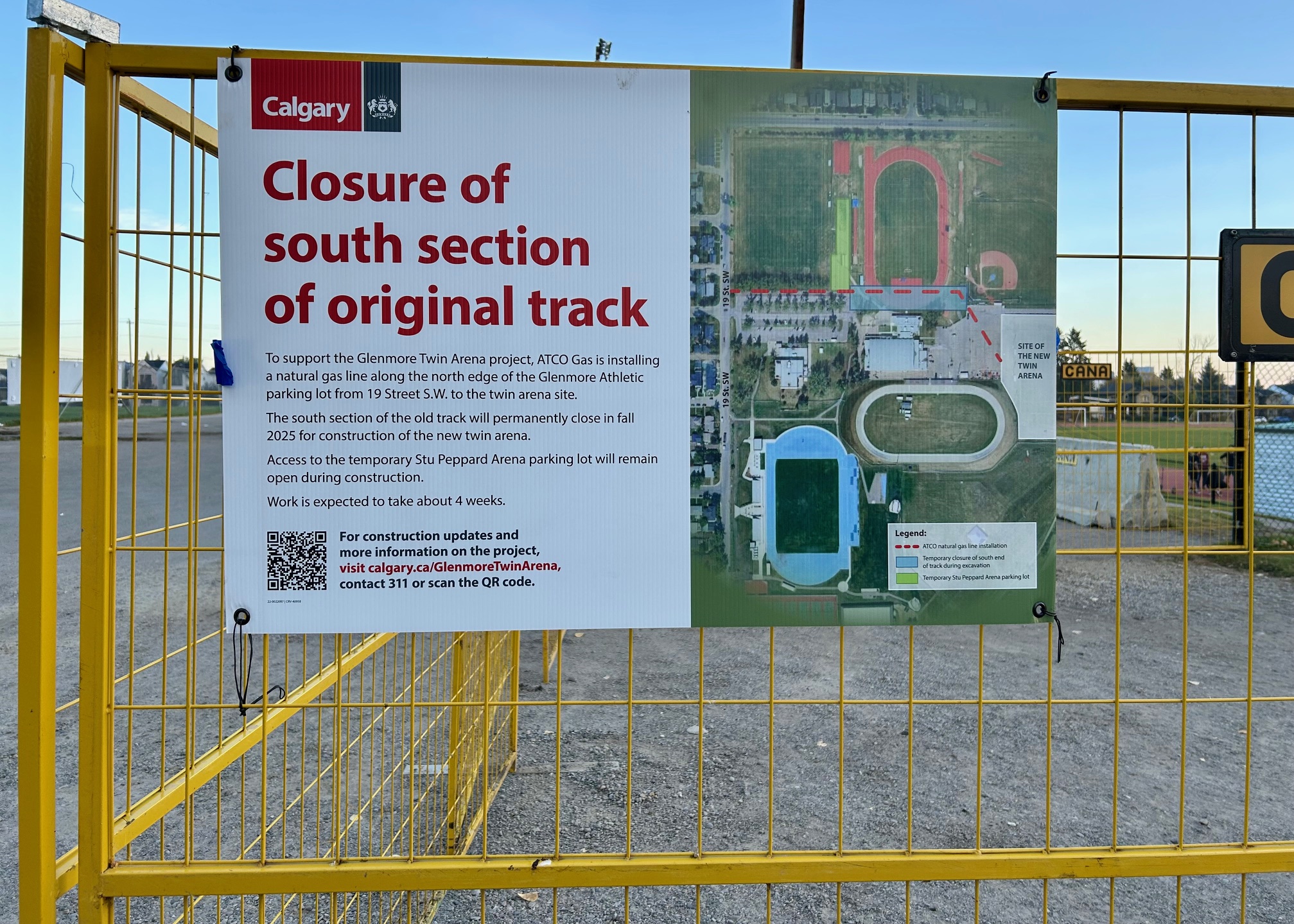
I know the guys in the excavators are just doing their job, but it was hard to watch them pulling up the tattered red surface. The sign posted on the fence helpfully explains that the work is for the installation of a natural gas line to serve the new Glenmore Twin Arena that is being constructed nearby. According to the City website, the south end of the track will become a parking lot. Of course, another parking lot.
I have countless memories of the old circuit. It’s been the site of race finishes (like the Stampede Road Race), club events like handicap races, and innumerable workouts. GAP has hosted hundreds of track meets over the last six decades, including one in May 2011, where my mates and I set a Canadian M35 age group record for the 4x800m relay. (Our record didn’t stand for long, so don’t bother searching for it.)
I wrote about the old GAP track in Stroke of Luck, about how just seeing the red surface puts me in a comfortable place. I also did a blog piece—Homage to GAP 1.0—to mark the seventieth anniversary of Roger Bannister’s historic four-minute mile and the sixtieth (or so) of the GAP track itself. That was more than a year ago.
Sure, with a new, modern facility (some have started calling that one Smurf Turf, but I prefer Big Blue) being built a stone’s throw away, the writing was on the wall. I dared to hope that the City would keep the old place open. And if that wasn’t going to happen, I was sure they would leave it in service until the new track was ready. Well, now we have our answers: no and no.
Here is the main issue I have with the City’s decision: there’s no convenient alternative for running clubs that train in Calgary’s Southwest. As rough as the surface was, the track was in constant use by individual runners and clubs. To demonstrate their commitment, athletes regularly organized themselves into shovelling crews to keep a couple of lanes open through the winter. Speaking of the winter, progress on the new facility seems rather slow, so we’ll have to wait until sometime in the new year.
I pointed out all of these things when I called 311 today, but it won’t change where we are.
I don’t need to repeat what I wrote in my previous piece. Instead, with a distinct feeling of nostalgia, the best thing for me to do is add a few more memories, to convey what the old track meant to me.
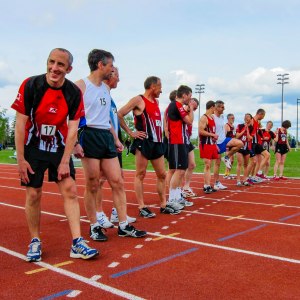
Here’s a photo from a one-mile senior’s challenge race, which took place in May 2010. It was all smiles on the start line, except for competitor 15 (me). For the record, I never smiled in the final few minutes before the gun. That’s okay, though, as I doubt anyone was smiling ten minutes later. I have no record of the results, so that might mean I didn’t do very well. Even so, it’s a cool memory.
This is the current state of the spotting booth on the back straight. Although the plywood mural that covers the scoreboard is deteriorating and falling off in chunks, I can report that the pigeons that have taken up residence in the booth are doing well. I like the juxtaposition of these two half-images.
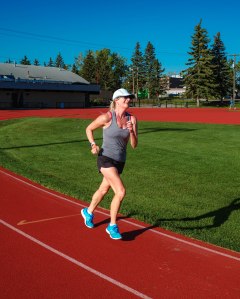
And here’s a photo I took during a recent workout. My friend Doreen and I ran intervals on a beautiful, warm August morning. Little did we know it would be our last spin around the track. This photo of Doreen, smiling as she heads into the back straight, seems to be a fitting one to close with.
I don’t know if there is such a thing as a memorial service for a facility, but I feel like the Calgary running community could do with one in this situation. For now, I tore off a chunk of the synthetic rubber surface as a keepsake. Deb was grossed out, but I don’t care—I’ll keep it in the garage.
Maybe I should deal with this the way I usually do—go for a jog and come to terms with this disappointing news.
Today We Die a Little: Emil Zatopek, Olympic Legend to Cold War Hero, by British journalist and author Richard Askwith, tells the fascinating story of the great Czech runner, Emil Zatopek.
Zatopek was an enigma. His life paralleled his country’s history and is intertwined with the Second World War and the rise and fall of the Soviet Union. Askwith did a thorough job of researching his subject.
The Czech Locomotive
Today, if people know anything about Zatopek, it’s likely because of his ungainly running style. Videos of his great performances are easily found, and worth a look. But his rolling head, flailing arms and gnashing teeth may be the least interesting part of his story.
Emil was a true sportsman. His nickname comes from a front-running style that left his competitors strung out behind him. He befriended those same runners and maintained contact with them well into old age. His training techniques were unorthodox. For instance, he was known to train in army boots, or in deep snow. Any of us who have done interval workouts can thank Zatopek—he may have invented 400m repeats. The difference? He did 60, 80, even 100 of them—every day.
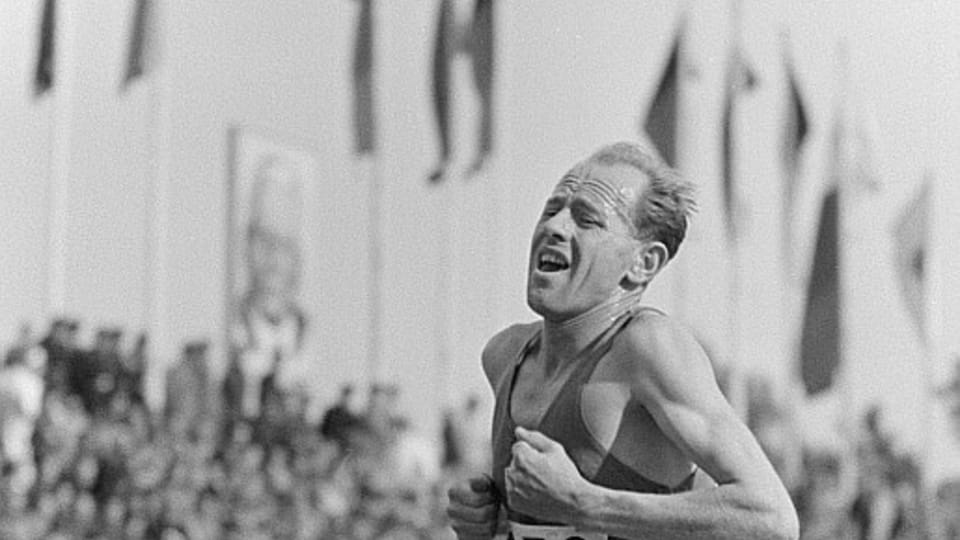
Emil Zatopek, giving it his all (Photo: Roger Rössing, Deutsche Fotothek)
There are so many anecdotes about Zatopek that it’s nearly impossible to separate fact from fiction. I give Askwith credit for trying. Some things are undisputed. Emil taught himself 8 or 9 languages by reading dictionaries. He and his wife, Dana, won four gold medals at the 1952 Helsinki Olympics—a count that was second only to the US. Emil won the 5000m, 10000m and marathon, a record likely never to be repeated. Dana won the women’s javelin competition.
Socialist icon or misunderstood hero?
Zatopek may have been the most famous athlete in the world in the late 1940s and early 1950s. Few could match his talent and charisma—he was the Muhammad Ali of his generation. Even after his competitors copied his tactics and started surpassing him, he remained a national hero. It seemed everyone wanted to meet him and feel the warmth of his personality.
The story that best demonstrates Zatopek’s generosity has him handing a small package to Australian runner Ron Clarke after Clarke visited Emil in Prague in 1966. Clarke competed at a high level internationally but had always come up empty-handed. Zatopek was the perfect host, readily sharing his training advice. Clarke assumed Zatopek had given him something he wanted smuggled out of the Iron Curtain. In fact, it was one of Zatopek’s 1952 Olympic gold medals. “Because you deserve it,” read the inscription.
Despite the constraints imposed by the Czech regime, Zatopek travelled the world. In fact, he became a sort of role model for socialist ideals. And it’s here where his story gets a bit hazy. Depending on who one believes, Zatopek was either a naive pawn of the regime or a committed agent. He was an officer in the Czech army, so it’s hard to totally accept the former view. However, he had managed to tread a fine line for a long time, apparently avoiding any suspicion of his commitment just by being his gregarious self. Or perhaps by mouthing the words that were expected of him.
Some things may never be known about Zatopek, but it is clear he believed in the concept of socialism. After all, it was how he had tried to live. When Soviet tanks moved in to crush the Prague Spring in 1968, he spoke up for compromise, possibly hoping his celebrity would save him from retribution. Soon after, he was expelled from the army, stripped of his status as a sporting hero, and exiled to years of manual labour in remote work camps. Through it all, he maintained a positive attitude. He was a broken man when he was finally allowed to return to his modest home. Then he suffered several strokes and was all but forgotten when he died in 2000.
Lessons far beyond the track
Askwith is sympathetic to Zatopek, and I found that his enthusiasm for the man sometimes clouds his judgment. If Askwith is to be faulted, it is for trying too hard. I came to accept Askwith’s case—that there is reason to doubt the worst accusations against Zatopek—but I found it unnecessary that he keep making it.
As for Zatopek, there is no reason to fault him for his eccentricities. He was an intelligent, independent and humble man. I found myself wondering how any of us would have managed in his situation; if our homeland had been first taken by the Nazis, then by the Communists. Zatopek lived and competed bravely, and left us lessons that apply beyond the realm of amateur competition.
The “Czech Locomotive” was a complex figure, a great athlete, and a gentleman. Askwith’s book is an homage to Zatopek, and there is much to commend it, not least so the reader can decide for themselves how they view the man. I started the book and put it aside for a while. When I persevered, I was rewarded with a complete picture of an astonishing athlete. It’s a worthwhile read.
By the way, the title of the book comes from the comment Zatopek made to his fellow competitors on the start line of the 1956 Olympic Marathon in Melbourne. By then, Zatopek was well past his best form. The day was brutally hot, and he made his remark just as the runners set off for what they all knew would be an extreme physical test. It was a noble gesture. Anyone who has set a challenging goal for themselves and worked hard to achieve it will relate to the sentiment.
When it comes to running history, few races can match Hamilton’s 30k Around the Bay Race. Many greats of the sport have competed in this event since it was first held in 1894, three years before the Boston Marathon. The late Jerome Drayton, one of Canada’s greatest runners, won the race in 1973 and 1974.
It occurs to me that this historic race deserves to have a book written about it. Short of that lofty goal, on this, the eve of the 131st edition of the race, I will add a retrospective piece to share what the “Bay Race” means for me.
The Around the Bay Race
For those unfamiliar with the race, it starts and finishes in downtown Hamilton. The course was measured in imperial units for almost 90 years, before being standardized at 30 kilometres in 1982. To this day, it is one of the few races contested at this distance. It’s a perfect tuneup for anyone planning a spring marathon. Even though the distance has varied, the roughly triangular course has remained the same.
The course has three distinct sections. Really, it’s three distinct personalities. The first 10k skirts Hamilton’s north end, the gritty industrial district that many people associate with the city. The middle third includes a narrow, exposed stretch on Beach Boulevard, between Hamilton Harbour and Lake Ontario. The final 10k through suburban Burlington is notable for rolling hills, which are a test for already tired legs.
As if that wasn’t enough, we must remember that we live in Canada and the race is held the last weekend of March. To state the obvious, weather can be a factor for ATB competitors. (It looks like that might be the case for this year’s edition, but forecasts can be wrong!)
1977 – Into the fray
My personal connection to the ATB goes back to my earliest days in the sport. I first ran the race in 1977, as a novice 16-year-old runner. I wrote extensively about the race in my memoir, Stroke of Luck. Here’s an excerpt:
“That same year, our coach proposed that several of us tackle a unique challenge, the annual Around the Bay Race. Even now it would seem odd to put teenagers through the kind of training needed to attempt this race. His logic was sound—he wanted us to build a base of fitness for the longer track races. … Three of us were signed up for the race. Our training program was simple but surprisingly effective. A couple of times each week, our coach would drive us eight or ten miles from the school and drop us off, and we would run back.”
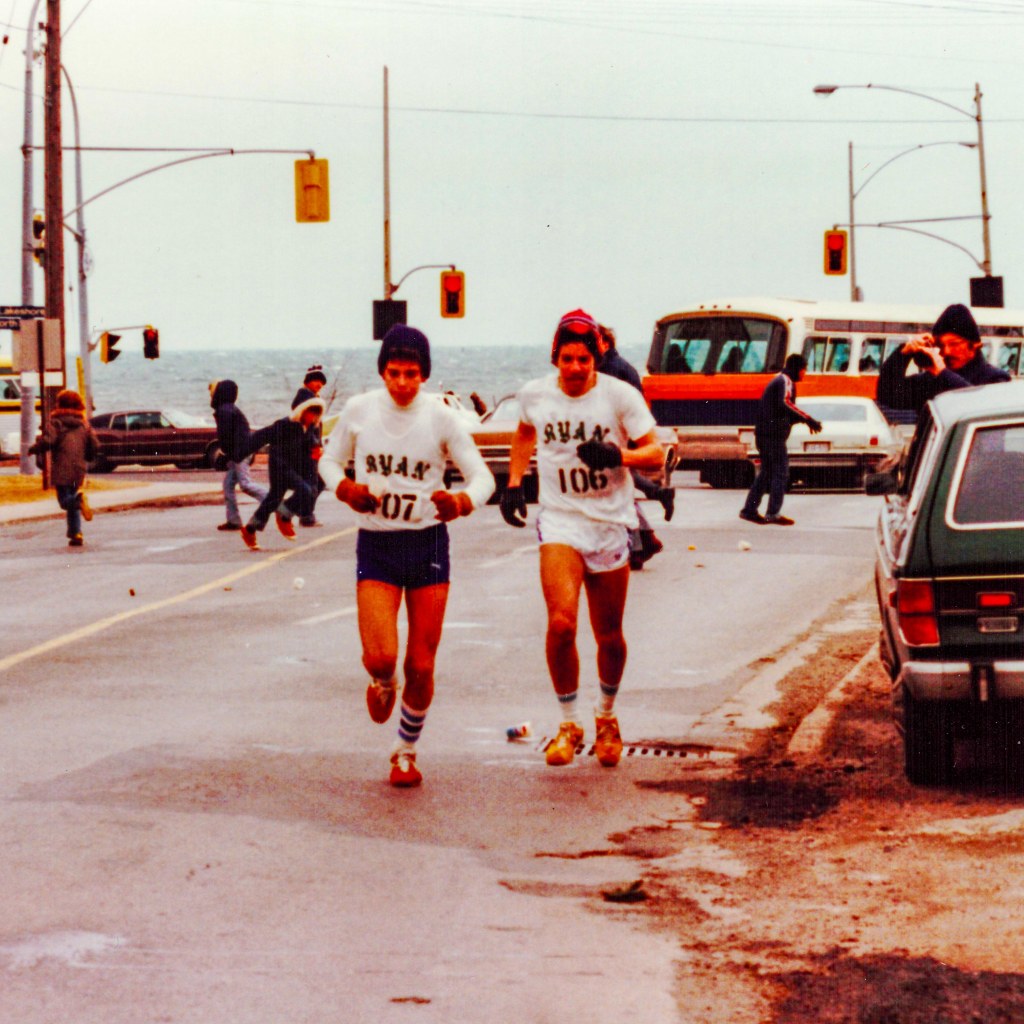
One of my most vivid running memories is captured in this photo. It was taken by my high school track coach, somewhere along Beach Boulevard. My teammate Mark Orzel and I were battling the elements. Behind us, whitecaps are visible on Lake Ontario. Keen observers might recognize my Tiger Jayhawk racing flats.
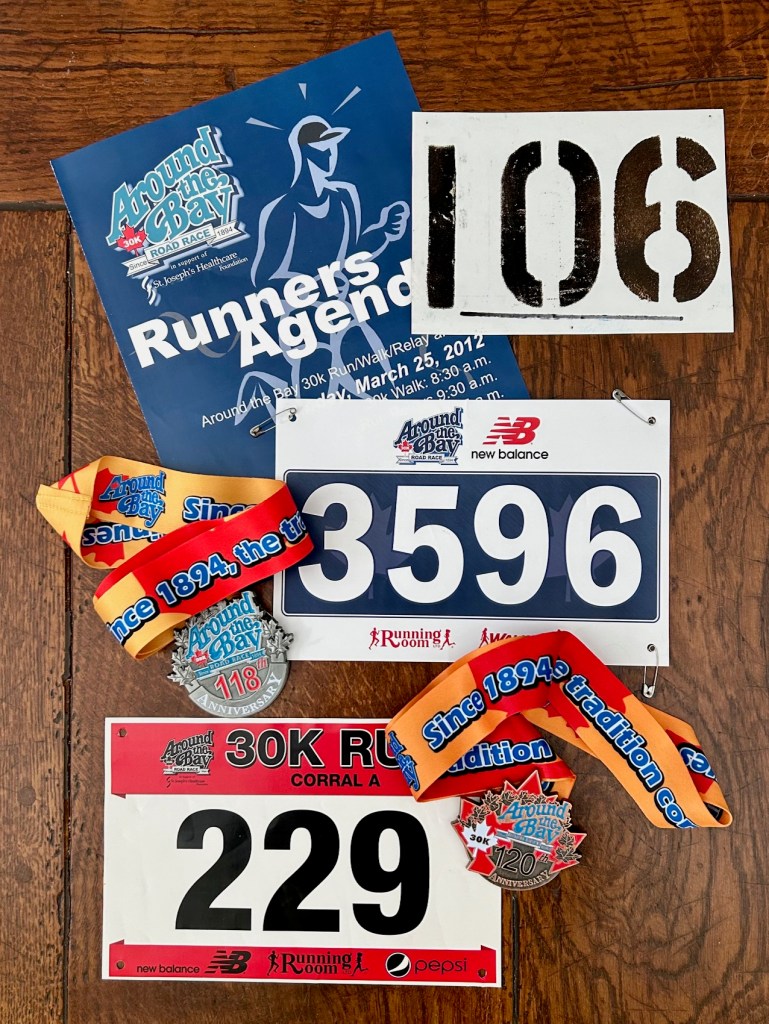
According to my handwritten notes on the back of my race bib—showing how much the sport has changed, it’s a stencil on the back of a scrap of floral wallpaper—I would go on to finish in 2:16:19, in 116th place. I was the only one of the three of us to finish. It was a tough day.
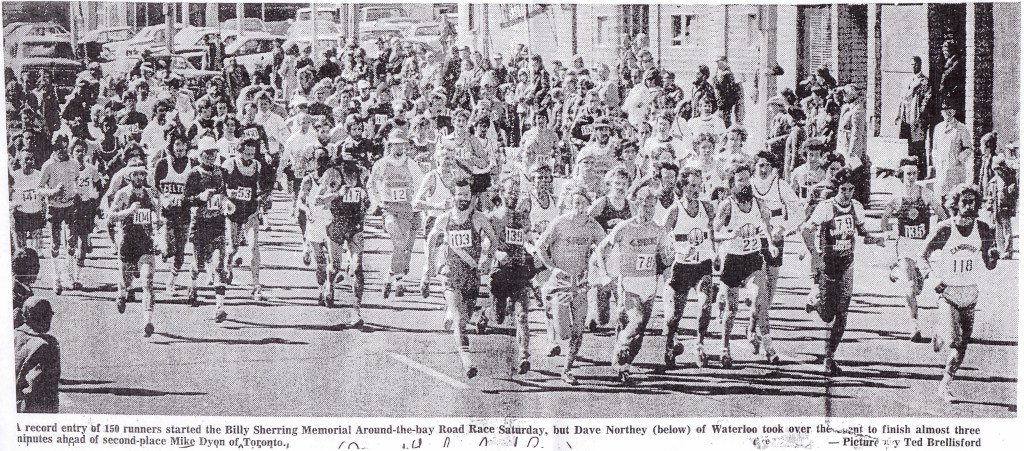
Around the Bay, a rich part of Hamilton’s history (Photo: Hamilton Spectator, March 1977)
My impact on the race may have been minimal, but its impact on me was not. In fact, it solidified my growing commitment to the sport. I would go on to try the marathon a few years later and have a lifetime of running adventures after that.
2012 – A virtual showdown
The gap between my first and second ATB race was 35 years. I don’t know where I got the idea to go back and compete against my younger self. Maybe it wasn’t so far-fetched though: Hamilton is my hometown, and I had been a keen follower of the race for years.
The race itself had gone through some lean years in the 1980s and 1990s but was enjoying a renaissance. By the early 2010s, the ATB had pride of place as one of the jewels in the Ontario race calendar. Entries ballooned to the thousands and the 30k race sold out every year. To me, this reflected what was happening to the sport in general, and it was terrific to see.
My plan was to go back and beat my time from 1977. By then, I had decades of running experience. Even though I was a “mature” runner, I thought my chances were good. Quoting again from my book:
“I managed to eke out a small victory in the virtual head-to-head match up, running 2:14:51 but finishing well down in the age group results. As I plodded through the latter stages of the race, I felt myself being transported back to that cold day in March so many years earlier. My exhausted legs seemed to relive every rolling hill on North Shore Boulevard. … I laughed as I ran by a costumed Grim Reaper at the crest of Valley Inn Road who was yelling at us to “D‑I‑E a little out there!” I let this amusing encounter be the beginning of my celebration of this wonderful day. I was overcome by the gamut of emotions. Where had all the time gone?”
It was a momentous day, and not only because I had proven I still had what it took to compete. I treasure the memory of my mother and my sister Carolyn—sadly, both now gone—meeting me at the finish inside the Copps Coliseum. Thinking about them in the context of the race, and the place running has long had in my family, is quite emotional.
2014 – A generation gap opens
Perhaps pushing the envelope of my involvement with the Bay Race, I went back again in 2014. However, this time I had no expectations other than finishing. In fact, the main reason for returning was to share the experience with our son, Daniel. He was rounding into form as a fine runner, and decided he’d like to run this historic race.
I had a tough day. I somehow let myself be psyched out by an adverse race day weather forecast. The thought of howling winds on Beach Boulevard undermined my plans before I’d taken a step. Talk about rookie mistakes! As it happened, race day weather was fine, but by then the damage was done.
The best I can say about the race is that I survived it. Even though I thought I had kept enough in reserve for the rolling hills, they still beat me up. It was a lesson in humility, as I laboured from start to finish. Our ATB rookie, Dan, ran an astonishing 1:54:59. What a performance! I was so proud of him, and I couldn’t wait to see what else he would accomplish.
And me? I was comfortable in the knowledge that I would be an ATB race spectator from then on.
Summing Up
Some races have more impact than others, and Hamilton’s Around The Bay Race is about as impactful as they come. It has a unique place in the history of our sport. It has more than its share of challenges for those brave enough to take it on.
This post has been an opportunity to share a little of my personal connection to the race. I could write so much more!
In short, the Around the Bay Race was instrumental in steering me to a life characterized by dedication to fitness, exploration of my own potential, and fellowship with other runners. It will always be special to me. Maybe that book isn’t such a bad idea…
We heard yesterday that Gord Hobbins had passed away. Deb and I are gutted by the news. The Calgary running community has lost one of its greatest supporters, and we’ve lost a friend of many years. It will take a long time to come to terms with his loss.
Coincidentally, Deb and I were walking near Gord’s Running Store a few days ago. We hadn’t been in that part of town for a while. As we passed the familiar storefront, tucked in a strip mall just off Centre Street NW, we chatted about him. I mentioned that the store was celebrating its 35th anniversary. Gord’s Instagram account had been featuring photos from the 1990s, when the hair was longer and the running shorts were shorter. Okay, too short. We had a laugh about that and recounted a few of our many stories about Gord. But our time was limited and we decided not to drop in. Now I wish we had.
My connection to the local running scene goes back more than three decades. We moved here in 1991, and it would have been shortly after that that I first stepped into Gord’s store. I immediately felt his personal warmth, his enthusiasm for the sport, and his passion for customer service. Of course, Gord’s customers soon became his friends, and that never changed. No matter how long since our previous visit, Gord was the same: genuine, kind, inquisitive. He always took time to chat. Visits to the shop were often stretched, so we could get caught up on each other’s family news. He was totally devoted to Cathy and their kids, Ailsa and Gareth.
Gord coached me for a few years, and he was a natural. He had a hand in preparing me for my first Boston Marathon. His trackside cues at the Talisman Centre… “Steve, relax your shoulders!”… were in my ears on race day in April 2001, and helped me to one of the most memorable achievements of my life. Later, I took up a coaching role in my own club, and Gord was a mentor. When he organized group runs from the store, he was invariably the perfect host, making sure all his sheep got back safely.
Gord and I even shared a similar medical history, having both gone through serious cardiovascular issues. We could each credit a lifetime devotion to the sport we loved for getting us through our unique and challenging episodes.
There was a good reason for the longevity of Gord’s store in the tough retail business: he was the best at what he did. He generously shared his vast knowledge of the latest shoes and running gear. I lost track of the number of times I referred people to him. “Go see Gord,” I would say. “There’s no one who knows more about fitting you for running shoes.”
Gord’s own running resume was impressive too. I first saw his name in race results in Edmonton (his hometown and our first stop in Alberta) in the mid-1980s. At the time, he was running road 10k’s and half marathons. But it would be in ultramarathons that he later made a name for himself.
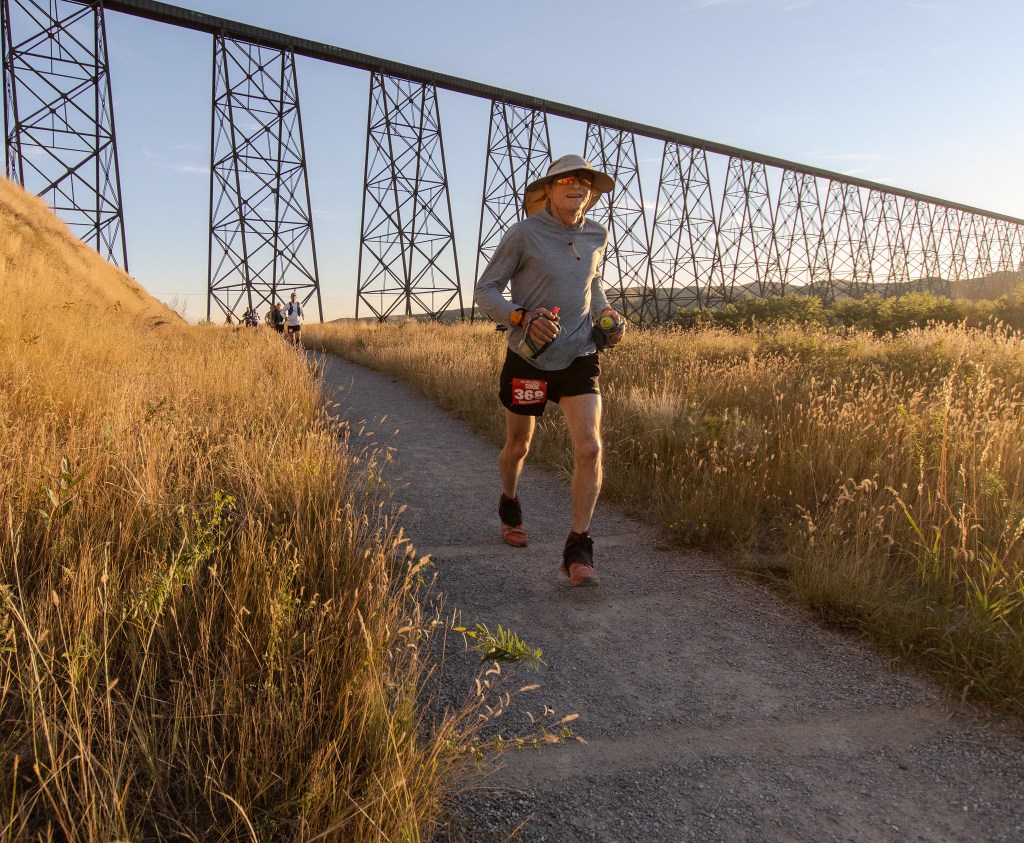
Gord’s success in ultra trail races was attested to by memorabilia in his store. In fact, the last time I saw him, he told me he was looking forward to completing his collection of carved finisher’s stones from the Lethbridge Lost Soul Ultra. He had run the race many times, so it was no surprise when he finished the 50k in an impressive time last September. (Photo by Mark Moland.)
I’ll miss Gord like a brother. His commitment to the sport ensures his legacy in the Calgary running community. More than that, his passion for making everyone around him better, fitter and happier is what I will remember most. Rest in peace, my friend. We wish his family, friends and staff peace and comfort in the difficult days ahead.
Do you have any sporting heroes? Maybe you do, or maybe you think the idea of sporting heroes is quaint and outdated. Given the commercialization of sports, I can certainly understand this view. I do have several sporting heroes, but maybe the best way to explain this is to say that there are people I have looked up to throughout my life. Some of them happen to have been great athletes.
Bobby Orr
It was Sunday, May 10, 1970. Game four of the Stanley Cup finals. Overtime. One brilliant play was about to etch itself in my brain forever. Here’s what I wrote about that moment in my book, Stroke of Luck:
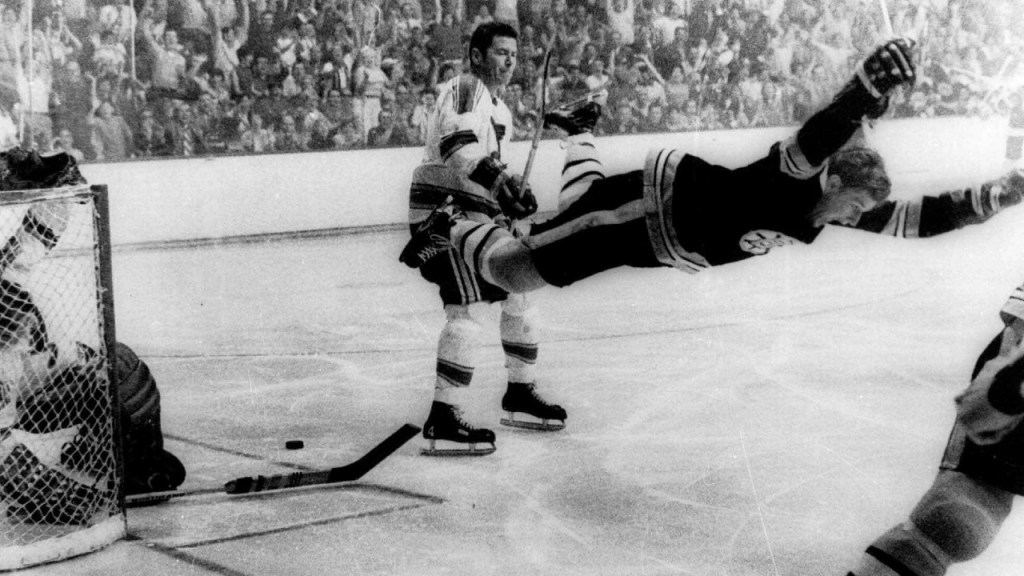
So it was that in May 1970, as an impressionable nine-year-old, I was watching game four of the Stanley Cup finals, between the Boston Bruins and the St. Louis Blues. It was less than a minute into overtime. Bobby Orr rushed the St. Louis net and took a pass from Derek Sanderson, who was behind the goal line. As Orr directed his shot into the net, to win the game and the Cup for the Bruins, I was in awe. I remember, like it was yesterday, Orr’s flying celebration of his goal. I was an instant fan of the Bruins, and I had found my first real sports hero in this young, talented defenseman.
Ray Lussier’s photograph of Orr flying through the air is one of the most iconic pictures in sports history. As Orr was half-tripped and half-jumped, he had already begun celebrating his cup-winning overtime goal. But here’s the thing: I don’t even need the photograph. I can play the whole video in perfect detail in my mind.
“The Goal” (Ray Lussier, May 1970)
Orr did more in his short career than most players could dream of. His ability to control a game was unmatched. I believe he was the best defenseman to ever play the game. And even today, I get goosebumps if I watch highlight videos of his end-to-end rushes. It’s a rare player who can make the best in the world look ordinary, but Orr did it to opponents game after game. And yet, he never grandstanded after scoring a goal. In interviews, he was quiet, almost shy. He let his ability speak for itself.
I followed Orr’s career from beginning to end. His wonky knees were his undoing, drastically shortening his career. I wonder how different things might have been had Orr played a generation later, given that surgical repair of torn ligaments is now routine. Instead, the last images of him (in a Chicago Blackhawks jersey, no less), struggling to execute moves that would have been routine just a few years earlier, are heartbreaking.
In my opinion, a worthy sporting hero can inspire us even in difficult circumstances, and beyond the field of play. Orr has been the perfect role model: humble in victory and accepting of defeat. We should all strive to emulate his example.
Sebastian Coe
I hinted at the depth of my admiration for Seb Coe in a brief passage when telling my own story:
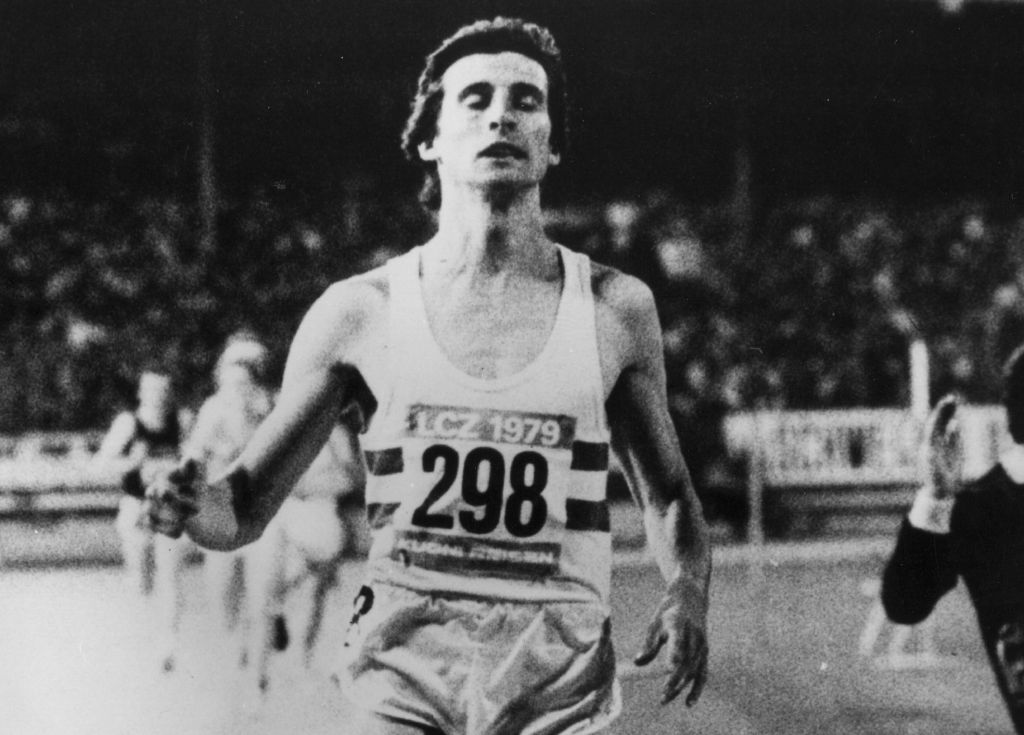
My appreciation and love of athletics grew. I followed all the results for my latest heroes, the middle-distance stars Sebastian Coe and Eamonn Coghlan. Coe became a global sensation when he set three brilliant world records on the track, all within six weeks in the summer of 1979. But it was the way he ran, with elegance and effortless power—with passion—that I admired most.
My dilemma when writing my book was whether I should say more about this gifted and charismatic runner, and the impact he had on me, or keep it brief to move the story along. I opted for brevity, but I feel I should add to what I wrote.
For context, in the summer of 1979, I was well on my own path. I had just finished my first year of engineering. I was dedicated to athletics, having participated in cross country and track in high school for several years.
Coe seemed to emerge on the scene out of nowhere. Of course, we didn’t have instant news and 24-hour coverage then. The athletics world held its collective breath as this slight, supremely talented 22-year-old Brit smashed three major world records in rapid succession. Here’s a synopsis:
July 5, Oslo: Coe shattered Alberto Juantorena’s world 800m record at the Bislett Games, running 1:42.33.
July 17, Oslo: In the Golden Mile, Coe broke John Walker’s record in 3:48.95 against a world-class field.
August 15, Zurich: At the Weltklasse meet, Coe broke Filbert Bayi’s 1500m world record in 3:32.03.
World record in the Golden Mile, July 1979 (Getty Images)
I remember scouring the newspapers for any information on Coe and his races. His records all came within a few weeks of my birthday, so it was as if he was gifting me with these performances. I felt I was somehow a part of his epic summer. In fact, I was so taken by Coe’s streak that I decided to try out for the university athletics team when the school year started in September. (Sadly, my performances fell so far short of his that my experiment ended quickly.)
Since the summer of 1979, Coe has had a full and productive career. He won two consecutive Olympic 1500m gold medals. He went on to lead the 2012 London Olympic Games committee, and he is the current president of the IAAF. From my perspective, Coe has always carried himself with that same passion and dignity that set him apart on the track. I’ve admired him for decades, both in my athletic and personal pursuits. I considered him a role model 45 years ago, and I still do.
Eamonn Coghlan
In my view, Eamonn Coghlan is underrated compared to some other big names in athletics. It turns out I have a couple of tenuous connections to this great middle-distance runner. Coghlan was born in Drimnagh, Ireland, a suburb of Dublin. Drimnagh is a short distance from Monasterevin, the hometown of my paternal ancestors. I wrote about Coghlan in my book:
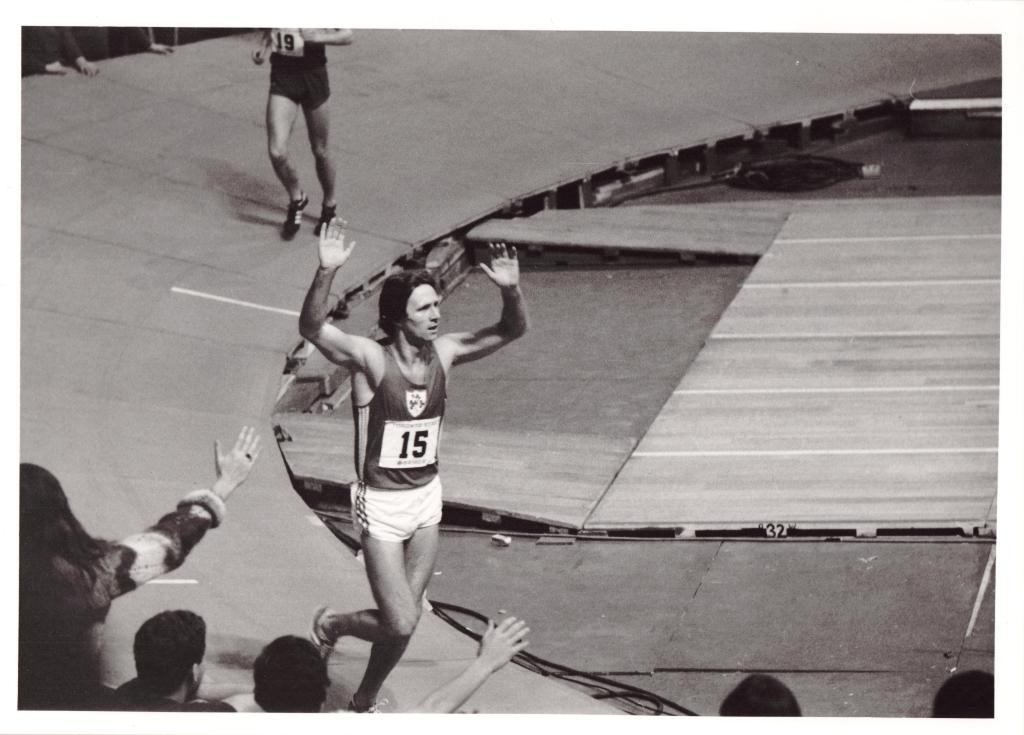
Coghlan’s specialty was the indoor mile. He had earned the nickname “Chairman of the Boards” due to his ability to perform well on tight, wooden indoor tracks. Deb humoured me for an evening in February 1981 at the Toronto Star Indoor Games, with its temporary track set up in Maple Leaf Gardens. I had run there as a schoolboy a few years earlier. We watched Coghlan win the mile in 3:55, an astounding achievement considering the quality of that track. I still have a black and white photograph that I snapped as he jogged around the track for his victory lap.
I found that picture as I was sorting through some old files the other day. It took me right back into Maple Leaf Gardens on that cold February night.
The Chairman of the Boards takes his victory lap (Toronto, February 1981)
As a mature athlete, I’ve always been most impressed by Coghlan’s consistency. It would be enough to say that he broke the 4-minute mile 83 times, but he did so much more. He dominated indoor meets, where tight turns are a handicap as compared to outdoor racing. He ran the first sub-3:50 mile indoors (February 1983), and he was the first man over 40 to break 4 minutes for the mile (February 1994). Quite a career!
Coghlan’s competitive track career spanned 20 years. Like Coe, he has had a fruitful career after athletics. He works as a coach and served as a senator in the Irish parliament from 2011 to 2016.
Wrapping Up
I’ve highlighted some of the lessons that I’ve learned from watching these three outstanding athletes. It confirms for me that great sportsmen (or should I say great people?) still have the power to inspire greatness in all of us.
Although it extends an already long post, I will add a few words about sources. Stephen Brunt’s excellent book, Searching for Bobby Orr, is a well-researched and eloquent biography that puts Orr’s career and life in the context of a sport that was changing dramatically. There is a lot of material available on Coe, including his own books. I enjoyed The Perfect Distance by Pat Butcher, which delves into the rivalry between Coe and another talented British middle-distance man, Steve Ovett. As for Coghlan, I relied on an excellent piece by John Cobley, on his Racing Past website. Cobley’s piece cites Coghlan’s autobiography, Chairman of the Boards, which is unfortunately out of print.
Until next time, be well and BE FAST! Happy New Year to all.
I recently read two well-known books in the running genre, one after the other. Once a Runner and Marathon Womancouldn’t be more different, so this piece shouldn’t be taken as a straight-up comparison. Still, it was useful to contrast (on one hand) a niche novel from a bygone era and (on the other) a personal memoir of one of the most compelling characters from that same era.
I’ll start with Parker’s book.
I had a copy of Once a Runner on my reader long before I read it. The idea of a fictional story set in the milieu of a university track and field team interested me, but less than, say, a memoir of one of the great runners from history. True stories just resonate more with me, I guess.
When I did finally dive in, the book was fine. Three out of five stars. Parker is a competent writer, but I found his characters to be thinly developed. I never really warmed up to the protagonist, Quenton Cassidy, a talented and driven miler. Cassidy’s mentor is the mysterious Bruce Denton. He isn’t the best role model, if I judge solely on how much he made me feel like going out for a run myself. And the female characters in the book don’t ever rise above the status of bit players or afterthoughts. There was quite a lot of 1970s-era stereotyping here too.
I found the plot totally predictable. But that flaw didn’t bother me too much, as I had minimal expectations for the story anyway.
What I liked in the book were Parker’s nuanced and detailed descriptions of distance training and racing. (This is no surprise, as the author was a talented runner who trained with the great Frank Shorter in Florida.) Sure, my days as an amateur track runner are well in the past, but I could fully relate to everything that Cassidy experiences as he prepares for and runs the climactic race—against a tough Kiwi, based with absolutely no disguise on the real-life John Walker—that closes the book. Anyone who has built up to a goal race would benefit from reading that part of the story.
Overall, Once a Runnerwill appeal most to dedicated students of the sport and hardcore enthusiasts. Even so, if you’re like me, you’ll probably have many other choices on your reading list. When you find yourself with a gap, you might give it a try.
The connection between my highlighted books may rest in the zone of those same societal stereotypes. In fact, Marathon Womanby Kathrine Switzer is the story of a dedicated young woman’s fight to break down those barriers.
I knew a little about Switzer, mostly from her infamous on-course encounter with Jock Semple when she ran as the first legitimate female entrant in the 1967 Boston Marathon.
Once I started into her book, I had trouble putting it down. Switzer writes in a comfortable style. While I wouldn’t say her book is aimed at a female audience—I really hope men read it—I did learn more about things like panty girdles than I ever thought I would.
That said, it’s the essence of her story that is so impactful—her long, solitary battle to gain recognition for women in distance running. The next time you stand on the starting grid for a race, look around at the women who have embraced running as a key part of their lifestyle. That’s what we all can thank Switzer for. She does a great job in the book of explaining the hurdles she had to overcome to make that possible.
Beyond her dedication as an advocate for change in women’s athletics, I had no idea how passionately Switzer pursued opportunities for women in other sports. Thanks to her diligent and courageous efforts, which are admittedly still a work in progress, women now compete on a more or less equal footing with men in many sports. I look at the Women’s World Cup which just started as an example. What a legacy Switzer has earned.
I think you can tell which of these two books I would recommend to my friends.









 My Second Running Life