Find Your “Why”

As I started thinking about this piece, I found a podcast on Todd Malcolm’s No Limits Triathlon website which helped me a lot. It’s Episode 151 (“Why do you train for triathlons?”) Kudos Todd, and thanks for the inspiration!


So, here’s a question for you: Have you ever thought about why you run?

(Feel free to substitute your own go-to activity for running, in what follows. I think it’s a valuable exercise, whatever the activity.)

There is a tendency to focus on the “what” of running, rather than the “why”. I might even go so far as to say that running has a “what” problem. 

I recently overheard two runners engaged in an animated conversation. Their talk was all about the “what”… upcoming races and new technical gear. Make no mistake, these are important topics of discussion, and I know they can be very exhilarating. If you were to include discussions about training mileage and pace, I’d guess you have the “what” of running totally covered. 

This is understandable, but in some ways unfortunate. 

We live in a society that focuses to a large extent on “what” questions, often in the realm of personal and professional achievements. So it’s hardly surprising that the running community sees the same reality. For runners, there’s always another must-do race, the latest shoe, or a new sure-fire workout. 

Here are a couple of recent product announcements that caught my eye:

  1. Adidas announced its latest high-performance shoe, the Adios Pro Evo 1. It’s a disposable shoe that is good for one marathon and sells for $650 CDN. Was it a coincidence that this announcement was made just before the B.A.A. announced its time cut-off for the 2024 Boston Marathon? Maybe. But there may soon be more demand for that shoe than Adidas can handle. 
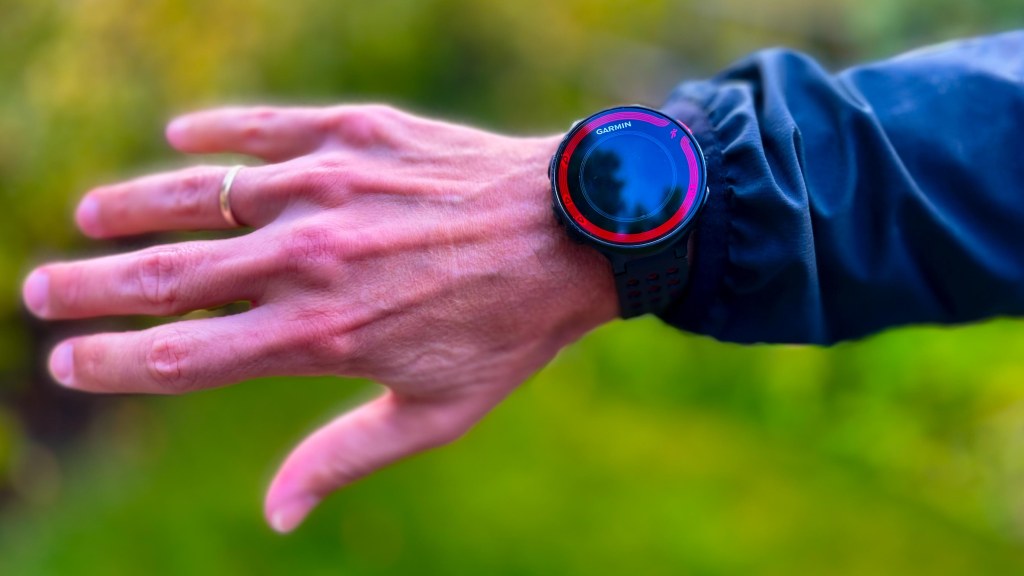
  2. Garmin announced a series of luxury GPS devices, the MARQ smartwatches, that will go for about $4,000 CDN. They feature a lot of titanium and carbon fibre, and according to Garmin, they are “built for greatness, so you can achieve yours”. I’m not sure how they will do that, but I admit they do look nice.

If you compete or just follow athletics, you understand this pressure… the pressure to always be improving. Acquiring. Checking boxes. Maybe you even thrive on it. 

What’s my point? Well, I feel that for whatever good this pressure can do, it can also lead us to miss the whole point of running. We shouldn’t forget to consider the “why”. The “why” has nothing to do with equipment, races or training schedules. 

You won’t find your why by adding things to your regimen. Instead, you should consider subtracting things. The why is inward-looking. 

Ask yourself this: if you didn’t have a major goal race to motivate you; if you had to make do without the latest shoes or GPS watch; if you couldn’t track your training pace or upload your workouts to Strava, would you still run?

If the answer to this question is yes, then you are starting to get at the why. 

If you are willing to go further with this mental exercise, try writing down some thoughts on your “why”. Maybe you enjoy the intrinsic benefits of running… how you feel while you are doing it. Maybe running is a place of refuge when the stress of everyday life seems overwhelming. Maybe you relish the camaraderie of long, easy runs with your friends. Or the challenge of setting hard goals, and then methodically doing the work needed to achieve them. You know, the work that no one sees. 

I hope that by being able to define whatever special benefits you get from running, you will be better able to enhance its indispensable role in your life. 
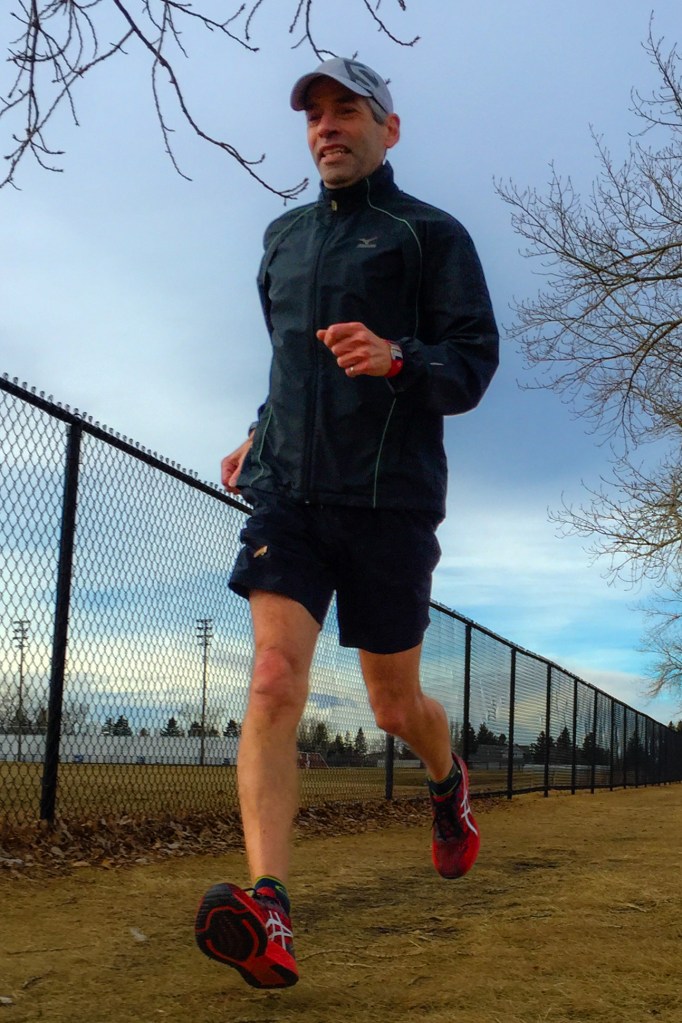
For me, it’s quite simple.

Running makes me a better person. I think more clearly, I work more efficiently and I believe (hope?) I’m more empathetic in my dealings with other people after a run. I learned these things several years ago, when I faced the prospect of not having running in my life.

You may have guessed that I won’t be on the wait list for any disposable shoes.

Until next time, happy running!
Treadmill… or Dreadmill?

My Resolution Sale is still on. Grab your copy of Stroke of Luck on Amazon for a New Year-inspired discount. This offer is only available until the end of the month!

This week, Alberta was invaded by an unwelcome visitor: the polar vortex. For a few days, we hoped that the forecast would turn out to be wrong. I enjoyed my last comfortable outdoor run on Tuesday with a feeling of impending doom. Change was already in the air: I left the house in fine weather and sunshine but spent the last two kilometres fighting a stiff, cold wind from the north.

Now we are in it. I read somewhere that today (Friday the 12th) was the coldest day in Calgary for the last 20 years. The prospect is for even colder weather in the next day or two.

“Yes, but it’s a dry cold” (January 12, 2024)

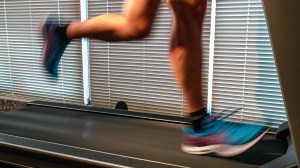
While I always prefer to run outside, the time had clearly come to switch to plan B: the treadmill. We have put many miles on our Landice L7 treadmill since buying it in 2010. At the time, I wanted an alternative to outdoor running to get me through the Alberta winter, so I could run the 2011 Boston Marathon.

While the Landice has been a reliable machine and a good investment, I have never warmed up to it. That’s because I find running on a treadmill harder than running outside. To be precise, I find running a given pace on a treadmill feels harder than on the road.

I did some research into why this might be the case. I know it is a debate that has strong opinions on both sides. Some runners hold exactly the opposite opinion than I do. They find treadmill running to be easier than road running.

I’ve always assumed that my perception of treadmill running is due to it being a relatively recent activity for me. In other words, am I programmed for outdoor running because I’ve done it for so long? No, there must be more to it.

There are plenty of studies that compare the two environments, and most find several benefits of treadmill running. For example, the belt turning under us imparts energy to our feet as we land. Treadmill belts are rubber, so there ought to be a small benefit in terms of impact forces on our joints. The ability to control speed and incline can be helpful when recovering from an injury or looking for very specific training conditions.

On the other hand, studies have also shown that many runners do perceive treadmill running to be more difficult. The benefit of a spongier surface may come at the cost of requiring the runner to expend more energy. Apparently, runners tend to self-adjust to a slower speed than they would outside. One study (I only read the summary) had runners do three segments at perceived effort: outside, then on a treadmill, then outside. It found that the treadmill portion was slowest by a statistically significant margin.

Running to stand still (January 2024)

On the physical side, I generally feel a bit of muscle soreness after a treadmill run. It would seem that I’m using different muscles, or interacting with the “ground” differently.

As for the perception of effort, I think it comes down to the way that our brains interact with our environment. I never get 100% comfortable moving while staying in the same spot. On a related point, while I agree that watching television is a welcome distraction available exclusively on a treadmill, I somehow get disoriented by the feeling of running toward the screen.

In practical terms, I find the best thing to do on a treadmill is a structured workout. Today, I did almost a full set of Yasso 800s (repeats of 800 metres at 10k pace). It’s a classic speed endurance workout, and it’s often cited as a predictor of marathon fitness. (Definitely not in my current plans!) Knowing that I have to complete a series of tasks (for example, run two laps on the little screen at a predetermined, not perceived, pace) helps me get past the feeling of confinement and boredom that often accompanies a treadmill run.

Besides, running in shorts and a T-shirt while looking out at a frozen -35c landscape isn’t all bad. And I did have a dram of Macallan 12-year-old sitting ready for me as a reward for getting through it.

The reward

We do what we have to do.

Thoughts on Pacing

It was a scenario that will be familiar to many runners. I arrived at our weekly interval session, only to find that my Garmin Forerunner watch had died. Given that our workout called for 600-metre repeats, and I had been tasked with leading a small group of new runners in our club, I had a sinking feeling. How would I measure our time and distance? And what about managing the pace for our group?

Oops… dead Garmin. Now what?

Fortunately, my training partners had fully charged watches, so we got through the session with no issues. But for me, going through the workout without a watch did make me think about the challenges of finding… maybe feeling is a better word… a specific training pace. That is especially true if we are building to a goal race, when pacing is most important.

Alex Hutchinson just wrote a piece on pacing for the latest edition of Canadian Running magazine. His article, Pacing for the Marathon, goes into the science behind pace-making and explores some of the latest research on the subject. Anyone who has tackled the monster that is the marathon knows how difficult it is to parcel out your resources over 42 kilometres.

Hutchinson’s article makes the point that the relationship between running speed and energy consumption isn’t a straight line, which argues for holding a steady pace in a race situation. In short, surges cost you more energy than you can get back by slowing down. The problem is that most runners tend to NOT run evenly-paced races. Of course, there are many variables that contribute to this result, including the course profile, our individual fitness, our perception of the distance itself, and the psychology of running against other competitors.

Hutchinson makes another point that seems to get to the heart of the issue. He notes that modern pacing theories focus on a runner’s subjective perception of effort. This suggests that with experience, a runner can learn how hard a pace should feel.

I couldn’t agree more.

This research supports the argument that we need to develop a good sense of what our target pace feels like.

I’ve long been a believer in doing at least some of my running without a watch, at least not a GPS watch. In my view, not every kilometre needs to be accurately timed. And besides, I think it’s too easy to rely on our high-tech devices rather than our own innate sense of what pace we are running.

Like most things, good pacing is a learned behaviour. We can work to improve it. For me, interval sessions are the perfect place to do just that. By working as a group, and especially by taking turns to lead a rep, we can improve our individual feel for pace.

There are also opportunities to improve our ability to dial in a pace in a race situation. For example, we can look for a local parkrun or low-key 5k or 10k race where we can practice finding and holding a goal pace.

Here’s another idea. Run a race (maybe not your major goal race) without a watch. See how close you can get to your predicted time. You’ll be training yourself what a certain pace feels like.

These skills can be very valuable on goal race day. I’m reminded of Trevor Hofbauer’s impressive run in the 2019 Toronto Marathon. At the time, his 2:09:51 finish was the second-fastest marathon ever run by a Canadian. Trevor ran that race without a watch, as he does with much of his training mileage. He said about his remarkable race, “I don’t use pace now, I just go off of time and effort. And that was how I ran today.”

I think there is something to be said for this approach. It requires a runner to be aware of how a given pace feels and trust in their training.

And what about our interval session, the one I ran without a watch? My internal watch told me we had kept a nice steady pace. When my partners shared their data later, it turned out that our pace for each 600m repeat was within a few seconds of our target. Not bad!

Four Ways Running Has Changed

  1. Technology

These days, most runners take for granted that they will have a permanent record of every kilometre they run. Some obsess over it. But the availability of all this information and more is a relatively recent phenomenon. For much of my time in the sport, that is to say, the last half-century, there was almost no information available on pace or distance, let alone heart rate, recovery time or anything else.

I used to check the time on the kitchen clock before I left my house for a run, so I could have some idea of how long I had been running when I got back. Pace? Forget about it. That started to change when GPS watches came into the market. Of course, they are now ubiquitous.

I still think of my Timex Ironman watch as something special. This reminds me, there is something liberating about setting off for a run with no watch of any kind. Try it sometime.

2. Gear

As I plodded through fresh, wet snow on a 16k run yesterday, I thought about how fortunate we are to have tights, high-tech base layers, and Gore-Tex jackets to get us through the worst of our Canadian winter weather. We finished with slightly wet feet, but otherwise we were warm and comfortable. And in the summer, breathable fabrics magically shed water to keep us dry.

Am I the only one that remembers Adidas tracksuits from the 1970s? You know, the gymnast-style pants with the loops that went under your foot? They were made of some strange synthetic fibre whose only attribute was to guarantee to chafe. Or how about cotton T-shirts and sweatpants, which held water like a sponge? Then there were the cringeworthy Dolfin running shorts from the early 1980s. Richard Simmons had nothing on me. Some things are best forgotten – forever.

3. Races

This is probably the category where I’ve seen the biggest changes. Some are good and some are not. I’m thrilled to see so many more races on the calendar than we ever had in the early days. Not only that, races are almost always well-organized now, with proper timing and accurate course measurement. Gone are the days of haphazard planning and poor execution by well-meaning but inexperienced race directors.

But I have to say, there are downsides. I object to shelling out $75 for a race that is, frankly, a pretty minor event. I don’t need a technical T-shirt and a finisher’s medal from each race I run. Sometimes, I’m just there for a quicker pace run, or to get a bit of competition. I’d much rather have the choice of whether to buy the shirt, and I really could do without the medal. Maybe that sentiment underlies the growing Parkrun trend, where runners can show up and run/race, without all the trappings.

4. Participation

For years, the only participants in road races were gaunt, sinewy veterans of the circuit. Even the big races were sparsely attended, and the runners who did show up were all of a certain demographic. Many races went through an existential crisis in the late 1970s, when it became clear that small fields of young adult males didn’t bode particularly well for the future of the sport.

It was the salvation of the sport that running became mainstream starting in the 1980s and 1990s. Frank Shorter is often given credit for enticing a whole generation of new runners to put on a pair of newfangled Nike Waffle Trainers and give it a try. (I think there was more to it, but that’s fine.) Whatever the reason, we should all be thankful, because we are now enjoying the benefits. The starting grid for just about any road race is a healthy cross-section of society, including people of all ages. We’re all better off for it.