Photo Run – Big Game Edition

Our long runs along the Bow River often take us past the Centre Street Bridge. It’s an imposing and historic structure, and in good morning light photo ops are plentiful. As we ran under the bridge last Sunday, I made a note to take a closer look at the lions that guard the four corners of the upper deck.

Fortunately, we ended up back at the bridge towards the end of our run. I welcomed an excuse to stop at that point. Deb was keen to do another kilometre. “Good for you”, I told her, “but I’ll be here checking out the big cats.”

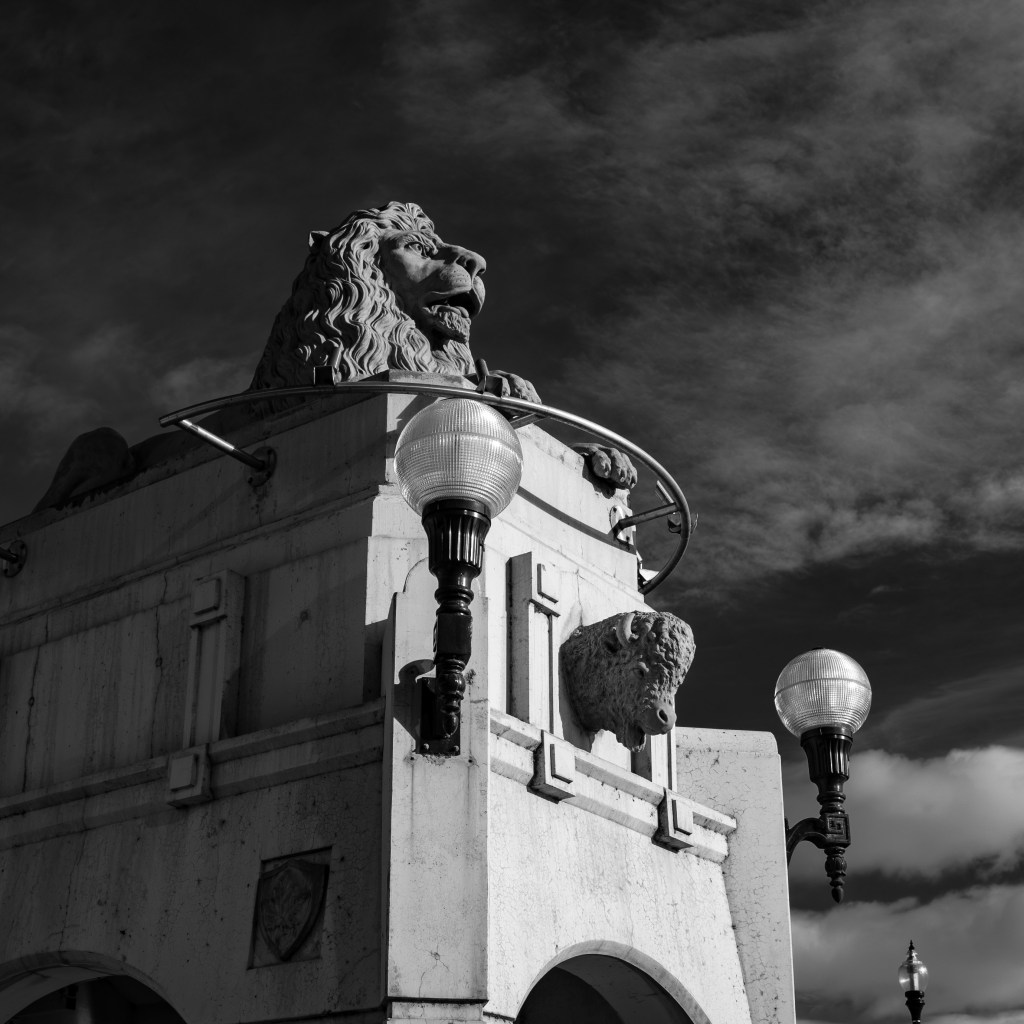
The morning light was strong and contrasty. From the pedestrian ramp, I got a couple of nice shots of the southwest lion. The statue looked great (regal, actually) with a monochrome edit in Lightroom.

Centre Street Bridge, Southwest corner (January 28, 2024)

I decided I would return in a couple of days for a photo run and a closer tour of the lions. In the meantime, I did some research into the history of the statues.

The original lions were commissioned in 1916, along with the bridge. They were modelled after bronze lions that guard Nelson’s Column in Trafalgar Square in London. The Calgary copies were cast in concrete by one James Thomson, a city employee. They each weigh 12,600 kilograms.

By the 1990s, the statues were in a state of significant deterioration, due to decades of Calgary weather cycles and vibration from bridge traffic. In 2000, city council directed the repair and conservation of the southwest lion. It also directed that the same lion be used as a template for the construction of four new statues. The restored lion now sits on display at Calgary’s municipal government building. The original northeast cat was repaired and conserved. It was relocated to its current location in Rotary Park in 2018.

With that background, here’s more on my photo run.

I went late in the afternoon, hoping for an interesting chinook sunset. We’ve had a lot of those lately. Would I get lucky? Yes and no.

I started my run in Rotary Park, so I could see the repaired northeast lion up close. It’s the only statue to have been returned to the bridge, and it commands a perfect spot at the south end of the park, overlooking downtown.

I navigated the ice and mud around the statue. I snapped a few shots, but none of the compositions I tried were very satisfying. I might have had better results with a wider focal length lens instead of the 28mm Ricoh GR III. No problem… this was supposed to be a run, so I moved on.

I jogged along the crest of the bluff for a few minutes and enjoyed the vista, then headed down towards the bridge. When I looked back up the hill, the lion was bathed in the low, setting sun. I knew I had only a few minutes before the light changed, so I scrambled back up the muddy pathway to a spot just below the lion. I snapped one shot. The light was amazing, and I think the result was good. It was by far my best shot of the day.

Rotary Park lion, enjoying the chinook sunset (January 30, 2024)

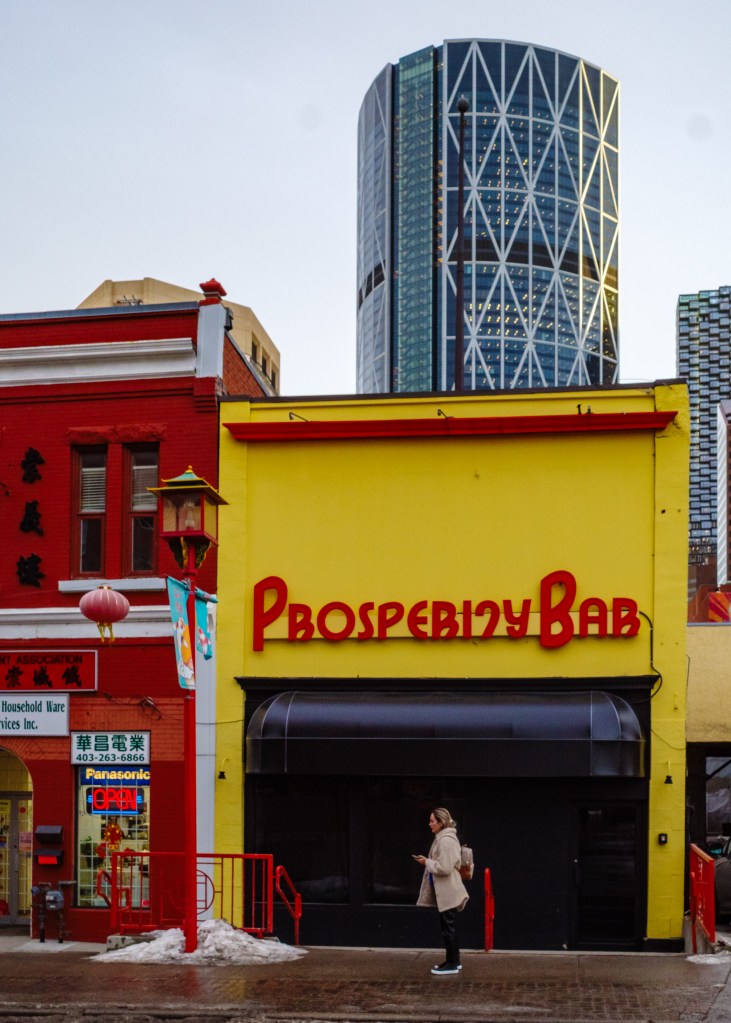
I continued down to the bridge and did a short loop around Chinatown. I was rewarded with a few worthy shots before I made my way back up the bridge on the west side. It had been a while since I ran up this hill… yes, it’s still tough!

Prosperity Bar (January 30, 2024)

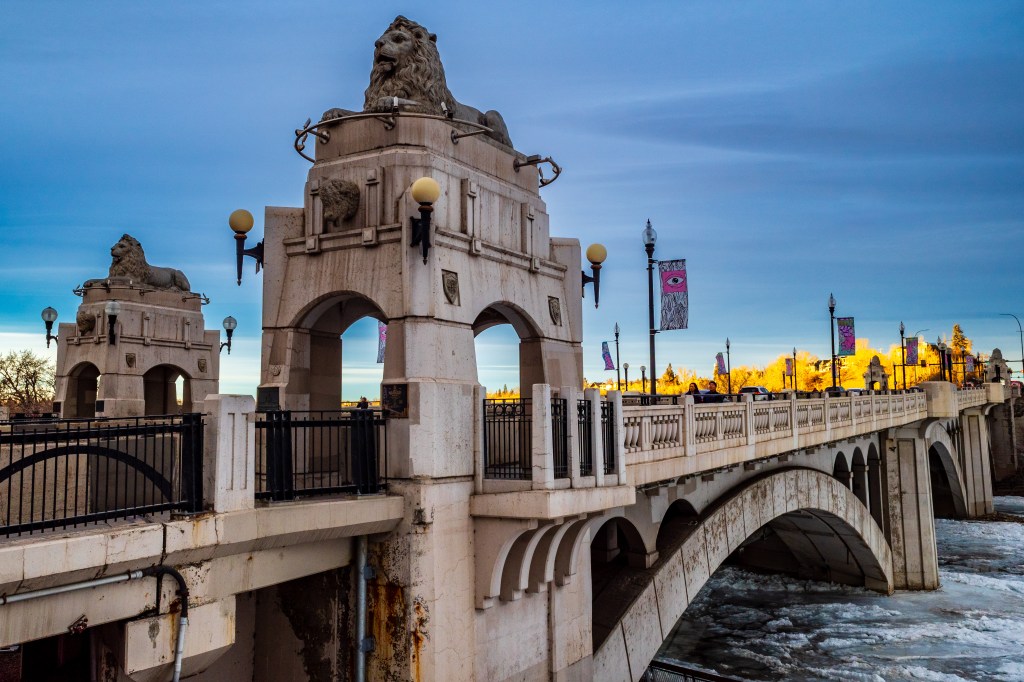
As for any more shots of the lions on the bridge, the fading light was quite flat and uninteresting by that time. There was a bit of chinook magic going on though… so I worked with what I had!

Centre Street Bridge, looking northwest (January 30, 2024)

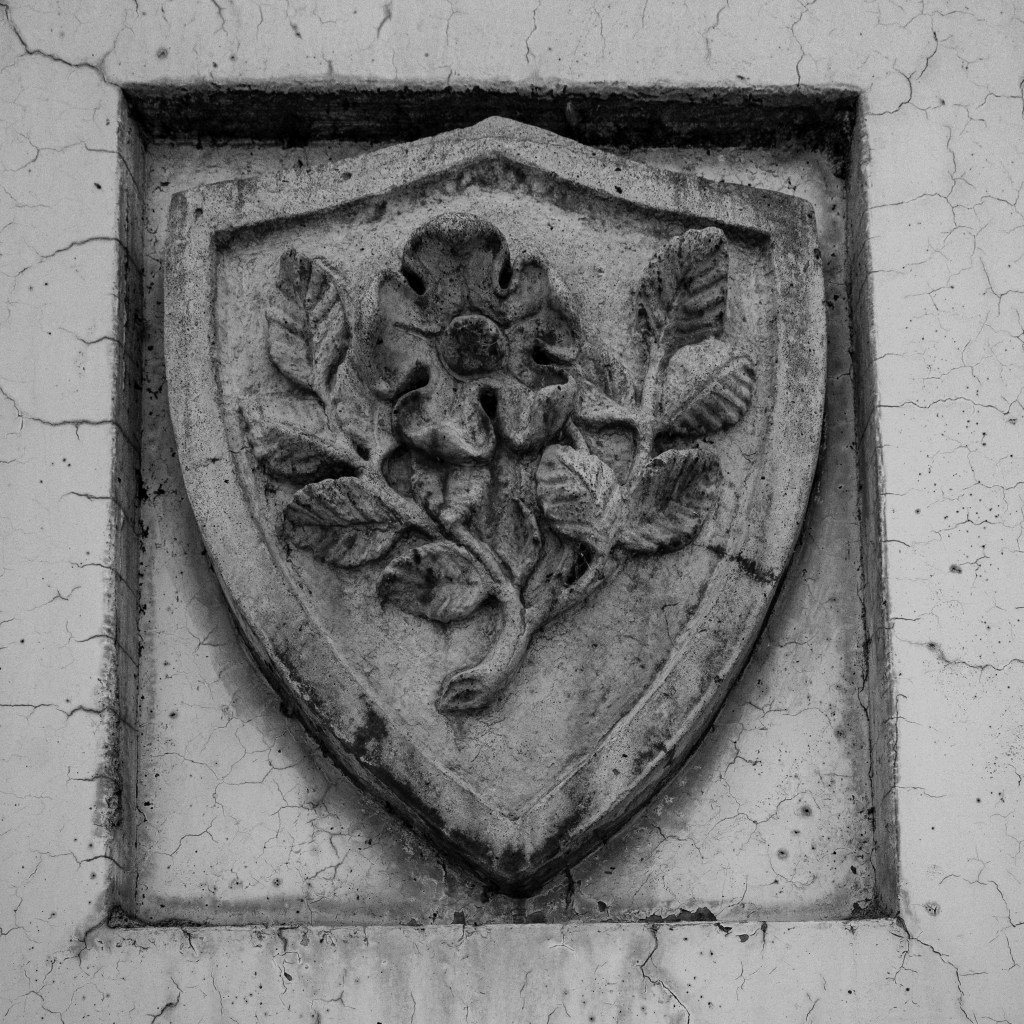
There was also the challenge of getting a good perspective on the statues and the other details on the bridge (like the medallions that recognize the distinct influences in Calgary’s past… see the example below) while being confined to the sidewalks that pass underneath the statues. I suppose a drone would have been a nice accessory for this shoot, but that’s not my thing.

Here’s one of the small details on the bridge: medallions on the side of the “kiosks” that serve as the base for the Centre Street Bridge lions.

There are roses for England, shamrocks for Ireland, thistles for Scotland, and maple leaves for Canada. And bison heads to represent the west.

In the end, I managed to get a few shots of the “big game”. But maybe the best result was the realization that I left many good ones on the bridge for another day.

Seeing Double?

Yesterday’s run along the Bow River was nice, but for the ice. And the wind. Otherwise, it was perfect! Good company, bright sunshine, and lots of runners out. Thanks, Deb and Sherrey for getting me to 13k, which was more than I expected to do.  

Given the conditions, we decided to head east from Eau Claire. Better to warm up a bit before facing the breeze. We reached the 12th St bridge in Inglewood before turning around, 3k into our run. Even after so many years, passing the confluence of the Bow and Elbow Rivers always feels special to me.

Our crossing point happens to be the location of a unique statue. Or maybe not so unique. But more on that shortly. 

The statue I’m referring to is called Wolfe and the Sparrows. It was sculpted in bronze by Brandon Vickerd in 2019. Vickerd is a Hamilton-based artist and professor at York University.

Wolfe and the Sparrows (Vickerd, 2019)

General Wolfe was the commander of the British forces at the Battle of the Plains of Abraham. He led the British to a rather important victory there in 1759. 

As I stepped carefully around the statue… that ice!… I stopped to admire it for a few seconds. I wondered what Vickerd had in mind when he replaced Wolfe’s upper body with a flock of sparrows.

Later, I read the city’s description of the statue, which states that the community wanted something  “critical, challenging and funny”. I think Vickerd succeeded with this piece.

According to his bio, Vickerd seeks to “provoke the viewer into questioning the dominate myth of progress ingrained in Western world views.” His Wolfe statue touches on themes of indigenous reconciliation, so maybe he hit the mark there too.

Why? Apparently, in many cultures and religions, sparrows represent good fortune, happiness, and resilience. They are non-native birds in North America, which makes them a good choice for a piece meant to convey the importance of reconciliation. 

I like Vickerd’s statue a lot. I decided that whatever he intended, it works as a thought-provoking piece of public art. 

Back to our run. Continuing west along the river past 14 St, we saw many familiar faces, including some quick runners in RunCalgary‘s 12k’s of Christmas. Well done, Reinier and Mel, Matt and Jeremy!

It was a quick pace at the front of the pack

Now, what about my comment about the uniqueness of the Wolfe statue?

On the drive home, I asked Deb to make a slight detour so we could stop at Calgary’s “other” Wolfe statue. Appropriately, this one sits in Wolfe Park in Mount Royal.

This bronze statue by Scottish sculptor John Massey Rhind was completed in 1898. It was originally located in New York City and was sold to Calgary philanthropist Eric Harvie in 1966. The statue was donated as a public art piece in 2009. 

Wolfe, with no sparrows (Rhind, 1898)

You’d have to call this version of Wolfe a traditional rendering. It shows the general looking off into the distance as if contemplating the battle to come. (By the way, Wolfe didn’t survive it.) 

I like this statue too, and I’ve photographed it often. It certainly is a worthy addition to the neighbourhood. I try capturing it in different lighting conditions, as it seems to change the expression on Wolfe’s face. 

From chest level down, these two statues are identical. Vickerd chose to do this. Was it homage to Rhind’s statue? Maybe. We are left to wonder what message he was sending by adding the swallows. For me, while the original statue is handsome, it can’t match Vickerd’s version as a provocative piece of art.

In closing, we’re fortunate to have two very different Wolfe statues in Calgary. Both are impressive pieces, in their own way. 

Luck… and Good Light

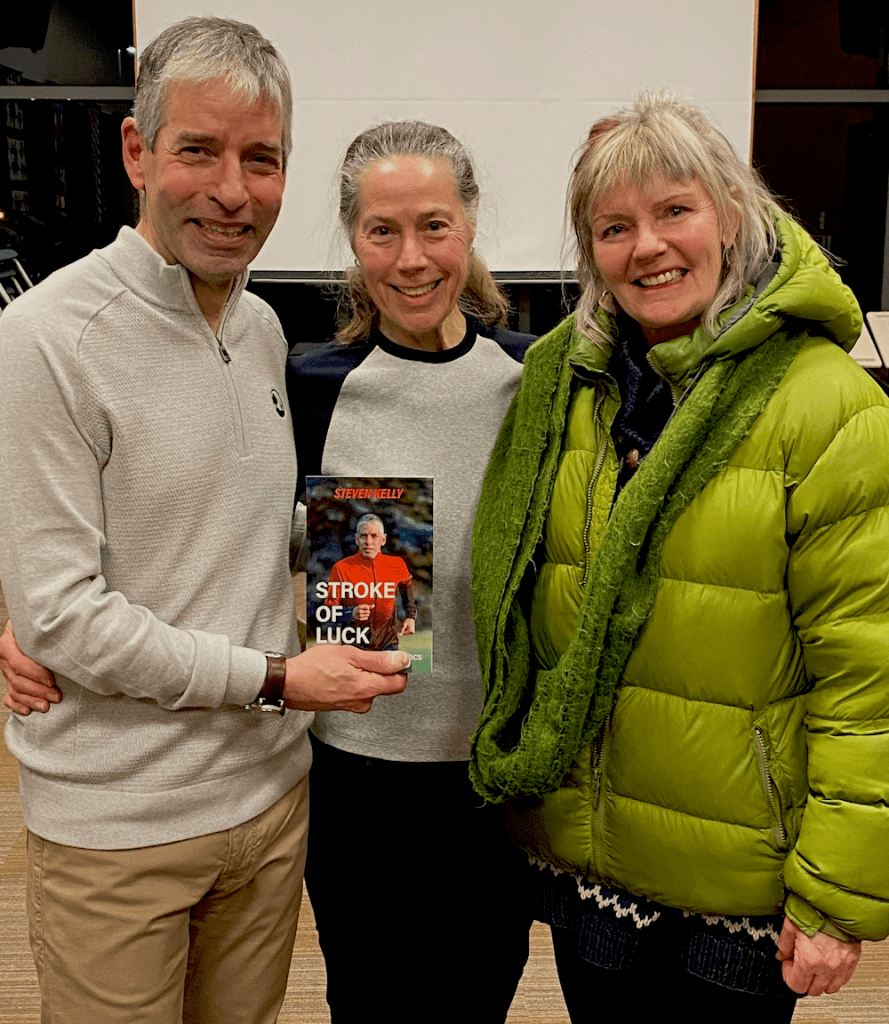
Don’t forget my Black Friday sale, through the end of November. Get your copy of Stroke of Luck: My Life in Amateur Athletics on Amazon for a marathon-inspired 26.2% discount!

Photography can be a curious hobby.

Sometimes pictures are everywhere. Other times you feel that you have lost the plot. Try as you might, it seems there are no worthwhile subjects at all. 

The last few weeks have been tough for a variety of reasons. Time hasn’t been on my side, due to work and volunteer commitments. Cameras have been sitting idle. And it doesn’t help that my motivation has been running low. Maybe it’s a seasonal thing. With the shorter days, finding an interesting scene… just finding any light at all… is difficult. 

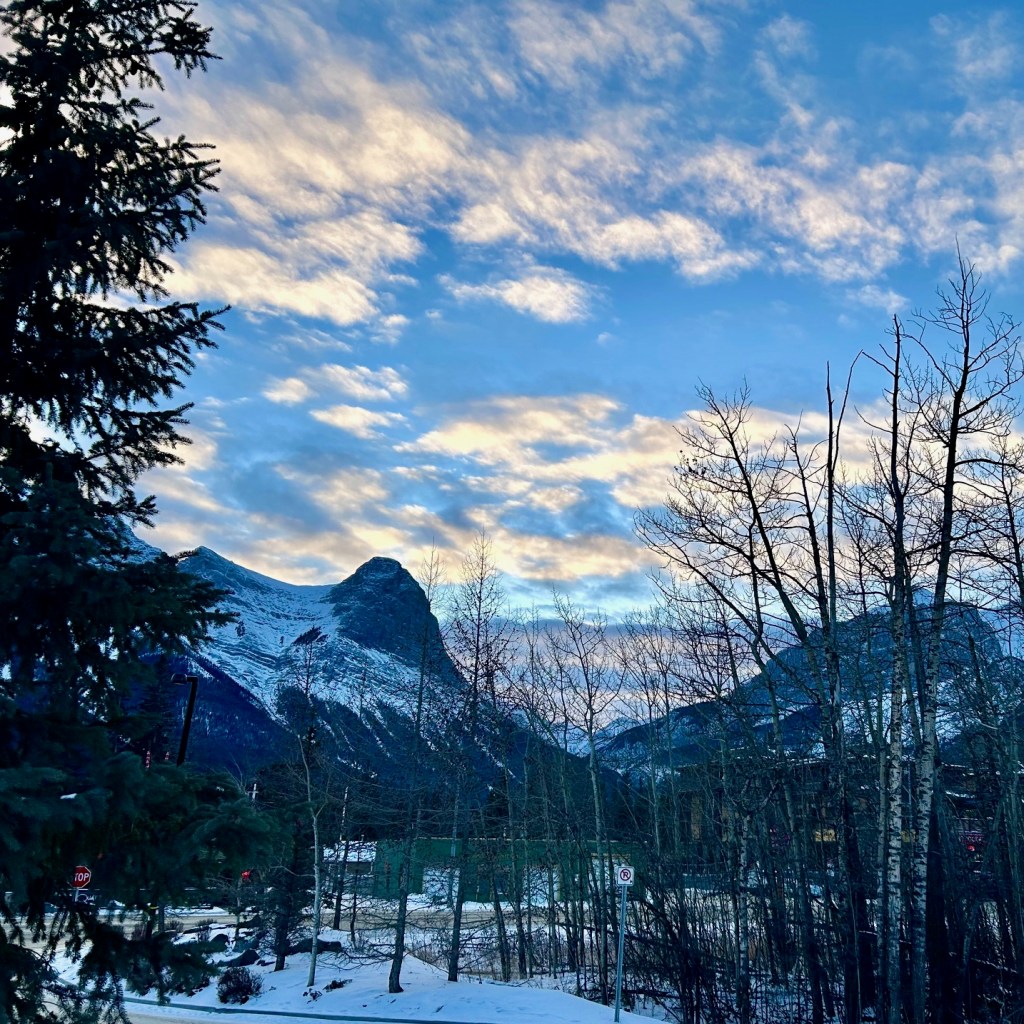
But here’s the good news. Whatever light we have at this time of year is often stunning. Any decent sunrise or sunset can be an easy capture because you don’t have to be up at an ungodly hour to shoot it. We are blessed in Calgary to have plenty of picturesque shots, thanks to our frequent Chinook arches

As if to remind me to snap out of my little funk, I’ve had several fortunate scenes appear before my eyes in the last week. 

One day, the light in the house was suddenly and strangely pink in the late afternoon. I looked outside, and the sky was glowing a magnificent rosy shade.  I almost tripped down the stairs to grab my Ricoh GR III. Quick, get out there! Shoot something! 

Admittedly, the firefighter across the street at the No. 5 Fire Station was slightly surprised to be the subject of my random shot, especially as he was walking to the rubbish bin. It didn’t matter. I wasn’t looking at him but at the amazing pink clouds above his head. A firestorm above the firehall. Easy!

No. 5 Fire Station, Fiery Sunset (November 2023)

Then, a few days later, as I picked up some things at the downtown Staples, I was drawn to a scene I’d passed many times. The setting sun was dipping below a Chinook arch and casting a golden glow over the skyscrapers. More awesome light. Again, shoot something. Anything! 

Looking east along the CP rail line, the tracks make natural leading lines. My challenge in the past has been in finding something to lead to… something other than a moving train, that is. 

Then I spotted my subject. A guy on a cool fixed-gear bike with bright green wheels was heading north on 11th Street. Standing in the middle of the street, I felt a bit exposed. I fumbled for my iPhone 14. C’mon man… hurry! I snapped my picture at the last split second, just as he entered my scene. Then I hustled out of the reach of the oncoming cars. 

Later, when I sat down with my pictures, I was more than happy with the results. With what had been snap-and-dash shots, I managed to get a couple of keepers.

Green Wheels, Golden Hour (November 2023)

Luck and good light. 

Just goes to show that you have to always be ready. And never give up. 

Downtown Wildlife “Photo Run”

A reminder that Stroke of Luck is now available. Click here for details.

I often feel that I’m rewarded with photo opportunities as long as I have a camera close to hand. Last week I made a rare trip into downtown. It was a day after the first blast of winter in Alberta. The snow was still falling. 

I’d walked by the Harley Hotchkiss Plaza next to the courthouse many times, and I’ve always admired the Joe Fafard sculpture (Do, Re, Mi, Fa, Sol, La, Si, Do). It is a special installation… large, dynamic and colourful. 

Fafard (1942-2019) is known for his large sculptures, which often feature animals and play with perspective. Many of his works are humorous and they always show his keen wit.

Fafard produced the eight horses that comprise this work from powder-coated 5/8” steel plate in 2010. There is a duplicate of the piece installed in le parc Notre-Dame-de-la-Garde in Quebec City. Apparently, Fafard used laser-cut steel pieces salvaged from his other works to create the horses. Up close or at a distance, they are fantastic.

I’ve taken pictures of Fafard’s sculpture a few times, but each time I found the size and breadth of the piece (not to mention an often busy background) made it hard to photograph. On this day, though, the snowy scene was a perfect monochromatic backdrop. I stopped for a few shots with my Ricoh GR III. 

When I edited my photo, I made use of the latest masking features in Lightroom. Adobe says these are based on AI. Whatever they did, they made the process quite intuitive. It saved me a lot of time in this case, because I visualized the photo with the intricate figures separated from the background. To make the horses stand out even more, I reduced the saturation in the background. 

Here is the result. I hope you like it. (Yes, it is a slight cheat, but I figure that since the horses are running, I can officially call this session a “photo run”.)

Do, Re, Mi, Fa, Sol, La, Si, Do by Joe Fafard (2010)

A little further north on 4th Street, I stopped again. This time, it was to admire the massive mural of a peregrine falcon on the south side of the building at 441 5th Avenue SW. The piece is by Jerry Rugg, who is known in the world of muralism as birdO. Rugg is a multidisciplinary artist based in Toronto. His beautiful mural was done for the Beltline Urban Mural Project (BUMP) in 2021.

birdO works on canvas, in digital print, and installation, but he may be best known for his large-scale mural work on walls and buildings around the world. This is a great example. I love this piece, and I especially like the way it brightened up an otherwise cold, grey day.

As in the previous photo, I toned down the saturation in the background, which was admittedly already desaturated. This let the brilliant colours in birdO’s mural shine.

Peregrine Falcon, BUMP mural by birdO (2021)

Speaking of Joe Fafard, I can’t resist including a closing word about him. There are several impressive Fafard pieces around Calgary. My favourite is Van Gogh Observes, a monumental piece which can be found outside Masters Gallery on 4th Street SW in Mission. According to the gallery’s description, it is one of Fafard’s largest pieces.

This shot is from my archives. I was lucky to capture Van Gogh, apparently engaged in conversation with a passing couple in 2020.

Van Gogh Observes by Joe Fafard (2018)

Hometown Photo Runs (+1)

An impromptu trip to my hometown of Hamilton, Ontario came together quickly last weekend. A visit with my mother was long overdue. While in the city, I took the opportunity to explore some of my old favourite running routes in the east end. There are some good ones. 

My first outing was to Gage Park, a 75-acre urban oasis a few kilometres east of downtown. The city purchased the land for the park from Robert Russell Gage in 1917. The landscape architects Howard and Lorrie Grubb designed the park from 1919 to 1927. It features a picturesque 2-kilometre paved pathway loop, a historic greenhouse, gardens, fountains and many monumental trees. 

I had racked up countless laps of the park as a novice runner. That was nearly fifty years ago. A couple of easy laps transported me right back to those days. There was something reassuring about seeing all the landmarks just as I remembered them. Where did all the years go?  

I made sure to check on my three favourite trees, a grouping of massive plane trees along the northern edge of the park. They were just as impressive as ever. Plane trees are large, deciduous trees that are native to North America, eastern Europe, and Asia. They are characterized by scaling bark, which I think looks fantastic in a black and white photograph. See if you agree.

Plane trees, Gage Park

I swung by the fountain which sits in the centre of the park. Surprisingly, it was operating. I can’t say I’ve seen that very often. A young couple was using the fountain as a backdrop for their wedding pictures. They didn’t seem to mind a sweaty runner stopping to snap a few pictures of his own. 

Wedding pictures, Gage Park

The next morning, I made my way to the Rosedale neighbourhood. As with Gage Park, I have many happy memories of running through and around the King’s Forest Golf Club as a high school cross-country runner. It was our training headquarters, and we knew every inch of the trails. Redhill Creek meanders through the golf course, and it made for a pleasant photo stop. 

Redhill Creek, King’s Forest GC

On my way home, I made sure to run along Kimberly Drive, as I knew the foliage on the Niagara Escarpment (aka “the Mountain” to those of us from Hamilton) would be in peak fall colours. I wasn’t disappointed. 

Fall colours, Hamilton escarpment

A bonus (non-running) photo from my time in Hamilton presented itself as I made my way to the GO Transit station for my trip back to Pearson airport. As a lifelong fan of my hometown team, the Tiger-Cats, I couldn’t help but stop and admire this mural of the great Angelo Mosca. He was inducted into the Canadian Football Hall of Fame in 1987. Mosca’s hard-hitting style of play suited Hamilton. He died in 2021. 

Local legend, Angelo Mosca #68 (1937-2021)

Fall Photo Run

It’s been a busy couple of months for your blog host. Between work and travel, there hasn’t been much time for a simple photo run in and around the neighbourhood. Knowing how short our autumn is here in Alberta, it looked like I might miss the whole season.

It was a pleasure to have a short window of opportunity a couple of weeks ago. So I grabbed the trusty Ricoh GR III, left my watch at home, and headed out on a perfect fall day.

Fall splendour was everywhere. Yellow leaves and green grass were on vivid display against the clear blue sky. Magical.

I ran by an elm tree in the corner of Wolfe Park, not far from home. I had to stop. The yellow leaves were glowing in the afternoon sunlight. Then, a minute later and only a few feet away, I came across a vintage trailer parked on the street. I snapped my pictures and finished my run, hoping that I had captured the feeling of the day.

The photos sat in the camera until this morning, when I finally got a few minutes to open them up in Lightroom.

The rich colour palette and stately profile of the elm tree did make for a nice photo. It was a classic fall shot of a fine-looking tree.

Elm tree in full sunlight, as we usually see it

But something seemed to be missing. My picture of the elm tree didn’t grab me as much as I had hoped. After all, the way it looked on that warm September afternoon had made me stop and reach for my camera.

I thought I would try the same shot in an infrared (IR) simulation mode that Lightroom conveniently offers. What’s that about, you may ask?

Well, the short answer is that IR shots respond to different wavelengths than the human eye. Here’s how it works. The human eye sees light in the 400-700 nanometre (nm) range, covering the colour spectrum from purple to red. IR light is in the range of 700-1200 nm; that is, beyond the visible spectrum. We can’t see IR light, but it can be captured (or as in this case, simulated) in photographs. Because the leaves of the elm tree emit light in the IR range, the yellow foliage is recorded as bright white. It can make for surreal images.

Here’s what the infrared version of the same photo looks like.

Same elm tree, simulated IR filter, as we can’t see it

I’m not sure which image I prefer. I like them both. I would never want to overuse the IR effect, given its other worldly look. Seeing the images side-by-side made me realize that there can never be anything that matches seeing nature in person. I am curious which image of the elm tree you prefer. Please let me know in the comments section, below.

As for the picture of the trailer, it was more straightforward to edit. I like the way that the blue of the trailer matches the sky. It’s a bonus that the curtains in the window of the trailer give the picture a distinct fall vibe, picking up the foliage in the background. But that’s just my opinion. What do you think?

Vintage trailer, Wolfe Park

I hope wherever you are, you are experiencing good weather and capturing lots of memorable photographs.

Enjoy.

Running, Across the Iberian Peninsula

Our trip to Portugal and Spain offered ample opportunities for us to explore the region on foot, and we did just that. Working our way from Lisbon to Barcelona, we made sure to include a run in each location. As many readers will attest, there is no better way to see a new place than at running speed. We had some memorable runs (camera in hand, of course) and faced only a few minor challenges along the way. Here’s a summary.

  1. Lisbon

The Portuguese capital was a charming place to start our Iberian tour. The Praça do Comércio and the Tagus River were just steps from the Pousada Lisboa Hotel. We did an easy out-and-back run to the Ponte 25 de Abril, enjoying magnificent views along the way. We decided to turn around before reaching the impressive modern Museum of Art, Architecture and Technology (MAAT) in Belém. We knew that we wanted to visit the area later in the day so we could explore the sights more fully. We were thrilled to see so many fast and fit runners on the (cobbled!) pathway.

Ponte 25 de Abril
The cobbled path along the Tagus River

And here’s what we saw later in Belém (but not running):

The spectacular Museum of Art, Architecture and Technology
The Jerónimos Monastery

2. Faro

We fit in a short run during our stopover in Faro, the capital city of the Algarve district in southern Portugal, which let us see the morning activity along the waterfront. Fishing boats were returning to port, and clamdiggers were taking full advantage of the low tide as the sun rose. The temperature was already climbing as we returned to our comfortable room among the narrow, cobbled streets of the old town.

Early morning, Faro harbour

3. Seville

Our first stop in Spain was a revelation. The capital of Andalucia is brimming with Spanish character. Our apartment was a few blocks from the historic Puente de Isabel on the beautiful Guadalquivir River. We were treated to many sights on our early morning seven-kilometre run. Rowers and runners were out in force, all with the same thought of avoiding the heat of the day. Unique public art, several famous monuments and contemporary architecture were all to be found along the route. Our turnaround point was the lush Maria Luisa Park, the gardens next to Plaza de España, and one of the many features in Seville that were constructed for the 1929 Ibero-American Exhibition.

We started from the historic Ponte Isabel II in Sevilla
Torre del Oro, one of the sights along the Guadalquivir River

4. Granada

Our challenge in this historic city was to find a flat spot to run. From our apartment in the Albaicin neighbourhood we had a panoramic view of the most famous feature of the city (the Alhambra, a massive Moorish fortress and palace), but it was also a steep, twisty and cobbled kilometre away from the city centre. As a result, we decided to enjoy a leisurely walk down to the Avenida de la Constitución before starting our run. A few laps of this pedestrian-friendly mall made for a pleasant outing. We didn’t see many other runners during our early morning run, but we did get a chance to say hello to statues of many famous people from the region.

Sunrise over the Alhambra, Granada
Good morning Granada

5. Madrid

We were impressed by the capital city of Spain as soon as we arrived at the handsome and historic Estación de Atocha. This very walkable city of 3.2 million people is crammed with sights, including the world-famous Prado Museum. We found surprises around every corner. When it came to planning our run, we were pleased to see that the Hotel Fénix Gran Meliá in the Salamanca district was a few minutes away from the Parque de Buen Retiro, possibly the most beautiful urban park in Europe. A lap of the gravel path around the park was 4.5 kilometres, leaving us with enough energy to check out the Estanque del Retiro, a spectacular artificial pond and monument. Aside from the Retiro, there are many other green spaces to explore in Madrid. We were disappointed to learn that a hugely popular 10k race (Corre por Madrid) was taking place on the morning we left the city. Maybe next time!

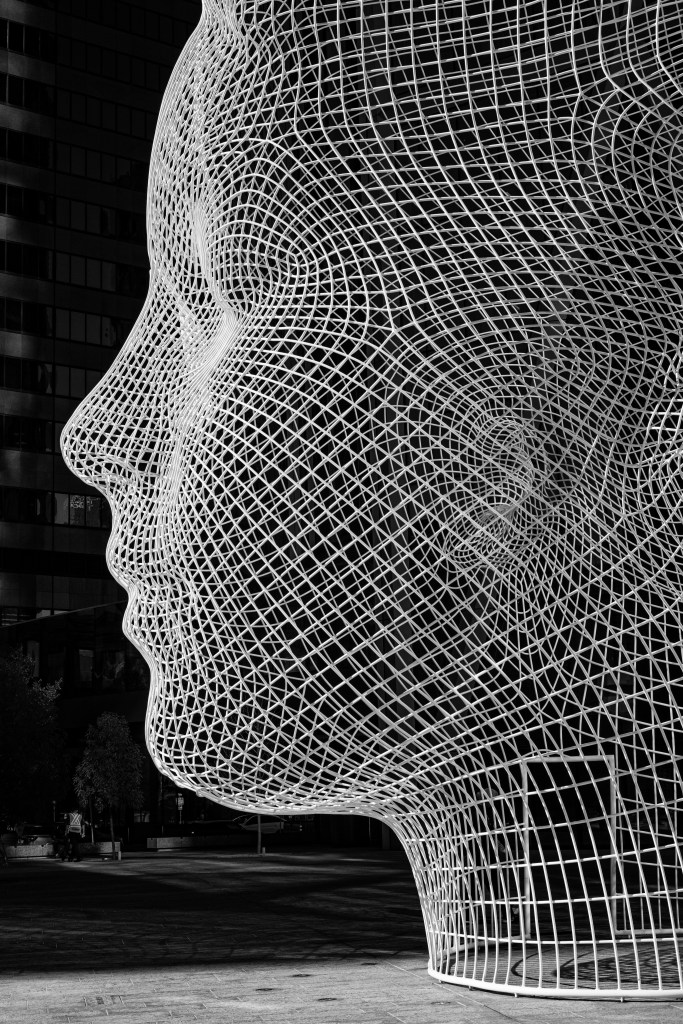
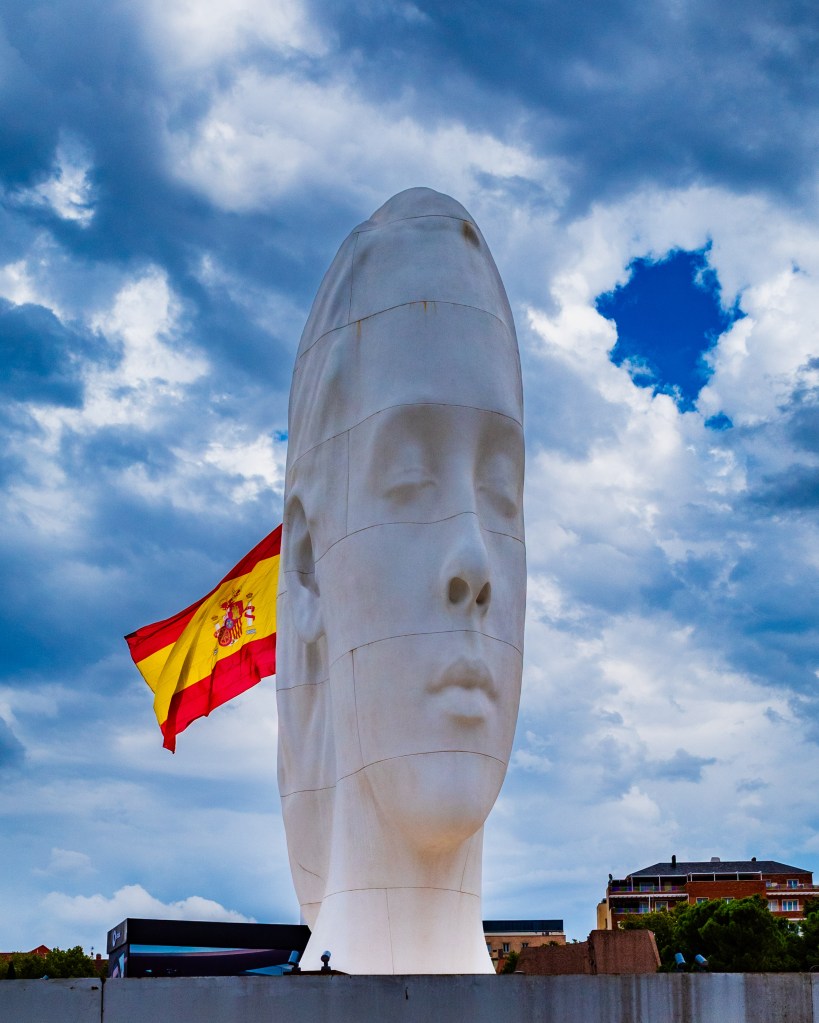
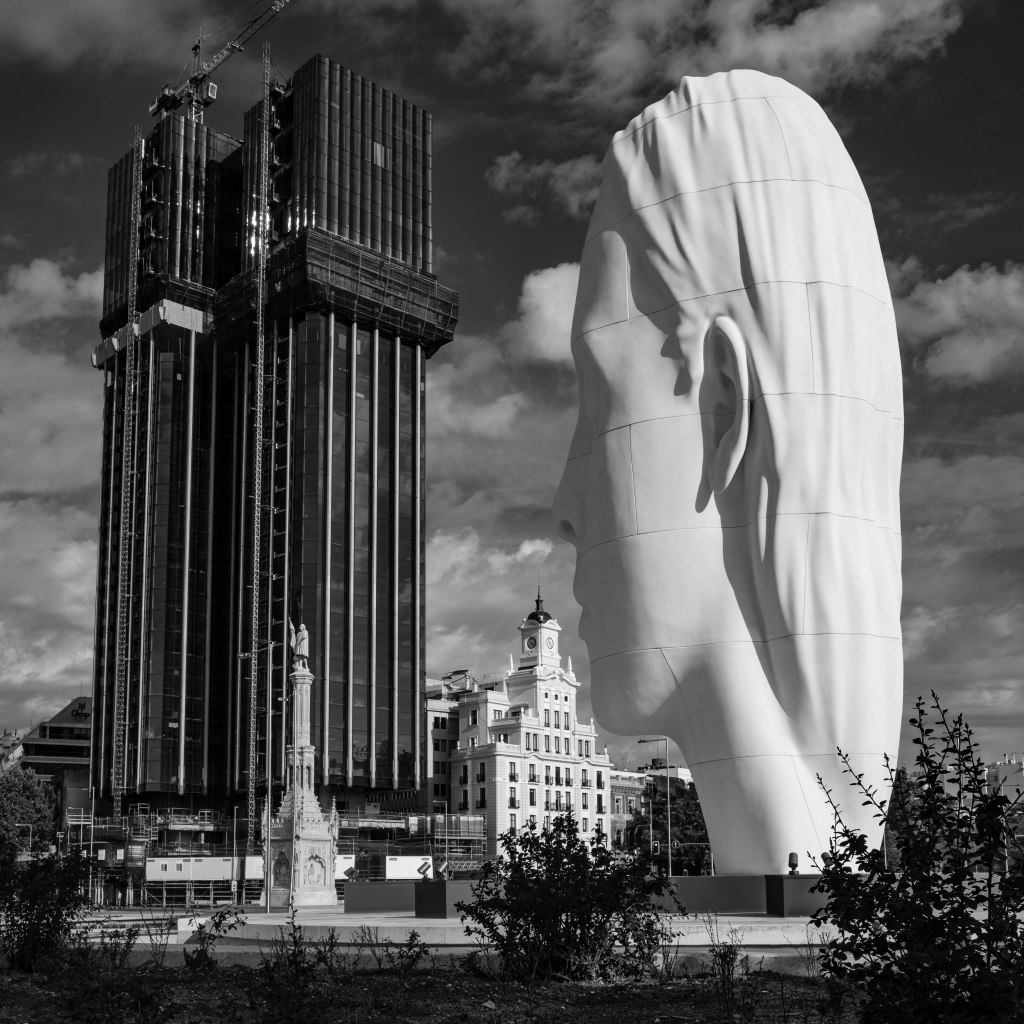
Julia, a monumental sculpture by Jaume Plensa
Just one of many picturesque spots in el Retiro, Madrid

6. Barcelona

Our stay at the Hotel Casa Fuster in the Gracia district of Barcelona was a highlight of the trip. Our fifth-floor view was dominated by the Sagrada Familia, Gaudi’s Modernist masterpiece. We intended to run an out-and-back route on via Diagonal, a pedestrian avenue near the hotel, but road construction and a close call with a taxi changed our plans. While looking for an easier route, we took a couple of wrong turns and found ourselves staring up at the iconic church. Breathtaking! We thoroughly enjoyed our stay in the capital city of the Catalonia region. The Sagrada and the Picasso Museum were well worth a visit.  Overall, it was a fitting end to our travels.

Navigating the roads in Barcelona
Sagrada Familia, Gaudi’s masterpiece

An Ideal Photo Run

Today’s photo run was perfect.

The weather in Calgary has taken a turn. I was about to write “for the worse” but since this is a blog about running, I’ll leave that comment off. Let’s say that we have seen a change, from something approaching “too hot” to “good running weather”.

Cool temperatures and drizzle often have a way of dampening (pun intended) my enthusiasm for a run. But one thing I’ve learned is that I need to look beyond those feelings and get myself out the door. Today was no exception.

After a block or two, I knew I had made the right call. The Elbow River pathway was quiet, and the river was looking fine. The sun was trying its best to make an appearance. I knew the light would be good for photographs, so I brought along my trusty Ricoh GR III.

One spot I’ve gone by a thousand times but have had trouble capturing is the small garden on Elbow Drive at 30 Avenue SW. It’s an attractive little spot but I’ve always found something challenging about the composition. Today, though, the combination of the soft lighting, misty conditions, and the new foliage was magical. I stopped and grabbed a couple of shots without a second thought. Later, I tried Lightroom’s infrared preset and got a result that I think was very cool. I hope you’ll agree

Almost back home, and content with the run (and the photos), I passed a leafy corner and noticed two eyes peeking out from between the hedges. Closer inspection revealed that it was, in fact, the headlights of a Triumph TR3 sportscar. At least I think it was a TR3. Maybe a car expert reading this piece can confirm its pedigree. In any case, it was a scene that made me smile, and a fitting way to end my run.

Enjoy.