Let me say at the outset that I approach camera equipment from a strictly amateur perspective. I’m an enthusiast, not a professional. I know what I’m doing when it comes to the gear, but I don’t chase pixels or specifications.
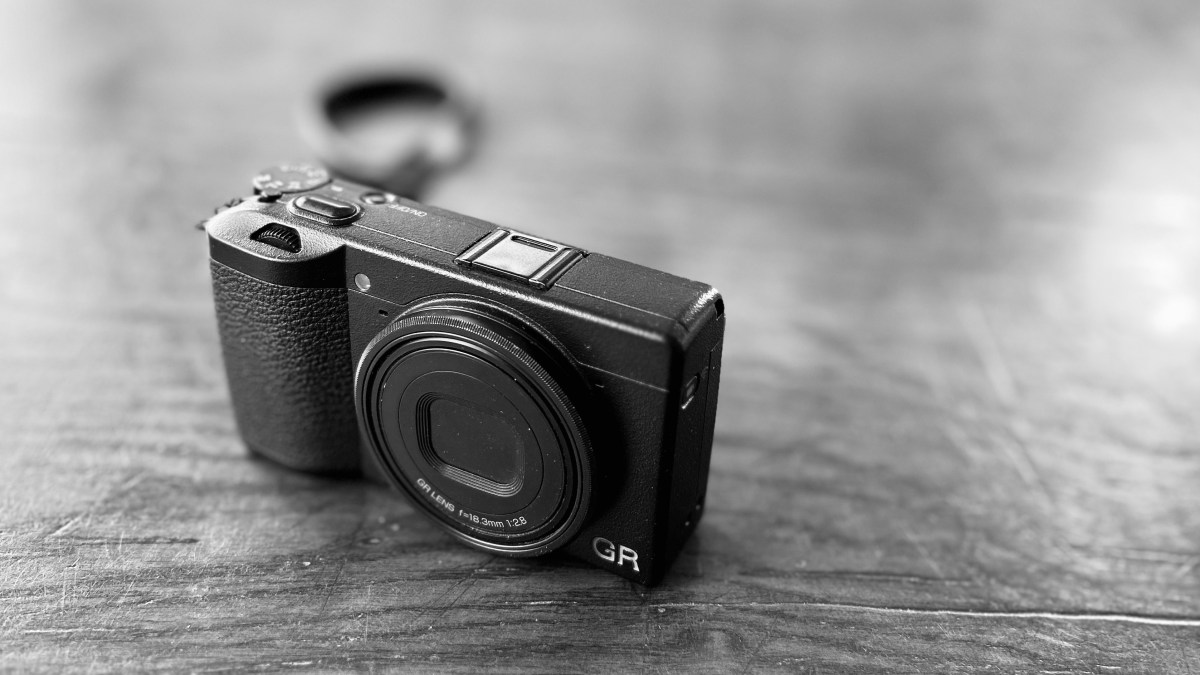
With that proviso, here is my review of a camera that I am very enthusiastic about: the Ricoh GR III.
I should explain that I predominantly use this camera for a different purpose than many other shooters. I bought the GR III to carry with me on what I call “photo runs”, easy runs of 5-15 kilometres. For that purpose, I needed a small, light, and fast-to-operate camera. Extra weight was a deal-breaker. Cameras with wide zoom ranges or fast lenses are generally bulky, so I eliminated those immediately.
I quickly got down to a shortlist, and a few features of the GR III won the day. At 257 grams, it met my weight criteria. Its f2.8 maximum aperture and 24MP resolution APS-C sensor are more than capable.
Where the GR III really shines is in the “fast and easy” category. It is faster to operate than most cameras, and easier to shoot than a cell phone. The camera’s form factor makes it easy to grip, and its snap focus feature makes it very quick to shoot. Since I carry the camera in a waistbelt (I use the excellent Salomon S-Lab belt, by the way) I can grab it with my right hand and be shooting one-handed in a matter of a second or so. That makes a difference when you are pulling over to get a shot, especially if you are out with your running mates. (Strangely, they don’t like to stop or even slow down to let me get back into the group.)
The GR III is ideal for the type of shooting I do on the run. Landscape shots are a good example, and a frequent subject if I’m running along Calgary’s picturesque river pathway system. I like being able to easily select different exposure settings with the top mode dial (most often a switch between Aperture Priority or Program mode).
Exposure compensation is a breeze with a quick sideways press of the ADJ lever. By pushing the same lever in, I can call up pre-set image control settings. The “high contrast monochrome” mode is one I often use for capturing afternoon clouds over the river or a piece of interesting architecture that I pass on my run. I’m also fond of the “positive film” mode for a Kodachrome look while running on the city streets.
I like being able to change a setting while I’m moving, and for that reason, I really appreciate the GR III’s accessible controls and the intuitive menu system. Because speed is my top priority, an even better solution was to program a couple of “run-friendly” shooting modes into the User programmable slots.
Another thing I really appreciate is the easy access to the multiple drive mode. It’s a simple toggle on the 4-way control dial, which is perfect if I decide to capture a sequence of my running partners in motion.
There’s one other thing that turns out to be essential for me. The Ricoh has proved that it can handle the worst of an Alberta winter. Consider this: I carried the GR III on my belt every day in December, while I participated in a running streak challenge organized by our local running store, Strides. That meant it was outside, sometimes exposed to a -30C wind chill, for up to 90 minutes. As long as I put a fully charged battery into it before leaving the house, it went on shooting for as long as I needed it. I should say, for as long as I could stand taking off my outer mitt to actually shoot it. Some of those runs were, in a word, brutal. And this camera kept up. Amazing!
As for things I don’t like, it’s a short list. Given its small form factor, I do find the GR III controls a bit finicky, especially with frozen hands. And the fixed 28mm focal length can sometimes be a constraint.
I’m willing to accept these limitations given all the positives that this camera delivers. What else would I expect but small controls on a camera of this size? And I find the standard JPG files out of the camera give me more than enough resolution if I need to crop and quickly edit a shot for posting on Strava or sharing with my partners after our run. Most of these shots aren’t fine art.
That said, if I do get a shot worthy of more attention, the in-camera stabilization helps me capture sharp images, which leaves me the latitude to work with the ample 24MP RAW file and crop it later in post-processing. It’s a nice option and one I’ve used many times.
Incidentally, that’s why the GR III has filled more voids than I ever expected it to. It is often the camera I reach for if I’m out walking around, as it is an excellent street shooter… unobtrusive to the subject and highly intuitive for the photographer. In fact, I carry it even if I’m bringing another camera with a 50mm or longer lens, in case I decide the 28mm viewpoint is more to my liking.
Overall, the Ricoh GR III has proven itself worthy of being a constant companion on my runs. It has exceeded my expectations, and that’s why I’m putting so many miles on it.

 My Second Running Life