Anyone who has read Slaughterhouse-Five (SH5) by Kurt Vonnegut will recognize this phrase. It stays with you after reading the most famous (or is it infamous?) and arguably the most representative of Vonnegut’s novels.
I’m not sure if SH5 is still required reading in high school English courses… I know it used to be. (I’d be reluctant to guess what required reading might be in high school these days, but that’s another topic.) For my part, I missed the opportunity to read SH5 when I was in school. Perhaps the book wasn’t considered appropriate fare for a Catholic school curriculum.
I’ve only come around to Vonnegut’s works in the last few years. I did read Galapagos in my early twenties, but I found it to be quite forgettable… it certainly didn’t convince me to read anything more by him. Maybe I wasn’t ready for the author’s unique style and keen critical eye.
Something must have changed, because I’ve read three of his books in rapid succession. In this post, I offer my thoughts on what may be his best-known novels. My comments are organized in my order of reading, which just happened to be in reverse order of their publishing date.
Kurt Vonnegut
The author of the books I’m going to discuss is worthy of some discussion himself. Kurt Vonnegut, Jr. (1922-2007) was born in Indianapolis, to German immigrants. He attended Cornell University but dropped out in 1943 after being placed on academic probation. He enlisted in the US Army and was deployed to Europe in 1944 as an intelligence scout. After the war, he pursued academic and technical career paths, never quite succeeding at anything. Vonnegut had a couple of stories published in the early 1950s, which persuaded him to give up other opportunities to pursue writing full-time. His success as a writer did not happen overnight.
Slaughterhouse-Five (1969)
It’s a challenge to summarize SH5. At its core, the story is an account of the Allied fire-bombing of Dresden, Germany in the final months of the Second World War. What genre is the book? Good question. There is an element of historical fiction, but it could just as easily be classified as science fiction. Given that the book was influenced by Vonnegut’s time in the US military, we could even label it as a biography. The author was captured by the Germans, and as a POW he witnessed the destruction of the city firsthand.
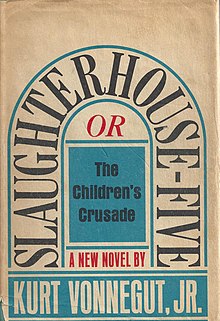
In Vonnegut’s signature style, there is a sharp satirical edge to the book. Vonnegut makes no secret of his disdain for “military intelligence”. The casual disregard for life in wartime is a theme repeated often in the book… almost sickeningly so. I think that’s exactly the response Vonnegut wants to elicit from us. That’s where the phrase “so it goes” comes from. SH5 was published at the height of the anti-war movement in the US, and it was the book that made Vonnegut a household name.
The main character in SH5 is Billy Pilgrim, a US draftee. The science fiction element to the story is that Pilgrim experiences time travel. He calls it coming “unstuck in time.” I think the message here is that history is bound to repeat itself. I found this to be a very effective tool; one that shows Vonnegut exercising his full prowess as a mature storyteller.
To summarize, I thought SH5 was brilliant. An amazing creative piece… forceful in its social commentary and totally original. Considering the current events in the world, it is as timely now as when it was written. Very highly recommended!
Cat’s Cradle (1960)
Where to begin in explaining this novel?
Cat’s Cradle is a first-person account of the narrator, Jonah, who travels to San Lorenzo, a fictitious and extremely poor island nation. Through an unbelievable sequence of events, Jonah becomes president of the country. At the subsequent inauguration ceremony, an unfortunate incident results in mass destruction on a global scale, when a material called “ice-nine” accidentally comes into contact with seawater.
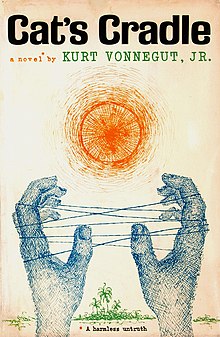
The book deals with two important themes and manages to touch on several others besides. One major subplot in the book is a fictitious, hedonistic religion called Bokonism. It is the dominant religion in San Lorenzo, seemingly a response by the poor citizens of the country to their dire socioeconomic circumstances.
The book is also a biting commentary on the risks of technology. Ice-nine was invented for military purposes by a brilliant scientist who has complete and callous indifference to the great risks it poses. The obvious parallel is to the proliferation of nuclear weapons, which would have been in Vonnegut’s mind when he wrote Cat’s Cradle in 1960. The story takes the idea of a manmade technological threat to its logical and tragic conclusion.
Only someone with a vivid imagination, black humour and a gift for sharp insight… someone like Vonnegut… could have created Cat’s Cradle. It was a fascinating read, and like SH5, very relevant to the unstable world we find ourselves in.
Player Piano (1952)
Player Piano was Vonnegut’s first novel. It tells the story of Paul Proteus, an engineer and manager of the Ilium Works, one of many large industrial complexes that have radically revamped American society. Machines have replaced human beings in every facet of life. For his part, Proteus becomes increasingly uncomfortable as he is being groomed for an expanded role in the system he helped create. The story turns on a clever “double agent” plot, as Proteus finds himself aligned with other, like-minded rebels.
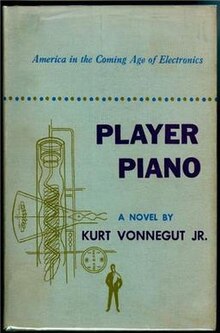
As compared to the other novels, I found the storyline in Player Piano to be the least risky… maybe even simplistic. There are no tricks with time travel here. I suspect Vonnegut was still finding his voice and his style when he wrote the book. Even so, it is a well-constructed story of an all-too-possible dystopian future. Such a future may have been easy to imagine in the early 1950s, as post-war innovations began to change American society; at least it was for Vonnegut.
Of the three novels, Player Piano had the most impact on me. I accept that as a result of my own work as an engineer and manager. Did my career path make me more sensitive to the sharp commentary that Vonnegut dishes out for these vocations in his grim novel? Probably. I don’t take any of it personally, but I do relate to his criticism of an unbridled drive for efficiency.
The world Vonnegut imagines in Player Piano is devoid of almost all pleasure, at least for the average citizen. For the elite (that is to say, the politically savvy) the upside is limitless, as long as the growing majority of displaced citizens are kept notionally busy and marginally employed. It’s a novel that heads to an inevitable tipping point.
The fatal flaw exposed in Player Piano is a conflation of an unstoppable quest for perfection (in countless industrial processes and even in human interactions) with human happiness. I found myself making connections to recent opinion pieces that assess the risks of the increasing use of Artificial Intelligence in our society. Again, Vonnegut’s story seems eerily relevant to our current circumstances.
I can recommend all three of these Vonnegut novels. In my view, his social commentary is timeless, and that keeps the books current. I want to continue my exploration of his work, to see how well his insights have held up in other areas.
Until next time, be well and BE FAST!


 My Second Running Life
we’re in a crazy time up in the great white north, so many books are on the chopping block and being pulled from school library shelves…I’m not sure of SH5 is one of them, but in Ontario they’ve pulled the Diary of Anne Frank!…..and yes some of our schools have stopped school dances, who knew that Footloose prophetic
LikeLike