
We live in interesting times in Calgary. I’ve formed strong opinions about what I see happening in my city. For many reasons, I think we’re on the wrong track. From what I’ve seen recently in other large Canadian cities, the same things are happening there, too.
One of the first pieces I wrote for this blog was on the topic of sustainability. You can find it here. My focus then was on objects that are perfectly designed for their intended purpose. They are sustainable, in that they can be expected to work perfectly for a lifetime (or longer) if properly maintained.
As I walk around inner-city neighbourhoods in Calgary, I’m bothered by a pattern that I see being repeated over and over again. Homes that have stood for decades are being levelled and replaced by one of two things: large, contemporary boxes or large, multi-family boxes. And it’s not just homes. Commercial buildings are being torn down and replaced by high-rise residential towers full of small (you guessed it) boxes.
Boxes, boxes and more boxes…
Why is this happening? Well, it is now presented as common knowledge that housing is a critical problem in Calgary. City administration has prepared or commissioned studies to explain the situation and how dire it is. I’ve read their material, and I’m willing to admit that I don’t know. I’m not an urban planner or a sociologist. Maybe it’s a crisis, or maybe it isn’t.
What I do know is that if I exercise my right to ask questions or comment on proposed developments that directly affect me, by writing letters to my councillor and city planners, the usual response consists of boilerplate talking points about housing supply and affordability challenges. I used to write such letters, but I don’t do so anymore. When a response starts with the words “because we are in a housing crisis…“, then it will include justification for all sorts of irrational actions.
As I said, I have many problems with this trend, but let me come back to that word, sustainability. I define sustainability as encompassing the social, environmental and economic aspects of a project. In my view, nothing in the current teardown and build cycle is sustainable. I’ve noticed that the experts who tout densification and the bureaucrats who facilitate it—the same people who are quick to extol its benefits—tend to be silent on this point. This isn’t an oversight; it’s because the facts don’t fit their narrative.
How about an illustration?
Yesterday, I walked by a row of three post-war houses. All were small, neat and well-kept. They have been standing for decades, so we know they have survived many brutal Calgary winters. The owners of these homes have replaced roofs, tended lawns, and done the hundreds of other routine tasks needed to keep them functioning. They have put their personal touches on them. These houses are not flashy, large, or modern, but they definitely are sustainable. On the evidence, these are the type of structures that stand in the way of solutions to our housing problem.
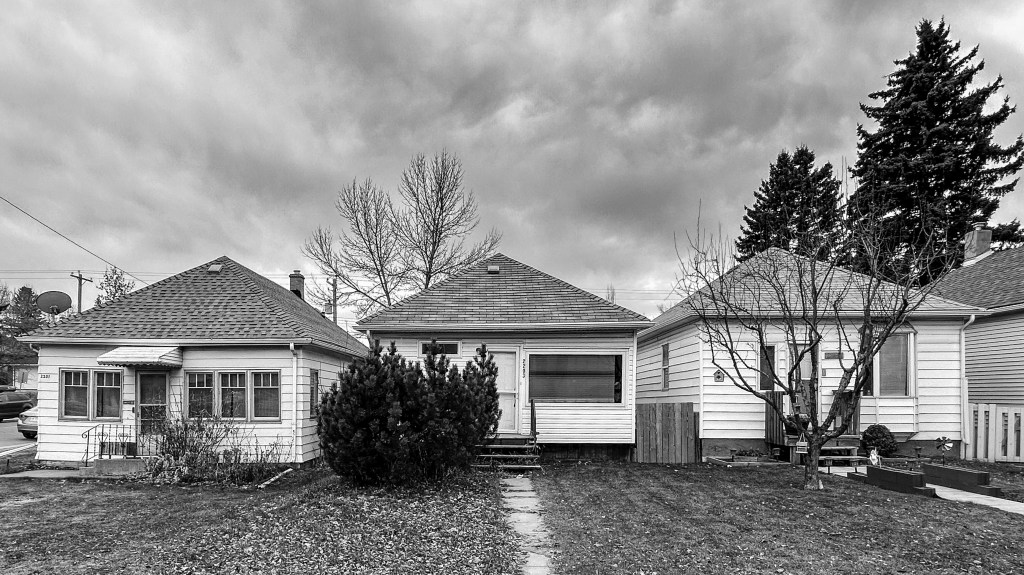
Let’s contrast this scene with another, where a transition has already occurred. The houses that used to stand in this location were like the ones pictured above. They have been replaced by multiple, multi-family dwellings; in this case, four fourplexes.
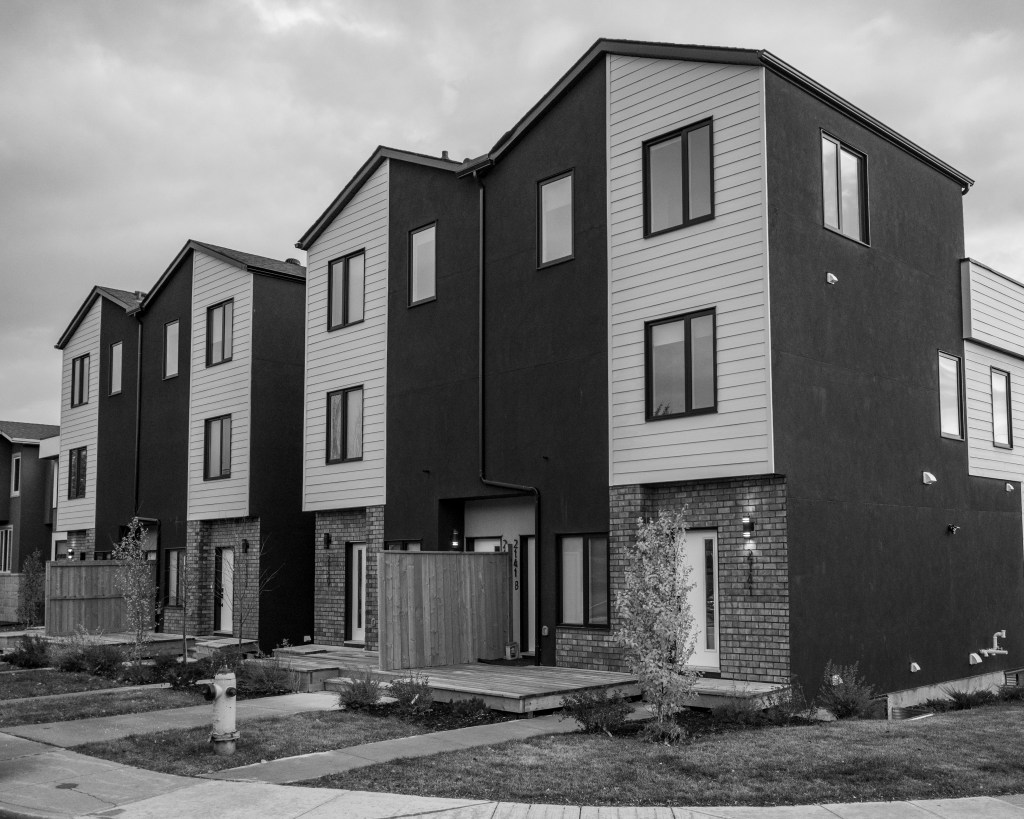
To get to this point, three houses were demolished and carted to the landfill. I estimate this would have generated 400 cubic metres (200 tonnes) of waste. That’s without consideration of the concrete foundations, which represent more waste to the landfill, and heavy waste at that.
Pouring new foundations generates significant GHG emissions, because cement manufacturing is one of the most GHG-intensive industries. Of course, there will be a continuous stream of waste while construction is in progress. And our lush urban tree canopy? Gone.
What are the main development scenarios for inner city locations?
If we see a custom contemporary house going up, it’s usually large and built to serve the needs of a couple or a small family. In other words, there will be a lot of space dedicated to a few people. Don’t get me wrong. This is a free country, and people can build to their own taste and budget. But on a full lifecycle basis, it’s hardly sustainable.
If it’s a multi-family dwelling, it’s almost certainly going to be built by a developer who will target the minimum building standards. There will be pressed board exterior walls, thin insulation and interior walls, plastic pipe and cheap finishings. Unlike the post-war houses pictured above, nothing built today will last. We can be sure of two more things: the developer will realize a healthy margin, and the finished units will not be affordable.
What about commercial properties? To round out my review, I checked the progress on the long-planned demolition of the Jimmie Condon Building at the corner of 17th Avenue and 14th Street. Some would say the building is (sorry, was) historic, and others would say its pagoda-style roofline was an eyesore. Either way, if a picture is worth a thousand words, then this one is a mouthful.
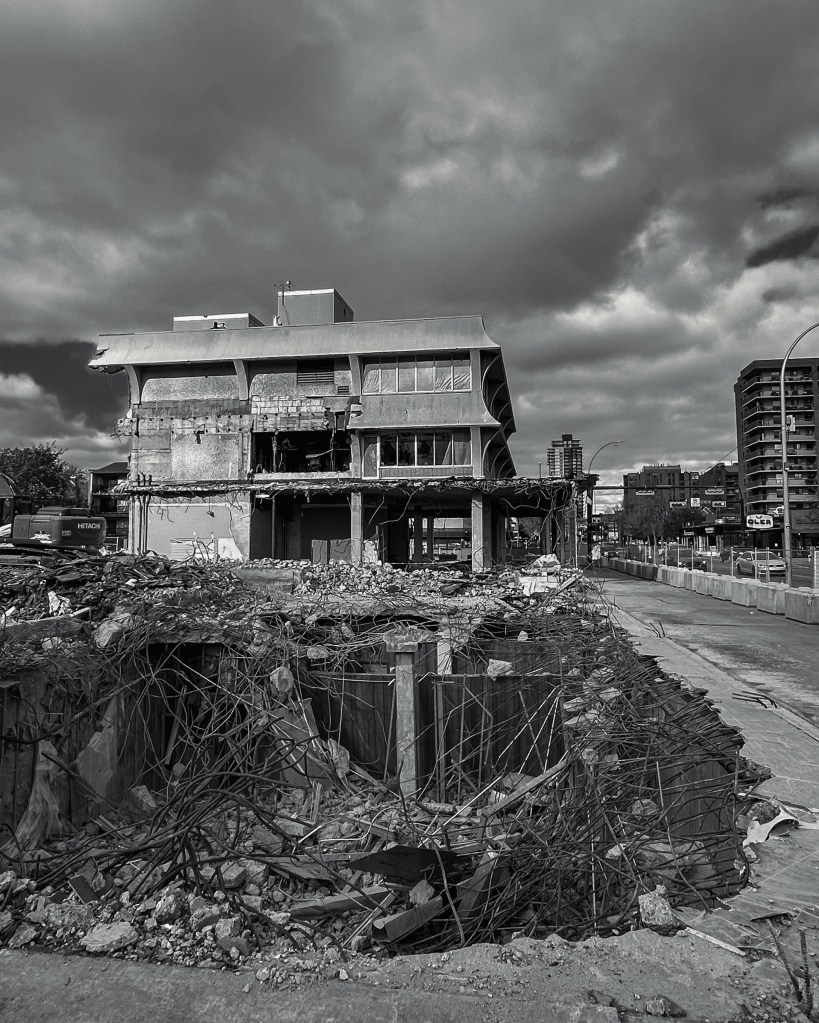
We hear a lot these days about the need to build more “climate resilient” infrastructure. In response, I’ll note that I’ve seen plenty of buildings shrouded in tarps a few years after construction, presumably to repair deficiencies in exterior construction or incorrect materials. That is neither resilient nor sustainable.
I’ll leave for another day related questions—like whether multi-family dwellings (or high-rise towers) will solve the apparent housing crisis that led to their construction in the first place. Or who ultimately pays for luxury condo units that sit on the market unsold, or peddled as short-term rentals. Or whether we should be replacing our city’s already small inventory of historic buildings with characterless, cheaply-built boxes.
To conclude, there’s a saying that a good crisis should never be wasted. I think our municipal government and administration are doing just that with their housing crisis. Their logic is simple: the more housing units that are built, the more tax revenue will be generated. So inner city buildings are being demolished at a rapid pace, with no consideration of what makes our neighbourhoods unique or desirable.
This is a trend that’s hard to justify if one is thinking sustainably. We’re targeting one objective—increasing the supply of housing units—at all costs. In this context, “at all costs” means neglecting environmental stewardship and economic sensibility.
Fortunately, the market has a way of correcting irrational behaviour. I hope we will soon see evidence that a much-needed correction is underway.


 My Second Running Life
I think its a choice. do we want larger and larger cities?
I look at a lot of new development around Edmonton/St Albert, lots of multifamily, condos and townhouses, and that’s in neighborhoods. And new detacted homes in new areas are right beside each other….the days of large large yards I think his history.
I know there are a lot older neighborhoods with the homes you’re pointing out, that with a little of work would be fine, but still a larger footprint. being closed And those older neighborhoods have had their neighborhood schools closed in favor a huge central schools, so no one with younger kids will want to move into them.
With larger cities there has to be a huge conversation. bigger cities, more freeways, wider roadways, higher taxes to provide those roadways, public transit, and for us, snow clearing…..we have freeways that were just build now being widened already because 3 or 4 lanes isn’t wide enough.
I don’t the answer, but we’re getting to the point when Edmonton, Calgary, Vancouver are turning into places like monstrosities like LA where when you fly into them, you’re flying over city forever, do we want that?…..and we have to look elsewhere for answers, places like Singapore or Tokyo where detached homes just don;t exist.
LikeLike
Hey Warren, thanks for your comments. I agree with much of what you’re saying. To answer your question, no, I don’t want larger and larger cities. Here in Calgary, we’re getting the worst of both worlds… inner city densification without limits (facilitated by an extremely unpopular change in the base zoning that was rammed through by our last council) AND unbounded urban sprawl. There are neighbourhoods I’ve never heard of springing up all around Calgary (and Edmonton too, I’m guessing). Hence the need for freeways.
Meanwhile, the experts seem to think they can turn our urban centres into Amsterdam, where living in a densified inner city and commuting by bicycle is the norm. This is unrealistic, given our climate. What I object to most is that we seem to have turned urban and suburban planning over to developers. We shouldn’t be surprised at the result… cities that all look the same, from the big box stores to the bland mid-rise blocks to the mid-block eightplexes in beautiful neighbourhoods like Altadore (Calgary) or Highlands (Edmonton).
I don’t have the answers, but I don’t like where we seem to be heading. Cheers.
LikeLike