Running, Across the Iberian Peninsula

Our trip to Portugal and Spain offered ample opportunities for us to explore the region on foot, and we did just that. Working our way from Lisbon to Barcelona, we made sure to include a run in each location. As many readers will attest, there is no better way to see a new place than at running speed. We had some memorable runs (camera in hand, of course) and faced only a few minor challenges along the way. Here’s a summary.

Lisbon

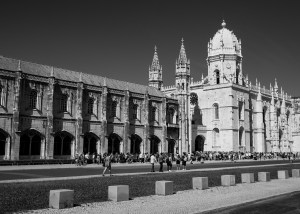
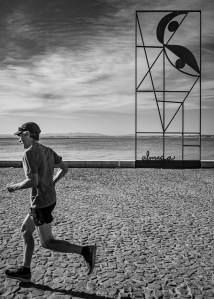
The Portuguese capital was a charming place to start our Iberian tour. The Praça do Comércio and the Tagus River were just steps from the Pousada Lisboa Hotel. We did an easy out-and-back run to the Ponte 25 de Abril, enjoying magnificent views along the way. We decided to turn around before reaching the impressive modern Museum of Art, Architecture and Technology (MAAT) in Belém. We knew that we wanted to visit the area later in the day so we could explore the sights more fully. We were thrilled to see so many fast and fit runners on the (cobbled!) pathway.
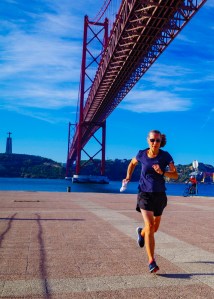
Ponte 25 de Abril
The cobbled path along the Tagus River

And here’s what we saw later in Belém (but not running):
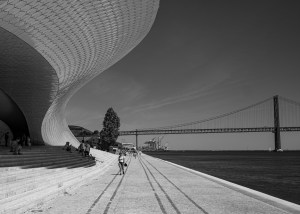
The spectacular Museum of Art, Architecture and Technology
The Jerónimos Monastery

Faro

We fit in a short run during our stopover in Faro, the capital city of the Algarve district in southern Portugal, which let us see the morning activity along the waterfront. Fishing boats were returning to port, and clamdiggers were taking full advantage of the low tide as the sun rose. The temperature was already climbing as we returned to our comfortable room among the narrow, cobbled streets of the old town.
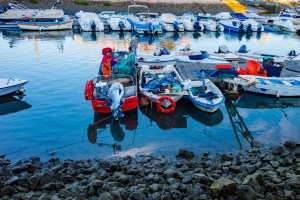
Early morning, Faro harbour

Seville

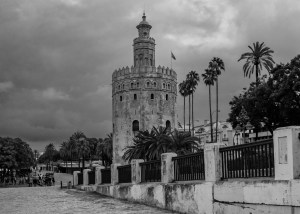
Our first stop in Spain was a revelation. The capital of Andalucia is brimming with Spanish character. Our apartment was a few blocks from the historic Puente de Isabel on the beautiful Guadalquivir River. We were treated to many sights on our early morning seven-kilometre run. Rowers and runners were out in force, all with the same thought of avoiding the heat of the day. Unique public art, several famous monuments and contemporary architecture were all to be found along the route. Our turnaround point was the lush Maria Luisa Park, the gardens next to Plaza de España, and one of the many features in Seville that were constructed for the 1929 Ibero-American Exhibition.
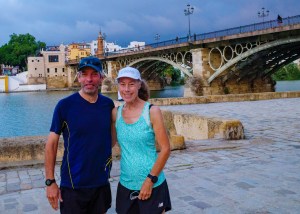
We started from the historic Ponte Isabel II in Sevilla
Torre del Oro, one of the sights along the Guadalquivir River

Granada

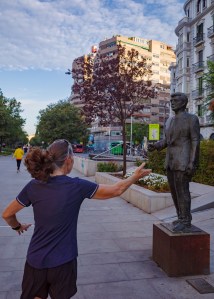
Our challenge in this historic city was to find a flat spot to run. From our apartment in the Albaicin neighbourhood we had a panoramic view of the most famous feature of the city (the Alhambra, a massive Moorish fortress and palace), but it was also a steep, twisty and cobbled kilometre away from the city centre. As a result, we decided to enjoy a leisurely walk down to the Avenida de la Constitución before starting our run. A few laps of this pedestrian-friendly mall made for a pleasant outing. We didn’t see many other runners during our early morning run, but we did get a chance to say hello to statues of many famous people from the region.
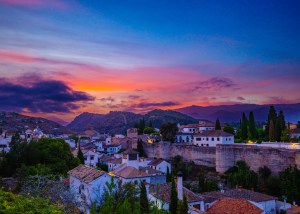
Sunrise over the Alhambra, Granada
Good morning Granada

Madrid

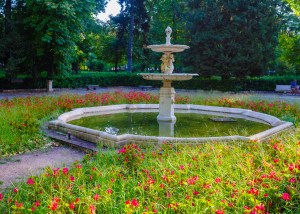
We were impressed by the capital city of Spain as soon as we arrived at the handsome and historic Estación de Atocha. This very walkable city of 3.2 million people is crammed with sights, including the world-famous Prado Museum. We found surprises around every corner. When it came to planning our run, we were pleased to see that the Hotel Fénix Gran Meliá in the Salamanca district was a few minutes away from the Parque de Buen Retiro, possibly the most beautiful urban park in Europe. A lap of the gravel path around the park was 4.5 kilometres, leaving us with enough energy to check out the Estanque del Retiro, a spectacular artificial pond and monument. Aside from the Retiro, there are many other green spaces to explore in Madrid. We were disappointed to learn that a hugely popular 10k race (Corre por Madrid) was taking place on the morning we left the city. Maybe next time!
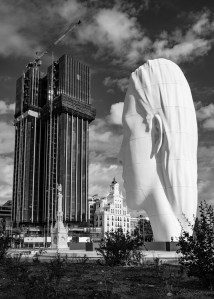
Julia, a monumental sculpture by Jaume Plensa
Just one of many picturesque spots in el Retiro, Madrid

Barcelona

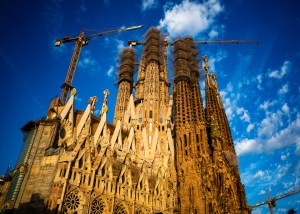
Our stay at the Hotel Casa Fuster in the Gracia district of Barcelona was a highlight of the trip. Our fifth-floor view was dominated by the Sagrada Familia, Gaudi’s Modernist masterpiece. We intended to run an out-and-back route on via Diagonal, a pedestrian avenue near the hotel, but road construction and a close call with a taxi changed our plans. While looking for an easier route, we took a couple of wrong turns and found ourselves staring up at the iconic church. Breathtaking! We thoroughly enjoyed our stay in the capital city of the Catalonia region. The Sagrada and the Picasso Museum were well worth a visit.  Overall, it was a fitting end to our travels.
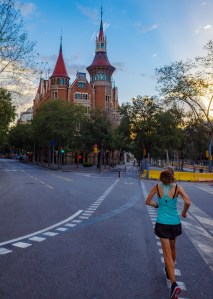
Navigating the roads in Barcelona
Sagrada Familia, Gaudi’s masterpiece

A Brief Introduction to an Amazing System

Two main sets of arteries feed blood to the human brain. At the front of the neck are the left and right common carotid arteries. The common carotids divide into the external and internal carotids. The carotid arteries are big, as far as arteries go, at about six millimetres in diameter for the average adult, and they account for about eighty percent of the total blood supply to our brains.

At the back of the neck, we find the left and right vertebral arteries—the verts. These major arteries run from a point behind the collarbones, up and through the vertebrae in our neck, and into the back of the brain. The verts originate from a junction with the subclavian arteries, another pair of large arteries that deliver blood into the arms. The verts are smaller than the subclavians, at about three millimetres in most adults.

As I’ve mentioned before, I look at medical subjects from a strictly layman’s perspective. One aspect of the arterial system feeding the brain that I find fascinating is the amount of redundancy that is built into it. In most people, the left and right vertebrals do the same job. The two separate arteries meet up in the back of the skull to form the larger basilar artery. It is the basilar artery that supplies the remainder of the blood to the brain, about twenty percent of the total.

Redundancy extends further than just between the left and right vertebrals. It also includes connectivity between the two sets of arteries feeding the brain, the carotids and the vertebrals. At the base of the brain, where the various arteries come together, there is a circle of connections between the carotid and vertebral arteries. This arrangement of communicating arteries is called the Circle of Willis, named for Thomas Willis, an English doctor who discovered it in the seventeenth century. Several other arteries meet up in the Circle of Willis and then take blood away to other parts of the brain.

The reason for the Circle of Willis is quite simple and elegant. If any of the main arteries is blocked, or occluded, then the parts of the brain that depend on the blocked artery can still get blood supply. In other words, blood can flow around the circle to get to its destination by another route.

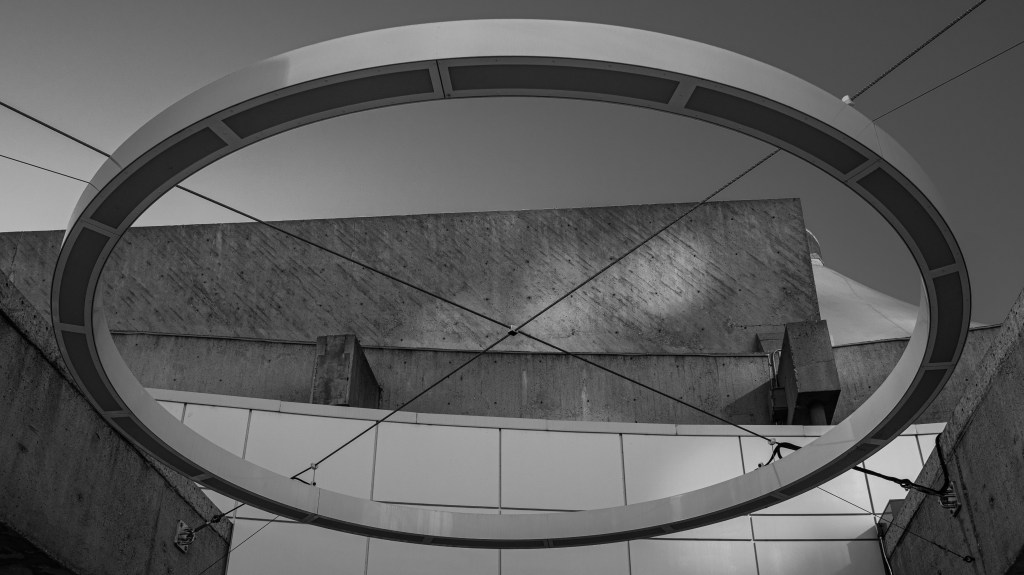
Not the Circle of Willis

There can be differences in each person’s arterial connections, and many people have an arrangement other than a textbook Circle of Willis. This is what a neurologist would refer to as an “incomplete Circle of Willis”. It doesn’t seem that having an incomplete Circle of Willis is necessarily a problem. Besides, there is no option to fix it, given the complexities involved. In other words, an incomplete Circle of Willis is likely something that would only ever be discovered in an autopsy.

So, why am I even writing about this?

I know from personal experience that having an incomplete Circle of Willis can lead to higher risks of stroke or other neurological problems.

Even if that weren’t the case, I look at this system from a chemical engineer’s perspective. And when I do, I can’t help but be fascinated by the perfection of the design for this most essential system.

Mine just doesn’t happen to be perfect.

Skyline Trail: One Less Bucket List Item

We were halfway into our Skyline Trail hike when Dan asked me a question. 

“So, how long have you wanted to do this hike?

I had to think for a minute. 

“I don’t know exactly, but it was long before you were born. Let’s say 40 years.”

Day 1, Lorraine Lake

To be truthful, I’d given up the idea of tackling this epic 45km trail in Jasper National Park. It seemed less likely after my health problems, and considering how much effort it would take to organize the required overnight backcountry camping. 

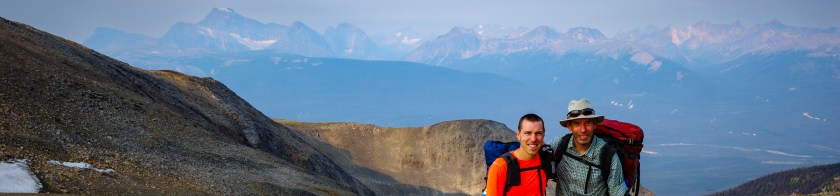
That was before I mentioned my bucket list item to my son, Dan. Next thing I knew he had sent me an email with possible itineraries and dates, complete with a packing list and even his menu suggestions. He’d already booked the campsites. 

I realized I had no reason to say no. We were going to Jasper on the August long weekend! 

I went into rapid preparation mode, starting with some shorter hikes and an actual backpack (my old Arc’teryx Bora 65). I bought some missing gear, which was almost as much fun as the hiking. Deb did us a huge favour by organizing our food into about a thousand convenient Ziploc bags. We were off!

We would do the hike in 3 days, in the typical south-to-north direction, from Maligne Lake to Signal Lake. The trail crosses three passes and gains 1,400 metres of elevation. Our days would increase from 8 km to 13 km to 26 km. I was secretly worried about that last day; I didn’t want to be the guy they had to rescue by helicopter. 

Day 2, Big Shovel Pass

As it turned out, I got more comfortable with my pack each day. The trail was perfectly maintained. I handled it all well. Dan was an amazing trail companion and a totally confident backpacker. He did all the planning, all the cooking (including the most unexpected and awesome birthday cake ever), and most of the hauling. There were only a couple of times I felt I was holding him back. I did decline his offer of a quick side scramble up Curator Mountain though. 

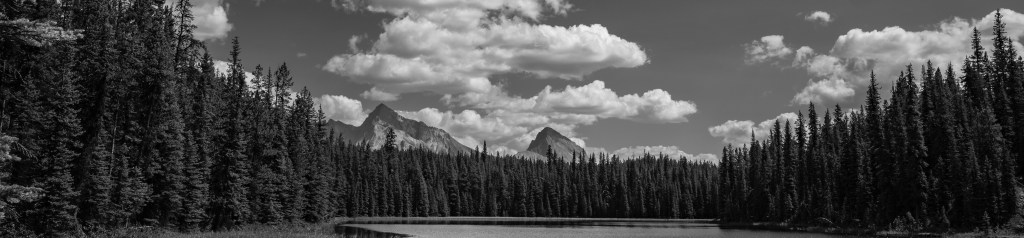
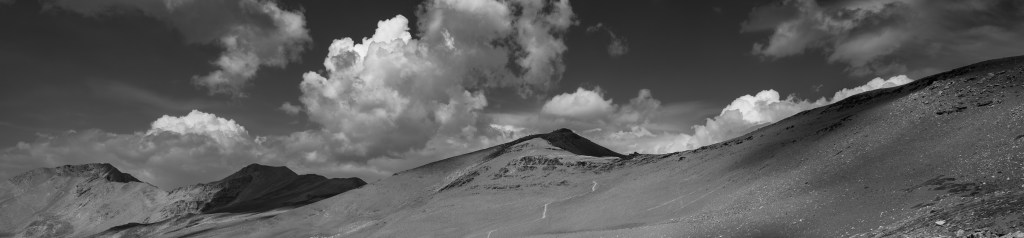
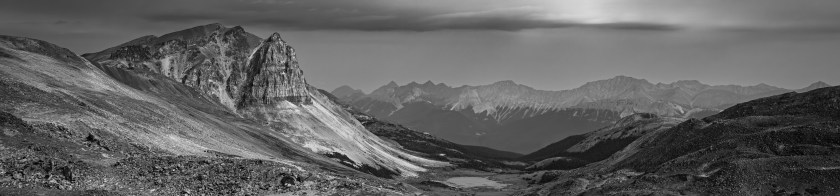
The scenery was spectacular, especially on either side of the third pass, The Notch, which at 2,500 metres is the highest point on the trail. We had an early start on day 3, and my mantra was “Notch by nine”. I told myself the climb was just another tough interval workout. It was fascinating to see how each pass opened up very different vistas and microclimates; from lush green valleys to moonscapes. There were great B&W landscapes everywhere you looked. (I had the capable and compact Ricoh GR III with me.)

Day 3, Descending from The Notch

We knew there was a chance of thunderstorms as we approached the final campsite, Signal. Suddenly, the sky darkened around us. I forgot all about my aching feet, as our attention shifted to one goal… getting to a lower elevation. 

Fortunately, the sky cleared, after dropping some large but harmless raindrops on us. That left us only with the monotony of an 8-km fire road to finish the hike. 

Overall, it was the fulfillment of a lifelong dream, and best of all, a chance to spend a few memorable days with a wonderful person. 

Day 3, The Notch, 2,500m

Recommended Reads

I recently read two well-known books in the running genre, one after the other. Once a Runner and Marathon Woman couldn’t be more different, so this piece shouldn’t be taken as a straight-up comparison. Still, it was useful to contrast (on one hand) a niche novel from a bygone era and (on the other) a personal memoir of one of the most compelling characters from that same era. 

I’ll start with Parker’s book. 

I had a copy of Once a Runner on my reader long before I read it. The idea of a fictional story set in the milieu of a university track and field team interested me, but less than, say, a memoir of one of the great runners from history. True stories just resonate more with me, I guess. 

When I did finally dive in, the book was fine. Three out of five stars. Parker is a competent writer, but I found his characters to be thinly developed. I never really warmed up to the protagonist, Quenton Cassidy, a talented and driven miler. Cassidy’s mentor is the mysterious Bruce Denton. He isn’t the best role model, if I judge solely on how much he made me feel like going out for a run myself. And the female characters in the book don’t ever rise above the status of bit players or afterthoughts. There was quite a lot of 1970s-era stereotyping here too. 

I found the plot totally predictable. But that flaw didn’t bother me too much, as I had minimal expectations for the story anyway. 

What I liked in the book were Parker’s nuanced and detailed descriptions of distance training and racing. (This is no surprise, as the author was a talented runner who trained with the great Frank Shorter in Florida.) Sure, my days as an amateur track runner are well in the past, but I could fully relate to everything that Cassidy experiences as he prepares for and runs the climactic race—against a tough Kiwi, based with absolutely no disguise on the real-life John Walker—that closes the book. Anyone who has built up to a goal race would benefit from reading that part of the story. 

Overall, Once a Runner will appeal most to dedicated students of the sport and hardcore enthusiasts. Even so, if you’re like me, you’ll probably have many other choices on your reading list. When you find yourself with a gap, you might give it a try. 

The connection between my highlighted books may rest in the zone of those same societal stereotypes. In fact, Marathon Woman by Kathrine Switzer is the story of a dedicated young woman’s fight to break down those barriers. 

I knew a little about Switzer, mostly from her infamous on-course encounter with Jock Semple when she ran as the first legitimate female entrant in the 1967 Boston Marathon. 

Once I started into her book, I had trouble putting it down. Switzer writes in a comfortable style. While I wouldn’t say her book is aimed at a female audience—I really hope men read it—I did learn more about things like panty girdles than I ever thought I would. 

That said, it’s the essence of her story that is so impactful—her long, solitary battle to gain recognition for women in distance running. The next time you stand on the starting grid for a race, look around at the women who have embraced running as a key part of their lifestyle. That’s what we all can thank Switzer for. She does a great job in the book of explaining the hurdles she had to overcome to make that possible. 

Beyond her dedication as an advocate for change in women’s athletics, I had no idea how passionately Switzer pursued opportunities for women in other sports. Thanks to her diligent and courageous efforts, which are admittedly still a work in progress, women now compete on a more or less equal footing with men in many sports. I look at the Women’s World Cup which just started as an example. What a legacy Switzer has earned. 

I think you can tell which of these two books I would recommend to my friends. 

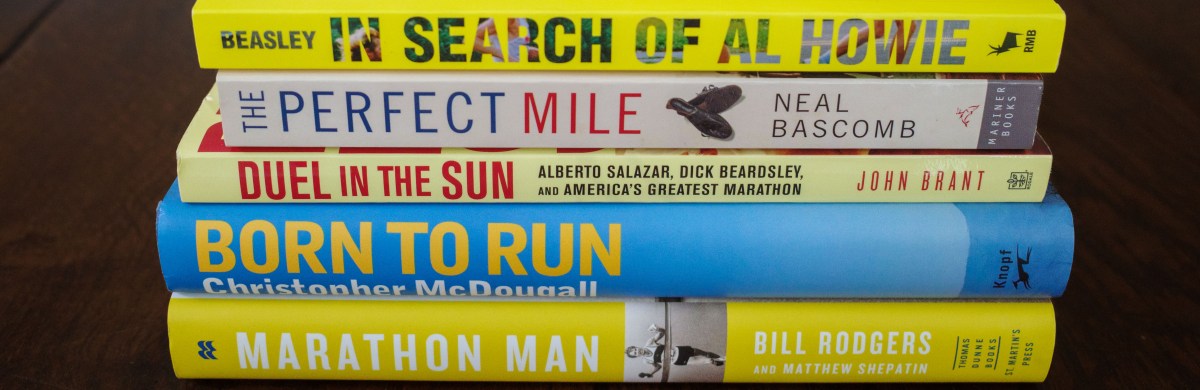
My Top 5 Books About Runners

Marathon Man, Bill Rodgers & Matthew Shepatin

Bill Rodgers was an unlikely sporting hero. His reputation as a flighty drifter stands in contrast to his intensely competitive racing personality. As we learn more about the man, we can understand this contrast and see how Rodgers progressed to the peak of the marathoning world.

I found his mile-by-mile account of the 1975 Boston Marathon—Rodgers’ breakout race and the first of his four Boston victories—to be worth the price of the book.

Marathon Man is full of motivation for amateur runners, and I highly recommend it.

In Search of Al Howie, Jared Beasley

Al Howie was an enigma. He was a troubled loner, who thought nothing of running thousands of kilometres just to compete in a race, only to turn around and run home. His 1991 record for the fastest run across Canada (72 days) stood for decades until it was broken in 2022 by local legend, Dave Proctor.

While Beasley’s book sheds some light on what drove Howie, we are in many ways left to come to our own conclusions about the man. And that’s fine.

I found the book helped me to sort out what running really means to me, and that’s why I recommend you read In Search of Al Howie for yourself.

The Perfect Mile, Neal Bascomb

All of us who enjoy running owe a debt to the three talented men who chased the four-minute mile in the early 1950s. Roger Bannister, a Brit, finally broke the barrier in 1954. And like us, he was a pure amateur. He juggled athletics training with medical studies and did groundbreaking research into the science behind aerobic exercise.

In my opinion, he paved the way for us to enjoy the sport as we do today.

What you may not know is that there was worldwide interest in the rivalry between Bannister, the Australian John Landy, and the American Wes Santee. Bascomb’s superb book, The Perfect Mile, brings this important piece of running history to life. Highly recommended!

Born to Run, Chris McDougall

This book caused quite a stir when it came out in 2010. It uncovered a whole new world of distance running, in the remote part of Mexico that is home to the fascinating Tarahumara people. Reading about their unbelievable feats of endurance left me in awe.

I was also intrigued by the mysterious American loner, Caballo Blanco, who lived and ran in the same mountain region.

The author’s own experience in a fifty-mile trail race leads him to investigate why human physiology makes us ideally suited to distance running.

These threads are woven together to make Born to Run a memorable read. See if you agree.

Duel in the Sun, John Brant

This is the story of one of the great rivalries in distance running, and possibly the most exciting Boston Marathon finish of all time.

The clash between Alberto Salazar and Dick Beardsley in 1982 has all the elements of a thriller: the brash young star and the workmanlike veteran, battling each other to the finish on a scorching day in Boston. Neither runner was ever the same again.

Their compelling personal stories are told in real-time as they run from Hopkinton to Boylston Street. Duel in the Sun is a must-read for anyone who has run that famous stretch of road. Or aspires to.  

Stroke Symptoms: Think You Know Them All?

Thanks to effective public awareness campaigns, many of us are familiar with the common signs of stroke. Think of the television ads that show us what to look for if we think someone is having a stroke.  The mnemonic “F-A-S-T” reminds us to look at the Face (is it drooping?), Arms (can you raise both?), and Speech (is it slurred?), and to waste no Time in getting help.

This checklist is a potential lifesaver because when it comes to strokes time is of the essence. But there’s more to the story. That’s because there’s more to the anatomy of our brains than what can be incorporated into a simple memory jogger of stroke symptoms. I learned this the hard way.

I’ve written elsewhere about the fascinating system that feeds blood into the human brain. More on that very soon. (By the way, everything I write on medical matters is in layman’s terms.) In brief, there are two main sets of arteries, the carotids and the vertebrals. These arteries are found in the front and back of the neck, respectively.

The carotids are the workhorses, accounting for about 80 percent of the total blood flow to the brain. And these are the arteries that, if they get blocked or damaged, can result in the symptoms noted above.

In 2017, I began to experience symptoms that didn’t fall into the handy, F-A-S-T category. Over a period of two months, I had several episodes of vertigo. I saw strange artifacts in my field of vision. I had a sensation that my body had become disconnected from my brain.

Then, one morning in July 2017, I woke up feeling odd. The first things I did were look in the mirror (to see if my Face was drooping) and talk (to see if my Speech was slurred). They weren’t. I could move my arms and legs, although they felt strangely heavy and lethargic. Naturally, I concluded I wasn’t having a stroke.

The scans done later that day in the ER said otherwise.

It turns out I had developed a blockage in my left vertebral artery. These arteries, left and right, run from a point about the level of your collarbones at the back of the neck. They join up to form the basilar artery, which feeds blood to the back of the brain. The vertebrals account for about 20 percent of the blood flow to the brain, and when they are blocked, functions like balance and coordination, including visual and hearing coordination, are affected.

The blockage in my vertebral artery had probably been there for some time before it started to cause symptoms. Until my situation was eventually brought under control, after a lengthy stay in the Foothills Medical Centre stroke ward, I experienced a wide range of symptoms. I had my eyes and ears go out of sync, as if someone had gotten hold of the control knobs in my brain and started twisting them randomly. My tongue turned into a frozen lump. My arms went into jerky spasms. It was not pleasant.

The reason I’m explaining all this is to share what I’ve learned. While catchwords are helpful, they don’t tell the whole story. If you, or someone you care about, is having any of the above symptoms or a long list of others[1], get it checked out immediately. Symptoms that are caused by a blockage in the vertebral arteries can be deadly serious, just like those in the carotid arteries.

By the way, when I did some research into the F-A-S-T mnemonic, I found some recommendations that it be modified to BE FAST. Why? The B and E would include Balance and Eye trouble in the checklist of stroke symptoms. This version of the mnemonic certainly would have helped me.


[1] Other potential symptoms of “vertebral artery stenosis” include sudden falls, severe headaches, breathing problems, confusion, trouble understanding speech, incontinence, and more.