Get your copy of Stroke of Luck: My Life in Amateur Athletics on Amazon, for a marathon-inspired 26.2 percent discount! The sale runs through the end of November.
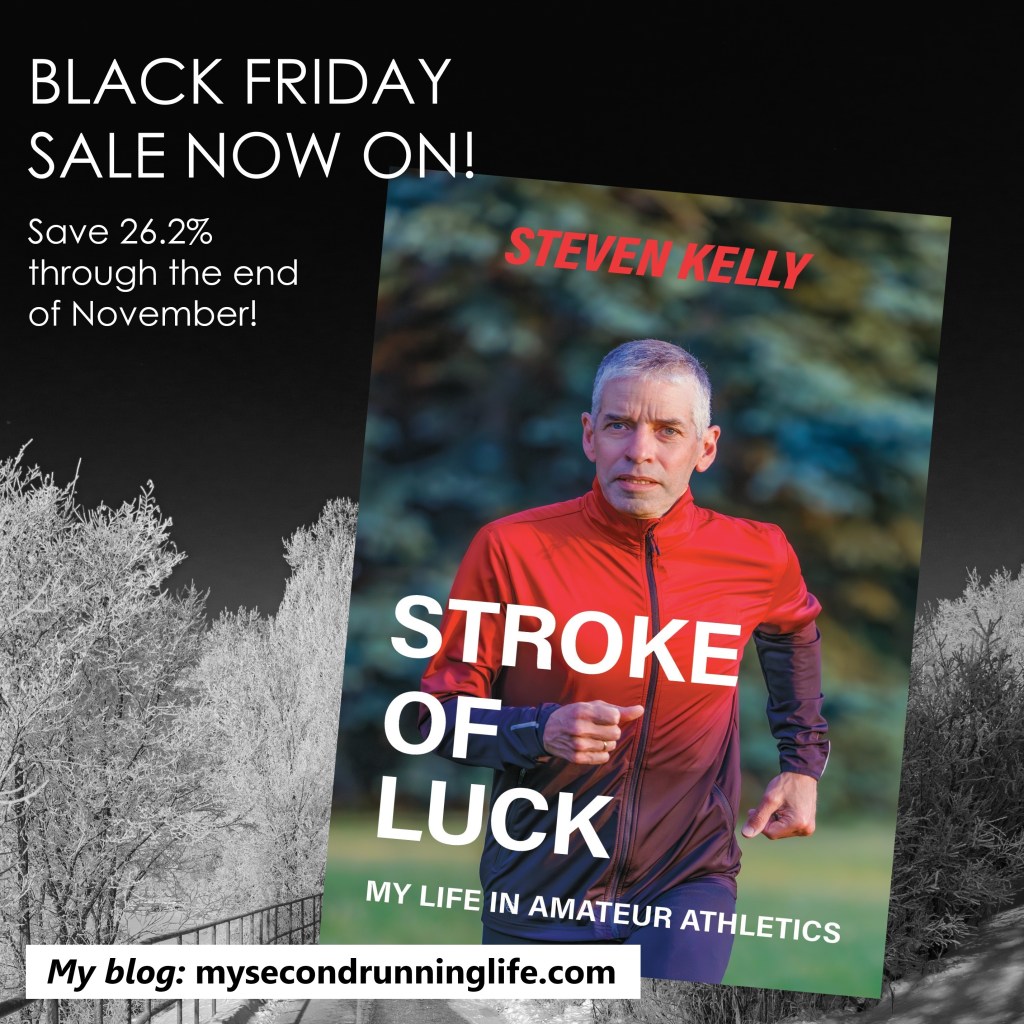

Get your copy of Stroke of Luck: My Life in Amateur Athletics on Amazon, for a marathon-inspired 26.2 percent discount! The sale runs through the end of November.
I’m pleased to announce that my memoir, Stroke of Luck: My Life in Amateur Athletics, was recently published. The book is available now on Amazon (in either print or e-book format) or through independent bookstores. For those in Calgary, you can reach out to me directly for a copy. You’ll find details about the book on the dedicated page on this site. Click here.
Writing and publishing the book has been a personal journey of discovery. I hope you will enjoy reading about my lifelong connection with distance running, and the process of recovering from a number of strokes in 2017.
To my readers, and to those of you following me on the blog or on Instagram, I appreciate your interest and support. I look forward to sharing more stories and photographs with you.
Steve
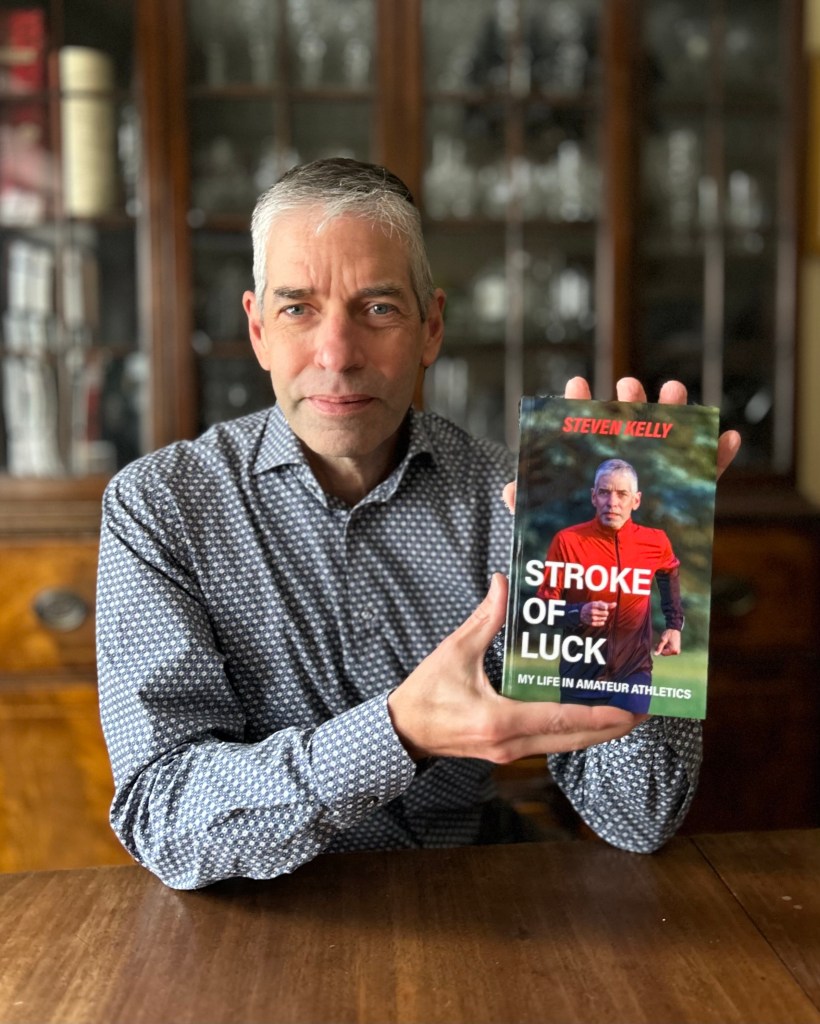
Stroke of Luck: My Life in Amateur Athletics – order your copy today!
As anyone who has lived here can tell you, Calgary doesn’t do fall very well. Sure, it can be nice one day, but we know not to be fooled. It’s only a matter of time before the weather turns into a demon.
This past week was a good case in point.
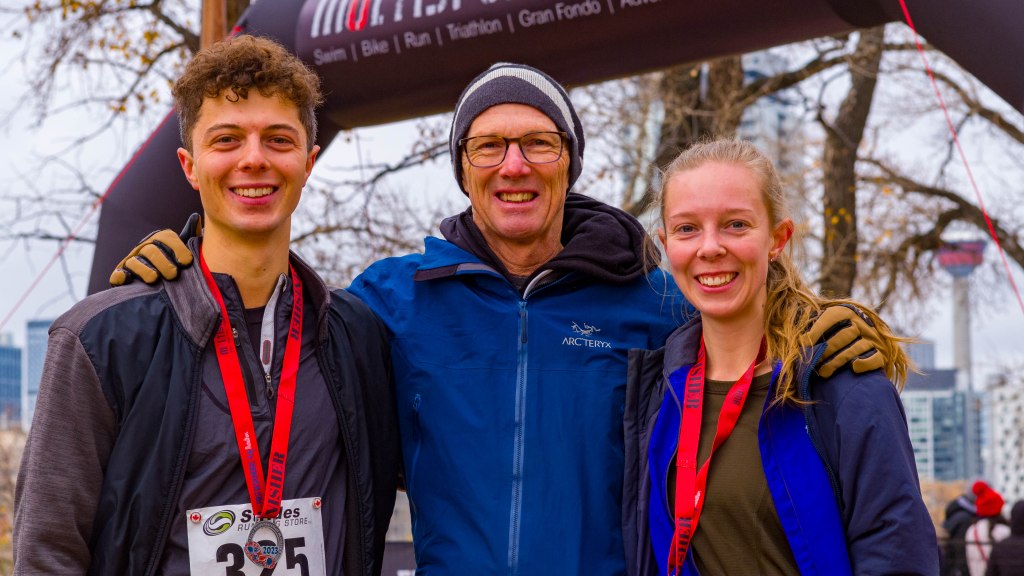
The First Responders races are hosted by Multisports Canada, in support of all first responders – police, fire, EMS and military. Races are held across Western Canada. This year, the Calgary race was held on October 22, on beautiful St. Patrick’s Island.
It was a cool day… a perfect day for racing. A good turnout for the 5k, 10k and half marathon races provided lots of opportunities for runners and spectators. Deb and I were there to cheer on some young athletes from our club. We were also fortunate to have Dan in town for the weekend. He was with members of his Cold Lake squadron, to compete in the 10k.
Overcast skies and the scenic backdrop of the island also promised some great photo opportunities. I got myself ready in a few strategic locations, with my Leica M10 and the excellent Voigtlander 75mm Heliar f1.8 lens in hand.
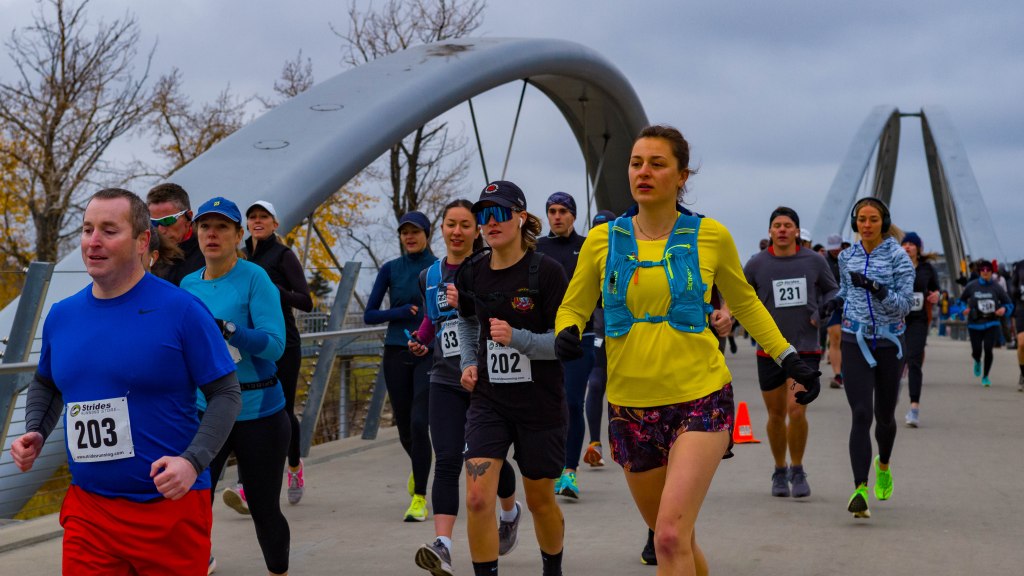
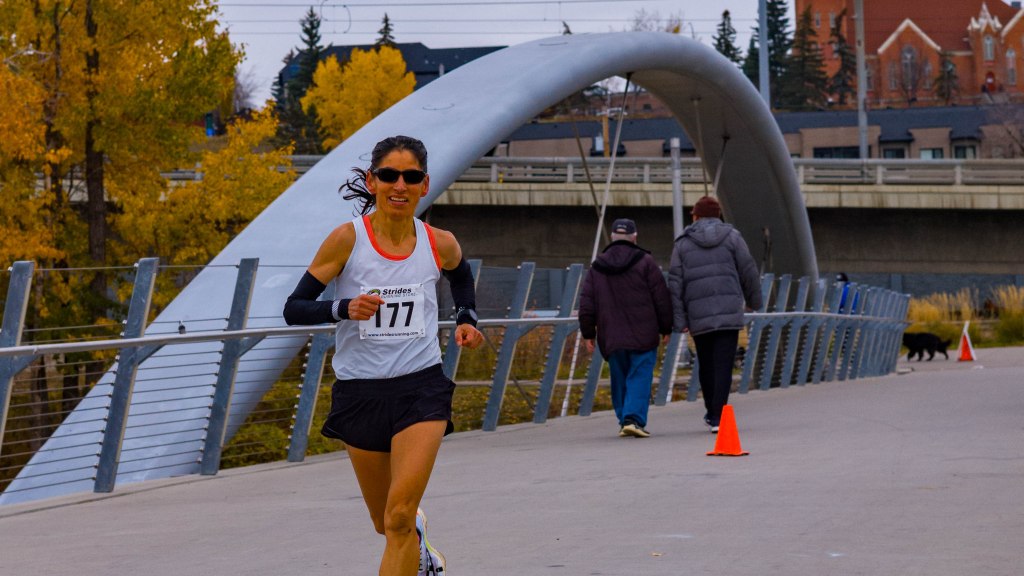
The racers didn’t disappoint. There was plenty of excitement and some terrific performances. You can find the results for all the races here. The ageless Maria Zambrano, who has been a fixture in the Calgary race scene for decades, won the 10k outright, in a sparkling time of 36:09. She isn’t getting older, she is getting faster. Amazing!
Providing more evidence that age is really just a number, Andrew Brown took home top honours in the half marathon, running 1:26:35. By the way, Andrew is in the 50-59 age group.
I was wearing two hats (well maybe three, given the temperature.) As an assistant coach, I was rooting for two young runners in our Adrenaline Rush club, Alison and Owen MacPherson. Both raced their plans to perfection, chalking up negative splits and looking far too comfortable at the finish. Dad Gord was there to cheer them on!
Now, what about the demon, you ask?
Our time ran out on Monday, with the arrival of a cold front. It was the first blast of winter. By the time it was done, 15cm of snow had fallen on Calgary, and our pleasant fall was a distant memory. We are still digging out! And running on treadmills for the most part.
Proving the resilience of the Calgary running community, a small army of volunteers picked up their shovels and headed for the track at the Glenmore Athletic Park.
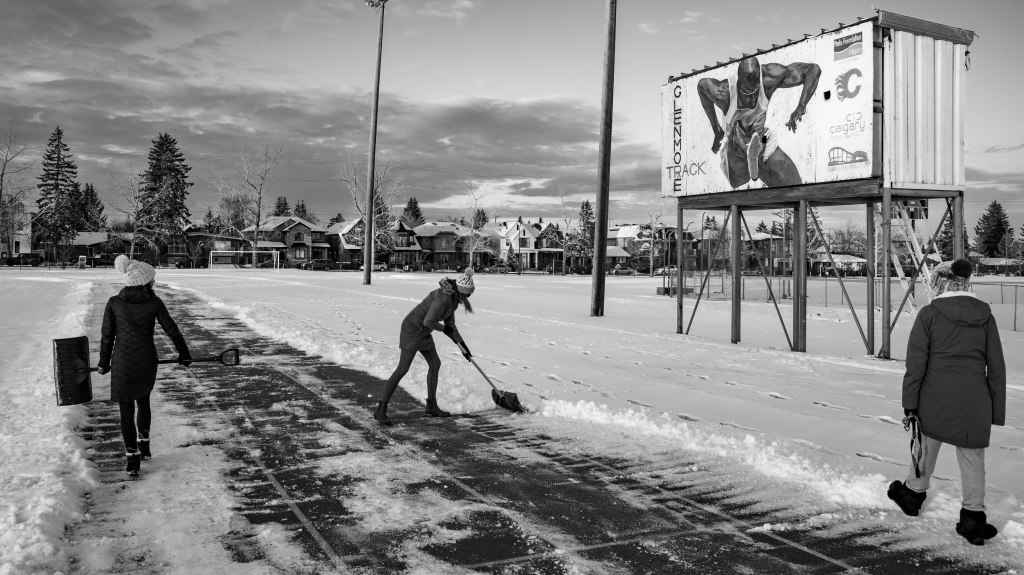
As Deb and I worked to clear a couple of lanes on the back straight, I did some math to take my mind off my aching back. It took us an hour of hard work to clear about 200m of one lane. Did you know that one lane on a standard track is 4 feet (1.2m) wide? That means each of us did about 250 square metres of shovelling.
I also had time to figure out that the total surface area of a 400m track is about 4,300 square metres. So, between Deb and I, we managed to clear about 12 percent of the total surface area of the track. Thank goodness we had a lot of help.
No wonder I’m sore today.

It all goes to show that Calgarians are adaptable, resilient and community-minded. We runners in the southwest will have a few lanes to train in, at least until the next snowfall.
Stay warm!
It was a scenario that will be familiar to many runners. I arrived at our weekly interval session, only to find that my Garmin Forerunner watch had died. Given that our workout called for 600-metre repeats, and I had been tasked with leading a small group of new runners in our club, I had a sinking feeling. How would I measure our time and distance? And what about managing the pace for our group?
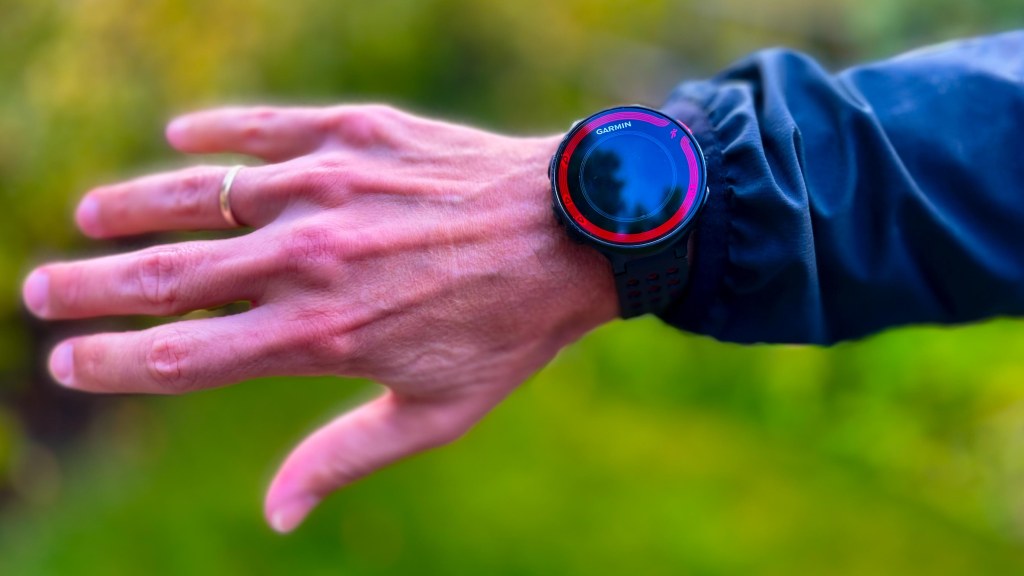
Fortunately, my training partners had fully charged watches, so we got through the session with no issues. But for me, going through the workout without a watch did make me think about the challenges of finding… maybe feeling is a better word… a specific training pace. That is especially true if we are building to a goal race, when pacing is most important.
Alex Hutchinson just wrote a piece on pacing for the latest edition of Canadian Running magazine. His article, Pacing for the Marathon, goes into the science behind pace-making and explores some of the latest research on the subject. Anyone who has tackled the monster that is the marathon knows how difficult it is to parcel out your resources over 42 kilometres.
Hutchinson’s article makes the point that the relationship between running speed and energy consumption isn’t a straight line, which argues for holding a steady pace in a race situation. In short, surges cost you more energy than you can get back by slowing down. The problem is that most runners tend to NOT run evenly-paced races. Of course, there are many variables that contribute to this result, including the course profile, our individual fitness, our perception of the distance itself, and the psychology of running against other competitors.
Hutchinson makes another point that seems to get to the heart of the issue. He notes that modern pacing theories focus on a runner’s subjective perception of effort. This suggests that with experience, a runner can learn how hard a pace should feel.
I couldn’t agree more.
This research supports the argument that we need to develop a good sense of what our target pace feels like.
I’ve long been a believer in doing at least some of my running without a watch, at least not a GPS watch. In my view, not every kilometre needs to be accurately timed. And besides, I think it’s too easy to rely on our high-tech devices rather than our own innate sense of what pace we are running.
Like most things, good pacing is a learned behaviour. We can work to improve it. For me, interval sessions are the perfect place to do just that. By working as a group, and especially by taking turns to lead a rep, we can improve our individual feel for pace.
There are also opportunities to improve our ability to dial in a pace in a race situation. For example, we can look for a local parkrun or low-key 5k or 10k race where we can practice finding and holding a goal pace.
Here’s another idea. Run a race (maybe not your major goal race) without a watch. See how close you can get to your predicted time. You’ll be training yourself what a certain pace feels like.
These skills can be very valuable on goal race day. I’m reminded of Trevor Hofbauer’s impressive run in the 2019 Toronto Marathon. At the time, his 2:09:51 finish was the second-fastest marathon ever run by a Canadian. Trevor ran that race without a watch, as he does with much of his training mileage. He said about his remarkable race, “I don’t use pace now, I just go off of time and effort. And that was how I ran today.”
I think there is something to be said for this approach. It requires a runner to be aware of how a given pace feels and trust in their training.
And what about our interval session, the one I ran without a watch? My internal watch told me we had kept a nice steady pace. When my partners shared their data later, it turned out that our pace for each 600m repeat was within a few seconds of our target. Not bad!
Our trip to Portugal and Spain offered ample opportunities for us to explore the region on foot, and we did just that. Working our way from Lisbon to Barcelona, we made sure to include a run in each location. As many readers will attest, there is no better way to see a new place than at running speed. We had some memorable runs (camera in hand, of course) and faced only a few minor challenges along the way. Here’s a summary.
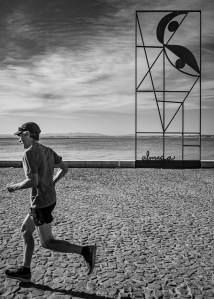
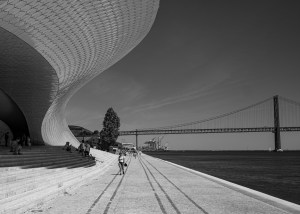
The Portuguese capital was a charming place to start our Iberian tour. The Praça do Comércio and the Tagus River were just steps from the Pousada Lisboa Hotel. We did an easy out-and-back run to the Ponte 25 de Abril, enjoying magnificent views along the way. We decided to turn around before reaching the impressive modern Museum of Art, Architecture and Technology (MAAT) in Belém. We knew that we wanted to visit the area later in the day so we could explore the sights more fully. We were thrilled to see so many fast and fit runners on the (cobbled!) pathway.
And here’s what we saw later in Belém (but not running):
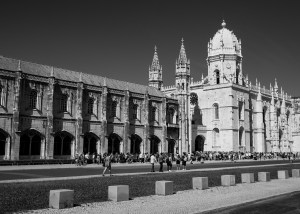
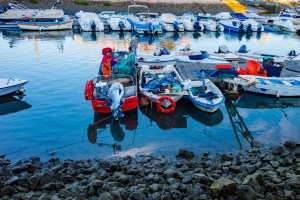
We fit in a short run during our stopover in Faro, the capital city of the Algarve district in southern Portugal, which let us see the morning activity along the waterfront. Fishing boats were returning to port, and clamdiggers were taking full advantage of the low tide as the sun rose. The temperature was already climbing as we returned to our comfortable room among the narrow, cobbled streets of the old town.
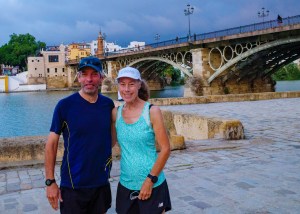
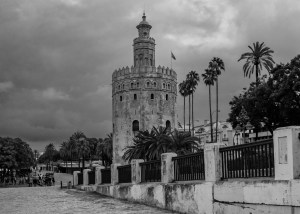
Our first stop in Spain was a revelation. The capital of Andalucia is brimming with Spanish character. Our apartment was a few blocks from the historic Puente de Isabel on the beautiful Guadalquivir River. We were treated to many sights on our early morning seven-kilometre run. Rowers and runners were out in force, all with the same thought of avoiding the heat of the day. Unique public art, several famous monuments and contemporary architecture were all to be found along the route. Our turnaround point was the lush Maria Luisa Park, the gardens next to Plaza de España, and one of the many features in Seville that were constructed for the 1929 Ibero-American Exhibition.
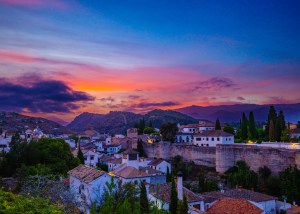
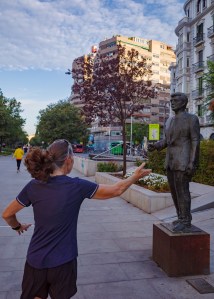
Our challenge in this historic city was to find a flat spot to run. From our apartment in the Albaicin neighbourhood we had a panoramic view of the most famous feature of the city (the Alhambra, a massive Moorish fortress and palace), but it was also a steep, twisty and cobbled kilometre away from the city centre. As a result, we decided to enjoy a leisurely walk down to the Avenida de la Constitución before starting our run. A few laps of this pedestrian-friendly mall made for a pleasant outing. We didn’t see many other runners during our early morning run, but we did get a chance to say hello to statues of many famous people from the region.
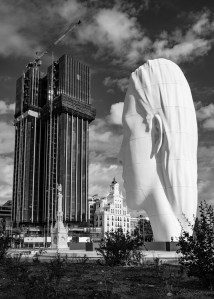
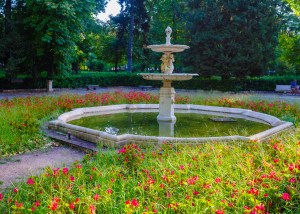
We were impressed by the capital city of Spain as soon as we arrived at the handsome and historic Estación de Atocha. This very walkable city of 3.2 million people is crammed with sights, including the world-famous Prado Museum. We found surprises around every corner. When it came to planning our run, we were pleased to see that the Hotel Fénix Gran Meliá in the Salamanca district was a few minutes away from the Parque de Buen Retiro, possibly the most beautiful urban park in Europe. A lap of the gravel path around the park was 4.5 kilometres, leaving us with enough energy to check out the Estanque del Retiro, a spectacular artificial pond and monument. Aside from the Retiro, there are many other green spaces to explore in Madrid. We were disappointed to learn that a hugely popular 10k race (Corre por Madrid) was taking place on the morning we left the city. Maybe next time!
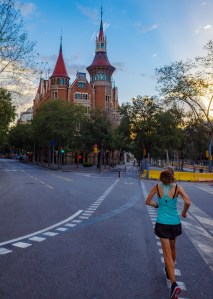
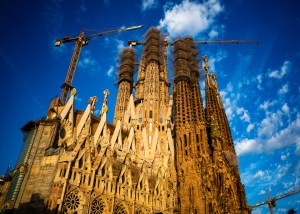
Our stay at the Hotel Casa Fuster in the Gracia district of Barcelona was a highlight of the trip. Our fifth-floor view was dominated by the Sagrada Familia, Gaudi’s Modernist masterpiece. We intended to run an out-and-back route on via Diagonal, a pedestrian avenue near the hotel, but road construction and a close call with a taxi changed our plans. While looking for an easier route, we took a couple of wrong turns and found ourselves staring up at the iconic church. Breathtaking! We thoroughly enjoyed our stay in the capital city of the Catalonia region. The Sagrada and the Picasso Museum were well worth a visit. Overall, it was a fitting end to our travels.
I recently read two well-known books in the running genre, one after the other. Once a Runner and Marathon Woman couldn’t be more different, so this piece shouldn’t be taken as a straight-up comparison. Still, it was useful to contrast (on one hand) a niche novel from a bygone era and (on the other) a personal memoir of one of the most compelling characters from that same era.
I’ll start with Parker’s book.
I had a copy of Once a Runner on my reader long before I read it. The idea of a fictional story set in the milieu of a university track and field team interested me, but less than, say, a memoir of one of the great runners from history. True stories just resonate more with me, I guess.
When I did finally dive in, the book was fine. Three out of five stars. Parker is a competent writer, but I found his characters to be thinly developed. I never really warmed up to the protagonist, Quenton Cassidy, a talented and driven miler. Cassidy’s mentor is the mysterious Bruce Denton. He isn’t the best role model, if I judge solely on how much he made me feel like going out for a run myself. And the female characters in the book don’t ever rise above the status of bit players or afterthoughts. There was quite a lot of 1970s-era stereotyping here too.
I found the plot totally predictable. But that flaw didn’t bother me too much, as I had minimal expectations for the story anyway.
What I liked in the book were Parker’s nuanced and detailed descriptions of distance training and racing. (This is no surprise, as the author was a talented runner who trained with the great Frank Shorter in Florida.) Sure, my days as an amateur track runner are well in the past, but I could fully relate to everything that Cassidy experiences as he prepares for and runs the climactic race—against a tough Kiwi, based with absolutely no disguise on the real-life John Walker—that closes the book. Anyone who has built up to a goal race would benefit from reading that part of the story.
Overall, Once a Runner will appeal most to dedicated students of the sport and hardcore enthusiasts. Even so, if you’re like me, you’ll probably have many other choices on your reading list. When you find yourself with a gap, you might give it a try.
The connection between my highlighted books may rest in the zone of those same societal stereotypes. In fact, Marathon Woman by Kathrine Switzer is the story of a dedicated young woman’s fight to break down those barriers.
I knew a little about Switzer, mostly from her infamous on-course encounter with Jock Semple when she ran as the first legitimate female entrant in the 1967 Boston Marathon.
Once I started into her book, I had trouble putting it down. Switzer writes in a comfortable style. While I wouldn’t say her book is aimed at a female audience—I really hope men read it—I did learn more about things like panty girdles than I ever thought I would.
That said, it’s the essence of her story that is so impactful—her long, solitary battle to gain recognition for women in distance running. The next time you stand on the starting grid for a race, look around at the women who have embraced running as a key part of their lifestyle. That’s what we all can thank Switzer for. She does a great job in the book of explaining the hurdles she had to overcome to make that possible.
Beyond her dedication as an advocate for change in women’s athletics, I had no idea how passionately Switzer pursued opportunities for women in other sports. Thanks to her diligent and courageous efforts, which are admittedly still a work in progress, women now compete on a more or less equal footing with men in many sports. I look at the Women’s World Cup which just started as an example. What a legacy Switzer has earned.
I think you can tell which of these two books I would recommend to my friends.

