BUMP Photo Runs – Part 1

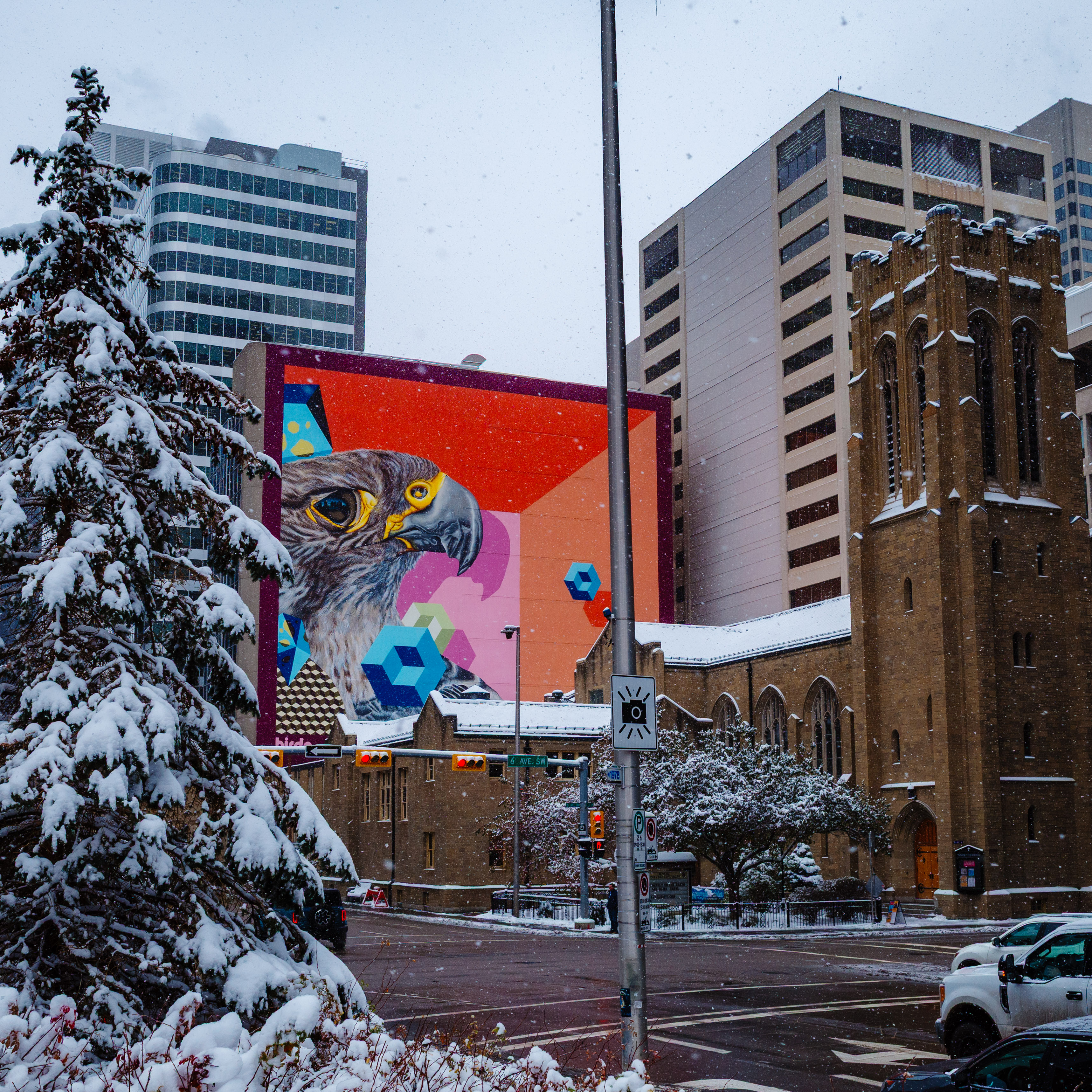
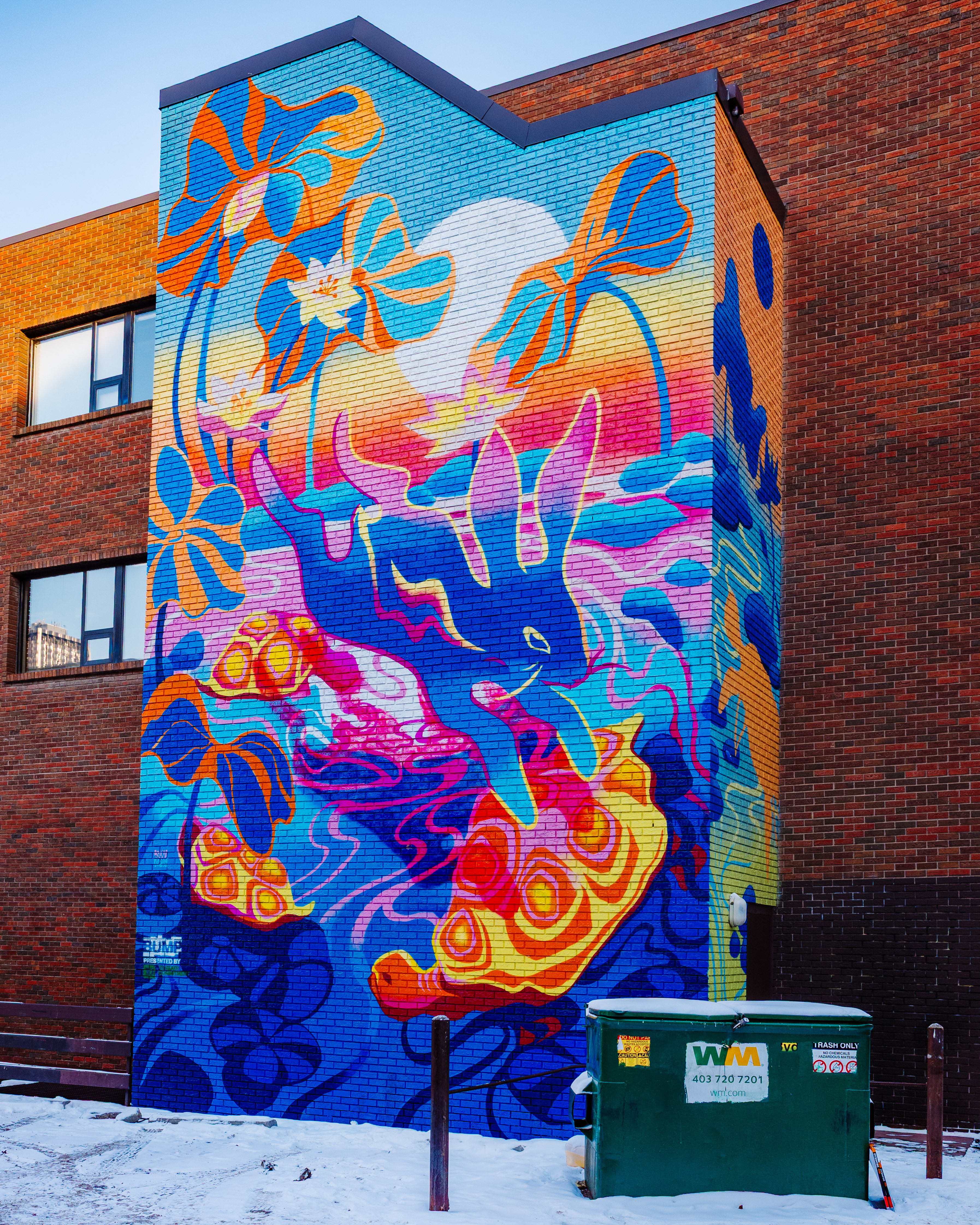
I was jogging around Calgary’s Beltline, feeling a bit short of ideas for my next urban run/photo adventure. As I rounded the corner from 7th Street onto 15th Avenue, I glanced up at the side of the building. What I saw stopped me in my tracks, and instantly gave me the inspiration I needed.

What’s BUMP?

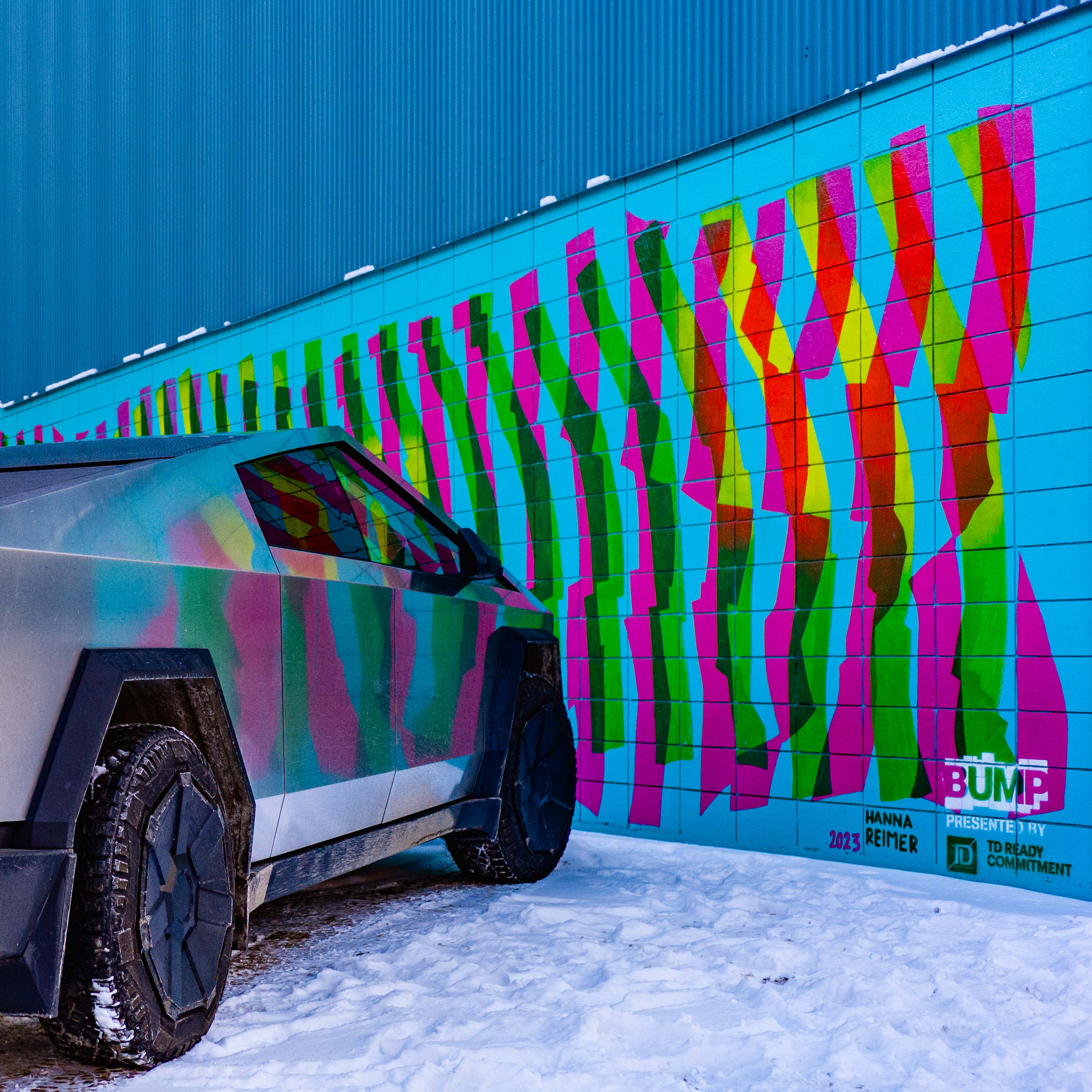
There’s a program called the Beltline Urban Mural Project… BUMP… that has been making Calgary’s inner city streets more interesting and colourful for years. I had to find out more.

From the BUMP website, I learned that the project started in 2017, and has grown significantly since then. Seeing all the artwork in one run would be challenging, if not impossible. There are dozens of sites, spread throughout the core. I needed a plan. I often start my runs near Lougheed House, so I decided to use that location as my base. I could get a good overview of the murals (and hopefully some worthy photos) by concentrating on different neighbourhoods over several runs. This is the first of what is likely to be an ongoing series.

Run 1 – BUMP in the Beltline

Run 1 focused on the Beltline itself… bounded roughly by 15th and 10th Avenue, and 1st and 10th Street. Here’s my Strava map:

Turning to the art, let me start with the mural that prompted this idea. It’s a large, striking piece in green, called “The Last Maple Leaf”. It was painted in 2023 by the Colombian artist Wosnan. This is from the mural description:

“Rising from nature an ancient guardian of the forest who merges the realms of magic, other worlds and dimensions, spirit and space stands tall, looking over our city…”

Wosnan, “The Last Maple Leaf”, 1411 7th Street SW

This was an apt description of the mysterious tree-like being that loomed over me, guarding his/her corner of the neighbourhood while pondering (no surprise) the last maple leaf. Stirring stuff! I studied the mural carefully, with my stopwatch running. The magnitude of the challenge I had taken on dawned on me. Maybe I should make this a slow photo walk…

No! I resumed my run, with my goal of at least five kilometres in mind. I tried to ignore the glimpses of colour that I started to notice down every alley.

Bottom line? I finished with lots of pictures and a feeling that I had made a small dent in the many Beltline murals. For full disclosure, while I saw all these murals on BUMP Run 1, some of the photos are from previous runs because I liked the shot more. Light is everything, you know!

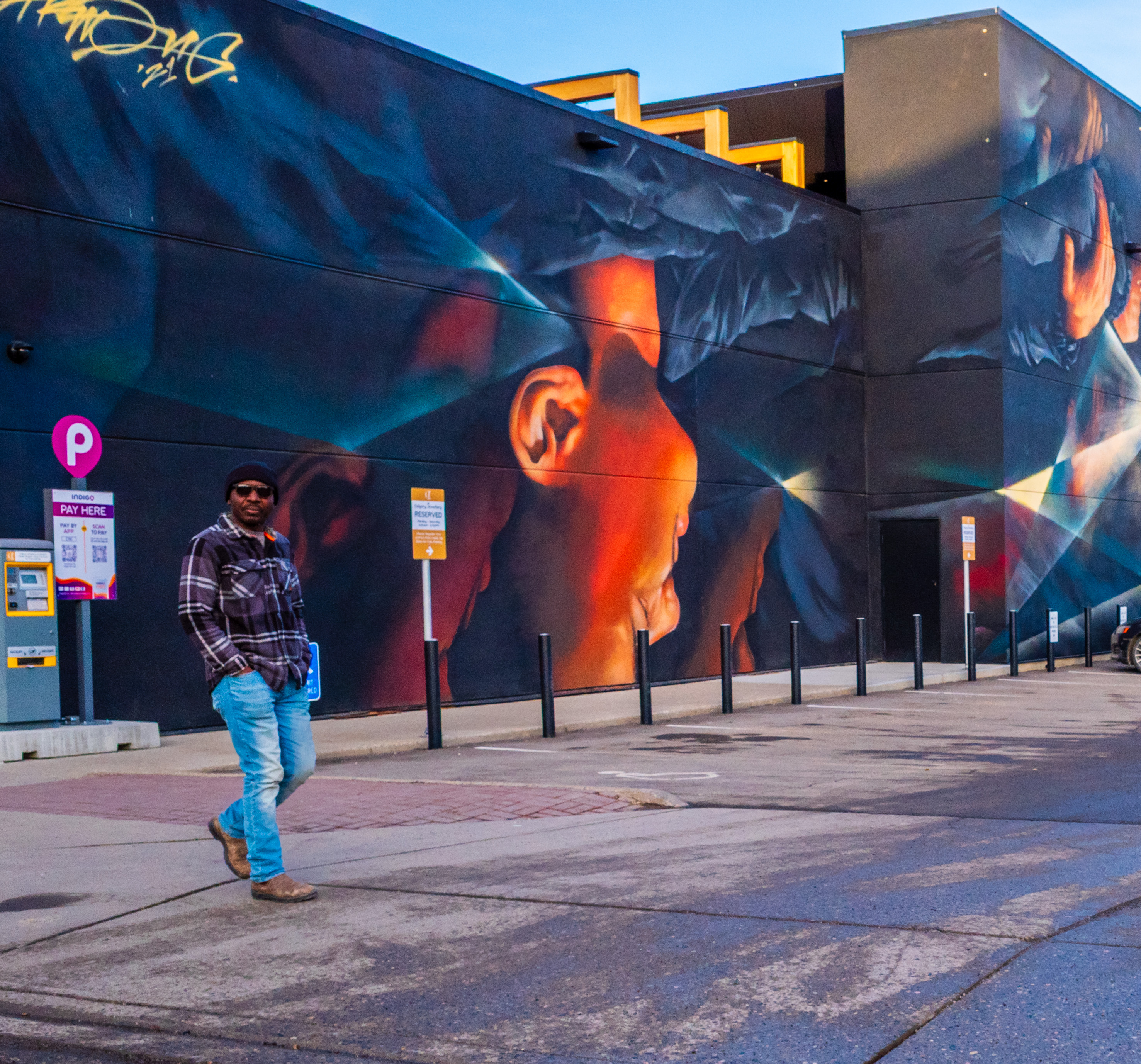
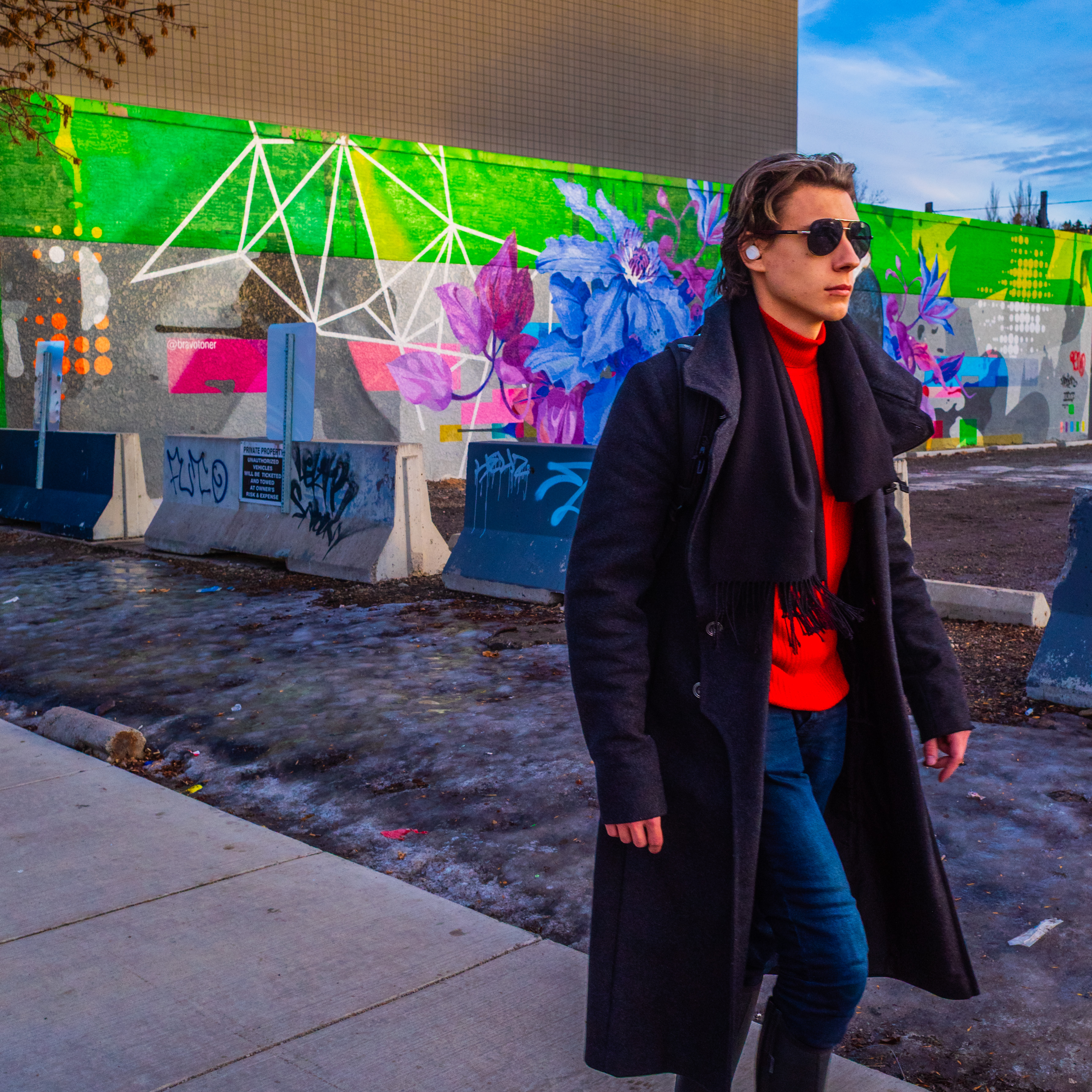
Here’s a short summary of the pieces in the photographs. I recommend following the links to the map on the BUMP website to find out more.

Mural Making – A Layman’s Perspective

Imagine painting a mural on a wall 60 feet wide by 30 feet high. How does one even begin? Laying out a piece at that size and scale must be extremely difficult. And the execution would bring very different challenges. I marvel at the way the artists manage the intricate details, while still capturing their vision for the whole piece.

I had a front-row seat for the creation of sôhkâtisiwin (that’s Canadian artist Kevin Ledo’s striking mural at 340 10 Avenue SW). The title means “strength/power” in the Cree language. The image is taken from a picture of B-Girl and traditional hoop dancer, Angela Gladue. I watched the beautiful portrait of this young Indigenous woman come to life in 2018, from the comfort of my office across the street. Kevin and his helpers toiled away in the hot summer sun on a stage lift, going up and down endlessly over several weeks to complete the image, which now livens up the west side of a parking garage. I made sure to give them a thumbs-up every time I walked by.

Here’s a rough timelapse of the process (I had many more pictures on my phone, but I recently deleted most of them). You get the idea though.

Impressions

This is an amazing initiative. To state the obvious, BUMP is a diverse selection of art. I’m impressed by the sheer number and quality of the murals. It’s great to have artists from around the world come to Calgary and share their talent. I hope the project continues and expands its reach across the city.

This is the kind of project that invites us to slow down and take a closer look at the art. Sure, we can (and most often, do) pass by these murals in our daily routine. Maybe we glance at them, maybe we don’t. But this first photo run has already prompted many questions… Who is this artist? What is their message? Do I think they succeeded? What does this piece make me feel?

The BUMP website helpfully lets the user select pieces they would like to see on a walking tour, and this is probably the correct way to see them. I will persevere with my photo run idea, knowing I will still see and learn a lot along the way.

My early impressions are very positive. I already have some favourites. I will defer any thoughts about that question until I’ve done more exploration. There will eventually be a personal top 10 list, but even that will be subject to change as I see more of the contenders. Look for more posts on my BUMP photo runs soon.

Thanks for reading. Please drop me a comment. Let me know if you have a favourite BUMP mural that you think I should see.

Until next time, be well and BE FAST!

Lessons from Sporting Legends

Do you have any sporting heroes? Maybe you do, or maybe you think the idea of sporting heroes is quaint and outdated. Given the commercialization of sports, I can certainly understand this view. I do have several sporting heroes, but maybe the best way to explain this is to say that there are people I have looked up to throughout my life. Some of them happen to have been great athletes.

Bobby Orr

It was Sunday, May 10, 1970. Game four of the Stanley Cup finals. Overtime. One brilliant play was about to etch itself in my brain forever. Here’s what I wrote about that moment in my book, Stroke of Luck:

So it was that in May 1970, as an impressionable nine-year-old, I was watching game four of the Stanley Cup finals, between the Boston Bruins and the St. Louis Blues. It was less than a minute into overtime. Bobby Orr rushed the St. Louis net and took a pass from Derek Sanderson, who was behind the goal line. As Orr directed his shot into the net, to win the game and the Cup for the Bruins, I was in awe. I remember, like it was yesterday, Orr’s flying celebration of his goal. I was an instant fan of the Bruins, and I had found my first real sports hero in this young, talented defenseman.

Ray Lussier’s photograph of Orr flying through the air is one of the most iconic pictures in sports history. As Orr was half-tripped and half-jumped, he had already begun celebrating his cup-winning overtime goal. But here’s the thing: I don’t even need the photograph. I can play the whole video in perfect detail in my mind.

“The Goal” (Ray Lussier, May 1970)

Orr did more in his short career than most players could dream of. His ability to control a game was unmatched. I believe he was the best defenseman to ever play the game. And even today, I get goosebumps if I watch highlight videos of his end-to-end rushes. It’s a rare player who can make the best in the world look ordinary, but Orr did it to opponents game after game. And yet, he never grandstanded after scoring a goal. In interviews, he was quiet, almost shy. He let his ability speak for itself.

I followed Orr’s career from beginning to end. His wonky knees were his undoing, drastically shortening his career. I wonder how different things might have been had Orr played a generation later, given that surgical repair of torn ligaments is now routine. Instead, the last images of him (in a Chicago Blackhawks jersey, no less), struggling to execute moves that would have been routine just a few years earlier, are heartbreaking.

In my opinion, a worthy sporting hero can inspire us even in difficult circumstances, and beyond the field of play. Orr has been the perfect role model: humble in victory and accepting of defeat. We should all strive to emulate his example.

Sebastian Coe

I hinted at the depth of my admiration for Seb Coe in a brief passage when telling my own story:

My appreciation and love of athletics grew. I followed all the results for my latest heroes, the middle-distance stars Sebastian Coe and Eamonn Coghlan. Coe became a global sensation when he set three brilliant world records on the track, all within six weeks in the summer of 1979. But it was the way he ran, with elegance and effortless power—with passion—that I admired most.

My dilemma when writing my book was whether I should say more about this gifted and charismatic runner, and the impact he had on me, or keep it brief to move the story along. I opted for brevity, but I feel I should add to what I wrote.

For context, in the summer of 1979, I was well on my own path. I had just finished my first year of engineering. I was dedicated to athletics, having participated in cross country and track in high school for several years.

Coe seemed to emerge on the scene out of nowhere. Of course, we didn’t have instant news and 24-hour coverage then. The athletics world held its collective breath as this slight, supremely talented 22-year-old Brit smashed three major world records in rapid succession. Here’s a synopsis:

  • July 5, Oslo: Coe shattered Alberto Juantorena’s world 800m record at the Bislett Games, running 1:42.33.
  • July 17, Oslo: In the Golden Mile, Coe broke John Walker’s record in 3:48.95 against a world-class field.
  • August 15, Zurich: At the Weltklasse meet, Coe broke Filbert Bayi’s 1500m world record in 3:32.03.
World record in the Golden Mile, July 1979 (Getty Images)

I remember scouring the newspapers for any information on Coe and his races. His records all came within a few weeks of my birthday, so it was as if he was gifting me with these performances. I felt I was somehow a part of his epic summer. In fact, I was so taken by Coe’s streak that I decided to try out for the university athletics team when the school year started in September. (Sadly, my performances fell so far short of his that my experiment ended quickly.)

Since the summer of 1979, Coe has had a full and productive career. He won two consecutive Olympic 1500m gold medals. He went on to lead the 2012 London Olympic Games committee, and he is the current president of the IAAF. From my perspective, Coe has always carried himself with that same passion and dignity that set him apart on the track. I’ve admired him for decades, both in my athletic and personal pursuits. I considered him a role model 45 years ago, and I still do.

Eamonn Coghlan

In my view, Eamonn Coghlan is underrated compared to some other big names in athletics. It turns out I have a couple of tenuous connections to this great middle-distance runner. Coghlan was born in Drimnagh, Ireland, a suburb of Dublin. Drimnagh is a short distance from Monasterevin, the hometown of my paternal ancestors. I wrote about Coghlan in my book:

Coghlan’s specialty was the indoor mile. He had earned the nickname “Chairman of the Boards” due to his ability to perform well on tight, wooden indoor tracks. Deb humoured me for an evening in February 1981 at the Toronto Star Indoor Games, with its temporary track set up in Maple Leaf Gardens. I had run there as a schoolboy a few years earlier. We watched Coghlan win the mile in 3:55, an astounding achievement considering the quality of that track. I still have a black and white photograph that I snapped as he jogged around the track for his victory lap.

I found that picture as I was sorting through some old files the other day. It took me right back into Maple Leaf Gardens on that cold February night.

The Chairman of the Boards takes his victory lap (Toronto, February 1981)

As a mature athlete, I’ve always been most impressed by Coghlan’s consistency. It would be enough to say that he broke the 4-minute mile 83 times, but he did so much more. He dominated indoor meets, where tight turns are a handicap as compared to outdoor racing. He ran the first sub-3:50 mile indoors (February 1983), and he was the first man over 40 to break 4 minutes for the mile (February 1994). Quite a career!

Coghlan’s competitive track career spanned 20 years. Like Coe, he has had a fruitful career after athletics. He works as a coach and served as a senator in the Irish parliament from 2011 to 2016.

Wrapping Up

I’ve highlighted some of the lessons that I’ve learned from watching these three outstanding athletes. It confirms for me that great sportsmen (or should I say great people?) still have the power to inspire greatness in all of us.

Although it extends an already long post, I will add a few words about sources. Stephen Brunt’s excellent book, Searching for Bobby Orr, is a well-researched and eloquent biography that puts Orr’s career and life in the context of a sport that was changing dramatically. There is a lot of material available on Coe, including his own books. I enjoyed The Perfect Distance by Pat Butcher, which delves into the rivalry between Coe and another talented British middle-distance man, Steve Ovett. As for Coghlan, I relied on an excellent piece by John Cobley, on his Racing Past website. Cobley’s piece cites Coghlan’s autobiography, Chairman of the Boards, which is unfortunately out of print.

Until next time, be well and BE FAST! Happy New Year to all.
Strokes, Streaks and Snow

Now for a post dedicated to the core subjects on this site: strokes, running, and of course photography. Covering all of that might seem like a tall order, but the last month has provided me with plenty of material on all three subjects. So, without further ado…

CanStroke Congress

In late November, Calgary hosted the 2024 Canadian Stroke Congress, which is described as “a forum for stroke researchers, trainees, clinicians, allied health, administrators, policymakers, and People With Lived Experience of stroke (PWLE) to share new discoveries and innovations, the latest science and therapies, and to build relationships for future collaboration.”

I learned about the congress in a recent conversation with representatives of the Heart and Stroke Foundation. By registering as a PWLE, I was able to attend any of the main sessions at a very reasonable cost. It was a unique opportunity to participate in an exceptional event.

Several workshops were offered on the day before the congress, and I attended one on patient engagement. We heard from scientists and advocates on a range of topics, all focused on ways that PWLE can become involved in stroke research and advocacy. Breakout sessions addressed the practicalities of various engagement paths. The workshop was a good chance to meet other people and share our respective stroke journeys.

I was so impressed with the workshop that I returned the next day to attend a couple of the main sessions. Dr. Andrew Demchuk, the hero of my own stroke story, and Dr. Thalia Field from UBC led a discussion, “What’s New in Stroke Prevention?” It was standing room only for this session. While much of the discussion was over my head, I was so impressed by the depth and breadth of the presentation, and the knowledge and confidence of the speakers. It reinforced my opinion that world-class stroke care is available in Canada.

Another session (“What’s New in Acute Stroke?”) had three eminent stroke neurologists discuss developments in stroke diagnostics and therapies, including some that I touched on in a recent post. It turns out I have a connection to all three of the speakers:

  • Dr. Michael Hill was one of the physicians involved in my care at the Foothills Stroke Unit in 2017. He kindly wrote the foreword for Stroke of Luck.
  • I’ve never met Dr. Mayank Goyal, but he would have been the physician responsible for inserting a stent into my blocked vertebral artery, should the decision have been made to follow this treatment route for me.
  • Finally, Dr. Aristeidis Katsanos is an eminent stroke neurologist at my alma mater, McMaster University.

My takeaway from attending the congress is that while stroke incidence is increasing and our healthcare system is under severe pressure, we should be encouraged by many significant advancements that are being made in stroke diagnostics and therapy. There is reason to be optimistic about the future.

A Blast of Winter

Coincident with the stroke congress was Calgary’s first blast of winter. This likely gave the conference organizers fits. It was quite a wallop. I think we got something like three times our usual November snowfall in one day. Now, while that did complicate a lot of things, it also provided for some great photography. Here are some shots from around the city… with a reminder that the copyright for all images is mine.

Strides Run Streak

Here we are, already halfway through December. Cue the usual observations about where the year has gone. December is also when many Calgary runners take on the annual Strides Run Streak. The challenge is simple: run at least one mile every day during the month.

I have some meaningful connections to this event, so whatever else is going on at this time of year, I like to sign up for it. One mile a day is an achievable goal. I give myself the added challenge of finding a worthy photo or two while I’m completing my run. Sometimes that is a bigger test, particularly with the days getting shorter and shorter!

This year, my commitment is strong, but the challenges are not insignificant. We started the month with plenty of snow on the roads and sidewalks, which have slowly turned into skating rinks. Ah, Calgary weather! I’m also doing most of my running solo these days, as my favourite training partner is sidelined with a sore hip. We are both hoping for some improvement soon.

Two weeks into December, my streak is intact, and I have managed to accumulate a few images. Maybe more images than miles, if I’m honest. While it is nice to capture the festive spirit… the snow does help with that… it isn’t essential. Rather, my goal is to find images that can transport me back into that time and place. It’s a way of adding meaning to my runs. When it comes together, it’s a nice feeling. Here’s a sample.

And while I did say the images don’t have to be festive, there is one that has the potential to put even a Grinch like me into the Christmas spirit. See what you think.

Look for more images soon. I have ideas for other posts before I shut things down for the holidays. In case that doesn’t happen, I will take this opportunity to offer my best wishes for a Merry Christmas to one and all.

Be well and BE FAST!

Signal Hill Photo Run

A recent errand led me to an unexpected trail of discovery through Calgary’s military history. I had stopped at the busy Westhills shopping district, the usual collection of big box stores. As I walked back to my car, I noticed the battalion numbers preserved on the side of the hill below the Signal Hill neighbourhood.

I knew about the battalion markers but hadn’t thought much about their significance. My first reaction when I saw the whitewashed stones was how small they looked, sandwiched in between the RONA store and Calgary’s residential sprawl just above. I made a point to return soon for a closer look.

Military history squeezed into the urban landscape

A couple of days later, I was jogging through North Glenmore Park, along the crest of the bluff. I ran by a monument at the west end of the park, one that I had passed hundreds of times. I decided to stop and check it out. The plaque indicated that this was a 1967 memorial to the 137th Battalion of the Canadian Expeditionary Force (the CEF) in World War I. I remembered that “137” was also one of the battalion numbers on Signal Hill.

The 1967 memorial to the 137th Battalion

I guessed, correctly, that this was the same 137th battalion immortalized on the hillside. Now I definitely had to make my way over to Signal Hill. I figured it would be a great excuse for a photo run.

I grabbed my camera (the Ricoh GR III of course) and parked at Battalion Park on Signal Hill Drive. Here’s the Strava entry for my easy run. It was a beautiful day and I did an enjoyable 6-kilometre loop around the neighbourhood.

The story of Sarcee Camp is well explained in a series of plaques next to the stairs that wind through the markers. I learned that the camp was established in 1914. It was in a section of the Sarcee Indian reserve (now Tsuu T’ina) that was leased by the Canadian militia as a training site.

Sarcee Camp was a busy place. As many as 45,000 military personnel from 30 battalions trained at the site during the war. It was customary for each battalion to construct a “geoglyph” (that’s a design or motif created by humans and built into the natural landscape) with their unit number. They did this using stones hauled by hand from the riverbed, which is two kilometres away from the hill. 

The 113 is the oldest of the four stone markers on Signal Hill. The 113th Battalion was formed as the Lethbridge Highlanders in 1915. The battalion relocated to Sarcee Camp in May 1916 and sailed for England in September of that year. The 113th was broken up for replacements, with most of the men transferred to France. The battalion never saw action as a unit and was disbanded in 1917.

The other numbers on the hillside were constructed by battalions of the CEF that trained at the Sarcee Camp, including the following:

  • The 137th Infantry Battalion of Calgary began recruiting in late 1915. After sailing to England in August 1916, the battalion was absorbed into the 21st Reserve Battalion.  It’s worth noting that the King’s Own Calgary Regiment (RCAC) perpetuates the 137th Battalion. Members of the 137th Battalion CEF Association erected the memorial to the unit in Glenmore Park.
  • The 151st Central Alberta Battalion began recruiting in 1915. It sailed to England in October 1916 and was absorbed into several reserve battalions.
  • The 51st Canadian Infantry Battalion was recruited in Edmonton. It sailed to England in April 1916 and provided reinforcements for the Canadian Corps until it was reorganized in November 1916.

Although there were approximately 20 geoglyphs built, most were destroyed in the 1950s during the construction of a mess hall.

When we first moved to Calgary in the early 1990’s, the battalion markers were just about the only thing in the area. Over time, residential development nearly swallowed up the geoglyphs. Fortunately, there was enough recognition of the significance of these markers that they were preserved. In fact, three of the markers (137, 151 and 51) were meticulously moved a short distance from their original locations.

You can see a few photos I took during my cooldown walk. I found it quite challenging to get any perspective on the geoglyphs when I was right next to them. In that respect, the parking lot of the RONA store isn’t a bad place to stop and admire this unique piece of Canada’s military history. Even so, with Remembrance Day just around the corner, I recommend getting closer and doing more exploration if you have the time.

Auroras and Other Distractions

Good news! I’ve extended my Dedication Sale through the end of October. It’s a nod to our Thanksgiving holiday.

Print and e-book versions are available on Amazon at a 20% discount.

There’s a hard stop on the sale on November 1!

In what was a fairly chaotic week, I did manage to capture a few interesting images. There was no shortage of subject matter. I only had to force myself out the door with a camera.

Auroras a-plenty!

This year has been unmatched for solar activity. I read that it’s all because the cycle of solar activity is at its peak. (Sounds like a topic for a future blog piece!)

I’ve always been interested in photographing the aurora borealis (the “Northern Lights”) but frankly, I wasn’t up to what I assumed was the significant effort needed to make it happen. What gear did I need? How much work would it be to get to a good location, and to do so in the middle of winter when the aurora are most active?

It turns out, this year at least, all one has to do is put an iPhone on a tripod (or maybe not), walk to the nearest park, and look up. I started seeing IG posts from friends who were taking pictures from their backyards, so I figured I could make a similar commitment.

I found a great website (Alberta Aurora Status) that estimates the combination of solar and atmospheric conditions necessary for good viewing. Lately, even that much science may not have been needed.

As for the photos, those took a few nights of experimentation. Fortunately, our recent weather has been agreeable and the skies have been mainly clear. I tried some shots with a “real” camera and soon learned that my iPhone 14 was more than adequate to land some decent shots. I plan to try again soon with other cameras… it looks like the good viewing isn’t finished yet.

The iPhone has a “Night Mode”, which uses a long exposure and some noise reduction. Later, it took some trial and error to get the best result with my photo editor… mainly I adjusted the exposure and added some saturation. Overall, I think the results are pretty good, considering how easy it all was.

Here are some of my edited shots from Lightroom.

Fall Colours and Intervals

Knowing that our daylight hours are in rapid decline, I made sure to join our weekly group run at Carburn Park on Thursday evening. It was a perfect outing, and it may turn out to be our last outdoor session for the season. A small group showed up since many of our teammates were in recovery mode after a recent target race. Jason G led us through some sets of 500m – 500m – 1k.

We headed over to the west side of the Bow River and turned north. The views back across the river were spectacular. The setting sun lit up the fall colours, with most of the leaves still on the trees. I used our short 1-minute breaks to good effect, snapping as many pictures as I could before the light show ended. I couldn’t have asked for better training partners than Doreen and Elidh. All pictures with the unbeatable Ricoh GR III.

A-B-C’s

A is for Art and B is for Borduas. What? Who?

On Saturday, Deb and I made our way to Masters Gallery, to catch the last day of a David Thauberger exhibit. He’s a Saskatchewan painter who’s been active for 50 years. The gallery had an interesting selection of works from his long career.

We always enjoy stopping into the gallery on 4th Street SW to chat with Ryan Green (@ryngreen on IG) and visit with his sidekick. This visit was no exception.

The sidekick I’m referring to is Borduas, aka “Bordy”. Bordy is a wonderful British Bulldog. He’s named after the Canadian artist, Paul-Émile Borduas (1905-1960), and he (the dog) is a fixture in the gallery. I snapped a few pictures of Ryan and Bordy because I had to. You’ll see what I mean.

And what about C? This week, C was for Competition, as in racing. After a long hiatus, I signed up for a 5k. This was largely due to peer pressure, from the same Jason I referenced earlier. He had signed up for the 5k as part of the Calgary Police Half Marathon… one of the longest-running, best-organized races in Calgary… and encouraged me to do the same. Thanks for the push, Jason!

I had no illusions of running with Jason, but I set as my goal to run a steady effort at a challenging pace. In other words, I wanted this to be a race, even though it was at my current (reduced) capabilities. I figured I might have a shot at a podium finish in the M60-69 age group, but it was no problem if it didn’t happen. I was just happy to be over my recent calf/Achilles tendon problem.

All photos by Deb Kelly:

Conditions were ideal for racing, and it was a successful outing for Adrenaline Rush runners. Jason flew to a 10th-place overall finish and set a personal best in the process. His time of 19:13 easily placed him first in his age group, by several minutes. Scott did very well in the 10k, running 53:43 and finishing 4th in his age group. Alistair (no photo) cruised to a second-place overall finish in the main event (the half marathon), running 1:22:34. That was impressive enough, but consider that he was taken off course by the lead cyclist, a miscue that added 500m to his race distance. Way to go, guys!

And me? I finished the 5k in 25:55. It was a solid effort. I was happy and maybe a bit surprised with it. I ran smart. I did miss the podium by one spot, and I missed running with Deb even more. Maybe next time!

Catching Up

It’s been a couple of weeks since I posted anything, so this will be a quick effort to catch up. I’ve been wrestling with some more pithy pieces. Those aren’t really coming together, and I needed an excuse to park them for a while.

The first thing I wanted to mention is that my Dedication Sale is still on.

For the rest of September, you can pick up a copy of Stroke of Luck on Amazon, at a 20% discount, in either print or e-book format.

Don’t miss out!

A Major Milestone

Deb and I marked a special occasion in early September: our 40th wedding anniversary. Although the day seemed to come up quickly… it’s been that kind of year… we did enjoy a quiet dinner together.

Apparently, the 40th anniversary gift is ruby. I can assure you that no rubies were exchanged. Maybe we will plan a vacation for early 2025 to mark the occasion.

It was fun to pull out our wedding album and confirm how little (?) we’ve changed over the years. No comments, please!

Street Scenes

Last week, I was reminded why it’s a good idea to always carry a camera. (I still don’t count the one in my phone.) I happened to be in the East Village during what would usually be the commuting hour. Good thing that I don’t have to bother with that anymore. It was a beautiful morning. The light was so amazing that I had to stop the car. I was at the corner of Centre Street at 11th Avenue SW.

I hadn’t seen a specific image, but I felt there might be some good shots for the taking. I didn’t have far to go. Overnight rain had conveniently left some puddles on the sidewalk. Looking east down 11th Avenue, the buildings were perfectly framed, with the sunrise reflected in the building across the street. I crouched down and snapped a couple of shots. Here’s the result.

East Village, morning commute (13 September, Ricoh GR III)

Two days later, I was driving north on Crowchild Trail with no real plans. Every time I pass the Eamon’s Bungalow Camp sign at the Tuscany LRT station, I think about stopping to have a look. As that isn’t my part of town, it took me a few minutes to actually find the station. The reason I’ve wanted to stop is that I remember the sign from our earliest years in Calgary. We used to take the kids to Butterfield Acres, and we would see the sign on our way up there.

I did some digging on the internet. The Eamon’s Tourist Centre was in operation from 1949 to 1961. It was basically a gas station and restaurant, with some motel-style bungalows. The place had some good years before the TransCanada Highway changed traffic patterns. The business declined and the restaurant was destroyed by fire. Of course, as Calgary expanded north, the whole area was eventually absorbed by urban sprawl. Fortunately, the city preserved the sign and incorporated it (rather nicely I think) into the architecture of the C-Train station.

My shot was taken on a sunny afternoon. The vibe was decidedly mid-century, so my photo had to be monochrome. The clouds added some interest. I even lucked out when a transit patron came into the shot, holding an umbrella.

Tuscany LRT Station, homage to Eamon’s (15 September, Ricoh GR III)

Always Grateful

I’ve missed several of our regular Thursday evening interval sessions at Carburn Park, and for a variety of reasons. I think I’m over the worst of my tight calf/Achilles tendon issue, thanks to Jenna Nichol at Alpine Sports Therapy. Then it was recovery from my tooth implant, and one missed session due to torrential rain.

Finally, this past Thursday, I was ready to give it a try. We had a good turnout, on a perfect late summer evening. I can almost hear the AC/DC soundtrack playing when I look at this photo.

Ready for business, Carburn Park (19 September, Ricoh GR III) Photo by Jason Gurevitch

Our workout called for mile repeats, with an option of some shorter stuff for those targeting shorter races or just returning to form. That last part suited me. I set my sights on 2 sets of 1 mile-800m-400m. I wasn’t sure I would even be able to achieve that.

I’ve gotten used to bringing up the rear among my talented teammates. Still, given that several of them are in the final stages of marathon training, and I am at a very different point, it promised to be a humbling experience.

In fact, it was a great workout. I surprised myself by managing to hang on the back of the bunch, but only just. My mind did its usual thing of wandering while I ran. I wondered, is there a running equivalent for the “lanterne rouge” of the Tour de France?

Given that I was doing a shorter version of the workout, I was back to our starting point with a bit of time before the thoroughbreds made it there. I had a few minutes to check out the lagoon and snap a couple of pictures of the peaceful scene in the fading light. Beautiful!

Carburn Park Lagoon, sunset (19 September, Ricoh GR III)

It was the kind of evening that makes me very grateful, for all the blessings I’ve had. I hope you may also be so fortunate.

Until next time, all the best.

Thoughts on Dedication… and a sale!

I’ve been thinking about the word DEDICATION recently; two quite different meanings of the same word, in fact. The following definitions are from the Collins English Dictionary:

dedication n. 2. an inscription… prefixed to a book… dedicating it to a person… 3. complete and wholehearted devotion, esp. to a career, ideal, etc.

Let me share some thoughts on these different but related meanings. Be sure to read through to the end of the piece for a sale announcement…

The Inscription to Stroke of Luck

Here’s what I wrote last year as the dedication of my memoir, Stroke of Luck:

“To the strong and resilient women I’ve been blessed to have in my life: Mom, Nonna and Grandma, Kathleen and Carolyn, Lisa, and for always, Deb”

It’s been a tough summer. My mother died in July. I wrote a piece about her, which you can find here. Naturally, she’s been on my mind a lot lately. What’s more, my late sister Carolyn’s birthday was in late August and we are coming up to the anniversary of her passing. It’s still hard to believe she’s gone. These two amazing women are missed and will continue to be missed.

Not all the news has been negative though. My sister Kathleen continues to be an inspiration to me. In a few days, my wife Deborah and I will celebrate a milestone anniversary. I know I don’t deserve her, and I count myself lucky every day. I can only hope she sees her way to keeping me around so we can enjoy many more years together.

The words I wrote about my mom, my sisters, my wife and the other important women in my life ring true, perhaps this year more than most.

I truly have been blessed.

Complete and Wholehearted Devotion

For many people, Labour Day is the first reminder that the end of summer is near. The rapidly shortening days are hard to ignore. For me, there is inevitably one night in August when the temperature drops enough to wake me up, freezing under a thin summer blanket. That has already happened… a couple of weeks ago!

So, fall is approaching. And even though I’m mostly on the sidelines now, I still think of September as the beginning of the fall racing season.

I’m in awe of runners who continue to show such dedication to our sport. I haven’t forgotten the feelings. There’s nothing quite as daunting, or as satisfying, as finishing a long training run in July, with a goal race still months away. Building up a base of fitness, day by day and workout by workout, resonates with me.

Speaking of goal races, what’s on the calendar this year? Quite a lot.

Several of my club mates are closing in on the St. George Marathon or the Portland Marathon (October 5 and 6, respectively). One of the world’s premier races, the Chicago Marathon, goes a week later. I recently met a couple of Calgary runners who have been preparing for Chicago. I’m so proud of all these great athletes, and I can’t wait to track their progress on race day!

In Canada, one of my all-time favourite races, the Royal Victoria Marathon, is also on October 13, our Thanksgiving weekend. Other upcoming events are the Marathon Beneva de Montreal (September 22) and the Toronto Waterfront Marathon (October 20).

Besides the marquee races, September also marks the start of the cross-country season. On the local scene, the Calgary Roadrunners organize an annual XC Grand Prix Series. The series includes ten races at various locations around town.

In short, it’s a great time of the year for runners or fans of athletics.

Anyone gearing up for a goal race will be anxious for the payoff, with months of preparation now in the rear-view mirror. All that remains are a few more weeks of targeted training before a well-earned taper. The final weeks before race day can be challenging: staying healthy and focused is key. Even the taper can be nerve-wracking, as we reluctantly scale back from the workload our bodies have become accustomed to.

It really does take extraordinary dedication. So, to all racers… I salute you. Best of luck!

And so, a Dedication Sale…

Maybe you are thinking about the important people in your life.

Or maybe you are gearing up for a fall race and need some extra motivation.

I’ve got just the thing for you… a Dedication Sale!

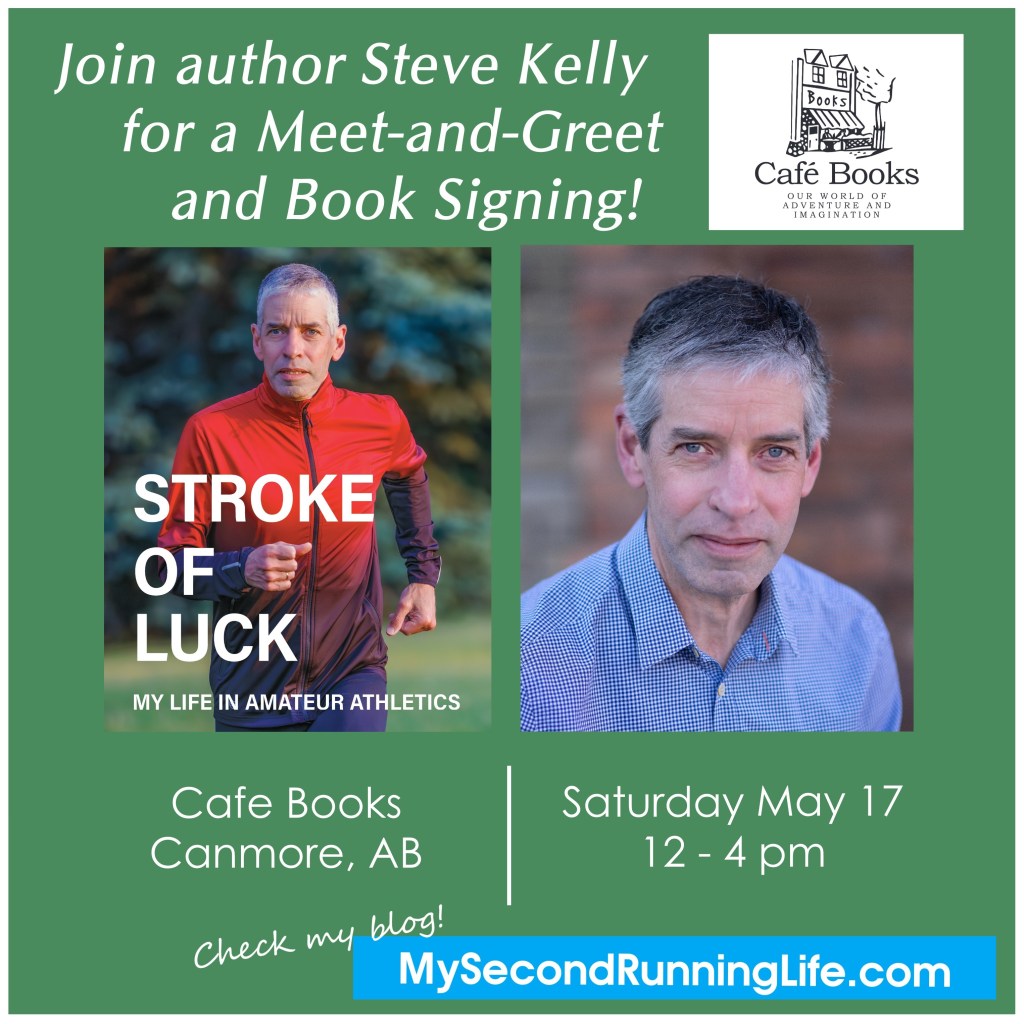
For the rest of September, you can purchase print and e-book versions of my memoir, Stroke of Luck: My Life in Amateur Athletics, at a special online price. Act fast, as the 20% discount applies only for a limited time.

Who knows, Stroke of Luck might be the secret sauce for a big race result. If you’re not a runner, I’m sure you will relate to my story. Why not order your copy today?

Until next time,

The Van Gogh to Van Gogh Photo Run

My photo run was bookended by two very different pieces of public art in Calgary. The pieces have a couple of things in common. Both are large, impressive sculptural works. And both have Vincent Van Gogh as their subject.

What a coincidence! I decided to do some research after I got home. But first, it was time to explore on foot. Here’s my route from Strava:

The Van Gogh Photo Run

And here’s what I found out about the artworks and the artists.

Van Gogh Observes, by Joe Fafard

I parked on 4th Street SW in Mission, near Masters Gallery, for the start of my easy run. I always like checking out what’s on display in their windows. Whatever else I happen to see, I can stop to admire the large piece installed just outside the gallery.

That piece, Van Gogh Observes (VGO), is a major sculpture by the late Joe Fafard. I wrote about Fafard last fall, when I photographed Do Re Mi Fa Sol La Si Do, his sculpture comprising eight stampeding horses. That piece is installed in Harley Hotchkiss Park in downtown Calgary.

Fafard’s piece is big and colourful. It’s fantastic. Van Gogh silently watches everything going on outside the gallery… hence the title. And from his vantage point, he’s seen a lot since the piece was unveiled in 2019. Van Gogh Observes was one of Fafard’s last major works… he died in March of the same year.

Although it wasn’t taken during my recent run, here’s one of my favourite pictures at that location. This couple seems to be deep in conversation with Vincent.

“Hello Vincent!”

Fafard was famous for his sculptural works, which often have a highly animated look. He sculpted livestock, people and other subjects, in bronze or laser-cut steel. His work is always visually appealing. This is certainly true of VGO. I think Fafard’s use of bold yellow and blue was a nod to Van Gogh’s frequent use of the same colours. It’s a piece that brightens up bleak winter days in Calgary.

Even from the back, it’s an amazing piece to look at.

Van Gogh Observes (Joe Fafard), from the rear

Van Gogh Monumental, by Bruno Catalano

I made my way to the UPTEN building at 10 Avenue and 1 Street SE to see Bruno Catalano’s 2020 painted bronze statue, Van Gogh Monumental. The four-metre-tall statue on the southeast corner of the intersection presents the artist walking purposefully while holding a well-used suitcase and carrying a painting on his back. He walks in the direction of the downtown core.

Van Gogh Monumental (Bruno Catalano)

The statue is part of Catalano’s Les Voyageurs series, all of which depict characters in motion. Many of Catalano’s sculptures, including this one, have a large diagonal gap, really a gash, at mid-torso. The sculptures seem to defy physics… they shouldn’t be standing, but they do. Catalano’s bio tells us he discovered this technique when he had a casting accident with an earlier piece. He liked the result, and he incorporated it into many of his subsequent works. It’s become his trademark.

Catalano’s sculpture invites speculation about its meaning. What is Van Gogh searching for? Where is he headed? Maybe there are clues in Catalano’s own story. He was born in Morocco. His French-Italian family moved to Marseille when he was ten. Catalano has Jewish ancestors, who were expelled from Spain in the 15th century, and eventually settled in North Africa. The theme of travelling, of searching nomadically, seems to fit naturally into his art. 

I find it interesting that Catalano chose Van Gogh for this sculpture, because most of his subjects are anonymous people. Here, he has chosen one of the world’s most famous and troubled artists. We shouldn’t be surprised to see Van Gogh searching for something while carrying his worldly possessions and his art. The gap in the statue is visually startling, but it also reinforces the idea that the subject has lost something quite fundamental.

Conclusion

As I jogged back to my car, I pondered the two art pieces I had just seen. I like both the Fafard and the Catalano pieces, even though they give us very different takes on an artist we all have some familiarity with.

The Fafard piece is approachable. Its animated look and bright colours give us an optimistic Van Gogh. Like the couple pictured above, we feel we could have a conversation with the man in the statue. That might explain why the statue is a huge attraction. I often see pedestrians stopping to admire it (or have a chat.)

On the other hand, the Catalano piece is more aligned with how we usually think of Van Gogh. It is a darker piece. The burdens Van Gogh is carrying and the cut across his body seem to portend his death by suicide. These are effective techniques to tell us something about the subject, but also about the artist. If Catalano relates to Van Gogh’s trials, he has done a great job of telling us.

I am most moved by the Catalano piece. What about you? Whichever piece you prefer, we are fortunate to have these important artworks in the city. It’s even better that they are just an easy jog apart.

Homage to GAP 1.0

Today’s run was just what I needed.

I had a late evening return flight from Ontario yesterday, so I was feeling a bit out of sorts as I parked next to the Glenmore Athletic Park (GAP) track. A high school track meet was in full swing. I watched from trackside for a few minutes, absorbing waves of energy and hearing the screams of hundreds of students as they cheered on their teammates. It motivated me to get going on my short and overdue run. 

I’d been thinking for some time about a homage post to the GAP track. I should say the original GAP track (GAP 1.0), because a spiffy new facility is being constructed by CANA, just a short distance away. I have a lot of criticism for decisions coming out of Calgary city hall but this isn’t one of them. I can’t wait for the new facility to be finished. 

The grandstands have been taken down and moved to the new track. The brilliant blue of the new surface looks magnificent and oh so ready for spiked shoes. Crews are working on the finishing touches, like landscaping. It will soon be the dawn of an exciting new era in track and field in Calgary. 

It seems timely to say a few words about GAP 1.0. I’ll be honest. The place is definitely looking worse for wear. Chunks of Lane 1 are crumbling into the infield. Patches and cracks are plentiful, thanks to our winter freeze-thaw cycles. The spotting booth on the back straight has been taken over by pigeons.

Pigeon holes on the back straight

I did a little research and found out that GAP 1.0 was built in 1962-63. It’s just a couple of years younger than me. No wonder it has cracks and wrinkles! 

Despite these blemishes, the track has also been the site of countless track meets, interval workouts and road race finishes. I’ve personally done thousands of laps of the track, in all sorts of weather. And that’s a good segue to the fact that the Calgary running community has been second to none when it comes to keeping a lane or two of GAP 1.0 open through the winter months. All it takes is willpower and a lot of shovels, as demonstrated in this shot from October 2023.

Deb, Reinier and Jeremy dig in

Here’s a shot of an interval session from late March. It was one of those Calgary spring evenings when we started with water in the far corner and ended with sheet ice. No one complained when we decided to cut things short.

Late March interval training, GAP 1.0

Or how about a photo from the 2019 Stampede Road Race? The park was a beehive of activity that morning, with lots of racing action and a pancake breakfast as our reward.

Sherrey and Deb, post-race

A recent track racing milestone got me thinking nostalgically about GAP 1.0. It was on May 6, 2024, the seventieth anniversary of Roger Bannister’s four-minute mile breakthrough on the Iffley Road track in Oxford, England.

It seemed fitting to make a brief pilgrimage, in pouring rain, to run four ceremonial laps in honour of this great achievement. After all, the GAP track is only 10 years younger than Bannister’s record. I pointed out the significance of the day to a young athlete who had just finished his track workout. He gave me a polite but puzzled smile. I secretly wished for him to do the same on the hundredth anniversary in 2054, running his commemorative laps on the new track. 

In closing, I have many fond memories of running on the GAP 1.0 track. I don’t know what lies ahead, but if they do tear it down I’ll miss that familiar red surface, flaws and all. For years, it has been a great venue and meeting place for runners. It’s one of my favourite spots in the city.

So here’s to a good run for a fine old facility! And here’s to GAP 2.0… can’t wait to try out “big blue”.

Until next time, be well and BE FAST!

Arizona Dreaming – Part 2

Sedona, Red Rock Country

Straight from our successful morning at the XTerra Black Canyon trail run, our convoy headed north to beautiful Sedona for a week at the Seven Canyons resort. Our theme for the week was “Elevate Performance”, and our hosts, Bill and Janice, were exceptionally generous, opening their home and directing all manner of activities. 

We explored the extensive trail system around Sedona, which brought us awesome views of the stunning “red rocks” for which the city is famous. Sedona was much busier than what we remembered from our last visit, so we made sure to get an early start for our trail runs. 

Did you know that the unique red colour of Sedona’s geological formations comes from iron oxide? The rocks are primarily sandstone and limestone. Because these are relatively soft rocks, they are susceptible to physical and chemical erosion. Wind and water (think flash flooding) have played a significant role in shaping the landscape over millions of years. And the result is spectacular… it’s unlike any other place I’ve been.

Our first group run was on the Little Horse-Bell Rock trail. We could have legitimately said we were still recovering from the race a couple of days earlier. That may have been partly true for Deb, but I was definitely okay with an easy start as I was still feeling the effects of my fall (and knowing that we had a busy week ahead of us.) This trail was perfect, even for those in our group who were a bit more ambitious. We did an out-and-back route that brought us all to the trailhead at the same time, so it all worked out. And what views!

“Elevate Performance” – Adrenaline Rush hits the trails at Little Horse

A highlight of the week was a trail run starting from the Dry Creek trailhead. We went out on the Long Canyon trail and returned via the Mescal-Yucca loop. We knew this route from prior runs, and we stopped along the way to enjoy the breathtaking… in both senses of the word… views.

Taking a break on Mescal

We added a second trail race to our calendar, given that the Sedona Stumble was conveniently scheduled for Saturday March 23, at the Posse Grounds Park in town. The 5k and 10k distances were full of challenges, including sections on a narrow single-track circuit and a mountain bike slalom course. Wow!

The race was very well organized by Run Sedona. Adrenaline Rush runners tackled both distances. Once around this technical loop was enough for Deb and me. We enjoyed the post-race snacks and festivities, especially the delicious donuts provided by Sedonuts. It was no surprise that Adrenaline Rush runners again made an impact on the podium. Congrats to Allison (1st in F50-59) and Al (1st in M60-69) in the 10k, to Doreen (1st in F60-69), Janice (2nd in F60-69) and Carolyn (1st in F50-59) in the 5k, and to the rest of our group on your strong results!

In addition to trail running, there was a lot of golf action on the beautiful Seven Canyons course throughout the week. Deb and I enjoyed a few casual games, although the glaring truth, for me at least, is that my game needs serious attention. A summer project, perhaps?

It was all smiles after the (cool and breezy) Adrenaline Rush golf game

Of course, I carried my Ricoh GR III with me on our runs and was rewarded with some good shots. From our vantage point on Rachel’s Knoll, I also got some amazing landscapes. The weather was cool and breezy, which meant some very interesting evening cloud formations. And the sunsets were outstanding.

Evening clouds roll in, Sedona

All told it was a magical week in paradise.

Thanks for reading,