We all know that February is the shortest month, at 28 (or 29) days, not the usual 30 or 31. But do you know how this came to be?
We have to go back to the Roman calendar, which divided the year into ten (not twelve) months, from March to December. These months were either 29 or 31 days, not 30, because the Romans considered even numbers to be unlucky. The early part of the year was not even named.
The second king of Rome, Numa Pompilius (ca. 753-652 BC) reformed the Roman calendar and introduced the months we know as January and February. However, it would have been problematic for these new months to have either 29 or 31 days. Why? Because the total number of days for the year (that is, the product of 12 odd-numbered months) would have ended up as an even number, not the required 365.
So, February was adjusted to make the annual math work. A couple of reasons are cited for this decision. The name itself comes from the Roman festival of purification, ‘februa’, which occurred at that time of the year. It was also the time when people mourned the departed. These factors led to February being the month that was shortened to 28 days.
I thought it would be fun to highlight individual performances that have inspired and motivated me. As you’ll see, it isn’t necessary that the person I’m writing about won the race in question. This is all about their effort on the day.
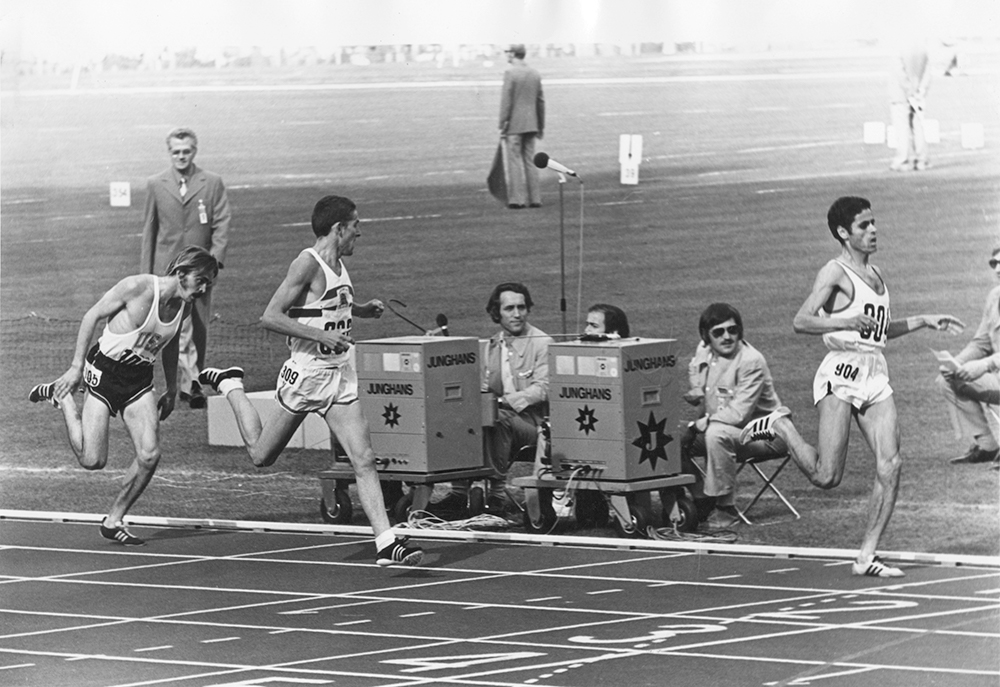
Steve Prefontaine, Munich 5000m Final
I’ll start with a confession: on my own race mornings, I used to watch the video of this great individual performance to get myself into the right frame of mind. BBC commentator David Coleman’s description of Steve Prefontaine, the brash American, as “a sort of athletic Beatle” is classic.
Setting the scene, Prefontaine was running in what would be his only Olympic final, against a deep field. With two slow miles behind them, Pre boldly “states his case” to lead to the finish. As a pack of five separates itself with two laps to go, the Finn Lasse Viren asserts control. Is it over? No, not with Pre in the mix. Time and again, he fights to regain the lead. Coleman’s fateful comment, with 200m to go, that “these are the medal men” would turn out to be wrong, as a totally spent Pre is passed in the last few metres by Ian Stewart. Viren won gold.
Measured by the result… fourth, and out of the medals… this could be seen as a foolish gamble by the inexperienced young American. Instead, I look at it as the epitome of racing. There was no playing it safe for Prefontaine. No wonder I get goosebumps every time I watch the video.
Prefontaine gambles it all, Munich Olympics 5000m final (Photo from Track and Field News)
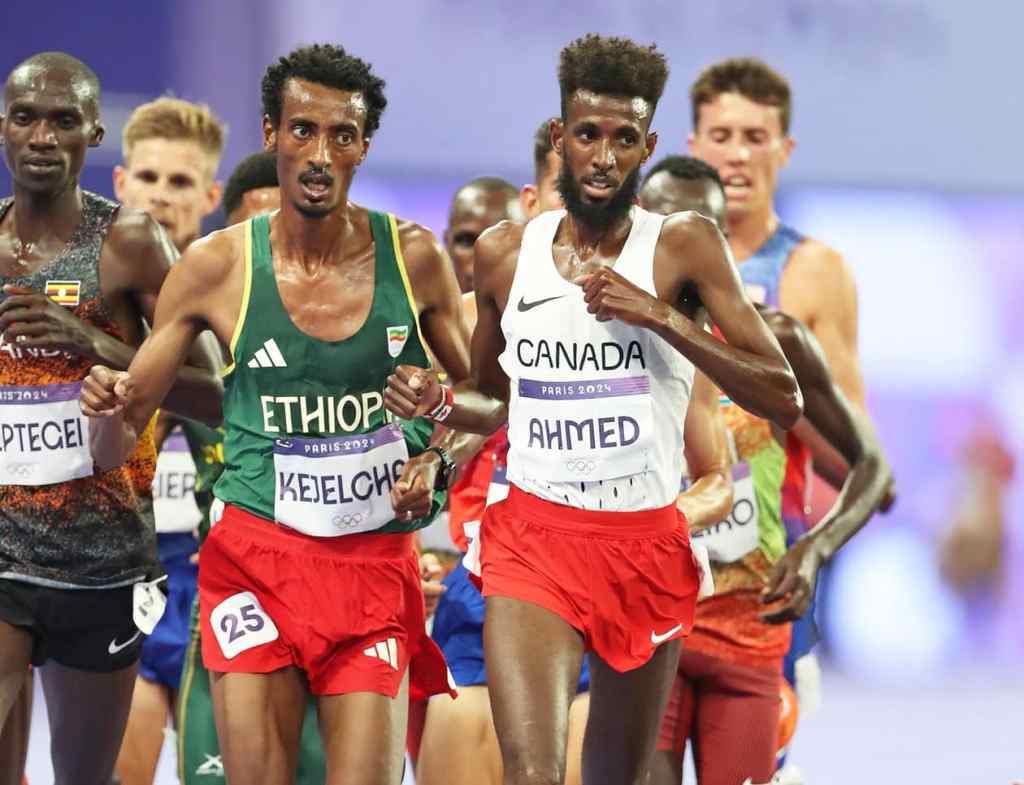
Mo Ahmed, Paris 10,000m Final
At the risk of repeating myself, I’ve chosen another Olympic finals performance that left the runner out of the medals. This time, it was Canadian Mo Ahmed in the Paris 2024 Olympics 10,000m final.
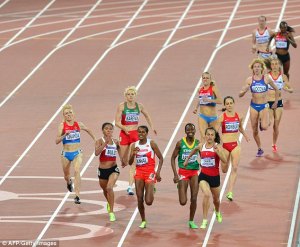
Ahmed ran what might be the smartest race I’ve ever seen. He stayed out of trouble in a top-class field, paced himself beautifully, and was in contention against team tactics of other runners until the final 30 metres. I thought I might have been the only one who noticed his deceptively smart racing, until I heard David Moorcroft (broadcasting for CBC) make the same observation.
Finishing with nothing in the tank, Ahmed’s performance (26:43.79) was good for fourth place. That he and 12 other finishers were well under the previous Olympic record attests to the quality of the field. It was a spectacular race, and one where Ahmed demonstrated that he belonged with the very best.
Mo Ahmed shines in the Paris 10,000m final (Photo from Athletics Canada)
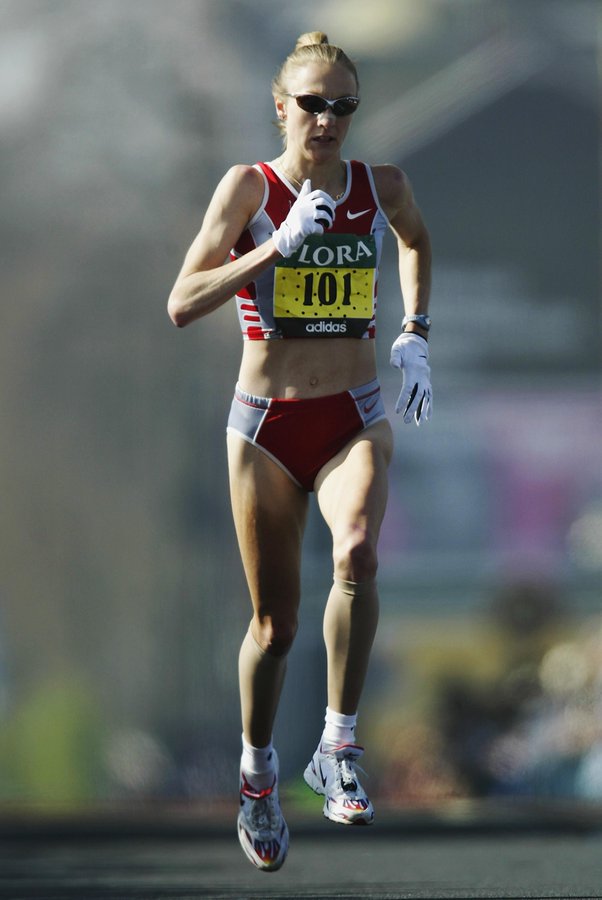
Paula Radcliffe, 2003 London Marathon
In 2002 and 2003, Paula Radcliffe was on top of the marathon world. She had set a world record in Chicago in October 2002, running 2:17:18, so there was great anticipation for her race the following spring in London. Running before her home crowd, Radcliffe didn’t disappoint. Leading from start to finish, she shattered her own world record, en route to an astonishing 2:15:25. Her nearest competitor was more than four minutes behind her.
I have a tenuous connection to Radcliffe’s race. You see, I was on the same course that sunny April morning in London. Admittedly I finished nearly an hour behind her. I’ve replayed the videos and read the stories so many times to fully grasp what Paula achieved. The strain on her face in the final few kilometres shows how much she wanted this result.
In an era before supershoes and without any team support, Radcliffe delivered a courageous performance, well deserving of being in my top 5.
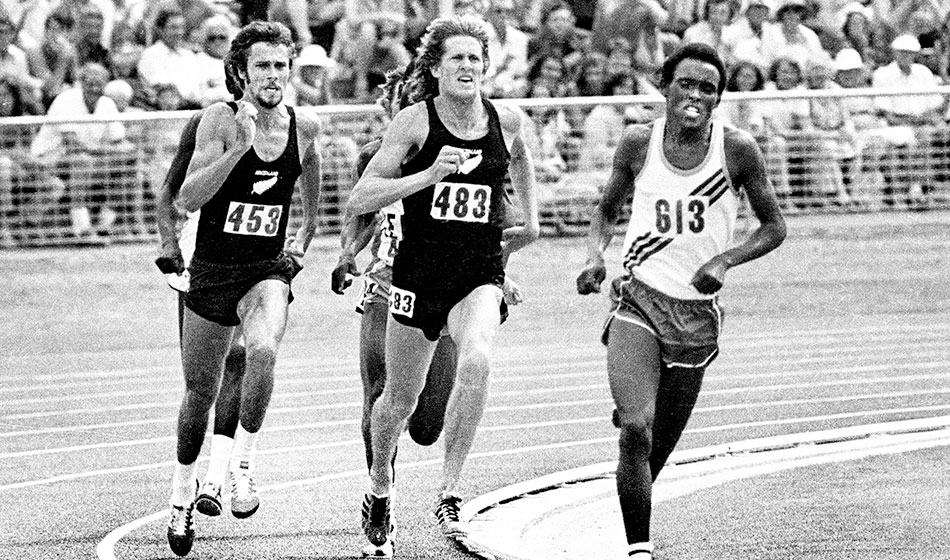
Filbert Bayi, Christchurch 1,500m Final
In recent years, the Commonwealth Games have struggled to remain relevant. Competition from other mega-events (like the Olympics and the World Cup) and other *um, political* factors have led prospective host cities to back away from the Games.
Whatever the future holds, the Games have been host to some great athletics history. Here’s a case in point. In 1974, the young Tanzanian runner, Filbert Bayi, was relatively unknown. That didn’t stop him from taking on a handful of the world’s best in the 1,500m final in Christchurch, New Zealand. His race was one of the most audacious performances of all time. He led from start to finish and set a world record of 3:32.2. Not only that, he beat the hometown favourite, Kiwi John Walker.
Bayi’s account of the race, in a wonderful Athletics Weekly article, leaves no doubt that he trusted his front-running strategy. “I was confident that anyone trying to close the gap over the last 100m or 200m would have a real fight on their hands,” he states. And with the field in a pack bearing down on him, his plans were certainly put to the test. In the end, Bayi beat Walker by a couple of strides. He knew immediately the importance of what he had achieved. It was a perfectly executed race.
Filbert Bayi leads John Walker and the rest to the finish (Photo from Athletics Weekly)
Roger Bannister, 1954 Mile Double
Even as the 1,500m has largely eclipsed the mile as the middle distance standard, it’s worth noting that the mile continues to get attention. In the last week, the men’s indoor mile record has been broken… not once, but twice. So it is worth looking back to the furor that surrounded Roger Bannister in 1954.
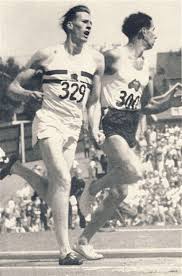
Cheating a little, I will highlight two of Sir Roger’s epic performances. His epic May 1954 run to break the four-minute barrier for the first time is the race everyone knows about. But I would suggest that with his performance in Vancouver at the then-called Empire Games in August, Bannister put an exclamation mark on his miraculous year.
By August 7, Bannister’s record time had already been beaten by Australian John Landy. The Vancouver race was the first time they competed head-to-head. The race generated global hype, and it became known as the Miracle Mile. Although Landy led most of the way, he made a fateful error on the last corner, looking to his left for the hard-charging Bannister. Sensing Landy’s weakness, Bannister passed on the right and didn’t let up. He reached the finish in 3:58.8, five yards and 0.8 seconds ahead of Landy.
I’ve written about Bannister, here and here. What impresses me most about him is that he competed as a pure amateur. As memorable as his exploits on the track were, he never considered them to be his greatest personal achievement.
So that’s my top 5. I could have easily found a top 10, but one has to draw the line somewhere! I’d be interested in any thoughts on these performances, and any that my readers are convinced I’ve missed.
Recently, I wrote a piece about several of my sporting heroes. To keep the piece to a reasonable length, I didn’t comment on another man who had certainly earned a place on my list. In fact, he had been one of my personal heroes for years. That man is Jerome Drayton. In light of his sudden passing on February 10 at the age of 80, I’m regretting that decision. It seems appropriate to talk about him now, and the impact he had on me.
Much has been written about Drayton. His personal story is one of strength and resilience. He was born in Germany to Russian-Ukranian parents, just as the war was coming to an end. His parents divorced, and he emigrated to Canada with his mother in 1956. His name at birth was Peter Buniak, and while we hear various reasons for his change of name, it was clearly his way of putting distance between his past in Europe and his future life in Canada.
He started running in high school in Toronto and found early success. More accurately, he earned it. His results speak volumes about his work ethic. I can start with his astounding mileage totals. He was a pure amateur, doing 200-mile weeks while working full-time. Mere mortals struggle to reach a quarter of that.
While I was discovering athletics in the mid-1970s, Drayton was already in the top echelon of the sport. I never met him, but I followed his exploits closely. Here’s some of what I wrote about him in Stroke of Luck:
“Coincidentally, the world around us was discovering running at the same time we were. The mid- to late-1970s marked the beginning of what is now called the running boom. Frank Shorter’s win in the 1972 Olympic Marathon for the United States is often cited as the beginning of the boom, but I wonder how strongly that event resonated in Canada. If we were following any world class distance runners, it was more likely to be the top Canadian, Jerome Drayton, or even some of the top British runners like Ron Hill, rather than the celebrated American.”
Drayton’s running resume is stellar. In an era when distance running was still seen as a fringe sport, Drayton fit the stereotype of the lone, somewhat aloof, character. Obituaries and tributes describe his single-mindedness and determination.
In my book, I described Drayton as an enigma, given his preference for running in dark aviator shades and a tendency to front-run against his toughest competitors. Perhaps fitting that persona, Drayton never seemed to say much. He let his running speak for itself.
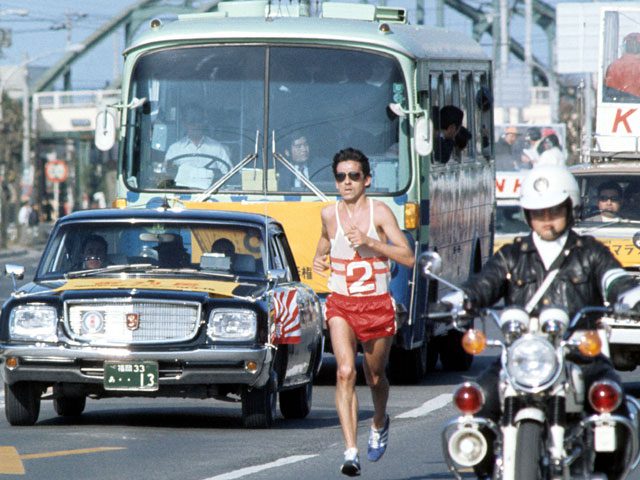
Consider this: long before Boston assumed the title of “world’s premier marathon”, the Fukuoka Marathon in Japan was at the pinnacle of the sport. Entry was by invitation only. Drayton won it, THREE TIMES, in 1969, 1975 and 1976. What about Boston? Well, he won that too, in 1977. He was the last Canadian man to do so.
Drayton in the 1976 Fukuoka Marathon (Photo from Canadian Running, 2013)
Speaking of Boston, I suppose we could add “irascible” to the list of words describing Drayton. Apparently, he wasn’t the most gracious winner. Rather, he took the opportunity to point out that he had just about been mugged in the early going, and that his victory had nearly been sabotaged by the lack of water stations. Hearing this story only made me admire him more. Any of us who have run the race can thank Drayton for dragging the BAA into the modern era.
I have to mention the most durable of Drayton’s achievements, his Canadian marathon record. He set the record (2:10:08) in the 1975 Fukuoka Marathon, and it stood for an incredible 43 years until Cam Levins broke it in the 2018 Toronto Waterfront Marathon.
There was a Hamilton connection too, which cemented Drayton’s place as one of my running heroes. Here’s another passage from my book, where I talked about his victories in the Around the Bay Race:
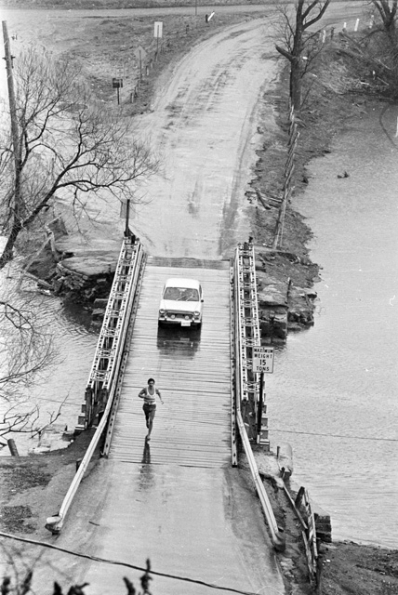
“The history of the Boston Marathon is intertwined with that other famous race, Hamilton’s own Around the Bay Race. Both races were first contested in the 1890s. Many icons of distance running, including some legendary Canadians, had competed in both events. The lists of past winners in Boston and Hamilton include many names that I recognized, even idolized. There was Jerome Drayton, the top Canadian marathoner, the national marathon record holder, and the 1977 Boston winner. He was also a two-time winner of the Bay Race, in 1973 and 1974.”
Drayton, alone in the lead at ATB (Photo from Hamilton Archives)
In the 1970s, finding any athletics news at all was tough. I scoured a lot of newspapers. Despite the sport’s relatively low profile, Drayton stood tall. His star shone brightly until his retirement in the early 1980s. When his racing days were behind him, Drayton was a reclusive role model. He appeared from time to time in interviews… this one in Canadian Running Magazine from 2009 is excellent… and when his Canadian record was finally beaten, he was gracious. He expressed surprise that it had taken so long.
In his later years, Drayton took on advisory roles with government sports agencies. He shunned publicity and lived a modest life in Toronto. Some stories mentioned his struggles with arthritis, which may have contributed to his unexpected death. The news reports I’ve read suggest his death came during knee surgery. Sadly ironic, for a man whose legs had carried him to the top of the marathon world half a century earlier.
Jerome Drayton was a true sporting legend, whose place in Canadian sporting history won’t easily be matched.
Until next time, be well and (emulating Drayton) BE FAST!
This is a short post, with the latest news. I’ve been busy compiling and editing photographs for my new BUMP Photo Run series. If you aren’t familiar with BUMP, it’s the Beltline Urban Mural Project, a vibrant project that has been brightening up our city since 2017. Check out my first piece here. You can read about the background of the project while enjoying photographs of some amazing art. Look for more posts very soon!
Canmore Public Library Event, Feb 12
UPDATED!
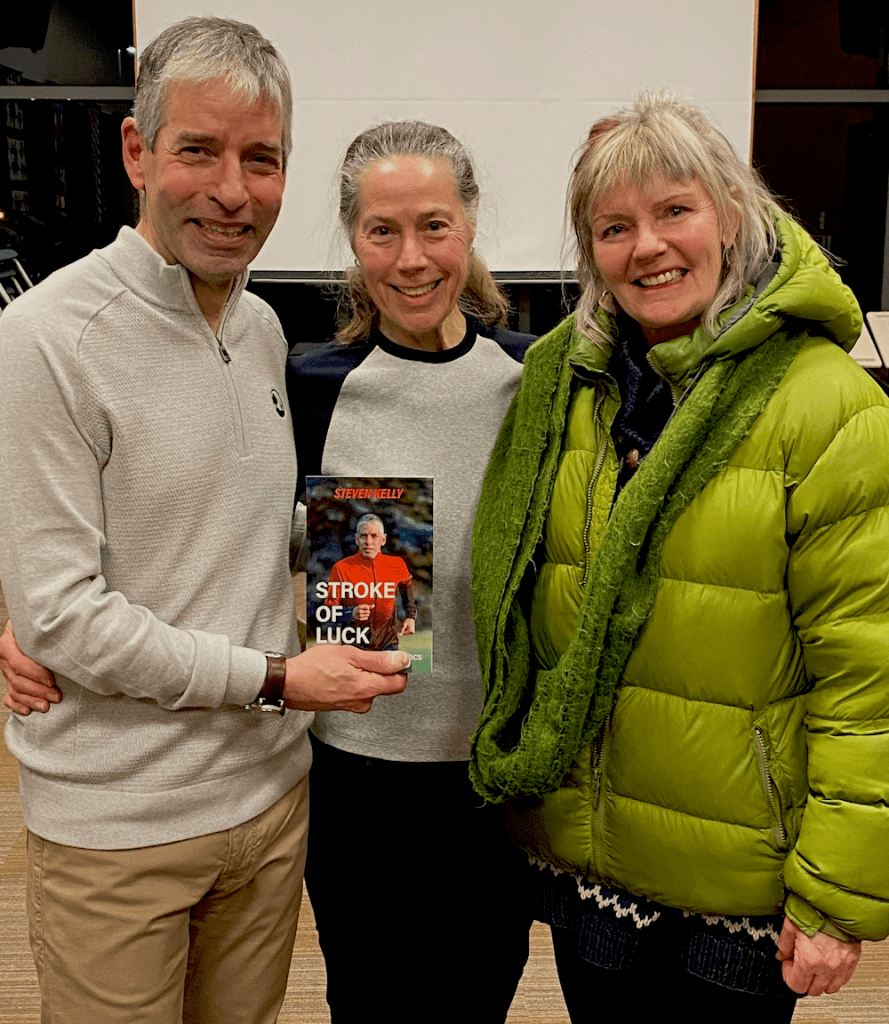
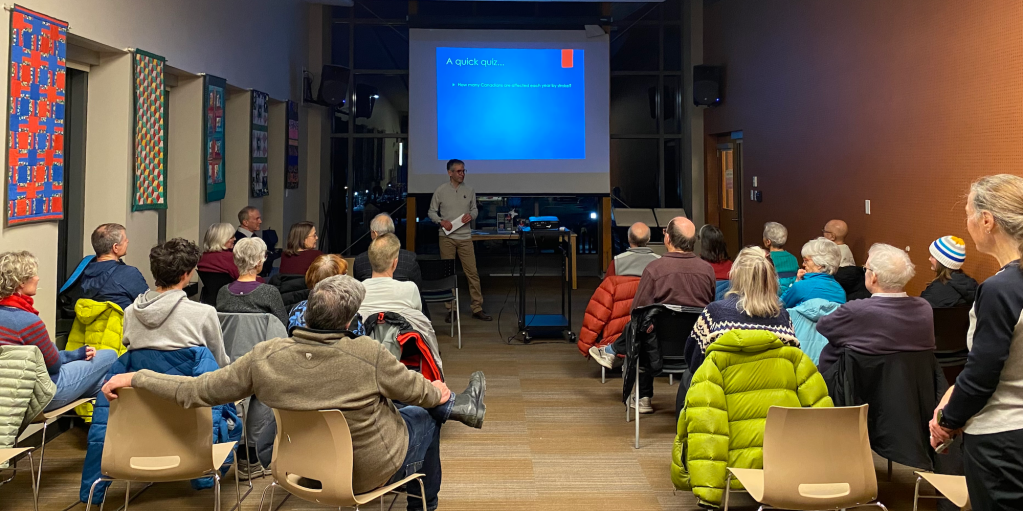
It was a wonderful evening in Canmore. The venue in Elevation Place was beautiful, we had a great turnout for our talk and an engaged audience. What more could we ask for?
Thanks to my friend, Don Crowe, for taking on MC duties, to Carey Lees of the Canmore Public Library for her flawless organization, and to all who attended. Thanks too, to Kylie and Tim at Strides Canmore, for their generous support of this event!
Here’s a synopsis of the talk:
A brief personal introduction
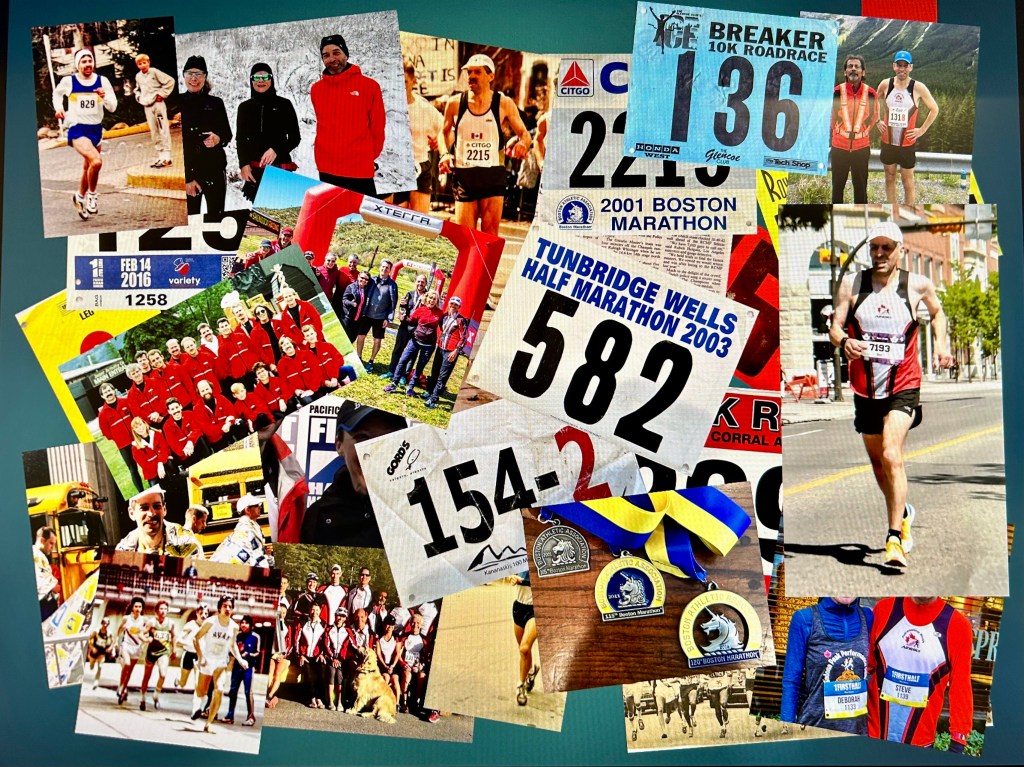
A collage of my running adventures (see below)
Discussion of my stroke journey, including the useful phrase to remember stroke symptoms (readers of this blog will already be familiar with BE FAST)
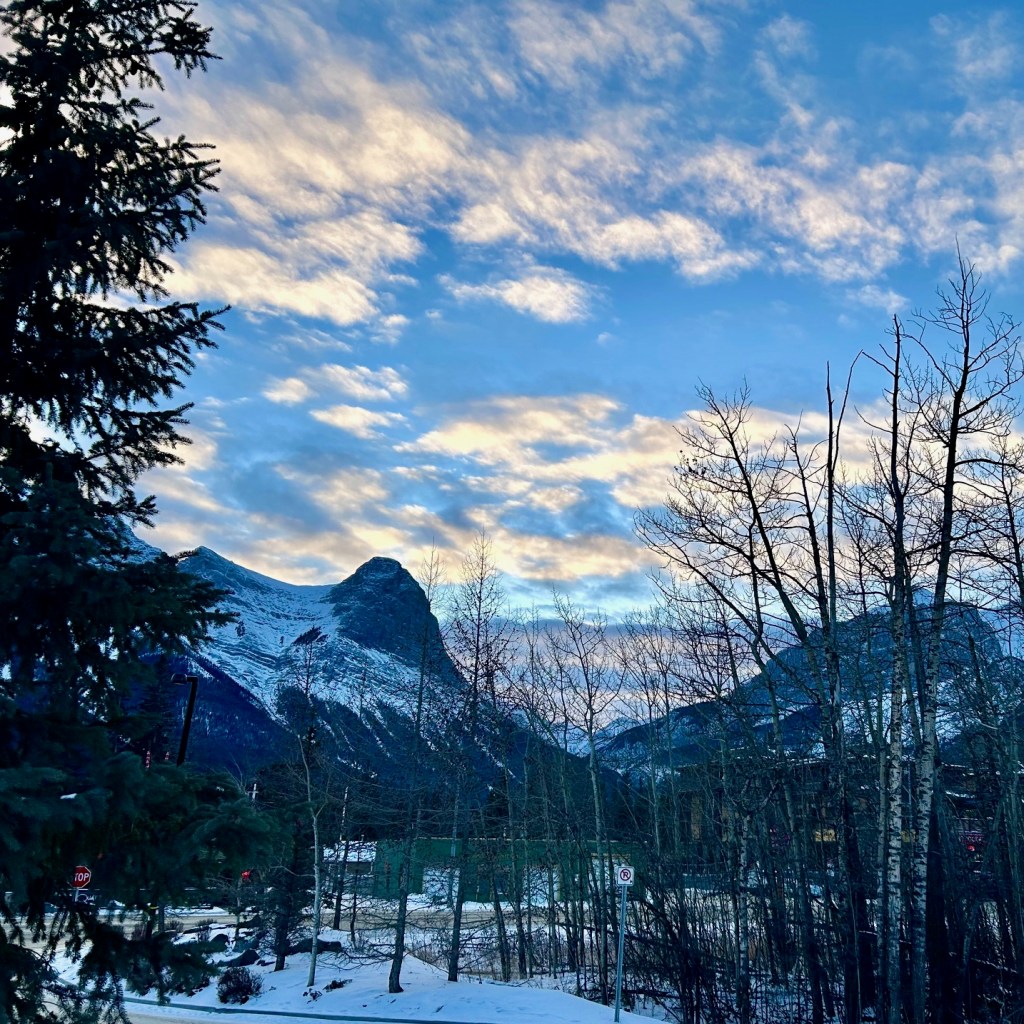
Steve and Deb greet Dianne DeansAuthor Event Feb 12Canmore Vista from Elevation Place
Of course, I shared my three main messages, listed below:
The importance of an active lifestyle
Awareness of ALL the symptoms of stroke
Raising funds to support the great work being done every day on stroke prevention and care at the Foothills Stroke Unit
This is what 50 years of running memories look like on one page!
You can read all the details in Stroke of Luck: My Life in Amateur Athletics. And there’s some news on that front: Cafe Books in Canmore will be carrying the book. So, if you live in Canmore, please drop into this unique bookstore and grab your copy!
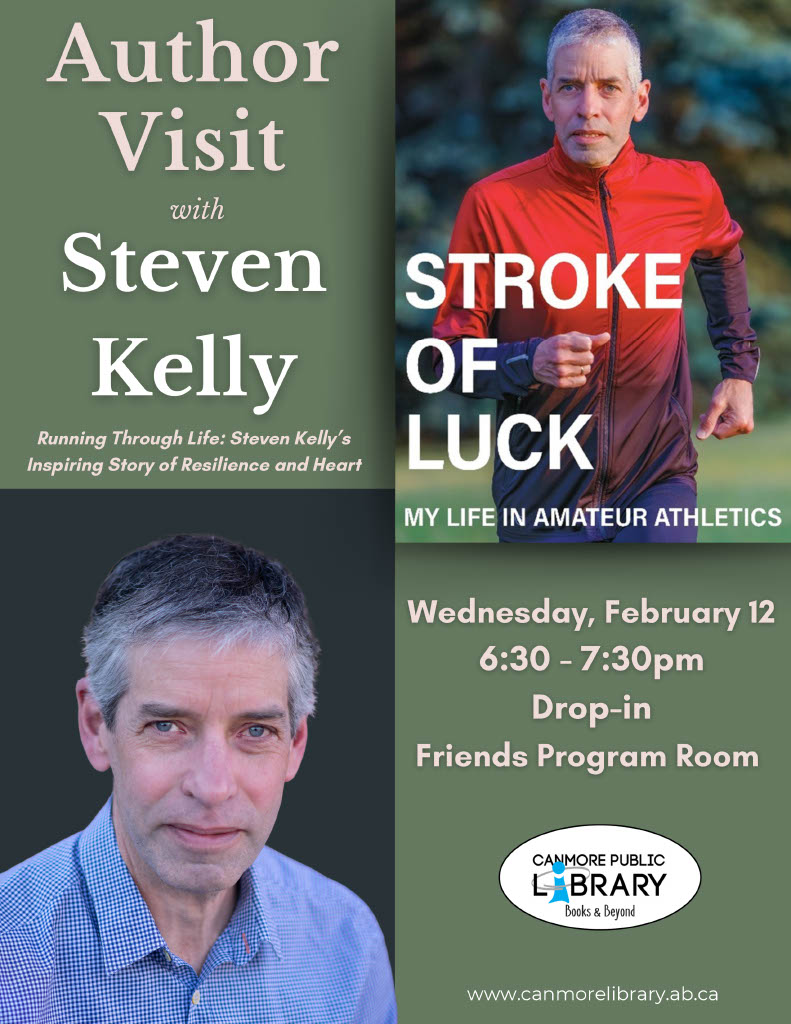
For anyone in the Canmore area this Wednesday (February 12), I’ll be speaking at an Author Event at the Canmore Public Library at 6:30 p.m. Join me if you can, for an informal (and informative) presentation of my story, as told in Stroke of Luck: My Life in Amateur Athletics. There will be a short presentation, a Q&A session, and some draw prizes. I’ll have copies of the book available for purchase, at a special event price. Proceeds from book sales support the great work being done every day in the Foothills Stroke Unit.
I’d like to thank the staff at the library for hosting us in your wonderful facility. Also, to my friends at Strides Canmore, thank you for spreading the word about this event, and for your ongoing support of my book project. I feel blessed to be part of the tremendous local running community… it’s second to none!
Finally, thanks to Dianne Deans, whom I had the pleasure of meeting at the CanStroke Congress in November. Dianne is an enthusiastic patient support volunteer for stroke victims at the Foothills Medical Centre. She kindly connected me with the Canmore library staff, which led to this event coming together. Thank you, Dianne!
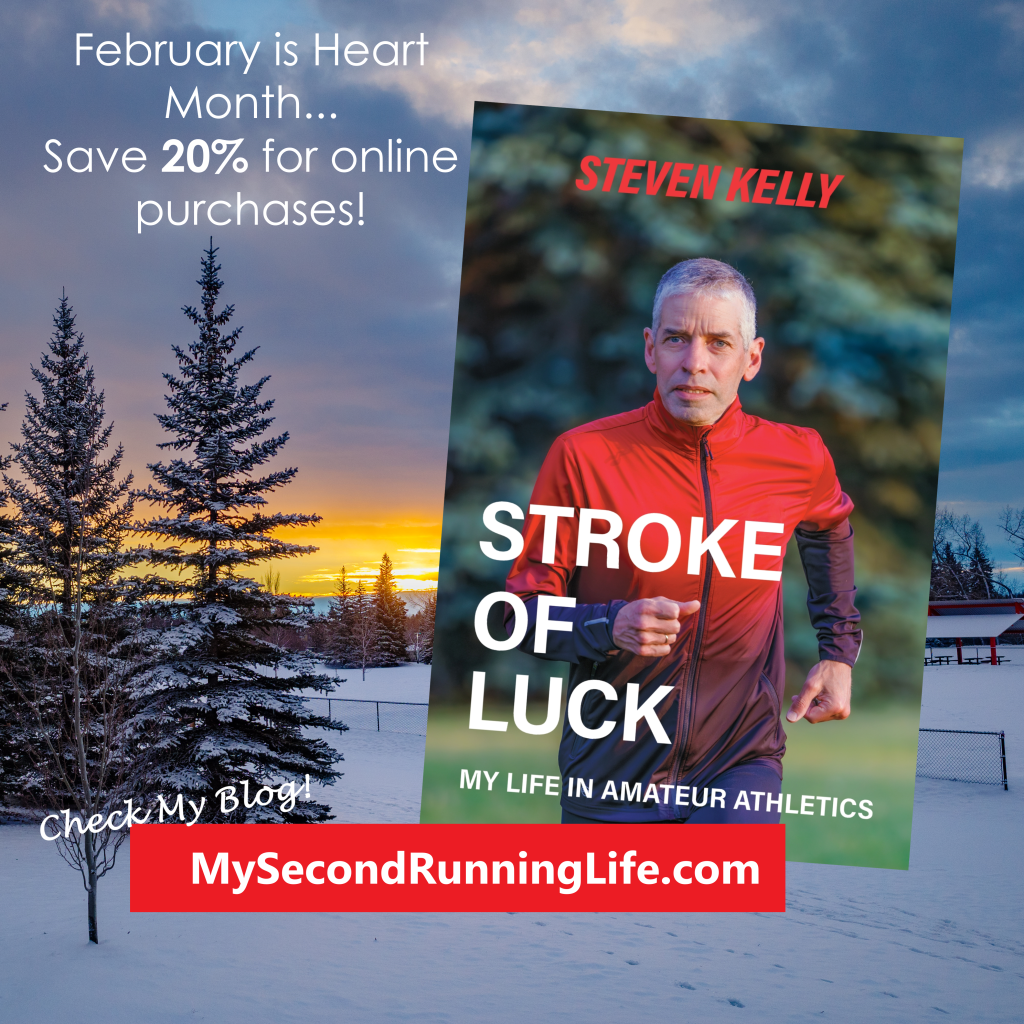
Heart Month Sale Still On!
What better way to markHeart Month than a healthy discount for online sales of Stroke of Luck?
Order your copy on Amazon, and save 20%. The sale will run through the end of February.
I was jogging around Calgary’s Beltline, feeling a bit short of ideas for my next urban run/photo adventure. As I rounded the corner from 7th Street onto 15th Avenue, I glanced up at the side of the building. What I saw stopped me in my tracks, and instantly gave me the inspiration I needed.
What’s BUMP?
There’s a program called the Beltline Urban Mural Project… BUMP… that has been making Calgary’s inner city streets more interesting and colourful for years. I had to find out more.
From the BUMP website, I learned that the project started in 2017, and has grown significantly since then. Seeing all the artwork in one run would be challenging, if not impossible. There are dozens of sites, spread throughout the core. I needed a plan. I often start my runs near Lougheed House, so I decided to use that location as my base. I could get a good overview of the murals (and hopefully some worthy photos) by concentrating on different neighbourhoods over several runs. This is the first of what is likely to be an ongoing series.
Run 1 – BUMP in the Beltline
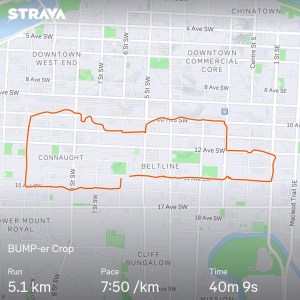
Run 1 focused on the Beltline itself… bounded roughly by 15th and 10th Avenue, and 1st and 10th Street. Here’s my Strava map:
Turning to the art, let me start with the mural that prompted this idea. It’s a large, striking piece in green, called “The Last Maple Leaf”. It was painted in 2023 by the Colombian artist Wosnan. This is from the mural description:
“Rising from nature an ancient guardian of the forest who merges the realms of magic, other worlds and dimensions, spirit and space stands tall, looking over our city…”
Wosnan, “The Last Maple Leaf”, 1411 7th Street SW
This was an apt description of the mysterious tree-like being that loomed over me, guarding his/her corner of the neighbourhood while pondering (no surprise) the last maple leaf. Stirring stuff! I studied the mural carefully, with my stopwatch running. The magnitude of the challenge I had taken on dawned on me. Maybe I should make this a slow photo walk…
No! I resumed my run, with my goal of at least five kilometres in mind. I tried to ignore the glimpses of colour that I started to notice down every alley.
Bottom line? I finished with lots of pictures and a feeling that I had made a small dent in the many Beltline murals. For full disclosure, while I saw all these murals on BUMP Run 1, some of the photos are from previous runs because I liked the shot more. Light is everything, you know!
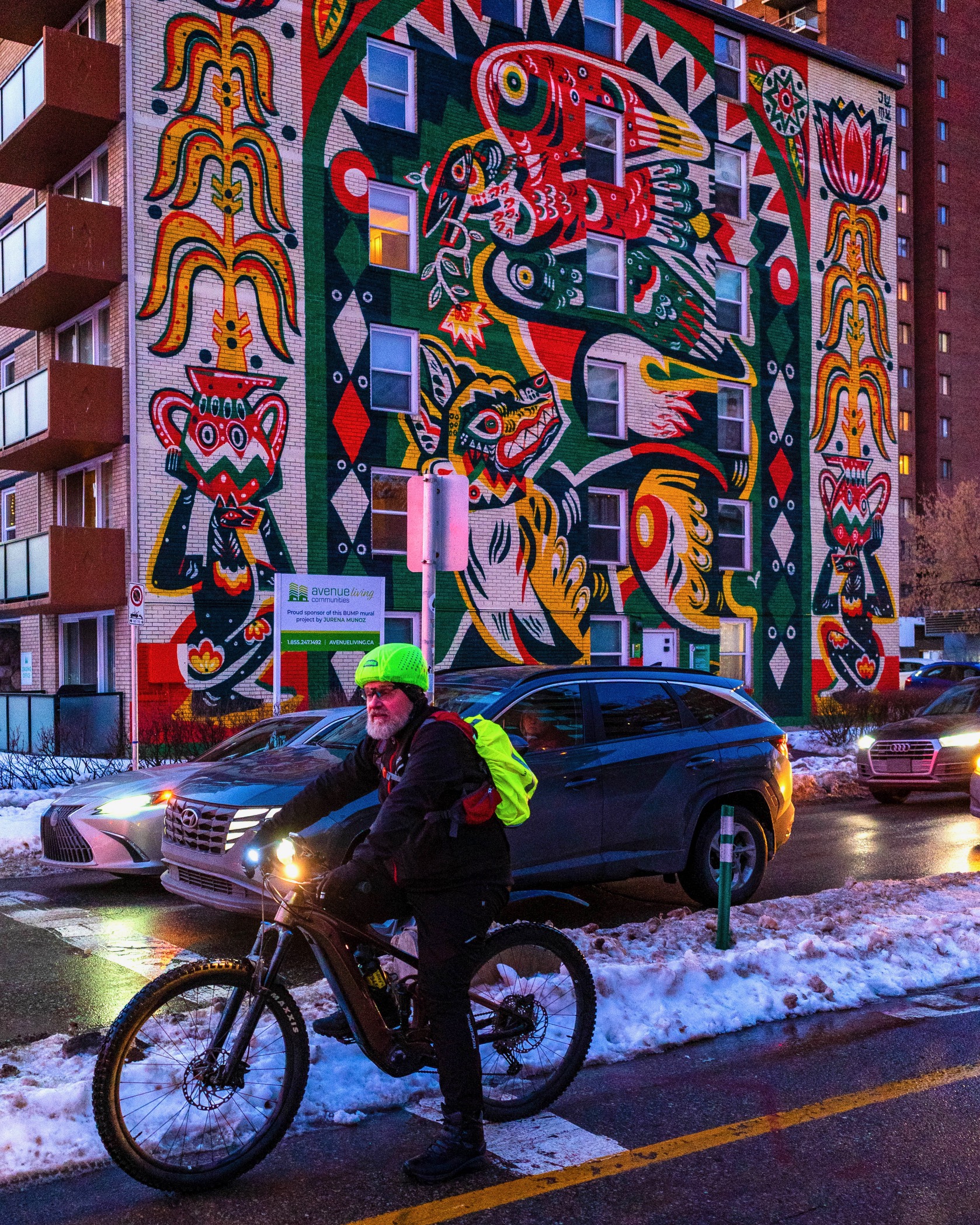
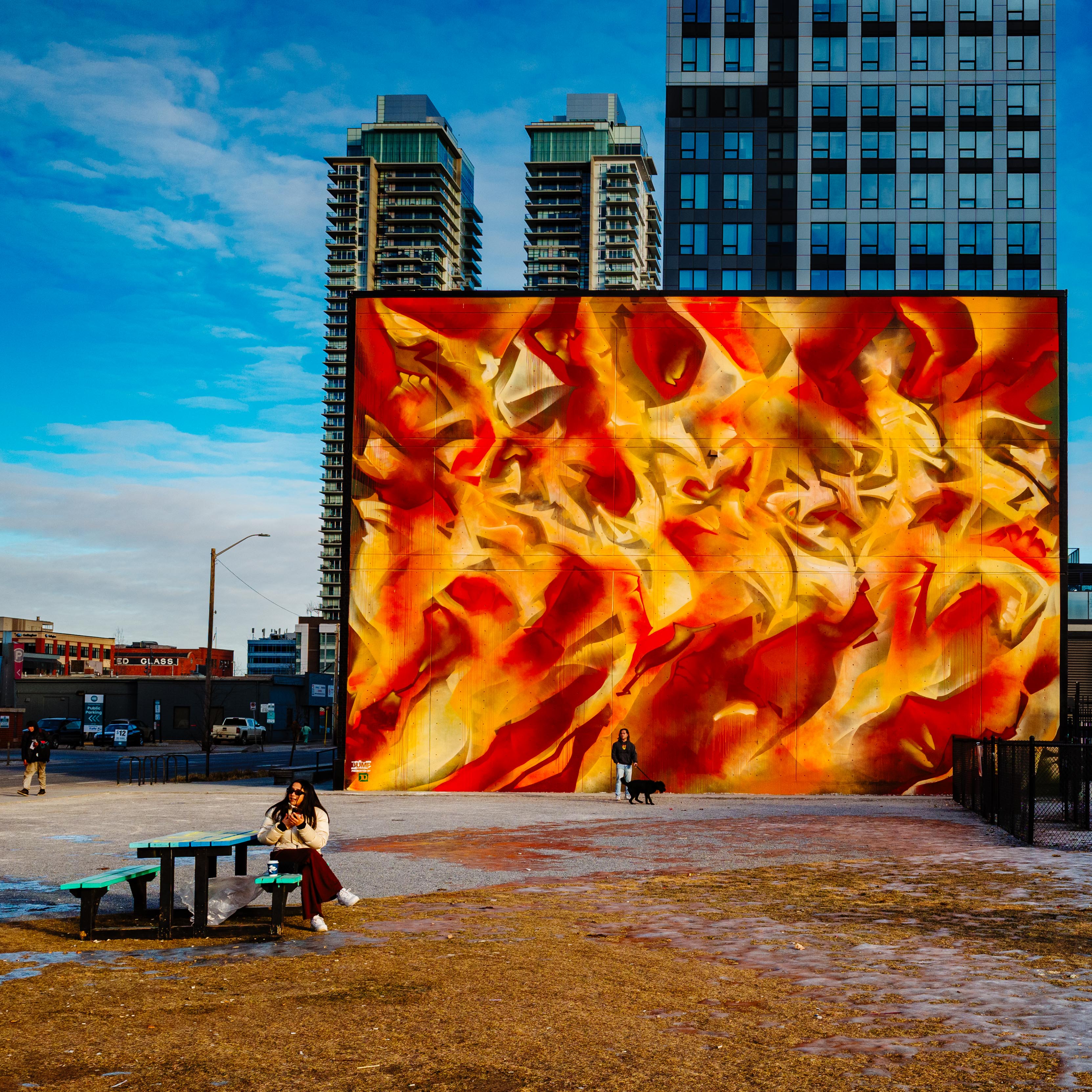
Here’s a short summary of the pieces in the photographs. I recommend following the links to the map on the BUMP website to find out more.
Imagine painting a mural on a wall 60 feet wide by 30 feet high. How does one even begin? Laying out a piece at that size and scale must be extremely difficult. And the execution would bring very different challenges. I marvel at the way the artists manage the intricate details, while still capturing their vision for the whole piece.
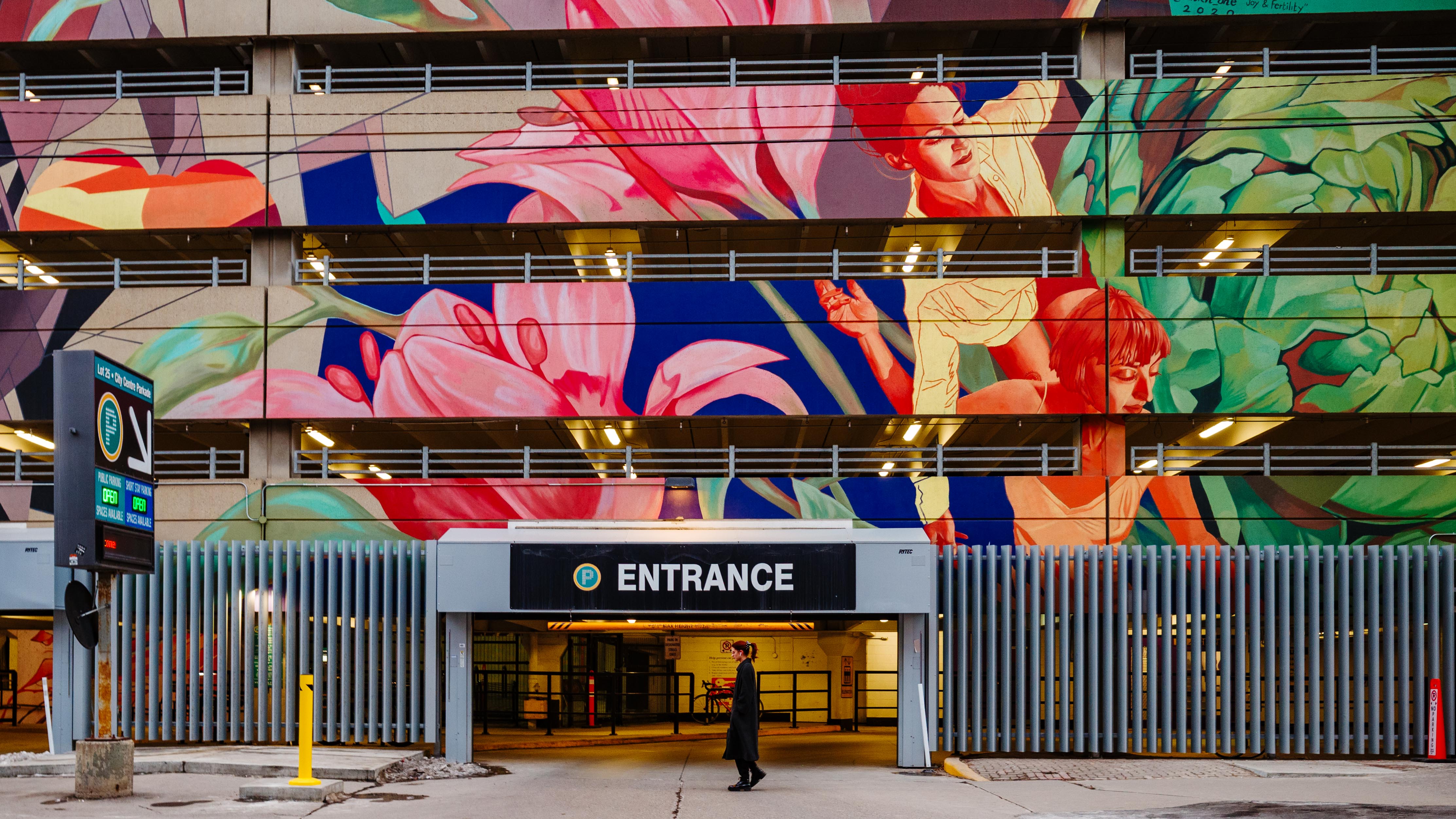
I had a front-row seat for the creation of sôhkâtisiwin (that’s Canadian artist Kevin Ledo’s striking mural at 340 10 Avenue SW). The title means “strength/power” in the Cree language. The image is taken from a picture of B-Girl and traditional hoop dancer, Angela Gladue. I watched the beautiful portrait of this young Indigenous woman come to life in 2018, from the comfort of my office across the street. Kevin and his helpers toiled away in the hot summer sun on a stage lift, going up and down endlessly over several weeks to complete the image, which now livens up the west side of a parking garage. I made sure to give them a thumbs-up every time I walked by.
Here’s a rough timelapse of the process (I had many more pictures on my phone, but I recently deleted most of them). You get the idea though.
Impressions
This is an amazing initiative. To state the obvious, BUMP is a diverse selection of art. I’m impressed by the sheer number and quality of the murals. It’s great to have artists from around the world come to Calgary and share their talent. I hope the project continues and expands its reach across the city.
This is the kind of project that invites us to slow down and take a closer look at the art. Sure, we can (and most often, do) pass by these murals in our daily routine. Maybe we glance at them, maybe we don’t. But this first photo run has already prompted many questions… Who is this artist? What is their message? Do I think they succeeded? What does this piece make me feel?
The BUMP website helpfully lets the user select pieces they would like to see on a walking tour, and this is probably the correct way to see them. I will persevere with my photo run idea, knowing I will still see and learn a lot along the way.
My early impressions are very positive. I already have some favourites. I will defer any thoughts about that question until I’ve done more exploration. There will eventually be a personal top 10 list, but even that will be subject to change as I see more of the contenders. Look for more posts on my BUMP photo runs soon.
Thanks for reading. Please drop me a comment. Let me know if you have a favourite BUMP mural that you think I should see.
Do you have any sporting heroes? Maybe you do, or maybe you think the idea of sporting heroes is quaint and outdated. Given the commercialization of sports, I can certainly understand this view. I do have several sporting heroes, but maybe the best way to explain this is to say that there are people I have looked up to throughout my life. Some of them happen to have been great athletes.
Bobby Orr
It was Sunday, May 10, 1970. Game four of the Stanley Cup finals. Overtime. One brilliant play was about to etch itself in my brain forever. Here’s what I wrote about that moment in my book, Stroke of Luck:
So it was that in May 1970, as an impressionable nine-year-old, I was watching game four of the Stanley Cup finals, between the Boston Bruins and the St. Louis Blues. It was less than a minute into overtime. Bobby Orr rushed the St. Louis net and took a pass from Derek Sanderson, who was behind the goal line. As Orr directed his shot into the net, to win the game and the Cup for the Bruins, I was in awe. I remember, like it was yesterday, Orr’s flying celebration of his goal. I was an instant fan of the Bruins, and I had found my first real sports hero in this young, talented defenseman.
Ray Lussier’s photograph of Orr flying through the air is one of the most iconic pictures in sports history. As Orr was half-tripped and half-jumped, he had already begun celebrating his cup-winning overtime goal. But here’s the thing: I don’t even need the photograph. I can play the whole video in perfect detail in my mind.
“The Goal” (Ray Lussier, May 1970)
Orr did more in his short career than most players could dream of. His ability to control a game was unmatched. I believe he was the best defenseman to ever play the game. And even today, I get goosebumps if I watch highlight videos of his end-to-end rushes. It’s a rare player who can make the best in the world look ordinary, but Orr did it to opponents game after game. And yet, he never grandstanded after scoring a goal. In interviews, he was quiet, almost shy. He let his ability speak for itself.
I followed Orr’s career from beginning to end. His wonky knees were his undoing, drastically shortening his career. I wonder how different things might have been had Orr played a generation later, given that surgical repair of torn ligaments is now routine. Instead, the last images of him (in a Chicago Blackhawks jersey, no less), struggling to execute moves that would have been routine just a few years earlier, are heartbreaking.
In my opinion, a worthy sporting hero can inspire us even in difficult circumstances, and beyond the field of play. Orr has been the perfect role model: humble in victory and accepting of defeat. We should all strive to emulate his example.
Sebastian Coe
I hinted at the depth of my admiration for Seb Coe in a brief passage when telling my own story:
My appreciation and love of athletics grew. I followed all the results for my latest heroes, the middle-distance stars Sebastian Coe and Eamonn Coghlan. Coe became a global sensation when he set three brilliant world records on the track, all within six weeks in the summer of 1979. But it was the way he ran, with elegance and effortless power—with passion—that I admired most.
My dilemma when writing my book was whether I should say more about this gifted and charismatic runner, and the impact he had on me, or keep it brief to move the story along. I opted for brevity, but I feel I should add to what I wrote.
For context, in the summer of 1979, I was well on my own path. I had just finished my first year of engineering. I was dedicated to athletics, having participated in cross country and track in high school for several years.
Coe seemed to emerge on the scene out of nowhere. Of course, we didn’t have instant news and 24-hour coverage then. The athletics world held its collective breath as this slight, supremely talented 22-year-old Brit smashed three major world records in rapid succession. Here’s a synopsis:
July 5, Oslo: Coe shattered Alberto Juantorena’s world 800m record at the Bislett Games, running 1:42.33.
July 17, Oslo: In the Golden Mile, Coe broke John Walker’s record in 3:48.95 against a world-class field.
August 15, Zurich: At the Weltklasse meet, Coe broke Filbert Bayi’s 1500m world record in 3:32.03.
World record in the Golden Mile, July 1979 (Getty Images)
I remember scouring the newspapers for any information on Coe and his races. His records all came within a few weeks of my birthday, so it was as if he was gifting me with these performances. I felt I was somehow a part of his epic summer. In fact, I was so taken by Coe’s streak that I decided to try out for the university athletics team when the school year started in September. (Sadly, my performances fell so far short of his that my experiment ended quickly.)
Since the summer of 1979, Coe has had a full and productive career. He won two consecutive Olympic 1500m gold medals. He went on to lead the 2012 London Olympic Games committee, and he is the current president of the IAAF. From my perspective, Coe has always carried himself with that same passion and dignity that set him apart on the track. I’ve admired him for decades, both in my athletic and personal pursuits. I considered him a role model 45 years ago, and I still do.
Eamonn Coghlan
In my view, Eamonn Coghlan is underrated compared to some other big names in athletics. It turns out I have a couple of tenuous connections to this great middle-distance runner. Coghlan was born in Drimnagh, Ireland, a suburb of Dublin. Drimnagh is a short distance from Monasterevin, the hometown of my paternal ancestors. I wrote about Coghlan in my book:
Coghlan’s specialty was the indoor mile. He had earned the nickname “Chairman of the Boards” due to his ability to perform well on tight, wooden indoor tracks. Deb humoured me for an evening in February 1981 at the Toronto Star Indoor Games, with its temporary track set up in Maple Leaf Gardens. I had run there as a schoolboy a few years earlier. We watched Coghlan win the mile in 3:55, an astounding achievement considering the quality of that track. I still have a black and white photograph that I snapped as he jogged around the track for his victory lap.
I found that picture as I was sorting through some old files the other day. It took me right back into Maple Leaf Gardens on that cold February night.
The Chairman of the Boards takes his victory lap (Toronto, February 1981)
As a mature athlete, I’ve always been most impressed by Coghlan’s consistency. It would be enough to say that he broke the 4-minute mile 83 times, but he did so much more. He dominated indoor meets, where tight turns are a handicap as compared to outdoor racing. He ran the first sub-3:50 mile indoors (February 1983), and he was the first man over 40 to break 4 minutes for the mile (February 1994). Quite a career!
Coghlan’s competitive track career spanned 20 years. Like Coe, he has had a fruitful career after athletics. He works as a coach and served as a senator in the Irish parliament from 2011 to 2016.
Wrapping Up
I’ve highlighted some of the lessons that I’ve learned from watching these three outstanding athletes. It confirms for me that great sportsmen (or should I say great people?) still have the power to inspire greatness in all of us.
Although it extends an already long post, I will add a few words about sources. Stephen Brunt’s excellent book, Searching for Bobby Orr, is a well-researched and eloquent biography that puts Orr’s career and life in the context of a sport that was changing dramatically. There is a lot of material available on Coe, including his own books. I enjoyed The Perfect Distance by Pat Butcher, which delves into the rivalry between Coe and another talented British middle-distance man, Steve Ovett. As for Coghlan, I relied on an excellent piece by John Cobley, on his Racing Past website. Cobley’s piece cites Coghlan’s autobiography, Chairman of the Boards, which is unfortunately out of print.
Until next time, be well and BE FAST! Happy New Year to all.