
Don’t Stop Believing

Sometimes life is hard.

It will be obvious from the long gap between posts that I haven’t been thinking much about the blog lately. It has been a difficult time on the personal front. I don’t feel like going into the specifics—maybe I will someday. 

Several times, I’ve tried putting my feelings into words, never sure if the result would end up in a blog post. Each time I’ve tried, it has been a failure. It’s frustrating, especially since I’m usually not at a loss for words. 

Music seems to help. As I write this, I’m listening to Car Wheels on a Gravel Road, a classic album by Lucinda Williams. This is melancholic music. It suits my mood and I think it makes me feel better—it’s hard to say. The lyrics of one of my favourite songs, Time from Pink Floyd’s Dark Side of the Moon, have been stuck in my head. This verse seems appropriate. 

Every year is getting shorter
Never seem to find the time
Plans that either come to naught
Or half a page of scribbled lines

My half pages (not literal, of course—they’re typed on my iPad) have been piling up, as I’ve grappled with anxiety. I’ve been feeling helpless against our overwhelming insignificance. Our impermanence. Our mortality.
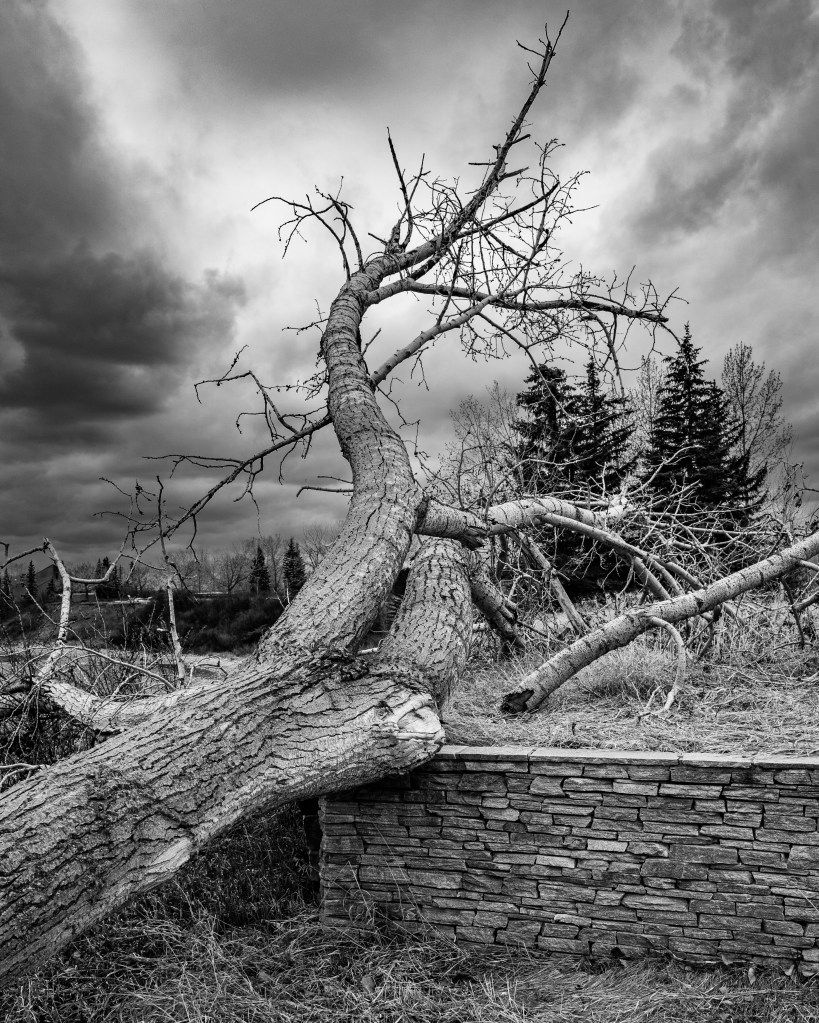
North Glenmore Park pathway, April 2024

Then came a breakthrough of sorts. It was in a situation that might not be conducive to finding inspiration. But it was no surprise to me because I was running at the time. Anyone familiar with my story (Stroke of Luck is still available, by the way) will know that running has often been a source of consolation and positivity in my life.

To set the scene, I met a small but hardy group of my teammates at Carburn Park in Calgary for an interval workout. It was a ladder workout, which for those who aren’t familiar, is a session with increasing length intervals. This workout, with intervals of 400m up to 2000m, looked daunting. Each set totaled 5.4k, and Coach Janice had specified 2-3 sets. I had to go back to her to confirm the details because it seemed that she must have miscalculated. This was TOO MUCH!

To add another degree of difficulty, the weather was awful. The threatening sky opened up just as we finished our warmup jog around the lagoon. Clouds turned to rain, then snow. My eyes were being pelted with icy crystals. We were soaked in no time. The temperature hovered just above freezing. 

We ran south beside the steel-blue water of the Bow River, and I began to wonder what on earth we were doing. It didn’t help that I was the slowest runner in our group, meaning I also had the pleasure of watching my friends stretch out and away from me as the first set wore on. 

As I approached the turnaround point, now miles from my warm car, my mood lightened. I was enjoying this. Even as my vision was being obscured by sleet, my thoughts were becoming clearer. Then, as if on cue, the sun peeked out briefly, casting a warm glow on the wet pathway in front of me. (I didn’t bring a camera on this run—it would have been waterlogged—so I can’t even show you a picture of that special but fleeting moment.)

By now, I was totally on my own. My teammates were out of sight, and the pathway was deserted. I was enjoying the feeling of movement, of being in control. Running was proof of life. I was thriving in what had just a few minutes earlier seemed an impossible task. 

Then the following thoughts came into my head, without any prompting:

  • I don’t have all the answers
  • Sometimes there are no answers to find
  • All I have to offer is my best effort
  • I can only control what I do, not what anyone else does 

I eventually made my way back to Carburn, where I caught up with my teammates. They had waited for me—how nice! We were soaked, shivering, and content. We patted each other on the back for getting through this monstrous workout on a rotten night, together. On that day, we were all heroes. Of course, even heroes need to dry off and warm up, so we said our short goodbyes and headed home. 

With my mind clear, even if temporarily, I was ready to face whatever challenges were still waiting for me. Running and music and writing can help me figure things out, even if the answers themselves remain elusive. 

Look for more pieces and photography soon. 

Peace.
Two Recommended Short Novels

I read two short but impactful novels with similar themes over the weekend. It helped that our weather was more suited to reading than outdoor pursuits. I’d been looking for something quick to read, and the books I chose were the thinnest ones on my shelf. (I know, not the best way to choose a book.) By coincidence, my selections turned out to be profoundly complementary. 

The Old Man and the Sea

First up was The Old Man and the Sea, Ernest Hemingway’s Nobel Prize-winning 1952 novel. I read this book in high school, but that was long enough ago that it seemed timely to read it again. I’m glad I did.

The book tells the compelling story of Santiago, an old Cuban fisherman who has had a long stretch of bad luck. He and his young apprentice, a boy named Manolin, share a tender friendship, even though the boy’s family has forbidden him from working with Santiago due to his lack of success.

Santiago’s luck changes all at once, alone and far out at sea. He hooks a huge marlin, the biggest one he has ever seen. He spends more than two days landing the fish, against all odds. It is so large it has to be lashed to the side of his skiff. His triumph soon turns to despair as sharks consume the fish, leaving him with only a carcass by the time he reaches his home port. 

The story resonated with me, for several reasons. Santiago’s optimism never wavers. His lifetime of experience equips him with the confidence to face his many challenges as they arise. Even the loss of his prize fish does not defeat him; his lifelong dedication to his craft allows him to transcend this tragic event. For me, the lesson is clear: we must never give up.

Here’s a passage I thought summed up the whole story:

“I wish I had a stone for the knife,” the old man said after he had checked the lashing on the oar butt. “I should have brought a stone.” You should have brought many things, he thought. But you did not bring them, old man. Now is the time to think of what you do have. Think of what you can do with what there is.

Ernest Hemingway, The Old Man and the Sea

In my own memoir, Stroke of Luck, I use the phrase “be curious, be diligent, be humble” to describe my approach to life. It was gratifying to read that Santiago relied on these same traits to get through his ordeal. Existence is fleeting, and we must never lose sight of what we have in the here and now.

Train Dreams

My second book of the weekend was Denis Johnson’s novella, Train Dreams. In just 116 pages, Johnson takes readers on a broad sweep of American history, across the rugged frontier of the Pacific Northwest. The main character, Robert Grainier, is a labourer and woodsman who works on some defining projects in the region.

Grainier suffers the unbearable loss of his wife and infant daughter in a catastrophic forest fire, and lives the rest of his long life in the woods as a solitary figure. He struggles with the guilt of surviving, and only through his dreams does he come to accept his loss.

As readers, we experience the loss of the frontier that is rapidly being transformed… consumed… to feed an expanding American economy. Grainier himself becomes the symbol of a disappearing way of life.  

I found some striking similarities in these two books. Hemingway is well known for his clear and direct writing. Johnson’s prose is sparse and powerful too. He conveys horrific and sometimes funny scenes with an economic writing style. Here’s a particularly evocative passage:

All his life Robert Grainier would remember vividly the burned valley at sundown, the most dreamlike business he’d ever witnessed waking- the brilliant pastels of the last light overhead, some clouds high and white, catching daylight from beyond the valley, others ribbed gray and pink… and beneath this wondrous sky the black valley, utterly still, the train moving through it making a great noise but unable to wake this dead world.

Denis Johnson, Train Dreams

The protagonists of these novels, Santiago and Grainier, are both strong and solitary figures, who face hardship with dignity and ultimately find a way to carry on. 

The men in these stories are engaged in very different struggles against nature, on opposite sides of the continent. It occurred to me that in the current zeal for “cancelling” books on topics deemed to be incompatible with contemporary values, these two could well be targets. I hope that doesn’t happen, as the books reinforce several key messages: having strength of character is a good thing; hard work and aspiration for success are to be celebrated; and accepting personal responsibility for one’s actions is a sign of maturity.

I highly recommend both of these books!