
Great news… I’ve extended the sale for online purchases of Stroke of Luck through the end of February!
Order your copy on Amazon and find the motivation to achieve your 2024 fitness goals.
Thanks for your support! Steve

Great news… I’ve extended the sale for online purchases of Stroke of Luck through the end of February!
Order your copy on Amazon and find the motivation to achieve your 2024 fitness goals.
Thanks for your support! Steve
In this, Heart Health Month, it was a great pleasure to sit down with Christa Abbott, Director of Marketing & Communications for Earl Grey Golf Club in Calgary. (I’m quite sure it used to be called Heart and Stroke Month, so I should be okay borrowing the older designation!)
I’ve been a member of Earl Grey for many years, although admittedly golf has taken second place behind running for most of that time.
Christa and I talked about my stroke journey… the medical one, not the golf one… about the role that running played in getting me through that ordeal, and about the process of writing my book, Stroke of Luck.
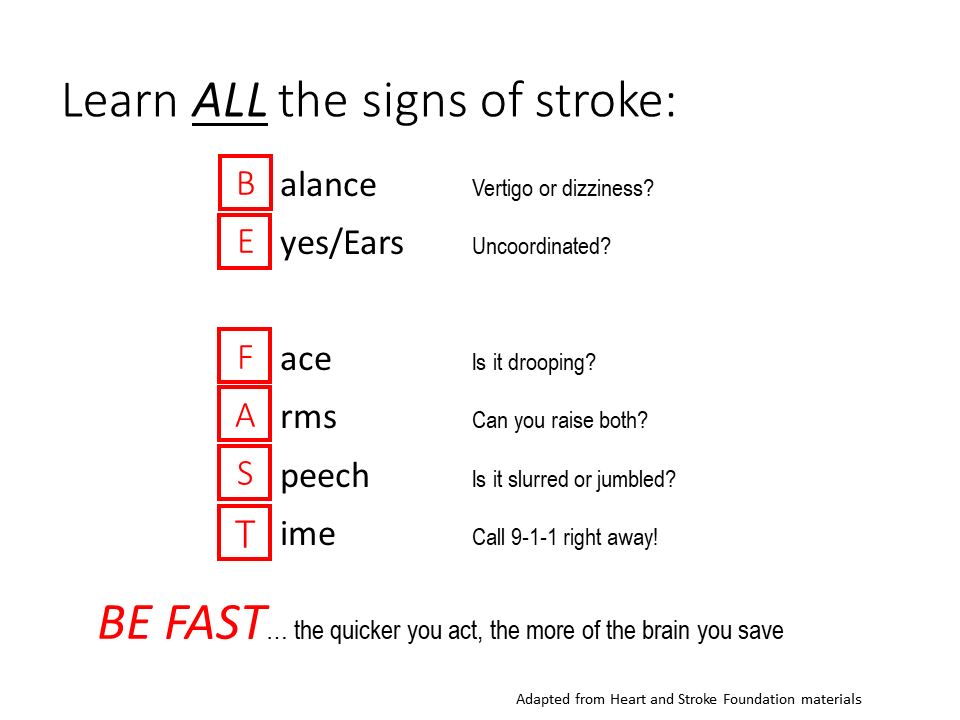
I was really pleased with the piece that Christa wrote, and in particular how she incorporated one of my main messages… the importance of knowing ALL the symptoms of stroke… into the graphic for her article. Here it is:
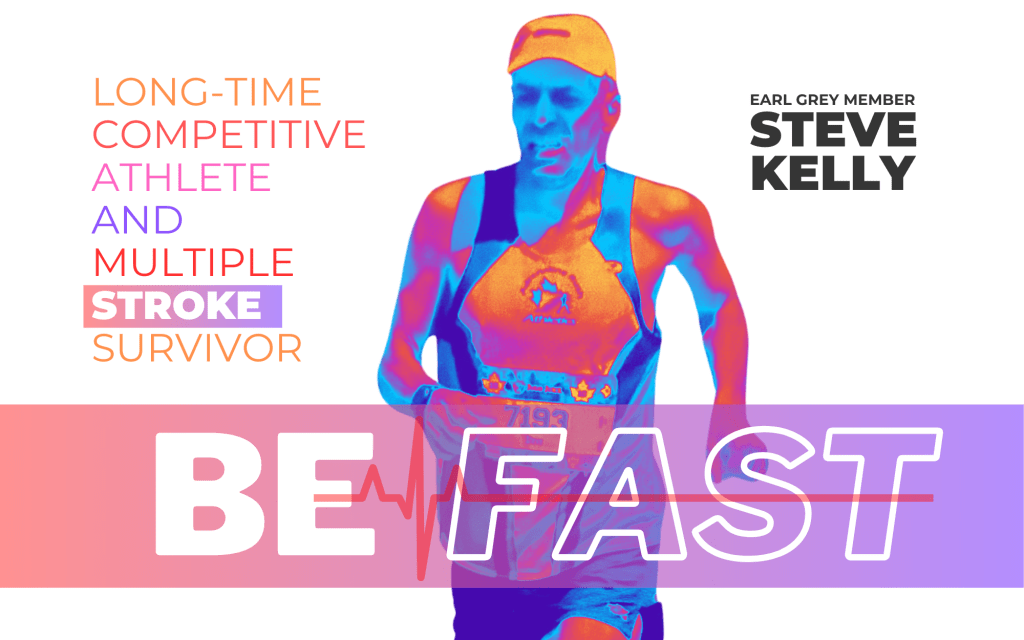
You can find the post on the club’s Instagram page here.
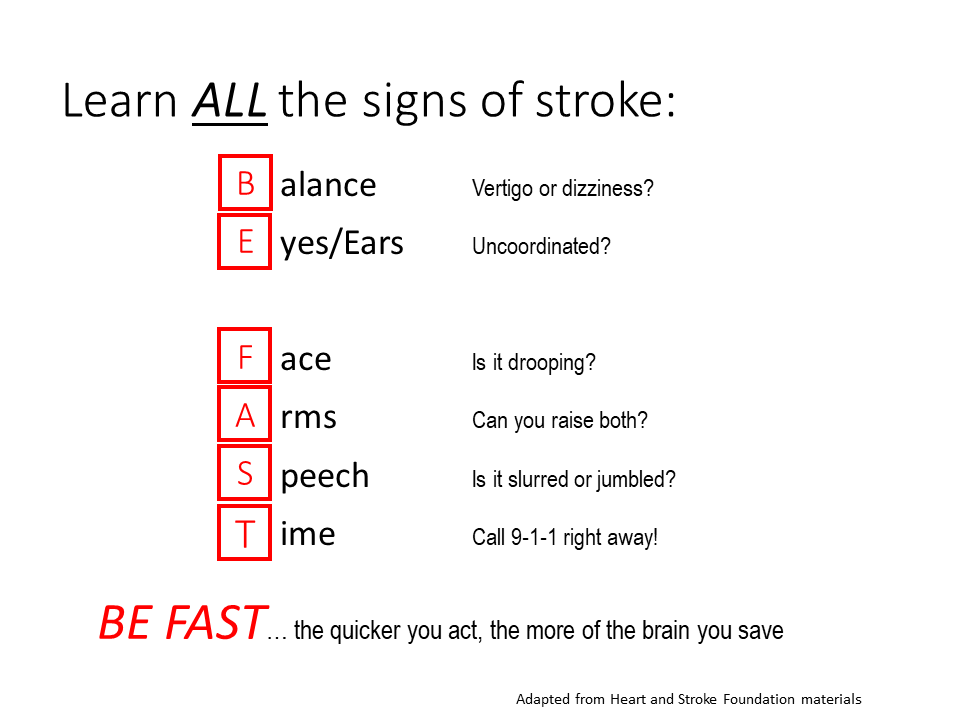
Christa neatly highlighted the phrase “BE FAST” as a reminder of the full range of stroke symptoms. You can read my post on this potentially life-saving topic here. I’ve included the information below, for quick reference.
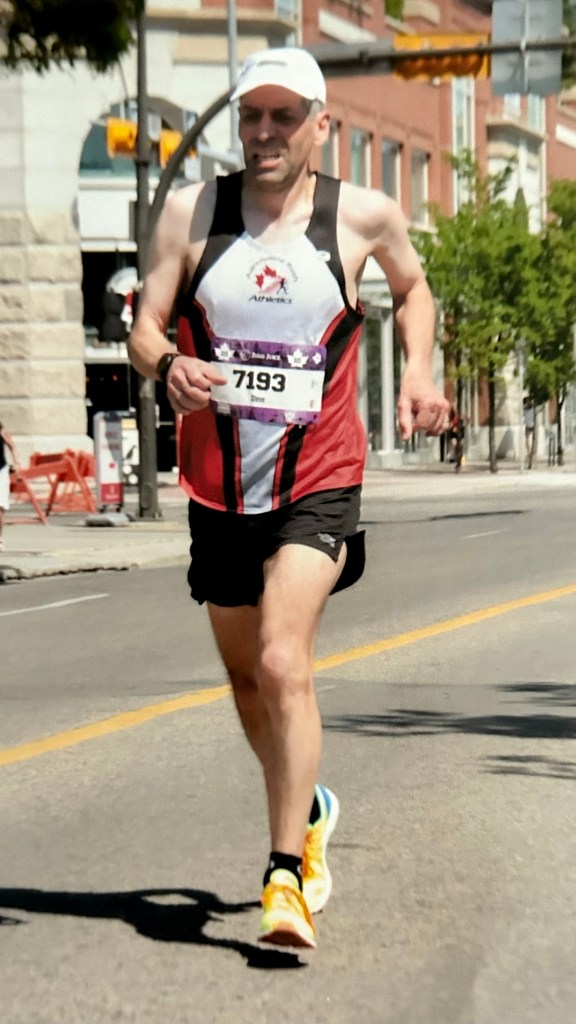
And the picture of me that Christa used?
It was taken at about the 8k mark in the Calgary 10k race, in May 2017. I’ll be the first to admit it isn’t the best picture that’s ever been taken of me during a race. That said, when I do show this picture, I point out that I had just suffered a vertebral artery stroke a few minutes before it was taken!
For me, this is a stark reminder that strokes can affect any of us, at any time.
You can read the full story in Stroke of Luck: My Life in Amateur Athletics, available online at Amazon, or at independent bookstores, like our great local store, Owl’s Nest Books.
Thanks to all my friends at Earl Grey, and everyone else who has supported me in this initiative. Oh, that reminds me, there is one thing I plan to do in this next phase of my life (My Second Running Life)… suck a little less at golf!
Happy Heart Health (and Stroke) Month to all,
Steve
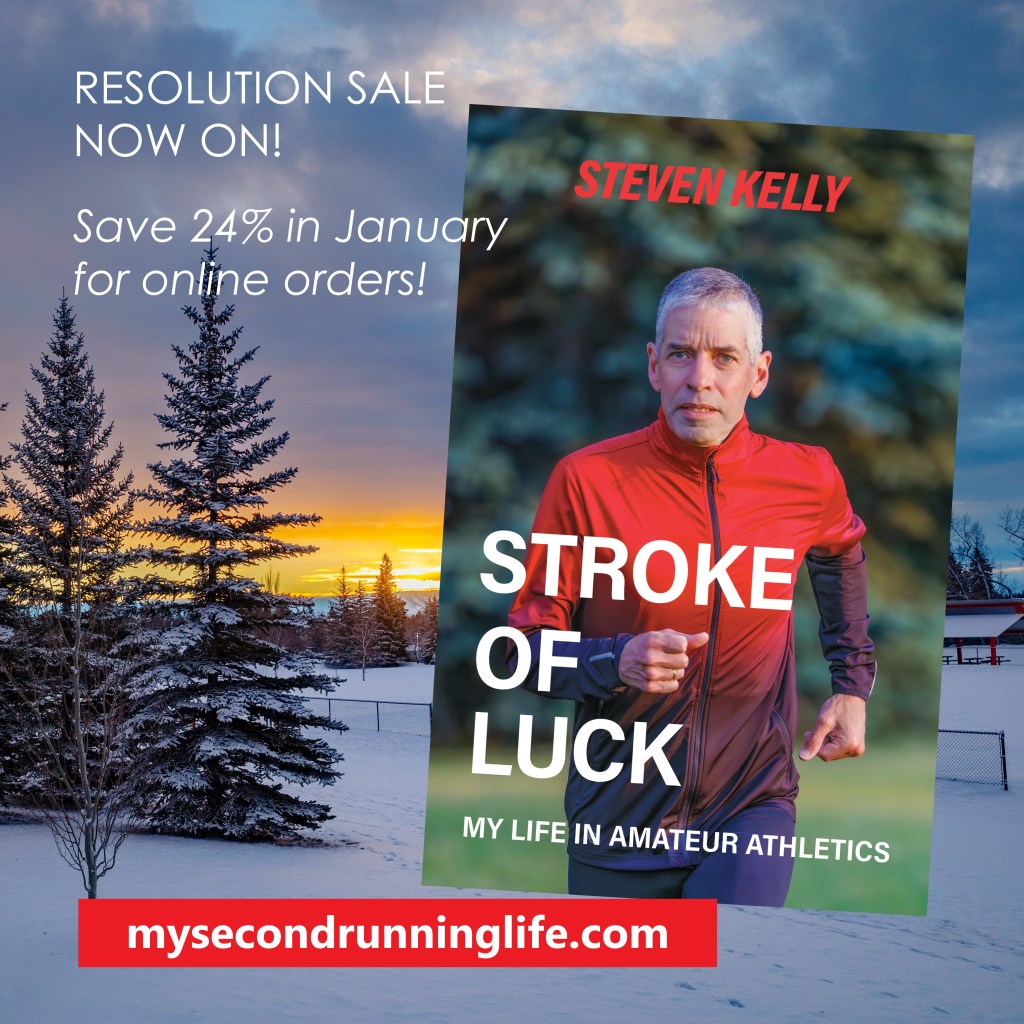
There are only a few days left in my Resolution Sale…
Order your copy of Stroke of Luck on Amazon and get a healthy 24% discount.
It’s a story sure to motivate you in pursuit of your personal goals!
I had the great pleasure of chatting with Todd Malcolm a few months back, just as I was preparing to launch Stroke of Luck: My Life in Amateur Athletics. In case you missed it, I recommend you check out Episode 141 of Todd’s excellent podcast series, “Map to Triathlon”, which is a feature of his No Limits Triathlon program.
My interview with Todd was an opportunity for us to look back over our long relationship, which has revolved around our mutual interest in amateur sports. Todd is a highly accomplished triathlete, and has been a respected triathlon coach in Calgary for almost as long as I’ve been a runner. That’s a long time!
Todd and I talked about my memoir, and the events surrounding my hospitalization in 2017 for a number of vertebral artery strokes. I shared my hopes and fears arising from that difficult period of my life. As you can probably tell from the title of my book, I consider myself fortunate to have come through that ordeal as well as I did, and to still have running in my life.
At the time of our interview, Todd was recovering from a serious bike crash, so we shared our thoughts about the importance of overcoming adversity and keeping a positive attitude. In fact, I want to remind my readers of the endorsement that Todd kindly wrote for the cover of Stroke of Luck. It seems very appropriate:
Once I started reading Steve’s book I couldn’t stop. His story really resonated with me. This book encourages an active lifestyle and is a reminder that when you find your passion, find ways to keep doing it.
Todd Malcolm
While you’re on Todd’s No Limits Triathlon website, I encourage you to check out all of his coaching services, and the many other great podcast episodes he has assembled. In a recent podcast (Episode 151) he looks at the question, “Why do you train for triathlons?” Coincidentally, I have been preparing a blog piece on the same question (“Find Your Why”). Look for that piece soon.
Thanks, Todd, for taking the time to chat. Thanks too for everything you do to support amateur athletes in Calgary!
Time is running out! Get your copy of Stroke of Luck: My Life in Amateur Athletics on Amazon in the next few days at a marathon-inspired 26.2% discount…
I recently wrote a piece about the common symptoms of stroke, and how public awareness campaigns, as effective as they are, can leave a gap in the number of strokes they help to detect.
I’ve been doing more reading on this subject, and turning up some interesting results.
For years, the mnemonic F-A-S-T has been used to trigger us to recognize when someone may be having a stroke. Using this word, we should check the Face (is it drooping?), Arms (can you raise both?), and Speech (is it slurred?). “T” is for Time, as in don’t waste any before getting help.
Sounds good. But is it?
I mentioned in my previous piece that there’s more to the story. Why? Because F-A-S-T refers to ischemic strokes that occur in the carotid arteries. (There are two types of stroke: ischemic strokes, which occur when blood clots block flow in the arteries; and hemorrhagic strokes, which are associated with a rupture in a blood vessel.)
As a reminder, the carotids are the large arteries at the front of the neck. They account for about 80 percent of the total blood flow to the brain. In neurological terms, the carotids are the workhorses. And these are the arteries that, if they get blocked or damaged, can result in the symptoms noted above.
The balance of the blood flow to the brain is delivered in the vertebral/basilar artery system at the back of the neck. These arteries are smaller and they deliver blood to different parts of the brain. Not surprisingly, blockages in this network of arteries produce different symptoms. When vertebral blood flow is restricted, problems with balance and coordination of the eyes and the limbs can occur.
It has been recognized that a modified mnemonic would help detect strokes that occur in the vertebral arteries. BE FAST is already being recommended by some healthcare agencies as a more comprehensive trigger. Here, “B” is for Balance, and “E” is for Eyes (or ears). That makes sense to me, especially as I was having precisely those symptoms for weeks before I acted on it.
A study done by the University of Kentucky Stroke Center suggested that 14 percent of stroke patients were not identified using FAST. When BE FAST was applied, the proportion of identified strokes that were missed dropped to 4 percent.
In other words, more strokes could be caught if a wider screen were in use. Coincidentally, but maybe not, the number of strokes missed by FAST more or less matches the proportion of blood flow to the brain that originates in the smaller, but still important, vertebral arteries.
Another article I read recently on CNN Health addressed the different presentation of strokes between men and women. Interestingly, women may experience other stroke symptoms, beyond the parameters of even the broader, BE FAST, mnemonic.
Research summarized in the CNN article has shown that women may present with atypical stroke symptoms or symptoms that are more subtle and vague. In some cases, symptoms such as severe headache, generalized weakness, generalized fatigue, shortness of breath and chest pains, nausea and vomiting, brain fog, and even hiccups, may occur instead of or in addition to the symptoms noted above.
As to the reason why men and women experience stroke differently, scientists have come up with different theories. First, it’s about hormones. Age is another factor. There are other possible explanations too. I recommend reading the article to get the whole story.
It goes without saying that any symptoms that suggest a neurological problem should be acted upon immediately. No one ever needs to apologize for flagging a problem that may turn out to be nothing. It really is a case of being better safe than sorry.
As a final point, I’ve been spreading the word about stroke symptom cues when I speak to my running friends. There’s something appropriate about advising runners to BE FAST. After all, this should be an easy phrase for them to remember… it’s what they’re trying to do already!
I’m pleased to announce that my memoir, Stroke of Luck: My Life in Amateur Athletics, was recently published. The book is available now on Amazon (in either print or e-book format) or through independent bookstores. For those in Calgary, you can reach out to me directly for a copy. You’ll find details about the book on the dedicated page on this site. Click here.
Writing and publishing the book has been a personal journey of discovery. I hope you will enjoy reading about my lifelong connection with distance running, and the process of recovering from a number of strokes in 2017.
To my readers, and to those of you following me on the blog or on Instagram, I appreciate your interest and support. I look forward to sharing more stories and photographs with you.
Steve
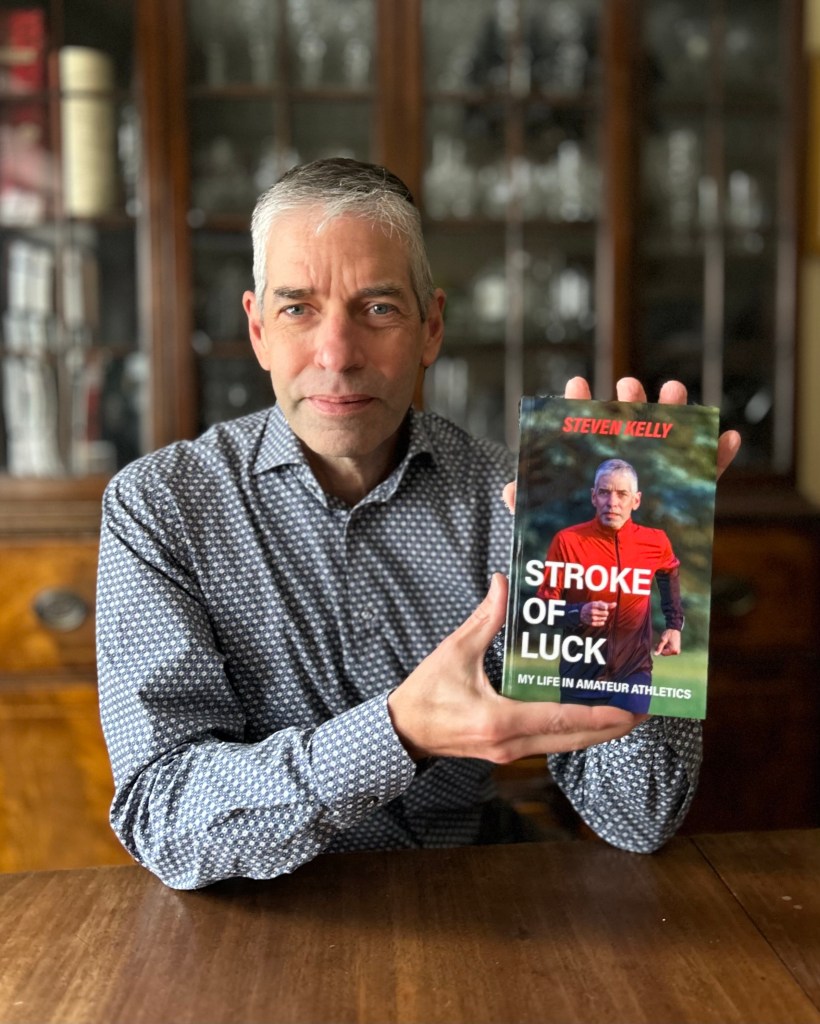
Stroke of Luck: My Life in Amateur Athletics – order your copy today!
 My Second Running Life