Thoughts on Pacing

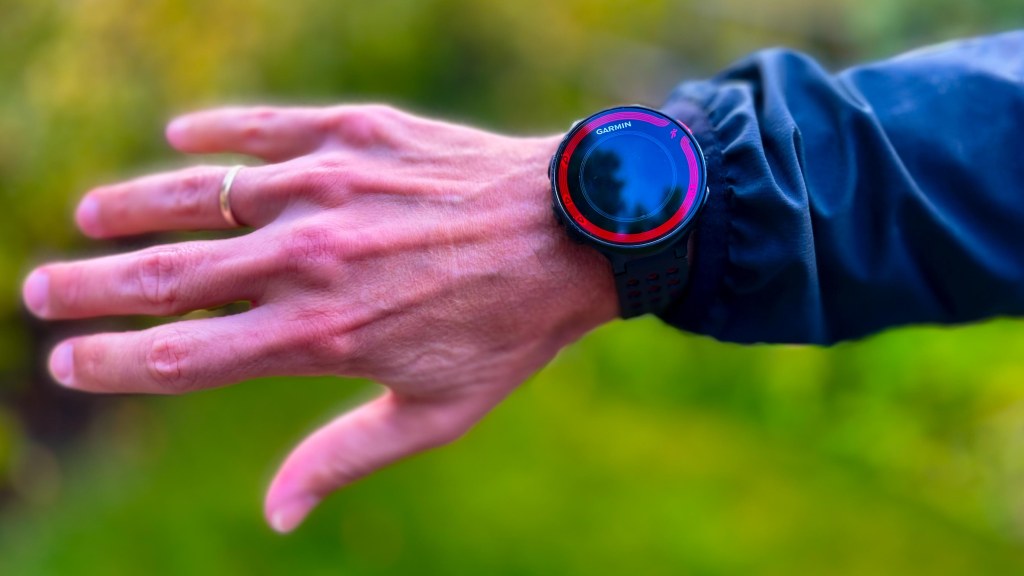
It was a scenario that will be familiar to many runners. I arrived at our weekly interval session, only to find that my Garmin Forerunner watch had died. Given that our workout called for 600-metre repeats, and I had been tasked with leading a small group of new runners in our club, I had a sinking feeling. How would I measure our time and distance? And what about managing the pace for our group?

Oops… dead Garmin. Now what?

Fortunately, my training partners had fully charged watches, so we got through the session with no issues. But for me, going through the workout without a watch did make me think about the challenges of finding… maybe feeling is a better word… a specific training pace. That is especially true if we are building to a goal race, when pacing is most important.

Alex Hutchinson just wrote a piece on pacing for the latest edition of Canadian Running magazine. His article, Pacing for the Marathon, goes into the science behind pace-making and explores some of the latest research on the subject. Anyone who has tackled the monster that is the marathon knows how difficult it is to parcel out your resources over 42 kilometres.

Hutchinson’s article makes the point that the relationship between running speed and energy consumption isn’t a straight line, which argues for holding a steady pace in a race situation. In short, surges cost you more energy than you can get back by slowing down. The problem is that most runners tend to NOT run evenly-paced races. Of course, there are many variables that contribute to this result, including the course profile, our individual fitness, our perception of the distance itself, and the psychology of running against other competitors.

Hutchinson makes another point that seems to get to the heart of the issue. He notes that modern pacing theories focus on a runner’s subjective perception of effort. This suggests that with experience, a runner can learn how hard a pace should feel.

I couldn’t agree more.

This research supports the argument that we need to develop a good sense of what our target pace feels like.

I’ve long been a believer in doing at least some of my running without a watch, at least not a GPS watch. In my view, not every kilometre needs to be accurately timed. And besides, I think it’s too easy to rely on our high-tech devices rather than our own innate sense of what pace we are running.

Like most things, good pacing is a learned behaviour. We can work to improve it. For me, interval sessions are the perfect place to do just that. By working as a group, and especially by taking turns to lead a rep, we can improve our individual feel for pace.

There are also opportunities to improve our ability to dial in a pace in a race situation. For example, we can look for a local parkrun or low-key 5k or 10k race where we can practice finding and holding a goal pace.

Here’s another idea. Run a race (maybe not your major goal race) without a watch. See how close you can get to your predicted time. You’ll be training yourself what a certain pace feels like.

These skills can be very valuable on goal race day. I’m reminded of Trevor Hofbauer’s impressive run in the 2019 Toronto Marathon. At the time, his 2:09:51 finish was the second-fastest marathon ever run by a Canadian. Trevor ran that race without a watch, as he does with much of his training mileage. He said about his remarkable race, “I don’t use pace now, I just go off of time and effort. And that was how I ran today.”

I think there is something to be said for this approach. It requires a runner to be aware of how a given pace feels and trust in their training.

And what about our interval session, the one I ran without a watch? My internal watch told me we had kept a nice steady pace. When my partners shared their data later, it turned out that our pace for each 600m repeat was within a few seconds of our target. Not bad!

Recommended Reads

I recently read two well-known books in the running genre, one after the other. Once a Runner and Marathon Woman couldn’t be more different, so this piece shouldn’t be taken as a straight-up comparison. Still, it was useful to contrast (on one hand) a niche novel from a bygone era and (on the other) a personal memoir of one of the most compelling characters from that same era. 

I’ll start with Parker’s book. 

I had a copy of Once a Runner on my reader long before I read it. The idea of a fictional story set in the milieu of a university track and field team interested me, but less than, say, a memoir of one of the great runners from history. True stories just resonate more with me, I guess. 

When I did finally dive in, the book was fine. Three out of five stars. Parker is a competent writer, but I found his characters to be thinly developed. I never really warmed up to the protagonist, Quenton Cassidy, a talented and driven miler. Cassidy’s mentor is the mysterious Bruce Denton. He isn’t the best role model, if I judge solely on how much he made me feel like going out for a run myself. And the female characters in the book don’t ever rise above the status of bit players or afterthoughts. There was quite a lot of 1970s-era stereotyping here too. 

I found the plot totally predictable. But that flaw didn’t bother me too much, as I had minimal expectations for the story anyway. 

What I liked in the book were Parker’s nuanced and detailed descriptions of distance training and racing. (This is no surprise, as the author was a talented runner who trained with the great Frank Shorter in Florida.) Sure, my days as an amateur track runner are well in the past, but I could fully relate to everything that Cassidy experiences as he prepares for and runs the climactic race—against a tough Kiwi, based with absolutely no disguise on the real-life John Walker—that closes the book. Anyone who has built up to a goal race would benefit from reading that part of the story. 

Overall, Once a Runner will appeal most to dedicated students of the sport and hardcore enthusiasts. Even so, if you’re like me, you’ll probably have many other choices on your reading list. When you find yourself with a gap, you might give it a try. 

The connection between my highlighted books may rest in the zone of those same societal stereotypes. In fact, Marathon Woman by Kathrine Switzer is the story of a dedicated young woman’s fight to break down those barriers. 

I knew a little about Switzer, mostly from her infamous on-course encounter with Jock Semple when she ran as the first legitimate female entrant in the 1967 Boston Marathon. 

Once I started into her book, I had trouble putting it down. Switzer writes in a comfortable style. While I wouldn’t say her book is aimed at a female audience—I really hope men read it—I did learn more about things like panty girdles than I ever thought I would. 

That said, it’s the essence of her story that is so impactful—her long, solitary battle to gain recognition for women in distance running. The next time you stand on the starting grid for a race, look around at the women who have embraced running as a key part of their lifestyle. That’s what we all can thank Switzer for. She does a great job in the book of explaining the hurdles she had to overcome to make that possible. 

Beyond her dedication as an advocate for change in women’s athletics, I had no idea how passionately Switzer pursued opportunities for women in other sports. Thanks to her diligent and courageous efforts, which are admittedly still a work in progress, women now compete on a more or less equal footing with men in many sports. I look at the Women’s World Cup which just started as an example. What a legacy Switzer has earned. 

I think you can tell which of these two books I would recommend to my friends. 

It’s Collateral

By any reasonable measure, I shouldn’t be writing this. I shouldn’t be able to do much of anything. And yet, here I sit, thinking and typing. My typing is certainly no worse than it was five years ago. That was before my first running life abruptly ended.

Over the last month, I’ve had an opportunity to push against the limits of my compromised vertebral artery system. Vertebral arteries – “verts” – are the second major set of arteries that supply blood to the brain; the back of the brain to be precise. The verts account for about 20 percent of the total blood supply to the brain. When they are blocked, like mine were, the result is an ischemic stroke.

In 2017, I had a number of transient ischemic attacks, or TIAs, which are often called mini-strokes. The strokes were due to a blockage in my left vertebral artery. The result was a long stay in the Foothills stroke ward in Calgary.

I’ll repeat what I’ve said many times since then: the doctors that deal with stroke patients every day are heroes. I know this firsthand because the Foothills heroes stabilized me and saved my life.

The blockage in my left vertebral artery remains untreated. This is only possible because my body has made a rather ingenious adaptation to the blockage, by building secondary arterial connections to keep blood flowing to my brain. We were able to watch this in real time, on a video taken from an angiogram procedure. It makes for fascinating viewing.

As I pushed through a 16k run in the snow yesterday, or a 20k run in fine weather the Sunday before, I realized that I am a real-life experiment. While I am apparently able to cover these distances without too much trouble, it has not been a straight-line recovery. Just after my hospital stay, I had trouble walking around the block. Slowly but surely, I put my life back together. As you’ll gather from the title of this blog, I call it my second running life.

I barely managed a 500m walk/jog a month after my last TIA. A year later I finished a 5k race side-by-side with my wife. Last year we ran the First Half Half Marathon in Vancouver.  

Now I’m at what I think is my upper limit. I can get through 20k, but not without discomfort. I know I’m at my threshold because my neck/shoulder are generally screaming for me to stop by the end.

Curiously, this is the same symptom I experienced before my strokes, when I was training at a much higher level. The pain was most severe during marathon buildups, and I’m certain that it was the first warning sign of the arterial problems I would have a few years later.

It occurred to me that I could perhaps use these pre- and post-stroke data points to estimate the change (if not the absolute amount) in blood flow to my brain. My assumption is that by comparing the usual measure of maximum oxygen uptake – the “VDOT” – I could arrive at an estimate of the amount of damage done to my vascular system by the strokes.

Before my hospitalization, I was training at a VDOT of between 50-52, based on my being able to run 1:25 to 1:30 for the half marathon. Last year, my wife and I completed a half marathon in 2:06, which suggests a VDOT of about 35. In both circumstances, I would consider myself to have been at my oxygen uptake limit.

Based on these empirical results, it would seem that I’ve experienced a reduction of between 30-35 percent in my ability to process oxygen in competitive running situations.

I’m not sure these estimates would have any value in a clinical setting, or whether it would be useful information in determining the next (if any) course of medical action. But it does make some sense, when you consider that I cannot come close to the kinds of performances I could manage five years ago. Even so, the fact that I can get through a strenuous run or race at all validates what I’ve come to see as the silver lining from this whole episode: I’ve been given a second chance, thanks to the remarkable machine that is my body. I know I mustn’t waste it.

On Racing and Recovering

Yesterday’s long run turned into a bit of a slog. Deb woke up with a pinched nerve in her neck, and I was feeling, well, crappy. Fatigued. Lethargic. We started with a walk, thinking that might be enough. Once we were warmed up, we slowly added some pace, but our run ended up being well short of what we planned to do, both in distance and pace. It was one of those runs best forgotten.

There may be more to the story than bad luck. You see, Sunday was two weeks on from a half-marathon that we ran in Vancouver. (Incidentally, it was the fantastic and well-organized First Half Half. Highly recommended!)

Although two weeks should be an adequate recovery period for a half, it got me thinking about how much downtime is enough after a race. I’ve always subscribed to an easy-to-remember formula that I learned years ago. It goes like this: treat yourself to one easy day for each mile you race.

Spelling it out, for a 10k race that means (more or less) a week of easy running; for a half marathon, two weeks; and for a marathon, a month.

There is a tendency to want to shorten these recovery periods. After all, if we had a positive race experience, why wouldn’t we want to get back in the saddle as soon as possible?

For me, that has usually not been an option. Inevitably, racing has taken more out of me than I’m willing to admit. Even after the immediate post-race soreness had cleared, the residual fatigue was too much to overcome in a few days. My effort in interval workouts or long runs during the recovery period, if I could do them at all, had to be scaled back significantly.

Add in the effects of aging, and whatever issues come along with it, and the rule-of-thumb recovery periods should get even longer. It makes sense that we aren’t as quick to bounce back as we used to be.

So, whether or not our recent experience was tied to an inadequate recovery or just bad luck, it’s worth remembering that a race puts major stress on our bodies. In summary, we should always respect the need for a full recovery.