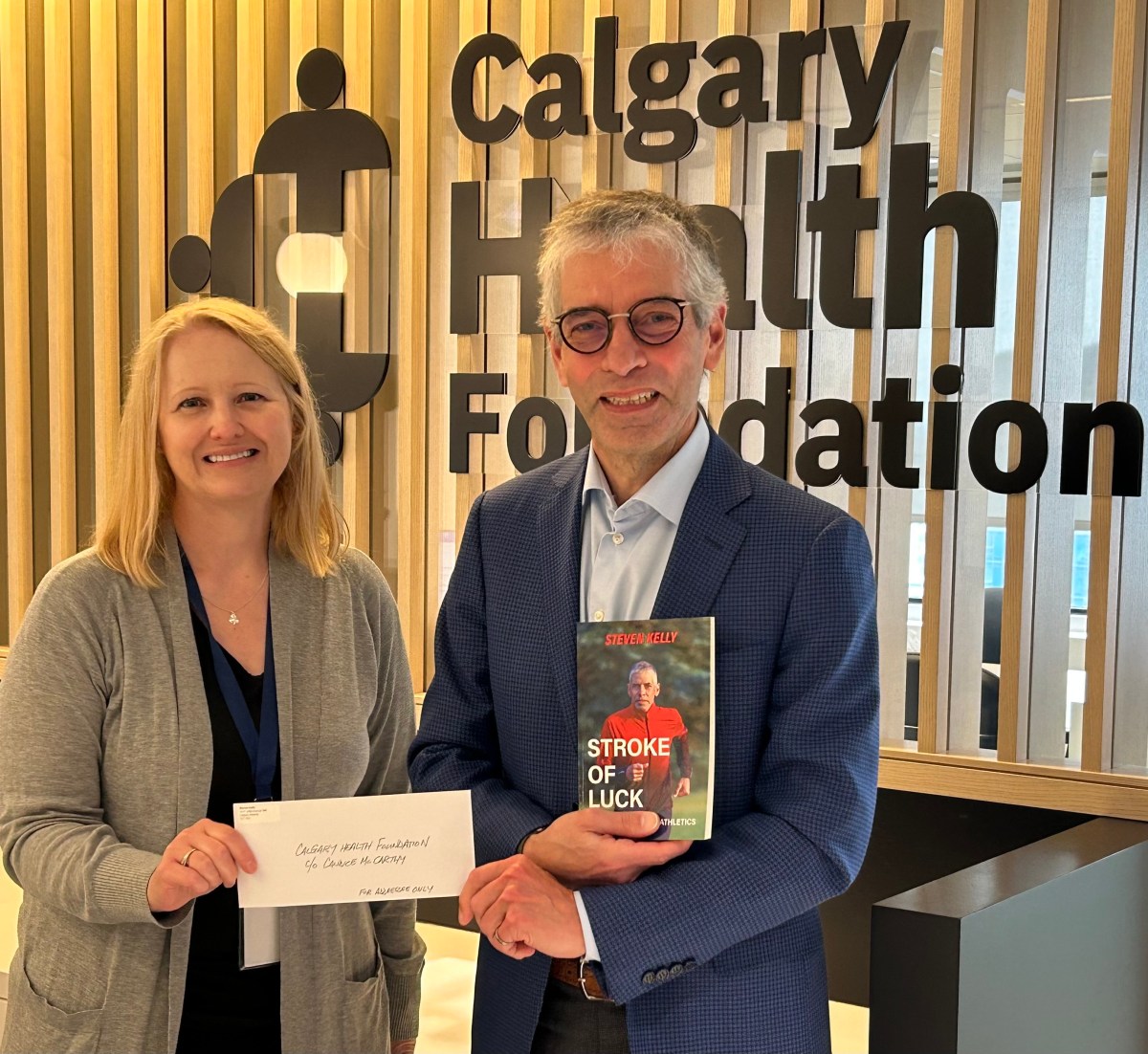
June is Stroke Awareness Month in Canada. I suppose I should say “was”. Due to a busy schedule, I’m late getting to some important stroke news. First things first—I’ve reduced prices on Amazon for print and Kindle copies of Stroke of Luck. Order a copy now and save 20 percent! The sale will run all month.
A Visit with Calgary Health Foundation
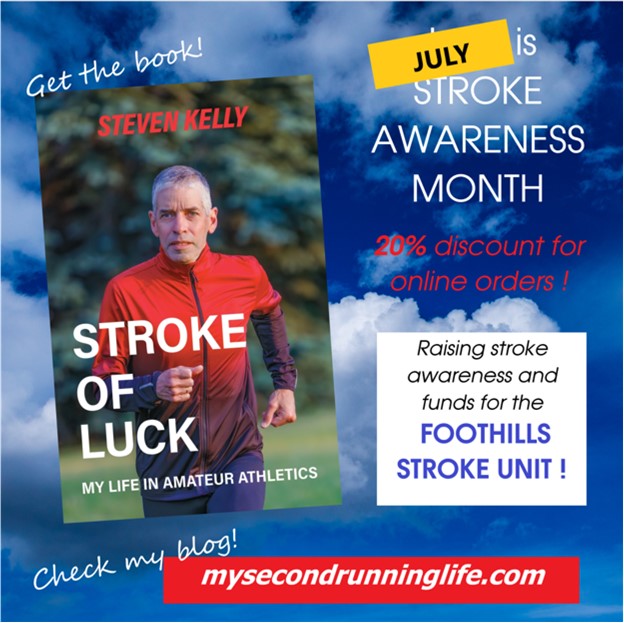
Earlier this week, I dropped into the (new) Calgary Health Foundation office to present CHF with a donation cheque on behalf of everyone who has supported me and my Stroke of Luck book project.
From the low point of my stroke recovery, writing a book was the furthest thing from my mind. I was indebted to the doctors, nurses and staff at the Foothills Medical Centre, Unit 100 (“the Stroke Unit“) for their care during and after my time in hospital. It occurred to me that crafting my story into a book might be a way for me to help ensure continuation of their invaluable work.
Since my book was published, I’ve committed to pool sales proceeds with any direct donations I receive (and as much of my own resources as I can spare). This year, with help from Candice McCarthy (Philanthropy Advisor), these funds will go to the Clinical Neurosciences team. See the featured image, above.
This is an opportunity for me to thank all who have bought the book or have contributed to the cause. Your support is greatly appreciated! By the way, I love hearing from readers, so don’t hesitate to reach out.
Focus on Tenecteplase, clot busting drug
In this piece, I look at one of the many breakthroughs pioneered by the neurosciences team at the University of Calgary: the use of Tenecteplase for treating acute ischemic stroke. You can read an article about Dr. Bijoy Menon and the team behind this project here. Dr. Menon is Section Head of the Neurology Department, and one of the heroes in my personal stroke story.
Tenecteplase is a “clot busting drug” that has revolutionized stroke treatment. When I did more reading on the subject, I uncovered a fascinating story, one that highlights many advances in biomedical engineering.
Warning: medical jargon ahead—but please bear with me!
Let me start with a brief overview of clot formation (hemostasis) and clot busting (fibrinolysis), two interrelated processes that are essential to human life. When we suffer damage to a blood vessel, clots form in three steps—constriction of the blood vessel; formation of a platelet plug at the site; and coagulation. Coagulation is a complex chain reaction, one that would take a whole article to explain (if I could). I’ll skip all the details, except one: the conversion of the soluble protein fibrinogen in the bloodstream into insoluble strands called fibrin. These strands weave together to close the wound.
Even as a clot is forming, the body begins a process that will allow the clot to break up in due course. It does this by binding an enzyme called plasminogen into the fibrin mesh. Damaged blood vessels release a protein, tissue plasminogen activator (tPA), which converts trapped plasminogen into its active form, called plasmin. Plasmin acts like microscopic scissors, slicing the fibrin mesh into small, soluble fragments that can be absorbed by the body.
You may ask, what does this have to do with strokes? Well…
When plaque that has built up in an artery is released into the bloodstream, it can restrict blood flow to the brain by blocking an artery. This is the definition of an ischemic stroke. The structure of these arterial clots—dense and highly cross-linked with plaque—is resistant to the body’s natural clot-busting process. Essentially, these clots outpace the body’s natural tPA response. That’s why doctors administer artificial clot-busting drugs, which are synthetic forms of tPA, to activate plasminogen and clear the blocked artery.
The development of synthetic tPA is a biomedical success story. The first generation of recombinant tPA (called Alteplase) was initially used in the 1980s for treating heart attacks. It was later expanded for use in ischemic strokes. A second-generation, bioengineered variant called Tenecteplase followed in 2000—it has many advantages over earlier drugs. Dr. Menon’s study led to Tenecteplase being approved for stroke treatment in 2025.
As a chemical engineer, I find two aspects of this story remarkable. First, is the targeted increase in efficiency of the clot busting process. We can think of natural tPA as an inefficient catalyst. While it initiates clot busting, it circulates broadly and it is quickly neutralized in the body. (That’s as it should be, otherwise we’d be at constant risk of bleeding to death.) What scientists have done is utilize recombinant DNA technology to make highly specific molecular modifications and create a catalyst that’s more efficient in targeting the fibrin mesh that holds clots together. In fact, Tenecteplase has a 15-fold increase in fibrin specificity compared to older drugs. This dramatically lowers the risk of severe bleeding complications.
Second, the molecular modifications drastically improve reaction kinetics. Tenecteplase is resistant to the body’s normal processes that would otherwise shut down its clot-busting action. That means it stays in the bloodstream longer, and unlike older drugs, it doesn’t require a difficult, continuous intravenous infusion. Instead, it can be administered in a rapid, highly effective single injection, often by first responders. As we know, minutes matter when it comes to stroke treatment.
Tenecteplase represents the culmination of decades of progress in medical science. It has quickly become the standard clot-busting treatment for acute ischemic strokes. As a result, lives are being saved every day. And for that, we can be thankful for the world-class research being done right here in Calgary!
Reminder: Stroke Symptoms
I usually close my posts with the acronym BE FAST, but it seems timely to remind readers just what this small and powerful phrase means. It’s a handy acronym to remember ALL the signs of stroke:
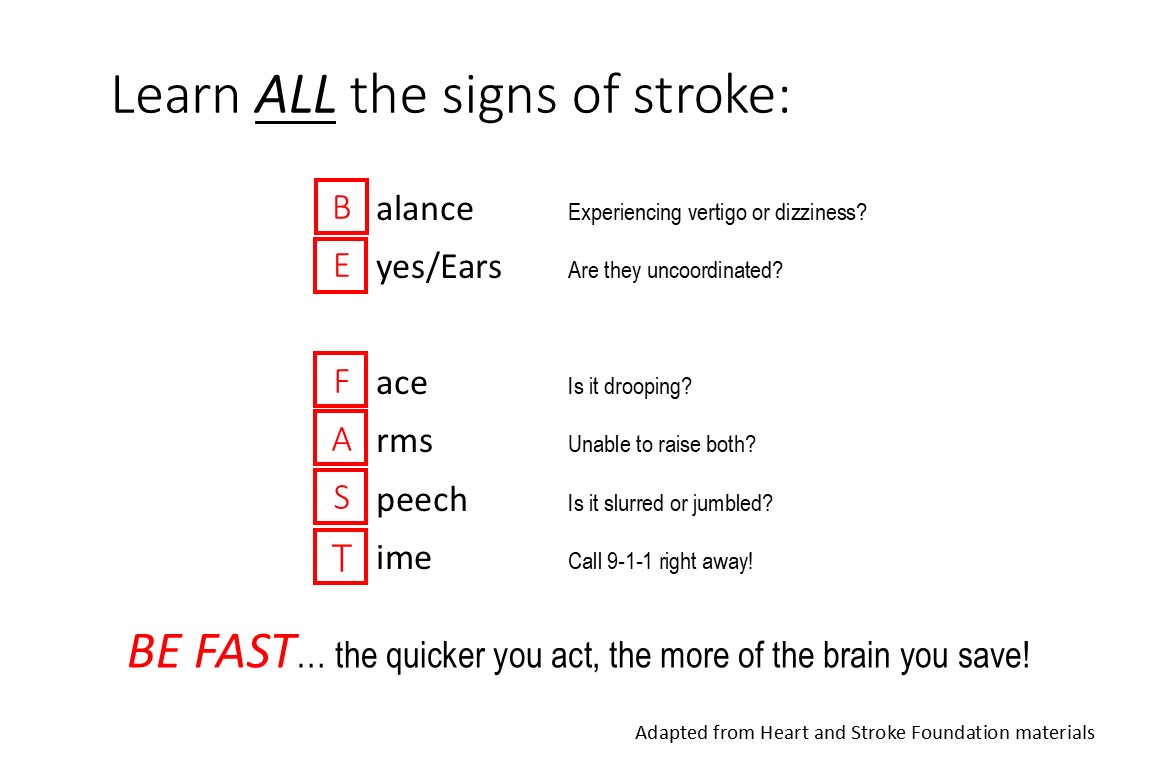
If you or someone you care about is experiencing any of these symptoms of stroke, don’t hesitate—call 9-1-1 right away! If you want to learn more, do check out some of these other posts on the blog: here, here, and here.
Until next time, be well and BE FAST!