More BUMP and Run

We had a brief return to winter weather last week, which was a good excuse for me to dig through more Beltline mural pictures. This piece is not a lesson in how to hit a “bump and run”… a crafty shot that will be familiar to golfers… it’s a mash-up of pictures from several recent photo runs.

Like the first post in this series, I scouted out Beltline Urban Mural Project (BUMP) murals and did background research on the artists. Routes for all my urban photo runs are “organic”… dictated by red lights, convenient turns, and whatever street scenes catch my eye.

This post highlights murals in the large area from 17th Avenue SW to the downtown core. There are so many pieces in this area, with more coming in 2025, that there will certainly be more posts in the future.

Some of my favourites:

  • Seeroro (Carolyn Wong, @seeroro_ ) is a Chinese-Canadian artist from Vancouver. “Euphoria” is a colourful, three-sided mural inspired by the Tortoise and Hare folktale and the year of the water rabbit in the lunar calendar. Wong’s mural is tucked in between the buildings at 625 11 Avenue SW. Well worth the search!
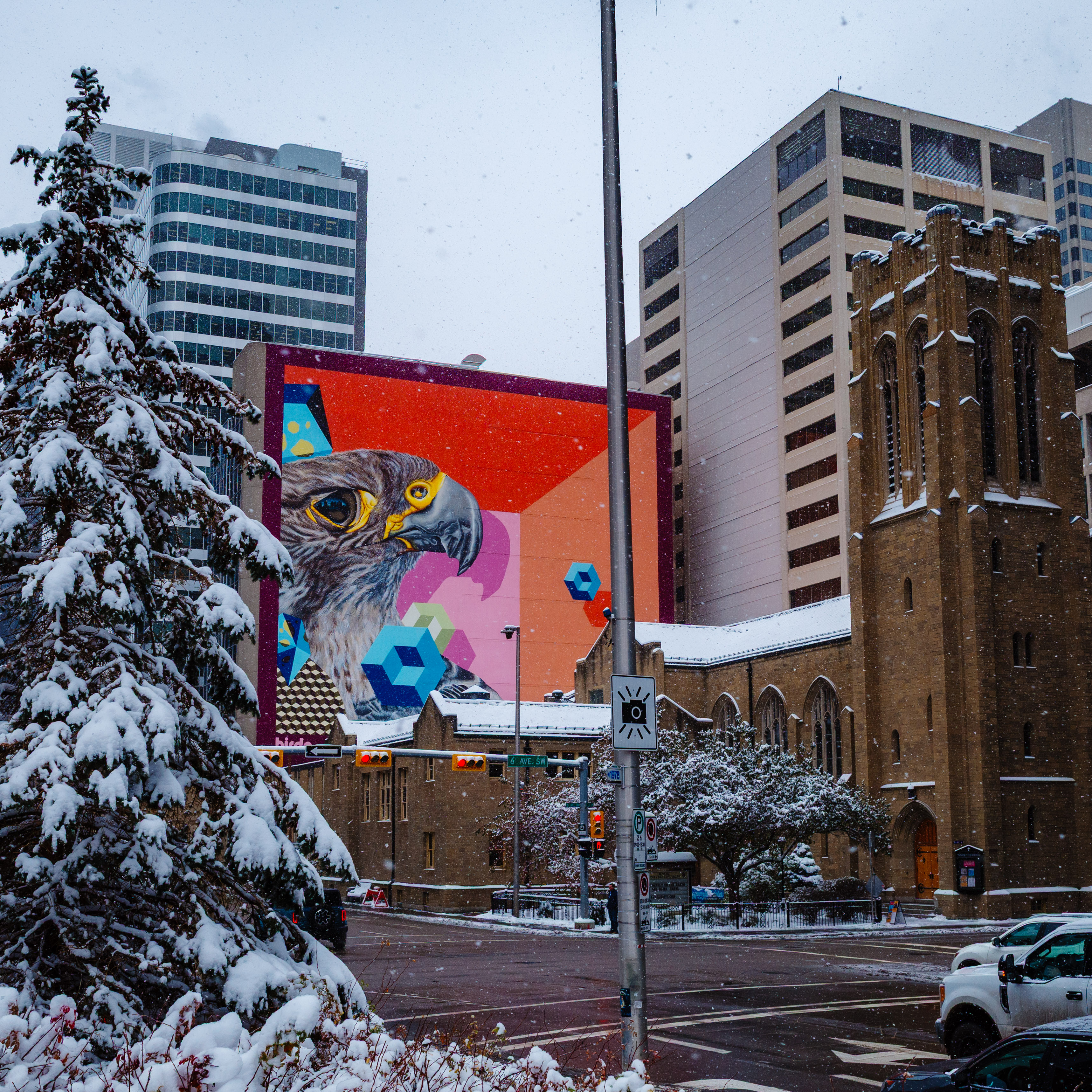
  • birdO (Jerry Rugg, @jerryrugg ) is a multidisciplinary artist based in Toronto. He is well-known for large-scale murals on walls and buildings. His spectacular untitled piece at 441 5th Avenue SW is of a peregrine falcon, with the city skyline reflected in the bird’s eye. I’ve photographed this piece often.
  • Fluke ( @fluke.art ) is based in Montreal. His work as a street artist has roots in graffiti going back to the mid-1990s. Working with photographers, Fluke merges street art and contemporary imagery to create his pieces. His untitled mural on the west face of 1039 17th Avenue SW was glowing in the setting sun when I shot my photo.
  • Hanna Reimer ( @hannaclare ) is a Treaty 1 artist from Winnipeg, whose works emphasize texture and pattern. Hanna’s interest in fabric was the inspiration for her mural at 739 11 Avenue SW. She chose colours and patterns to make the wall appear to be flowing like sheer fabric. I found the juxtaposition with the angular Cybertruck jarring, but too good to pass up.

And a few more:

While I was thinking about murals, I paged through my files and came up with more pictures and stories. These fall a bit outside the topic of this post as they weren’t taken “on the run”, but that’s okay.

In 2019, I was walking around the Beltline with a newly repaired Voigtlander Vitessa T. I had picked the camera up on eBay with low expectations. It was 70 years old and non-operational. The camera is unique: it’s a rangefinder, and it has a plunger instead of the usual film advance lever. (Perhaps not surprisingly, this is a weak element of the design. It’s probably why this feature didn’t find its way into other cameras!) Fortunately, I found a fellow in Calgary who patiently (and cheaply) sourced the required spring to get it going again.

My first shots with the Voigtlander were of the multicultural artist Fathima Mohiuddin ( @fatspatrol ), as she was finishing her mural at 708 11 Avenue SW. We chatted for a few minutes and I took photos of her in front of the mural. It’s in her signature graphic style, and it’s awesome!

I had no idea if I’d get anything out of the Vitessa, but I was very happy with the result. I never saw Fathima again, so I hope she will see this picture.

The following pictures were taken within a minute of each other. I had been walking around 17th Avenue SW with my Ricoh GR III, on the lookout for interesting people or street scenes. On that day, I remember being disappointed that I had not seen much that caught my eye.

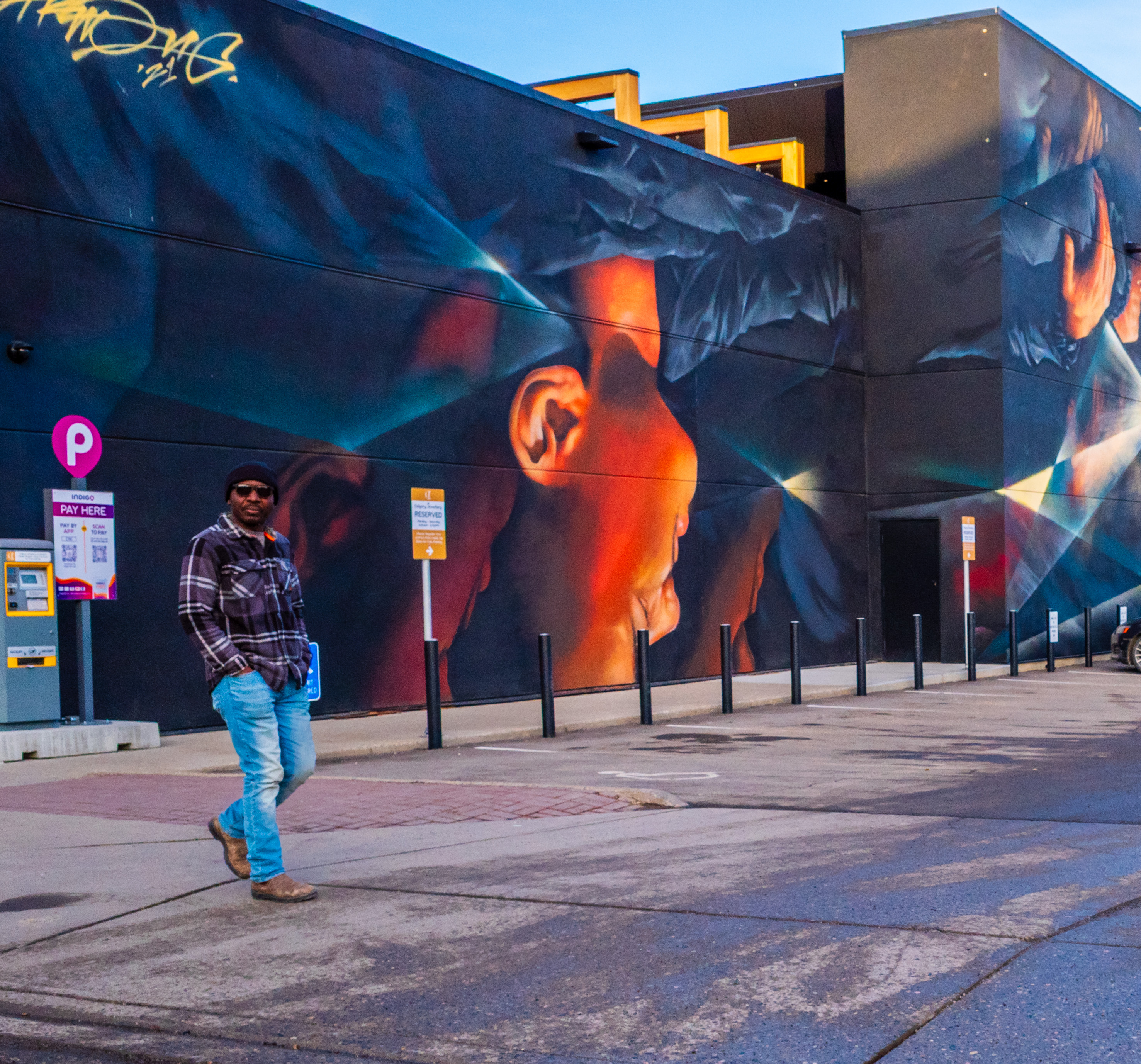
I walked down 13th Street, past the alley behind Calgary Jewellery, and snapped a quick shot of a fellow walking by Alex Kwong‘s huge (and hugely impressive) 2021 piece. Unfortunately, I don’t have many details about the mural. It doesn’t appear to be part of the BUMP series. Alex has done other pieces around the city, including a couple for BUMP. Check out his website and Instagram ( @_alexkwong ).

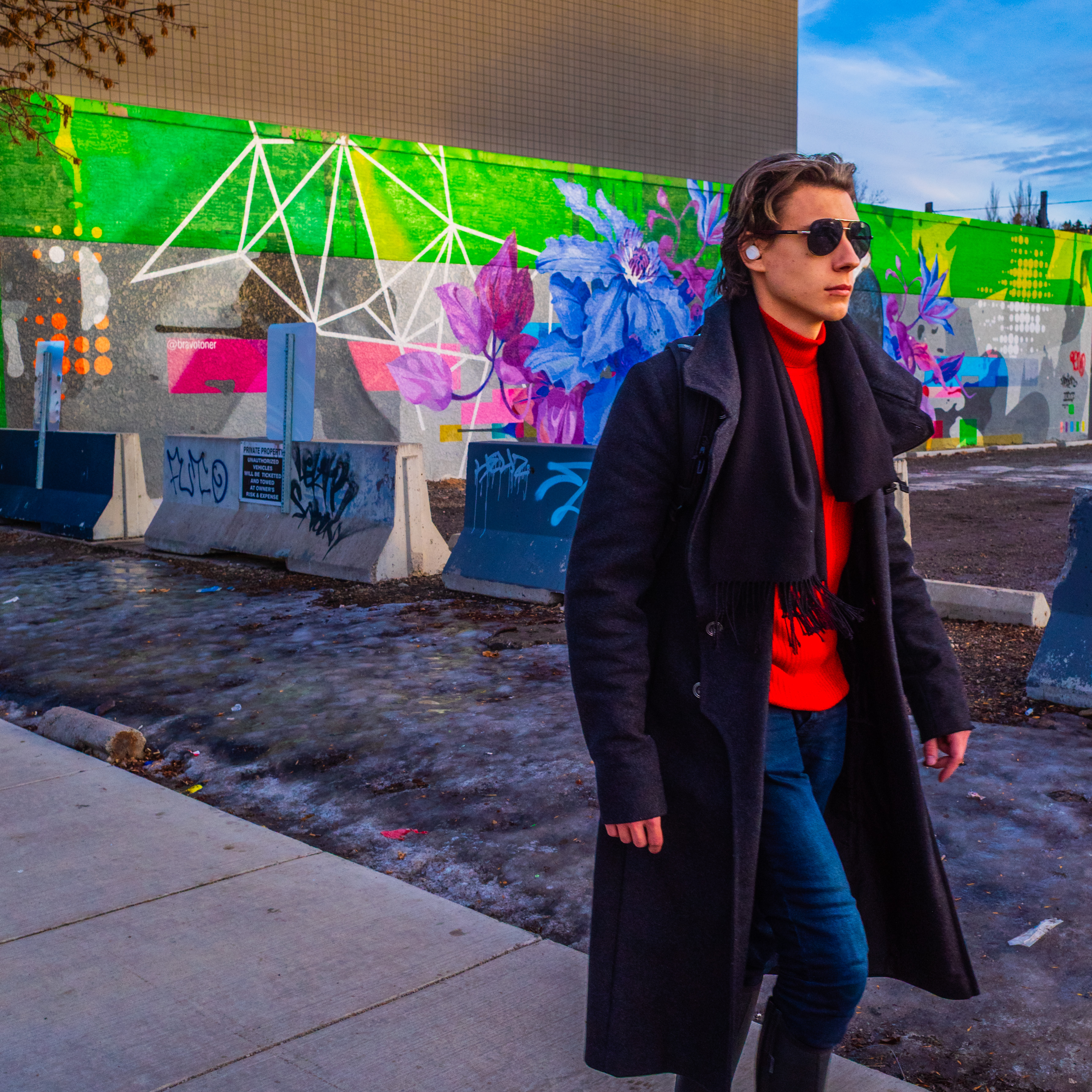
After I snapped this picture I turned onto 17th Avenue, and I noticed a stylish guy approaching me. An obvious picture was coming together… I just had to wait for him to pass in front of the colourful mural at 1137 17th Avenue SW. The bright elements in the mural complement his confident personal style.

In my research, I learned that the mural is by Calgary artist Toner ( @bravotoner ). The piece is titled Companion and it was painted in 2020. I realized I wasn’t being totally fair to Toner by having the best part of his mural obscured, so I went back and photographed it on its own to reveal a beautiful parrot. Here’s the whole image. Nice work Toner!

“Companion” by Toner, 1137 17th Avenue SW, painted in 2020

An interesting fact is that Toner and Kwong have collaborated on pieces around the city. I’ll be back soon with more in my next post.

Until then, be well and BE FAST!

An Important Visit With CHF

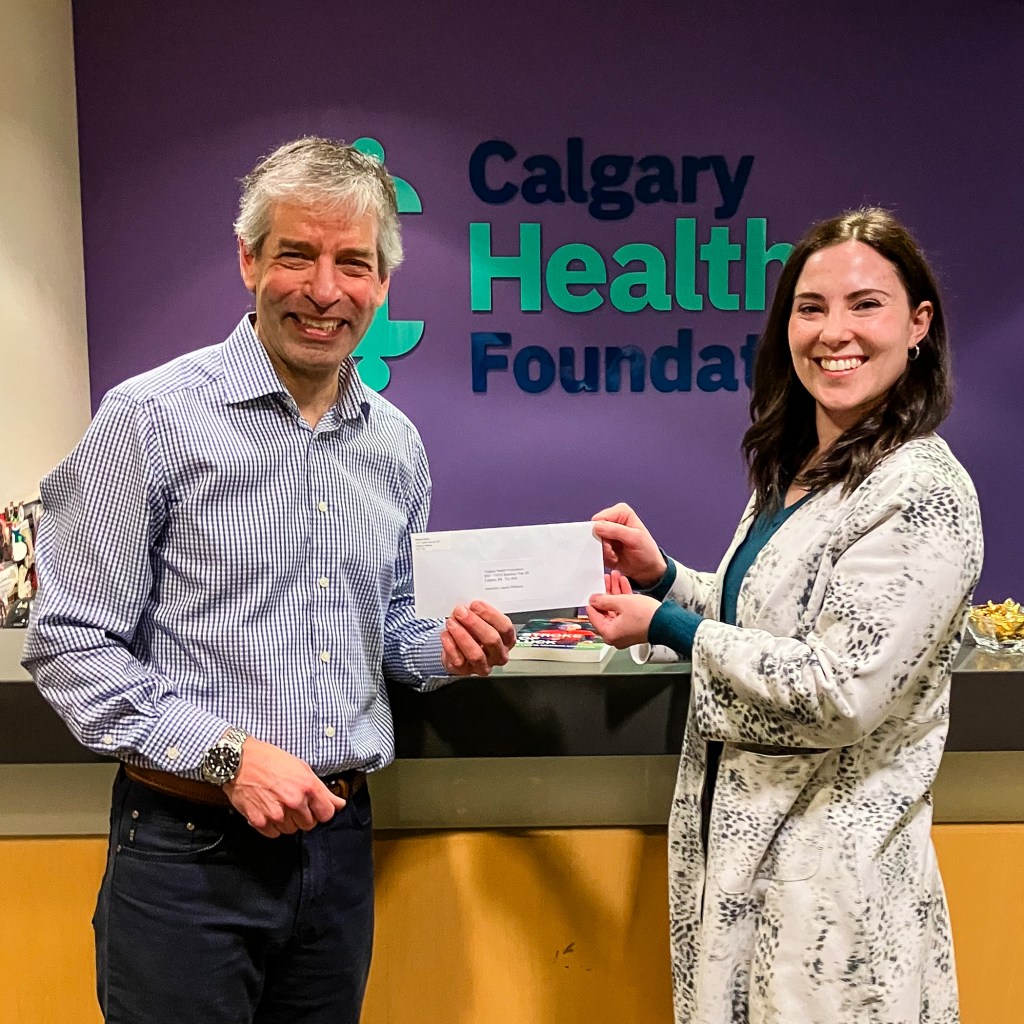
I had the pleasure of dropping into the Calgary Health Foundation office today. The purpose of my visit was to present CHF with a donation cheque, on behalf of everyone who has supported my Stroke of Luck book project.

When I first considered writing a book about my stroke journey, it was a daunting prospect. I was indebted to the doctors, nurses and staff at the Foothills Medical Centre, Unit 100 (“the Stroke Unit“) for their care during my stroke journey. As a grateful patient, it was ultimately an easy decision to go ahead with the project, once I realized that my book could be a platform for helping them in their invaluable work.

I’ve committed to sharing with the Stroke Unit proceeds from book sales, plus all other direct donations I receive. With the help of Laurel Williams (Philanthropy Advisor) and Ashley Oakley (Communications Advisor), these funds will go directly toward the ongoing needs of the Stroke Unit. It’s the least I can do.

Thanks again to all who have bought the book or have contributed to the cause. Your support is greatly appreciated!

With Laurel Williams, CHF Philanthropy Advisor, March 2025 (Photo by Ashley Oakley)

While I’m writing, I will take the opportunity to remind my readers about my three main messages:

  • The importance of an active lifestyle
  • Awareness of ALL the symptoms of stroke, and of course…
  • Raising funds to support the great work being done every day on stroke prevention and care at the Foothills Medical Centre’s Stroke Unit

Finally, if you have not already read the story that Ashley wrote about my stroke journey, you can find it here.

Until next time, be well and BE FAST!

Tribute to Gord Hobbins

We heard yesterday that Gord Hobbins had passed away. Deb and I are gutted by the news. The Calgary running community has lost one of its greatest supporters, and we’ve lost a friend of many years. It will take a long time to come to terms with his loss.

Coincidentally, Deb and I were walking near Gord’s Running Store a few days ago. We hadn’t been in that part of town for a while. As we passed the familiar storefront, tucked in a strip mall just off Centre Street NW, we chatted about him. I mentioned that the store was celebrating its 35th anniversary. Gord’s Instagram account had been featuring photos from the 1990s, when the hair was longer and the running shorts were shorter. Okay, too short. We had a laugh about that and recounted a few of our many stories about Gord. But our time was limited and we decided not to drop in. Now I wish we had.

My connection to the local running scene goes back more than three decades. We moved here in 1991, and it would have been shortly after that that I first stepped into Gord’s store. I immediately felt his personal warmth, his enthusiasm for the sport, and his passion for customer service. Of course, Gord’s customers soon became his friends, and that never changed. No matter how long since our previous visit, Gord was the same: genuine, kind, inquisitive. He always took time to chat. Visits to the shop were often stretched, so we could get caught up on each other’s family news. He was totally devoted to Cathy and their kids, Ailsa and Gareth.

Gord coached me for a few years, and he was a natural. He had a hand in preparing me for my first Boston Marathon. His trackside cues at the Talisman Centre… “Steve, relax your shoulders!”… were in my ears on race day in April 2001, and helped me to one of the most memorable achievements of my life. Later, I took up a coaching role in my own club, and Gord was a mentor. When he organized group runs from the store, he was invariably the perfect host, making sure all his sheep got back safely.

Gord and I even shared a similar medical history, having both gone through serious cardiovascular issues. We could each credit a lifetime devotion to the sport we loved for getting us through our unique and challenging episodes.

There was a good reason for the longevity of Gord’s store in the tough retail business: he was the best at what he did. He generously shared his vast knowledge of the latest shoes and running gear. I lost track of the number of times I referred people to him. “Go see Gord,” I would say. “There’s no one who knows more about fitting you for running shoes.”

Gord’s own running resume was impressive too. I first saw his name in race results in Edmonton (his hometown and our first stop in Alberta) in the mid-1980s. At the time, he was running road 10k’s and half marathons. But it would be in ultramarathons that he later made a name for himself.

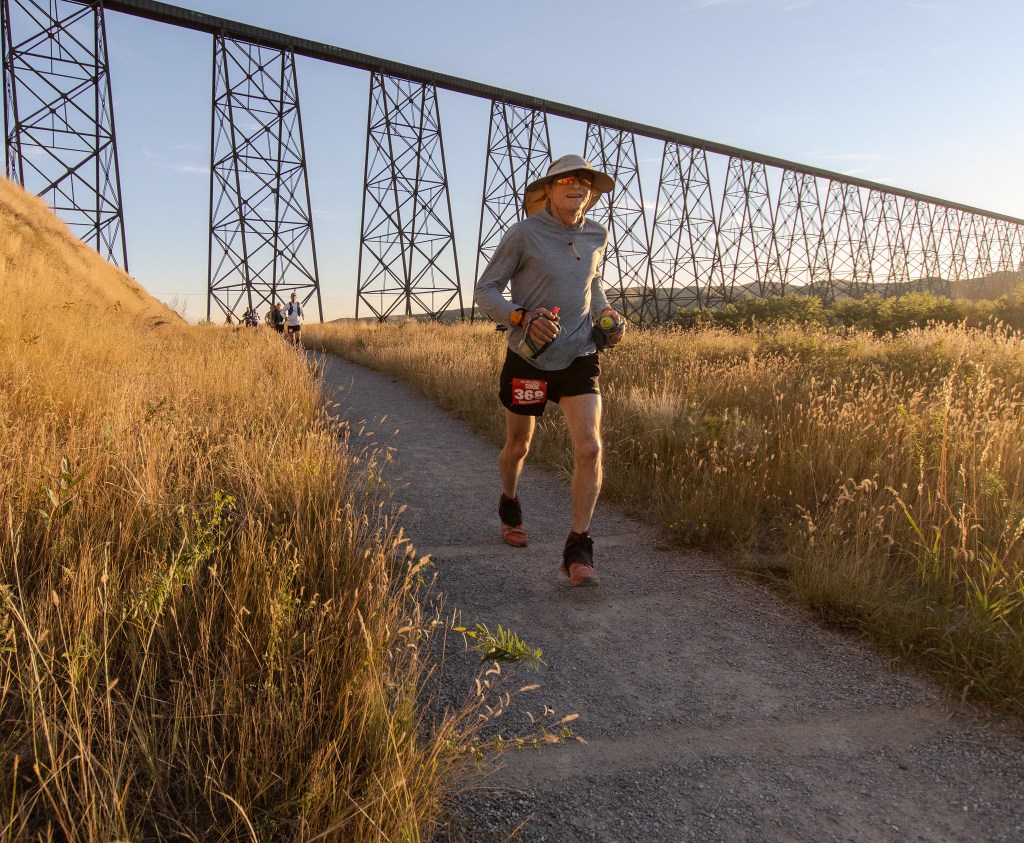
Gord’s success in ultra trail races was attested to by memorabilia in his store. In fact, the last time I saw him, he told me he was looking forward to completing his collection of carved finisher’s stones from the Lethbridge Lost Soul Ultra. He had run the race many times, so it was no surprise when he finished the 50k in an impressive time last September. (Photo by Mark Moland.)

I’ll miss Gord like a brother. His commitment to the sport ensures his legacy in the Calgary running community. More than that, his passion for making everyone around him better, fitter and happier is what I will remember most. Rest in peace, my friend. We wish his family, friends and staff peace and comfort in the difficult days ahead.

What’s Gone Wrong With Athletics?

I like to keep up with news from the wonderful sport of athletics, but I’ll admit to some recent frustration. I regularly scan the headlines from online sources, having largely given up on print media. I’m always interested in results from major road races and track meets around the world. To a lesser extent, I follow developments in equipment, training techniques and nutrition.

Lately, it seems that all I’ve read about is controversy. Some examples…

  • Twelve years after the race, competitors in the women’s 1,500m final at the 2012 London Olympics are still being disqualified for doping infractions. The race has been called the “dirtiest of all time”, with five of the 12 racers now banned. Maybe the last three finishers shouldn’t give up hope for a medal yet.
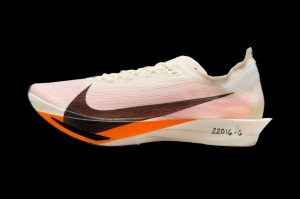
  • Two competitors in a collegiate 5,000m event were disqualified for wearing shoes that didn’t meet NCAA regulations for “stack height”. One racer set a massive PB in the shoes, the swift-sounding Nike Streakfly 2.  If only they’d stuck with the lowly (and lower?) Streakfly 1…
  • A runner and social media influencer was banned for life from the Chinese Half-Marathon Championships after she was discovered to have worn a fake race bib. Not surprisingly, the perpetrator claimed she had been duped. The race is clearly popular: it received more than 150,000 applications, of which less than 10 percent were accepted.
The dirtiest race in history? (Photo from Daily Mail Online)
The Nike VF2. Too stacked? (Photo from Canadian Running Magazine)

I could go on, but you get the idea. It’s all rather depressing. In my opinion, these stories detract from what I believe is STILL the greatest of sports. Athletics is getting harder to love.

The Problem

I’ll explain what I think the problem is, and it starts at the top echelon of the sport. It’s money. Pure and simple. Athletics has become a big, commercial business. There’s a lot at stake in the Olympics and other major championships. As a result, exciting races and great individual performances (and there are many) frequently get lost in controversy.

Cheating seems to affect athletics more directly than other sports. And I believe that stems from athletics being the most accessible of sports. Comparatively speaking, while none of us will make it to the NHL, any of us can lace up a pair of running shoes and find a road or trail to run on.

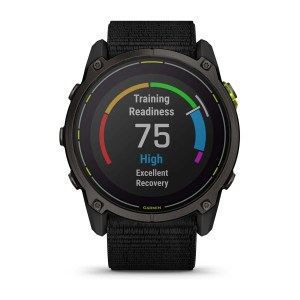
The accessibility of running is both good and bad. It’s good because of the health benefits that accrue from an active lifestyle. The negative part is that we can become overly influenced by other people’s opinions about what defines success in this sport. Today, influencers are everywhere. Technology imbues every aspect of the sport: race results are micro-analyzed, every kilometre is measured, workouts are instantly posted to Strava. Heck, our watches even estimate our recovery time… can anyone tell me why this is necessary?

Do I need this? (Photo from Garmin, for the Enduro 3)

All of this creates extraordinary pressure to always be improving. There’s a trickle-down effect, from elite athletes to self-appointed experts to average runners. We can wear the same carbon-plated shoe, use the same GPS watch, and gulp down the same gel as Eliud Kipchoge, while we chase every second in the marathon. And why not? What’s a few hundred bucks for the latest super shoe, if we would gladly spend thousands more once the shoes earn us that elusive race entry we’re seeking? (That reminds me of another recent headline. The 2025 New York Marathon received a record 200,000 applications for lottery entry… that’s up 22 percent from 2024. Good luck!)

I need to emphasize that the vast majority of runners compete fairly, and there is nothing wrong with taking advantage of the available technology. We have to recognize that some will be tempted to cross the line; many more will lose sight of what’s really important.

The Way Forward

A quest for constant improvement and achievement might make sense if we were professional athletes. (Not the doping stuff, of course.) But the fact is, we’re not.

From my perspective, which is that of an average runner… a pure amateur… with his best days behind him, let me offer a few thoughts on how we move on from these challenges.

First, recognizing that most of us will never make it to the top tier of the sport, we should celebrate rather than fight against this reality. To do that, we should define where running fits within our specific life puzzle. How you balance work, family and running is unique to you. Success in the sport should mean different things to different people. Give yourself permission to do your best, to let your performances ebb and flow, and most importantly, be content with the results.

I’ve written about the joy I now get from what I call photo runs… where I swap a GPS watch for a camera. For me, it’s been a way to get back to the carefree days when I took up running as a teenager. Then, I was an open book. I loved the freedom that came with running on a wooded trail or a quiet road. I ran in the shoes I had, and I used a cheap Timex watch. I discovered the rich history of the sport and followed great runners… true role models… before anyone had heard of doping.

If you are willing to ditch the influencers and find your own path (I call it finding your why) I think you might be better off. If that path becomes a journey to finish all six (sorry, seven) Abbott World Major Marathons, that’s fine. But if it means enjoying easy runs around a local park with friends, while wearing budget shoes, that’s fine too. Maybe better, in fact.

And me? I should stop scanning the headlines.

Until next time, be well and BE FAST!
February Sale – Time is Running Out!

February is Heart Month in Canada, and to mark the event, online purchases of Stroke of Luck: My Life in Amateur Athletics enjoy a healthy 20% discount. But act fast, the month… and the sale… are nearly done. Order your copy today on Amazon!

Did You Know?

We all know that February is the shortest month, at 28 (or 29) days, not the usual 30 or 31. But do you know how this came to be?

We have to go back to the Roman calendar, which divided the year into ten (not twelve) months, from March to December. These months were either 29 or 31 days, not 30, because the Romans considered even numbers to be unlucky. The early part of the year was not even named.

The second king of Rome, Numa Pompilius (ca. 753-652 BC) reformed the Roman calendar and introduced the months we know as January and February. However, it would have been problematic for these new months to have either 29 or 31 days. Why? Because the total number of days for the year (that is, the product of 12 odd-numbered months) would have ended up as an even number, not the required 365.

So, February was adjusted to make the annual math work. A couple of reasons are cited for this decision. The name itself comes from the Roman festival of purification, ‘februa’, which occurred at that time of the year. It was also the time when people mourned the departed. These factors led to February being the month that was shortened to 28 days.


Until next time, be well and BE FAST!

Top 5 Athletics Performances

I thought it would be fun to highlight individual performances that have inspired and motivated me. As you’ll see, it isn’t necessary that the person I’m writing about won the race in question. This is all about their effort on the day.

Steve Prefontaine, Munich 5000m Final

I’ll start with a confession: on my own race mornings, I used to watch the video of this great individual performance to get myself into the right frame of mind. BBC commentator David Coleman’s description of Steve Prefontaine, the brash American, as “a sort of athletic Beatle” is classic.

Setting the scene, Prefontaine was running in what would be his only Olympic final, against a deep field. With two slow miles behind them, Pre boldly “states his case” to lead to the finish. As a pack of five separates itself with two laps to go, the Finn Lasse Viren asserts control. Is it over? No, not with Pre in the mix. Time and again, he fights to regain the lead. Coleman’s fateful comment, with 200m to go, that “these are the medal men” would turn out to be wrong, as a totally spent Pre is passed in the last few metres by Ian Stewart. Viren won gold.

Measured by the result… fourth, and out of the medals… this could be seen as a foolish gamble by the inexperienced young American. Instead, I look at it as the epitome of racing. There was no playing it safe for Prefontaine. No wonder I get goosebumps every time I watch the video.

Prefontaine gambles it all, Munich Olympics 5000m final (Photo from Track and Field News)

Mo Ahmed, Paris 10,000m Final

At the risk of repeating myself, I’ve chosen another Olympic finals performance that left the runner out of the medals. This time, it was Canadian Mo Ahmed in the Paris 2024 Olympics 10,000m final.

Ahmed ran what might be the smartest race I’ve ever seen. He stayed out of trouble in a top-class field, paced himself beautifully, and was in contention against team tactics of other runners until the final 30 metres. I thought I might have been the only one who noticed his deceptively smart racing, until I heard David Moorcroft (broadcasting for CBC) make the same observation.

Finishing with nothing in the tank, Ahmed’s performance (26:43.79) was good for fourth place. That he and 12 other finishers were well under the previous Olympic record attests to the quality of the field. It was a spectacular race, and one where Ahmed demonstrated that he belonged with the very best.

Mo Ahmed shines in the Paris 10,000m final (Photo from Athletics Canada)

Paula Radcliffe, 2003 London Marathon

In 2002 and 2003, Paula Radcliffe was on top of the marathon world. She had set a world record in Chicago in October 2002, running 2:17:18, so there was great anticipation for her race the following spring in London. Running before her home crowd, Radcliffe didn’t disappoint. Leading from start to finish, she shattered her own world record, en route to an astonishing 2:15:25. Her nearest competitor was more than four minutes behind her.

I have a tenuous connection to Radcliffe’s race. You see, I was on the same course that sunny April morning in London. Admittedly I finished nearly an hour behind her. I’ve replayed the videos and read the stories so many times to fully grasp what Paula achieved. The strain on her face in the final few kilometres shows how much she wanted this result.

In an era before supershoes and without any team support, Radcliffe delivered a courageous performance, well deserving of being in my top 5.

Filbert Bayi, Christchurch 1,500m Final

In recent years, the Commonwealth Games have struggled to remain relevant. Competition from other mega-events (like the Olympics and the World Cup) and other *um, political* factors have led prospective host cities to back away from the Games.

Whatever the future holds, the Games have been host to some great athletics history. Here’s a case in point. In 1974, the young Tanzanian runner, Filbert Bayi, was relatively unknown. That didn’t stop him from taking on a handful of the world’s best in the 1,500m final in Christchurch, New Zealand. His race was one of the most audacious performances of all time. He led from start to finish and set a world record of 3:32.2. Not only that, he beat the hometown favourite, Kiwi John Walker.

Bayi’s account of the race, in a wonderful Athletics Weekly article, leaves no doubt that he trusted his front-running strategy. “I was confident that anyone trying to close the gap over the last 100m or 200m would have a real fight on their hands,” he states. And with the field in a pack bearing down on him, his plans were certainly put to the test. In the end, Bayi beat Walker by a couple of strides. He knew immediately the importance of what he had achieved. It was a perfectly executed race.

Filbert Bayi leads John Walker and the rest to the finish (Photo from Athletics Weekly)

Roger Bannister, 1954 Mile Double

Even as the 1,500m has largely eclipsed the mile as the middle distance standard, it’s worth noting that the mile continues to get attention. In the last week, the men’s indoor mile record has been broken… not once, but twice. So it is worth looking back to the furor that surrounded Roger Bannister in 1954.

Cheating a little, I will highlight two of Sir Roger’s epic performances. His epic May 1954 run to break the four-minute barrier for the first time is the race everyone knows about. But I would suggest that with his performance in Vancouver at the then-called Empire Games in August, Bannister put an exclamation mark on his miraculous year.

By August 7, Bannister’s record time had already been beaten by Australian John Landy. The Vancouver race was the first time they competed head-to-head. The race generated global hype, and it became known as the Miracle Mile. Although Landy led most of the way, he made a fateful error on the last corner, looking to his left for the hard-charging Bannister. Sensing Landy’s weakness, Bannister passed on the right and didn’t let up. He reached the finish in 3:58.8, five yards and 0.8 seconds ahead of Landy.

I’ve written about Bannister, here and here. What impresses me most about him is that he competed as a pure amateur. As memorable as his exploits on the track were, he never considered them to be his greatest personal achievement.


So that’s my top 5. I could have easily found a top 10, but one has to draw the line somewhere! I’d be interested in any thoughts on these performances, and any that my readers are convinced I’ve missed.

Until next time, be well and BE FAST!